
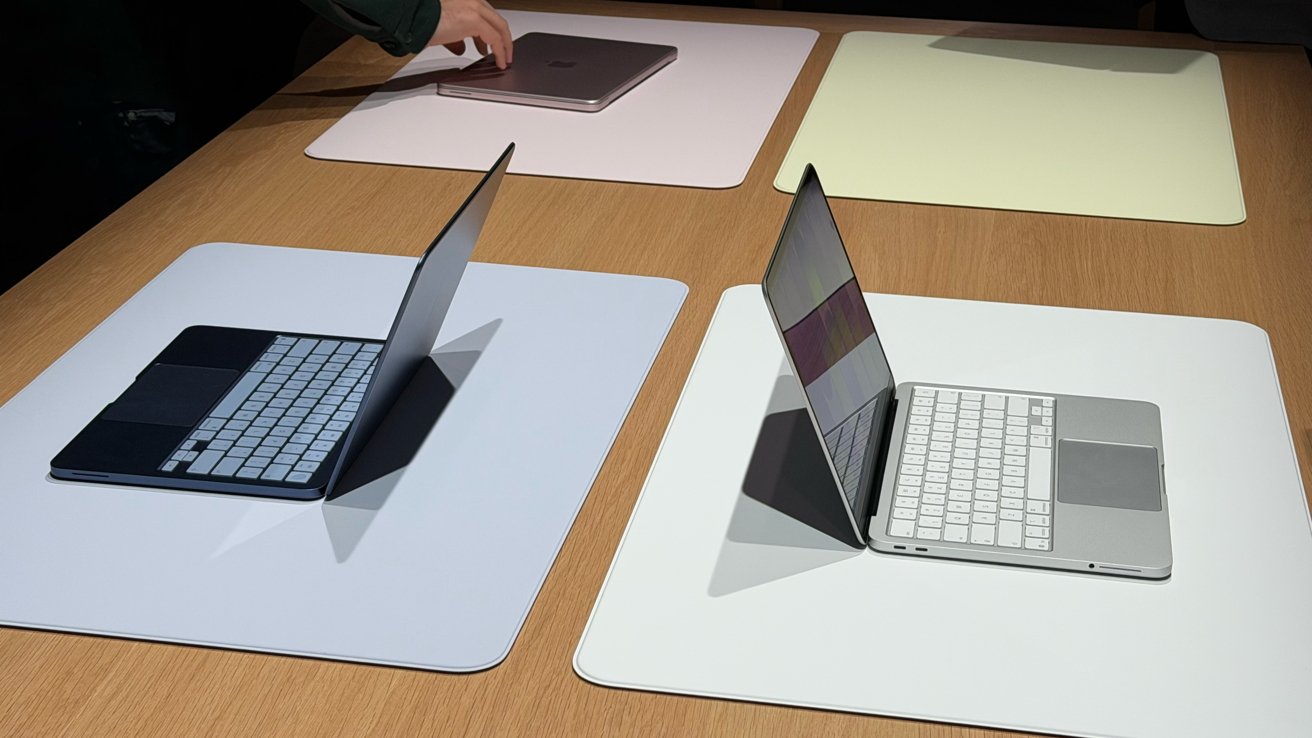
Following years of rumors, Apple has finally rolled out the new entry-level MacBook Neo. It’s $599.
The MacBook Pro and MacBook Air are premium notebooks on the market, with Apple avoiding the more budget-focused end for quite a few years. However, with its latest introduction, it is going to compete with Chromebooks and other low-cost notebook options, but on its own terms.
The new MacBook Neo is an effort to tempt value-oriented consumers to sign up to Apple’s ecosystem. To do this, Apple had to create a low-cost MacBook, stripping it down to the bare essentials.
From the outside, it looks like a MacBook Air, complete with a thin aluminum slab-style appearance. At 0.5 inches thick, it’s a tiny bit thicker than a MacBook Air, with its 11.71 by 8.12-inch footprint also a little bit smaller than the 13-inch Air.
At 2.7 pounds, it weighs the same.
Scaled back specs
The core of that change is the use of the A18 Pro, an A-series chip used in the iPhone 16 Pro, instead of the usual M-series Apple Silicon chips. This isn’t too much of a stretch for Apple to get working, considering the Apple Silicon range is based on the same tech it created for the A-series chips in the first place.
This technically isn’t the first Mac to have an A-series chip, as the 2020 Apple Developer Transition Kit housed an A12Z Bionic. However, this is the first to be actually sold directly to the public.
Multiple colors will be available for the MacBook Neo
That’s a chip with a 6-core CPU, with two performance cores and four efficiency cores, as well as a 5-core GPU. The 16-core Neural Engine also makes an appearance.
While not an M-series chip, consumers can expect to see multicore performance comparable to the M1, and single-core power about M4 speeds. While not as powerful as the latest M5 chips, it’s still more than enough for everyday tasks and workloads that don’t require massive graphical processing.
Along with the chip, Apple has also scaled down other core specifications of the MacBook. This includes the unified memory, which now sits at 8 gigabytes versus the 16 gigabytes you’d expect from the cheapest MacBook Air. There are no upgrades available.
Storage is also similarly cut to the bone, with only 256GB or 512GB capacities available — with the $100 upgrade to 512GB version also coming with Touch ID. The port selection hasn’t suffered too much, with one side having both USB 3 and USB 2-speed USB-C ports, and the other having a 3.5mm headphone jack.
Notably, the unit does not have Thunderbolt.
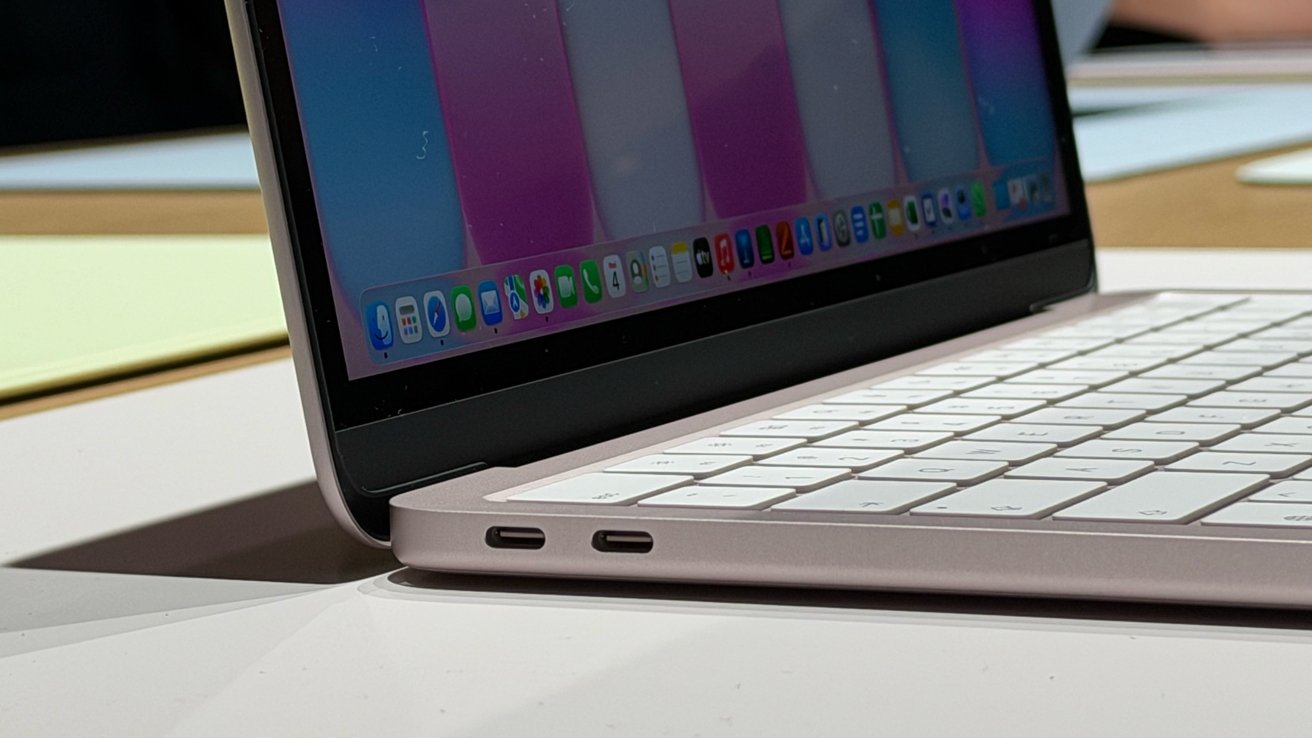
Apple kept a few essential ports on the MacBook Neo
While it does have a 13-inch display, it’s not the high-grade Retina that consumers are used to. At 2,408 by 1,506, it’s a lesser 219 pixels per inch. This is a bit more DPI than a 4K 32-inch monitor.
That screen has sRGB gamut support, as well as up to 500 nits of brightness.
External display support is curtailed compared to the other models, with it able to work with a single 4K screen at 60Hz. That display is connected to the USB 3 port, which has native DisplayPort 1.4 support.
There is a 1080p FaceTime HD camera in the top of the screen. This time, without the notch, like the iPad.
Still a serviceable notebook
While a lot has been cut from the model to make it affordable, there’s a lot of staple elements from Apple’s designs that are incorporated into this model.
You still get a full-size Magic Keyboard with 12 full-height function keys. However, you can only get Touch ID with the upper-tier model.
For wireless networking, Wi-Fi 6E is included along with Bluetooth 6 support.
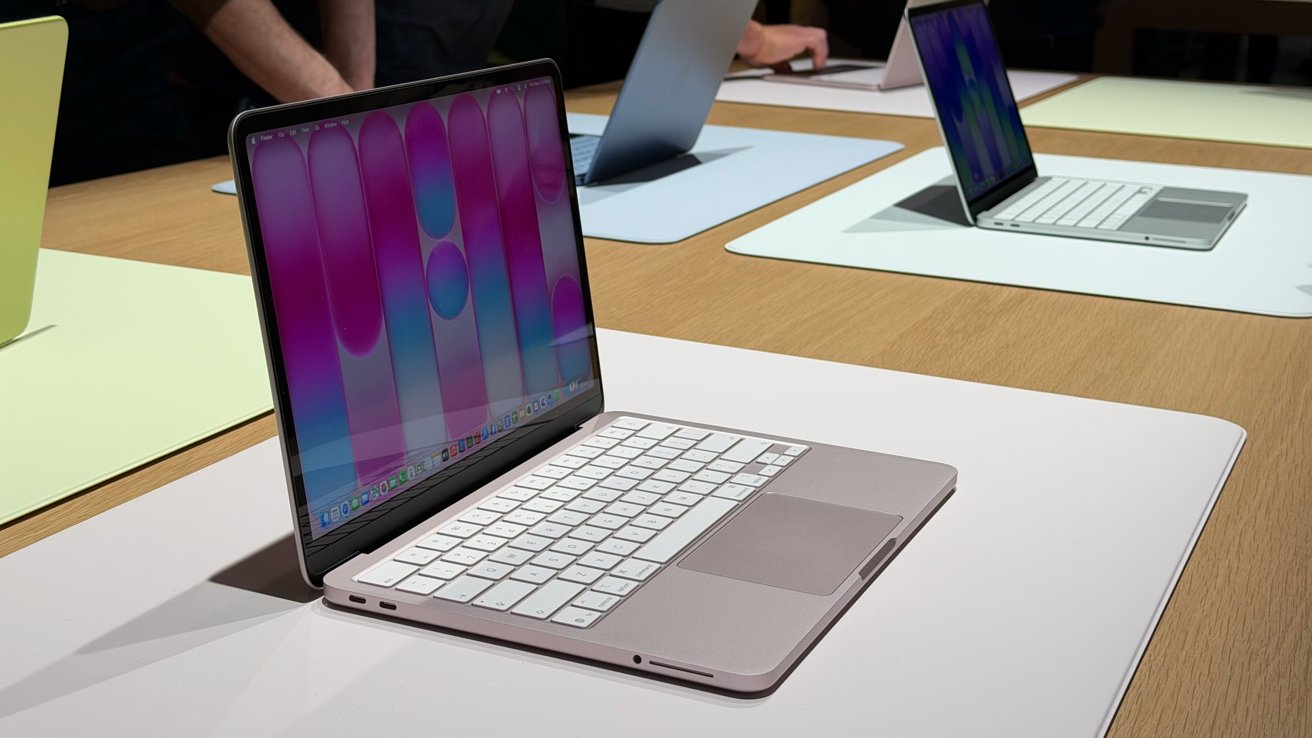
The Magic Keyboard returns with the MacBook Neo, but you only get Touch ID on the upper-capacity model.
Though the MacBook Air and MacBook Pro have four and six-speaker sound systems, this new model instead provides two-speaker stereo. There’s still Spatial Audio support if you have compatible earphones.
Apple includes a dual-mic array as part of its audio setup, which also has directional beamforming and performs the same processing tricks as an iPhone for voice clarity.
Apple even claims that it has enough battery power to last up to 16 hours for video streaming, or up to 11 hours of wireless web surfing. The battery is a small 36.5-watt-hour lithium-ion cell, recharged by either of the USB-C ports, not MagSafe.
Budget-friendly, soon
Apple has made the MacBook Neo available to preorder, with availability from March 11. It will ship in four colors: Silver, Blush, Citrus, and Indigo.
Pricing starts from $599 for the 256GB model, while the 512GB capacity option with added Touch ID is $699.