[www.indiegala.com] Explore this nightmarish world of twisted religion and discover its many secrets hidden deep inside Blasphemous.
Day 10: Fruitbat Factory Sale, up to -75%
[www.indiegala.com] Join our Crypto Sale, and get an EXTRA 30% OFF on all bundles and 15% OFF on all store deals when paying with a supported cryptocurrency!
There is a new Humble Bundle of interest to game developers, the Humble Book Bundle: Programming Languages by O’Reilly bundle. This is a collection of ebooks covering a variety of programming languages. This bundle includes the following tiers:
1$ Tier
97 Things Every Java Programmer Should Know
Think Julia
Programming Scala
Introducing Go
Learning Perl
8$ Tier
Learning SQL
Programming PHP
R Cookbook
Head First Kotlin
Using Ayncio in Python
15$ Tier
Programming Rust
C# 8 in a Nutshell
Fluent Python
Learning Java
Programming TypeScript
As with all Humbles, you can decide how your money is allocated, between Humble, charity, the publisher and if you so choose (and thanks a ton if you do!) to support GFS by using this link. You can learn more about the bundle in the video below.
Simply click the big green "Install" button at the top right of the page, a dialog box will open asking you to run Steam, click Open Steam Client Bootstrap and wait for Steam to launch and open the game installer, now install the game and it's yours to keep :)
Or you can just type - !addlicense asf 484645 - if you're an ASF user.
We are welcoming everyone to join our discord[discord.gg]. We are more active there on finding giveaways, small or large.
Posted by: xSicKxBot - 07-28-2020, 10:41 AM - Forum: Windows
- No Replies
Microsoft tests hydrogen fuel cells for backup power at datacenters
In a worldwide first that could jumpstart a long-forecast clean energy economy built around the most abundant element in the universe, hydrogen fuel cells have powered a row of datacenter servers for 48 consecutive hours, Microsoft announced Monday.
Diesel fuel accounts for less than 1% of Microsoft’s overall emissions. Its use is primarily confined to Azure datacenters, where, like at most cloud providers around the world, diesel-powered generators support continuous operations in the event of power outages and other service disruptions.
“They are expensive. And they sit around and don’t do anything for more than 99% of their life,” said Mark Monroe, a principle infrastructure engineer on Microsoft’s team for datacenter advanced development.
Lucas Joppa, Microsoft’s chief environmental officer, is Microsoft’s representative on the Hydrogen Council, a global initiative of leading energy, transport and industry companies to spur the hydrogen economy. Credit: Roderigo De Medeiros
In recent years, hydrogen fuel cell costs have plummeted to the point that they are now an economically viable alternative to diesel-powered backup generators.
“And the idea of running them on green hydrogen fits right in with our overall carbon commitments,” Monroe said.
What’s more, he added, an Azure datacenter outfitted with fuel cells, a hydrogen storage tank and an electrolyzer that converts water molecules into hydrogen and oxygen could be integrated with the electric power grid to provide load balancing services.
For example, the electrolyzer could be turned on during periods of excess wind or solar energy production to store the renewable energy as hydrogen. Then, during periods of high demand, Microsoft could start up the hydrogen fuel cells to generate electricity for the grid.
Hydrogen-powered long-haul vehicles could pullup at datacenters to fill their tanks.
“All of that infrastructure represents an opportunity for Microsoft to play a role in what will surely be a more dynamic kind of overall energy optimization framework that the world will be deploying over the coming years,” said Lucas Joppa, Microsoft’s chief environmental officer.
To further explore how Microsoft can leverage its investment in hydrogen fuel cells and related infrastructure, the company today named Joppa as its representative on the Hydrogen Council, a global initiative of leading energy, transport and industry companies to spur the hydrogen economy.
Scientists have already proved that hydrogen fuel cells can be used to generate greenhouse gas-free energy from the most abundant element in the universe, Joppa noted.
“We know how to do it,” he said. “The council exists because we don’t necessarily know how to scale the generation of hydrogen, transportation of hydrogen, supply of hydrogen and then consumption of it in the various ways that we would like to. There’s still tons of work that needs to be done.”
Replacements for diesel
Mark Monroe, a principle infrastructure engineer on Microsoft’s team for datacenter advanced development, is leading a project exploring the potential of hydrogen fuel cells to power backup generators at datacenters. Credit: Mark Monroe/Microsoft.
Microsoft strives to provide Azure datacenter customers “five-nines” of service availability, which means that the datacenter is operational 99.999% of the time. Backup generators are fired up during power grid outages and other service interruptions.
“We don’t use the diesel generators very much,” Monroe said. “We start them up once a month to make sure they run and give them a load test once a year to make sure we can transfer load to them correctly, but on average they cover a power outage less than one time per year.”
Microsoft is researching replacement technologies to diesel that would maintain or improve service availability and sees promise in hydrogen fuel cells and batteries, explained Brian Janous, general manager of Microsoft’s team for datacenter energy and sustainability strategy.
“The work that the team is doing today is really looking at trying to evaluate the feasibility of different solutions,” he said.
Batteries already supply short-term backup power, filling the 30-second gap between an outage on the grid and the time it takes to power up the diesel generators. More advanced batteries have longer durations.
“If you get to a scenario where the durations that you require are of such a length that batteries cease to be effective, that’s when you would spill over into looking at something like fuel cells,” Janous said.
Proof of concept
Power Innovations built a 250-kilowatt fuel cell system to help Microsoft explore the potential of using hydrogen fuel cells for backup power generation at datacenters. In a proof of concept, the system powered a row of datacenter servers for 48 consecutive hours. Credit: Power Innovations.
The seed for using hydrogen fuel cells for backup power was planted in spring 2018, when researchers at the National Renewable Energy Laboratory in Golden, Colorado, powered a rack of computers with a proton exchange membrane, or PEM, hydrogen fuel cell. Monroe and his colleagues were on hand for the demonstration.
“We got intrigued because we knew that they were using an automotive fuel cell,” Monroe said. “An automotive fuel cell has the reaction time like a diesel generator does. It can turn on quickly. It can be ready for a full load within seconds. You can floor it, let it off, let it idle.”
PEM fuel cells combine hydrogen and oxygen in a process that produces water vapor and electricity. Automotive companies are developing the technology to power cars, trucks and other vehicles. After the demonstration, Microsoft started thinking about using fuel cells for backup power at datacenters.
Monroe’s team procured a 250-kilowatt fuel cell system, which is sufficient to power a full row, on the order of 10 racks, of datacenter servers. Tests began at Power Innovations, the system developer, outside Salt Lake City in September 2019. The system passed the 24-hour endurance test that December; the 48-hour test this June.
“It is the largest computer backup power system that we know that is running on hydrogen and it has run the longest continuous test,” Monroe said.
The next step for the team is to procure and test a 3-megawatt fuel cell system, which is on par with the size of diesel-powered backup generators at Azure datacenters.
Fuel cell explorations
Brian Janous is general manager of Microsoft’s team for datacenter energy and sustainability strategy. His team is exploring replacement technologies to diesel powered backup generators. Credit: Scott Eklund/Red Box Pictures.
Even before that 2018 demonstration, Microsoft had been looking at ways to use fuel cells. The company started to explore fuel cell technology in 2013 with the National Fuel Cell Research Center at the University of California, Irvine, where they tested the idea of powering racks of servers with solid oxide fuel cells, or SOFCs, which are fueled by natural gas.
“They have the ability to make their own hydrogen out of the natural gas feed that they get,” Monroe explained. “They take natural gas, a little bit of water, they heat it up to 600 degrees C, which is the temperature of a hot charcoal fire.”
That’s hot enough for a process called steam methane reformation that generates a stream of hydrogen atoms for electricity generation.
Microsoft has continued to explore the potential of SOFC fuel cell technology to provide baseload power, which could free datacenters from the electric power grid while making them 8 to 10 times more energy efficient. For now, though, the technology remains too expensive for widespread deployment.
The SOFC process also produces carbon dioxide, which is another reason that Microsoft is exploring PEM fuel cells, Monroe noted.
In addition, estimated costs for PEM fuel cell systems for backup power generation at datacenters have fallen more than 75% since the demonstration at the National Renewable Energy Laboratory. If the trend continues, in a year or two the capital costs of fuel cell generators could be price competitive with diesel generators.
The increased production of fuel cells to meet the demand from the datacenter industry could potentially further drive down costs, he added.
“We very much see ourselves as a catalyst in this whole hydrogen economy,” Monroe said.
Hydrogen economy
From Microsoft’s perspective, other parts of this economy include infrastructure to procure, store and maintain a sufficient supply of green hydrogen to power the backup generators for 12 to 48 hours, which is standard in the industry to enable those “five nines” of service availability.
For example, for 48 hours of backup power generation, each datacenter would require up to 100,000 kilograms of hydrogen to fuel the backup generators for an extended power outage, Monroe said.
Internal conversations about how to secure this infrastructure have led to discussions about the role Microsoft could play in spurring the hydrogen economy, Janous noted.
“What if you could take all of these assets the datacenter has and integrate them into the grid in a way that helps to further accelerate decarbonization of the grid more broadly rather than just a point solution for the datacenter itself,” he said. “That’s where I think all of this gets interesting.”
Top image: Microsoft used hydrogen stored in tanks on trailers parked outside a lab near Salt Lake City, Utah, to fuel hydrogen fuel cells that powered a row of datacenter servers for 48 consecutive hours. Credit: Power Innovations.
Related:
John Roach writes about Microsoft research and innovation. Follow him on Twitter.
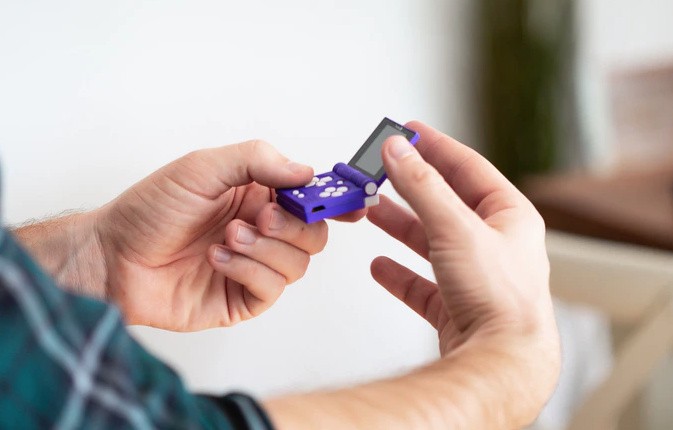
The FunKey S Is A Handheld Console That Fits On Your Keyring
The impossibly dinky retro handheld FunKey S is close to finishing its Kickstarter run, and has raised an impressive £124,000 so far – and it’s easy to see why.
This diminutive handheld system is small enough to fit onto your bunch of keys, yet it runs Game Boy, Game Boy Advance, SNES and even PlayStation titles. It even comes with a sensor which detects when the console is closed so gameplay is automatically suspended and the unit is powered down.
Boasting dimensions of 42.5 x 44.5 x 13.8 mm and powered by an ARM Cortex-A7 running at 1.2 GHz, the FunKey S is built around open-source hardware and software. The campaign has 4 days remaining, during which you can pick one up for the discounted price of £57.
Let us know if you’ve supported this device by posting a comment below.
Microsoft Store Fortnite Tournament in Support of NPH USA
The Microsoft Store team is proud to partner with NPH USA to host a Fortnite Game Tournament! The tournament is open for free for any United States resident, but a donation to NPH USA is encouraged. We also are happy to give away promotional Xbox Gift Cards as prizes to first, second, and third places on the tournament!
NPH USA transforms the lives of vulnerable children in Latin America and the Caribbean by supporting the homes, health services, and educational programs of Nuestros Pequeños Hermanos (NPH, Spanish for “Our Little Brothers and Sisters”). They help children overcome poverty and become leaders in their own communities.
You can join our tournament on July 25 starting at 11.45 a.m. PDT by going to https://smash.gg/nphusa and choosing one of the three matches on this Battle Royale tournament (please read the Terms & Conditions on the event home page). First place will receive a $100 Xbox Gift Card, second place will receive a $50 Xbox Gift Card, and third place a $25 Xbox Gift Card. You’ll also get a free Microsoft Store Tournament avatar shirt by participating in the event.
We can’t wait to see you on July 25 and help support NPH USA. According to NPH USA Northwest Regional Director Ross Egge, NPH transforms the lives of vulnerable children in Latin America and the Caribbean by ensuring they have much more than just the basics. NPH provides food, shelter, healthcare and education. They also make sure that children have the space, safety and opportunity to thrive, be kids, play and have fun too.
We hope you can join us for a great and fun tournament and help raise awareness and funds to this great cause.
Posted by: xSicKxBot - 07-28-2020, 10:40 AM - Forum: Lounge
- No Replies
Don’t Miss: Inside the campaign design of Halo 5: Guardians
Halo’s single-player level design has long been shaped to better serve new weapons, enemies, and AI behavior. The developers created flowing canyons, rifts, and cityscapes that subtly guide players on a quest to save the galaxy.
In the past, gameplay has typically been about working your way up a hierarchy of enemies in each encounter. Playing by yourself or maybe with a couple friends, you prioritize small Grunts and fearsome Elites based on their weaponry and how it can be used in small to medium-sized spaces. Large spaces were usually reserved for vehicle levels or sniper shootouts.
But in Halo 5: Guardians, something’s very different: Enemies come in large and unfamiliar groupings. There are sniping perches that rise higher and higher over the battlefield. At certain points, the game literally asks you to wander around and listen to civilian chatter.
To figure out what drove these significant changes, we spoke to the campaign design team and did some digging ourselves to observe how this rethink makes the new levels feel different.
These are Spartans
Nicole Makila, lead producer on 343’s campaign team, says that in designing Halo 5’s new kinds of levels, various departments were constantly in meetings with each other.
“We’d ask ourselves what are the goals of the level, and how do we translate that into environment art?”
Rather than letting the level design team set out the path and have art and character teams react to that vision, the teams reacted to each other’s projects and tried to balance and flow off of each other’s work.
“We’d ask ourselves what are the goals of the level, and how do we translate that into environment art?” she says. “If there’s a new character, how does the space showcase that character’s behaviors? And if the sandbox team is developing Spartan abilities, what do we need to do with verticality to showcase those?”
To analyze Halo 5’s design, she says to start looking at where those new mechanics and rules push against the familiar Halo space.
Take the increased number of playable Spartans. While Halo games have always had co-op modes to accommodate up to four players, Halo 5 is the first to assume that four characters will be playing at all times. Master Chief and Spartan Locke will each be joined by a crew of three Spartans controlled by AI or other human beings.
Makila and her colleagues had to make sure that these four-Spartan squad always have something unique to be doing in a given space.
Lead campaign designer Chris Haluke calls these new spaces “bowls,” and explains that the goal in their design is to create multiple paths through that accommodate different shooter playstyles.
(Pictured above: seen from behind, one of the game’s strongest “bowls,” with a sniper perch on the right, a bottleneck down the middle, and an ammo cache on the left)
“You enter an area, and you have three to four tactical areas all around you and players can interact with a big variety of verticalities and heights,” he says. “From there, we can populate each path with slightly different encounters, which can vary even more depending on if all four players charge down one path, or if they split up.”
“So it is based on playstyle, but some of the spaces we’ve talked about are so large that we have the need to just have more enemies to fill them up.”
Enemy of mine enemy
Halo 5 doesn’t add substantially new kinds of enemies, but the ones defined in Halo 4–mixes of Covenant and Promethean enemy types–do get new roles.
“We had a specialized group of developers that took care of encounters from a higher [complexity] level,” says Haluke, “and we stuck to the principles of the previous Halo games to make things familiar for players.”
“If you’re used to seeing an Elite, three Grunts, and some Jackals in that classic combination, we’re going to do the same arrangement, but we augment it with more clusters of enemies to get our number count up.”
One striking example of this enemy augmentation is that Promethean Crawlers, the doglike enemies introduced in Halo 4, can be populated in bigger numbers than Halo 4. Before, they would supplement squads of Knight-type enemies the same way Grunts have stood by Elites, but now they can form hordes of their own and force the player to be watching their feet at short to medium range engagements. This shows how the increased space and increased number of players can lead to opportunities to tweak enemy arrangements and AI behaviors.
(Pictured above, crawlers moving to flank three Spartans engaging a Knight.)
Boosting and ground-pounding
The last big shift for Halo 5’s level design comes from the Spartan abilities. In the past, Spartan abilities were pickups that could be swapped around like firearms, leaving no guarantee a player would have a specific ability unless the game forced it on them. In Halo 5, Spartans have the same abilities all the time, including 3 new ones that significantly alter their physical speed and placement–the boost, the charge, and the ground pound.
While each of these moves has utility in the game’s combat, lead environment artist Justin Dinges says that they also shaped his work in building out the geography and terrain of the different levels.
“One of them, the Spartan Charge, lets us do old school secret wall kind of stuff,” he says. “We got to build out this visual language the player would respond to, so they could identify suspicious walls and crack it to reveal weapon stashes or other secrets. That let us get into the exploratory adventure mode.”
“Secrets” don’t just include power rewards though. Walls can also conceal flanking paths and audio logs can be found by boosting over gaps. Constantly rewarding players by using these things to explore doesn’t just mean creating hidden power nodes–it also winds up shaping how they think about movement in newer, bigger spaces.(Above: The Spartan on the right boosts in the air in the game’s arena mode.)
Halo 5’s successes will ultimately need reach beyond its level design into an ambitious story and an eSports-focused multiplayer mode to find the level of success that Microsoft is hoping for. But as the first all-new Halo game on the Xbox One, its increased player count, tweaked enemy organization, and use of fixed player abilities tightly show how core gameplay decisions can influence the size, geography, and sense of presence in the craft of level design.
Posted by: xSicKxBot - 07-28-2020, 10:40 AM - Forum: Lounge
- No Replies
Blog: The Rapid Prototyping Game
The following blog post, unless otherwise noted, was written by a member of Gamasutras community. The thoughts and opinions expressed are those of the writer and not Gamasutra or its parent company.
The Rapid Prototyping Game
I am a teacher. I make a living helping others. So when I began to adjunct at my local university, it was only natural that I, like any of you, would want the students to succeed in their scholarly endeavors. My task as an employee in the School of Digital Animation and Game Design was to take my passion, game-based learning and game design, and instruct first year students in the basics of game development.
No problem, right?
Well…it turns out that knowing game design and teaching game design are two very different skills and I am humble enough to admit that I had a lot to learn in that first year when it came to both.
Luckily another instructor, and a friend of mine, Andrew Peterson was willing to spend the time answering my many questions and I felt that each iteration of the class was continuing to improve. While I knew the content and delivery was getting better, I still had this nagging feeling in my stomach.
You see, the students were still struggling. They were afraid of failing. They were unoriginal. They made games like Chutes and Ladders or Monopoly. They didn’t see any value in board games and they told me quite honestly that they really only wanted to make video games.
As you can see, this was going to be quite the challenge. Each student came to class with a diverse gaming background. Some had taken a programming or game design class in high school, others had families who valued game night, a few took the course because it sounded better than a humanities credit, and many loved to play video games and wanted to make a career of it.
If I was going to teach game design well, I needed to create a plan that would take account of all of these factors.
What I really needed to do was create a way to increase the students exposure to game mechanics and also teach them how the elements of game design exist within a game. I thought of it like training a chef. What they really needed was time in the kitchen–to understand major flavor profiles and to recognize that adding certain combinations worked well. They needed experience and they needed it crammed into one semester.
It was at this time I remember mentioning to Andrew that it would be amazing to have a repository of game mechanics that that students could access. A resource where they could go to see the mechanic, have it explained, see it in a game, a dictionary of sorts for them to reference–aside from an online database. Call me old school, but I find value in holding a physical book in my hands and lovingly turning the dog-eared pages looking for untold answers.
Not long after our conversation, we attended Gencon and found out that, like many good ideas, someone had accomplished it. We immediately purchased Geoffrey Engelstein and Isaac Shalev‘s book Building Blocks of Tabletop Game Design: An Encyclopedia of Mechanisms and instantly fell in love with it. It was exactly what we needed as a reference book for our students.
Armed with this book, it was time to take the next step. As an instructional designer, I knew that I had the content that I needed for the course, now it was time to work on the delivery method. Playing games is tactile, it’s community, it’s strategy and critical thinking. The delivery method had to mimic those qualities. This had to be done as group work. The students had to manipulate a game board, work with the pieces, and think about how the elements worked together. Most importantly, they needed to understand the iterative process of game design.
Understanding these teaching strategies, I began to categorize the game mechanics for the students. My goal was to create a user-friendly delivery system which grouped the elements into manageable categories which would allow the students to isolate specific components. In doing so they would be able to analyze how adding, subtracting or combining these elements would create dynamic changes in a game. What I found was that many times students would focus on the entertainment when they were play testing–without ever thinking analytically about why they were having fun. This new system, which I called The Rapid Prototyping Game, taught them how to make meaningful choices as they learned the iterative process through game play.
The first rendition of the RPG game consisted of dice, index cards, and tool box stocked with gaming pieces, markers, pens, and other tools of a game designer.
Loaded down with my prototype, I unleashed my creation on the students in five phases. I described that they were going to build a game, but many of the elements would be decided for them. There job as game designers was to “make it work”. There were many open variables that they could include in the game design, but I did warn them not to fall in love with their initial design because it was assuredly going to change.
The first phase was to divide the students into teams and then have them roll a dice to determine the first of what I called the “core elements” of their game.
Dice Categories
Game Medium (board game, card game, etc.)
Game Format (competitive, cooperative, etc.)
Game Objective (exploration, building, etc.)
After a short period of group discussion, I then had them begin to pull from the card decks I had created.
Element Decks
Mechanics Deck (nine categories)
Theme Deck
Victory Condition Deck
Turn Order Deck
The students took this information and ran with it. They absolutely loved the challenge of designing a game under these parameters and I watched as teams sketched, discussed, referenced the Tabletop book and used their phones and whatever resources they could to craft their game. Numbers were exchanged and I had found in our meeting the next week that many teams met on their own and spent many hours working on their first game. They had went down the rabbit hole on their own.
Reflection
Good teaching comes from reflection and effective educators value the time they can allow their students to engage in what I call “directed reflection”. This is where a moderator, usually the teacher, can help the students transform into self-directed critical thinkers through group talk. Reflection is a key component in improvement, which is why I knew I had to include this element in the Rapid Prototyping Game. So the students came back to class with another deck waiting for them, the Reflection deck. It asked them pointed questions about the game design process. Questions like: Do players care when other players are taking their turn? A simple question that started a conversation about player agency and player choices.
Iteration
After the reflection, it was time to remind the students that there were more challenges ahead. This was a bit of a game, right? They made their way to the front and pulled from the Iteration deck. This was where their best laid plans were thwarted by the other teams. They drew cards from the deck that forced them to make changes to their game–getting a new mechanic, an additional victory condition, or changing the way they took their turns. While initially this was incredibly frustrating, it changed the atmosphere of the room. Students were talking about how a new theme completely changed the way a mechanic worked.
It was the best time to be a teacher. You see, we revel in light bulb moments and you could see the fog of uncertainty lifting as students began to “get it”. The students began to understand that board games do have something to them that creates a feeling. How you introduce these elements does matter. They found out that game design wasn’t an intimidating experience and most importantly they began to see themselves as game designers.
Well, as luck would have it, when I reached out to Geoffrey Engelstein and the folks at Taylor and Francis publishing company, they loved the idea as much as we did and they agreed to publish the game. What that meant was Andrew and I had to put some polish on my tattered prototype and put together something educators, game designers, and hobbyists could use. Along with our graphic artist friend, Mel Danes, we created and agreed to terms with the publishing company for our official Rapid Prototyping Game. I hope to update any of you with the release date information which we anticipate happening in the Fall.
I am ridiculously excited by the prospect that this game might inspire a reader in some way or help a student. If any of you would be interested in another excerpt concerning the curriculum I use, or strategies for implementing the game, I would be more than happy to create another post. In fact, if you have specific questions I can be reached at [email protected]
Posted by: xSicKxBot - 07-28-2020, 10:40 AM - Forum: Lounge
- No Replies
G.I. Joe's Snake Eyes Spinoff Movie Delayed To 2021
Toy behemoth Hasbro has announced that its new G.I. Joe movie Snake Eyes: G.I. Joe Origins, initially eyeing an October 2020 release date, has been delayed into 2021 due to COVID-19's impact on the company's bottom line. After posting second-quarter financial results that missed Wall Street forecasts for earnings and revenue, Hasbro Chairman and CEO Brian Goldner told the Hollywood Reporter that the company is "working out the specifics with Paramount." The film is a joint production between Hasbro and Paramount Pictures.
Snake Eyes will be the third installment and also a reboot of the G.I. Joe film series, which kicked off with 2009's G.I. Joe: The Rise of Cobra. Snake Eyes has a script from Evan Spiliotopoulos, who worked on Disney's live-action Beauty and the Beast and The Huntsman: Winter's War. Robert Schwentke (R.I.P.D., The Time Traveler's Wife) is the director.
The movie reportedly stars Henry Golding in the titular role, and Andrew Koji will portray Storm Shadow. All that's really known as of this writing about the movie's plot is it will serve as an origin story for the character Snake Eyes, who is the G.I. Joe team's original commando--whose history and even basic biographical information have remained from the very beginning unclear or classified. In the original comics, his voice has never been heard and his face has never been seen since the character was disfigured and his vocal cords were permanently injured after a helicopter attack.
Posted by: xSicKxBot - 07-27-2020, 09:56 PM - Forum: Windows
- No Replies
New Windows Virtual Desktop capabilities now generally available
With the global pandemic, customers are relying on remote work more than ever, and Windows Virtual Desktop is helping customers rapidly deliver a secure Windows 10 desktop experience to their users. Charlie Anderson, CIO of Fife Council in the United Kingdom, was planning to modernize his companies’ existing Remote Destop Services (RDS) infrastructure, and then business requirements changed. He needed increased agility and scale to meet the changing requirements. In his own words:
“Windows Virtual Desktop was absolutely essential for us in terms of our response to the COVID-19 pandemic. Like many, we were faced with a continuity issue unparalleled in recent times. For us, this meant not only the continuation of services we already delivered, but also responding very quickly to new demands arising as a result of our public response to the pandemic.
To do that, we needed to provide as close to the “in-office” experience as we could to a workforce now working away from our offices. This meant multiplying previous remote working capacities by a factor of 15 almost overnight – something which would have been impossible without a scalable and cloud-based approach, which also worked well on a range of Council and self-provided devices.
There is little doubt that the Windows Virtual Desktop solution will not only be vital to the future resilience of our public services to the people of Fife, but it will also form a key part of our future device strategy as we seek to develop new, agile, and cost-effective approaches going forward.“
In April 2020, we released the public preview of Azure portal integration which made it easier to deploy and manage Windows Virtual Desktop. We also announced a new audio/video redirection (A/V redirect) capability that provided seamless meeting and collaboration experience for Microsoft Teams. We are humbled by the amazing feedback we’ve received from you on these capabilities, and that’s been a huge motivation for our team to accelerate development. We are happy to announce that both the Azure portal integration and A/V redirect in Microsoft Teams are now generally available.
Azure portal integration
With the Azure portal integration, you get a simple interface to deploy and manage your apps and virtual desktops. Host pool, workspace, and all other objects you create are Azure Resource Manager objects and are managed the same way you manage other Azure resources.
Customers who have existing deployments based on the previous (classic) model can continue using it. We will soon publish guidance on migrating to the new Azure Resource Manager-based deployment model so you can take advantage of all the new capabilities, including:
Azure role-based access control (RBAC)
You can use Azure RBAC to provide fine-grained access control to your Windows Virtual Desktop resources. There are four built-in admin roles that you can get started with, and you can create custom roles if necessary.
User management
Previously, you could only publish Remote Apps and Desktops to individual users. You can now publish resources to Azure Active Directory (Azure AD) groups, which makes it much easier to scale.
Monitoring
The monitoring logs are now stored in Azure Monitor Logs. You can analyze the logs with Log Analytics and create visualizations to help you quickly troubleshoot issues.
A/V redirect for Microsoft Teams
Many of you use Microsoft Teams to collaborate with your colleagues. Traditionally, virtual desktops have not been ideal for audio and video conferencing due to latency issues. That changes with the new A/V redirect feature in Windows Virtual Desktop. Once you enable A/V redirect in the Desktop client for Windows, the audio and video will be handled locally for Microsoft Teams calls and meetings. You can still use Microsoft Teams on Windows Virtual Desktop with other clients without optimized calling and meetings. Microsoft Teams chat and collaboration features are supported on all platforms.









 (Above: The Spartan on the right boosts in the air in the game’s arena mode.)


