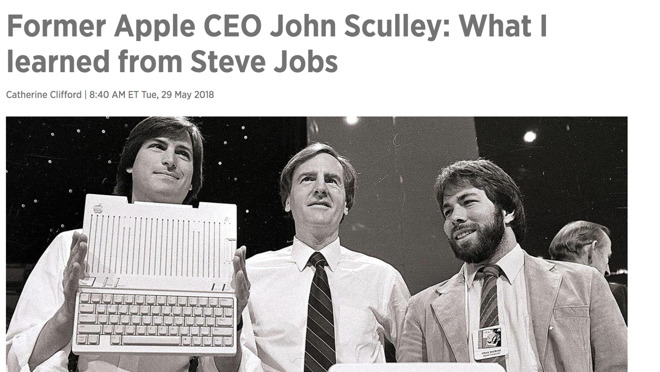
25 years ago, Apple’s board of directors pushed out CEO John Sculley
The CEO who famously won a power struggle with Steve Jobs in 1985 surrendered the chief executive position a quarter-century ago, placing the executive in a unique, strange purgatory.
The CEO of PepsiCo during the “Cola wars” of the early 1980s, Sculley was famously lured to Apple in 1983 with Steve Jobs’ pitch “do you want to sell sugared water for the rest of your life? Or do you want to come with me and change the world?” Unlike many Jobs quotes that frequently circulate, that one was real and not apocryphal.
Scully’s initial hiring was an early example of what’s known in Silicon Valley as “adult supervision”- an upstart company bringing in a veteran CEO to oversee its young, inexperienced founders.
Despite a positive start, Jobs and Sculley soon clashed over everything from the fate of the Macintosh division, to how much to focus on education, through Jobs’ supposed insubordination. In 1985, Jobs attempted a coup against Sculley, which failed, leading to Jobs’ banishment and resignation later that year.
Sculley and Jobs never reconciled prior to Jobs’ death in 2011.
“He never forgave me for that,” Sculley told Business Insiderin a 2015 interview. “No. [The friendship was] never repaired. And it’s really a shame because if I look back, I say what a big mistake on my part.”
Sculley remained CEO of Apple for another eight years after the battle and for ten years altogether, a pretty long tenure by most standards. But, Sculley has long been defined in the public imagination by his clash with Jobs, with his departure mostly seen as an event that started a chain of events that led to the co-founder’s eventual return.
That, at least, comprises an outsized percentage of what Sculley has been asked about over the years in interviews.
The CEO years
John Sculley came to Apple in order to apply his “Pepsi Challenge”-era marketing wizardry to the computer business, while also giving the company some experience and veteran expertise. At the time that Sculley became CEO of Apple, Steve Jobs was 28 years old, and Sculley was 44.
Sculley’s tenure spans the introduction of the Macintosh in early 1984, including its legendary marketing push that included the 1984-inspired Super Bowl commercial. Other successes included the launch of the PowerBook and the addition of color to the MacOS operating system interface, both in 1991, which is remembered as a period of significant innovation in Mac history. Sculley emphasized desktop publishing and other new functions of the Macintosh.
As for Sculley’s failures, he was present for the introduction of numerous failed products, most notably the Newton personal digital assistant, and a switch to the PowerPC microprocessor which Sculley later acknowledged as a mistake. By early 1993, things had clearly gotten ugly for Sculley at Apple.
Endgame
As a result of PC price wars that hurt Apple significantly, the company made only $86 million in profit in fiscal 1993, as opposed to $530 million the year before. The drop in profits led to significant layoffs inside Apple.
Sculley resigned at CEO of Apple on June 18, 1993 with Michael Spindler stepping in as his replacement. Sculley, however, remained the company’s chairman for an additional four months.
During that time he took a sabbatical and began spending more time with his wife in Connecticut, with Fortune reporting that Sculley had lobbied the incoming Clinton Administration for a nomination as Secretary of Commerce.
Sculley would resign from the board in October of that year, following another terrible quarter. Mike Markkula would replace him as chairman.
Things for Apple would get much worse in the ensuring years, under Spindler and his successor Gil Amelio, leading up to Jobs’ return to the company in 1997.
Sculley after Apple
Sculley’s first position after Apple was as CEO of Spectrum Technologies, an early wireless telecommunications firm. That was a job that ended in acrimony within a year.
In the last two decades Sculley has mostly been known as a serial entrepreneur. He founded or invested in a wide variety of companies in the years since, including MetroPCS, NFO Research, Hotwire.com, PopTech, and even a wine accessory called The Wine Clip, which he had enjoyed as a customer and later decided to invest in the company.
His most recent ventures are the data company Zeta Global, the emerging market smartphone company Obi Worldphone and the healthcare firm RxAdvance.
A strange purgatory
Despite all of his other ventures, the now 79-year-old John Sculley is in a position different from just about any other executive in the history of American business. Despite a long and relatively distinguished career, nearly all of the frequent interviews Sculley gives are about a job he had three decades ago that didn’t ultimately work out, and his clash with the man who is seen as a legendary figure.
The timing of Sculley’s media tour wasn’t exactly coincidental; Jobs had passed away in late 2011, and a wide variety of books and movies, most notably Walter Isaacson’s bestselling authorized biography of Jobs, had brought the late CEO’s legacy and the details of his biography to the forefront of public attention. In the Ashton Kutcher Steve Jobs movie, Sculley was portrayed by Matthew Modine; in the Michael Fassbender version, he was played by Jeff Daniels, as he and Jobs had an intense confrontation that very much did not actually take place:
[embedded content]
More recently, however, there’s been a new interview with Sculley on a seemingly monthly basis, and the main topic of nearly all of them is Sculley’s relationship with, and history with, Steve Jobs.
Sculley is also sometimes asked in interviews about present-day goings-on at Apple, general business topics, or even his current ventures. Sculley also made news earlier this year for purchasing a home in Palm Beach for nearly $15 million, indicating that whatever else you can see about the man, his career has made him fantastically wealthy.
It must be odd for Sculley to constantly have to answer questions about a not-very-comfortable period in his professional life more than 30 years ago.
This is the story of a brad named Bard who became a … no, sorry, it’s a bard named Bradbarian who … wait, a barbarian named Brad who became a bard. That’s it. He hung up his steel axe for a golden six-stringed axe and has an axe to grind with the monsters trying to destroy his home’s precious Town Crystal, which, as we all know, was the centrepiece of any medieval municipality.
Bardbarian is a really cool mix of tower defense, action RPG, and bullet-hell shooter. Since Brad the Bradbar… Bardbarian has tired of busting skulls over shredding riffs, he doesn’t do any fighting himself, preferring to summon a party from the town to support him. Each party member has a slightly different ability, from pure DPS to area-effect to healing, which makes up the strategy part of the game. More important, though, is the action.
All the baddies shoot projectiles, so that’s where the bullet-hell shooter gameplay comes in. You’ve got to dodge the incoming fire, not only to stay alive but also to build up your stun ability that only charges after five untouched kills in a row and is vital to bring down the larger groups later in the game. Overall, the bullets are slower than in your average space-shooter, and they start pretty well spaced. However, in Bardbarian, you also have to drag along your party of warriors and keep them from getting hit too, which can be an impossible task when a half-dozen goblins are shooting death-flowers at you. Weaving your party through incoming fire is a major part of the gameplay, so much so that one upgrade (it’s Body spray, hah!) helps you tighten up the group to make them harder targets. The controls are a solid swipe-anywhere control stick that is precise and easy to use even as the gameplay becomes more frantic. There are also two bonus modes that get rid of any strategy elements whatsoever and go pure arcade.
The game has a great cartoony art style with floating limbs like Rayman that may have been chosen only because they are easier to animate but are still working really well in this game. Enemies and bullets are easy to spot and distinguish, even on tiny devices. The music is good fun too: pounding heavy metal riffs that will pump you up but won’t bother you when they repeat or get stuck in your head later in the day. Each of Brad’s buffs and summons will let loose a squeal of a solo, but even those are varied and fun enough to not be a drag after the hundredth time you hear them. The sense of humor is goofy in that very online sort of way (strips of delicious bacon are your healing pickups, for example) but never obnoxious.
You make progress by collecting gold each run through the campaign and upgrading Brad’s abilities, the troops, or the town itself. Some of them make bigger change in the gameplay than others, like the pet that will snag pickups for you. Most of them are just iterative numerical upgrades that make your party faster or stronger, without changing the fundamentals is a big way.
Despite all the loot and upgrades, it’s difficult to feel like you are making real progress in Bardbarian, mostly because the playing field is identical every game. Once you finally do beat a boss and unlock the next chapter, you can feel free to start your new game from the checkpoint. However, you’ll be at a major disadvantage, because your troops will start at their base level (admittedly, this base level can be upgraded) and your stockpile of notes will start at zero too. It’s very difficult to make any more progress from that point, so a better idea is to start your new game all the way over from the beginning. Of course, your higher-level allies and buffs will (albeit slowly) make mincemeat of the initial waves of enemies but putting up with the boredom will net you piles and piles of gold and notes that you can use to push forward once you reach a level that’s challenging. That leaves the game feeling very grindy, because your best strategy is just to take it easy until you can upgrade your stuff enough to survive the higher-level enemies. It’s just a slow race to make your numbers bigger than the bad guys.
Whether you enjoy the game will depend on how much the core bullet-dodging gameplay sinks its hooks into you. If you have a blast weaving your party around the slow but soon overwhelming bullets you won’t mind facing the same enemies over and over to make a little progress. If you’re looking for a deeper strategic tower defense or RPG experience, this is not your game. There’s a free-to-play version of the game for Android, so if that’s your platform, you’re lucky to be able to try before you buy. It’s actually too bad that the iOS version is premium only because the real test of a game like this is whether it’s genre-bending scratches your itch or not, because the rest of the design just isn’t that compelling.
The PlayCanvas HTML5 game engine just added 2D support in the form of Sprites, texture atlases, animated sprites, sprite components and 9 patch support.
PlayCanvas is one of the most popular ways to build 3D interactive web content today. But before 3D graphics was a thing, there was 2D graphics!
Today we’re excited to launch the first part of our 2D graphics support. Great for building classic 2D games.
There are 5 great new features which will help you build 2D games using PlayCanvas.
Those new features are:
Texture Atlas assets
Sprite Asset
Sprite Component
Sprite Editor
9 Slicing
For more details on the new 2D functionality in the PlayCanvas editor, be sure to check out this hands-on video where we illustrate how to import a texture atlas and use it to create 2D sprite animations:
[embedded content]
If you are interested in learning more about PlayCanvas, be sure to check out our two part tutorial on building a simple bowling title in PlayCanvas available here and here.
Last Chance: Free And Cheap PC Games In GOG's Big Summer Sale
Anyone who wants to save money on PC games is in luck because GOG has kicked off a massive summer sale, with over 1,000 games available for up to 90 percent off. They're even throwing some free PC games into the mix, some of which are only available for a limited time. The sale runs between now and June 18 and, as always with GOG, the games are DRM-free. [Update: It's now June 18, giving you just a few more hours to take advantage of this sale.]
Two games are easy to get for free. If you spend $5 on games during the summer sale, you'll get a free copy of Sunless Sea, a roguelike survival game set in a watery, apocalyptic version of London. Spend $20, and you'll unlock Rime, a game of puzzle-solving and exploration that takes place on a mysterious island.
We have more picks below, or you can see the full list of games on sale here. And if you want even more suggestions, check out this list compiled by GameSpot's editorial team.
Can Apple’s HomePod take on a surround sound theater system?
Apple’s HomePod is one of the best sounding smart speakers on the market, and the recent addition of stereo pairing with AirPlay 2 makes the setup even more engaging. But how does a pair of HomePods stack up against a dedicated home theater system?
[embedded content]
When Apple revealed their HomePod at WWDC 2017, they promised users the ability to pair two speakers together with Airplay 2, a new wireless protocol that also enables multi room audio streaming and other audio enhancements. A long time coming, AirPlay 2 was finally released alongside iOS 11.4 last month.
We tested out stereo pairing on our HomePods and not only did it work perfectly, but it sounded really good. Two speakers are obviously louder than one, but the update also increased bass when a pair of HomePods are cranked up all the way.
With engaging, immersive sound, it’s only natural to wonder if a pair of stereo HomePods would make a viable home theater setup for the Apple TV.
Obviously, the HomePod is unable to achieve true 5.1 channel surround sound, which uses 5 separate speakers and a subwoofer, but Apple’s devices do feature technology that bounces sound off walls and nearby objects to simulate a deep soundstage. With stereo pairing, HomePods detect each other and their respective placement in a a room, so they know exactly where to send different channels of sound for optimal audio reproduction.
To be clear, this is not Apple’s attempt at 5.1 channel virtualization, but the solution does broaden HomePod’s soundstage considerably.
Testing
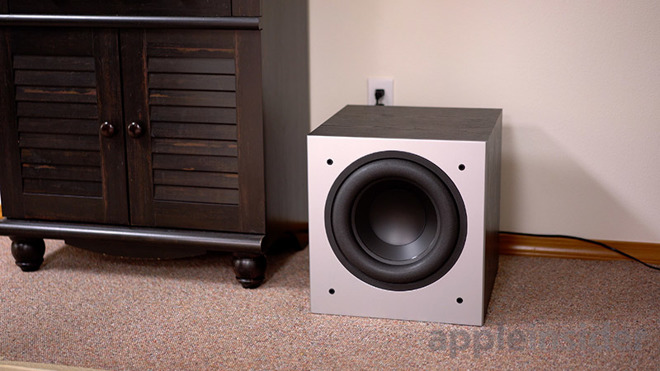
We pitted a pair of HomePods against a 5.1.2 channel Dolby Atmos-compatible surround sound system. For our test, the two overhead speakers were disabled, as Apple TV will not support Atmos until the September release of tvOS 12.
Starting off with the intro scene to “The Greatest Showman,” the surround sound system output very clear vocals with deep bass. The YouTube clip was streamed over AirPlay from an iPhone to an Apple TV. Hugh Jackman’s voice played through the center channel, music played from the front and rear channels, and sound effects played across all channels.
The bass thumped very loud and we could discern crowds behind us like we were sitting in the circus watching a live performance. When Anne was being pulled up into the air, her voice shifted from the left and right speakers up to center, really selling the experience.
Switching over to the HomePods, we were immediately greeted with an issue. The Apple TV 4K would not allow us to stream from an iPhone X. Instead, it automatically switched back to the HDMI output for audio. We ended up using the native YouTube tvOS app as a workaround.
Playing back the same “Greatest Showman” clip on HomePods was disappointing. Even at max volume, it was much quieter than my surround sound system was at 80 percent volume. A little digging revealed that the YouTube clip lacked adequate audio output levels, and while the dedicated surround sound system had enough power to compensate for the low input volume, the HomePods simply could not keep up.
The sound quality wasn’t bad though, and we even heard the virtual surround sound algorithms at work. Instead of the crowds being behind us, however, we heard them from the side. The crisp highs and low bass of the dedicated system were still miles ahead of the HomePods, even at low volumes.
Next we watched some “Pirates of the Caribbean” through the Netflix app, and once again the volume was extremely low on our HomePod setup. The home theater system sounded great, and just required a bit more volume than typical to compensate.
Interestingly, sound effects come through much louder on HomePod when navigating the Apple TV 4K’s menu, but levels drop once a movie starts.
We wanted to make sure that there wasn’t a problem with the setup, so we played some music from the Apple Music app. We were greeted with much higher volumes, and while it didn’t match up to the massive front left and right Polk Audio speakers, it sounded much better than output from our movie streaming apps.
We moved on to “Thor: Ragnarok,” where HomePod volume was a bit louder than the two previous films, but still much too quiet for a good movie experience and nothing that compared to the surround sound system. Apple’s speakers were unable to keep up with a $350 LG soundbar with wireless subwoofer. It could be the fact that audio in films do not constantly come close to 0 decibels like most songs do, or that Apple TV outputs a lower signal when playing back films, but we suspect it’s a bit of both.
Impressions
The surround sound system sounded amazing in all respects, as loud as a good movie theater but with a better surround sound experience since it is tuned to an exact point in space. Moving to the HomePod, we were in some cases surprised to hear crowd both in front and behind us. The vocals were clear, but not as crisp as we would like. We had a similar experience with the bass, which was present but not as visceral as the output from a dedicated woofer.
The thing that was missing most was the volume. The built in speakers of any modern TV are at least twice, if not three times as loud as Apple’s max settings.
Apple has a function built in to limit HomePod volume, but not to boost it. That’s a feature it needs to be a viable home theater solution.
As expected, HomePod is not a replacement for a surround sound system, nor is it marketed as such. Users can purchase an entry-level dedicated surround system, or a very good soundbar with Atmos support, for the price of two HomePods.
At this time it’s best to keep HomePod limited to Apple Music, where it does great job, and look elsewhere for movie watching needs.
Former Telltale CEO and co-founder Kevin Bruner is suing the studio
Former Telltale CEO and co-founder Kevin Bruner is suing the studio over his expulsion in March last year, according to a report in the Marin Independent Journal.
Bruner helped launch the company, known for episodic game series like The Walking Dead and Tales from the Borderlands, in 2004 alongside Dan Connors and Troy Molander. He initially served as president, CTO, and director, before taking on the role of CEO in 2015.
Fast-forward to March 2017, and Bruner stepped down seemingly of his own accord, although the former CEO now alleges he was pushed out after board members sought to change the company’s business model.
He also claims he wasn’t given the necessary assistance as he attempted to sell his holdings in common and preferred stock, and was eventually purged from the Telltale board of directors via illegitimate means.
Telltale, meanwhile, has called the lawsuit “meritless,” and suggests it has been filed “as an apparent means of extracting revenge on a company already under financial strain.”
“The company is now working to turn around the decline that it experienced under Plaintiff’s stewardship,” continues the developer’s response.
Judge Roy Chernus has rejected studio’s initial attempt to defeat the lawsuit outright, and believes “there are issues that appear to deserve further examination.” With that in mind, a case management conference has been set for July 17.
Blog: Composing video game music for virtual reality – Part 3
The following blog post, unless otherwise noted, was written by a member of Gamasutra’s community. The thoughts and opinions expressed are those of the writer and not Gamasutra or its parent company.
So happy you’ve joined us! I’m videogame composer Winifred Phillips. Welcome back to our four part discussion of the role that music plays in Virtual Reality video games! These articles are based on the presentation I gave at this year’s gathering of the famous Game Developer’s Conference in San Francisco. My talk was entitled Music in Virtual Reality (I’ve included the official description of my talk at this end of this article). If you haven’t read the previous two articles, you’ll find them here:
During my GDC presentation, I focused on three important questions for VR video game composers:
Do we compose our music in 3D or 2D?
Do we structure our music to be Diegetic or Non-Diegetic?
Do we focus our music on enhancing player Comfort or Performance?
While attempting to answer these questions during my GDC talk, I discussed my work on four of my own VR game projects – the Bebylon: Battle Royale arena combat game from Kite & Lightning, the Dragon Front strategy game from High Voltage Software, the Fail Factory comedy game from Armature Studio, and the Scraper: First Strike shooter/RPG from Labrodex Inc.
In these articles, I’ve been sharing the discussions and conclusions that formed the basis of my GDC talk, including numerous examples from these four VR game projects. So now let’s look at the second of our three questions:
Do we structure our music to be Diegetic or Non-Diegetic?
Before we launch into this discussion, let’s revisit one of the examples from the previous article. You’ll remember that we took a look at the Main Theme music I composed for the popular Dragon Front VR strategy game, in order to examine how music can best transition from a traditionally 2D stereo delivery to a 3D positional implementation. So in this case, the big victorious anthem that I composed for Dragon Front makes its first appearance as a bombastic stereo mix directly piped into the player’s headphones, and then transitions smoothly to a spatially positioned environmental sound issuing from a small in-game radio. Just as a reminder, let’s take another look at that:
[embedded content]
In this example, we see how the Dragon Front theme music starts as traditional underscore (that is, a non-diegetic score), but then moves into the VR space and becomes a diegetic score – one that is understood to be present in the game world. And that brings us to the second of the three core debates at the heart of music in VR: should music in VR be diegetic or non-diegetic?
It’s a thorny issue. As we know, musical underscore is absolutely vital in gaming – it creates momentum, motivates players and adds emotional texture to the story and the characters. However, in VR, the idea of presence becomes paramount. We want players to feel like they are inside the fiction of an awesome VR world. So, when the non-diegetic music starts playing, we worry that players might stop and wonder, ‘where’s this music coming from? Why am I hearing it?’
The obvious solution is to make all of the music in the game diegetic – somehow, in this VR world, all music comes from in-game sources that players can see in the environment around them. Here’s an example from one of my VR projects – Bebylon: Battle Royale, from developers Kite & Lightning.
Bebylon is a great example of a completely diegetic score in VR. The whole premise hinges on immortal babies battling it out in over-the-top arena fights in a futuristic setting. Music during gameplay is represented by a group of in-game baby musicians, so the music originates from that source, and we’re able to see this happening in the VR world. So, let’s take a look at that:
[embedded content]
Bebylon: Battle Royale proves that its possible to get away with a completely diegetic score, but we’d need really specific circumstances to justify it. Most games won’t be able to make this approach work. So, what then? I’ve found that there are three strategies to ease non-diegetic music into VR:
Keep it subtle and gradual,
Keep it dry and warm, and
Keep it both inside and outside the VR world.
So let’s start with the first strategy – subtle and gradual.
We’ve already discussed this technique in the first article in this series, when we took a look at the ambient music for Scraper, a first-person VR shooter set inside colossal skyscrapers in a futuristic city. Exploring the massive buildings in the Scraper fictional universe requires a musical soundtrack to set the tone, but introducing it so that it feels natural in VR is a challenge.
In order to address this problem, I composed the ambient music in Scraper so that it would come and go in subtle, gradual ways. As a technique for music implementation in VR, this can be an effective approach. Let’s take another look at what that was like in Scraper:
[embedded content]
While this technique works well for the ambient music, it wasn’t an option for combat. Battles in Scraper are pretty intense – the music begins with a bang and keeps on whaling away until the room is cleared of enemies. At the beginning of the project, we’d decided on a stereo music mix rather than spatialization – considering how important audio cues are to expert first-person-shooter players, we didn’t want a spatialized score to introduce any confusion. My job at that point was to figure out a way to delineate the stereo music mix from the VR world so that the player wouldn’t wonder where the music was coming from.
From here, I started thinking about proximity effect – it’s a term relating to microphone recording. You’ll notice proximity effect when someone speaks into a mike while leaning very close to it. The voice starts sounding really bassy and warm in tone, and the mike picks up a lot of the dry source signal, with less of the room acoustics coming through. When you listen with headphones to a recording with lots of proximity effect, it tends to feel like it’s inside your head. I thought – great! If the music is in our heads, we’re not going to be looking around, wondering where it’s coming from.
I recorded the music for Scraper with fairly dry acoustics, and when I mixed the music, I focused on keeping the tone warm and bassy, with a solid low end and some rich mids in the EQ spectrum. Here’s an example of how that worked in combat sequences of the Scraper VR game:
[embedded content]
I also recorded the music of Fail Factory with dry acoustics and a warm, bassy mix – this effect is especially prevalent during the Fail Factory tutorial.
In the Fail Factory Tutorial, the instructor zips around on a hover craft while offering tips and guidelines. In those circumstances, having the music in a dry, warm mix allows it to feel closer to the player, and more separated from the spatialized sounds from the instructor. Let’s check that out:
[embedded content]
So now let’s look at another approach, which I’ve called ‘Inside and Outside.’ If music is 3D – if it’s spatialized – we’re more likely to think it actually exists inside the fictional world. If music is 2D – if it’s a direct stereo mix – we’ll be more likely to accept it as non-diegetic, as outside the experience.
Remember the example I showed earlier from Dragon Front – when the main theme music of the game transitioned into a spatialized music source coming from inside the VR space? This is an example of music making the jump from non-diegetic to diegetic, and that can help the player accept the presence of music as a part of the VR game. Watch how players can look around in the Dragon Front hub area, locate the source of the music, and actually turn it off if they want to:
[embedded content]
So we’ve now discussed the second of the three important questions for video game composers creating music for VR games:
Do we compose our music in 3D or 2D?
Do we structure our music to be Diegetic or Non-Diegetic?
Do we focus our music on enhancing player Comfort or Performance?
We’ve contemplated what role our music should play in the VR experience – whether it should be considered a part of the fictional world or an outside commentary that shapes the player’s emotional experience. Both roles are valid, but the choice between them is especially meaningful within the context of VR. The next article will focus on the third of the three questions: whether music in VR should enhance player comfort or player performance. Thanks for reading, and please feel free to leave your comments in the space below!
Music in Virtual Reality (GDC 2018 Session)
This lecture presented ideas for creating a musical score that complements an immersive VR experience. Composer Winifred Phillips shared tips from several of her VR projects. Beginning with a historical overview of positional audio technologies, Phillips addressed several important problems facing composers in VR.
Topics included 3D versus 2D music implementation, and the role of spatialized audio in a musical score for VR. The use of diegetic and non-diegetic music were explored, including methods that blur the distinction between the two categories.
The discussion also included an examination of the VIMS phenomenon (Visually Induced Motion Sickness), and the role of music in alleviating its symptoms. Phillips’ talk offered techniques for composers and audio directors looking to utilize music in the most advantageous way within a VR project.
Takeaway
Through examples from several VR games, Phillips provided an analysis of music composition strategies that help music integrate successfully in a VR environment. The talk included concrete examples and practical advice that audience members can apply to their own games.
Intended Audience
This session provided composers and audio directors with strategies for designing music for VR. It included an overview of the history of positional sound and the VIMS problem (useful knowledge for designers.)
The talk was intended to be approachable for all levels (advanced composers may better appreciate the specific composition techniques discussed).
Winifred Phillips is an award-winning video game music composer whose most recent projects are the triple-A first person shooter Homefront: The Revolution and the Dragon Front VR game for Oculus Rift. Her credits include games in five of the most famous and popular franchises in gaming: Assassin’s Creed, LittleBigPlanet, Total War, God of War, and The Sims. She is the author of the award-winning bestseller A COMPOSER’S GUIDE TO GAME MUSIC, published by the MIT Press. As a VR game music expert, she writes frequently on the future of music in virtual reality games.
Dungeon Defenders II: Protean Shift is nearly upon us! Get ready to set up shop, gain new rewards, and explore our new Expeditions in one of our biggest expansions ever. Protean Shift features an airship-load of new features and systems for players to engage with. Because this is such a substantial change, we wanted to make sure we had community input on the new direction. We shaped this latest expansion with our community utilizing user research, live playtests, and giving earlier access to testing new features.
Community and creativity are key to the Dungeon Defenders experience. Defenders are constantly experimenting within the game, tailoring their heroes and defenses to their liking, and interacting with others. Protean Shift deepens and extends the core experience, adding several tasty new layers to the delicious cake that is Dungeon Defenders II.
The first layer is build expressiveness. We’re a loot-based game, and we want to empower players to customize and maximize their loot to fit their unique play styles. Items can now contain Magical Offensive and Defensive Subroutines, or “Mods” for short. These Mods add unique additional powers to items that grant them the ability to excel at thwarting specific threats or dangers. Tired of those pesky Geodes that reflect your projectile attacks with their shield? Find a new item with a Piercer Mod and watch as your attacks phase through their shield effortlessly. Because we love you, we’ve added a Mods for Relics that produce similar effects. Thus far we’ve crafted over 120 new Mods for you to experiment with and lay waste to the Old One’s armies. I’ve even heard rumors around the office water cooler that there are unique Mods coming from deep floors of Onslaught and gaining Ancient Power.
But how will I coordinate my Mods you ask? Am I to lay myself at the altar of RNGesus and pray for his favor? Well, dry your eyes and look no further than our second layer – Tinkering and Player Shops. Tinkering is a new process available in Town that will allow you to instantaneously transfer Mods between pieces of equipment. Using Tinkering will be key to developing the sort of build hyper-coordination that will cement your name in the history books of Etheria. If you can’t find a specific Mod at the quality you need, however, you may be able to purchase one from a Defender who has. Starting with Protean Shift everyone will be able to sell items to other Defenders in their session via Player Shops. To help aid in the discovery process, we’ve added a Dragonfall Market map to the War Table that will be exclusively for facilitating player-to-player purchases.
With all this new gear you will be uniquely tailoring to maximize each hero’s potential and style, you’ll need a method to carry gear through Chaos difficulties and Ancient Power. That is why the third new layer is our revamped upgrading system. You can now upgrade, evolve, and advance items all the way from Worn quality at the first map of the campaign to Legendary Chaos 8 tier (and no that’s not a typo). Want to slay enemies in Onslaught floor 9001 with that awesome sword you got from killing you first boss in DD2? (oh the memories!) This system allows you to do that provided that you obtain the correct materials, catalysts, and currency. Shards have even gotten some love. You can now “dust” your unwanted Shards and purchase new ones. When you find the one you want, you can Gild it in order to reach new levels of power and forestall the effects of Ancient Power.
The final layer, or you could say “the icing on the cake” would be our additional content and rewards. There are new costumes for our Gunwitch and Barbarian, and several new weapons for every hero. There are even new Protean weapons that will “Shrinkinate” your foes. We can’t wait for everyone to share their favorite new looks and weapons.
Unfortunately, with all this new stuff going into the game, we had to end Chaos Trials. There was just too much going on and we couldn’t figure out how to keep them going. Though we know this will be a loss felt deeply throughout the community, in their place you will now find Expeditions that allow you to choose where and how you want to play. Did I mention we were focusing on player choice and creativity?
Protean Shift is the largest expansion that we’ve ever released and brings many game-changing new systems and updates to Dungeon Defenders II. We still have many more places to go, and we can’t wait to share the journey with our Xbox community. In the future, look forward to exploring new areas of Etheria and new ways to interact with your friends and fellow Defenders. As always, check out our official forums and social media and let us know what you think about these upcoming changes. Additionally, check out our various content creators online and look for us on Mixer! We’re always watching streams and engaging with community members.
Talking Point: What Were The Biggest Highs And Lows From E3 2018?
E3 is finally over for another year, bringing to a close the biggest event yet. From surprise promotional crossovers on the Ubisoft conference to a certain game pretty much taking over Nintendo’s big summer Direct, there’s been plenty of topics to talk about now the dust is beginning to settle. So we’ve switched on the NL symbol, turned it towards the night’s sky and from the darkness, Team Nintendo Life has appeared to discuss our biggest takeaways. As always, we want to hear what you made of Nintendo’s presence at the big expo, so be sure to leave a comment below…
Glen Fox, guides editor
Honestly, I’m feeling a little deflated after Nintendo’s E3 showing because I was really hoping for at least one big new announcement for this year. It was pretty telling that most of the Direct focused on Super Smash Bros. Ultimate, because that’s all Nintendo’s really got for year two. That’s great for fans of Smash Bros., but I’ve never really had more than a passing interest in it.
So what did that leave? Let’s Go Pokémon, which is pretty much designed to plug the gap between now and the core RPG next year. I think it will also serve as a nice stepping stone for all of the new fans that Pokémon GO clawed in. There’s also Super Mario Party, which I personally could not care less about.
But it was nice to see some footage of Fire Emblem: Three Houses, which looks like it could be the best entry in the franchise yet. Also, Fortnite dropped, and that’s a MASSIVE boon for the Switch. Been hooked to it ever since. Ultimately, I feel like I was right to look to third-party developers for Switch joy as the year comes to a close. Starlink features Star Fox, Fallout 76 MIGHT come to Switch, and I’m still psyched for FIFA 19.
Dom Reseigh-Lincoln, editor
E3 2018 was an odd one for Nintendo. Much like the other big platform holders, there were no earth-shattering announcements or brand new IP that made every stop, look and listen. The announcement of the Star Fox announcement for Starlink: Battle for Atlas was a great move, mainly because it a) satisfies those of us that really want a new adventure of Fox McCloud and the crew and b) gives a title attempting to reignite the cooling embers of the toys-to-life genre a much-needed burst of heat.
But there’s no getting away from the fact the huge onus on Super Smash Bros. Ultimate left very little room for other titles to shine. It’s Nintendo’s big winter release, but the sheer glut of details felt like a poor use of ‘prime time’ broadcasting space that could have been used to showcase the next big indie hit or a Switch-exclusive title deserving of more attention.
Ryan Craddock, staff writer
For me, this year’s Nintendo highlights were all the big announcements. The Super Smash Bros. Ultimate reveal – despite going into a bit too much detail for me – was always going to be the star of the show, and the complete roster, beautiful looking updates to the graphics and lighting, and the addition of Ridley are all fantastic.
I’m also excited about Fortnite – and really wish it hadn’t been leaked beforehand so that the intended shock factor would have been as intense as planned – and can’t wait to get stuck in this weekend. I’ve played it on PS4 before (so that means a new account for me – thanks Sony!) and I suck at it. Hopefully I’ll improve with practice!
Finally, Starlink: Battle for Atlas has really shocked me. Not just because of the Star Fox inclusion (which is awesome) but because the Treehouse: Live footage looked amazing. As long as the story content is well done, flying around those gorgeous worlds looks like it could be really good fun.
Liam Doolan, Australia correspondent
When the Super Smash Bros. Ultimate director Mashiro Sakurai appeared on my monitor during this week’s Nintendo Direct, I knew the big moment had finally arrived. The details about the new Smash title were ongoing from that point, with 25 minutes of comprehensive coverage.
One major highlight during this particular reveal was the news every character previously featured in the all-star series would be returning in the latest outing. When Young Link from Super Smash Bros. Melee then popped up, for me, it felt like an old friend had returned. I used to main the fast and agile hero of time until he was essentially replaced with the different but similar character, Toon Link. With both of these fighters now back in the series, I’m not sure which one I’ll gravitate towards. Regardless of who I opt with, I’m glad Nintendo is giving its fans this option.
Alex Olney, video producer
To be honest I think one of my favourite announcements was probably Fortnite. Now before any of you start dashing down to the comments to tell me what a sheep I am, it’s mainly because now I feel I can finally breathe a bit. So many denied all the evidence, so many claimed it would be bad for it to come to Switch for some reason unbeknownst to anyone, but now it’s finally here and there’s no going back.
Also it’s good fun with friends, and if people are having fun in a healthy way that doesn’t negatively impact anyone else, can that really ever be a bad thing? Best thing was Smash though, let’s not try and deny that. Oh, and Super Mario Party.
Jon Cousins, Japan correspondent
As with every Nintendo Direct, most of their E3 showing (well, the third party stuff) leaked ahead of time, but aside from the smash segment being really long and ’inside baseball’, I thought it was reasonable. It was great to see Hollow Knight release during the event, and Fortnite was the worst kept secret since Mario + Rabbids, so my highlights are definitely Daemon X Machina and Super Mario Party.
Although I’d hardly call myself a mech or anime fan, DXM had a real dynamism and vivid art style, and it’s great to see a new IP from some veteran talent. I’ve never got into the Mario Party series, but I love me a mini-game or two with mates, and with the really interesting ways to use the system, SMP has the potential to be great.
Gonçalo Lopes, contributing writer
Nintendo’s E3 presentation did not just start with a bang – it began with several dozens of them accompanied by loud heavy metal music and unbelievable mecha carnage. After recognizing several names among the staff, I am fairly certain that Daemon X Machina is the mech action game of my dreams, one already hinted by Xenoblade Chronicles X back in 2015. A very special birthday ahead for yours truly when n the 16th of October Starlink: Battle for Atlas lands with exclusive Star Fox ship, pilot and mission content. The perfect crossover and a continuation of Nintendo and Ubisoft’s discrete relationship of mutual respect.
There was nothing even slightly F-Zero related, I still don’t know who is making Metroid Prime 4 and Bayonetta 3 remains illusive as ever but the sadness of those omissions is tiny when stacked up to the amount of joy from the amazing new games (and new content for old ones) heading our way in the next six months. The Switch is quickly becoming the most important games console I ever owned in my life and I look to the future with a big childish smile slapped across my face. Mission accomplished, Mr. Iwata. I thank you “Directly!” for so, so much.
Richard Atkinson, contributing writer
The unruly and unpredictable E3 storm has passed which means it’s time to shrug off the inevitable disappointment from getting WAY too hyped, focus on the slices of goodness that we got from Nintendo this year and turn our attention to what brought a smile to our faces. For me, the instant release of the Splatoon 2: Octo Expansion was one of the most welcome surprises – the thought of having to wait even longer was too much to bear and my prayers were answered.
But there was one title that got me even more excited than a Nintendo fan learning of ‘normal’ voice chat without the use of a silly app and that was Super Mario Party. The patent that Nintendo filed a few months back finally saw its commercial light and, boy, did it look great. The idea of tapping two Switch screens together to make a bigger playing field on a table in a pub, friend’s house or train coach excites me and I can’t wait to see what the title has to offer. Time for many friendships to be ruined all over again.
Alan Lopez, contributing writer
You’ll hear what I think about Super Smash Bros. Ultimate, but now is nowhere near its release date of 7th December. Heck, it’s not even June 22nd, henceforward ‘Mario Aces Day’. So instead of sitting on my hands, I joined with 100 million people before me and downloaded Fallout Shelter, the free-to-play sensation that’s one more toe from hit-maker Bethesda’s toe-in-the-water approach on Nintendo platforms.
And admittedly, somewhat surprisingly, I didn’t know much about it beyond screenshots. After deciding this would be my first post-E3 experience, I booted it up, learned the ropes, and started colonising my little ant farm of people. Like an upside down Sim Tower, I nurtured my little citizens into good health and great fortune. Hours went by. I basked in the dull hum of fallout.
Sure, maybe it’s two years late, but E3 has a way of making everything exciting. My face was close to my Switch screen all weekend playing games and checking the e-shop, like a child pressed against a cooking microwave. I’m thinking, “Am I gonna get radiation from this?” But I just want a front row seat to all the changes…
Dave Frear, retro reviewer
Many games from 2018’s E3 caught my interest, but one unexpected surprise was Starlink: Battle for Atlas. I was unimpressed when it was shown off last time, but as the segment unfolded at this years Ubisoft conference I began to warm to it – and then we were hit with a burst of Cornerian radio chatter and learned Fox McCloud would be popping up in the Switch version. That raised my interest levels further and whilst it could turn out to be rubbish, it looks quite fun from what we’ve seen so far.
Less likely to be rubbish is Super Smash Bros. Ultimate. He kept us waiting, but Snake has made his return as have all previous fighters, plus playing as Ridley is going to be a thing. Awesome. Nintendo may have dedicated too much time to it in their presentation, but I can see it being hard to put down come December.
Morgan Sleeper, E3 2018 reporter
Thinking back on my time on the show floor over this year’s E3, one thing stands out: getting to go hands-on with the Poké Ball Plus. I also had a great time playing Super Smash Bros. Ultimate, but it will be a long time before anything else in gaming knocks me out as much as catching and then hearing Pokémon in the palm of my hand.
Still as much as I enjoyed Nintendo’s line-up, the real highlight was getting to check out so many exciting third-party games. I loved banging on the Joy Con and belting out beats in the full-bodied, freeform musical adventure of Gal Metal; I loved exploring the charming world of Little Dragons Café, foraging for ingredients and cooking up meals; I loved the stunningly stylish rhythm action of Musynx; I loved beating the stuffing (and cupcakes, and glitter) out of opponents in the pastel party fighter SNK Heroines; and I loved the Etrian Odyssey-meets-Disgaea dungeon crawling of Labyrinth of Refrain: Coven of Dusk.
These were all especially exciting for me because they prove that even among the first-party frontrunners, high-profile ports, and indie hits, the Switch has plenty of room left for what quickly became my favourite section of the 3DS’ library: colourful, quirky imports. Long may that continue!
A New Animal Crossing-Themed 2DS XL Is Coming To Europe Next Month
A brand new Animal Crossing-themed New Nintendo 2DS XL has appeared on the Nintendo UK store, set to be available in Europe next month.
The console hasn’t received an official announcement from Nintendo just yet, but some details can be found on the Nintendo 3DS Family page of the website. The system is set to include a digital copy of Animal Crossing: New Leaf – Welcome amiibo (the updated version of Animal Crossing: New Leaf) which will be pre-installed onto a 4GB microSD card, and a Nintendo 3DS AC adapter will also be in the box.
This console edition will launch on 20th July this year in Europe, although no news has been provided just yet surrounding a North American release. Whether this release is designed to coincide with an upcoming Animal Crossing on Switch announcement, or simply as something to tide fans over for another few months, is unknown.
Would you like to add this new 2DS XL to your collection? Are you desperately waiting for news of an Animal Crossing game on Switch? Let us know down below.







 Before we launch into this discussion, let’s revisit one of the examples from the previous article. You’ll remember that we took a look at the Main Theme music I composed for the popular Dragon Front VR strategy game, in order to examine how music can best transition from a traditionally 2D stereo delivery to a 3D positional implementation. So in this case, the big victorious anthem that I composed for Dragon Front makes its first appearance as a bombastic stereo mix directly piped into the player’s headphones, and then transitions smoothly to a spatially positioned environmental sound issuing from a small in-game radio. Just as a reminder, let’s take another look at that:
 Bebylon is a great example of a completely diegetic score in VR. The whole premise hinges on immortal babies battling it out in over-the-top arena fights in a futuristic setting. Music during gameplay is represented by a group of in-game baby musicians, so the music originates from that source, and we’re able to see this happening in the VR world. So, let’s take a look at that:
 We’ve already discussed this technique in the first article in this series, when we took a look at the ambient music for Scraper, a first-person VR shooter set inside colossal skyscrapers in a futuristic city. Exploring the massive buildings in the Scraper fictional universe requires a musical soundtrack to set the tone, but introducing it so that it feels natural in VR is a challenge.
 From here, I started thinking about proximity effect – it’s a term relating to microphone recording. You’ll notice proximity effect when someone speaks into a mike while leaning very close to it. The voice starts sounding really bassy and warm in tone, and the mike picks up a lot of the dry source signal, with less of the room acoustics coming through. When you listen with headphones to a recording with lots of proximity effect, it tends to feel like it’s inside your head. I thought – great! If the music is in our heads, we’re not going to be looking around, wondering where it’s coming from.
 I also recorded the music of Fail Factory with dry acoustics and a warm, bassy mix – this effect is especially prevalent during the Fail Factory tutorial.
 Remember the example I showed earlier from Dragon Front – when the main theme music of the game transitioned into a spatialized music source coming from inside the VR space? This is an example of music making the jump from non-diegetic to diegetic, and that can help the player accept the presence of music as a part of the VR game. Watch how players can look around in the Dragon Front hub area, locate the source of the music, and actually turn it off if they want to:
 This lecture presented ideas for creating a musical score that complements an immersive VR experience. Composer Winifred Phillips shared tips from several of her VR projects. Beginning with a historical overview of positional audio technologies, Phillips addressed several important problems facing composers in VR.
 Winifred Phillips is an award-winning video game music composer whose most recent projects are the triple-A first person shooter Homefront: The Revolution and the Dragon Front VR game for Oculus Rift. Her credits include games in five of the most famous and popular franchises in gaming: Assassin’s Creed, LittleBigPlanet, Total War, God of War, and The Sims. She is the author of the award-winning bestseller


