Posted on Leave a comment

AI helping vulnerable communities in India better understand heat wave dangers

As heat waves grow more common, frequent, and intense in India and around the world, researchers say it’s having a disproportionate effect on some of the world’s poorest communities.

In India, that harsher impact is being felt in the nation’s slums, which researchers say can be as much as 6°C (42.8°F) warmer than other parts of the city

“In the slums, it is so difficult to step out and find shade on a hot summer day,” Anshu Sharma said. “It is so congested. The houses are often made of tin sheets, which heat up much faster compared to other materials.”

Sharma is the co-founder of SEEDS, a New Delhi-based disaster response and preparedness non-profit organization, which has measured the temperature disparity between the slums and other parts of the city.

Since 2017, SEEDS has been working with communities most vulnerable to heat waves, to help people come up with solutions to beat the heat. And now, with the support of Microsoft’s AI for Humanitarian Action grant, SEEDS has developed an artificial intelligence (AI) model to predict the impact of multiple hazards like cyclones, earthquakes or heat waves in any given area.

The model, called Sunny Lives, has generated heat wave risk information for around 125,000 people living in slums in New Delhi, India’s sprawling capital, and Nagpur, a central Indian city susceptible to intense heat waves.

Here’s the story of how SEEDS married cutting-edge technology, shoe-leather surveys, and collaborative project management to raise awareness about what is often an invisible enemy.

An invisible enemy

a shot of a congested urban slum with tin-roofed shacks in delhi underneath a flyover
Most makeshift construction materials used in urban slums trap more heat, thus increasing the indoor temperature. The roofs are often made of tin sheets and houses are crammed together without windows or ventilation. (Photo: Amit Verma for Microsoft)

In humans, heat stress is known to cause higher blood pressure, extreme fatigue, and sleeping troubles. The risk of heat stress is highest outdoors, between noon and 4 p.m. But, alarmingly, in some cases staying indoors might be more dangerous.

Quite simply, if you don’t live in a house made from the right kind of materials, it could be hotter indoors than it is outdoors. Sharma shared some numbers to drive home the point.

“Suppose the outdoor temperature is about 38°C (100.4°F),” he said. “If you’re in a tin shack in a slum, the indoor temperature can be as high as 45°C (113°F). And it’s the older people, and young children, who spend the day indoors, that suffer.”

Central to the problem is the fact that most makeshift construction materials used in urban slums trap more heat, thus increasing the indoor temperature. The roofs are often made of tin sheets and houses are crammed together without windows or ventilation.

A study recently published in Nature examined the indoor temperature variations in different housing types across five low-income locations in South Asia. One of the key findings from the study was about the monthly temperature variation in tin-roofed houses in a village in the western Indian state of Maharashtra: in the months of May and June, the temperature was a good three or four degrees Celsius (37.4°F-39.2°F) higher compared to the outdoor temperature.

That’s been an especially concerning scenario this year.

Blazing summers in the Indian subcontinent are considered the norm, but even by the region’s own standards, the heat this year was intense and widespread. In mid-May, the India Meteorological Department reported record high temperatures between 45°C (113°F) and 50°C (122°F) in several parts of the country.

Experts say such intense heat waves are likely to continue. According to a study published in the Weather and Climate Extremes journal last year, India saw more than double the number of heat waves between 2000-2019 than it did between 1980-1999.

“In the future, these kinds of heat waves are going to be normal,” Professor Petteri Taalas, the secretary general of the World Meteorological Organization (WMO), said in a recent report.

Posted on Leave a comment

Gaming for everyone, everywhere: Our view on the Activision Blizzard acquisition

Game developers around the world are creating innovative and groundbreaking games. We think that we can do more to bring those experiences to the billions of players everywhere. Our announcement in January that we intend to acquire Activision Blizzard was an important milestone in our journey to do so. Since then, regulators, game developers and players have been asking what the acquisition means for the industry and, most importantly, for players.

While we love consoles, we recognize that they are not the only way that people play games. Today, the largest and fastest growing segment of gaming is mobile platforms. To reach the billions of players where they are and no matter what device they play on, we need to embrace choice. Giving players choice in how they play their games makes gaming more accessible and leads to larger, more vibrant communities of players. Choice is equally important to developers. Developers benefit from having a diversity of distribution and business models for their games. Choice unlocks opportunities for innovation and enables the industry to grow.

We are expanding choice in two ways: through the creation of Game Pass, which gives players a subscription option; and by bringing more games to mobile platforms, including through our cloud game streaming technology. Subscription services like Game Pass make gaming more affordable and help players from all over the world find their next favorite game. Game Pass empowers developers to bring more games to more players, not fewer.  We intend to make Activision Blizzard’s much-loved library of games – including Overwatch, Diablo and Call of Duty – available in Game Pass and to grow those gaming communities. By delivering even more value to players, we hope to continue growing Game Pass, extending its appeal to mobile phones and any connected device.

Bringing more games to mobile platforms, however, requires new capabilities. The expertise that the teams at Activision Blizzard bring in developing games for mobile platforms will help us understand how to create games that engage players around the world. In addition, we hope that players will be eager to play traditional console games from Activision Blizzard on other platforms via our cloud game streaming technology. This promises to open up mobile gaming, creating new distribution opportunities for game developers outside of mobile app stores while delivering compelling and immersive experiences for players by using the power of the cloud. And we can extend the joy of playing to devices that people already own, including Smart TVs and laptops.

In doing so, we will pursue a principled path. We’ve heard that this deal might take franchises like Call of Duty away from the places where people currently play them.  That’s why, as we’ve said before, we are committed to making the same version of Call of Duty available on PlayStation on the same day the game launches elsewhere.  We will continue to enable people to play with each other across platforms and across devices. We know players benefit from this approach because we’ve done it with Minecraft, which continues to be available on multiple platforms and has expanded to even more since Mojang joined Microsoft in 2014.  As we extend our gaming storefront across new devices and platforms, we will make sure that we do so in a manner that protects the ability of developers to choose how to distribute their games.

We will continue to engage with regulators with a spirit of transparency and openness as they review this acquisition. We respect and welcome the hard questions that are being asked. The gaming industry today is robust and dynamic. Industry leaders, including Tencent and Sony, continue to expand their deep and extensive libraries of games as well as other entertainment brands and franchises, which are enjoyed by players everywhere. We believe that a thorough review will show that the combination of Microsoft and Activision Blizzard will benefit the industry and players.

For all the players and game developers out there, you remain at the center of everything we do, and we will continue to listen to your feedback and do everything we can to nurture this industry we all love.

(Editor’s Note) For more information on the deal:

Tags: ,

Posted on Leave a comment

Halo Infinite update: Sept. 2022

With the end of Season 2 drawing ever closer, we want to provide you with an update on the future of all things Halo Infinite.

Joseph Staten, Sean Baron, and Brian Jarrard sat down for a roundtable discussion about the current state of the game, priorities, and player experience goals. Also covered is the upcoming “Winter Update,” Season 3, and other features (such as the Forge Beta and Campaign Network Co-Op) which you can check out in the video below.

In addition, we have also updated the roadmap for what’s coming in the Winter Update and Season 3, featuring new maps, modes, weapons, armor, and much more.

Halo Infinite roadmap update for September 2022

We continue to be grateful for the community’s passion and patience as we look to what’s coming on the horizon. Nothing excites us more than being able to deliver the experiences of everything that’s coming on the roadmap (and beyond!), and for your creativity to soar when Forge is in your hands, knowing that our best days are yet ahead of us!

Posted on Leave a comment

New sidebar in Microsoft Edge helps you multitask smarter

At Microsoft Edge, we’re always thinking of ways to help you make the most of your time online – and often times, this involves multitasking. But, multitasking is hard to do well – you start with writing an email, and then you toggle to another tab to grab a link … and next thing you know, you’ve lost your focus and are buried in a new task. That got us thinking: how can Microsoft Edge help you strike the right balance of focus and function? And today, we’re excited to announce that we’ve introduced the sidebar in Microsoft Edge to help you achieve more without losing your flow.

The new sidebar in Microsoft Edge lets you access tools and features side-by-side within your browser, even as you navigate between tabs. From being able to search specifically within the page you’re viewing, to using tools to do quick math without opening another tab, we’ve found a way to help you be more productive without losing your place as you browse.

Today, these features include search, Discover, tools, Games, Office, and Outlook. We plan to add new features to the sidebar in the future, but for now, let us introduce you to the current lineup.

Quickly access your files with Office

Office gives you convenient access to all your productivity apps directly in your web browser for free. Also, it makes it easier to search for your files right from the sidebar; you can see your most recent files and even filter depending on the app you want to use. You’ll be automatically logged into your Microsoft account if you’re already signed into Microsoft Edge, so there is no extra step required. If you don’t yet have a Microsoft account, you can get started for free right in the sidebar. Learn more about accessing your apps in sidebar here.

Microsoft Edge and Outlook work even better together

Outlook lets you monitor your inbox or check your calendar without having to navigate away from your browsing activities – and it’s even better when you need to reference content in your browser. Say, you’re planning a vacation with friends. You can easily check flight options next to your calendar. And when you want input on a few vacation rentals, you can compose an email while easily toggling between tabs to copy and paste links for their consideration. Voila, and bon voyage!

Explore more with Discover

Discover in the sidebar boosts your browsing experience and provides more relevant information as you search the web. Jump to a web page and with a simple click on the Discover button, you’ll get page-related facts, articles, and videos, designed to help you find more of the knowledge and inspiration you’re looking for, all at a quick glance. For example, have you ever found a recipe in a blog you’re really excited about, but when you go to check if you have the ingredients to make it, you have to scroll through lots of extra information to find them way at the bottom of the page? With Discover, you can save time scrolling and quickly find the information you need, plus explore other content like similar recipes, related blogs, and cooking videos.

One-click access to fun, free games from your sidebar

Recently, we announced new gaming features that make Microsoft Edge the best browser for gamers. Now, you can take a break and access the Games menu right from your sidebar. Simply click on the games icon on your sidebar to access a variety of free-to-play casual and arcade games.

Use tools for quick help without navigating away

If you find yourself flipping between browser tabs to convert units and do quick math, then tools helps you maintain focus by bringing these functions to the side, where they’re ready to use without cluttering your browser window. We even included an internet speed test, so you can quickly diagnose your connection if a site seems to be loading slowly.

Just like the toolbar in Microsoft Edge, the sidebar is meant to be all your own and customizable, so you can choose the features that help you multitask best. To customize the sidebar, just click the + button to add and remove features. Or, if you want it out of the way, you can hide it with the click of a single button at the bottom of the sidebar. The sidebar is available for users in English markets in the latest version of Microsoft Edge. The sidebar will show up automatically for some users; if you don’t see it, you can enable it by clicking Settings and more (…) and then “Show sidebar.”

Posted on Leave a comment

Elevate your visualizations with Azure Managed Grafana, now generally available

As part of our continued commitment to open source solutions, we are announcing the general availability of Azure Managed Grafana, a managed service that enables you to run Grafana natively within the Azure cloud platform. With Azure Managed Grafana, you can seamlessly and securely connect with and scale to businesses’ existing Azure services, enhancing observability and cloud management.

In addition to the features announced during preview, with general availability, we’re introducing new capabilities that include the latest Grafana v9.0 features with its improved alerting experience as well as zone redundancy (in preview) and API key support.

New connections and integrations with Azure services

With general availability, we are adding new integrations with Azure services, allowing you to realize the benefits of Grafana as efficiently and effectively as possible.

We have introduced several new out-of-the-box dashboards for Azure Monitor. For example, with Availability Tests Geo Map dashboard for Azure Monitor application insights, you can view the results and responsiveness of your application availability tests based on geographic location. Additionally, with the new out-of-the-box Load Balancing dashboard for Azure Monitor network insights, you can monitor key performance metrics for all your Azure load balancing resources, including Load Balancers, Application Gateway, Front Door, and Traffic Manager.

A dashboard on a black background. In the center-left is a world map with translucent red and green dots on it. On the far right are 2 graphs, one line graph and another semi circular one.

A dashboard on a black background. There are 4 line graphs (in green) across the center of the page.

The new “pin to Grafana” feature for Azure Monitor Logs allows you to seamlessly add charts and queries from Azure Monitor Logs to Grafana dashboards with just one click. In the illustration below, you can see how the Azure Monitor Logs query on the left is replicated in the Grafana interface on the right.

179391_image 4a179391_image 4b

Similarly, we have introduced new out-of-the-box dashboards for Azure Container Apps as well. The new Aggregate View dashboard for Azure Container Apps depicts a geographic map of your container apps filtered by resource group, environment, and region with drill-down links to a detailed dashboard for each app. The new App View dashboard for Azure Container Apps monitors the performance of Azure Container Apps by viewing the key metrics of CPU, memory, restarts, and network traffic or by revision, replica, and status code.

A dashboard on a black background. There are 6 line graphs in this view, all capturing different metrics of container app.

Read the Azure Managed Grafana technical community blog to learn more about the latest enhancements.

Get started with Azure Managed Grafana

Try it free for the first 30 days from the Azure portal today.

Go to the Azure Managed Grafana product page.

Read the technical documentation.

Share feedback on Microsoft Q&A.

Posted on Leave a comment

Microsoft opens first global datacenter region in Qatar

Invent the future from Qatar to the worldThe new cloud datacenter region launches with Microsoft Azure and Microsoft 365, giving organizations access to hundreds of scalable, highly available and resilient cloud services.

Today, Microsoft announced the launch of its new datacenter region in Qatar, marking a major milestone for Microsoft as the first hyperscale cloud provider to deliver enterprise-grade services in the country. The new world-class datacenters are open for business with Microsoft Azure and Microsoft 365 available today.

The continued investment is in response to Qatar’s growing demand for high performance computing, and fast and reliable access to Microsoft services. The new datacenter region will play a pivotal role in providing access to scalable, highly available, and resilient cloud services to accelerate the digital transformation and advance intelligent cloud adoption of businesses, customers, and partners across Qatar.

Speaking at the opening ceremony, H.E. Mr. Mohammed bin Ali Al Mannai, Minister of Communications and Information Technology, said: The launch of the Data Centre today is considered an important milestone in the process of transforming the State of Qatar into an advanced and pioneering digital center in the Middle East and the world. This journey was inspired by the Qatar National Vision 2030, which aims to establish a diversified and competitive national economy.”

His Excellency continued: “These pioneering projects in the field of digital transformation, communications and information technology would not have been achieved without the ambitions of the country’s wise leadership and its vision to this vital sector, believing in its crucial role in the development of other economic sectors. Legislative and legal regulation of the sector and enhance its attractiveness.

Microsoft has more datacenter regions than any other cloud provider and today we are proud to deliver the first hyperscale cloud datacenter region to Qatar. This development will increase opportunities for organizations of all sizes and across all sectors to leverage our trusted cloud to innovate, better serve their customers and achieve their business goals – ultimately supporting continued economic growth that benefits all residents. said Ralph Haupter, President of Microsoft EMEA.

Providing new opportunities for customers and partners

The Qatar cloud datacenter region will drive growth and scale for Microsoft customers and partners in the country. Microsoft customers across multiple industries, including the Ministry of Communication and Information technology, TASMU PLATFORM, the Supreme Committee for Delivery & Legacy, and many others, have already embraced the Microsoft Cloud to develop digital capabilities and innovate in their industries. Microsoft partners such as EY, OoredooVodafone, QDS, PWCICTMalomatia, Intel, Mannai, Meeza, Starlink, and Veeam are delivering transformative solutions across the Microsoft Cloud to drive customer success.

 Building future ready skills for employability

Earlier this year, Microsoft, in partnership with the Ministry of Communications and Information Technology (MCIT), launched the National Skilling Program, with the goal to upskill over 50,000 people in Qatar through providing digital skills acquisition programs over the next four years. To date, the program had benefited over 14,000 people.

Microsoft has also established a first-of-its kind Digital Center of Excellence to help bridge the skills gap amongst the IT community and help accelerate digital transformation, in collaboration with leading universities such as MIT xPro, the European Institute of Business Administration (INSEAD) and HEC Paris.

Delivering reliable, trusted, and resilient cloud, securely

Businesses of all sizes and industries can now host their cloud workloads in Microsoft’s Qatar datacenter, taking advantage of enterprise-grade reliability and performance. Customers can begin leveraging Microsoft Azure to develop advanced applications using AI, data and analytics, IoT and hybrid capabilities with advanced digital security and more, as well as Microsoft 365, the world’s productivity cloud that delivers best-of-breed productivity apps delivered seamlessly through cloud services.

With over 100 compliance offerings – the broadest set of compliance offerings and programs of any public cloud provider – the Microsoft cloud significantly empowers customers to meet local compliance and policy requirements. This includes the National Information Assurance Certification issued by the National Cyber Security Agency, which Microsoft received earlier this year.

With its longstanding history as an early adopter of technology, Qatar has completely embraced cloud solutions and revolutionized entire industries to develop a new, advanced digital economy. Today’s announcement will enable the country to take these groundbreaking innovations to the world, showcase its standing as a leader in digital transformation and cement Qatar’s place as a global hub for innovation,” said Lana Khalaf, Microsoft Country Manager.

To learn more about the Microsoft cloud datacenter region in Qatar, please visit the website.

Posted on Leave a comment

Microsoft joins NOAA’s Weather-Ready Nation Ambassador Initiative

Microsoft announced today that it has joined the Weather-Ready Nation Ambassador initiative with the National Oceanic and Atmospheric Administration (NOAA). This initiative is NOAA’s successful, long-running program to formally recognize partners who are improving the United States’ readiness, responsiveness and resilience against extreme weather, water and climate events.

Weather by Microsoft Start powers experiences integrated into Microsoft 365, the Microsoft Edge browser and over 1.4 billion Windows devices worldwide. Using industry-leading machine learning and AI, Microsoft combines multiple observational datasets with its proprietary algorithms designed to generate highly accurate forecasts. As a proud Weather-Ready Nation Ambassador, Microsoft will continue to connect users with weather information that matters to them, helping people make informed and knowledgeable decisions.

Map showing severe weather warning for Winnsboro, Louisiana
NOAA NWS Warnings on Microsoft Start

Microsoft’s mission to empower every person and every organization on the planet to achieve more closely aligns with the NOAA National Weather Service’s mission to provide weather, water and climate data, forecasts, warnings and impact-based decision support services for the protection of life and property and enhancement of the national economy.

This alignment will enable Microsoft to continue building capabilities to better keep users informed and prepared for weather events and help NOAA reach even more people as they work to safeguard life and property. Weather by Microsoft Start is built into an intelligent, personalized feed that delivers up-to-the-minute information in intuitive experiences at users’ fingertips at no cost.

“Microsoft performs a critical role in making sure the public receives National Weather Service weather warnings,” said Ken Graham, director of NOAA’s National Weather Service. “Working together with our Weather-Ready Nation Ambassadors, we provide useful and relevant information to communities, businesses and individuals to help them become ready, responsive and resilient to extreme weather and water events.”

“The Weather Ready Nation Ambassador role for Microsoft makes perfect sense given the mission alignment,” said Taroon Mandhana, Corporate Vice President of Content Services. “However, this is just the beginning — further efforts in building a Weather-Ready Nation will include additional capabilities, notifications and weather content helping both Microsoft and NOAA reach our common goals to protect and empower everyone.

Users can reach their personalized weather forecast and feed by clicking on the weather icons on the Windows 10 and 11 taskbars, from the Microsoft Edge new tab page, or from the Microsoft Start homepage.

Windows 11 weather flyout menu
Windows 10 weather flyout menu
Posted on Leave a comment

Stop Ransomware with Microsoft Security digital event presents threat intelligence in action

One of the biggest challenges in security today is visibility. And by visibility, I don’t just mean keeping an eye on ever-evolving cyberthreats, but also seeing your own security environment clearly—especially where you’re vulnerable.

For defenders who are working hard to manage threats across multiple clouds, platforms, and devices, research and investigation is a time-consuming and difficult challenge. Thankfully, we’ve recently launched two new security solutions designed to give you a comprehensive view of the security threats to your business—and track what’s changing day-to-day.

I’m really excited about these new products and invite you to learn more about them at our next digital event—Stop Ransomware with Microsoft Security—on September 15, 2022.

See the latest threat intelligence solutions in action

We have a lot to look forward to at this event. Charlie Bell, Executive Vice President of Microsoft Security, and Vasu Jakkal, Corporate Vice President of Microsoft Security, Compliance, Identity, and Privacy Business, will join other security experts to discuss how to get ahead of ransomware and proactively prepare for even the most sophisticated attacks.

But this event goes beyond strategies and thought leadership—you’ll also get an exciting, in-depth look at two innovative new security products:

  • Microsoft Defender Threat Intelligence
  • Microsoft Defender External Attack Surface Management

These new security solutions work together to help you understand both your adversaries and your own security environment. With more visibility into your infrastructure and better insights into breaches and potential threats, you’ll be able to prioritize the right response tactics and keep pace with an ever-changing threat environment.

Register for the Stop Ransomware with Microsoft Security digital event to learn more.

Stay ahead of adversaries

Let’s start with Microsoft Defender Threat Intelligence. This solution works by analyzing signals from across the internet, then enriching this data with powerful machine learning algorithms to extract insights relevant to your organization.

When you attend this free digital event, you’ll learn exactly how to use this new solution to dive deep into a breach and really understand the nature of the attack and the assets affected.

Elevate your security posture

While Microsoft Defender Threat Intelligence can help you understand the threat landscape, Microsoft Defender External Attack Surface Management gives you greater knowledge of your attack surface.

With the help of this tool, you can build a more complete understanding of your security posture and locate unknown, unmanaged resources that are visible from the internet—the same view an attacker has when selecting a target. 

Throughout the Stop Ransomware with Microsoft Security digital event, we’ll be demonstrating both Microsoft Defender Threat Intelligence and Microsoft Defender External Attack Surface Management. Join us to learn how you can bolster your security strategy by integrating both products into your own security operation center—or connect with cybersecurity professionals during a live question and answer chat if you have questions.

Learn from the experts firsthand

We crafted every session in the Stop Ransomware with Microsoft Security digital event to empower you with the tools and insights you need to make the most of threat intelligence. Join your fellow cybersecurity professionals in the following sessions:

  • Ransomware, threat intelligence, and the state of security: Join Vasu Jakkal and Charlie Bell as they discuss the Microsoft approach to security, including what analysts are seeing in the threat landscape and how threat intelligence can help organizations prepare for the worst.
  • Unmask adversaries with Microsoft Defender Threat Intelligence: Threat intelligence is the foundation of effective cybersecurity. As threats like ransomware increase in sophistication, it becomes even more critical to understand adversaries and their infrastructure. Learn how threat intelligence can enhance incident response and give your business the insights you need to stay ahead of threats.
  • Locate and secure your external attack surface: The external attack surface is constantly changing, and unknown, unsecured resources may fall outside your security coverage. Learn how to view your organization from the outside in—the same way an attacker does—and not only locate unmanaged assets but also protect them.
  • Threat intelligence is the cornerstone of solid security: Explore common use cases for threat intelligence and discover real-world applications to learn how you can enhance your existing security solutions and stop ransomware in its tracks.

Don’t just react to threats. Get ahead of them.

Join the Stop Ransomware with Microsoft Security digital event to learn how to safeguard your organization from today’s attacks—and be ready for tomorrow’s.

At this digital event, you’ll:

  • Hear key insights from Microsoft’s leadership, including a fireside conversation between Charlie Bell, Executive Vice President of Microsoft Security, and Vasu Jakkal, Corporate Vice President of Microsoft Security, Compliance, Identity, and Privacy Business.
  • Learn about two new security solutions: Microsoft Defender Threat Intelligence and Microsoft Defender External Attack Surface Management.
  • See threat intelligence from Microsoft Security in action and learn how to use it to prevent and remove even the most sophisticated ransomware.
  • Get your questions answered by threat protection experts during a live question and answer chat.

Secure everything. Limit nothing. Be fearless.

Register now.

Stop Ransomware with Microsoft Security
September 15, 2022
9:00 AM-10:30 AM PT

To learn more about Microsoft Security solutions, visit our website. Bookmark the Security blog to keep up with our expert coverage on security matters. Also, follow us at @MSFTSecurity for the latest news and updates on cybersecurity.

Posted on Leave a comment

Tune in to the Tokyo Game Show 2022 Xbox Stream on Sept. 15

We are pleased to confirm that Xbox will be making its digital return to Tokyo Game Show on September 15 at 6 p.m. JST / 9 a.m. UTC / 2 a.m. PDT, with a streamed broadcast celebrating the vibrant players and visionary creators across the region. Like years’ past, this will be a show curated for our players in Japan and Asia.

We invite fans to tune in to the Tokyo Game Show 2022 Xbox Stream where you can expect to see updates on existing titles from Xbox Game Studios and titles launching from developer partners that we hope will delight players here in Japan, across Asia and around the world.

The Xbox Stream will be available on Tokyo Game Show’s official YouTube channel, Xbox YouTube channels in Japan, Korea, Hong Kong, Taiwan, Southeast Asia, Australia and New Zealand, and on Bilibili in China.

While Tokyo Game Show 2022 will open its gates to the public for the first time in three years this September, the hybrid nature will allow players from around the world to also enjoy the latest in video games, technology, and games culture in Japan. With the theme of “Nothing Stops Gaming,” Tokyo Game Show 2022 will embody the solidarity of gamers and the promising future that lies ahead for our industry.

Gaming has always provided an important way to connect, but especially over the past few years. It has a transformative power to bring joy and foster community, and it’s at TGS where we can all enjoy the spirit of games together.

We look forward to you joining us digitally for the Xbox Stream on September 15 at 6 p.m. JST / 9 a.m. UTC / 2 a.m. PDT.

For more details on Tokyo Game Show 2022, visit the official site for the full schedule from the show’s organizers.

Join the conversation at @Xbox_JP #XboxJP #TGS2022

Posted on Leave a comment

How education tools like Reflect in Microsoft Teams can support students’ well-being

In these challenging times, closing learning gaps and helping students catch up are top of mind for educators working to accelerate learning. But where does student well-being fit in with this? There’s a strong case to be made for focusing more heavily on assessing and addressing student emotional wellness. After all, helping students build confidence and gain self-awareness skills can drive positive learning outcomes and benefit them throughout their lives.

The latest accelerate learning paper, “Prioritizing and Supporting Student Well-being,” calls attention to the importance of well-being and highlights the built-in capabilities of the Reflect tool in Microsoft Teams. This tool can help build students’ emotional vocabulary to deepen their empathy, provide teachers with the opportunity to gauge their students’ well-being, and give schools more thorough data to identify and address student needs at scale.  

Before diving into how edtech tools like Reflect can support well-being, it’s important to understand the relationship between emotions and learning. In the booklet “The Nature of Learning, Using Research to Inspire Practice,” which is part of a project from the Organisation for Economic Co-operation and Development (OECD), the authors state that one of the seven fundamentals of learning is that emotions are the gatekeepers of learning1. The reason for this is that emotion and cognition work together in the brain to guide learning. Positive emotions encourage recall and understanding, and negative emotions can disrupt it. That’s why it’s more important now than ever to focus on students’ social and emotional development and wellness.

“If we really want all students to leave school having developed certain academic, social, personal, and cultural capacities, we need to think really carefully about whether we as educators are creating the types of experiences that we know from research will help develop those capacities.”— Dr. Dave Paunesku, Senior Behavioral Scientist at Stanford University

Many factors have contributed to students feeling negative emotions over the past few years, and there is much discussion among educators about how to best support students and create positive learning environments. In Houghton Mifflin Harcourt’s annual Educator Confidence Report, 72% of educators reported that accommodating students’ well-being needs was their largest concern, and 82% said they believed that an integrated, detailed well-being program would positively impact students2. Additionally, according to a 2021 report from the Thomas B. Fordham Institute, more than 90% of parents support programs that encourage students to acquire and practice life skills such as goal setting, problem solving, and self-confidence3—all elements that contribute to positive well-being. Perhaps the most compelling evidence to integrate social-emotional skills and well-being checks into learning environments is that the nonprofit Collaborative for Academic, Social, and Emotional Learning (CASEL)—a longtime leader in the social emotional learning (SEL) movement—reports that students who’ve completed SEL programs gain 11 percentile points in core academic areas4.

This data makes it clear that embedding social emotional education into curricula, while regularly evaluating students’ progress and emotional state, has significant wide-ranging benefits for students.  

Integrating well-being checks into daily routines 

There are many everyday moments that can be transformational for students. This includes moments when they have the opportunity to self-reflect, build and demonstrate empathy skills for their peers, and to learn to engage with the world meaningfully. Building check-ins into regular routines can help students recognize and name emotions, becoming “reflectors” of their own emotional lives and developing their capacity to learn and grow with intention. Regular check-ins can also help teachers assess their class’s comfort with subject matter, to see where students may need more support. And since things can change quickly, it’s a good idea for teachers to use opportunities as they arise throughout a school day to “take the temperature” of their students.

Of course, for such check-ins to be effective and fit naturally into the day, it’s helpful to have a clear, easy way to send and receive communications. Ideally integrated directly into learning tools that students and teachers already use. It’s important for students to be able to see how their responses change over time so they can track their own growth, and for educators to be able to evaluate where additional support or intervention might be needed to help students grow.

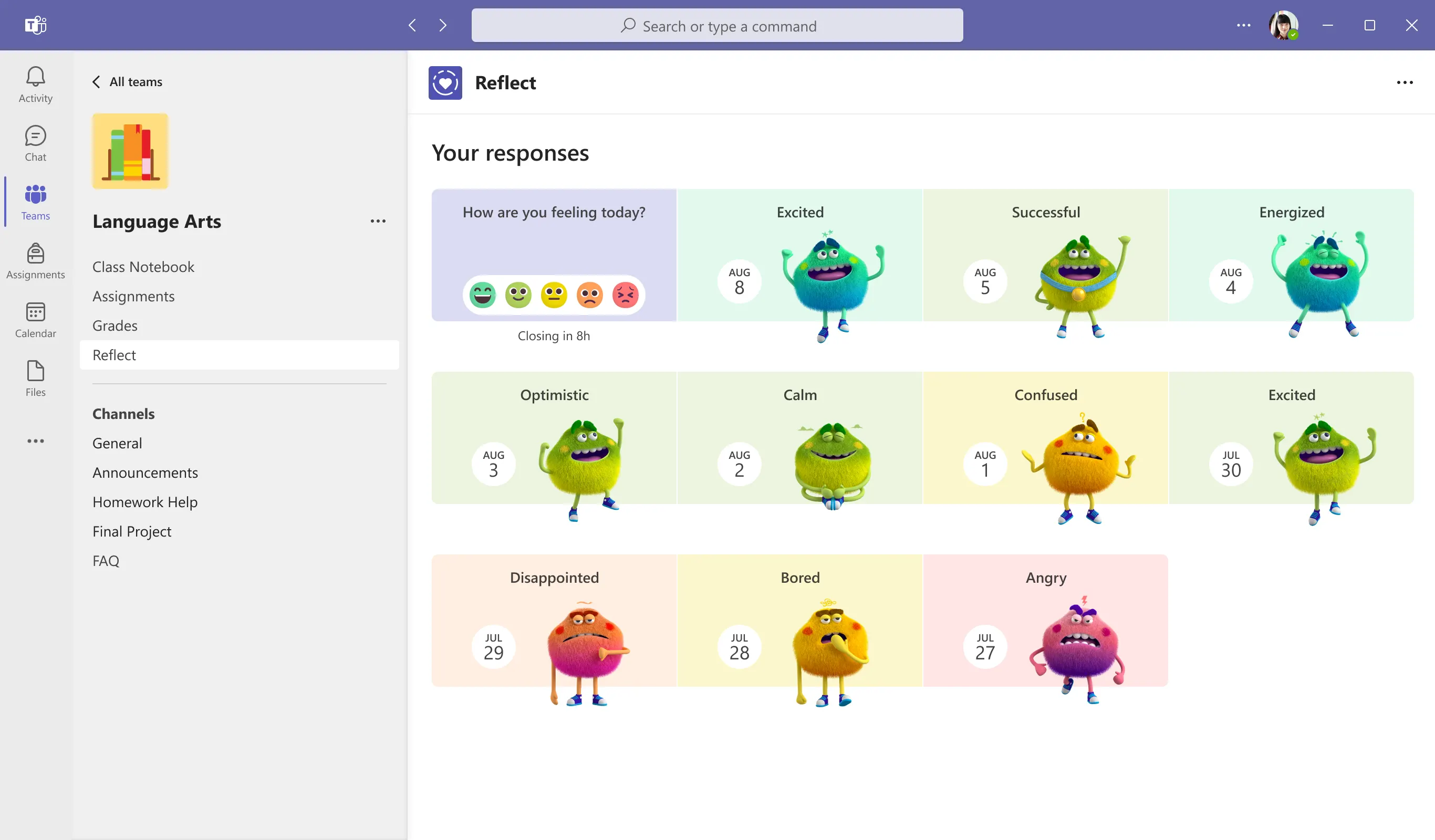
Reflect in Microsoft Teams for Education is built directly into the digital learning hub that unites assessments, communication, and collaboration. To help students visualize their feelings, there are “Feelings Monsters” that depict more than 50 emotions. Students can use these to understand their emotions and communicate with their teachers. And in addition to helping students name different moods, these visualizations also help start conversations about what causes pleasant and unpleasant feelings, how they affect learning, and how to navigate them. 

Individual emotions can be infectious and can drive the tone in a classroom, which can change as moods shift, similar to an ever-changing “thermostat.” Educators can use Reflect to gain information that helps them guide the tone of their class, and turn the energy up or down. With regular check-ins, teachers can respect and respond to the unique emotional lives of their students. Helping young people have insights into their emotional state can lead to increases in student leadership skills, student voice, and greater agency.5
Comparing well-being check-in tools 

To evaluate the ease-of-use and effectiveness of Reflect check-ins, the authors of “Prioritizing and Supporting Student Well-being” reviewed the process for educators to create a Reflect check-in. The authors also reviewed the process for students to respond, and for either students or educators to review responses in Teams. Next, they evaluated the equivalent Google Classroom solutions. And since Google does not have a built-in well-being tool similar to Reflect, the authors reviewed the process over two applications: Google Forms and Google Classroom. (Note: Google does not have a comparable tool that provides well-being data to educators or students as Reflect and Insights does.)

The results of the review were clear. They showed that Microsoft Reflect was more effective, easier to use, and a more comprehensive tool for checking in on student well-being, helping students understand and express their emotions and providing educators with clear and actionable analysis of aggregated results. With built-in applications like Reflect, educators can better understand the needs of all students, review data to inform decision-making, and help students improve their academic performance.

Want to learn more about how Microsoft 365 Education solutions can assist educators with understanding students’ well-being? Read “Prioritizing and Supporting Student Well-being” and be sure to check out the other papers in the series so far:

The next paper in the series will highlight read-aloud applications that support literacy, so look for that coming soon!


1 The Nature of Learning, Using Research to Inspire Practice | OECD

2 7th Annual Educator Confidence Report | Houghton Mifflin Harcourt

3 How to Sell SEL | Thomas B. Fordham Institute

4 What Does the Research Say? | CASEL

5 When Social Emotional Learning is Misused | Education Week