Posted on Leave a comment

The power and promise of digital healthcare in the Middle East and Africa

Mirembe, 24, lives in a rural village in north-east Uganda, where access to healthcare is limited. Mirembe is pregnant and walks, cradling her swollen belly and fanning herself from the heat, 15 kilometres to the closest clinic to check on her unborn child.

Hundreds of expectant mothers, elderly men and women, and sickly children line the corridors of the clinic patiently awaiting medical attention. Midwives and nurses are few, and they wearily dart from patient to patient doing what they can to help. Mirembe will wait six hours to be attended to.

When she’s finally seen, she’s told the clinic doesn’t have an ultrasound machine. If she wants to have an ultrasound, she must travel to the Mulago Hospital in Kampala, Uganda’s largest public hospital, where she must pay 20,000 Ugandan shillings, equivalent to about US$5, for a prenatal visit. In this part of the world, that is a significant amount of money.

According to the World Health Organisation (WHO), about 830 women die from pregnancy or childbirth-related complications around the world every day. It’s estimated that in 2015, roughly 303 000 women died during and after pregnancy and childbirth. Many of these deaths were in low-resource locations like Uganda, and most could have been prevented.

However, technology is helping to eliminate some of the challenges of distance and lack of trained medical staff. Mirembe can now hear her unborn child’s heartbeat from the comfort of her own home through an innovative app call WinSenga, which reassures her that both she and her baby are healthy.

WinSenga is a mobile tool, supported by Microsoft technologies, which helps mothers with prenatal care. The idea was conceived when the Microsoft Imagine Cup competition inspired then-university students Okello and Aaron Tushabe to use their computer science skills to tackle some of Africa’s biggest problems. They were motivated by the plight of mothers like Mirembe who live outside the reach of modern medical care.

The handheld device scans the womb of a pregnant woman and reports foetal weight, position, breathing patterns, gestational age, and heart rate. The app makes use of a trumpet-shaped device and a microphone which transmits the data to a smart phone. The mobile application plays the part of the nurse’s ear and recommends a course of action. The analysis and recommendations are uploaded to the cloud and can be accessed by a doctor anywhere.

man touching a smart tablet

This is just one example of how Africa, a continent that bears one-quarter of the global disease burden but only has two percent of the world’s doctors, could outperform developed nations’ healthcare systems by leapfrogging over inefficiencies and legacy infrastructure.

In fact, digital healthcare in the Middle East and Africa (MEA) region is booming with the proliferation of disruptive solutions underpinned by 21st century innovations like cloud, mobile, Internet of Things (IoT) and Artificial Intelligence (AI).

Let’s talk telemedicine

One trend revolutionising the delivery of healthcare in MEA is telemedicine, which is the use of telecommunication and IT to provide clinical healthcare over long distances. Given the region’s high rate of mobile penetration, telemedicine is growing rapidly. In fact, the telemedicine market in MEA was estimated at $2.19 billion in 2015 and is projected to reach $3.67 billion in 2020.

Forward-thinking countries like Botswana are making swift progress when it comes to the implementation of sustainable telemedicine projects.  Microsoft and the Botswana Innovation Hub launched Africa’s first telemedicine service over TV white spaces in 2017. Through this initiative, clinics in outlying areas of Botswana can now access specialised care remotely using TV white spaces, which are unused broadcasting frequencies in the wireless spectrum.

Posted on Leave a comment

The power of machine learning to change—and maybe even save—the world

In the last two decades, the impact of artificial intelligence (AI) has grown from a very small community of data scientists to something that is woven into many people’s daily lives. Machine learning, computer vision, and other AI disciplines—supported by the cloud—are helping people achieve more, from mundane tasks, like avoiding a traffic jam, to revolutionary breakthroughs, like curing cancer.

Over the past year, Microsoft has been on a journey to apply these transformative technologies to the world’s biggest environmental challenges. On July 12, 2017, Microsoft launched AI for Earth as a $2 million program in London, with a goal of providing AI and cloud tools to researchers working on the frontlines of environmental challenges in the areas of agriculture, water, biodiversity, and climate change.

Since that time, AI for Earth has grown into a $50 million over five-year program, with 112 grantees in 27 countries and seven featured projects. People are using machine learning and computer vision to learn more than previously possible about our planet and how it’s changing, and increasingly using these insights to chart a better future.

These are big goals, but we’re confident in our ability to get there because we know how advanced our tools like machine learning and computer vision already are. Consider machine learning. We have come a long way from the simple pattern-matching of ELIZA. Fifteen years ago, when I got my degree in artificial intelligence, problems like facial recognition, machine translation, and speech recognition were dreams of the field, and now they are solved problems. Among other things, machine learning can group similar items together, detect unusual occurrences, and construct mathematical models of historical data to make future predictions.

These techniques are incredibly helpful for sorting through large amounts of data. Today, we’re excited to share a new story about the power of this technology that also helps answer a basic question: what is the value of AI when we don’t have massive amounts of data already waiting to be processed? This is an issue for many individuals and organizations working in the field of biodiversity, especially when the species are very small, travel great distances, and are hidden from public view.

That’s precisely the challenge we set out to address recently at the most magical place in the world – Walt Disney World Resort. Purple martins are yearly visitors to Disney, nesting at the park before returning their journey to the Brazilian Amazon. Disney scientists have been working with the purple martin community and have provided homes for the families for the past 20 years, studying the conservation of the species with more than 170 nests each year. Despite their annual visits, there is still lots to be learned about nesting behavior of these birds, in part because they nest in enclosed structures known as gourds. Some of what is known is troubling – the species is in decline, with an estimated population drop of 40 percent since 1966.

How do you close this data gap quickly to better understand the species to protect their future? Enter AI. Tiny connected homes, including cameras and cloud-connected sensors were installed, and those combined with computer vision began to deliver data on behaviors that were infrequently observed, like hatching, the caring for and growth of purple martins. External factors, like temperature, humidity, and air pressure were also recorded. Disney and Microsoft hope to expand this work, and AI will help pull all this data together to deliver insights in hopes of inspiring the next generation of conservationists to protect the purple martins for the future.

While this is our newest story, this work is happening across the world. We’re proud to support AI-enabled solutions for biodiversity, including:

PAWS: Machine learning to predict poaching. Spearheaded by a team of researchers at USC, an AI for Earth partner, with additional work being done by a member of the team now at Carnegie Mellon University, an AI for Earth grantee, the Protection Assistant for Wildlife Security (PAWS) processes data about previous poaching activities in an area and creates optimized routes for rangers to patrol based on where poaching is most likely to occur. These routes are also randomized to keep poachers from learning and adapting to patrol patterns. Currently, the PAWS algorithm is being improved so that it can incorporate new information that rangers see while on patrol—such as human footprints—to alter the proposed patrol route in real-time.

Access to ranger patrol data is key. That’s why PAWS partnered with the Uganda Wildlife Authority at Queen Elizabeth National Park. They had collected 14 years of patrol data and more than 125,000 observations on animal sightings, snares, animal remains, and other signs of poaching. PAWS is now being used in several parks, and the system has led to more observations of poacher activities per kilometer than were possible without technology.

Wildbook: Machine learning and computer vision to identify species. One of our newest featured projects, Wild Me, is showing what is possible by pushing the limits of computer vision, with an AI tool that smartly identifies, captions, and moderates pictures. Researchers often have little meaningful data on species. But computer vision makes it possible to tap into an explosion of images, available for free or at a low cost from camera traps, drones, professional photographers, safari-goers, and citizen scientists. Wild Me is not only using computer vision to identify images of zebras, for example, but is also identifying the individual animals in photos—helping to address a fundamental problem in conservation. If we can identify individual animals, then this eliminates the need for physically tagging them, which can harm the animal.

This new data on animals then goes into Wildbook, the platform developed by Wild Me. Using machine learning, it’s possible to either match an animal within the database or determine that the individual is new. Once an animal is identified, it can be tracked in other photographs. Wildbook stores information about the animals, such as their location at a specific time, in a fully developed database. This combination of AI tools and human ingenuity makes it possible to connect information about sightings with additional relevant data, enabling new science, conservation, and education at unprecedented scales and resolution. With a much more detailed and useful picture of what is happening, researchers and other decision-makers are able to implement new, more effective conservation strategies.

We see incredible potential and tremendous progress in our grantees’ work and in the explosive pace at which new algorithms are being built, refined, and made publicly available. And these are just a few of the grantees, featured projects, and partners we’re working with in the area of biodiversity; there’s equally exciting work in water, agriculture, and climate change that we look forward to sharing in the near future on this blog. Check out the amazing organizations and individuals we’re supporting, apply for a grant to join us or our new partnership with National Geographic Society, or just follow our progress on Twitter by following @Microsoft_Green, or me at @jennifermarsman.

Tags: , , ,

Posted on Leave a comment

Microsoft announces the public preview of Windows 10 IoT Core Services

Woman holding a Windows IoT device

The Internet of Things (IoT) is transforming how businesses gather and use data to develop competitive insights and create new financial opportunities. As IoT technology matures and our partners gain more experience, they are evolving their business models to increase the overall return on investment of their IoT solutions. This includes adding recurring revenue, enhancing security, and reducing support costs.

At Computex a few weeks back, we announced Windows 10 IoT Core Services, which enables our IoT partners to commercialize their solutions running on Windows 10 IoT Core. We are now excited to announce the public preview of this service along with details on purchasing and pricing. As described in our previous blog, IoT Core Services provides 10 years of operating system support along with services to manage device updates and assess device health.

Windows 10 IoT Core Services helps our partners monetize their solutions by creating a business model that provides ongoing long-term value. IoT devices are often in service for many years, so device support costs are important considerations that are either included in the initial purchase cost or often paid over time through a service contract. Windows 10 IoT Core Services provides our partners with the ability to distribute maintenance costs over the life of the device while also giving them tools to streamline and reduce maintenance overhead. This service can be purchased up front with a device or through a recurring subscription and provides 10 years of operating system support, including updates for security and reliability.

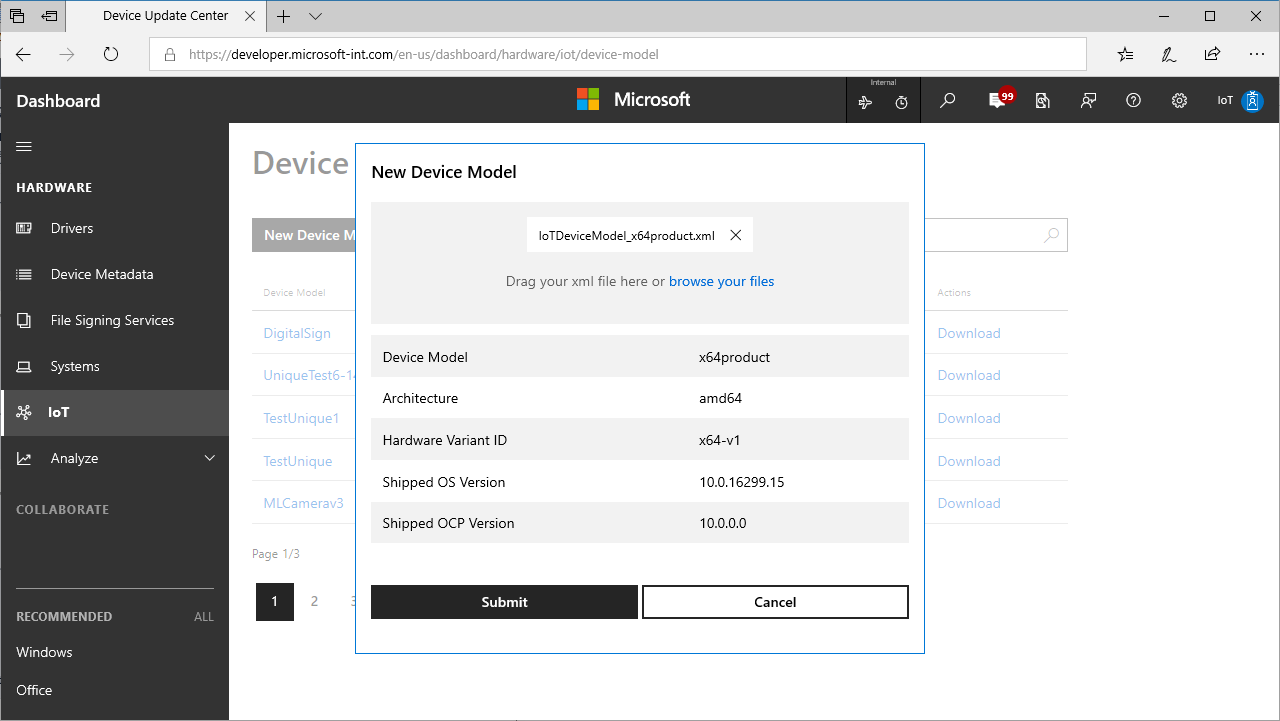
Device Update Center is part of the Windows Hardware Device Center and is used to create, control, and distribute device updates for the OS, custom apps, drivers, and other files. The steps to register a new Windows 10 IoT Core device are described in the Device Update Center User Guide. Entries can be created in Device Update Center for each unique device model as shown below.

Device Update Center

Device Update Center

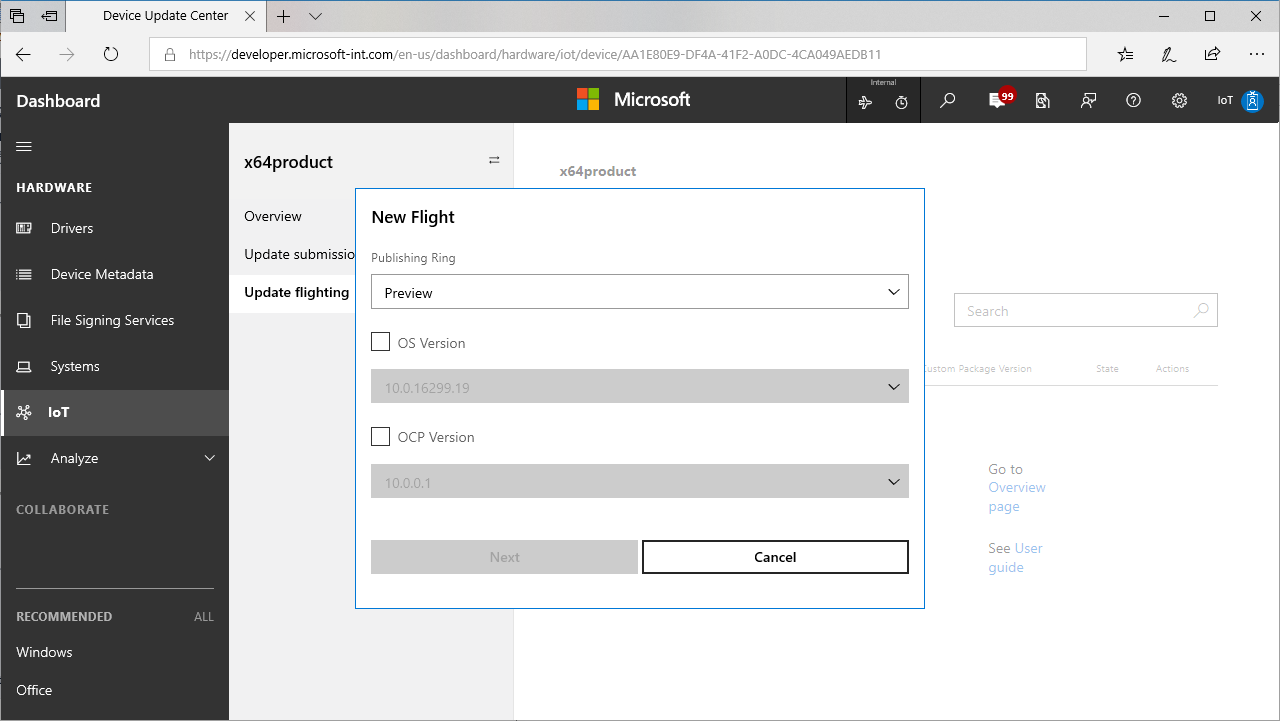
OS updates and custom updates (apps, drivers and files) are delivered through the same content distribution network that is used daily by hundreds of millions of Windows users around the world. Updates can be flighted in three distinct rings – Preview (test devices), Early Adopter (self-host devices) and General Availability (production devices) to have a controlled roll-out process where new changes can be validated with smaller sets of devices before broader deployment.

Flight 2

In addition to long-term support and device update control, Windows 10 IoT Core Services includes rights to commercialize with Device Health Attestation. This cloud-based service evaluates device health and can integrate with a device management system to improve the security of an IoT solution. These features give our partners the foundation to build sustainable business models based on Windows 10 IoT Core.

The Windows 10 IoT Core operating system remains royalty-free. Windows 10 IoT Core Services is a paid offering that can easily be added depending on the scenario.

  • Businesses and solution integrators can purchase IoT Core Services through an Azure subscription. The subscription price will be $0.30 per device per month when the product releases later this fall. During the preview period, the price is $0.15 per device per month.
  • Partners enrolled in our Cloud Solution Provider (CSP) program will be able to resell the service and establish ongoing relationships with their customers. They can sell a flexible, pay-as-you-go subscription as needed to meet device requirements. This option will be available later in the year.
  • OEMs can license the service with a device by pre-paying for the service. This option will be available later in the year.

Microsoft is committed to offerings to help our partners provide compelling solutions and achieve their business goals. Along with our recently announced support for NXP silicon platforms, long-term support, and the Windows AI Platform, Windows 10 IoT Core Services is another step in meeting our partners’ needs.

To learn more about developing with Windows 10 IoT, enroll in our Early Adopter Program at EEAPIOTPartner@microsoft.com and to learn more about Windows 10 IoT Services, see the technical details at the Windows IoT Core Dev Center.

Posted on Leave a comment

Why Surface Pro is the only device that can keep up with 2 UK motorbike makers

Combining that equipment with the knowledge and skills that come with years of working with aluminium means the brothers can create bikes that are likely to be in high demand for decades to come.

“Everything in here is aluminium, as it’s always considered to be the go-to material,” Bujar points out. “However, it’s a lot harder to work with, and welding is almost impossible, so you need a lot of skill. On the other hand, using aluminium rubber-stamps the quality. For example, Ferrari only made 99 versions of its 1964 275 coupe in aluminium and they now sell for four times the price of a regular model. In 10 years’ time a new bike made out of steel might start rusting, but you can leave our aluminium bikes for 30 years and they will stay exactly the same. It’s not going to look out of date.”

Bujar and his brother decided to manufacture the bikes themselves after failing to find anyone who could copy their designs in aluminium: “We were only approached by old guys who used to do this back in the day. They thought they might be able to do it but not the way we wanted. They couldn’t think in terms of surfaces, only in moulds.”

This was a line in the sand for them. The pair were adamant they needed specific designs to cope with the levels of downforce and lift their fast bikes would create – problems that manufacturers didn’t have to worry about several decades ago, when bikes were much heavier and slower.

Unable to find anyone who could bring their visions to life, the pair picked up their tools and got to work.

Posted on Leave a comment

Xbox is coming to gamescom next month in Cologne; here’s what to plan for

It’s a great time to be an Xbox gamer! Hot on the heels of our record-breaking E3 briefing, and the amazing reaction we’ve had from our fans, we’re excited to let you know that Xbox will be coming to gamescom in Cologne, Germany this August. We’ll be bringing a great line up of games from developers around the world that we can’t wait for gamers in Europe to get their hands on.

Here’s a quick overview of what we’ll be getting up to at the show this year:

Inside Xbox

This year at gamescom, we will be hosting a special episode of Inside Xbox, broadcast live from our Xbox booth in the Koelnmesse. Tune in on Tuesday, August 21, at 4:30 p.m. CEST (7:30 a.m. PDT) for lots of news, new Xbox One bundles and accessories, and features on upcoming titles that we can’t wait to tell you more about and perhaps even a few surprises!

You can catch the show on xbox.comMixerTwitchYouTubeFacebook, and Twitter.

Xbox FanFest: gamescom 2018

Xbox FanFest will return to gamescom once again this year, this year on the Rhein River! FanFest will happen for one incredible night on Thursday, August 23.  More information on tickets and all the special activities happening on this day will be revealed very soon.   Be sure to track #XboxFanFest for all updates.

Xbox Booth

The Xbox booth will feature a fantastic line up of 25 games across a diverse range of genres – we’ll be making sure everyone has a way to play and have fun! If you’re coming to the show, do make sure you pay us a visit – we’re in Hall 8 of the Koelnmesse (North entrance).

This is the first time that European gamers will have the chance to jump in and try out many of our newest gameplay experiences including the open world freedom of driving through stunning beautiful historic Britain in Forza Horizon 4 or embarking on a journey to unravel Ori’s true destiny in this emotionally engaging, hand-crafted, story-driven adventure in Ori and the Will of the Wisps. Gamers will also have the opportunity to get the first ever hands-on with State of Decay 2’s Daybreak Pack, an all-new mode set to release in September.

And you won’t want to miss the PlayerUnknown’s Battlegrounds experience, featuring a new mode for Xbox One, playable for the first time at gamescom – and only in the Xbox booth.

Mixer Booth

Microsoft’s livestreaming service Mixer will also be at gamescom, located right next to the Xbox booth in Hall 8, where they will be bringing back the always popular HypeZone LIVE experience! Attendees will have the chance to earn victory in battle royale matches and even walk away with big prizes, while everyone at home can watch the turmoil unfold.  Get a head start on the competition by watching some HypeZone action on Mixer.com now.

Visit the Xbox Official Gear Shop

Making our European debut and in partnership with Game Legends, come and visit the Xbox Official Gear Shop in the Gamescom fanshop arena. Fly your gaming colors and show off your fandom for Xbox and award-winning franchises like Halo, PUBG, and Gears of War with all new apparel and collectibles. We will have more information on this exciting new initiative over the coming weeks.

Show opening times are as follows:

  • Tuesday, August 21 – 9:00 a.m. until 7:00 p.m. CEST (press/trade only day)
  • Wednesday, August 22 – 9:00 a.m. to 8:00 p.m. CEST
  • Thursday, August 23 – 9:00 a.m. – 8:00 p.m. CEST
  • Friday, August 24 – 9:00 a.m. – 8:00 p.m. CEST
  • Saturday, August 25 – 9:00 a.m. – 8:00 p.m. CEST

Remember to keep your eyes on Xbox social channels all gamescom week for the latest – Mixer, Facebook, Twitter – we’ll keep you updated with all the great activity happening from the show. Can’t wait to see you there!

Posted on Leave a comment

Why Microsoft and National Geographic Society are working together to advance conservation science with computer science

Camper sitting at creek with night sky above
Photograph by Devlin Gandy/National Geographic

By Dr. Jonathan Baillie, chief scientist at National Geographic Society, and Dr. Lucas Joppa, chief environmental scientist at Microsoft

Yesterday, Microsoft and National Geographic Society announced a new, joint grant program that will equip explorers working on the most challenging environmental issues of the 21st century with the most advanced technologies available today. “AI for Earth Innovation” grants will fund new solutions that leverage AI and cloud technologies to monitor, model and manage Earth’s natural resources. Application forms are available today, here, to anyone working at the intersection of computer science and environmental science, especially in the areas of agriculture, biodiversity, climate change and water.

As scientists that have spent our entire respective careers focused on conservation, we’ve come to believe that increased adoption of technology, including AI, is critical to make the progress needed – and at the pace needed – to protect our planet. From producing the foundational estimates on how rapidly species are going extinct to determining the effectiveness of our current conservation efforts, we realized that progress was slow or impossible without deploying scalable technology solutions.

There have been some notable success stories – including those we featured in a book we jointly published on the role of protected areas in conservation. But they are, frustratingly, the exception to the rule.

Now, in our roles as chief scientists at global organizations (for science and exploration and innovative technology, respectively), we hope to solve the root cause of that frustration. That is the goal of this partnership, and why Microsoft and National Geographic Society are bringing $1 million and access to our experts and technology together in this new partnership.

While different, both organizations are focused on pushing the boundaries of science and exploration for the benefit of the planet. National Geographic is synonymous with science and exploration. For 130 years, the organization has opened minds to the natural world, challenged perceptions of what is possible and set the stage for future exploration. For more than 35 years, Microsoft, too, has explored and pushed forward the boundaries of what technology can do, and what it can do for people and the world.

Our organizations have a unique combination of expertise in conservation and computer science, capacity building and public engagement, providing incredible potential to drive fundamental change. We will work together to empower people everywhere to respond to some of the most challenging environmental issues of the 21st century.

We realize that to some, it may seem counterintuitive to try to protect the planet with technology. It’s true that past industrial revolutions and technology development has directly contributed to our current climate crisis. Certainly, we recognize it’s not a panacea. But we’re fundamentally optimistic, because over the course of human history, every solution to a major societal challenge has been the result of human ingenuity and new technologies. It’s been the combination of scientific exploration and technological advances that has fueled new discoveries and led to major breakthroughs in our understanding of the planet and life on Earth. It’s as true today as it was when National Geographic Explorer Bob Ballard discovered new forms of life at the bottom of the ocean using then-cutting edge underwater remotely operated vehicle (ROV) technology.

Lately, innovation in technology has far outpaced anything imaginable before, but scientific knowledge isn’t keeping pace. We have often imagined a future where that is no longer the case, and our individual organizations have worked tirelessly to change this, too.

By partnering, we’re ready to move from imagining to enabling. With AI and the cloud, researchers can stay focused on new discoveries, rather than data collection and sorting. Their findings can more easily be shared with other researchers around the world, creating new economies of scale that accelerate and improve the state of conservation science in near-real time.

While there are only a handful of grants, the program is structured to provide exponential impact. By ensuring that all models supported through this grant follow an open source approach and are publicly available, we will allow environmental researchers and innovators around the globe to take advantage of these new innovations immediately and directly in their own vital work.

For the health of our planet and our future, we all need to get back to nature with the help of technology. Microsoft and National Geographic are ready to put our tools and skills to work for researchers working to make that more sustainable future a reality. Come join us!

Tags: ,

Posted on Leave a comment

Sea of Thieves ‘Cursed Sails’ free update to unleash skeleton ships on July 31

At last month’s E3 we gave players a tease of the upcoming Sea of Thieves content updates that we have planned for the summer. We’re thrilled to announce that the first of these summer updates – Cursed Sails – will be available for free to all Sea of Thieves players from July 31.

New Content To Include Skeleton Ship AI Enemies and the Brigantine Ship Designed For Three-Player Crews

As part of our ongoing commitment to deliver new Sea of Thieves content throughout the year, Cursed Sails will offer our biggest update yet at no charge for those who own the game or access it through Xbox Game Pass. Players will now be able to battle terrifying new skeleton ships, set sail in the new three-player Brigantine ship and form Alliances with other players to take on bigger challenges and share greater rewards.

Sea of Thieves Cursed Sails Skeleton Ship

Sea of Thieves Cursed Sails Skeleton Ship

This permanent new content will be introduced into the game through a special time-limited campaign, Cursed Sails. Offering players a range of unique rewards, this three-week campaign will see skeleton ships terrorise outposts and challenge pirates to do battle on the seas. A story-driven side quest will also allow players to investigate the source of the skeleton scourge. For a taste of what’s to come, watch our new trailer above.

This Cursed Sails campaign and content update will be available free and without charge to all Sea of Thieves players who have bought the game across the Xbox One family of devices or on Windows 10 PC, or who have access to it as part of Xbox Game Pass. Once it goes live from July 31, simply download and install the latest Sea of Thieves update to get access. And don’t worry, if you’re unable to take part in the time-limited campaign, all the features introduced with this campaign will remain in the Sea of Thieves world for everyone to see and experience.

New to Sea of Thieves? Join over four million players at xbox.com/seaofthieves, and visit the Sea of Thieves website at SeaofThieves.com to embark with the community. See you out on the seas.

Posted on Leave a comment

VentureBeat: ‘Microsoft’s AI for Earth Innovation Grant gives data scientists access to AI tools’

Microsoft and National Geographic are teaming up to support data scientists who are tackling the “world’s biggest challenges.” The two companies today announced the AI for Earth Innovation Grant program, a $1 million grant that’ll provide recipients financial assistance, access to AI tools and cloud services, and more to advance conservation research.

The grant program, which is accepting applications until October 8, will support between five and 15 projects in five core areas: agriculture, biodiversity, conservation, climate change, and water. In addition to funding, researchers will gain access to Microsoft’s AI platform and development tools, inclusion in the National Geographic Explorer community, and affiliation with National Geographic Labs, National Geographic’s research incubation and accelerator initiative.

“[I]n Microsoft, we found a partner that is well-positioned to accelerate the pace of scientific research and new solutions to protect our natural world,” Jonathan Baillie, chief scientist and executive vice president at the National Geographic Society, said in a statement. “With today’s announcement, we will enable outstanding explorers seeking solutions for a sustainable future with the cloud and AI technologies that can quickly improve the speed, scope, and scale of their work, as well as support National Geographic Labs’ activities around technology and innovation for a planet in balance.”

The aim is to make trained algorithms broadly available to the global community of environmental researchers, Lucas Joppa, Microsoft’s chief environmental scientist, said in a press release.

“Microsoft is constantly exploring the boundaries of what technology can do, and what it can do for people and the world,” Joppa said. “We believe that humans and computers, working together through AI, can change the way that society monitors, models, and manages Earth’s natural systems. We believe this because we’ve seen it — we’re constantly amazed by the advances our AI for Earth collaborators have made over the past months. Scaling this through National Geographic’s … network will create a whole new generation of explorers who use AI to create a more sustainable future for the planet and everyone on it.”

Selected recipients will be announced in December.

The AI for Earth Innovation Grant is an expansion of Microsoft’s AI for Earth program, announced in June 2017. In December, the Redmond company committed $50 million to an “extended strategic plan” that includes providing advanced training to universities and NGOs and the formation of a “multi-disciplinary” team of AI and sustainability experts.

Microsoft claims that in the past two years, the AI for Earth program has awarded more than 35 grants globally for access to its Azure platform and AI technologies.

Posted on Leave a comment

Lilly strives to speed innovation with help from Microsoft 365 Enterprise


Profile picture of Ron Markezich.The nearly 40,000 employees of Eli Lilly and Company are on a mission to make medicines that help people live longer, healthier, and more active lives. But they know that developing new treatments for cancer, diabetes, and other debilitating diseases requires collaboration with the best minds working together to foster innovation.

That’s why Lilly takes a collaborative approach to discovering and developing new medicines—between lab researchers and the rest of the company—as well as with a global network of physicians, medical researchers, and healthcare organizations. Working together—creatively and efficiently—can help generate new ideas that fuel innovation. To bring together scientists across hundreds of locations and organizations and truly empower the workforce, Lilly selected Microsoft 365 Enterprise.

While Lilly is in the early stage of deployment, these cloud-based collaboration tools, including Microsoft Teams, are making an impact. Mike Meadows, vice president and chief technology officer at Lilly, says that the technology will allow for enhanced productivity and teamwork, while helping to protect IP:

“Collaboration tools like Microsoft Teams enhance our ability for researchers and other employees to work together in faster and more creative ways, advancing our promise to make life better through innovative medicines. Microsoft 365 helps us bring the best minds together while keeping data secure and addressing regulatory compliance requirements.”

Like enterprise customers across the globe, Lilly sees Microsoft 365 as a robust, intelligent productivity and collaboration solution that empowers employees to be creative and work together. And when deployment of Windows 10 is complete, employees across the company will advance a new culture of work where creative collaboration that sparks critical thinking and innovation happens anywhere, anytime.

At Microsoft, we’re humbled to play a role in helping Lilly make life better for people around the world.

—Ron Markezich

Posted on Leave a comment

Bloomberg: ‘How Amy Hood won back Wall Street and helped reboot Microsoft’

Terms of Service Violation

Your usage has been flagged as a violation of our terms of service.

For inquiries related to this message please contact support. For sales inquiries, please visit http://www.bloomberg.com/professional/request-demo

If you believe this to be in error, please confirm below that you are not a robot by clicking “I’m not a robot” below.

Please make sure your browser supports JavaScript and cookies and that you are not blocking them from loading. For more information you can review the Terms of Service and Cookie Policy.

Block reference ID: