Posted on Leave a comment

Doing more with less with the Microsoft Cloud

The following is an excerpt from my remarks at Microsoft Ignite this morning.

We are living through a period of historic economic, societal, and technological change, but for all the uncertainty we continue to see in the world one thing is clear: Organizations in every industry are turning to you and your digital capability to help them do more with less, so they can navigate this change and emerge much stronger.

You are the change agents who make doing more with less possible – less time, less cost, and less complexity, but with more innovation, more agility, and more resilience. Doing more with less doesn’t mean working harder or longer. It means applying technology to amplify what you can do and ultimately what an organization can achieve amid today’s constraints.

Over the past few years, we’ve talked extensively about digital transformation, but today we need to deliver on the digital imperative for every organization. And it all comes down to how we can help you do this with the Microsoft Cloud. No other cloud offers both best-of-category products and best-of-suite solutions.

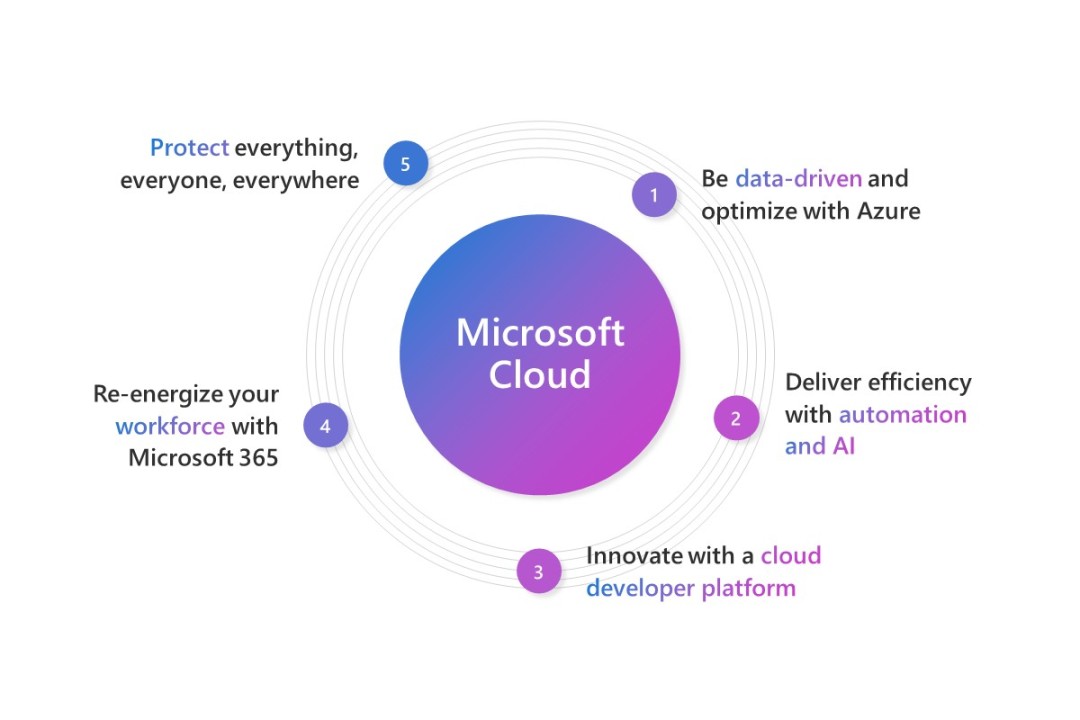
At Ignite, I walked through five key imperatives for every organization.

Be data-driven and optimize with Azure

It all starts at the infrastructure layer, and how we are helping you build agility and optimize your business with Azure. Moving to the cloud is the best way to align your IT investments to scale with demand, so that you can do more with less.

Azure is the only cloud that supports all organizations and all workloads, from enterprises to startups, to highly regulated industries. Azure is the world’s computer. We have more than 60 data center regions connected by 175,000 miles of fiber, but it doesn’t stop there. We want to help you deliver the power of Azure anywhere. That’s where Azure Arc comes in.

Azure Arc extends the Azure platform so you can build applications with Azure services that can run across on-premises, edge, and multi-cloud environments. As Kubernetes adoption takes off, you can use Arc to run containerized applications with Azure Kubernetes Service on Azure Stack HCI, Windows Server, Windows devices, and Windows IoT, enabling a consistent experience from cloud to edge. And we will enable AKS to run on even more platforms going forward.

We also want to help you modernize your infrastructure from the ground up, taking a systems-level approach, starting with compute. Our new Azure VMs with Ampere Altra ARM-based processors operate the highest clock speed of any ARM-based processor available in the cloud today and are more cost-effective and power efficient, without compromising on performance.

With new premium SSD v2 disk storage, we offer the most advanced general purpose block storage solution available, designed for performance critical workloads that consistently need sub-millisecond latency combined with high IOPS and throughput.

And with Azure Elastic SAN, we offer the industry’s first cloud-native, fully managed storage area network service. It offers massive scale and enables customers to seamlessly transition their SAN data state to the cloud without having to refactor their application architectures.

When we say the trusted computing platform for all organizations and all platforms, we mean it. Azure is the only cloud provider enabling highly-regulated industries to bring their most sensitive applications to the cloud.

Azure Confidential Computing can help you protect data while in use, thanks to enclaves that protect and isolate code and data in a Zero Trust environment so that customers can prevent even Azure as the cloud provider from gaining access. We provide the broadest and deepest set of virtual machines, containers, and services, powered by the latest confidential capable CPUs from Intel and AMD, as well as confidential GPUs from Nvidia.

And we continue to expand our Azure Confidential Computing portfolio with Confidential VM Node Pools on AKS, enabling a seamless lift and shift of Linux container workloads and Confidential VM options on both Azure Virtual Desktop and SQL on Azure VM. I was also excited to announce the preview of Azure Managed Confidential Consortium Framework, which allows developers to build, deploy and manage highly sensitive multi-party applications.

Now, let’s turn to data.

With our Microsoft Intelligent Data Platform, we provide a complete data fabric, from operational stores to analytics and data governance, so you can spend more time creating value and less time integrating and managing your data estate.

Our goal is to provide you with the most comprehensive end-to-end data platform, so you don’t have to wrestle with the complexities of building and operating cloud scale data infrastructure yourself.

Analytics alone on our Intelligent Data platform costs up to 59% less than any other cloud analytics out there. And today, we’re going even further. When it comes to our operational databases, Azure Cosmos DB will now support distributed relational data with support for native PostgreSQL. This offers the best of both worlds: the scalability and the high performance of a NoSQL, as well as the familiarity and the benefits of a relational database.

When it comes to analytics, with Azure Synapse, organizations can put their data to work much more quickly, productively, and securely, generating insights from across data sources. We offer out-of-the box link connectors for Azure SQL, Cosmos DB, and Dataverse, and we are working with many partners to deliver link connectors for even more hybrid and multi-cloud data sources.

Finally, when it comes to governance, all of these operational and analytical capabilities are fully integrated with Microsoft Purview. With Purview, organizations can scan, catalogue, lineage-trace, and configure data management and access policies across the entire data estate.

And we know this is a team sport. We are working across our entire partner ecosystem to ensure category-leading solutions are deeply integrated with everything I’ve talked about.

Deliver efficiency with automation and AI

Now, let’s talk about our second imperative: delivering efficiency with automation and AI. When it comes to doing more with less, AI is the ultimate amplifier. It’s going to change what an application looks like, what the design language of an application is, and how it gets built and gets delivered.

We are committed to making the promise of AI real for you and doing this responsibly. We have built next-generation supercomputers in Azure that are being used by us and OpenAI, as well as customers like Meta, to train some of the largest and most powerful AI models.

Azure provides almost 2x higher compute throughput per GPU and near linear scaling to thousands of GPUs, thanks to world-class networking and systems software optimization. And for inferencing, Azure is more cost effective than any other cloud, delivering 2x the performance per dollar.

In Azure, we also offer the best tools across the ML lifecycle, from data preparation to model management. Data scientists and machine learning engineers can use Azure Machine Learning to build, train, deploy, and operate large scale models at scale.

We ourselves, along with our partners, are using all of these capabilities to train state-of-the art AI models. We are seeing exponential progress in their practical capabilities and are at a real inflection point. We have trained Turing for rich language understanding, Z-code for translation across hundreds of languages, and Florence for breakthrough visual recognition.

The other massive thing we have been doing is our work with OpenAI. We have trained the GPT family of models for human-like language generation, DALL-E for realistic image generation and editing, and Codex for code generation in more than a dozen programming languages.

And, at Ignite, I talked with OpenAI co-founder and CEO Sam Altman about our work together, and how we are turning these breakthroughs into capabilities for our customers, announcing that we will bring the power of Dall-E to the Azure OpenAI Service. Sam also showed a demo of OpenAI’s latest Codex prototype:

We are bringing these advances to our first-party Microsoft services too, including the new Microsoft Designer. We fundamentally believe that AI will not only amplify what we can do but also augment our curiosity, creativity, and imagination. Designer is your personal design generator powered by AI models, including DALL-E 2. It creates new designs that the world has never seen before and that are uniquely yours.

I showed how useful this could be for a small business, for example:

Innovate with a cloud developer platform

We’re also applying these AI models to transform how people build software, which brings us to the third imperative: innovating with the most comprehensive cloud developer platform.

With GitHub Copilot, we are applying Codex to suggest code and entire functions in real time, right from your editor, turning natural language into coding suggestions. It draws context from the code you’re working on to finish the lines you start and even suggest entire functions.

Just like the rise of compilers and interpreters, we believe AI-assisted coding will fundamentally change the nature of software development, giving developers a new tool to write better code, easier and faster. Developers tell us they feel more fulfilled and less frustrated when coding, and ultimately are able to do more with less. 

We are bringing the same principles and capabilities behind Copilot to Power Platform. With Express Design and Power Apps, you can upload a hand-drawn sketch and it will be converted into a working app within seconds. It’s that easy. You can also describe what you want to do in natural language, and Power Apps will generate a list of most relevant Power FX formulas for you to choose from. The code essentially writes itself.

And, we are going even further, bringing AI-powered Copilot capabilities to Power Automate. You can describe what you want to automate, and it’ll generate suggested flows to jumpstart your Flow creation:

Reenergizing your workforce

Now, let’s turn to our next imperative: reenergizing your workforce. We are experiencing a once-in-a-lifetime change in work patterns. We’re not going back to 2019. We need to accept that and find a new path forward, and we need to directly address the lessons we have learned over the past couple of years.

Our latest Work Trend Index identifies three clear priorities for every organization: We need to stop the endless productivity paranoia. People are working more than ever, but leaders still worry employees are not getting the job done. We need to embrace data over dogma, and realign organizations around the most important work. We need to embrace that people come to the office for each other, not policy. And, as leaders, we need to re-recruit our employees. Re-recruiting doesn’t end when the job offer is accepted. Leaders must continuously help their employees learn new skills or risk losing them.

Employees must be empowered and energized to do meaningful work so that they can thrive. To do so, organizations require a new system to build human, social, and knowledge capital across the entire organization. You need to help people feel aligned to the company’s mission, purpose, and business priorities. You need to help them connect with each other, wherever they are and whenever they’re working. You need to help them continuously build new skills in the flow of work, and you need to have all these things working in harmony to have a workforce that thrives.

That’s what Microsoft 365, Microsoft Teams and Microsoft Viva enable.

With Microsoft 365, we provide a complete cloud-first experience that makes work better for today’s digitally connected, distributed workforce. Customers can save more than 60 percent, compared to a patchwork of competitive solutions. Microsoft 365 includes Teams, plus the apps you’ve always relied on – Word, Excel, PowerPoint and Outlook, as well as new apps for creation and expression, like Loop, Clipchamp, Stream, and Designer.

And it’s all built on Microsoft Graph, which makes available to you information about people, their relationships, and all their work artifacts, in one interconnected system. Thanks to the Graph, you can understand how work is changing and how your digitally distributed workforce is working.

This is so critical, and it all comes alive with the new Microsoft 365 application. It provides personalized recommendations, powered by the Graph. It brings together all your favorite productivity tools, as well as the third-party solutions you choose to add.

Now, let’s talk about Microsoft Teams. Work doesn’t happen in a vacuum. You need to be great at sync, async, in-person, as well as remote collaboration.

Teams supports all the ways people work today. It has become essential to how hundreds of millions of people meet, call, chat, collaborate, and do business. And, we’re announcing new Teams features today at Ignite to help you not only have better meetings, but to change meeting culture too.

This includes Teams Premium, which delivers advanced meeting protection so you never have to worry that your most sensitive conversations might be shared, and also Intelligent Recap, which uses AI to assign tasks during meetings and call out important moments in the recording.

The killer app, of course, for Teams is the Teams App platform, and how it has become the organizing layer for all the applications you can use to run your business. Just like mobile devices completely transformed how people consume software, we’re seeing collaborative applications in Teams transform how people work together.

Collaborative apps represent a paradigm shift in how apps are built. Instead of apps being the focal point where users go, collaborative apps bring business workflows, data, and insights to where users are. More than 1,600 third-party applications are available on the Teams app store today, and more than 100,000 companies have deployed their own custom line of business applications in Teams.

American Airlines, for example, has used Power Apps to build a collaborative application that brings together ground crews with its flight crews, in order to speed turnaround times at its gates:

When it comes to new collaboration patterns, our approach extends to where people work so you can unlock productivity wherever you are. With Teams Rooms, we’re bringing Teams to a growing ecosystem of devices and space configurations to help people stay connected and participate from anywhere.

And I’m very excited to announce that Cisco will become a Microsoft Teams Room certified device partner and will run Teams Rooms on Android natively on their room systems. The certified device portfolio will include multiple meeting devices and peripherals, with more to come.

Our approach to space extends to the metaverse, and how we’re bringing together the digital and physical worlds. We’re taking an approach to ensure that our software can benefit users on all their favorite devices. Just yesterday, we announced with Meta that we are bringing Teams immersive meeting experiences to Quest, so you can connect, share and collaborate in VR, as though you’re together in person.

And today, I was thrilled to announce the private preview of Mesh avatars in Microsoft Teams globally. Customers will be able to build their avatars in a way that reflects their identity and can represent them in meetings, giving them the flexibility and choice to be present without ever having to turn on a camera.

And, we’re not stopping there. We want to help you evolve and manage your space for both hybrid and in-person work. The hybrid workplace today is too often completely ad hoc. Leaders are being asked to rethink their real estate portfolio with limited data, and employees are being asked to go into the office, with limited understanding of why they should have to come in.

And that’s why we’re announcing Microsoft Places. We want to help you turn your space into a place. A space becomes a place when people give it meaning. Think about the importance of the Outlook calendar for orchestrating when people meet and collaborate. Places will do the same for where:

Finally, let’s talk about Microsoft Viva. When work is increasingly happening anywhere, anytime, the employee experience needs to adapt accordingly.

Viva is the first employee experience platform for hybrid work. It brings insights, connections, purpose, and growth into the flow of work to empower employees and teams to do their very best. Viva provides one system for leaders and employees to receive actionable insights and feedback, connect the entire company from the frontline to the CEO, align on an organization’s goals, and learn new skills so that they can collectively drive better business outcomes.

Just last month, we announced the availability of new capabilities that bring business goals into the flow of everyday work, making it easier to share OKRs and track progress across the organization. Think about how powerful that is: When all your objectives and key results are shared across the organization, everyone gets aligned.

Viva helps every employee excel, and we are also extending Viva with tailored solutions to meet role-specific needs. For example, Viva Sales, which became generally available last week, provides sellers with a unified view of their activities, bringing real-time CRM data directly into their customer interactions across Teams and Outlook. And we’ll have more role-specific solutions coming in the near future.

Just like we are building Teams, Viva, and Places for the new era of work, there are two other platforms that I want to talk about, and that’s Microsoft Edge and Windows.

With Edge, our mission is to build the most secure and most productive browser. Edge is the browser for business. Edge makes it easier to protect your organization’s data as well as your privacy online.

And I was very excited to introduce Edge Workspaces, a new experience which enables everyone working on a project to see the same websites and files in one place, so that they can stay on the same page. Instead of sending links over e-mail or chat, you can open an Edge workspace and access a shared set of tabs:

When it comes to Windows, we have fundamentally redesigned the operating system, from the client to the cloud, for hybrid work. Windows 11 is designed for the future of work today. From the new PCs we announced this morning, to the expansion of our cloud offerings, Windows continues to evolve to work the way you do. And with Windows 365, we are transforming how you experience Windows by bringing together the power of Windows computers with Azure computing.

Protect everything, everyone, everywhere

As the pace of threats accelerates, security is a top priority for every organization. Protecting is complex and can get expensive. Every organization experiences this: The more agile you become, the more your security teams struggle to manage risk. And the more connected we become, the faster a successful attacker can move laterally through the enterprise to their target.

For far too long, customers have been forced to adopt multiple disconnected solutions from disparate sources that don’t integrate well and leave gaps. We offer a better option, a natively integrated security solution that is supported by a vibrant partner ecosystem.

It starts with Microsoft Entra, our new vision and portfolio for identity and access. It extends to Microsoft Purview, as well as Microsoft Priva to help you manage privacy, and Microsoft Intune to protect your endpoints and manage them, and of course, Microsoft Defender and Sentinel.

You get a comprehensive solution that closes gaps and works for you at machine speed. On average, customers save more than 60% when they turn to us, compared to a multivendor solution.

Our approach extends to all clouds and all platforms, and we are investing to protect you. Today, we introduced new innovations in Defender for Cloud, including enhanced security posture management that will help you focus on the most critical risks and provide built-in multi-cloud security recommendations. The new Defender for DevOps helps you secure the entire development lifecycle in a unified DevOps security management across multiple environments.

We’re also adding automatic attack disruption to Defender to limit lateral movement and help you stop ransomware before it gets a chance to encrypt your data. And we are adding new identity governance capabilities to Entra, providing even greater control over digital identities across on-premises and the cloud so that only the right people are granted the right access to the right resources at the right time, which is so critical in a world where everything is just one login away.

 ***

I’ll end where I started. These are the digital imperatives for every organization. And what I’ve shared with you is just a snapshot of what you’ll see this week at Ignite. We’re introducing more than 100 updates across the Microsoft Cloud in order to help you do more with less.

These are your building blocks. Ultimately, it all comes down to the outcomes you drive with these platforms and tools, and how you’re able to use them to transform your company, your industry, and the world.

Posted on Leave a comment

Haleon harnesses Microsoft’s Seeing AI technology to make health product information more accessible

For Marc Powell, a seemingly simple trip to the store to buy medication or other consumer health products is often an onerous, complicated undertaking.

Powell, who is blind, usually must ask a store employee to help find what he needs and then read the information on the packaging to him, which can feel intrusive. At home he’ll ask his partner, who has partial sight, for help, but the print is sometimes too small for her to read. In a pinch, he’ll scour the internet or wait until a family member stops by and can read aloud to him the information he needs.

“I’m incredibly reliant on somebody else to let me know about the product — what I’m meant to do with it, how many tablets I can take or what it contains,” says Powell, the accessibility innovation lead for the U.K.-based Royal National Institute of Blind People (RNIB), who lives in Cambridge, England. “It’s crazy to say that, isn’t it?”

Head and shoulders portrait of Marc Powell, accessibility innovation lead for the U.K.-based RNIB.
Marc Powell.

A new collaboration between Microsoft and global consumer health company Haleon aims to make health product information more accessible for people who are blind or have partial vision, or individuals with low literacy. The companies worked together to expand the functionality of Microsoft’s Seeing AI app to provide detailed audio information for more than 1,500 Haleon products in the U.S. and the U.K., including brands such as Centrum, Sensodyne and Emergen-C. The initiative was launched in recognition of World Sight Day Oct. 13.

Using Seeing AI, users can now scan the bar code on Haleon products and hear the same information that is provided on the packaging, such as the product name, usage instructions and ingredients. When users point a phone at a Haleon product, the Seeing AI app guides them to the bar code with a series of intensifying beeps. After scanning the code, users can navigate between sections to get the specific information they want, a feature that has been well-received by partially sighted people who tried out the functionality before its launch.

“We have had great feedback from people who are blind and have low vision,” says Tamara Rogers, global chief marketing officer at Haleon. “They really value the increased independence that comes from being empowered to access our product information themselves.”

Black and white head shot of Tamara Rogers, chief marketing officer for Haleon.
Tamara Rogers.

The new functionality was developed not just for people who are blind or have low vision, but also for those who have literacy challenges, Rogers says. “There’s a classic health industry saying which is, ‘Always read the label, always read the instructions,’ and for some, that just isn’t possible,” she says.

“This initiative will make Haleon products more accessible to people who are blind or have low vision. It will also provide more independence to people with low literacy levels. This is a great way of being able to communicate in a different way, audibly, rather than asking people to read.”

Launched in 2017, Microsoft’s Seeing AI application is an AI camera-based app that can read text such as documents or signs, describe scenes, recognize currency and even identify friends. Available in 19 languages, the app has become a multipurpose tool that is helping people who are blind or have low vision navigate their daily lives. The newly enhanced functionality helps consumers in the U.S. and U.K. read packaging details in English. Previously, there wasn’t an easy way for Seeing AI to read detailed information on packaging without a user moving a camera around the text.

The collaboration with Haleon “is really important and exciting, because Seeing AI has always been able to recognize products, but the challenge has been having access to data that is really rich, and that comes from the manufacturer,” says Saqib Shaikh, an engineering manager at Microsoft who led the team that developed Seeing AI.

“Now you can just scan the barcode and hear exactly what was written on the package. It’s directly what the manufacturer wanted you to hear. The information is really accurate, and you’re getting it all in one place. You’re not having to scan all the different sides of the package to find the bits you want. It’s all right there once you’ve scanned the barcode.

“Now you can give more information, and trustworthy information,” Shaikh says. “Haleon is leading the way in doing this.”

Shaikh hopes more companies will follow Haleon’s lead and use technology to provide audio information for people who are blind or who have low vision, or those with literacy challenges. Doing so could provide important information not just for health products, he says, but for food items and countless other things people use in their daily lives.

“I’d love to make every product out there accessible so you can just scan it, whether by bar code or some other future technology, and know what it is,” he says. “This data is out there. It’s just that all the data’s in siloes. What we were able to do here was, by the companies having the will, to break down these siloes.”

Close-up of hands holding a box of Centrum in one hand and a phone showing the Seeing AI app in the other.
Using the Seeing AI app, detailed audio information will be available for detailed audio information for more than 1,500 Haleon products in the U.S. and the U.K.

More than 3 million people in the United States and more than 2 million in the U.K. are living with sight loss, and millions more struggle with poor literacy. A study commissioned by Haleon found that 93 percent of respondents didn’t think health products were accessible enough, and almost one in five said they had taken an incorrect dosage of a product because they couldn’t read the packaging.

Haleon saw technology as a tool to address those issues, Rogers says, but wanted to build on an existing platform rather than creating new technology that people who are blind or have low vision would need to adopt. Haleon approached Microsoft about using the Seeing AI app to create audio guides for its products, and the two companies worked closely together to build out the new functionality for Haleon’s bar codes. Microsoft developed an end-to-end pipeline that allows Haleon to control the data for its consumer products, which is stored in Azure, and update information or add new items as needed.

Powell says to his knowledge, Haleon — a spinoff of GlaxoSmithKline created in July 2022 to focus on consumer health products — is the first consumer health company to provide accessible information through Seeing AI for its products.

“I think this will be really useful,” he says. “This allows us as blind people to have the same level of knowledge and understanding as someone who can read the packaging. So this is a really good step.”

Posted on Leave a comment

How brands are using Microsoft AI to be more productive and imaginative

For instance, TaylorMade Golf Company turned to Microsoft Syntex for a comprehensive document management system to organize and secure emails, attachments and other documents for intellectual property and patent filings. At the time, company lawyers manually managed this content, spending hours filing and moving documents to be shared and processed later.

With Microsoft Syntex, these documents are automatically classified, tagged and filtered in a way that’s more secure and makes them easy to find through search instead of needing to dig through a traditional file and folder system. TaylorMade is also exploring ways to use Microsoft Syntex to automatically process orders, receipts and other transactional documents for the accounts payable and finance teams.

Other customers are using Microsoft Syntex for contract management and assembly, noted Teper. While every contract may have unique elements, they are constructed with common clauses around financial terms, change control, timeline and so forth. Rather than write those common clauses from scratch each time, people can use Syntex to assemble them from various documents and then introduce changes.

“They need AI and machine learning to spot, ‘Hey, this paragraph is very different from our standard terms. This could use some extra oversight,’” he said.

“If you’re trying to read a 100-page contract and look for the thing that’s significantly changed, that’s a lot of work versus the AI helping with that,” he added. “And then there’s the workflow around those contracts: Who approves them? Where are they stored? How do you find them later on? There’s a big part of this that’s metadata.”

When DALL∙E 2 gets personal

The availability of DALL∙E 2 in Azure OpenAI Service has sparked a series of explorations at RTL Deutschland, Germany’s largest privately held cross-media company, about how to generate personalized images based on customers’ interests. For example, in RTL’s data, research and AI competence center, data scientists are testing various strategies to enhance the user experience by generative imagery.

RTL Deutschland’s streaming service RTL+ is expanding to offer on-demand access to millions of videos, music albums, podcasts, audiobooks and e-magazines. The platform relies heavily on images to grab people’s attention, said Marc Egger, senior vice president of data products and technology for the RTL data team.

“Even if you have the perfect recommendation, you still don’t know whether the user will click on it because the user is using visual cues to decide whether he or she is interested in consuming something. So artwork is really important, and you have to have the right artwork for the right person,” he said.

Imagine a romcom movie about a professional soccer player who gets transferred to Paris and falls in love with a French sportswriter. A sports fan might be more inclined to check out the movie if there’s an image of a soccer game. Someone who loves romance novels or travel might be more interested in an image of the couple kissing under the Eiffel Tower.

Combining the power of DALL∙E 2 and metadata about what kind of content a user has interacted with in the past offers the potential to offer personalized imagery on a previously inconceivable scale, Egger said.

“If you have millions of users and millions of assets, you have the problem that you simply can’t scale it – the workforce doesn’t exist,” he said. “You would never have enough graphic designers to create all the personalized images you want. So, this is an enabling technology for doing things you would not otherwise be able to do.”

Egger’s team is also considering how to use DALL∙E 2 in Azure OpenAI Service to create visuals for content that currently lacks imagery, such as podcast episodes and scenes in audiobooks. For instance, metadata from a podcast episode could be used to generate a unique image to accompany it, rather than repeating the same generic podcast image over and over.

Five smartphones are in a row. On each screen is information about a podcast episode, and each episode contains unique cover art generated by DALL∙E 2. This use of DALL∙E 2
RTL Deutchland, Germany’s largest privately held crossmedia company, is exploring how to use DALL∙E 2 in Azure OpenAI Service to engage people browsing its streaming service RTL+. One idea is to use DALL∙E 2 to generate unique images to illustrate individual podcast episodes, rather than relying on the same podcast cover art.

Along similar lines, a person who is listening to an audiobook on their phone would typically look at the same book cover art for each chapter. DALL∙E 2 could be used to generate a unique image to accompany each scene in each chapter.

Using DALL∙E 2 through Azure OpenAI Service, Egger added, provides access to other Azure services and tools in one place, which allows his team to work efficiently and seamlessly. “As with all other software-as-a-service products, we can be sure that if we need massive amounts of imagery created by DALL∙E, we are not worried about having it online.”

The appropriate and responsible use of DALL∙E 2

No AI technology has elicited as much excitement as systems such as DALL∙E 2 that can generate images from natural language descriptions, according to Sarah Bird, a Microsoft principal group project manager for Azure AI.

“People love images, and for someone like me who is not visually artistic at all, I’m able to make something much more beautiful than I would ever be able to using other visual tools,” she said of DALL∙E 2. “It’s giving humans a new tool to express themselves creatively and communicate in compelling and fun and engaging ways.”

Her team focuses on the development of tools and techniques that guide people toward the appropriate and responsible use of AI tools such as DALL∙E 2 in Azure AI and that limit their use in ways that could cause harm.

To help prevent DALL∙E 2 from delivering inappropriate outputs in Azure OpenAI Service, OpenAI removed the most explicit sexual and violent content from the dataset used to train the model, and Azure AI deployed filters to reject prompts that violate content policy.

In addition, the team has integrated techniques that prevent DALL∙E 2 from creating images of celebrities as well as objects that are commonly used to try to trick the system into generating sexual or violent content. On the output side, the team has added models that remove AI generated images that appear to contain adult, gore and other types of inappropriate content.

Posted on Leave a comment

We’re bringing Teams Rooms to Cisco meeting room devices, as we work to connect people across the hybrid workplace.

LinkedIn and 3rd parties use essential and non-essential cookies to provide, secure, analyze and improve our Services, and to show you relevant ads (including professional and job ads) on and off LinkedIn. Learn more in our Cookie Policy.

Select Accept to consent or Reject to decline non-essential cookies for this use. You can update your choices at any time in your settings.

Posted on Leave a comment

Doing more with less means applying technology to amplify what you can do and what an organization can achieve amid today’s constraints. Here are highlights from my keynote today at #MSIgnite.

Today, we celebrated community, collaboration, and career growth as we opened the first-ever Power Platform Conference! The energy from the sold-out crowd is incredible, and I appreciate your participation, enthusiasm, and support!  On stage, we shared several exciting new product and program announcements, including the launch of the Power Up skilling program, which will help individuals advance their careers with low-code technology skills, and improved SAP integrations, which will make connecting mission critical SAP instances to your Power Platform solutions easier than ever. I also highlighted two fantastic Power Apps features for collaborative apps: realtime coauthoring and cards. Coauthoring enables real-time immersive collaboration among multiple developers working on the same app at the same time – a Power Platform first! Additionally, cards makes it simple to create and distribute microapps in Teams and Outlook, right where users are collaborating! Read the blog to learn more: https://aka.ms/MPPC22blog #MPPC22 #powerplatform #powerapps

Posted on Leave a comment

Looking forward to #MSIgnite today, where we’ll share new innovations across the Microsoft Cloud, as we work to help organizations do more with less. Please join us.

Today, we celebrated community, collaboration, and career growth as we opened the first-ever Power Platform Conference! The energy from the sold-out crowd is incredible, and I appreciate your participation, enthusiasm, and support!  On stage, we shared several exciting new product and program announcements, including the launch of the Power Up skilling program, which will help individuals advance their careers with low-code technology skills, and improved SAP integrations, which will make connecting mission critical SAP instances to your Power Platform solutions easier than ever. I also highlighted two fantastic Power Apps features for collaborative apps: realtime coauthoring and cards. Coauthoring enables real-time immersive collaboration among multiple developers working on the same app at the same time – a Power Platform first! Additionally, cards makes it simple to create and distribute microapps in Teams and Outlook, right where users are collaborating! Read the blog to learn more: https://aka.ms/MPPC22blog #MPPC22 #powerplatform #powerapps

Posted on Leave a comment

How communities are creating more equitable justice systems with a focus on mental health

More than 200 people have finished the program since it began in 2019. About 96% of them have avoided further involvement with the justice system. More than 70% of eligible people who entered the program are Black, African American, Hispanic or Latinx.

“That is a stark difference from what you usually see with diversion efforts. Usually, due to restrictive rules of who is eligible for these programs, we see that people of color are left out and who you see in the programs are mostly white folks,” says Brett Taylor, senior advisor for West Coast Initiatives at the Center for Court Innovation. The New York-based nonprofit provides technical assistance to Los Angeles County, where more than 700 people are currently enrolled in Rapid Diversion.

For the program, the more inclusive eligibility makes access to treatment and social services more equitable and “can help mitigate the effects of years of over-policing in communities of color,” Taylor says. The organization also intentionally places the program in cities with large Black and African American communities, where a history of disinvestment has left a dearth of mental health services.

Three people sit outside smiling
Center for Court Innovation staff and West Coast Initiatives team members Chidinma Ume, interim director of policy (left); Brett Taylor, senior advisor (center); and Oceana Gilliam, planner (photo provided by the Center for Court Innovation)

The Center partnered with Microsoft to support Los Angeles County’s capacity to collect data related to disparities and other indicators.

“A lot of jurisdictions assume information is being collected and then a year later say, ‘We should look at racial disparities. Oh wait, we haven’t been collecting that information,’” says Chidinma Ume, interim director of policy for the Center. “Microsoft helped us bring focus and put in place how we’re going to collect it and how we’re going to measure it.”

The technical work will help Los Angeles County guide its strategy and assess the systemic impact of Rapid Diversion.

When participants complete the program, they’re invited to share their reflections at a final courtroom hearing. One woman, who had been sleeping in her car, shared how she was able to find work, move into an apartment and reunite with her child because of Rapid Diversion. A man, who had struggled with mental illness and substance use disorder since his teens, reflected that he was able to get into treatment, find permanent housing, become a cook and reconcile with his family through the program.

“I think about the generational impacts of this work and how if we’re able to help one person and change their trajectory, it can have compounding impacts for their families and their communities,” Ume says.

Community organizations interested in using data and technology to address the intersection of mental health and the criminal legal system are invited to apply for the Catalyst Grant Program.


Lead photo: PAD community engagement specialists Kareem Osborne (left) and Stacy Piper (photo by DV Photo Video)

Posted on Leave a comment

LatinExplorers: Learning Hispanic heritage in Minecraft

With challenges facing classrooms worldwide, it’s essential to find new ways to engage and inspire young people to take an active role in developing leadership skills. Educators and families can support students as they learn how to make a positive change in their communities. In celebration of Hispanic Heritage Month, Minecraft: Education Edition offers a chance to have some fun along the way.

“Minecraft is one of the games that we encourage our kids to play because they can explore, learn, and collaborate with other friends. We saw the opportunity to showcase real-world Hispanic heroes utilizing one of the world’s most popular games—and one in which my children love to play—to reach a new generation of leaders.” – Antonio Tijerino, President and CEO of the Hispanic Heritage Foundation

Minecraft Education has partnered with the Hispanic Heritage Foundation to create LatinExplorers: A Hispanic Heritage Journey! We have turned Latino leaders into Minecraft characters to inspire, guide, and equip young people to become changemakers in an immersive learning experience.

Helping students understand the importance of humanitarianism  

Players will explore the actions of impactful Latino leaders through three powerful game narratives about climate, community, and creativity. Taking what they’ve learned into the outside world, students can build leadership skills, becoming bolder and more innovative problem solvers.

With the recent hurricanes that have devastated communities in Puerto Rico and Florida, the learning experience takes on an especially critical opportunity to connect passion to action. In the Culture and Care section, young learners explore a community that has been decimated by a hurricane and needs help. Players work together with a Minecraft character based on real-life Dr. Joe Greer, a Cuban physician and advocate for health equity, to help the citizens build temporary shelters to help protect against the sun and rain. Players will then deliver supplies and basic necessities to the local community. Humanitarian aid is important because it provides life-saving assistance to people affected by conflicts, disasters, and poverty. Teachers can connect current events and gameplay to help students better understand humanitarianism efforts and to think about how they can help those in need today.

In-game Hispanic representation  

The game will also share the Hispanic culture with the entire world to create a more understanding, collaborative, and unified global community by embracing diversity, identity, and inclusion. One of the most important drivers in LatinExplorers is creating an opportunity within Minecraft for players to see themselves in the game. Parents and teachers have shared the pride that students feel when seeing their culture in the game and NPCs that share their language and customs. Other parents have identified the topics raised in the game as critical to the Hispanic community.

“When a video game addresses social determinants of health and other challenges that Latinos face in this country, you know that a lot of thought was put into it.” – Lucia Zegarra, healthcare provider and parent

Meet the game characters based on real-life Latino leaders  

In the game, players meet characters based on Latino leaders who are doing extraordinary things in climate science, community services, and the creative arts. Through their effort and commitment, they are inspiring a new generation of leaders in the Hispanic community.

Dr. Eligio Garcia Serrano works to preserve the monarch butterfly and address climate change. Students can celebrate the Day of the Dead in Michoacán, Mexico, helping to create an ofrenda. Players can follow Dr. Serrano to explore the local Monarch Butterfly Biosphere Reserve, and to learn why the monarchs are so important to the local culture and what actions are being taken to preserve them.

Dr. Pedro Jose Greer is a physician who helps the homeless and demonstrates care and humanitarianism. Players work to deliver critical supplies and basic necessities alongside Dr. Greer to a town recently hit by a hurricane. Students can also help build a temporary shelter and coordinate the community’s emergency response.

Yehimi Cambron is a muralist/artists/activist focusing on social justice through creativity. Yehimi will introduce the art area of the in-game learning hub so students can explore available activities. Players can use their journey and observations to creatively explore their feelings and find their own voice.

Expand your lessons with game-based learning with Minecraft  

LatinExplorers is available for free in both Minecraft: Education Edition and Bedrock via the Minecraft Marketplace in 29 languages. If you don’t have Minecraft Education Edition, download a free trial today. You can also learn about licensing options that are available.

To help teachers create a lesson plan, LatinExplorers comes with an educator guide. It includes other activities for workforce development, a slide deck, a family toolkit to make sure everyone can participate, and a facilitator guide. Young learners will also learn about pathways to tech fields! Find everything you need to teach with LatinExplorers here

To get started, check out the new 1-hour Microsoft Learn Minecraft 101 training to learn the basics.

Posted on Leave a comment

Microsoft publishes report on how to manage insider risk holistically

The risk landscape for organizations has changed significantly in the past few years. The amount of data captured, copied, and consumed is expected to grow to more than 180 zettabytes through 2025.1  Traditional ways of identifying and mitigating risks don’t always work. Historically, organizations have focused on external threats; however, risks from within the organization can be just as prevalent and harmful. These internal risks include unprotected and ungoverned data, accidental or intentional data oversharing, as well as the risks for failing to meet ever-changing regulations. Not to mention, with more than 300 million people working remotely, data is being created, accessed, shared, and stored outside of the traditional borders of business.

Core to a security team’s mission is protecting the company’s assets, especially its data. Strong data protection requires securing the most sensitive or critical data, preventing that data from leaving the organization, and managing potential risks inside and outside of your environment.

And managing internal risks can be challenging because it requires analyzing millions of daily signals to detect potentially risky user actions that may lead to a data security incident. For example, what confidential files are your users sharing or accessing? Are users sharing sensitive files externally? Are they downloading files to unapproved devices or uploading them to unapproved locations? All the while, you must balance security controls and productivity, and ensure user privacy is built into your program.

To be effective in addressing insider risks, it’s critical that organizations start thinking about how and why they should be implementing a holistic data protection strategy across their entire organization that encompasses people, processes, training, and tools. At Microsoft, we transitioned from a fragmented insider risk management approach to one in which we addressed it holistically by taking a more comprehensive approach, getting more buy-in from organizational leadership, and making sure user privacy is built in from the get-go.

Following our own transition, Microsoft wanted to better understand how organizations are approaching insider risk management, specifically how some of these security and compliance teams were thinking about insider risk management holistically. Today we’re publishing our first Microsoft report specifically addressing insider risk, “Building a Holistic Insider Risk Management program.”

This Microsoft-commissioned report lays out several new insights about how organizations go from a fragmented approach to insider risk management to a holistic one, addressing potential risks from multiple lenses as part of a greater data protection strategy, with cross-leadership buy-in. For example, we found that more than 90 percent of holistic organizations believe privacy controls should be used in the early stages of investigations. Holistic organizations also get more buy-in on their risk programs from other departments, like legal, HR, or compliance teams, which is critical to building a culture of security. Furthermore, they put a greater emphasis on training with 92 percent agreeing that “training and education are vital to proactively address and reduce insider risks,” compared with 50 percent of fragmented organizations.

The report also shares best practices for organizations who endeavor to approach insider risk management more holistically and build a program that fosters trust, empowers users, and makes privacy a priority.

You can read the full report here.

Learn more

Learn more about Microsoft Purview.

To learn more about Microsoft Security solutions, visit our website. Bookmark the Security blog to keep up with our expert coverage on security matters. Also, follow us at @MSFTSecurity for the latest news and updates on cybersecurity.


1Volume of data/information created, captured, copied, and consumed worldwide from 2010 to 2020, with forecasts from 2021 to 2025, Statista. September 8, 2022.

Posted on Leave a comment

Tech workers turn their skills toward helping the world — one disaster at a time

“When you get off the train, you might have enough savings to get to a group home and support yourself for a little while, but that usually dries up quickly, and it’s important that help be available as soon as that happens,” says Helena Krajewska, a Polish Humanitarian Action spokesperson who met the Dubohray family in June. “People were applying to us for help without much hope, because they hadn’t received assistance from others, and they were surprised to receive support so quickly from us.

“Technology played a big role in this,” Krajewska says, “because it sped up the process and allowed us to process a lot of applications at the same time.”

Woman sits with child in lap
Lyubov Volodimirivna Dubohray and her son (Photo by Roman Baluk/Polish Humanitarian Action)

The impact of technology during times of crisis has always been clear and has become even more critical in recent years. Global warming has brought more catastrophic storms and floods affecting hundreds of millions around the world. In just the past few weeks, Microsoft has activated giving campaigns to help those affected by Hurricane Fiona in Puerto Rico and Hurricane Ian in Florida. Disaster response teams are providing technical assistance and resources to organizations in need.

The coronavirus pandemic brought unprecedented global challenges as well, and Microsoft’s disaster response efforts have grown accordingly. The company has honed its processes to make a timely difference in the communities where it operates, not just through software and hardware donations but by harnessing the skills of a vast global workforce made up of people longing to help with their time, talents or money.

“Unfortunately, we’ve had too many opportunities, over the last few years particularly, to build our muscles for disaster response,” says Kate Behncken, who’s been leading Microsoft Philanthropies since 2019 and saw employee giving skyrocket for the COVID-19 and Ukraine response efforts. “The level of energy across the company for the social impact work Microsoft does is at an all-time high. Employees will often say it’s one of the things they value about working at the company, the fact it values both profit and purpose and invests in both.”

The seriousness with which the company takes its role in society — executives often say giving is “in our DNA” due to the influence of Microsoft founder Bill Gates’ philanthropic mother, Mary Gates — is what drew Lena Ryuji there 15 years ago. She now leads philanthropic engagement in Japan, a country that has had to cope with more natural disasters than most, so she keeps the disaster-response team on speed-dial.

Ryuji was working with nonprofits to help the most vulnerable in the aftermath of the 2011 earthquake and tsunami when a Japanese state government official reached out. It was taking days to issue critical reports to the public on the radiation levels after the Fukushima nuclear accident, as inspectors used paper and fax machines to report from dozens of monitoring posts around the country. Within a few hours, Ryuji and her colleagues pulled together a team and had Microsoft engineers working on the problem. When she woke up the next morning, the system was in place with a secure and mobile cloud solution.

Two people people work on a tablet
Lena Ryuji, right, who leads Microsoft’s philanthropic engagement in Japan, and Tadayuki Nakamura, left, a government official, using the cloud to connect evacuation centers after the Kumamoto earthquake in 2016 (Photo provided by Ryuji)

That experience wasn’t an anomaly, Ryuji says, adding that employees have jumped in to help with mudslides, floods and other emergencies that have taken place every year. And just as Microsoft is helping governments and first-responder organizations prepare ahead of time for disaster relief, it has refined its own methods to be more effective. Each department has assigned individuals who understand how the company and its employees are equipped to help, how to reach the right contacts and how best to work together so it’s not a scramble in the midst of a crisis, Ryuji says.

“I really appreciate that we as Microsoft are also prepared, that we have a process that’s handled centrally and that we are trained on,” she says.

Erich Pfeiffer was working for Microsoft as a principal consultant at the U.S. military’s Ramstein Air Base in Germany last year when the Taliban’s seizure of Afghanistan led to the largest air lift in U.S. history. He watched as a runway was turned into an impromptu tent city to house a steady stream of unexpected refugees.

“I went home late that Friday night and thought, ‘We have a disaster response unit in Microsoft, so I wonder if we can do anything to help,’” Pfeiffer recalls.

By the end of that weekend, he’d gotten a mission approved to help with the Afghanistan evacuation. Work began Monday morning to create a digital system to track and manage housing, food and ration cards, and more for the thousands of refugees suddenly living on the base.

“There were people who had been on planes for 15, 18 hours, just come out of a war zone, and while they’re waiting to be processed they don’t have a bed to sleep in and they’re just sitting on the ground for hours,” Pfeiffer says. “So the faster you can get them processed, the faster you can get them settled down to recuperate.”

Engineers, cybersecurity experts and a whole infrastructure team from northern Germany all rushed in to help, giving up sleep themselves for days, Pfeiffer says. They built an application and set up dozens of consoles that helped track, locate and reunite families amid the mayhem and more than quadrupled the number of refugees getting processed each hour to about 250, only stopping because that was as fast as tents could be set up.

Four people sit smiling
Microsoft employees Michael Vasiloff, Matt Hillman, Erich Pfeiffer and Stephon Westfall helped create tech solutions that moved tired refugees arriving from Afghanistan more quickly to the tents being erected for them at a U.S. military base in Germany. (Photo provided by Pfeiffer)

“We were empowering the people processing them to get these folks moved through to a better place where they could have a better life,” Pfeiffer says. “There isn’t a single one of us who wouldn’t do it all over again. And in fact, we all are. Fast forward to February and every one of us is back at it helping displaced people again, but from Ukraine this time.”

Pfeiffer and his colleagues have harnessed their experience to create volunteer and refugee management systems around Europe, helping Ukrainians find housing, join their host countries’ healthcare systems and more. Depending on the situation, they volunteer their hours or bill Microsoft’s disaster response team as a member of a formal company engagement, Pfeiffer says.

“Everything Microsoft’s disaster response team does — everything — is at zero cost and has to meet one simple criteria: It has to relieve human suffering,” he says.

Beyond the free disaster-response assistance, Microsoft gave $2.5 billion in grants and discounts to more than 300,000 nonprofits last year alone. And the new Microsoft Cloud for Nonprofit provides solutions for activities every charitable organization around the world has to manage — fundraising, program design, volunteer management and the like — so such groups can respond faster and more efficiently, especially during times of crises.

Microsoft also matches employees’ volunteer time and cash donations through the Employee Giving program, which is almost as old as the company itself and has provided $2.49 billion in assistance over the decades.

Microsoft disaster response map
Click to enlarge or download.

It uses its wide reach to partner with customers as well. Xbox, for example, teamed up with the gaming community to raise millions of dollars for organizations including World Central Kitchen, which has been feeding people all over Ukraine since the day after the first missile hit on Feb. 24. LinkedIn gives grants to nonprofits that help newly settled refugees find jobs that match their skills, and it created a site with tools for displaced people that’s available in seven languages. Microsoft Advertising offers ad grants on channels including Yahoo and MSN. And Bing provides awareness on the home page and directs users to fundraisers and other ways to help.

While the war in Ukraine has dominated news in 2022, there are more displaced people in the world than ever before, with 100 million refugees fleeing wars and natural disasters. Tech companies are uniquely placed to help, especially since technology now touches every aspect of life, says Juan Lavista Ferres, Microsoft’s chief data scientist and the director of the AI for Good Research Lab.

“There are problems that only artificial intelligence can solve, and more than 90% of AI experts work in the tech and financial sectors, not the nonprofits or governments,” Lavista Ferres says. “So we as a company have a responsibility to use our knowledge to help the world.”