Today, we are announcing the beta release of Clarity, an analytics product that empowers webmasters to visualize user behavior at scale to make data driven decisions on what exactly they should change and improve on their sites to optimize conversion, engagement and retention. For this purpose, Clarity supports playback of how users interacted and used their websites. Clarity also has other typical functionalities such as heatmap and scroll map.
Why do I need Clarity?
Building a compelling and user-friendly website requires a deeper understanding of user behavior, their pain points and what users are looking for. Traditionally, web developers utilize user research and A/B experimentation to update web experiences. While these have proven to be great techniques – each has its own limitations. Sample users in research studies may not fully represent your target audience. A/B experimentation tell how your metrics are affected by a change but not why. Clarity fills in these gaps by letting you replay your users’ session to see how your users really use your site. With session replay, you can see where people get stuck, or where they are highly engaged.
Clarity session replay lets you visualize what users see and their interactions with the web page. Being able to replay users’ mouse movements, touch gestures and click events allows you to empathize with users and understand their pain points.
In accordance with Microsoft’s principles and approach to privacy, Clarity respects users’ privacy by using text masking. Text is masked by default in the instrumentation layer and is not uploaded.
Clarity has yielded positive results within Microsoft and our pre-release partners, one of which is CookWithManali.com
Detecting Malware on Bing with Clarity
How can Clarity help find user experience problems? One example comes from Microsoft’s search engine, Bing. Engineers in Bing team used Clairty to look into cases where users are not successful in their search experience. In some cases, Bing’s engineers were surprised to see that some pages that had ads and other content that looked very different from the expected user experience.
The first image shows the page of Bing with malware while the second image shows Bing default experience after removal of malware.
Thanks to Clarity, Bing’s engineers were able see what the user actually saw – which wasn’t at all what they expected. To diagnose the cause of the strange content, they used Clarity to determine that the content came from malware installed on the end user’s machine, which were hijacking the page and modifying the content. As a result, people did not engage with Bing content and page load performance was also impacted. Clarity helped the developers to design and implement changes to defend Bing pages against this malware. Not only did this greatly improve the user experience, it led to a significant improvement in Bing’s business metrics.
Improving engagement on CookwithManali with Clarity
Bing is a multi-million user product, but web sites of all sizes can benefit from Clarity. One early partner of Clarity is a food blog, Cook with Manali. Cook with Manali is run by a young entrepreneur who does everything — from creating recipes to photos to running her site. Manali wants to create a great experience for her users and Clarity helped her accomplish that.
All bloggers want to engage their users. Typically, a cooking blog post begins with a story about the inspiration behind the recipe, followed by detailed instructions on how to prepare the meal, photographs of the dish and step by step pictures and a shorthand recipe card summarizing ingredients, instructions and nutritional information at the end. This long post format helps bloggers to connect emotionally with their readers and preemptively address any complications in the recipe.
When Manali started using Clarity, she realized that a lot of users were abandoning the page before reaching the bottom, which has important information about the recipe. After replaying sessions of users who abandoned her blog, she noticed that users who were only interested in the recipe, which is at the bottom, scrolled through the long post and gave up midway and abandoned the page. To fix this, she added a “Jump to recipe” button at the top of the page and flighted the change.
With the new button added, she was able to see users utilizing the new button and getting directly to the content they cared about. Abandonment for these pages went down significantly, indicating an improvement in user satisfaction and retention. Interestingly, many users now utilize the “Jump to Recipe” button to then scroll back up to read the larger story afterwards.
Can I use Clarity on my site?
Clarity works on any HTML webpage (desktop or mobile) after adding a small piece of JavaScript to the website. As soon as the script is added, Clarity receives your site’s data and you can start using Clarity.
The JavaScript code listens to browser events and instruments layout changes, network requests and user interactions. That data is then uploaded and stored in the Clarity server running on Microsoft Azure.
**Update 12/12, 12pm PST: Clarity is compatible with the most common two and three letter top level domains (such as .com, .edu, .au, .uk, etc); we currently working on increasing the compatibility to other general top level domains. Please check back soon if you are looking to use Clarity for a GTLD.**
How do I get started?
Sign up at the Clarity website using your Microsoft Account! (In case you don’t have one, you can sign-up here.)
When you create a new project, it will be added to the waitlist. A notification will be sent when your project is approved for onboarding and you can login to Clarity to retrieve the uniquely generated JS code for your project. Once you have added the code to your website, you can use Clarity dashboard to start replaying user sessions and gain insights.
Please reach out to ClarityMS@microsoft.com if you have any questions.
Contributing to Clarity
The Clarity team has also open sourced the JavaScript library which instruments pages to help understand user behavior on websites on GitHub . As Clarity is in active development with continuous improvements, join our community and contribute. Getting started is easy, just visit GitHub and read through our README.
What’s next?
Here are some of the exciting new feature the Clarity team is brewing up:
Interesting sessions are automatically bubbled up based on Clarity’s AI and machine learning capabilities to help web developers review user sessions with abnormal click or scroll behavior, session length, JavaScript errors and more. Web developers can spend less time and gain more insight into their users focusing on the sessions that Clarity marks as most relevant.
Related sessions are a grouping of similar sessions that are recommended based a single session. This feature allows web developers to quickly understand the scope of a specific user behavior and find other occurrences for the same user as well as other users.
Heatmaps provide a view into user behavior at an aggregate level through click/touch and scroll heatmaps. Click/touch heatmap provides distribution of user interactions across a webpage. Scroll heatmaps provide how far users scroll on your webpage.
This week, Microsoft Research threw down the gauntlet with the launch of a competition challenging researchers around the world to develop AI agents that can solve text-based games. Conceived by the Machine Reading Comprehension team at Microsoft Research Montreal, the competition—First TextWorld Problems: A Reinforcement and Language Learning Challenge—runs from December 8, 2018 through May 31, 2019.
First TextWorld Problems is built on the TextWorld framework. TextWorld was released to the public in July 2018 at aka.ms/textworld. TextWorld is an extensible, sandbox learning environment for reinforcement learning in text-based games. Beyond game simulation, it has the capacity to generate games stochastically from a user-specified distribution. Such a distribution of games opens new possibilities for the study of generalization and continual or meta-learning in a reinforcement learning setting, by enabling researchers to train and test agents on distinct but related games. TextWorld’s generator gives fine control over game parameters like the size of the game world, the branching factor and length of quests, the density of rewards, and the stochasticity of transitions. Game vocabulary can also be controlled; this directly affects the action and observation spaces. Researchers can also use TextWorld to handcraft games that test for specific knowledge and skills.
The theme for First TextWorld Problems is gathering ingredients to cook a recipe. Agents must determine the necessary ingredients from a recipe book, explore the house to gather ingredients, and return to the kitchen to cook up a delicious meal. Additionally, agents will need to use tools like knives and frying pans. Locked doors and other obstacles along the way must be overcome. The necessary ingredients and their locations change from game to game, as does the layout of the house itself; agents cannot simply memorize a procedure in order to succeed.
Hang on … did someone change the floorplan in this house? Example house layouts generated by TextWorld.
While a simple cooking task may seem quotidian by human standards, it is still very difficult for AI. Observations and actions are all text-based (see the example below), so a successful agent must learn to understand and manipulate its environment through language, as well as to ground its language in the environmental dynamics. It must also deal with classic, open reinforcement learning problems like partial observability and sparse rewards.
An example of a text-based cooking game whipped up in the TextWorld framework kitchen.
We hope this competition fosters research into generalization across tasks, meta-learning, zero-shot language understanding, common-sense reasoning, efficient exploration, and effective handling of combinatorial action spaces. The winning team will be awarded a prize of $2000 USD, plus an exclusive one-hour discussion session with a Microsoft Research researcher, as well as being featured in a Microsoft Research blog post and in an accompanying article in the Microsoft Research Newsletter (some restrictions apply, please check competition rules and regulations for details.)
Did we pique your interest? We encourage everyone to put their reinforcement learning prowess—and culinary talents—to the test in First TextWorld Problems. Go to aka.ms/textworld-challenge and sign up today!
As much as we enjoy tearing open a cozy couple of socks or peeling back the paper on a snazzy blender (you shouldn’t have!), we’re of the firm belief that educators reign supreme when it comes to giving the perfect gift. For them, giving is an almost year-round thing, and the results are useful for the rest of your life. In our last episode of What’s New in EDU for 2018, we look back on a year’s worth of tools that supercharged learning and the amazing educators who brought it all to life for students around the world.
If that’s you: Thank you! Over the past year we’ve heard from thousands of teachers, districts, students – even parents – who are excited to step foot in today’s classroom and step up the possibilities available to their students in the future. With your feedback, we’ve been able to keep tailoring tools for educators want to boost and protect student voice, elevating it above the din of our demanding lives. We’ve seen that when students feel heard, feel seen, and feel acknowledged, their motivation to learn grows substantially.
Our passion for empowering all students went big this year, with our CEO Satya Nadella announcing our partnership with the Made by Dyslexia initiative. Together, we’ve rolled out new features to make learning more accessible for the 700 million students living with dyslexia.
We also saw another brilliant Hack the Classroom event, where changemakers in education and the passionate innovators in student-centered learning invented new ways to help students build future-ready skills and ignite their interest in STEM learning.
Computer science got a bit of a makeover in 2018 as well – as you’ll see in the video above, there’s a reason “the world doesn’t need any more computer scientists,” with educators expanding the subject to include all different kinds of creative projects, passions and people.
You might also remember catching #FlipgridFever this year. We were happy to announce that Flipgrid joined the Microsoft family, helping recast the role of video in the classroom, from a passive experience to a tool that empowers and amplifies every student’s voice. We also kicked off our You Can series of Tips (You Can catch up on all of them here).
And we can’t forget Minecraft: Education Edition’s year of cool coding updates: We announced the new Minecraft Hour of Codetutorial, Voyage Aquatic, where students use their creativity and problem solving skills to explore and build underwater worlds with code. We also expanded coding possibilities in Minecraft: Education Edition with the new Code Builder update. If you’re looking forward to having some time off during the holidays, you can download a free trial of Minecraft: Education Edition now and practice coding at home!
Finally, let’s squeeze in one more thank you to all you hard-working educators. You’re changing the world, inspiring us constantly and always pushing us to think of new ways to help you write those student success stories. From inclusivity to STEM, to the addition of new tools like Flipgrid into the Microsoft family, it was an amazing year.
We’re primed and ready for next year – and beyond!
Earlier this year, our corporate venture fund, M12, took an important step in helping identify promising women entrepreneurs and accelerating their access to capital. Partnering with EQT Ventures and SVB Financial Group, we launched the Female Founders Competition, awarding $4M to two women-led companies building innovative software solutions for the enterprise.
Those following this industry are well aware of the hard truths women founders face when seeking funding: just 17 percent of all startups boast a single female founder; and of that small percent, only 2.2 percent of total global venture capital funding went to female founders over the past two years. While the numbers clearly indicate there’s a need to do more, many investors struggle with where to start.
There are plenty of women entrepreneurs focused on solving enterprise technology challenges, but we needed a better way of finding them. With the previous success in sourcing incredibly promising portfolio companies from our Innovate.AI competition, we decided to try a competition again, but this time focused on surfacing female founders. And the results spoke volumes.
We received hundreds of submissions from female founders building enterprise solutions that spanned a multitude of industries and countries. This competition, while a small step to shift how we sourced deals, not only showed us that there is more than one way to effectively discover talent and expand networks, but it’s our responsibility as venture capitalists to begin leveling the playing field so those companies receiving funding are a truer reflection of the world in which we live.
Today, it’s my pleasure to share the results of the Female Founders Competition, and the stories behind the two incredible women whose companies will now join our portfolio.
Acerta
Greta Cutulenco, CEO and co-founder of Acerta, began her journey as a software engineering student at the University of Waterloo in Ontario, Canada, where she developed an interest in robotics and autonomous vehicle systems. While working on a research project with Sebastian Fischmeister, a professor at the university, she became fascinated with recent developments in connected and autonomous vehicles, sparking a career that led her to work with and learn from automotive original equipment manufacturers (OEMs) and Tier-1 manufacturers before returning to her roots in research. Cutulenco, Fischmeister and another colleague, Jean-Christophe Petkovich, would go on to create Acerta, using machine learning to provide real-time malfunction detection and failure prediction in vehicles. To commercialize their work, Cutulenco spent time in local incubators and attending business and sales courses before securing Acerta’s participation in the Techstars Mobility accelerator in Detroit. Just over two years later, Acerta has grown from a team of three to nearly 20, with Greta recently being named to Forbes 30 under 30 for Manufacturing and Industry, the company gaining traction with some of the largest auto manufacturers as customers, and now becoming a winner of the Female Founders competition.
“We are thrilled for the opportunity to work with M12, EQT Ventures, and SVB Financial Group,” said Cutulenco. “The funding and ongoing support will bring a big boost to the company’s long-term growth.”
Julie Dorsey, founder and chief scientist of Mental Canvas, trained as an architect before becoming a world-class computer scientist specializing in computer graphics. Her appreciation for, and expertise in these two disciplines inspired her to create the core technology behind Mental Canvas, which reimagines sketch for the digital age by augmenting it with spatial strokes, 3D navigation, and free-form animations. As supported by its early customers, Mental Canvas is a platform that addresses a wide and varied market, with early customers spanning a variety of industries from architecture, concept development for movies, animation and games, product design, education, and scientific illustration. Dorsey is also a professor of computer science at Yale University, and previously was on the faculty at MIT, where she held tenured appointments in the departments of Electrical Engineering & Computer Science and Architecture. She is an inventor on more than a dozen awarded and four pending patents, and for the past two years, has devoted herself full-time to her vision of enhancing visual communication by fundamentally elevating the way people draw.
“It is a great honor to be recognized in this way,” said Dorsey. “Of course, we are pleased with the funding, but even more, we are thrilled by the recognition and affirmation this prize provides. It says to me and our team that the technology Mental Canvas is developing to bring sketch into the digital age is groundbreaking and impactful. We look forward to working with M12, EQT Ventures and SVB Financial Group to make our company’s vision a reality.”
This afternoon, I’ll join the next generation of female leaders at a forum focused on building and nurturing this community and preparing them for what’s next. While it’s a great way to welcome our winners to the M12 portfolio, it’s also an opportunity to continue this journey – one that is very personal to me – of doing our part to ensure that everyone has a seat at the table.
From the melting glaciers in the Arctic Circle to algae blooms in the previously pristine Lake Atitlan to ecosystem change around Murchison Falls to penguin tracking in Antarctica, the need for greater knowledge about the world around us and how it’s changing is both apparent and acute. Today, in partnership with the National Geographic Society, we’re excited to announce the winners in the Microsoft and National Geographic Society AI for Earth Innovation Grant program, announced in July.
These 11 changemakers will, with the help of artificial intelligence (AI), uncover new insights to better monitor, model and ultimately manage the world’s natural resources more effectively and sustainably. These grantees, like our 200-plus AI for Earth grantees globally, are testing innovative applications of AI in scientific exploration and research to help solve critical environmental challenges. We introduce you to these innovative leaders and their inspiring work below, in four categories — climate change, biodiversity conservation, agriculture and water.
The data is clear — climate change is real and demands a global response. But what actions will be most effective? And how can progress be measured? These two grantees are helping answer these questions with AI.
Gaining a better understanding of Earth’s melting glaciers
Joseph Cook, polar scientist from the United Kingdom. Photo courtesy of Joseph Cook.
Melting glaciers provide some of the clearest visual evidence of the Earth’s warming temperatures. Unfortunately, collecting data and measuring these changes can only be done crudely, making it tricky to measure glacier surface change and melt rates, never mind project those changes into the future.
This is a frustration Joseph Cook knows all too well. In the last decade, he has conducted more than 12 Arctic field expeditions, mostly in field camps on the Greenland Ice Sheet, and pumped out findings and research insights in scientific journals, documentaries and conferences around the globe.
These experiences led Cook to machine learning, specifically applying it to optical data from drones and satellites to explore the changing cryosphere. The key is capturing the complexity of ice surface evolution, from pristine snow to dust-covered, algae-covered and waterlogged ice. By training the algorithms to recognize how the different surfaces reflect certain wavelengths of light — wavelengths that can be measured by satellites as well as by drones — precision study of vast areas becomes feasible. After testing the algorithms on imagery from custom-built drones, Cook’s team will then apply them to satellite remote-sensing data, enabling them to scale up to entire glaciers.
Predicting climate-related migration in Africa
Solomon Hsiang, Chancellor’s Associate Professor of Public Policy at UC Berkeley, where he founded and directs the Global Policy Laboratory. Photo courtesy of Solomon Hsiang.
People around the world are already adapting their behavior to deal with a changing climate, including changing their address. These actions can provide helpful clues as to how certain geographies are experiencing climate change and how people will respond. But predicting when, where and how climate change may induce mass migration of people is incredibly difficult because historical patterns in many countries are undocumented.
Solomon Hsiang helped break new ground with studies showing that climate change both increases conflict at all levels of society and correlates to dramatic drops in productivity. Now, Hsiang’s team is applying AI to see how climate changes affected migrations across Africa in the past, with an eye to the future.
The team is digitizing 1.6 million aerial photographs from surveys of 18 African countries taken since 1943. By applying machine learning to the scanned images, the team is reconstructing a chronicle of population density, urban extents and land use across Africa over time. With statistical tools, economic theory and climate model projections, they can use that chronicle to estimate migration risk across Africa in the future. By understanding who’s at risk, where and why, society — particularly governments — will finally have information that can change the present and adapt for the future.
The latest reports indicate the situation is dire for life on Earth. Considering the small fraction of species that have been classified out of the estimated millions of species on the planet, the situation is likely far worse. Time is short, resources are thin and the data exists on a planetary level. Sounds like a job for changemakers armed with AI, like these four grantees working on biodiversity projects.
Tracking Antarctic penguin populations
Heather Lynch, quantitative ecologist and associate professor jointly appointed in the Department of Ecology and Evolution and the Institute for Advanced Computational Science at Stony Brook. Photo courtesy of Heather Lynch.
Antarctica and its surrounding oceans are a remote and pristine wilderness under threat from the impacts of climate change, with melting ice and warming temperatures changing the habitat and feeding grounds for local wildlife populations — including penguins. Penguin populations are tricky to track. Their remote habitat presents difficulties for both collecting and processing data, and identifying their colonies often means looking for hard-to-find markers, like guano stains against a similarly colored rock.
Heather Lynch, a quantitative ecologist and an associate professor at Stony Brook University, thinks that AI can be used to improve, if not solve, both data challenges. Specifically, she plans to use computer vision to find guano stains in satellite images. This will help inform and develop classification algorithms to generate population estimates for penguin colonies.
“With this penguin project, we have one of the first real examples where we can automatically get and process satellite imagery, generate population estimates and deliver that information through decision support tools — making it as readily available as a weather forecast,” explains Lynch. Her hope? A better forecast for penguins once conservationists and policymakers have data easily and continuously available.
Identifying bird songs in acoustic field recordings
Justin Kitzes, assistant professor in the Department of Biological Sciences at the University of Pittsburgh in the United States. Photo courtesy of Justin Kitzes.
To protect threatened species, scientists need to gather a lot of data, often more than can be captured by direct field observers. Indirect observation methods — microphones, camera traps and other autonomous sensors — are indispensable tools in closing this gap. But these transformative tools come with a new challenge — more is only more if you can parse through it all to discern some insights.
Bird songs are particularly hard to classify due to their complexity. But bird populations are important to monitor because they provide an early warning of unhealthy environments. Justin Kitzes, an assistant professor at the University of Pittsburgh’s Department of Biological Sciences, is pioneering AI-assisted survey and classification of bird songs to better understand bird population changes.
His OpenSoundscape software will provide acoustic analysis on a laptop, cloud service or supercomputer, along with a trained classifier library for around 600 bird species found in the United States. The data collection enabled by this work will help to form the foundation for effective conservation of birds and other vocal species on a changing planet.
Monitoring insect sounds in tropical rainforests
Holger Klinck, director of the Cornell Lab’s Bioacoustics Research Program in Ithaca, N.Y. Photo courtesy of Holger Klinck.
While the benefits of rainforests are well known — vast biodiversity, as well as carbon storage and oxygen production — a detailed understanding of species and ecosystems contained within is still largely out of reach, as high canopies and dense vegetation make it hard to observe wildlife. Holger Klinck and Laurel Symes of Cornell University’s Bioacoustics Research Program are looking to AI-powered acoustic monitoring of insects as a way of better understanding the dynamics of rainforest habitats.
Insects typically produce a single mating call that varies little within a species, simplifying identification and classification. They also rarely travel far from where they’re born, making them a good indicator of the health of their local environment.
Klinck’s team is focusing first on neotropical rainforest katydids, a diverse species that occupies a central position in tropical food webs. How the wide variety of katydids interacts with the rest of the forest species, both plants and animals, can provide lots of information about the overall ecosystem. Klinck aims to scale beyond insects to other species, including birds, monkeys and other vocal animals, to help advance conservation of tropical rainforests.
Capturing and sharing data on lion populations
Lion Identification Network of Collaborators systems engineer Justin Downs. Photo courtesy of Stephanie Dolrenry.
Effective animal conservation requires knowing what you have and where. But some animals travel widely, ignoring artificial boundaries such as national borders and conservation reserves. Those borders constrain researchers for travel and data sharing, as well as sheer resources, which makes it challenging to get accurate population numbers. Are they counting different animals in each area, or the same ones ranging over a wider area? What happens if the herd migrates across a border in the middle of the field work? Answering these questions is even harder when the animals have few distinguishing features — lions all look nearly the same even to highly trained researchers.
Making that easier is the task of the Lion Identification Network of Collaborators (LINC), the brainchild of biologist Stephanie Dolrenry and systems engineer Justin Downs. It brings together lion research through a custom web application that combines a collaborative database, innovative AI search capabilities and social media tools. LINC creates a platform for interaction and data sharing among conservation efforts, citizen scientists and government institutions, to help shape and inform conservation policy.
Currently, the LINC team is further developing AI techniques to identify individual lions. One technique maps the lion’s facial features with more precision than humans can see; the other can identify the whisker patterns, which like fingerprints are unique to each lion. Better identification will enable more coordinated research and conservation efforts.
Farmland around the world is ground zero for one of the greatest challenges of our time — feeding 3 billion more people than today, without many acres of new arable land, while using less water, dealing with more pests and managing unpredictable growing seasons. Solving this is possible, with a lot of human ingenuity and new technologies already being tested by our three grantees.
Improving irrigation efficiency in Uganda
Torsten Bondo, business development manager and senior remote sensing engineer from DHI GRAS in Denmark. Photo courtesy of Torsten Bondo.
To get more yield with fewer resources, precision is key — particularly with a precious resource like water. One way to know how much water crops really need is by measuring how much water evaporates from the soil and plant surfaces — the evapotranspiration (or ET) rate. Without that, farmers are most likely watering inefficiently, but it’s hard to measure.
Torsten Bondo and Radoslaw Guzinski are exploring how to generate field-level ET measurements using machine learning and satellite imagery. They’re developing an open-source algorithm that can merge data from optical and thermal satellites as well as meteorological data to determine the right amount of water for effective irrigation. The system will be tested on a large national irrigation project in Uganda, where water is becoming scarce because of a growing population and climate change.
The team predicts that this technique could reduce water use by up to 30 percent for the same yield within the district. They hope the technique will pave the way for better irrigation practices in other drought-prone countries around the globe — helping save water and providing food for generations to come.
Mapping agricultural land and water use
Kelly Caylor, director of the Earth Research Institute and professor of Ecohydrology in the Department of Geography and the Bren School of Environmental Science and Management at the University of California, Santa Barbara. Photo courtesy of Kelly Caylor.
As climate change disrupts weather patterns, rainfall is becoming more unreliable. Farmers are drilling more wells for center-pivot irrigation — a method where crops are watered with sprinklers rotating around a central source. However, this approach can lead to lowered or even drained water tables, salination of coastal aquifers, land subsidence and disruption to ecosystems.
Kelly Caylor, a professor of ecohydrology at the University of California, Santa Barbara, is investigating how much water is being used from these groundwater sources. He is developing a web tool that uses machine learning to identify active crop fields in satellite imagery and geospatial analysis tools to monitor how crops change over time. Knowing where the crops are growing and for how long, and then correlating that to weather data, the system can also infer how much water is being used.
With a better understanding of how much groundwater is used by center-pivot irrigation will come opportunities to develop more optimal and efficient practices, as well as policies for better water stewardship. With the online map and tools, farmers, water resource managers, policymakers and the public will be better able to make agriculture more land and water efficient.
Detecting land cover changes in Uganda
Ketty Adoch, Geographical Information Systems Specialist from Uganda. Photo courtesy of Ketty Adoch.
Uganda’s Murchison Falls National Park is a safe home for iconic species like elephants, giraffes, hippos and chimpanzees. Nearby Lake Albert and the surrounding area support fishing and agriculture and are rich in other natural resources, like oil, that also provide income to the country. Managing natural resources, especially when they are potentially in competition, is essentially impossible to do without knowing what changes are happening to the land. Around Murchison Falls, land cover mapping was last done more than a decade ago.
Ketty Adoch, a geographical information systems specialist, is working to address this. A huge advocate for applying technology tools to geographic data, she will use supervised classification and machine learning on satellite images to detect changes in the shape or size of land cover types, like shadows from changing tree cover. She’ll conduct these analyses both historically and, once promising algorithms have been developed, on an ongoing basis for the coming decade.
The key outcomes — algorithms and maps to document the findings — will enable researchers, conservationists and technologists to monitor land cover change in the area, see the impact of oil activities and support conservation efforts going forward.
Freshwater makes up less than 2 percent of the water on the planet, and just 1 percent of that is readily accessible. That’s a lot of pressure on an incredibly important and very finite resource. Two of our grantees are leading the way on new techniques to measure, monitor and manage this precious resource more effectively.
Providing early warning of harmful algal bloom outbreaks
Africa Flores, research scientist at the Earth System Science Center in the University of Alabama. Photo courtesy of Africa Flores.
For many years, the waters of Lake Atitlán in the Guatemalan highlands were pristine, a landmark for natural beauty and biodiversity. However, in 2009 the lake experienced the first of several harmful algal blooms (HABs) — out-of-control colonies of algae that suck oxygen out of the water and make it potentially toxic to life.
Africa Flores describes that first HAB in Lake Atitlán as a wakeup call for action to preserve its precious biodiversity. But Guatemala has limited resources and means to investigate and better understand the causes and help predict and prevent future outbreaks. Thankfully, Flores’ work as a research scientist at the Earth System Science Center at the University of Alabama in Huntsville allows her to focus on this very issue.
Flores and her team will conduct deep analyses on image datasets from different satellites. Machine learning will help them to identify the variables that could predict future algal blooms. Knowledge on what those triggers are can turn into precise preventative action, not just in the lake in Flores’ home country but also in other freshwater bodies with similar conditions in Central and South America.
Detecting and mapping small dams and reservoirs
Gretchen Daily, cofounder and faculty director of the Natural Capital Project, based at Stanford University. Photo courtesy of Gretchen Daily.
Millions of dams and reservoirs around the world deliver drinking water and hydropower generation, but if not built and managed thoughtfully, they can pose risks to the environment. And surprisingly few are mapped systematically, which makes it essentially impossible to understand how these interact and affect one another and the ecosystems around them.
At the Natural Capital Project, a small team — Gretchen Daily, Lisa Mandle, Richard Sharp and Charlotte Weil — is out to change the status quo. The team is combining remote sensing data with machine learning to develop a model that can detect smaller dams and reservoirs. To do this, they will locate thousands of already-mapped dams on high-resolution satellite images using the dams’ coordinates and then use machine learning to project where other dams are located based on shared characteristics in the satellite imagery.
The result will be an open-source algorithm for detecting dams and reservoirs, as well as sample results — all made freely available to the broader conservation and sustainable development community. Knowing where the dams and reservoirs are located will contribute to mitigating their impact, to conserving and managing hydrological ecosystem services, and to planning development more sustainably.
For some, holiday gift giving is an exercise in ingenuity, and shoppers become even more resourceful as the countdown winds down. Microsoft Store conducted an online survey* with U.S. shoppers who self-identify as last-minute gifters. They shared why they procrastinate when it comes to purchasing gifts.
The survey revealed that the majority of last-minute gift shopping is done in two weeks or less, with 25 percent taking place in two days or less – and 37 percent feel stressed about it. If you’re one of these shoppers, Microsoft Store can help you up your gifting game this holiday season and ease the pressure thanks to free shipping and returns on every item, every day. You can also buy your gifts online and pick them up at your local Microsoft Store. Or go entirely digital, by gifting apps, games, and other content through your Windows 10 PC, Xbox One console, or online.
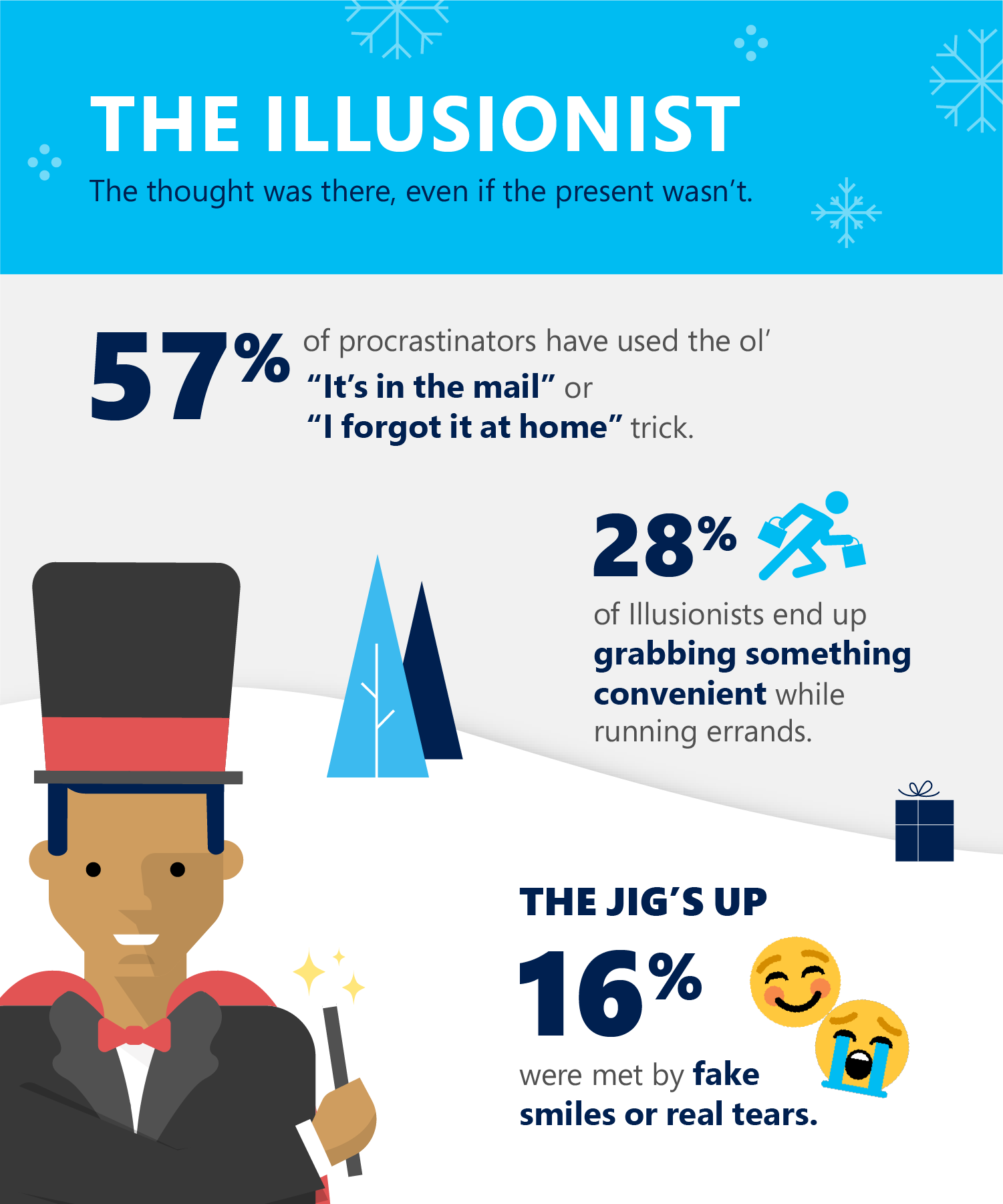
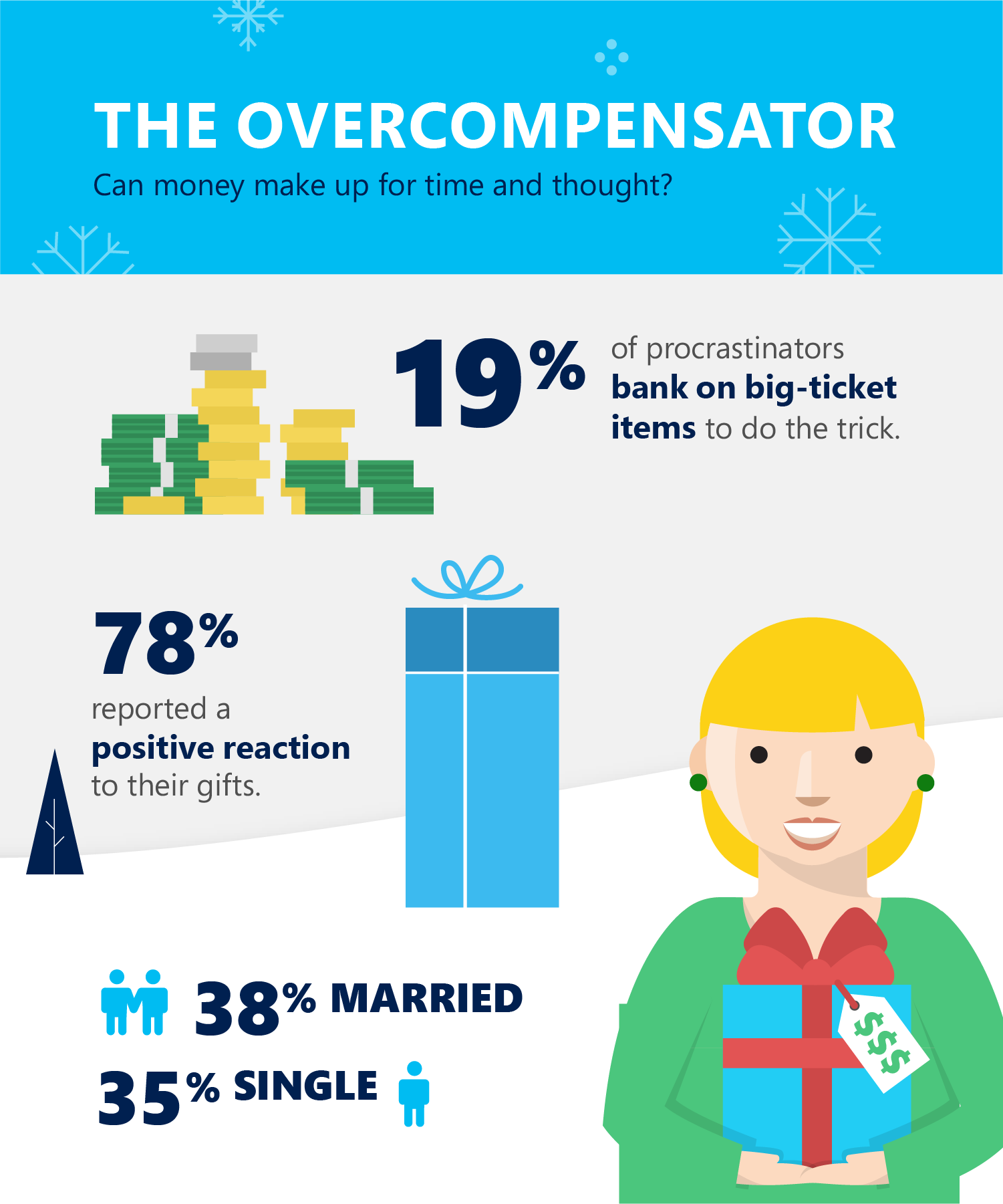
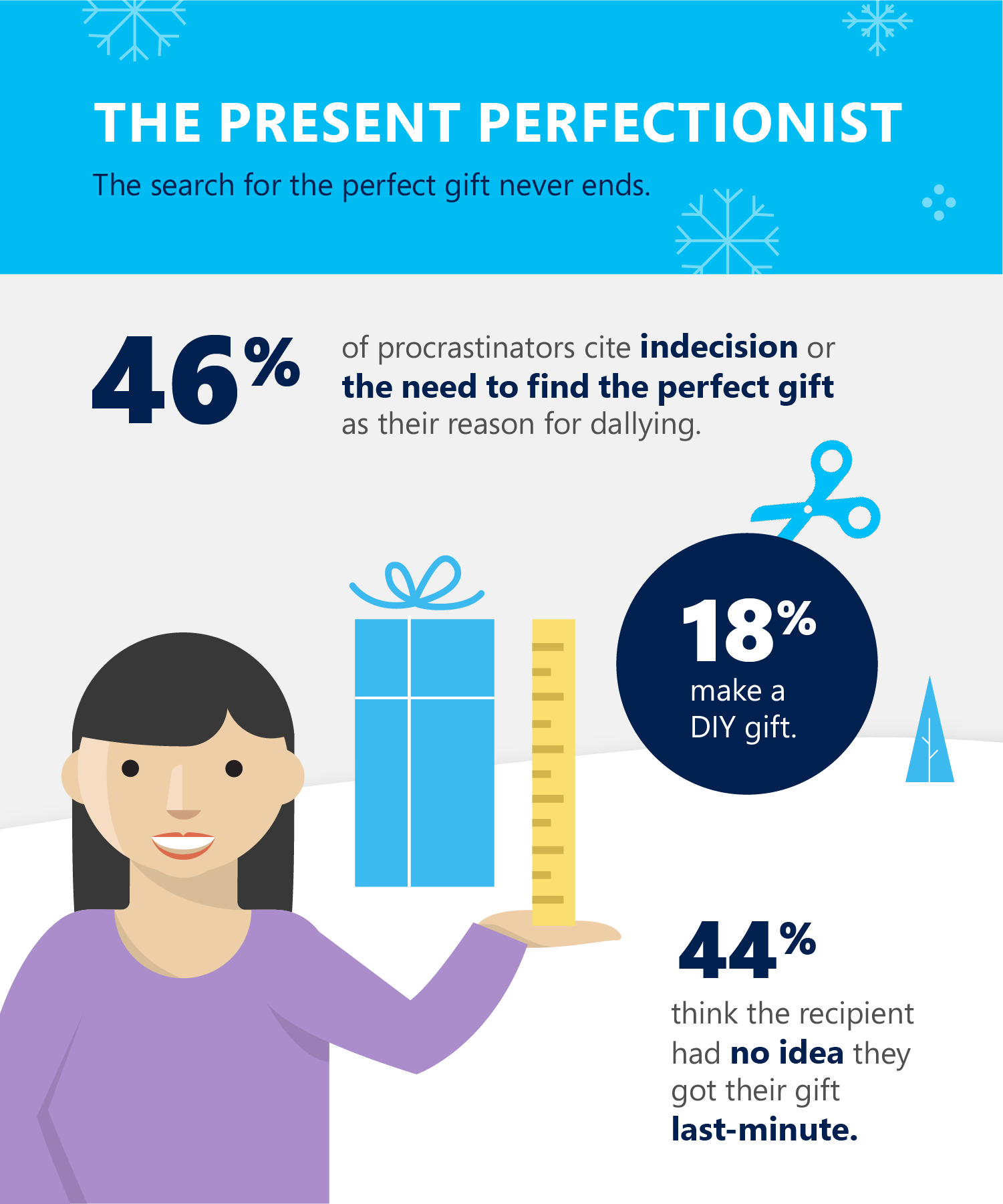
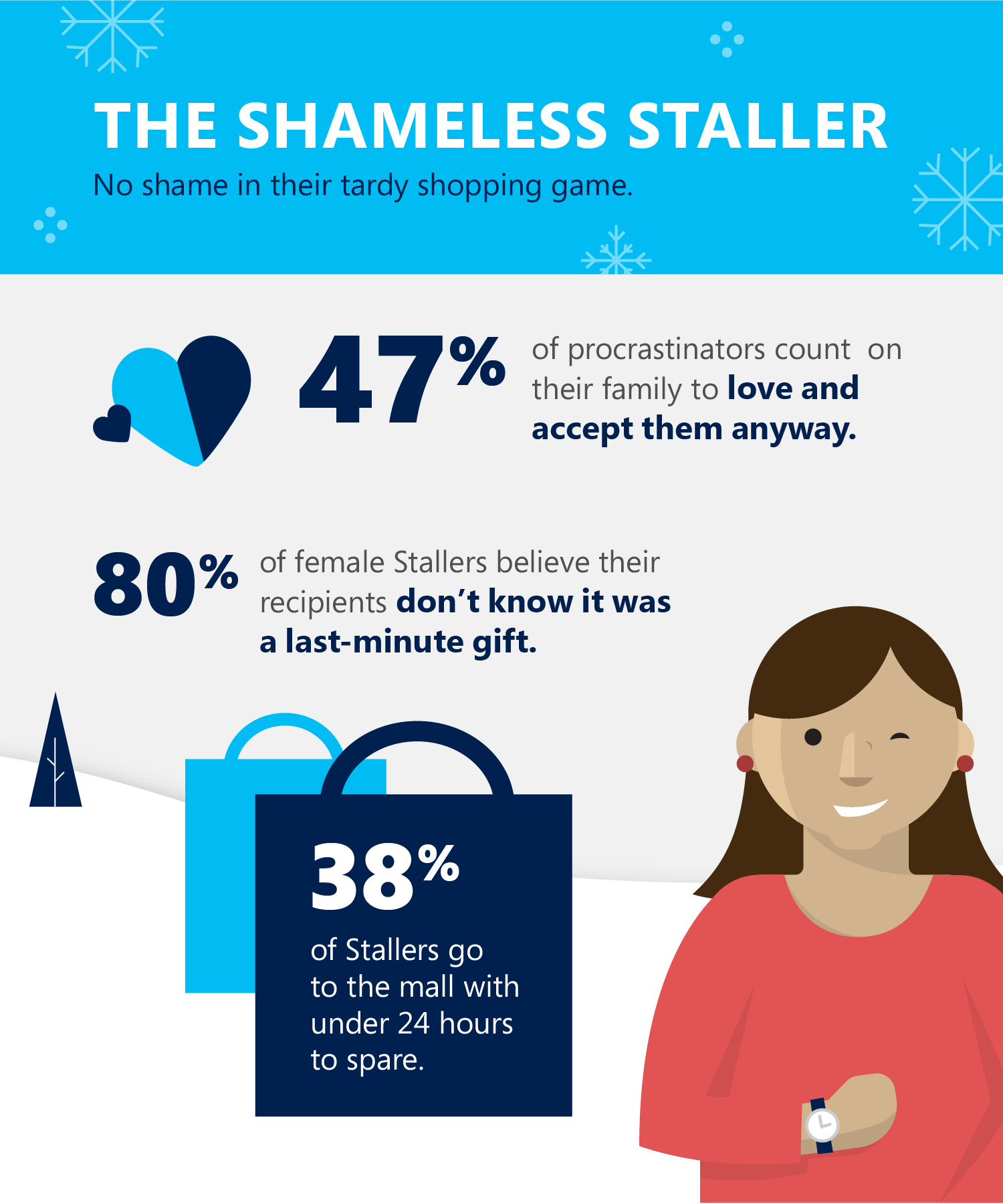
Microsoft Store also has you covered when it comes to selecting gifts that suit your last-minute shopping style. Additional results uncovered procrastinating behaviors that were decoded into five archetypes: the Illusionist, the Overcompensator, the Card Dealer, the Present Perfectionist, and the Shameless Staller.
Think you fall into one of these categories? Read on to find out more about each type and the Microsoft Store’s suggestions for what each type could pick up as presents while there’s still time. For more inspiration, check out Microsoft’s holiday gift guide.
What to buy?
JBL Flip 4 Portable Bluetooth Speaker:From partying on the patio to boomin’ on the beach, this waterproof Bluetooth speaker is ready to crank out the jams.
Xbox Design Lab: From shadows to camos to NFL team logos, you can make them a one-in-a-billion controller that perfectly matches them and their style, gaming and otherwise.
Harry Potter Kano Coding Kit: Kids – and big kids – get to unlock their inner wizard and learn how to code by making wand-directed magic happen.
What to buy?
Surface Go: The most portable Surface yet is primed for life on the go. At just over a pound, they’ll go far.
JLab Audio Epic Sport Wireless Earbuds:Durable, sweat-proof, and wireless with customizable sizing for comfort and top tier audio make an epic gift, especially for those who tune in on the go.
*SurveyMonkey. Last-Minute Gifting Survey, 11-12 Oct. 2018. Based on a sample of 1,607 Americans aged 18-44 who identify as last-minute gift givers.
n early 2016, two years into running Microsoft, CEO Satya Nadella needed advice from one of his newest employees, the cofounder of an app-tool maker Microsoft had just bought. Nadella was close to pulling off his blockbuster $27 billion acquisition of LinkedIn, but he wanted to talk about another company he coveted: GitHub. “Can we do it?” Nadella asked the executive. “Have we earned the trust?”
Back then, the answer was no. GitHub is the virtual watercooler of software development, a site where millions of programmers talk shop and share code across company boundaries. Microsoft had earned a reputation during its 1990s heyday as its polar opposite, an insular software belligerent, and GitHub was seen as wanting nothing to do with it. But after watching Nadella lead the Redmond, Washington-based giant for two years, GitHub made a surprise move, choosing Microsoft over Google as its acquirer this past June.
The December 31, 2018 issue of Forbes featuring Satya Nadella.
It was the latest coup for Nadella, 51, who’s breaking free of Microsoft’s recent past by returning it to its roots under cofounder Bill Gates.
“Bill used to teach me, ‘Every dollar we make, there’s got to be five dollars, ten dollars on the outside,’ ” Nadella tells Forbes, in his first sit-down interview since the $7.5 billion deal closed.
Great companies were once built on Microsoft’s code, Nadella says he was reminded by Gates. Nadella’s mission: Rebuild Microsoft brick by brick until it can happen again. “That’s what I want us to rediscover,” he says.
Signs of Nadella’s progress are found everywhere. From a Microsoft voice assistant that integrates with Amazon’s Alexa to a deepening alliance with Samsung and, most crucially, in its financial statements. Revenue, at $110 billion, is growing at a double-digit percentage after slumping for most of the past decade, in large part because of the hard-charging—and high-margin—cloud suite the company has built around Office and Azure, Microsoft’s challenger to Amazon’s cloud juggernaut. Net profits are at $16.6 billion, an increasing share of which is attributable to Azure, which is growing at 91% annually with multiyear contracts only just starting to boost the bottom line. Microsoft ended November as the most valuable company in the world, eclipsing Apple and Amazon. The consensus among analysts is that it will hit $1 trillion in market cap sometime next year.
Read the complete Just 100 2019: America’s Best Corporate Citizens
Much of the credit belongs to Nadella, a Microsoft near-lifer who took the reins from Steve Ballmer in 2014 and immediately started knocking down walls. The former engineer says he has focused the company around a simple concept: “equitable growth.”
“People are finally coming around to saying, ‘It’s not just the surplus you’ve created for yourself. What’s the state of the world around you?,’ ” Nadella says. “That’s where I feel like we’re at our best.”
Nadella signaled his intentions with the help of an iPhone. Weeks after his start as CEO, Microsoft opened up its Azure cloud service to make it easier for developers to create iOS apps. The following year, Nadella used an iPhone onstage at an event—unthinkable for a company that had brewed up the market-lagging Windows phone in 2010 and then blew more than $7 billion in 2014 buying Nokia’s mobile division to support it. When Nadella took over, he wrote off the whole deal as a loss.
Behind the scenes, Nadella got to work on Microsoft’s culture of infighting and of treating competitors as if it were “straight-up war,” as a former Oracle exec puts it. With its rearward-facing obsession with Windows, the cash-cow operating system, Microsoft was caught unawares by the cloud boom (exemplified by Amazon Web Services) and by subscription software businesses like Salesforce.
CEO Nadella is returning to a core Bill Gates lesson: “Every dollar we make, there’s got to be five dollars, ten dollars on the outside.”
Nadella, who immigrated to America from India in 1988, was an insider who led the company’s nascent cloud business before taking the top job. He quickly installed new leaders and smashed the barriers between Microsoft and open-source rival Linux, which had been famously called a “cancer” by his pugnacious predecessor Steve Ballmer. Nadella and Scott Guthrie, the new cloud boss, welcomed Linux onto Azure’s IT framework, where it’s now used by half of all computer systems operating on Microsoft’s cloud. “When we achieved our success, with that success came out the classic hubris that I describe as being the know-it-alls,” Nadella says. “I said, ‘Let’s shed that.’ ”
To chip away at Amazon’s massive head start in cloud (Amazon Web Services is on track to make $27 billion in revenue a year, compared with an estimated pace of $10 billion for Microsoft’s Azure and $3 billion for Google), Microsoft turned to its partners. Sales reps are now compensated when a deal with a key ally of Microsoft leads to more activity on Microsoft’s cloud. And companies working with Azure find themselves brought into million-dollar deals at the one-yard line. “All of us have been stunned they are doing it,” says Bob Muglia, CEO of San Mateo-based data-warehouse software maker Snowflake and a 23-year Microsoft veteran, who left in the Ballmer years. “Satya’s recognized this is a service-oriented world.”
Starbucks, which uses Microsoft to help power its ordering app, sent a dozen engineers to the world’s largest invite-only hackathon, hosted by Microsoft—another Nadella-era idea. “It’s a different approach from a traditional software company,” says Gerri Martin-Flickinger, Starbucks’ CTO.
But there are asterisks attached to this new exuberance. Much of Microsoft’s success has come from moving existing customers onto its cloud services and its revamped Office 365 work software suite, raising concerns that the company is simply harvesting low-hanging fruit, says Dan Ives, an analyst at the Los Angeles investment firm Wedbush. And while the breadth of Microsoft’s portfolio, which also includes gaming, search and devices like Surface tablets, is a great strength, it could still get tripped up again by success. “The risk is they go back to the old days,” says Raimo Lenschow, an analyst at Barclays. (Both are bullish on the stock.)
“People are finally coming around to saying, ‘It’s not just the surplus you’ve created for yourself. What’s the state of the world around you?’ That’s where I feel like we’re at our best.”
Now with GitHub in the fold—following acquisitions of the maker of Minecraft ($2.5 billion, 2014), app-building-tool provider Xamarin (reported as $400 million, 2016) and LinkedIn—Nadella’s team needs to avoid falling into bad habits such as restrictive long-term contracts. How the company integrates all these purchases—and history suggests it will be difficult—will also test Nadella. To navigate these challenges, Nadella relies on his broader vision that happier employees, customer and partners—even prickly coders—have to do well for Microsoft’s business to flourish. “A successful product is one that fosters more success around it,” Nadella says.
To pull it off, Nadella will lean on new leaders like Nat Friedman, the Xamarin cofounder whom Nadella asked about GitHub in 2016 and then tapped to run the business for Microsoft once the deal closed. As Friedman, whose new job entails evangelizing that message to GitHub’s 31 million developers, puts it: “People are giving Microsoft the benefit of the doubt.”
Reach Alex Konrad at akonrad@forbes.com. Cover image by Jamel Toppin for Forbes.
This story appears in the December 31, 2018 issue of Forbes. Subscribe
Wow, 2018 has been a remarkable year for educators. Our #MSFTEduChat TweetMeets have brought us together every month and unfurled so much knowledge, we’re going to need some extra help looking back and capturing the highlights. Well, with over 140 hosts joining us for this special Best of 2018 TweetMeet, we just might do it!
Over the last twelve months, many of you joined the Microsoft Educator Community and have taken part in the courses, learning paths, lesson plans and other resources it offers. The global MIEExpert community continues to grow with incredible collaboration projects taking place between classrooms around the world.
This month we’re offering more simultaneous language tracks than ever before, for a total of 17. New this month are Македонски (Macedonian), हिंदी (Hindi) and Česky (Czech).
For each language track, we have one or more hosts to post the translated questions and respond to educators. As always, we’re super grateful to all current and former hosts who are collaborating closely to provide this service.
The #TweetMeetXX hashtags for non-English languages are to be used together with #MSFTEduChat so that everyone can find the conversations back in their own language. For example: Portuguese-speaking people use the combination #TweetMeetPT #MSFTEduChat. English-speaking educators may all use #MSFTEduChat on its own.
The monthly #MSFTEduchat TweetMeets by Microsoft Education themselves underwent significant changes in 2018 as well. Our events are now multilingual and more global than ever. Team TweetMeet, which organizes the events, now consists of three people: Marjolein Hoekstra, Francisco Texeira and Anica Tričković.
Last September we decided to move all preparations for these Twitter events to Microsoft Teams. The switch to the Teams platform allows Team TweetMeet and our expert hosts to collaborate more effectively, because it combines the power of group conversations, file sharing and meetings all in one system. Being able to add guests to our teams is an incredible benefit, too.
Celebrating 2.5 years of TweetMeets
The first Microsoft Education TweetMeets were held in the summer of 2016. To celebrate their 2.5 years in existence, and to close 2018 in style, we decided to invite all former hosts to return once again. As many as 143 of these former hosts immediately accepted this invitation. They are very much looking forward to your best experiences, products and resources from 2018.
With so many hosts coming together for this special occasion, we just had to make a video to introduce (or re-introduce) them all to you:
Post-event summary: We will publish a new post after this #MSFTEduChat event summarizing the key lessons from the conversations during the TweetMeet. The hosts will collaborate to curate a top selection of the tweets and trends they found most significant. For even more highlights from the TweetMeet, the blog post will offer multiple Twitter Moments – curated stories and conversations from Twitter. Look for this blog post on Thursday, December 20.
TweetMeet fan? Show it off on your Twitter profile: Every month more people discover the unique nature of the TweetMeets and become passionate about them. Well, you can now show your passion for the TweetMeets right from your Twitter page. The dimensions of our Twitter Header Photo are 1500×500 – the perfect size for your Twitter profile. Get this month’s image here: #MSFTEduChat Twitter Header Photo.
Why join the #MSFTEduChat TweetMeets?
TweetMeets are monthly recurring Twitter conversations about themes relevant to educators, facilitated by Microsoft Education. The purpose of these events is to help professionals in education to learn from each other and inspire their students while they are preparing for their future. The TweetMeets also nurture personal learning networks among educators from across the globe.
We’re grateful to have a support group made up exclusively of former TweetMeet hosts, who volunteer to translate communication and check the quality of our questions and promotional materials. They also help identify the best candidates for future events, provide relevant resources, promote the events among their networks, and, in general, cheer everybody on.
Our hosts are thrilled about this upcoming TweetMeet. Watch how each of them has their own exciting way of inviting you to the event:
When and how can I join?
Join us Tuesday, December 18 from 10 a.m. to 11 a.m. PDT on Twitter using the hashtags #MSFTEduChat, #Bestof2018and#MicrosoftEDU (which you can always use to stay in touch with us). To find the event time for your specific location, use this time zone announcer.
From our monthly surveys we know that you may be in class at event time, busy doing other things or maybe even asleep – well, no problem! All educators are most welcome to join after the event. Simply take a look at the questions below and respond to these at a day and time that suit you best. You can also schedule your tweets in advance. In that case, be sure to quote the entire question and mention the hashtag #MSFTEduChat, so that everyone knows the right question and conversation to which you are responding. Mark the exact timings – they are different this month.
How can I best prepare?
To prepare for the #MSFTEduChatTweetMeet, have a look at the questions we crafted this time. Because of the enormous scale of the December event, we will have 4 questions this month. This will give everyone more time to engage with each other.
TweetMeet Questions
Hosts
With 143 educators on this month’s #MSFTEduChat hosts team, it’s not possible to list everyone’s profile in this announcement like we normally do. We did once again make a Twitter list so you can easily follow everyone.
Every month Microsoft Education organizes social events on Twitter targeted at educators globally. The hashtag we use is #MSFTEduChat. A team of topic specialists and international MIE Expert teachers prepare and host these TweetMeets together. Our team of educator hosts first crafts several questions around a certain topic. Then, before the event, they share these questions on social media. Combined with a range of resources, a blog post and background information about the events, this allows all participants to prepare themselves to the full. Afterwards we make an archive available of the most notable tweets and resources shared during the event.
Please connect with TweetMeet organizer Marjolein Hoekstra @OneNoteC on Twitter if you have any questions about TweetMeets or helping out as a host.
Join for next month’s topic: Transforming classroom time
This blog post was co-authored by Nikisha Reyes-Grange, Senior Product Marketing Manager, Azure Marketing, and Balamurugan Balakreshnan, Cloud Solution Architect, CSU-Data and AI.
Johnson Controls has been a pioneer in building management solutions and services since founder Warren Johnson invented the first electric room thermostat in 1885. Johnson Controls has introduced many innovations to the building industry over the years and are now tackling a problem that costs the building industry billions each year.
Modern buildings include multiple systems that handle everything from building management to HVAC to security. These systems are managed by protocols, proprietary systems, and applications without a common data model, which prevents interoperability, limits scalability, and costs the industry an estimated $15 billion annually.
Solution
To help building operators gather and understand data about their buildings, operations, and occupants, Johnson Controls created Digital Vault to integrate internal and external data sources and present a harmonized view of energy usage, security breaches, fire alarm status, temperature controls, and other building management systems. Digital Vault, powered by Azure Cosmos DB, simplifies object relationship management through a single Application Programming Interface (API) layer for IoT data and events while at rest and in motion. Another API layer leverages Azure Cosmos DB’s auto-indexing and multi-modal capabilities to accept data in forms ranging from key-value to graph. Digital Vault is then able to create a virtual version of a physical structure, like a floor or room, making it easy to conceptualize the relationships between building assets.
Johnson Controls Digital Vault technical architecture
Combining and processing data from Operational Technology (OT) and Information Technology (IT) of smart environments, Digital Vault creates a real-time knowledge graph that can answer questions about a building’s past and present conditions and make predictions about its future. OT data comes from devices and sensors in the building, and from HVAC, fire, lighting, security, IT, asset tracking, and more. The challenge in such an environment is the variety, volume, and velocity of data. As devices evolve over time, so do their schema and data models. With multiple generations of devices present in buildings, a data store must flexibly handle a variety of schemas. Sensors can save data at high rates, dramatically increasing the volume of saved data as the number of sensors increase. Velocity increases as data stores power real-time views, dashboards, and decisions, while also enabling historical data to be leveraged for advanced analytics and AI.
By processing incoming OT data, Digital Vault can perform common data cleaning and analytic functions automatically. Building owners and application developers do not have to spend time building out a processing system for streaming data. The raw and processed data from devices is available in one spot, with common algorithms for filling missing values, cleaning and smoothing outliers, and many analytic and normalization functions already applied to the stream.
Why Azure Cosmos DB?
In order to service thousands of buildings around the world generating billions of daily data samples, Johnson Controls knew they needed a platform-as-a-solution (PaaS) data store that could provide global service, manage huge volumes of data, scale as needed, reduce costs, and keep operational complexity low. They turned to Azure Cosmos DB to meet these needs while also easily managing data in a variety of models, auto-indexing data, and integrating with other Azure services.
Digital Vault uses Azure IoT Hub to collect data streams from devices in buildings, Azure Event Hubs to manage the streams of data, and Spark in an HDInsight cluster to process the full stream and apply the analytical algorithms that embody Johnson Control’s 135 years of experience in building management. Azure Cosmos DB is at the heart of the processing system, feeding in additional data as needed and storing processed data, with its Graph API allowing developers to process graph data in any language with minimal integration time.
Digital Vault architecture
For a building to be truly smart, it must have access to a significant amount of IT data – data that has traditionally been held in multiple silos, with no connection to OT data. To store and manage the IT portion of the knowledge graph, Johnson Controls again turned to Azure Cosmos DB. Just as with the OT data, there is a huge variety in schema and shape of IT data. Digital Vault ingests, stores, and incorporates IT data into a building’s knowledge graph using the Azure Cosmos DB Graph API. This makes it possible for Johnson Controls’ developers to use industry-standard APIs for processing graph data from any language.
This graph understands the relationships between different types and sources of data and makes it possible to navigate among the many sensors, assets, people, and processes in the building. Digital Vault is, in turn, able to assess the current health and maintenance history of equipment and apply predictive models to anticipate future status and trends.
The Internet of Things (IoT) is reshaping every industry from manufacturing to medicine, and opportunities to transform business are nearly limitless. And while IoT is a complicated endeavor requiring multiple partners, skillsets, and technologies, new innovations are making projects easier to deploy, more secure, and more intelligent than ever.
Below I’ve called out four innovations that are revolutionizing the IoT industry. To learn more about how to take advantage of these innovations, be sure to register for our upcoming IoT in Action Virtual Bootcamp.
1. Artificial intelligence (AI) and cognitive capabilities
Cognitive services and AI used to come with a high price tag. But times have changed, and these capabilities are becoming increasingly accessible.
IoT Hub and Cognitive Services enable you to tailor IoT solutions with advanced intelligence without a team of data scientists. Not only do AI and Cognitive Services make it easier to infuse IoT solutions with capabilities such as image recognition, speech analytics, and intelligent recommendations, but they also help companies act on the data being gathered and realize the true value of IoT. Scenarios are virtually limitless. Companies like UBER are using visual identity verification to increase platform security, and Spektacom is making cricket better with its AI-infused sticker for cricket bats that can deliver insights around batting style.
2. Real-time analytics at the intelligent edge
You need data analytics to make your IoT solution complete, but all the data you need is not where you want it to be—it’s at the edge. One solution is to reproduce a cloud environment locally, but this can be costly and you may end up having to support two solutions, not one.
Now you can extend cloud intelligence and analytics to the edge. Azure IoT Edge optimizes performance between the edge and cloud, reducing latency, so you get real-time data. This secure solution enables edge devices to operate reliably even when they have intermittent cloud connectivity, while also ensuring that only the data you need gets sent to the cloud. And by combining data from the cloud and data from the edge, you get the best of both worlds.
3. More secure IoT devices
IoT security continues to evolve. Which means it’s never been easier to lock down your IoT solutions. At Microsoft, we continue to build uncompromising security into every product we make. We recently released Azure Sphere, which is an end-to-end solution for creating highly-secure, connected devices using a new class of microcontrollers (MCUs). Azure Sphere powers edge devices, combining three key components including Azure Sphere certified MCUs, Azure Sphere OS, and the Azure Sphere Security Service.
4. Provisioning IoT quickly at scale
Provisioning IoT manually is time-intensive and can quickly become a showstopper, especially when you’ve got hundreds, thousands, or even millions of devices to configure. Even if manual provisioning is possible now, building in the capability to quickly and securely provision future devices is critical.
Azure IoT Hub features a Device Provisioning Service (DPS) that enables remote provisioning without human intervention. Azure DPS provides the infrastructure needed to provision millions of devices in a secure and scalable way. DPS extends trust from the silicon to the cloud where it creates registries to enable managed identity services including location, mapping, aging, and retirement. It works in a variety of scenarios from automatic configuration based on solution-specific needs to load balancing across multiple hubs to connecting devices based on geo-location.
Register for the IoT in Action Virtual Bootcamp
To learn more about how you can take advantage of these innovations, be sure to register for an IoT in Action Virtual Bootcamp. Whether you are an engineer, software architect, or practice owner, this virtual bootcamp will give you a clear understanding of IoT from device to cloud and accelerate the development of an IoT solution for your business.
This event will help you get hands on with the latest in IoT devices and cloud services including secure MCUs, IoT OSes, and advanced application services. You will also receive trusted guidance and a singular ecosystem view, supporting you in the design of secure IoT solutions that add real-world business value and create exciting new customer experiences. Join us to establish a leadership position in the IoT ecosystem by creating new experiences and revenue streams while optimizing bottom-line performance.
Register for an IoT in Action Virtual Bootcamp in your time zone:
Interested in attending one of our in-person IoT in Action event? Register for a free event coming to a city near you.