Posted on Leave a comment

Preparing for a Russian cyber offensive against Ukraine this winter

As we report more fully below, in the wake of Russian battlefield losses to Ukraine this fall, Moscow has intensified its multi-pronged hybrid technology approach to pressure the sources of Kyiv’s military and political support, domestic and foreign. This approach has included destructive missile and cyber strikes on civilian infrastructure in Ukraine, cyberattacks on Ukrainian and now foreign-based supply chains, and cyber-enabled influence operations[1]—intended to undermine US, EU, and NATO political support for Ukraine, and to shake the confidence and determination of Ukrainian citizens.

In recent months, cyberthreat actors affiliated with Russian military intelligence have launched destructive wiper attacks against energy, water and other critical infrastructure organizations’ networks in Ukraine as missile strikes knocked out power and water supplies to civilians across the country. Russian military operators also expanded destructive cyberactivity outside Ukraine to Poland, a critical logistics hub, in a possible attempt to disrupt the movement of weapons and supplies to the front.

Meanwhile, Russian propaganda seeks to amplify the intensity of popular dissent over energy and inflation across Europe by boosting select narratives online through state-affiliated media outlets and social media accounts to undermine elected officials and democratic institutions. To date, these have had only limited public impact, but they foreshadow what may become broadening tactics during the winter ahead.

We believe these recent trends suggest that the world should be prepared for several lines of potential Russian attack in the digital domain over the course of this winter. First, we can expect a continuation of Russia’s cyber offensive against Ukrainian critical infrastructure. We should also be prepared for the possibility that Russian military intelligence actors’ recent execution of a ransomware-style attack – known as Prestige – in Poland may be a harbinger of Russia further extending cyberattacks beyond the borders of Ukraine. Such cyber operations may target those countries and companies that are providing Ukraine with vital supply chains of aid and weaponry this winter.

Second, we should also be prepared for cyber-enabled influence operations that target Europe to be conducted in parallel with cyberthreat activity. Russia will seek to exploit cracks in popular support for Ukraine to undermine coalitions essential to Ukraine’s resilience, hoping to impair the humanitarian and military aid flowing to the region. The good news is that, when equipped with more information, a media-savvy public can act with awareness and judgment to counter this threat.

Here’s what we are seeing at Microsoft since Ukraine’s counteroffensive has pushed the Russian army into retreat, what we anticipate Russia’s cyber and influence operations might look like headed into the winter months, and how we at Microsoft will help prepare and prevent harm to Microsoft customers and democracies facing these attacks.

Combined missile and cyber strikes focus on destruction of civilian infrastructure

As Russia retreated from formerly occupied territory in Ukraine in late October, the Kremlin unleashed new missile and drone strikes against Ukrainian cities and the energy and transportation infrastructure that supports them. Missile barrages cut power to more than 10 million Ukrainians and left up to 80% of Kyiv’s population without running water.[2] The intent to inflict suffering on Ukraine’s civilians has been clear, and was effectively acknowledged by Russian officials.[3]

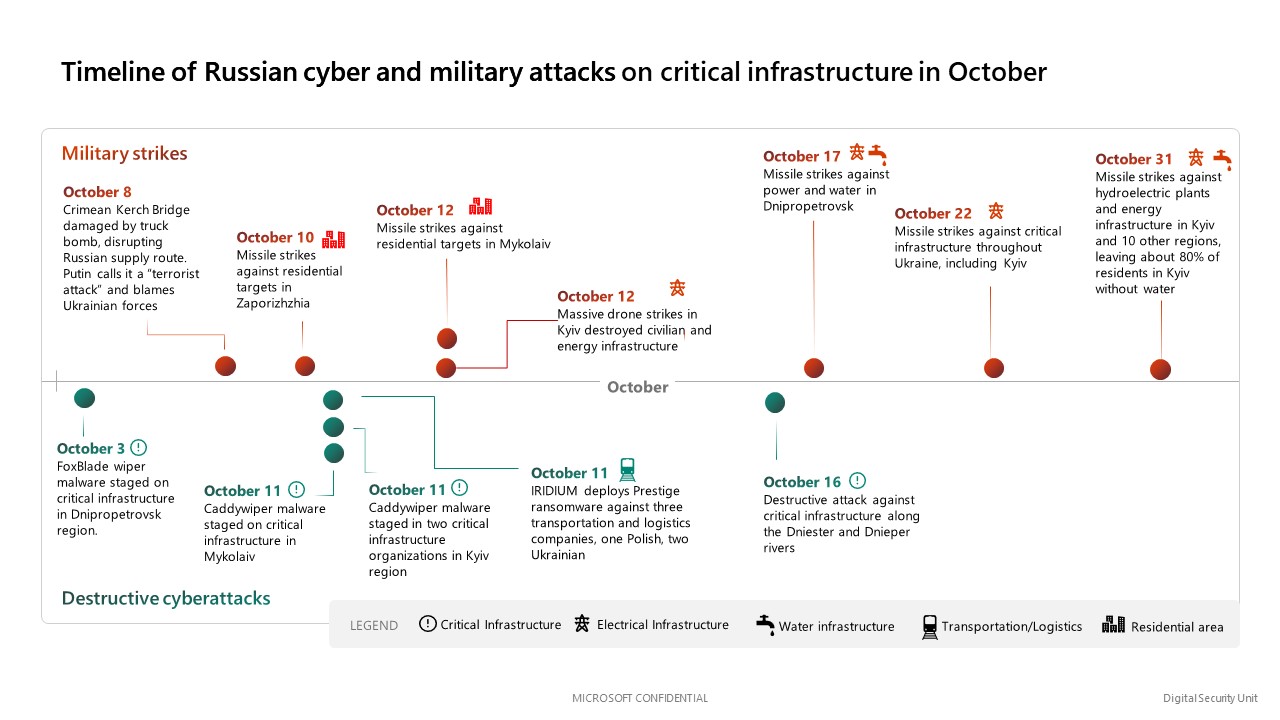
Notably, these recent missile strikes have been accompanied by cyberattacks on the same sectors, perpetrated by a threat group – known at Microsoft by the element name IRIDIUM and by others as Sandworm – associated with Russia’s military intelligence service, the GRU. The repeated temporal, sectoral and geographic association of these cyberattacks by Russian military intelligence with corresponding military kinetic attacks indicate a shared set of operational priorities and provides strong circumstantial evidence that the efforts are coordinated, as reflected in the timelines below.

Microsoft’s research of IRIDIUM shows a history of destructive attacks against Ukraine’s critical energy infrastructure that dates back nearly a decade. Following Russia’s annexation of Crimea in 2014, IRIDIUM launched a series of wintertime operations against Ukrainian electricity providers, cutting power to hundreds of thousands of citizens in 2015 and 2016.[4] The group’s pursuit of destruction in Ukraine spread globally in 2017 with the NotPetya attack, which inflicted $10 billion of damage to companies including international firms such as Maersk, Merck and Mondelēz, and underscores the risk of this actor’s operations to the global digital ecosystem.[5]

The wave of Russian destructive cyberattacks that began on February 23, and subsequent destructive attacks against Ukrainian targets in support of the Russian war effort have been the responsibility of IRIDIUM, as we have previously reported.[6] In October, IRIDIUM’s destructive attacks against Ukrainian critical services networks spiked, after two months of little to no wiper activity. As the Ukrainian counteroffensive progressed and winter approached, Microsoft observed that IRIDIUM deployed Caddywiper and FoxBlade wiper malware to destroy data from networks of organizations involved in power generation, water supply and the transportation of people and goods. The predominant focus was on the Kyiv region, as well as the southern and central-eastern regions of the country, where the physical conflict has been the most intense.

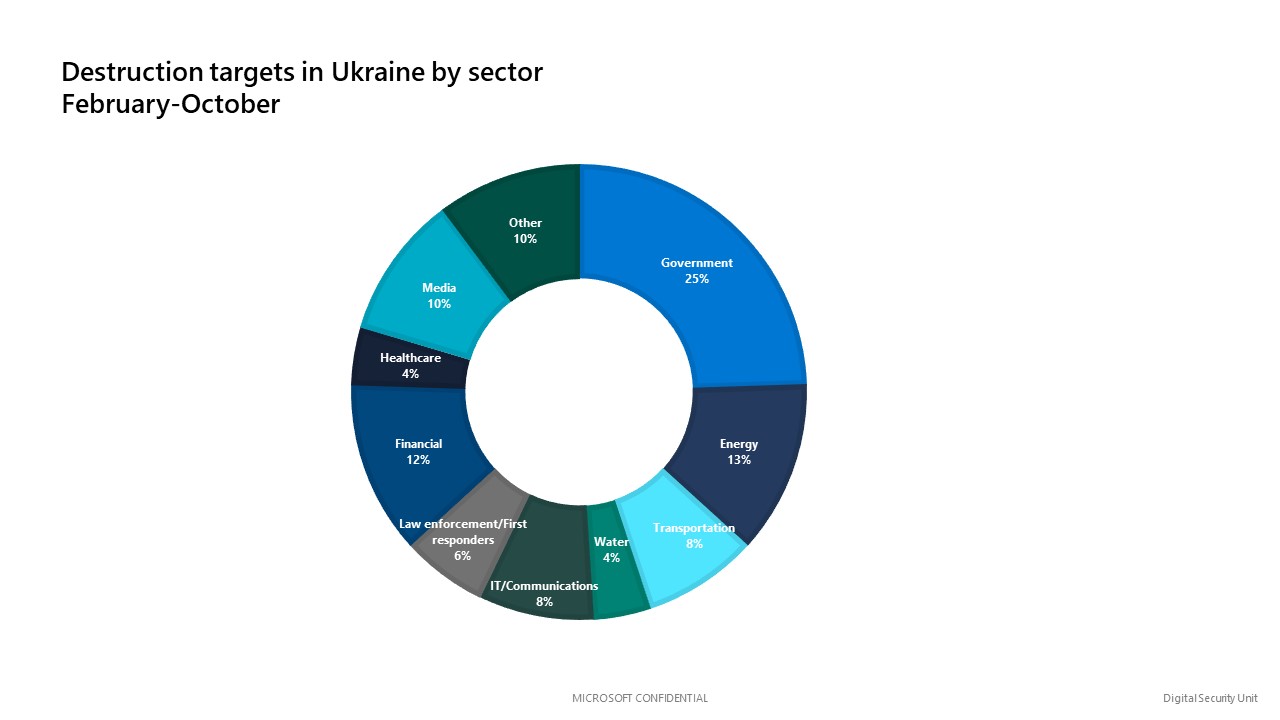
Cyber and missile strikes on transportation and logistics companies may interfere with the transportation of weapons and supplies. However, such attacks can also disrupt the passage of humanitarian aid to Ukrainian citizens, compounding the harm from curtailing the supply of electricity.Timeline of Russian cyber and military attacks on critical infrastructure in OctoberThis tactic of targeting civilian infrastructure has been in play since the beginning of the conflict. Of the roughly 50 Ukrainian organizations that Russian military operators have hit with destructive wiper malware since February 2022, 55% were critical infrastructure organizations, including in the energy, transportation, water, law enforcement and emergency services, and health care sectors.Destruction in Ukraine by sectorIn most instances, threat actors have deployed wipers against the business networks of the targeted critical infrastructure organizations. However, operational technology networks are also vulnerable. For example, IRIDIUM attempted to inflict severe damage on energy production in April by targeting the industrial control systems (ICS) of a Ukrainian energy provider.[7] Quick action by CERT-UA and international partners thwarted the attack, but the risk of future ICS attacks that would disrupt or destroy the productive capacity of Ukrainian power or water infrastructure is high.
Russian cyberattacks extend outside Ukraine

Russian cyber strikes extended outside Ukraine in October, when IRIDIUM deployed its novel Prestige ransomware against several logistics and transportation sector networks in Poland and Ukraine.[8] This was the first war-related cyberattack against entities outside of Ukraine since the Viasat KA-SAT attack at the start of the invasion.[9]

The Prestige event in October may represent a measured shift in Russia’s cyberattack strategy, reflecting a willingness by Moscow to use its cyberweapons against organizations outside Ukraine in support of its ongoing war. Since Spring 2022, Microsoft has observed that IRIDIUM and suspected Russian state operators have targeted transportation and logistics organizations across Ukraine in probable attempts to collect intelligence on or disrupt the flow of military and humanitarian aid through the country. But these recent attacks in Poland suggest that Russian state-sponsored cyberattacks may increasingly be used outside Ukraine in an effort to undermine foreign-based supply chains.Timeline of Prestige ransomware deployment

IRIDIUM’s success in the Prestige destructive attack was limited. Early customer notifications and rapid response, including from Microsoft’s Detection and Response Team (DART) and the Microsoft Threat Intelligence Center (MSTIC), along with local incident responders in Poland, reportedly helped contain the attack’s impact to less than 20% of one targeted organization’s network. However, while the destructive impact was limited, IRIDIUM almost certainly collected intelligence on supply routes and logistics operations that could facilitate future attacks.

Perhaps in part because the impact was successfully limited by the defenders and responders in this instance, international outcry against this new extension of the hybrid war beyond the borders of Ukraine has been muted. Nevertheless, this attack highlights the continued risk of Russian destructive cyberattacks to European organizations that directly supply or transport humanitarian and military assistance to Ukraine.

Cyber-enabled influence operations seek to fuel real-world discord across Europe

This winter, European populations seeking to keep warm amid energy shortages and heightened inflation will likely be targeted by Russian attempts to stir up and potentially mobilize grievances through cyber-enabled influence operations.

Such operations offer the Kremlin a more deniable but nonetheless effective method of shaping discourse around conflict and major geopolitical events. Russia’s “active measures” approach involves infiltrating the constituencies of Kremlin adversaries while elevating candidates and officials who share Russia’s preferred foreign policy positions. Since 2014, Russia has sought to achieve its objectives “through the force of politics, rather than the politics of force,”[10] across democratic contests including the 2016 Brexit referendum and elections in the US, France and Germany, among others. Russia has also exploited political, economic and social divisions to mobilize citizens and even incite violence inside democracies. It is likely that these tools will be deployed in Europe and globally to reduce support for Ukraine’s defense.

Russia has a well-established ability to sway public opinion both in the U.S. and Europe through cyber-enabled influence operations. In 2016, the Internet Research Agency in St. Petersburg, known better as the Russian “troll farm,” famously orchestrated protests in Texas[11] and Florida.[12] Earlier that same year, Russian state media ran a story about an alleged assault of a young girl by migrants in Germany – accusations later disproved – and promoted the narrative that the German government had deliberately concealed the truth. The subsequent media flurry sparked a series of protests within Germany’s sizeable Russian diaspora, who were outraged by what they were being told was failure on the part of the German justice system.[13]

In 2018, the same Kremlin trolls involved in the 2016 US presidential election amplified the “yellow vest” protests in France. Russia did not organize these protests, but its online campaigns elevated calls to protest President Emmanuel Macron’s government by using a blend of overt, state-sponsored media to promote the cause while boosting the movement’s hashtag #giletsjaunes via covert accounts online.[14]

Our Digital Threat Analysis Center (DTAC) team closely tracks cyber-enabled influence operations. Protests in Europe this fall related to energy, inflation, and the war in Ukraine broadly – and their steady promotion by Russian propaganda outlets – foreshadow additional operations we may encounter this winter in support of Russian objectives by seeking to increase European dissatisfaction with energy supply, energy pricing and inflation.[15] If energy and electricity disruptions in Ukraine lead to more refugees throughout Europe, Russian cyber-enabled influence operations may seek to increase frictions over migration to create intra- and inter-country conflicts – a theme visible in the Kremlin’s campaigns over the last decade as refugees fled to Eastern and Central Europe during the Syrian Civil War.[16]

In the coming months, European nations will likely be subjected to a range of influence techniques tailored to their populations’ concerns about energy prices and inflation more broadly. Russia has and will likely continue to focus these campaigns on Germany, a country critical for maintaining Europe’s unity and home to a large Russian diaspora, seeking to nudge popular and elite consensus toward a path favorable to the Kremlin.[17] Strong connections between Kremlin-affiliated ideologues and Germany’s far right will likely be leveraged both online and offline in campaigns targeting German audiences with hardline narratives on the war in Ukraine as well as criticism of the government’s handling of the energy crisis.[18]

Recent quantitative analyses support these assessments. Microsoft’s AI for Good Lab has created a Russian Propaganda Index (RPI) to monitor the consumption of news from Russian state-controlled and state-sponsored news outlets and amplifiers. This index measures the proportion of this propaganda flow to overall news traffic on the internet. The RPI in Germany currently is the highest in Western Europe, over three times the regional average.

Higher Russian propaganda consumption in Germany may be in part due to decades of Russian investment in soft power and public diplomacy targeting the country, home to one of the largest Russian diaspora populations in Europe. Many of the soft power organizations’ express purpose is to create people-to-people and party-to-party ties between the two countries, and several Russian state-sponsored media outlets have been based in Germany.[19] Germany’s large Russian-speaking population, estimated at nearly 6 million people, makes Russian cyber-enabled influence operations and propaganda published in both Russian and German more accessible to German audiences.[20] Meanwhile, German policy since the end of the Cold War, during which time Soviet and East German active measures efforts were conducted synergistically,[21] has sought a normalization of relations with Russia bolstered by economic cooperation, with no greater example than the Nord Stream 2 natural gas pipeline. U.S. sanctions against this project, unpopular in both Russia and Germany, gave anti-Western and pro-Russian propaganda and influence operations, particularly on economic and energy topics, a more sympathetic audience.[22]

Throughout Western Europe, readers are exposed to Russian propaganda on both Russian-language sites – including Russian state-owned media sites – and local-language, pro-Russia sites. Consumption of local-language sites in Germany is three times higher than the Western European average, in keeping with Germany’s high levels of Russian propaganda consumption in the aggregate. In Germany, the local-language sites that generate the most traffic are anti-spiegel.ru, uncutnews.ch and the German-language edition of Russia Today (RT), de.rt.com. Local sites focus more attention on local issues. Anti-Spiegel in particular has focused its content on leveraging the current economic climate to promote the Kremlin and vilify the West. The headlines of its three most-read articles, for example, from the last four months are:

  1. “That the US wants to destroy the German economy is considered a conspiracy theory and Russian propaganda, but it is obvious.”[23]
  2. “The Nord Stream pipelines have been blown up and the Western media are staging what is arguably the stupidest propaganda operation ever.”[24]
  3. “I am often asked why I am so convinced that Russian President Putin is not part of [the World Economic Forum] & Co. and its new world order. Here I want to answer that.”[25]

Aside from Germany, many other European nations may also need to reckon with the combined weight of Russian meddling and organic popular discontent. Earlier this year, Russia-affiliated threat actor SEABORGIUM (which overlaps with threat groups tracked as Callisto Group, TA446 and COLDRIVER) targeted the UK, utilizing allegedly stolen material to sow distrust in the British government,[26] while pro-Russia media like Modern Diplomacy and Strategic Culture Foundation, an outlet directed by the Russian Foreign Intelligence Service (SVR),[27] publish content alleging British involvement in the Kerch Strait Bridge explosion.[28]

Ongoing protests in the Czech Republic, meanwhile, have promoted Russia’s talking points on energy and are repeatedly featured in Russian state-owned and state-affiliated media.[29] Ladislav Vrábel – one of the organizers of the protest movement Czech Republic First – has been a repeated guest on Russian media such as Sputnik News since protests began,[30] while PolitNavigator – a Russian-language site reportedly directed by the FSB[31] – sent a correspondent to cover the protests from the beginning.[32] Further, among public figures who supported and spoke at the demonstrations are several politicians with long and well-documented records of pro-Russian activity, such as unofficial trips to occupied Crimea and high-level involvement with Kremlin-funded biker gang Night Wolves.[33]

France, not as reliant on Russian gas as its neighbors, is perhaps less vulnerable to energy-related influence. However, there is an ongoing risk that Russian agencies will seek to meddle in French affairs through inauthentic social media campaigns – building on previous efforts[34] and its success seeding and exploiting anti-French sentiment throughout Africa via propaganda, fake think tanks, and local engagement – which point to Russia’s willingness undermine French leadership.[35] Finally, Italy, with rising energy costs,[36] emerges as an additional target.

Defending the digital domain this winter: A way forward 

In our June 2022 report, Defending Ukraine: Early Lessons from the Cyber War, Microsoft offered a methodology for combating digital threats. Multidimensional threats require multidimensional defenses. At Microsoft, we’ve built our approach around “Four Ds” to counter malicious cyber and influence activity. Throughout the winter and into 2023, we will be working with our customers and in support of democracies to:

  • Detect: Collectively identify, across Microsoft’s threat intelligence teams, those cyber actors that may strike at supply chains supporting Ukraine and the energy industry keeping Europe warm this winter. We will also evaluate cyberattacks to determine which are designed to limit support and supplies to Ukraine and which may be part of broader hack-and-leak operations designed to undermine unity of support for Ukraine. For customers, we’ll preemptively evaluate and assess potential risks to those that may be targets of Russia or other nation state threat actors. This vulnerability assessment will closely evaluate transportation, defense and energy companies Microsoft serves to help increase the collective speed of detection and response. Microsoft will also continue to track and identify Russian cyber-enabled influence operations, publishing our findings to notify the public and industry partners to improve information integrity of our own platforms and broader detection efforts.
  • Disrupt: Microsoft’s Threat Intelligence Center (MSTIC) will alert customers and the public to emerging cyber methods enabling the entire ecosystem to rapidly employ sensors, patches, and mitigations. Where we encounter cyber-enabled influence campaigns, we will pursue a similar strategy, shining a light on operations aimed at creating doubt, distrust or dissent within Ukraine or across its partners seeking to undermine support for Ukraine. Our team will share this information with our customers and the public to these operations and lessen their impact.
  • Defend: Microsoft will increase the collective defenses of the broader cyber ecosystem through increased information sharing and improved technology to defend against Russian threats and address vulnerabilities. Our teams will continue to support nonprofits, journalists and academics both within Ukraine and across allies, allowing those partners to broaden their defense of the information ecosystem. For example, Microsoft recently partnered with International Media Support (IMS) and the Center for Strategic Communication and Information Security within Ukraine to improve rapid information sharing and response between the private sector, NGOs and journalists within Ukraine through a dedicated secure communications hub.
  • Deter: Microsoft has been dedicated for more than a decade to securing international norms for cyberspace. This winter, our Digital Diplomacy and Democracy Forward teams will work with affected customers and their representative governments to push for unified action to protect our customers’ supply chains against nation state attacks. And we will continue our ongoing efforts to provide actionable threat intelligence to entities targeted or compromised by Russian actors in Ukraine and in the countries supporting its defense.

Finally, for customers, Microsoft encourages the use of strong cyber hygiene and the latest detection and response technology to reduce vulnerabilities to and recover from cyberattacks – a listing of these specific recommendations can be found in the recently released Microsoft Digital Defense Report (MDDR) 2022.[37]

Ukraine has fought a brave defense both online and on-the-ground against a merciless Russian assault. With the help of its partner nations, companies and democratic citizens, we all can ensure that Ukraine and Europe’s infrastructure is protected and democracy resilient in the face of authoritarianism this winter.


[1] Cyber-enabled influence operations refer to targeted, online information campaigns designed to shift public opinion through manipulative or subversive means.

[2] https://www.msn.com/en-us/news/world/russian-strikes-on-ukraine-leave-most-of-kyiv-without-running-water/ar-AA13zw4A, https://www.axios.com/2022/10/31/russia-strikes-ukraine-kyiv-water 

[3] Following the attack, Dmitry Peskov, Russian President Vladimir Putin’s press secretary, implied Russia’s intentions with its strikes on Ukraine’s critical infrastructure is to force President Zelenskyy to negotiate.

[4] https://www.wired.com/story/sandworm-kremlin-most-dangerous-hackers/

[5] https://www.darkreading.com/threat-intelligence/3-years-after-notpetya-many-organizations-still-in-danger-of-similar-attacks

[6] https://blogs.microsoft.com/on-the-issues/2022/06/22/defending-ukraine-early-lessons-from-the-cyber-war/

[7] https://www.welivesecurity.com/2022/04/12/industroyer2-industroyer-reloaded/; https://cert.gov.ua/article/39518

[8] https://www.microsoft.com/en-us/security/blog/2022/10/14/new-prestige-ransomware-impacts-organizations-in-ukraine-and-poland/

[9] https://techcrunch.com/2022/05/10/russia-viasat-cyberattack/

[10] https://securingdemocracy.gmfus.org/so-what-did-we-learn-looking-back-on-four-years-of-russias-cyber-enabled-active-measures/

[11] https://www.dallasnews.com/news/politics/2019/10/08/russian-trolls-orchestrated-2016-clash-houston-islamic-center-senate-intel-report-says/

[12] https://www.thedailybeast.com/russians-appear-to-use-facebook-to-push-pro-trump-flash-mobs-in-florida

[13] https://www.reuters.com/article/us-germany-russia-idUSKCN0VA31O, https://www.bbc.com/news/blogs-eu-35413134

[14] https://www.theguardian.com/world/2018/dec/17/gilets-jaunes-grassroots-heroes-or-kremlin-tools

[15] https://www.politnavigator.news/fiala-ty-idiot-reportazh-s-prorossijjskogo-mitinga-v-chekhii.html

[16] https://www.vice.com/en/article/y3pqwk/russia-propaganda-rt-ukraine-refugees, https://www.atlanticcouncil.org/blogs/ukrainealert/six-outrageous-lies-russian-disinformation-peddled-about-europe-in-2016/, https://www.dw.com/en/russia-uses-the-refugee-crisis-for-propaganda/a-18989796; https://www.atlanticcouncil.org/blogs/syriasource/russia-s-disinformation-campaign-has-changed-how-we-see-syria/

[17] https://www.politico.eu/article/russia-influence-ukraine-fake-news; https://www.dw.com/en/russian-disinformation-threat-looms-large-over-cold-german-winter/a-63096336

[18] https://sputniknews.com/20220819/germany-should-immediately-launch-nord-stream-2-bundestag-vice-speaker-says-1099755921.html, https://www.rt.com/business/559754-horror-chart-germany-energy-crisis, https://www.rt.com/news/559740-german-mayors-nord-stream-letter, https://www.rt.com/business/567368-germany-russian-gas-alternatives

[19] https://www.csis.org/analysis/kremlin-playbook, https://www.thedailybeast.com/grassroots-media-startup-redfish-is-supported-by-the-kremlin, https://www.reuters.com/world/europe/exclusive-russian-news-agency-berlin-faces-staff-exodus-over-ukraine-invasion-2022-02-28

[20] https://www.dw.com/en/germanys-russian-community-faces-harassment-and-hostility/a-61055867

[21] https://www.wilsoncenter.org/blog-post/operation-denver-kgb-and-stasi-disinformation-regarding-aids, https://www.wilsoncenter.org/publication/kgbstasi-cooperation

[22] https://www.nytimes.com/2022/12/02/world/europe/germany-russia-nord-stream-pipeline.html

[23] https://www.anti-spiegel.ru/2022/mit-hilfe-der-gruenen-die-usa-planen-die-zerstoerung-der-deutschen-wirtschaft/

[24] https://www.anti-spiegel.ru/2022/nord-stream-gesprengt-die-wohl-duemmste-propaganda-aller-zeiten/

[25] https://www.anti-spiegel.ru/2022/sitzt-putin-mit-schwabs-weltwirtschaftsforum-co-in-einem-boot/

[26] https://www.microsoft.com/en-us/security/blog/2022/08/15/disrupting-seaborgiums-ongoing-phishing-operations/

[27] https://home.treasury.gov/news/press-releases/jy0126

[28] https://moderndiplomacy.eu/2022/10/14/the-grayzone-ukraine-blew-up-kerch-bridge-british-spies-plotted-it, https://strategic-culture.org/news/2022/10/13/before-ukraine-blew-up-kerch-bridge-british-spies-plotted-it

[29] https://cz.sputniknews.com/20221122/dalsi-rozpoutani-valky-je-zradou-vuci-cechum-vrabel-rekl-kdo-je-zodpovedny-za-umrti-na-ukrajine–18906016.html, https://www.rt.com/news/565552-czech-protestors-demand-pm-resign/, https://cz.sputniknews.com/20221028/vrabel-ceska-vlada-hraje-valecny-fotbal-kdy-fandi-jedne-strane-proti-druhe-nemuzeme-si-to-dovolit-18803610.html, https://cz.sputniknews.com/20221025/havel-prioritou-vlady-ma-byt-pomoc-cechum-abychom-mohli-pomahat-druhym-musime-nejprve-pomoci-sobe-18789293.html

[30] https://www.idnes.cz/zpravy/domaci/vrabel-rusko-omluva-ukrajina-demonstrace.A220909_143314_domaci_vapo, https://odysee.com/@Sputnjik.Srbija:7/Sputnjik-Intervju—Ladislav-Vrabel:6, https://www.tydenikhrot.cz/clanek/cesko-by-se-melo-orientovat-na-moskvu-tvrdi-organizator-protivladnich-protestu-vrabel

[31] https://apnews.com/article/russia-ukraine-coronavirus-pandemic-health-moscow-media-ff4a56b7b08bcdc6adaf02313a85edd9

[32] https://www.politnavigator.net/fiala-ty-idiot-reportazh-s-prorossijjskogo-mitinga-v-chekhii.html

[33] https://manipulatori.cz/jaroslav-foldyna-a-jeho-nocni-vlci-a-srbsti-nacionaliste/, https://www.lidovky.cz/domov/putinovi-nocni-vlci-dorazili-do-prahy.A190506_122904_ln_domov_zdp, https://blog.aktualne.cz/blogy/roman-maca.php?itemid=39721, https://www.idnes.cz/zpravy/zahranicni/bitva-o-stalingrad-vyroci-75-volgograd-putin-vojenska-prehlidka.A180202_134302_zahranicni_PAS, https://www.parlamentnilisty.cz/arena/rozhovory/Rusku-zapadni-sankce-skutecne-nadmiru-prospivaji-Komunista-Skala-se-vratil-z-Ruska-a-toto-vse-tam-videl-549240, https://hlidacipes.org/__trashed/, https://zpravy.tiscali.cz/na-navstevu-za-chirurgem-sef-nocnich-vlku-prijima-hosty-na-krymu-pozval-i-slovenskeho-prezidenta-kisku-316604, https://www.theguardian.com/world/2015/may/08/pro-putin-bikers-russia-night-wolves-state-funds

[34] https://www.bbc.com/news/blogs-trending-39845105, https://www.politico.eu/article/france-election-2017-russia-hacked-cyberattacks, https://www.theguardian.com/technology/2022/sep/27/meta-takes-down-influence-operations-run-by-china-and-russia, https://www.dw.com/en/frances-yellow-vests-and-the-russian-trolls-that-encourage-them/a-46753388

[35] https://home.treasury.gov/news/press-releases/jy0126, https://www.4freerussia.org/wp-content/uploads/sites/3/2020/09/The-Company-You-Keep-Yevgeny-Prigozhins-Influence-Operations-in-Africa.pdf

[36] https://www.reuters.com/business/energy/italys-regulated-household-electricity-prices-rise-59-q4-arera-2022-09-29/#:~:text=According%20to%20the%20regulator%2C%20the,inflation%20hit%209.1%25%20in%20August., https://www.reuters.com/business/energy/italy-spend-100-bln-euros-this-year-import-energy-2022-09-03/

[37] https://www.microsoft.com/en-us/security/business/security-insider/threat-guidance/using-cybersecurity-to-help-manage-volatility-in-the-global-threat-landscape/

Posted on Leave a comment

Microsoft presents latest AI and machine learning research at NeurIPS 2022

abstract banner for Microsoft at NeurIPS 2022

Microsoft is proud to be a platinum sponsor of the 36th annual conference on Neural Information Processing Systems (NeurIPS), which is widely regarded as the world’s most prestigious research conference on artificial intelligence and machine learning.

Microsoft has a strong presence at NeurIPS again this year, with more than 150 of our researchers participating in the conference and 122 of our research papers accepted. Our researchers are also taking part in 10 workshops, four competitions and a tutorial.

In one of the workshops, AI for Science: Progress and Promises, a panel of leading researchers will discuss how artificial intelligence and machine learning have the potential to advance scientific discovery. The panel will include two Microsoft researchers: Max Welling, Vice President and Distinguished Scientist, Microsoft Research AI4Science, who will serve as moderator, and Peter Lee, Corporate Vice President, Microsoft Research and Incubations.

Of the 122 Microsoft research papers accepted for the conference, seven have been selected for oral presentations during the virtual NeurIPS experience the week of December 4th. The oral presentations provide a deeper dive into each of the featured research topics.

In addition, two other Microsoft research papers received Outstanding Paper Awards for NeurIPS 2022. One of those papers, Gradient Estimation with Discrete Stein Operators, explains how researchers developed a gradient estimator that achieves substantially lower variance than state-of-the-art estimators with the same number of function evaluations, which has the potential to improve problem solving in machine learning. In the other paper, A Neural Corpus Indexer for Document Retrieval, researchers demonstrate that an end-to-end deep neural network that unifies training and indexing stages can significantly improve the recall performance of traditional document retrieval methods.

Spotlight: On-Demand EVENT

Microsoft Research Summit 2022

On-Demand
Watch now to learn about some of the most pressing questions facing our research community and listen in on conversations with 120+ researchers around how to ensure new technologies have the broadest possible benefit for humanity.

Below we have provided the titles, authors and abstracts for all seven of the Microsoft research papers chosen for oral presentations at NeurIPS, with links to additional information for those who want to explore the topics more fully:

Uni[MASK]: Unified Inference in Sequential Decision Problems

Micah Carroll, Orr Paradise, Jessy Lin, Raluca Georgescu, Mingfei Sun, David Bignell, Stephanie Milani, Katja Hofmann, Matthew Hausknecht, Anca Dragan, Sam Devlin

Abstract: Randomly masking and predicting word tokens has been a successful approach in pre-training language models for a variety of downstream tasks. In this work, we observe that the same idea also applies naturally to sequential decision making, where many well-studied tasks like behavior cloning, offline RL, inverse dynamics, and waypoint conditioning correspond to different sequence maskings over a sequence of states, actions, and returns. We introduce the UniMASK framework, which provides a unified way to specify models which can be trained on many different sequential decision-making tasks. We show that a single UniMASK model is often capable of carrying out many tasks with performance similar to or better than single-task models. Additionally, after fine tuning, our UniMASK models consistently outperform comparable single-task models.


K-LITE: Learning Transferable Visual Models with External Knowledge

Sheng Shen, Chunyuan Li, Xiaowei Hu, Yujia Xie, Jianwei Yang, Pengchuan Zhang, Zhe Gan, Lijuan Wang, Lu Yuan, Ce Liu, Kurt Keutzer, Trevor Darrell, Anna Rohrbach, Jianfeng Gao

Abstract: The new generation of state-of-the-art computer vision systems are trained from natural language supervision, ranging from simple object category names to descriptive captions. This form of supervision ensures high generality and usability of the learned visual models, based on the broad concept coverage achieved through large-scale data collection process. Alternatively, we argue that learning with external knowledge about images is a promising way which leverages a much more structured source of supervision and offers sample efficiency.

In this paper, we propose K-LITE (Knowledge-augmented Language-Image Training and Evaluation), a simple strategy to leverage external knowledge for building transferable visual systems: In training, it enriches entities in natural language with WordNet and Wiktionary knowledge, leading to an efficient and scalable approach to learning image representations that uses knowledge about the visual concepts; In evaluation, the natural language is also augmented with external knowledge and then used to reference learned visual concepts (or describe new ones) to enable zero-shot and few-shot transfer of the pre-trained models. We study the performance of K-LITE on two important computer vision problems, image classification and object detection, benchmarking on 20 and 13 different existing datasets, respectively. The proposed knowledge-augmented models show significant improvement in transfer learning performance over existing methods. Our code is released at https://github.com/microsoft/klite.


Extreme Compression for Pre-trained Transformers Made Simple and Efficient

Xiaoxia Wu, Zhewei Yao, Minjia Zhang, Conglong Li, Yuxiong He

Abstract: Extreme compression, particularly ultra-low bit precision (binary/ternary) quantization, has been proposed to fit large NLP models on resource-constraint devices. However, to preserve the accuracy for such aggressive compression schemes, cutting-edge methods usually introduce complicated compression pipelines, e.g., multi-stage expensive knowledge distillation with extensive hyperparameter tuning. Also, they oftentimes focus less on smaller transformer models that have already been heavily compressed via knowledge distillation and lack a systematic study to show the effectiveness of their methods.

In this paper, we perform a very comprehensive systematic study to measure the impact of many key hyperparameters and training strategies from previous. As a result, we find out that previous baselines for ultra-low bit precision quantization are significantly under-trained. Based on our study, we propose a simple yet effective compression pipeline for extreme compression.

Our simplified pipeline demonstrates that:

(1) we can skip the pre-training knowledge distillation to obtain a 5-layer \bert while achieving better performance than previous state-of-the-art methods, like TinyBERT;

(2) extreme quantization plus layer reduction is able to reduce the model size by 50x, resulting in new state-of-the-art results on GLUE tasks.


On the Complexity of Adversarial Decision Making

Dylan J Foster, Alexander Rakhlin, Ayush Sekhari, Karthik Sridharan

Abstract: A central problem in online learning and decision making—from bandits to reinforcement learning—is to understand what modeling assumptions lead to sample-efficient learning guarantees. We consider a general adversarial decision-making framework that encompasses (structured) bandit problems with adversarial rewards and reinforcement learning problems with adversarial dynamics. Our main result is to show—via new upper and lower bounds—that the Decision-Estimation Coefficient, a complexity measure introduced by Foster et al. in the stochastic counterpart to our setting, is necessary and sufficient to obtain low regret for adversarial decision making. However, compared to the stochastic setting, one must apply the Decision-Estimation Coefficient to the convex hull of the class of models (or, hypotheses) under consideration. This establishes that the price of accommodating adversarial rewards or dynamics is governed by the behavior of the model class under convexification, and recovers a number of existing results –both positive and negative. En route to obtaining these guarantees, we provide new structural results that connect the Decision-Estimation Coefficient to variants of other well-known complexity measures, including the Information Ratio of Russo and Van Roy and the Exploration-by-Optimization objective of Lattimore and György.


Maximum Class Separation as Inductive Bias in One Matrix

Tejaswi Kasarla, Gertjan J. Burghouts, Max van Spengler, Elise van der Pol, Rita Cucchiara, Pascal Mettes

Abstract: Maximizing the separation between classes constitutes a well-known inductive bias in machine learning and a pillar of many traditional algorithms. By default, deep networks are not equipped with this inductive bias and therefore many alternative solutions have been proposed through differential optimization. Current approaches tend to optimize classification and separation jointly: aligning inputs with class vectors and separating class vectors angularly.

This paper proposes a simple alternative: encoding maximum separation as an inductive bias in the network by adding one fixed matrix multiplication before computing the softmax activations. The main observation behind our approach is that separation does not require optimization but can be solved in closed-form prior to training and plugged into a network. We outline a recursive approach to obtain the matrix consisting of maximally separable vectors for any number of classes, which can be added with negligible engineering effort and computational overhead. Despite its simple nature, this one matrix multiplication provides real impact. We show that our proposal directly boosts classification, long-tailed recognition, out-of-distribution detection, and open-set recognition, from CIFAR to ImageNet. We find empirically that maximum separation works best as a fixed bias; making the matrix learnable adds nothing to the performance. The closed-form implementation and code to reproduce the experiments are available on GitHub.


Censored Quantile Regression Neural Networks for Distribution-Free Survival Analysis

Tim Pearce, Jong-Hyeon Jeong, Yichen Jia, Jun Zhu

Abstract: This paper considers doing quantile regression on censored data using neural networks (NNs). This adds to the survival analysis toolkit by allowing direct prediction of the target variable, along with a distribution-free characterization of uncertainty, using a flexible function approximator. We begin by showing how an algorithm popular in linear models can be applied to NNs. However, the resulting procedure is inefficient, requiring sequential optimization of an individual NN at each desired quantile. Our major contribution is a novel algorithm that simultaneously optimizes a grid of quantiles output by a single NN. To offer theoretical insight into our algorithm, we show firstly that it can be interpreted as a form of expectation-maximization, and secondly that it exhibits a desirable `self-correcting’ property. Experimentally, the algorithm produces quantiles that are better calibrated than existing methods on 10 out of 12 real datasets.


Learning (Very) Simple Generative Models Is Hard

Sitan Chen, Jerry Li, Yuanzhi Li

Abstract: Motivated by the recent empirical successes of deep generative models, we study the computational complexity of the following unsupervised learning problem. For an unknown neural network \(F:\mathbb{R}^d\to\mathbb{R}^{d’}\), let \(D\) be the distribution over \(\mathbb{R}^{d’}\) given by pushing the standard Gaussian \(\mathcal{N}(0,\textrm{Id}_d)\) through \(F\). Given i.i.d. samples from \(D\), the goal is to output \({any}\) distribution close to \(D\) in statistical distance.

We show under the statistical query (SQ) model that no polynomial-time algorithm can solve this problem even when the output coordinates of \(F\) are one-hidden-layer ReLU networks with \(\log(d)\) neurons. Previously, the best lower bounds for this problem simply followed from lower bounds for \(supervised\) \(learning\) and required at least two hidden layers and \(poly(d)\) neurons [Daniely-Vardi ’21, Chen-Gollakota-Klivans-Meka ’22].

The key ingredient in our proof is an ODE-based construction of a compactly supported, piecewise-linear function \(f\) with polynomially-bounded slopes such that the pushforward of \(\mathcal{N}(0,1)\) under \(f\) matches all low-degree moments of \(\mathcal{N}(0,1)\).

Posted on Leave a comment

After 40 years, creativity is still at the heart of Adobe

In this episode of “Digital Now,” Cynthia Stoddard, Adobe senior vice president and chief information officer, says that the creative spirit that has always flourished at Adobe – famous for its groundbreaking tools for designers, producers, developers and photographers – now extends to the company’s digital transformation initiatives.

She shares the example of Lab82, named for the year Adobe was born, where employees have an opportunity to use and react to collaborative workspaces before they are widely deployed. She also explains how the company uses data to inform automation that “eliminates toil” so that employees can focus on what’s important.

“Digital Now” is a video series hosted by Andrew Wilson, chief digital officer at Microsoft, who invites friends and industry leaders inside and outside of Microsoft to share how they are tackling digital and business transformation, and explores themes like the future of work, security, artificial intelligence and the democratization of code and data.

Visit Digital Now on YouTube to view more episodes.

Posted on Leave a comment

Int’l Day of Persons with Disabilities is Dec. 3; Read 3 stories of progress through inclusive learning

On December 3rd, we celebrate International Day of Persons with Disabilities to acknowledge the more than 1 billion people in the world with disabilities and their roles as vibrant and valuable members of society. Considering that 1 in every 10 children is a child with a disability, students need classroom technology that is inclusively designed; giving them multiple ways to create, engage, and participate in constructing knowledge regardless of ability, income, language, location, or identity.

Inclusive design opens Microsoft’s education tools to more students with a wider range of abilities. To support the unique needs of all learners, tools––like Microsoft 365, Teams, and Windows 11––offer powerful accessibility options that are built-in, mainstream, and non-stigmatizing.

Profiles in inclusive learning

When the pandemic broke the routines of many children in 2020, this disruption in learning strongly impacted schools specializing in the education of children with special needs. Educators all over the world utilized technology to create more inclusive learning environments so that all students, regardless of unique needs, could thrive.

Inclusive education tools give more students access to curriculum, optimize educator time, and improve learning outcomes. Students can grow their potential and gain independence while educators are more empowered to engage every learner.

Discover how real educators are using Microsoft education solutions to create more accessible and engaged learning experiences.

The Loom School: Virtual solutions for real-world results

The Loom School in Decatur, Georgia, is a small private school for children with learning disabilities and mental health issues. As the COVID-19 health crisis swept across the country, the school’s leadership team realized the safest thing to do was to move to primarily virtual learning and services. And since the school already utilized Microsoft 365, they realized that Microsoft Teams for Education had everything they needed to create a rich virtual learning environment.

Teams provided the kind of integrated communications experience and accessibility features the Loom community was accustomed to even with virtual instruction. Features such as the Whiteboard app, YouTube for Teams, screen sharing, and chat kept students engaged and included.

“When you work with kids with special needs, it’s just so important to have an emotional connection and build a great learning group. Teams does that for our school.” – Katrina Todd, Executive Director, The Loom School

Read more about how Microsoft Teams supported virtual learning at The Loom School.

Newmark Education: Leaving its mark on a new world of learning

Founded by Dr. Regina Peter and Cynthia Allman in 2001, New Jersey’s Newmark Education K-8 and High School is committed to the academic and personal success of students with behavioral disorders and disabilities. And when COVID-19 led Newmark to suspend in-person learning, the school was well-prepared to transition to a remote learning environment, thanks to dedication, a 1:1 program, and Microsoft Teams.

Early investment in Microsoft Teams enabled a smooth and speedy transition. OneDrive—perfect for students who needed to develop executive functioning skills like organization and time management—and the Insights tab—allowing educators to be more efficient with response time and feedback—worked to enable remote learning and increase engagement. Beyond classroom content, Newmark has also used Teams to meet the mental health needs of those students: creating social groups for students helped them to connect with each other through Teams when not in class.

“The number one thing is using Teams to stay connected, because there’s nothing like human connection.” – Dr. Regina Peter, Founder of Newmark Education

Hamlin Robinson School: Empowering students with inclusive function

Seattle, Washington’s Hamlin Robinson School serves students with dyslexia and other language-based learning differences. After roughly a week into pandemic-necessitated distance learning, the school realized they needed a more robust solution than sending home packets of schoolwork.

Hamlin Robinson School was drawn to Microsoft resources because of built-in accessibility features. Students who had trouble typing, for instance, used the Dictate tool, or speech-to-text, a function of Office 365. These learning and accessibility tools are embedded across Microsoft 365 products and can support students with visual impairments, hearing loss, and cognitive disabilities.

“[Microsoft] Teams seems to be easiest platform for our students to use in terms of the way it’s organized and its user interface. The fact that a student could have an assignment issued to them, could use the accessibility tools, complete the assignment, and then return the assignment all within Teams is what made it clear that this was going to be the right app for our students.” – Josh Phillips, Head of Middle School, Hamlin Robinson

Read more about how accessibility tools support Hamlin Robinson students.

Tools built for accessibility

Microsoft 365 and Microsoft Teams for Education support accessible learning experiences whether online, blended, or in-person.

  • Word, PowerPoint, OneNote, and Microsoft Teams go beyond screen reading, providing alternative pathways to foster comprehension. Through built-in tools, like Immersive Reader, students have access to supports such as line focus, translation, and picture dictionary.
  • Tools such as dictation in Word and OneNote can make the digital world more accessible for students with dyslexia or other cognitive differences.
  • For students who are hard of hearing, have hearing loss, or have deafness, Microsoft’s specialized features can provide solutions including live captions and live transcriptions in Teams, with translation and mono sound.
  • Accessibility Checker offers inspection results and recommended actions to help ensure files are accessible for everyone in Microsoft Word, PowerPoint, Excel, OneNote, and Outlook.

Windows 11 built-in accessibility features empower every student to fully participate in learning.

  • Vision features. Students can view content in a way that makes sense to them or skip the screen entirely. Narrator, Windows built-in screen reader, simplifies navigation and describes images for students in a natural, human-sounding voice.
  • Hearing features. Students can take in every word from any audio with Windows 11 live captions.
  • Mobility features. Voice access, eye control, and voice typing empower students to interact with their devices in a way that fits their unique needs.
  • Neurodiversity and learning features. Students can use tools to enhance focus, attention, and reading comprehension, while building healthy digital habits and boosting productivity with Focus sessions.

Microsoft believes accessibility is essential to the progress of all people. Accessible technologies help students with disabilities unlock their full potential. Students are growing, changing, and adapting to the world around them every day. Microsoft designs their tools to reflect that diversity.

Learn more about accessible tools and features in the following blog posts:

Posted on Leave a comment

The metaverse: An evolution in transportation, travel and hospitality

The amount of hype around the metaverse is overwhelming

It has been 30 years since author Neal Stephenson’s sci-fi novel Snow Crash appeared and the term metaverse was coined. During that timeframe, we have seen the launch of online networks that embody many of the metaverse’s most important concepts, without ever using the term.

The rebranding of Facebook to Meta in October 2021 significantly increased metaverse conversation, and the hype has been driven by a variety of technology players preemptively claiming to be metaverse companies or to be creating a metaverse.

Metaverse is one of the latest technology buzzwords to hit the headlines. What is it and will it revolutionize everything? The answer is yes, no, and maybe. Is it simply the latest phase in the evolution of business transformation? Certainly, the metaverse expands the traditional notion of an ecosystem into a 21st-century virtual business, social, and collaborative interaction space.

Microsoft for Automotive

Accelerating the future of mobility.

Image of car and iconsImage of car and icons

I hope to shed a bit of light and stimulate conversation about this latest evolution of the internet.

What is the metaverse?

According to Matthew Ball—venture capitalist and author—the metaverse is a massively scaled and interoperable network of real-time rendered 3D virtual worlds that can be experienced synchronously and persistently by an effectively unlimited number of users with an individual sense of presence, and with continuity of data, such as identity, history, entitlements, objects, communications, and payments.1

We see it as a set of technologies that allow for persistent digital representation, connected to aspects of the real world. Meta means, “beyond,” and verse means “universe.” Together, the metaverse refers to a virtual world parallel to the real world that can be experienced more completely with technologies such as augmented reality (AR) and virtual reality (VR). These virtual worlds will connect to a social system and fully functioning economy in which data, digital goods, content, and intellectual property (IP) can pass, and individual users, organizations, and companies can create content and goods to ensure that the metaverse continues to expand and evolve.

In 2014, Microsoft acquired Mojang Studios, which launched Minecraft, for $2.5 billion (about $8 per person in the United States) and over time, made virtual reality versions available on Oculus Rift, PlayStation, and Microsoft HoloLens.

The beauty of Minecraft is that like Lego blocks, it offers infinite possibilities within an infinite digital space to allow anyone to create their own metaverse. With over 130 million monthly users, Minecraft is but one early example of the metaverse impacting our daily lives.

The metaverse: An evolution of the internet

The metaverse will not fundamentally replace the internet, but instead, build upon and iteratively transform it. It is a logical evolution of the internet. Just like fixed-line internet ushered in the age of personal computing and mobile internet increased the proliferation of content and access to the internet, the metaverse will place everyone inside a “virtual” version of the internet on a continuous basis. It will enable us to constantly be “within” the internet, creating more immediate experiences.

Technology is extending the imagination boundary

From a technical standpoint, the building blocks of the metaverse, VR, AR, AI, and blockchain are rapidly evolving. VR enables the use of computer simulation to generate a three-dimensional space of the virtual world, and a way to provide the user the visual and other sensory stimulation to feel as if they are in the real world.

Identity and the economic system will leverage blockchain technology to establish credibility. As a distributed database or ledger shared among computer network nodes, blockchain guarantees the accuracy and security of a record of data without the need for a trusted third party.

To ensure the plurality of the metaverse, edge computing technology is needed to ensure a consistent experience for all users.

Metaverse use cases

A quick web search for metaverse shows increased mentions across the entire mobility sector. Microsoft is also active in this space by supporting both the consumer and industrial metaverse. A recent announcement mentioned how Microsoft and Meta are partnering to deliver immersive experiences for the future of work and play. And, at the Microsoft Ignite conference in September, examples of current industrial metaverse applications were shared, like Kawasaki Heavy Industries demonstrating metaverse enabling collaborative spaces for engineers, service technicians, and frontline workers utilizing the Internet of Things (IoT), digital twins, and mixed reality.

Metaverse in automotive

We see the convergence of digital and physical worlds evolving in the automotive industry in areas including virtual vehicle design and physical production, led by real-time collaboration on engineering design and materials.

In manufacturing and supply chain operations, the metaverse and digital twin models are enabling rapid production processes that require significantly less physical testing, improving efficiency. This results in reduced risk and improved quality control with detailed, physics-based designs to shrink the margin of error for production. A metaverse-based digital twin can also be used to streamline and optimize supply chain management, from product design through procurement, manufacturing, and inventory.

With vehicle sales, the metaverse is bridging the gap between the dealership and customers opting for online purchasing. 2D and 3D solutions in this space are offering virtual viewing of vehicles, test drives, and explanations of complex technology features to create a more fluid customer journey and buying experience for consumers.

Opportunities to enhance the in-car customer experience are also being explored. Entertainment, gaming, and productivity are all potential opportunities that can engage vehicle occupants where appropriate. When it comes to service, the metaverse is accelerating the upskill of existing technicians and enabling remote virtual diagnostics and repair of vehicles. This touchless, frictionless approach will result in greater customer satisfaction to improved customer retention.

Metaverse in transportation

While some argue that the metaverse will enable more satisfying virtual social interaction and therefore less need for physical mobility, others look towards a more efficient multi-modal mobility future.

The metaverse will enable intelligently networked, constantly evolving, and integrated multi-modal transportation networks. By leveraging digital twins of physical infrastructure like airports and major roadway systems, all the way down to transit infrastructure, the coordination of transporting people and goods will improve dramatically. With AI automation dynamically creating less friction between origins, stops, and destinations, travelers will plan and execute journeys across multiple transportation modes in an increasingly more cost-effective and efficient manner as these services become part of the larger metaverse network.

Metaverse in travel and hospitality

While the metaverse cannot replace travel, it can enable the travel industry to provide enhanced experiences and the opportunity to engage with the customer more deeply with new and unexpected adventures.

The metaverse will help the hospitality business meet evolving guest expectations. In the area of pre-travel planning, a virtual concierge can enable travelers to take virtual, three-dimensional walkthroughs of hotel room options, airport terminals, destinations, and attractions. The objective will be to provide travelers with options and a clear idea of what they might expect when they visit their destination. This will enhance the booking experience, improve guest satisfaction, and increase booking volume.

Status—where are we now?

As I have shared, there are several examples of actual metaverse scenarios impacting the industry today. There are also many opportunities yet to be explored as the technology is still in its initial stages. As these examples continue to develop, we see metaverse experiences classified as industrial or consumer metaverse, further defining the intended applications. In either application, removing walled gardens is important to ensure continued growth and adoption. This means that the metaverse will require a mutually agreed-upon set of underlying standards that make it possible for people to live, work, and play in the metaverse together and to move between different instances with persistent digital identities and profiles.

Other key elements will include the creator economy, universally accepted rules of behavior, recognition of digital currencies and a means of converting them into real-world currencies, digital object ownership rights, security standards and processes, and Web 3.0.

Web 3.0 and the metaverse

In Web 1.0, internet browsers connected everyone online. Web 2.0 extended this connectivity and has revolutionized the availability, speed, and access to information and transformed the way we connect and interact with people and the world around us.

Web 3.0 is known as the next generation of the internet. It will introduce new capabilities such as blockchain with aspirations to become more equitable, transparent, and decentralized, concentrating the power (and data) in the hands of users, instead of entities. It will analyze, understand, intelligently integrate, and interpret information to provide users with an enhanced, hyper-personalized, and interactive experience.

While Web 3.0 is focused on who will own and control tomorrow’s decentralized internet, the metaverse is focused on new ways in which users will experience the internet of the future. Web 3.0 and the metaverse complement each other, with Web 3.0 serving as the basis for connectivity in the metaverse, and the creator economy in the metaverse supplementing the vision of Web 3.0.

What’s next

We have only begun to scratch the surface of possibilities with the metaverse. It will continue to be an evolving platform that will dramatically change the way we interact with the world around us. From an industrial metaverse or consumer metaverse point of view, we see growing interest, application, and exploration of metaverse capabilities in the broader mobility industry, and with adjacent industries like retail, banking and insurance, and energy as well. The future may well be shaped by the visions created within the metaverse today.


1Framework for the Metaverse, The Metaverse Primer, MatthewBall.vc.

Posted on Leave a comment

Where people are moving – and when they’re going into work

With great disruption came great mobility, as workers scattered across the country during the pandemic. The proliferation of remote work at the beginning of 2020 catalyzed a cascade of changes, from where people chose to live to how they wanted to work. Many took advantage of the newfound flexibility to move out of big cities, trading downtown digs for vaster expanses. Now, as companies settle into the new normal, technology workers in particular are returning to industry hubs. But people still want the option to spend some days away from the office.

While Florida is the most moved-to state overall, Austin, Texas, leads among metropolitan areas as the most popular destination, based on LinkedIn members changing their profile locations. People seem to love Texas’s capital city: According to data from the LinkedIn Economic Graph Workforce Reports, which capture when members change the location in their profiles, it was the metro area that gained the most people during the 12 months ending in October 2022, for the fifth year in a row. It’s an enduring trend—Americans keep moving to Austin. 

“Austin has emerged as a hub for tech talent, with more open space, no income taxes, and greater affordability—although less so recently—than the traditional tech cities,” says Brian Xu, a data scientist at LinkedIn. “The pandemic made these qualities more desirable as workers were able to work remotely.” 

A newcomer on the October list? The San Francisco Bay Area, with a net migration rate of 55 per 10,000 LinkedIn members, the first time it has made the list since February 2017. (And the November report, just published, shows the same trend.)

Technology Workers Are Returning to San Francisco

In the 12 months that ended in July, San Francisco showed a 48 percent year-over-year increase in terms of its inflow/outflow ratio; meanwhile, 35 percent more people left Portland, Oregon, than moved there. Click each city to see the inflow/outflow ratio for the past two years and year-over-year change.

Area with a year-over-year increase in people moving to it
Area with a year-over-year decrease in people moving to it

2021 undefined2022 undefinedY-o-Yundefined%± 50%± 25%

Source: LinkedIn
Infographic by Catalogtree

According to a separate data set provided by LinkedIn, the Bay Area had a net gain of technology workers in the 12 months that ended in July, with 1.12 people moving there for every one person who left—a 48 percent increase from the same time last year. (Last year, it had a net loss, with 0.76 people in the technology industry moving to the region for every one person who left.) The New York City Metropolitan Area saw a similar pattern.  

In 2021, longer term remote policies had not yet been formed, Xu says, making it easy for technology workers in particular to move away or postpone their moves to these metropolitan areas. “Tech emerged as the industry with the greatest percentage of remote jobs. Many were not required to live near company headquarters in San Francisco or New York as companies decided on their remote work policies.” Now, though, more (but not all) technology companies have implemented requirements for employees to spend some time on-site, potentially contributing to what researchers Arjun Ramani and Nicholas Bloom have called the donut effect—movement from city centers to the suburban areas around them. 

The Other Great Reshuffle 

When people first started working remotely in large numbers, it was hard to judge how wide-ranging the consequences would be. News outlets covered stories of remote-work “zoomtowns” in rural parts of the country like Idaho and Arkansas. But now, people seem to be settling closer to where they started: the office.   

“The media stories about people going to rural areas may have been accurate for 2021,” says Riordan Frost, a researcher at the Harvard Joint Center for Housing Studies. Over the course of the pandemic, Frost says he did see rural counties go from a small net loss of people to a small net positive flow of newcomers. But in more recent data, he’s seen more of a re-sort, or reshuffle, than a mass exodus from cities.  

“Many people are going to have some kind of hybrid situation with their work so they can have more flexibility to live wherever they want within a metropolitan area,” Frost says. “We’re seeing these suburban counties in the metropolitan areas really gaining migrants.” 

Indeed, the October city-by-city Workforce reports show that the majority of workers were moving to more populated areas from suburbs or smaller cities in the same or nearby states, with the exception of large migrations to Austin from San Francisco, to Miami from New York City, and to Nashville and Seattle from Los Angeles. These moves were usually made by workers transferring from primary to secondary industry hubs, according to Xu. “San Francisco to Austin is tech; New York City to Miami is finance and the emergence of crypto; and Los Angeles to Seattle and Nashville is a mixture of healthcare, entertainment, and tech.”  

Where People Are Coming From (and Moving To)

People moving to Washington, DC are mainly coming from surrounding areas, but people moving to Los Angeles are coming from DC. And people moving from LA are going to San Francisco. People who leave San Francisco are going to Austin. Select a city to see where people are going to (and coming from) when they move.

Population gain (per 10,000 LinkedIn members)
Population loss (per 10,000 LinkedIn members)

Source: LinkedIn
Infographic by Catalogtree

New Office Norms 

But even if people are returning to employment hubs, they still seek the flexibility they experienced over the past few years. Whether their workers are longtime locals or new arrivals, for now, most mid-to-large companies are resisting hard and fast 40-hours-a-week in-person requirements. According to our Work Trend Index research, the average company requires 2.3 days per week on-site, and while the average employee is on-site 2.2 days per week, they’d prefer to go in for an average of 1.7 days instead. That data also shows that the most popular day for hybrid workers to go into the office is Wednesday. The least popular, perhaps unsurprisingly, is Friday. 

What Workers Want

Most workers prefer to spend the majority of their time off-site, and on average 
they want to come into the office between one and two days per week.

Source: Microsoft Work Trend Index 2022
Infographic by Catalogtree

Austin was early to this hybrid way of working: Bryce Bencivengo, the director of public relations for the Austin Chamber of Commerce, says that before the pandemic, many employers there already offered remote or flexible work. People were used to working from home when they wanted, and companies there didn’t seem to have much trouble getting people back to the office when it was needed. 

Austin Goes to Work

Austin has the highest office occupancy rate of any major city; San Francisco has one of the lowest. Shown below are office occupancy in percentages in April 2022 and October 2022.

Source: Kastle
Infographic by Catalogtree

New York and San Francisco had the biggest increases for the six-month period we looked at, but Austin currently has the highest office occupancy rate of any major US city (and has for the past year), according to keycard data from Kastle, a security management company. It’s a state that has been ascribed to the city’s relatively young population and, tech boom aside, the rise of industries in the area that tend to require more in-person time, like manufacturing and professional services.   

Now, as people trickle back to the Bay Area, it remains to be seen if they’ll keep trickling back to the office too. 

Posted on Leave a comment

What’s new in Microsoft Teams for November

From meetings to devices, from large meetings to 1;1 chats, we keep finding ways to innovate in a fashion that you can continue to easily collaborate. Between finding devices to ensure everyone in the meetings in included to leveraging AI enhancements for transcription, Microsoft Teams ensure that you have the information at your fingertips. Learn more about the November features in the What’s New in Microsoft Teams!

Meetings

Calling

Devices

Chat and Collaboration

Management

Government

Meetings

Use a 1-click Instant Poll for a quick check-in during Teams meetings
Defined binary responses to get immediate answers to your spoken poll question (yes/no, thumb up/down, heart/broken heart). Presenters can launch these polls without preparing in advance – say your question out loud then click the corresponding response icon. Microsoft Polls is the only app offering a 1-click instant binary poll. With our competitors, presenters must take time to draft a poll in advance.

Instant poll_2_Use if only 1 image.png

Instant poll_1.png

Support PSTN dial-in, dial-out, and call-me attendees in meetings to join Breakout Rooms
Enabling dial-in, dial-out and call-me PSTN participants to join breakout rooms and come back to the main room when breakout rooms end.

Automatically view up to 49 videos (7×7) in Teams meeting
Microsoft Teams Meetings currently supports a maximum of 9 videos (3×3) on the screen by default (i.e., Gallery view). For seeing more than 9 videos, user needs to manually select the Large Gallery view. With this update, users will be able to automatically see up to 49 videos (7×7) on their screen by default without an explicit action. The actual number of videos seen by a user will depend on hardware/device capabilities.

Modern meeting experience on the web
The modern meeting and calling experience will be available for Teams on the web in Chrome and Edge browsers – including improved pre-join, dynamic view, and the updated control bar.

Calling

Screen pop for incoming PSTN calls
Admins can enable this policy in the Teams Admin Center, so that on acceptance of a PSTN call, an automatic browser launch can happen alongside Teams, displaying relevant information (CRM data, case data, etc.) to the user. This feature can also now be turned off in user settings.

Transcription for calls on Microsoft Teams for Android 
Transcription for 1:1 calls and group calls is now available on the Teams app for Android for whenever you’re on the go or just don’t have a notepad handy.

Devices

Microsoft Teams Rooms Companion Device Experience Enhancement

Utilizing Proximity Join, Microsoft Teams Rooms on Windows will now suppress the video streams of in-room participants on the front of room display, to optimize the meeting experience. When joining an existing meeting in Teams Rooms with a personal laptop, the video galleries on both the Teams Room and the in-room laptops will be optimized to display only remote attendees video streams.

Microsoft Companion Device Experience.gif

Hot Desking in portrait mode for Teams Displays
Teams displays will now support hot desking in portrait mode. Hot desking on Teams display makes finding a space to work easier by allowing you to locate and reserve flexible workspaces.

In addition to reserving hotdesks, you can now extend reservations (if hotdesk is available) and choose the end-time of a hotdesking session. Once signed-in, you will be directed to the personal ambient user experience. At the end of the hot desk session, you will be automatically signed out.

Hot Desking in portrait mode for Teams Displays.png

Licensing Updates
The existing Common Area Phone (CAP) license has been rebranded to the Teams Shared Devices license to enable broader functionalities for shared devices including Teams displays.

The Teams Shared Devices license on Teams displays will now offer the hotdesking experience. With this license, you can reserve a desk and make a call on Teams displays as well as accessing your meetings, chats and files, by signing into the hot desk device with your personal credentials. Learn More.

Certified Devices

Poly G7500
Poly G7500 is a modular system connecting cameras, microphones, and additional components and is now certified for large meeting rooms for Microsoft Teams on Android. The system is easy to configure to your specifications, providing rich collaboration experiences. Learn More.

Poly G7500.jpg

Chat & Collaboration

Teams users can now accept or block a group chat invitation from an unmanaged user
The ability to accept or block a one-on-one chat from an unmanaged user already exists for Team users. We are extending the additional safety layer for Teams users to also accept or block a group chat invitation from an unmanaged user.

accept or block a group chat invitation from an unmanaged user.png

Schedule send
With more people working remotely or with flexible work hours and in different time zones, it can prove challenging to coordinate around your colleague’s work schedule when sending a message without disrupting their work-off hours. Similar to delaying the delivery of emails in Outlook, you now can manually select the future date and time you would like a chat message to be delivered. Users can simply right-click the send button to schedule send and have the confidence their message will be delivered as scheduled.

Schedule send.png

Start a Teams Chat with Distribution Groups, Mail-enabled Security Groups, and Office 365 Groups
You will now be able to start a Teams Chat with Distribution Groups, Mail-enabled Security Groups, and O365 Groups. This feature will respect the limits on members in a group chat, currently set to 250 members.

Click on search message results to view the entire chat conversation history
Users who click on the chat message search result will now be presented with the entire message thread, regardless of the age of the message. This update creates efficiency as it ensures the user has the full context of the conversation.

Click on search message results to view the entire chat conversation history.png

Unread toggle
Users will now find it easier to view, triage and catch up with their unread chat message notifications by easily turning on the unread toggle button in their activity feed panel. Alternatively, users will also be able to turn off the unread toggle to view both read and unread notifications.

Unread toggle.png

Upload documents form OneDrive for Business in E-signature Approvals
When creating an e-signature request in Approvals, users can now upload a document to be signed from OneDrive for Business directly. This enables access to your document from anywhere and on any device.

Upload documents form OneDrive for Business in E-signature Approvals.png

Management

Manage Surface Hubs as Teams devices from Teams admin center
Administrators can manage the entire lifecycle of Surface Hubs as Teams devices from the Teams admin center. Available features include remote restart, download of logs, configuration of settings, and detailed device information.

Unread Toggle on Activity Feed
Unread Toggle will help the user review only unread items on the activity feed easily and efficiently.

Government

These features currently available to Microsoft’s commercial customers in multi-tenant cloud environments are now rolling out to our customers in US Government Community Cloud (GCC), US Government Community Cloud High (GCC-High), and/or United States Department of Defense (DoD).

Connectors in GCC
Teams Connectors, which support webhook integrations, will be made available in GCC.

Casting from Teams desktop client to Microsoft Teams Rooms in GCC-H
For quick ad-hoc sessions that don’t require setting up a formal meeting, users can leverage Teams casting to wirelessly connect to a Teams Room and display content from the Teams desktop client (Windows and Mac). Users can broadcast their screen and cast content stored locally on their computer or accessible via Office 365.

Posted on Leave a comment

Xbox Game Studios Game Camp alums talk about their game creation journeys

Xbox Game Studios Game Camp was founded in 2020 on the belief that extraordinary talent resides everywhere. The goal of the program is to enable people from traditionally marginalized communities and non-traditional backgrounds to realize their potential in the gaming industry and grow thriving games communities and industries in places all over the world.

In this Q&A series, we aim to highlight the stories of Game Camp Alumni with unique game creation journeys. Today, we will be chatting with the CEO & Creative Director of LemonJuice Game Studio Austin-Taylor Caldwell, about his experience at Game Camp and his current project, Beyond the Nightlight, a 3D horror adventure game that sheds light on mental health and addiction.


Tell us about yourself (if applicable: your team and the game you’re working on)?

My name is Austin-Taylor Caldwell. Like most other individuals in the gaming industry, I grew up playing video games. However, to think about making a career in gaming was laughable to me from a young age. I was raised in the poorest county in my state where resources and connections to the tech industry were extremely far and few. Fast forward to 2020, I decided to jump into the deep end and founded LemonJuice Game Studio to make cinematic games within the horror genre. From solo development to Game Camp, LemonJuice now stands at 20 members who are working closely together on our current title, Beyond the Nightlight. It is a 3D horror adventure game that centers around mental health and addiction in hopes to shine light on the topic and potentially help those struggling with these illnesses every day.

Why did you decide to center Beyond the Nightlight on mental health and addiction?

Beyond the Nightlight centers around the study that when we die our brains have seven minutes of activity left, during this time is when our life ‘flashes before our eyes.’ Our protagonist Jolene is in her final seven minutes and does not know it yet. She races through this odd world in a porcelain doll body, chased by Death, to reclaim her memory of what happened to her and how she can get a second chance at life.

I lost my mother in 2019 to drug addiction and that was probably the hardest point in my life. A year later, I found out from my therapist that I have both depression and anxiety…which didn’t help the situation. Beyond the Nightlight is built from real trauma and experiences from real people to show the players that do struggle with similar if not exact issues, that they’re not alone.

Cartoon image of a young woman holding a torch and wearing a white dress and red cape.

“Xbox Game Studios Game Camp taught me things I would have otherwise taken 10 years to learn. Game Camp helped me identify my “superpower” in development and focus on that instead of spreading myself thin.”

Austin-Taylor Caldwell, CEO & Creative Director of LemonJuice Game Studio

Walk us through your game creation journey before you attended Xbox Game Studios Game Camp?

Before Game Camp, I taught myself game design through Unreal Engine Documentation and a ton of YouTube. Working a full-time job made devoting time to learn game development difficult, but not impossible. I would wake up a couple hours early to get through a few lessons or add a new feature to my project, then go into work and use my lunch to research various systems or solve some problems I may have run into that morning. Returning home after work was when I really put in the work by staying up way later than I should to continue adding features to my project and learning everything I could to make a playable product.

What are some of the key takeaways you learned from your experience at Xbox Game Studios Game Camp?

Xbox Game Studios Game Camp taught me things I would have otherwise taken 10 years to learn. Game Camp helped me identify my “superpower” in development and focus on that instead of spreading myself thin trying to be distinguished in every department. That alone is invaluable, but more than that it also taught me how to manage a team, communicate and network to establish long lasting relationships, how to create and manage a development pipeline, and so much more. Game Camp truly changed my life.

What excites you about the game creation process?

Seeing the first prototype is a feeling words cannot describe. Spending days on days crafting this world and seeing it come to life is enthralling. Directing that is extremely fun to me and seeing others get inspired and watching their eyes light up over a new idea they propose is truly what makes game development so beautiful.

What are some unique challenges your dev teams overcame? Were there any tools/services that helped overcome this?

The biggest challenge we faced was switching our 2D project from Unity to the 3D project it is now within Unreal Engine. Having to rebuild the code in a different language took a bit to get off the ground, but Unreal Engine Documentation helped us as a team get our bearings together and now, we are back up on the ground and sprinting!

Image containing the 5 prototyped characters.

Tell us about the tools you are using for game development and why.

We are utilizing Unreal Engine 5 and Quixel Megascans for Beyond the Nightlight . We decided to work within Unreal Engine 5 as the amount of tools provided free of cost truly tip the scales on what we can accomplish. Plus, having Megascans that we can use with ease and easily import into Unreal Engine is amazing for painting a very detailed and immersive environment.

Can you tell us about your experience working with an Xbox Game Studios mentor and what you learned from them about the game creation process?

Working with our mentor, Rosa Dachtler, was a great experience. She was extremely helpful and always available to help in any way she could. Particularly, she guided and supported us as we made an extreme switch in production with only 2 weeks of production time left. She taught us how to build a powerful narrative around action-packed gameplay and how departments can better communicate with each other throughout the design process.”

Now that you’ve attended Xbox Game Studios Game Camp, what’s next for LemonJuice?

Game Camp readied LemonJuice with the tools and knowledge needed to dive headfirst into the industry. We are currently in the final stages of wrapping up our prototype for Beyond the Nightlight. We intend to bring it to publishers so LemonJuice as a collective can work on this project full time and be equipped with the necessary tools to make it as beautiful as we have envisioned. I have always dreamed big, and it is still my dream and goal for my company to become a 1st or 2nd party studio for Xbox Game Studios.


To learn more about Xbox Game Studios Game Camp visit xbox.com/gamecamp.

Posted on Leave a comment

Microsoft and PMI announce certifications for university students to drive employability

Headshot of article author Ryan Cunningham

Microsoft and the Project Management Institute (PMI) are partnering to announce the Power Platform University Hub. The University Hub teaches students how to solve a wide range of business problems with low-code—one of the fastest growing technologies in the job landscape today.

Technology has become a critical part of almost every element of an organization’s operations. This means huge demand for employees who can innovate to help solve today’s business problems like how to streamline processes, gain efficiencies, improve business intelligence, and ultimately drive digital transformation across the organization. Historically organizations have relied on developers and IT to build the solutions they need; however, the need for developers is growing much faster than the number of new developers entering the workforce. Low-code platforms mean that organizations no longer need to be dependent on professional developer skills for all of their solutions. Gartner® forecasts that by 2025, 70 percent of new enterprise applications will use low-code technologies.1

Low-code student developers create business solutions

The Power Platform University Hub provides students with an integrated curriculum focused on the power of using low-code platforms to accelerate digital transformation. Students in the program are granted access to a learning journey that includes more than a dozen courses. Courses span topics like low-code development and analytics tools. Students who successfully complete the curriculum will receive two certifications: a PMI Citizen Developer™ Practitioner Micro-Credential and a PL-100 Microsoft Power Platform App Maker certification.

Training more students in low-code tools addresses the existing gap that has resulted from a shortage of pro-code developers and the growing need for organizations and companies to be able to create business solutions without relying solely on overstretched IT departments. To date, 28 universities have successfully participated in a pilot program and set more than 1,500 low-code student developers on their path to building applications for their future companies.

o	The courses page of the Power Platform University Hub showing the curriculum of the integrated learning journey across PMI and Microsoft Power Platform content. The left-hand menu also shows the other available pages: certifications and user guide.

“At PMI we are committed to helping equip the next generation of leaders with tools that will enable them to excel in the workforce,” said Sam Sibley, Global Head of Citizen Developer at PMI. “The entire citizen development movement is a catalyst for faster change and is revolutionizing the way we work, as well as the way we are able to create social impact. Which is why we are excited to work with Microsoft to help enable students across the globe with the skills they need to thrive, both in the workplace and when impacting social change.”

The Power Platform University Hub helps educational institutions prepare their students to enter the workforce and make their students more attractive to potential employers by offering a self-guided learning journey across both the managerial aspect of accelerating and managing adoption of low-code solutions with best practices in mind, as well as the technical knowledge needed to build apps, data visualizations, chat bots, websites, and automation with low-code efficiently and effectively. These skills are covered through interactive learning paths paired with hands-on labs and evaluated through a rigorous certification process.

“The Power Platform University Hub provides an excellent training environment with certified courses which leverages Project Management Institute’s citizen development body of knowledge and Microsoft’s Power Platform. This allows non-technical students to create apps, software solutions and even enterprise-grade applications without necessarily having to learn to code,” said Dr. Noel Carroll, Associate Head of Learning and Founder of the Citizen Developer Lab at the University of Galway. “I am extremely passionate about building student confidence in using digital technology and empower them to question, create, experiment, develop, and learn. In this digital world, we need to ensure we are creating an inclusive society and learning environment. Diversity of opinions and experiences are a critical part of digital innovation and therefore empowering students through education is an important enabler for them to play a role in digital transformation across society and business. The Power Platform University Hub supports us to achieve this.”

Sign up to give your students access to the University Hub

Drive employability for your students by using the Power Platform University Hub to help them become certified low-code professionals and their future companies, industries, and communities realize the full potential of digital transformation. Sign up today by having a faculty member complete the onboarding form. Once your form submission has been processed, your school’s Microsoft accounts will be given access to the Power Platform University Hub so your students can embark on their low-code learning journeys.


1Gartner, Harness the Disruptive Powers of Low-Code: A Gartner Trend Insight Report, Jason Wong, Kyle Davis, 18 July 2022

GARTNER is a registered trademark and service mark of Gartner, Inc. and/or its affiliates in the U.S. and internationally and is used herein with permission. All rights reserved.

Posted on Leave a comment

Announcing Microsoft’s next steps to help the world learn new skills

Today, we’re launching the next step in our Skills for Jobs program, providing free access to 350 courses and six new Career Essentials Certificates for six of the most in-demand jobs in the digital economy. Using data from LinkedIn and the Burning Glass Institute, we analyzed job listings to determine six of the roles in greatest demand: Administrative Professional, Project Manager, Business Analyst, Systems Administrator, Software Developer or Data Analyst.  We’ll also be offering up to 50,000 LinkedIn Premium subscriptions to help learners from nonprofit partners of Microsoft and LinkedIn, who complete a career certificate, get access to the 18,000 LinkedIn Learning courses offered through Premium. And this skilling content is available to anyone, right now, at opportunity.linkedin.com – completely free, no fee, no paid subscription. In addition, we are announcing a partnership between Microsoft and the Project Management Institute to launch the Power Platform University Hub, which will provide students with an integrated curriculum focused on using low-code platforms to accelerate digital transformation.  

These roles show explosive demand: Project Manager, for example, is a job field that will see tremendous growth – the global economy is estimated to need 25 million new project professionals by 2030, according to the Project Management Institute. For these new certifications, we developed new content, localization, and technology to support learners looking to move into these roles. This ranges from four hours of skilling content for the Digital Literacy learning path to nearly 15 for the Project Manager certificate.  

We’ve also developed three new learning paths that set Foundational Skills – Digital Literacy & Productivity, Soft Skills and Entrepreneurship so that anyone, regardless of their current digital fluency level, can pursue a Career Essential Certificate. These certificates and Foundational Skills courses will be available in English, French, German, Spanish, Portuguese, Simplified Chinese, and Japanese. 

Today’s launch builds on our Global Skills Initiative. To date, we’ve helped 80 million jobseekers around the world access digital skilling resources. By 2025, we’ll help train and certify 10 million people with  skills for in demand jobs.  

Career Essential Certificates & New Learning Paths 

2020 was a hard year for workers. In the United States, we saw “job loss in the labor market on a scale not seen since the Great Depression,” according to the Department of Labor, a trend mirrored in many countries around the world. We knew the world would look vastly different on the other side of the pandemic, where digital skills would be more important than ever. That’s why in June 2020 we launched our global skills initiative, aimed at bringing digital skills to people around the world, especially those hardest hit by job losses, including those with lower incomes, women, and underrepresented minorities. 

Digital skills are more important than ever, almost every job requires some level of digital fluency, and the pandemic has only accelerated that change. Everyone will need digital skills to pursue in-demand roles and build livelihoods in this changing economy, just as fluency in sustainability is becoming a needed skill for careers. 

Tech and tech-enabled roles are high-wage, high-growth jobs, but people from historically excluded communities are consistently underrepresented in technology. That isn’t right, which is why our skilling work has always put diversity at the forefront of its work, including our Cybersecurity Skills Initiative’s focus on closing the gender gap in the global cybersecurity workforce. This new chapter is no different, and together with our partners, we can help people excluded from the digital economy because of race, gender, geography, displacement, or other barriers gain the skills they need for new jobs and livelihoods.   

What we learned  

Skills alone clearly aren’t enough for people to get the jobs they want. People, especially those changing careers, need to be able to show hiring managers that they have these skills. For many, that comes in the form of a college degree, an internship, or an apprenticeship. But for many others – especially people looking to make a midcareer transition or those seeking to deepen their expertise, industry-recognized certifications are a big help.  

The ability to learn and showcase in-demand skills is critical to helping people get a foot in the door with a new company or finding a new role within their organization. For many professions, certifications have emerged as key to this, with the number of people on LinkedIn who’ve added certifications to their profile increasing 44% over the last two years. And research from Pearson VUE indicates that certified employees earn an average of 15 percent more than their uncertified colleagues, 23 percent of those that received a certification were able to find new jobs in the same industry, and 21 percent earned a promotion or saw job advancement.  

This is exactly why we’re creating these certificates: to help job seekers showcase their skills to prospective employers. Upon completion of a learning path, learners will receive a LinkedIn badge indicating that they’ve earned a certificate, demonstrating fluency in a topic, which we believe will help the job seeker stand out in the market. 

How this will work 

Another major learning from our global skills initiative is that governments and proven local partners are often the best means of delivering customized skilling and employment services at scale. These courses and learning pathways are available today for anyone that wishes to learn a new skill, completely free and we’ll also be providing grants to nonprofit partners around the world who are providing skilling resources and training to their communities. These organizations are already working on the ground and trusted by their communities, and by providing them with additional resources and funding, we can help amplify their impact within their communities without duplicating or complicating work. We’ll provide them with train-the-trainers support, access to low-cost industry recognized certificates, and ongoing support throughout this effort. And finally, we’ll work with partners in government and the private sector , providing our skilling resources and expertise to help with their own efforts.  

Power Platform University Hub with Project Management Institute 

Additionally, we are working with the Project Management Institute (PMI), a nonprofit professional organization for project management to upskill students. Through the Power Platform University Hub, students learn to use low code platforms to accelerate digital transformation for businesses and other institutions. This will help address the app gap resulting from the growing need among organizations and companies to create apps, but not enough trained professionals and graduates available to build them. There is huge demand for employees who can innovate to help solve today’s business problems including how to streamline business processes, gain efficiencies, improve business intelligence, and ultimately drive digital transformation across the organization. Students who complete the curriculum will receive two certifications: a PMI Citizen Developer Practitioner micro-credential and a Microsoft PL-100 Power Platform App Maker certification. To learn more, click here

Our hope 

The pandemic changed the world, accelerating trends that were already beginning, transforming the way we do business, creating new jobs and new paths to prosperity. But we need to provide people with the skills they need to fill those jobs and ensure economic opportunity is inclusive —for every country, every community, every business, and every person.   

I hope you’ll consider sharing a link to this blog or our skilling website with anyone you might know that is interested in learning new skills or finding a new career.