Posted on Leave a comment

December 2019 in review: Apple releases the long awaited new Mac Pro

The Mac Pro and the Pro Display XDR dominated December, but there was also possibly, just possibly, an end to the year-long issues with China.

Apple's Mac Pro at WWDC 2019

Apple’s Mac Pro at WWDC 2019

Buyers had barely got their hands on the new 16-inch MacBook Pro when suddenly it was December and all eyes were on how Apple was bringing out the Mac Pro. Yet before you could dismiss the MacBook Pro as last month’s news, some of those new buyers were finding fault with their machine. Overall the reviews and hands-on pieces that continued into December were overwhelmingly positive, but there was this one issue about sound.

If you were using certain applications such as Final Cut Pro X, Logic Pro X or just any app that played audio, you might hear a popping noise. It would appear immediately after you’ve stopped playing, but also cropped up for some people as they scrubbed through audio and video files.

Apple's new 16-inch MacBook Pro

Apple’s new 16-inch MacBook Pro

Apple confirmed that this was a software bug and that it was working on fixing it.

As AppleInsider pointed out, though, Apple has some history with this popping or sometimes clicking sound. We could trace back similar issues to even 2007, when Apple had to update the then-current OS X Tiger.

But come December 10, 2019, the superb new 16-inch MacBook Pro was eclipsed somewhat by the superb and costly new Mac Pro.

About that cost

The Mac Pro was the biggest Apple news all month, but it isn’t in any danger of eclipsing other products in the Mac line. It simply isn’t aimed at the majority of users. Surely no one was looking at their Mac mini and planning a tiny upgrade to the Mac Pro.

That’s not in any way to say that Apple was aiming at the wrong market, rather to explicitly say that it was aiming at a particular one. AppleInsider had already talked to potential buyers about their reasons. And as disparate as they all were, they were each desperate for the power that this machine was due to bring.

Then it’s not that anyone is going to casually drop the $5,999 base price for the Mac Pro, it’s that there are users for whom even the cost of the highest-spec model was financially worth it.

[youtube https://www.youtube.com/watch?v=Qza8iibuvPI&w=560&h=315]

We all went to Apple’s Build to Order page, got out PCalc on our iPhones, and totted up that you could spend around $53,000 on a Mac Pro. That was the maximum on launch day, and since then further storage options have been added.

In late-December, the most you can spend on a Mac Pro is $53,948, and there are still more graphics card options to come. Plus the regular base model is at some point going to be joined by one that’s built to be rack-mounted. That will start at $6,499 or a further $500.

Ultimately the price is easily going to crack $55,000 and still we’re going to say that’s worth it. Even if you then have to drop $5,999 for the Pro Display XDR and a grand more for the stand.

From the moment the base price and configuration were announced, there were people who wanted much higher specifications and a much, much, much lower price, please. More reasonably, there were people arguing that the equivalent Windows workstations were cheaper. But, they aren’t.

You could spec out an equivalent Windows PC —and we did —and you could examine the specifications of what we called the “fantastically fast” new Mac Pro.

[youtube https://www.youtube.com/watch?v=p3xiMpN3TKc&w=560&h=315]

Or you could ask buyers. The UK’s Lunar Animation studio, for instance, has had both the Mac Pro and a Pro Display XDR for the weeks when it was working on the film “Jumanji: The Next Level.”

Enthused by how the Mac Pro revolutionized their workflow compared to the iMac Pro machines they had previously been using, still the company zeroes in on the display as the true game-changer.

“It essentially meant that we now had a reference monitor in the studio,” continued the firm. “As a smaller studio without 30k to drop on a monitor, it’s allowed us to see exactly what the final deliverable looked like as it was intended to go to the client.”

That’s why this new Mac Pro isn’t overpriced.

Even if you can’t justify dropping the cash that would otherwise get you a high-spec Tesla Model 3 car, though, the work that Apple did on the Mac Pro is significant.

We might not see the new Afterburner card make its way into cheaper Macs, but you can be sure that lessons learned from keeping this machine cool will benefit us all.

The sheer incredible speed that it offers us now will also increase over time as hardware and software engineers exploit the features of the new Mac Pro.

A rack-mounted Mac Pro seen during testing

A rack-mounted Mac Pro seen during testing

Apple stuck to its word about making this machine the best Mac ever, and it stuck to its promise of making it modular.

It just didn’t entirely stick to the idea that every Mac Pro would be made in Texas.

If you’re in the US, then then the Mac Pro you order will be assembled at the plant in Texas. But if you’re outside the US, the machine you get is likely to have been assembled in China.

China again

Barely a minute has gone by all year without China being an issue for Apple. Right from January, we had Apple reporting falling profits there, and throughout the months since, the US and China have been in a trade dispute.

What we learned about Apple’s profits in China this month was that nobody knows what’s going on —except that the game continues.

It’s a different situation with trade tensions and tariffs, though. It’s premature to say that all of this was utterly and finally resolved in December, but it was at least eased.

A further round of increased tariffs that would have affected the iPhone, iPad and Mac were dropped in the middle of the month as the two nations struck a trade deal.

The Pro Display XDR

The Pro Display XDR

That didn’t stop Tim Cook being continually pressed on the topic. In December, he visited Japan and while there, was asked about the whole issue of why Apple products are made where they are.

“The glass on this iPhone is made by Corning in Kentucky,” he said to the Nikkei Asian Review. “Several of the semiconductors in the iPhone are made in the United States. There’s enormous manufacturing happening in the US, just not the assembly of the final product.”

“The way that we do manufacturing is we look at all countries and look to see what skills are resident in each country, and we pick the best,” he said.

Worldwide

Apple is truly a worldwide company in terms of manufacturing and the supply chain, but it’s also a global sales operation.

In December 2019, we learned that it’s Apple that dominates the entire planet-wide wearable technology market, specifically because of the Apple Watch and AirPods.

You already know that in almost five years since it was announced, the Apple Watch has become an overnight sensation. But this device, which never gets as much mention as the iPhone or now even as much as Apple TV+, is even bigger than you think.

According to industry analysts, the Apple Watch has eclipsed the iPod in terms of sales.

Apple is doomed

That’s still not as much as the iPhone continues to earn. It’s estimated that Apple earned some 66%, or two thirds, of the entire smartphone market’s profits in 2019.

Note that this figure is specifically profits, and it amounts to something in the order of $8 billion. It’s not the number of phones sold, as it’s easily arguable that assorted Android handsets outsell the iPhone.

However, for all the devices it may have sold, or at least shipped, Samsung reportedly only took 17% of the market’s profits. Significantly, that puts Samsung in second place. That’s how far ahead Apple is.

That was then, this is now

The Apple that is now headed into 2020 is a rather different company than the one it was a year ago. In this last year, we’ve had huge services launched —Apple Card, Apple TV+, Apple Arcade and Apple News+ —and we’ve seen a revamp of how the company even presents its news.

With all of these services in place, it’s going to be interesting to see if 2020 sees Apple returning to a more familiar pattern of events that are centered on hardware.

We’ll be crossing fingers that hardware updates will include a 13-inch MacBook Pro with that new keyboard. We’ll be counting on September 2020’s “iPhone 12” featuring 5G.

And we’ll brace ourselves for yet more global concerns that are far less technological and much more political. Such as Apple Maps, which should’ve rounded out 2019 in some triumph as the greater detailed updates now cover the entire US. But instead, it got embroiled in a debacle over the Crimea Peninsula, and specifically who that territory belongs to.

Politics, legal issues, and more episodes of “The Morning Show.” Apple never stops.

Keep up with AppleInsider by downloading the AppleInsider app for iOS, and follow us on YouTube, Twitter @appleinsider and Facebook for live, late-breaking coverage. You can also check out our official Instagram account for exclusive photos.

Posted on Leave a comment

Hot Deals: 64GB Apple TV (4th Gen) for $99; $800-$1,300 off 15″ MacBook Pros; $20 off $200+ CPO iPhones


Apple deals are heating up this week with instant savings on closeout hardware. Save 50% on the 64GB 4th generation Apple TV, or pick up a loaded Late 2016 15-inch MacBook Pro with at least 1TB of storage for as low as $2,349. Gazelle is also knocking an additional $20 off all CPO phones priced at $200 or more, including the iPhone X.

64GB Apple TV (4th Gen) for $99.50

64GB Apple TV (4th Gen) for $99.50
($100 off + free shipping)

While supplies last, AT&T Wireless is knocking 50% off original MSRP on the 4th generation Apple TV with 64GB capacity. Now $99.50 after an instant cash rebate, this is the lowest price we could find anywhere, with retailers selling the lower capacity 32GB 4th gen model for at least $139.00.

These Apple TVs also qualify for free shipping, as well as in-store pickup within two hours at many locations.

$800 to $1,300 off 2016 15″ MacBook Pros

Time is also running out to pick up remaining Late 2016 15-inch MacBook Pros at reduced prices. While supplies last, save $800 to $1,300 on the loaded models linked below — all of which feature at least 1TB of storage, as well as faster processors and better graphics compared to the standard configuration. These systems also qualify for free shipping to the contiguous U.S. for fast delivery to your doorstep.

In the case of the top-of-the-line 2TB model for $2,999.00, supply is limited at the bargain basement price and may sell out at any time. To see how these deals compare to markdowns on current models, please see our 2017 15-inch MacBook Pro Price Guide.

$800 to $1,300 off additional closeouts

  • 15″ (2.7GHz 16GB 1TB Radeon 455) in Space Gray for $2,249.00 *
    ($950 off + no tax outside NY and NJ)
  • 15″ (2.7GHz 16GB 1TB Radeon 460) in Space Gray for $2,499.00 *
    ($800 off + no tax outside NY and NJ)
  • 15″ (2.9GHz 16GB 2TB Radeon 460) in Space Gray for $2,999.00 *
    ($1,300 off + no tax outside NY and NJ)
    * B&H will not collect sales tax on orders shipped outside NY & NJ. CO and VT residents, see here.

Add AppleCare

You can easily tack on an AppleCare+ extended protection plan to these Late 2016 15-inch MacBook Pros for $379 by selecting the AppleCare option immediately after you press the “Add to Cart” button on B&H website.

$20 off CPO phones priced $200+ at Gazelle

Gazelle, a leader in the buyback arena, also has a wide assortment of certified pre-owned iPhones on sale at aggressive prices. The savings go even further this week, though, as all Gazelle CPO phones priced $200 or more are eligible for a $20 discount when you activate the offer through this link. After the discount, prices on modern iPhones start at just $189 with iPhone X devices marked down to as low as $779.

Top iPhone picks

iPhone 6s as low as $189

iPhone 6s Plus as low as $279

iPhone 7 as low as $349

iPhone 7 Plus as low as $449

iPhone 8 as low as $589

iPhone 8 Plus as low as $639

iPhone X as low as $779
*To activate the $20 discount, shop though the links above and look for the reduced price in cart.

Additional Apple Deals

AppleInsider and Apple authorized resellers are also running a handful of additional exclusive promotions this month on Apple hardware that will not only deliver the lowest prices on many of the items, but also throw in discounts on AppleCare, software and accessories. These deals are as follows:

See if there is a Mac, iPad, Apple Watch or Certified Used iPhone deal that will save you $100s by checking out prices.appleinsider.com and deals.appleinsider.com.

Posted on Leave a comment

Comparing the six major live TV streaming services for cord cutters

For all the appeal of services like Netflix and HBO Now, some people just can’t bear to part with live TV when they cut the cord. Here are the major options DirecTV Now, Playstation Vue, Sling TV, Hulu with Live TV, YouTube TV, and WatchTV compared, and how to decide which to get — if any.

Fiber optic cables

Sling TV

Sling TV

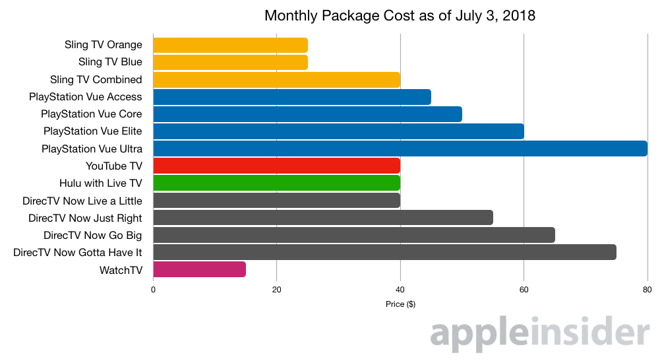
One of the first internet-only live TV services and still often considered the go-to, Dish Network’s Sling is divided primarily into “Orange” and “Blue” bundles, each costing $25 per month. The first includes 30 channels, while the second includes 42. The biggest difference is that while Blue includes Fox, NBC, and the pair’s sports networks, Orange has ESPN 1, 2, and 3. $40 merges both packages with plenty of overlap.

Instead of selling additional tiers, Sling relies on small add-ons. Most, such as Epix, “Sports Extra,” and “Best of Spanish TV,” are $5 per month. There’s a strong emphasis on international content — indeed for some people Sling may be the only way to go, since it has add-ons for countries you may not find anywhere else, like China and India.

“Premium” channels like HBO, Showtime, and Starz are also available, but usually at a higher cost. HBO for example is $15, as much as a separate HBO Now subscription, although here you get the live feed on top of on-demand content. Basketball freaks can sign up for NBA “Team Passes” that cover specific teams for $18, or the entire league for $29.

Cloud DVR support is another $5 add-on. This includes up to 50 hours of material, so you can’t go berserk picking shows and movies.

Supported Apple devices include iPhones, iPads, and the Apple TV.

PlayStation Vue

PlayStation Vue

In case there was any confusion, PlayStation Vue has long been available on more than just Sony’s PlayStation consoles. As with Sling, it’s on iPhones, iPads, and the Apple TV.

The platform is divided into four tiers: Access, Core, Elite, and Ultra. Access, priced at $45 per month, includes about 47 channels such as AMC, Cartoon Network, SyFy, and ESPN 1 and 2. Notably this includes sports networks from NBC and Fox.

Sony has a pretty hefty amount of sports content included in its default plans, and even some non-sports channels you might have a hard time finding. To sum up though, Core costs $50 for over 60 channels, Elite is $60 for 87, and Ultra is $80 for over 90. Notably, Ultra incorporates HBO and Showtime.

There are far fewer add-on options for Vue than Sling, but some include channels that are missing even from the Ultra package, such as Cinemax or some of the more niche sports channels.

Some perks of the service include up to 10 profiles, the ability to stream on as many as five devices simultaneously, and hold as much DVR content as you want for up to 28 days and 500 programs.

YouTube TV

YouTube TV

This one has just a single $40 plan, but with over 60 channels, some highlights being several ESPN options, and the four major broadcast networks: ABC, CBS, NBC, and Fox, along with a bunch of their affiliated channels. Naturally Google also tosses in YouTube Red Originals.

Showtime, Starz, Shudder, Fox Soccer Plus, and Sundance Now are the only add-ons available, so people wanting the likes of HBO will have to turn elsewhere. It also lacks important channels like Comedy Central, so keep that in mind.

As features go there isn’t much to distinguish YouTube — a subscription includes six accounts, and the ability to stream to three devices simultaneously. The biggest selling point may be its cloud DVR functions, which are practically unlimited since you can keep any and all recordings for as long as nine months.

The service was initially heavily mobile-focused, but you can now watch it on the Apple TV as well as iPhones and iPads.

Hulu with Live TV

Hulu Live TV

Hulu is a relative latecomer to live TV, but it may be hard to beat for the simple reason that $39.99 gets you not just 50-plus channels, but access to the company’s regular on-demand library, including shows and a spattering of movies. Depending on your tastes, a Hulu account could eliminate the need for separate services like Netflix.

Most of the usual suspects are present in the service’s channel lineup, but there are some conspicuous gaps, such as Comedy Central once again. And on-demand content is included in the form of a “Limited Commercials” plan, so expect to be annoyed by advertising that would you wouldn’t run into with Netflix.

All Apple devices are supported, but by default you can only stream on two devices simultaneously. Likewise, cloud DVR functions are normally restricted to 50 hours of material.

Hulu not only charges you for premium channels — $14.99 for HBO, $9.99 for Cinemax, and $8.99 for Showtime — but extra for a 200-hour DVR and/or more screens (unlimited at home, three on the road).

DirecTV Now

DirecTV Now

If you absolutely insist on having a cable-like experience, AT&T’s DirecTV Now foregoes anything like a “skinny” bundle. There are five tiers, the smallest offering over 60 channels and the biggest over 120. Every recent Apple device is compatible.

For a while the service was considered something of a bargain, so long as you were willing to put up with early disruptions and a clunky interface. AT&T has tried to clean up the experience, and as of this writing it’s even still offering a free Apple TV 4K if you’re willing to prepay for three months. Prices are going up on Aug. 1 however, such that packages will cost $40, $55, $65, and $75 — roughly aligned with the rest of the market.

The service is also relatively stingy in features, offering just a 20-hour beta DVR and charging customers $5 to stream to a third screen on top of the first two. You can however add HBO or Cinemax for just $5, while Starz and Showtime are $8 apiece.

WatchTV

WatchTV

Another AT&T offering, the newest service on this list is only $15 per month, but currently offers just 31 channels. None of these carry sports, so if you want to watch the NFL, you’re out of luck.

The main reason to subscribe to WatchTV at this stage is if you have one of AT&T’s “Unlimited &More” data plans, in which case the service is free and even lets you add one of several “premium” services at no extra cost. You can add something like HBO or Showtime, but a few non-video services are available too, such as Pandora Premium and Amazon Music Unlimited.

Which should you choose?

Monthly Package Cost July 2018

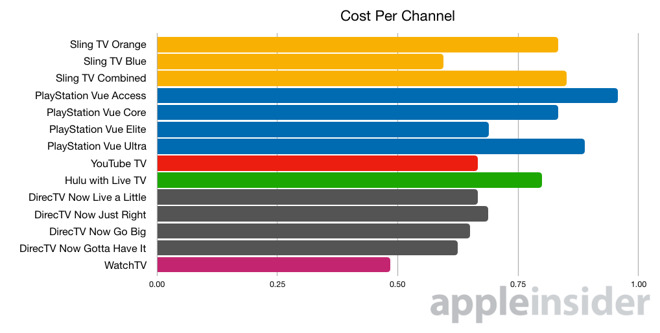
Before anything else, make sure to check that a service or package has channels you’ll actually use. Having 120 channels is meaningless if you never see most of them. Accordingly many people will probably be happy with Sling Orange or Blue, and as we said, Hulu may be appealing to people who want more on-demand content.

Cost per channel

It’s also worth evaluating whether you like the interface a service has. All of the above options are usable, but some will suit your style of viewing better than others. We found DirecTV Now to be more awkward than Sling or YouTube for example, yet your experience may vary.

We strongly recommend taking advantage of the trials each service offers before making a commitment. There’s no skin lost as long as you’re quick to cancel anything you don’t want to keep.

You may even find yourself questioning the value of live TV. Sports fans don’t have much choice, but people who only care about news, shows, and movies can possibly combine a few on-demand services and still save money — say, Netflix and HBO Now.