Posted on Leave a comment

How to Fix “ValueError: The truth value of an array with more than one element is ambiguous. Use a.any() or a.all()”

ValueError: The truth value of an array with more than one element is ambiguous. Use a.any() or a.all()

If you run the following code, you’ll experience a special ValueError:

import numpy as np
a = np.array([1, 2, 3])
b = bool(a)
print(b)

The output will be this error message:

ValueError: The truth value of an array with more than one element is ambiguous. Use a.any() or a.all()

Try It Yourself in our interactive browser shell:

Solution: Using the Numpy functions called logical_and() and logical_or() instead of Python’s logical operators (“and” and “or”) is the solution.

Why does the ValueError occur at all?

Many programmers who start learning Numpy think they can use Python’s logical operators while writing code, but the creators of this module have decided that there is not one commonly understood way to rate an array in a boolean context.

It might mean True if any element is True, or True if all elements are True, or True if the array is of non-zero length. And we only mentioned three possibilities—there are more!

Because different users may have various needs and goals, developers refused to speculate and decided to raise the ValueError each time someone tries to evaluate an array in a Boolean context, so what did they give in exchange?

Logical_and() function – the equivalent for “and”

The logical_and() function is equivalent to the Python built-in “and” logical operator. When we use this function, the program will return an array with True and False values. 

This function has two crucial parameters, i.e. our input arrays, which we put after the comma (in this example arr1 < 3 and arr_2 > 3). Let’s take a look at the example:

import numpy as np arr_1 = np.arange(5)
arr_2 = np.arange(6, 10)
arr_3 = np.array(['First', 'Second', 'Third', 'Fourth', 'Fifth']) mask = np.logical_and(arr_1 < 3, arr_2 > 3)
print(arr_3[mask])

Output:

['First' 'Second' 'Third']

The code printed the first, second and third element of the array arr_3, because it checked our conditions and it came out that the first three numbers of our arrays meet the conditions at the same time. 

Logical_or() function – the equivalent for “or”

The functionality is the same as the previous one. It also has two most important parameters—input arrays. The only difference is in the behavior of the code, after all we want to achieve something different:

import numpy as np arr_1 = np.arange(5)
arr_2 = np.arange(5, 10)
arr_3 = np.array(['First', 'Second', 'Third', 'Fourth', 'Fifth']) mask = np.logical_or(arr_1 >= 3, arr_2 < 3)
print(arr_3[mask])

As at least one of the elements in positions 4 and 5 of our arrays meets our condition, the result is as follows:

['Fourth' 'Fifth']

Logical And with “&” and Logical Or with “|”

Instead of writing logical_and() or logical_or() we can use & and | symbols. Take a look at this code: 

import numpy
arr_1 = np.arange(5)
arr_2 = np.arange(5, 10)
arr_3 = np.array(['First', 'Second', 'Third', 'Fourth', 'Fifth']) # Same functionality as logical_and
mask = np.array((arr_1 < 3) & (arr_2 > 3))
print(arr_3[mask]) # Same functionality as logical_or
mask = np.array((arr_1 >= 3) | (arr_2 < 3))
print(arr_3[mask])

Output:

['Fourth' 'Fifth']
['First' 'Second' 'Third']

any() and all()

As these two functions appear in the topic, here is a quick explanation of what they do at all!

The function any() checks if any of the elements are non-zero and all() checks if all elements are non-zero.These functions takes several parameters, but two are the most important:

  • a -> Input array or object that can be converted to an array.
  • axis -> Axis or axes along which a logical OR reduction is performed. The default (axis=None) is to perform a logical OR over all the dimensions of the input array. axis may be negative, in which case it counts from the last to the first axis.
arr_1 = np.array([[1, 2, 3, 0],[0, 1, 2, 3]]) print('Outputs of function any')
print(np.any(arr_1))
print(np.any(arr_1, axis=0))
print(np.any(arr_1, axis=1)) print('\nOutputs of function all')
print(np.all(arr_1))
print(np.all(arr_1, axis=0))
print(np.all(arr_1, axis=1))

Output:

Outputs of function any:
True
[ True True True True]
[ True True] Outputs of function all:
False
[False True True False]
[False False]

As you can see, our script checked at the beginning if any values along the axis are not zero.

Note: axis=0 is a vertical axis and axis=1 is a horizontal axis.

Summary

We learned why there is a ValueError error when we want to use the logical operators built into Python (“and” and “or”) in logical operations while using arrays. Next, there were 2 equivalents of these logical operators (“logical_and” and “logical_or”) and an even faster way to achieve the same. Finally, the function any() and all() in the Numpy module was explained.

References

Posted on Leave a comment

Python Keyboard Errors

When you’re learning and working with Python, you’re going to encounter errors and there’s no getting around that fact. So how do you get around them? It helps to learn about the errors. We’re going to take the opportunity to learn one of them today.

What is “Keyboard Interrupt”?

This is an error that you’re not likely to run across often unless you are running a Python program for more than two seconds. If your program has loops, a while loop specifically, then there might come a point when you need to stop the program. Because while loops, when not written with an ending in mind, keep going, like the Energizer Bunny.

In this example, we created a simple while loop that is loaded with print statements. If you run it, then the script will keep printing the same three statements.

Impressive, isn’t it? You can keep it going for a long time, but you might want to think about stopping it. When you press Ctrl and C, you’ll get this Exception that pops up, otherwise known as the Keyboard Interrupt.

This is one of the built-in exceptions that you’ll come across when programming in Python. Based on the hierarchy, the Keyboard Interruption exception is right towards the top, underneath Base Exception and System Exit. You can find the full hierarchy here.

Now you might be wondering if there is any way you can keep that error from popping up? Not really. It is there for a reason and it’s to stop the script from running.

Unless you want to keep it going forever. We hope your computer is built for that. However, we do know of a good way for you to clean it up a little bit.

The Try/Except method

If you’re hoping to avoid those awkward error messages that pop up when running your Python code, then this is the best route for you to go. The Try/Except method is another solid way for you to run your Python code. And you can do so without dealing with specific errors in your code

This is the simplest example that we can provide for how it works.

You put the code that you want to run underneath the try. And underneath your except is what you can enter to deal with any errors you might encounter. This can help you with larger projects. If you’re building a Twitter bot, for example, you could set it up so that it runs your code and if there’s a problem with getting the tweet out, you’ll be able to catch the error.

You might not think you’ll need it, but once you start catching errors when running your code, you’ll want to use it.

To get it to work, we’re going to make a few adjustments.

At the top of our script, we imported the Sys module, which is built-in for Python. You don’t need to install it.

Inside of our while loop, we enter our Try and Except block. Underneath Try, we put in three print statements. You’re free to put as many print statements as you want in this. If you want to make it 10, then go for it! We want you to be ambitious with your infinite time loop.

Underneath except, we just have one print statement in there. Obviously, you can do more, but that would defeat the purpose. Please don’t go crazy with your print statements.  Put them all underneath your try statement.

What we put in next, underneath our print statement, is what you would consider an exit command. And there’s more than one you can use. However, for this instance, we just chose sys.exit(). You can also import os and use the exit command for that one.

In fact, you don’t need to import any Python modules. You can just use quit() and it works just as well. But we like to be fancy sometimes.

Works pretty good, don’t you think?

Let’s Build A Time Loop

What we have now makes for a pretty good time loop. But now we can try to have a little more fun with our Python script. Let’s build it differently and see how that can work. And we’ll set it up so you can’t escape from the loop.

Now when we say you won’t escape, we mostly mean it won’t be as simple as pressing Ctrl + C on your keyboard. If you’re worried about stopping it, all you would theoretically need to do is just exit out of your command line. It would stop at that point. Of course, you’d have to start all over by re-opening your line. But let’s have some fun.

First, you’ll need to import the Time module, which is built-in already for Python. We’ll be making some sleep functions later on in our code. But first, we’re going to create the time loop function.

It will be simple. Just one print statement involved. However, you can create as many print statements as your heart desires.

The function will look like this:

Once that is done, we can make our while loop. Embedded in it will be our try and except blocks. Underneath try, we’ll include the time_loop() function, as well as our sleep function. Inside the parenthesis, you’ll want to put in how long you want the program to sleep for. It’s done in seconds. You could have it at 1, 100, 1000, 10000, whatever you want. For our example, we chose five seconds. It should be a little easier on your eyes, instead of having it go non-stop. Gives you that breath of fresh air!

While under the except one, we add another print statement. It might seem cruel to you, but hey it’s a time loop. You’re stuck! Isn’t that how time loops work, at least? We don’t know for sure. We watched Palm Springs recently and that fills up about 98% of our knowledge on the topic.

But your time loop should end up looking like this:

Pretty cool, right? You’ll have a fun and frustrating time trying to escape this time loop. Of course, like we said, you can always exit out of command line. But why take the risk? 😊

If nothing else, now is your chance to play around with the script. Have some fun. Maybe try to do something different with your time loop. Get a little creative!

Posted on Leave a comment

Replacements For Switch Statement In Python?

Summary: Since switch-case statements are not a part of Python, you can use one of the following methods to create a switch-case construct in your code :

Problem: Given a selection control switch case scenario in python; how to find a replacement for switch statement since python does not have a provision for switch-case statements.

Overview: Before we discuss the solutions to our problem, we must have a clear picture of the switch-case statement itself. To understand the switch statements let us answer a few questions :

What is a switch statement?

In programming languages like C, C++, C#, Java, etc switch is a conditional statement used to test the value of a variable and then compare this value with several cases. Once the match case is found, the block of code defined within the matched case is executed. Let us have a look at the following flowchart to visualize the working principle of switch case:

fig: switch-case statement depicting program flow when nth case is TRUE

switch vs if-else

In a program that needs a complex set of nested if statements, a switch statement is always a better and more efficient alternative in such situations. Following are some of the key factors which should be taken into consideration while deciding whether to use switch case or if-else statements in the code:

  1. If the number of cases is more, then switch-case statements are always more efficient and faster than if-else.
  2. Switch case statements are more suited for fixed data values whereas if-else conditionals should be used in case of boolean values.
  3. Switch statements check expressions based only on a single parameter / variable value whereas if-else conditional statements can be used to test expressions on a range of values.

There are a few other factors governing the proper usage of the two statements. However, that is beyond the scope of this article, as we are going to focus on the replacements for switch statements in python in this article. Now that brings us to the next and probably the most important question.

Why does Python Not Have A “switch” Statement?

Thinking Face on Facebook 2.0

You might have been wondering all the while, why are we even proposing a solution for replacing the switch statement in python. Does python not have a “switch” statement?

The answer is NO!!! Python does not need one.

  • Most programming languages have switch-case statements because they lack proper mapping constructs. While in Python, we have well-defined mapping constructs and you can easily have a mapping table in the form of a python dictionary.
  • Furthermore, Python does not have a switch statement because none of the proposals that have been suggested so far have been deemed acceptable.

#Note

Guido van Rossum says, “Some kind of switch statement is found in many languages and it is not unreasonable to expect that its addition to Python will allow us to write up certain code more cleanly and efficiently than before.” So this might indicate that in the future we might find that the switch statement is implemented in Python, though it is quite unlikely to happen anytime soon. (But the future is full of unpredictabilities!!!)

Now that we have an overview of the switch-statement, let us find out the alternatives for switch statements that can be used in python.

Solutions

Let us discuss how we can create alternatives to switch cases and ask the user to select an option for the operation they want to perform. Based on the users’ choice the output shall be displayed. Here’s a sample output of what we want to achieve:

Press 1: Addition
Press 2: Subtraction
Press 3: Multiplication
Press 4: Division Enter your choice: 1
Enter 1st Number: 500
Enter 2nd Number: 2000
Answer = 2500

So without further delay, let the games begin!

Method 1: Using A Dictionary

A dictionary in python stores items in the form of key-value pairs such that a certain value maps to a specific key. Let us have a look at the following code to understand how we can use a dictionary as an alternative to switch case and solve our problem (Please follow the comments to get a better grip on the code):

# The default case when no case matches
def default(a, b): return "Invalid Entry!" def switch(option, a, b): # create the dictionary and switch-cases / choices return { '1': lambda a, b: a + b, '2': lambda a, b: a - b, '3': lambda a, b: a * b, '4': lambda a, b: a / b, }.get(option, default)(a, b) # User Menu Prompt
print('''
Press 1: Addition
Press 2: Subtraction
Press 3: Multiplication
Press 4: Division ''')
# Accept User Entry
choice = input("Enter your choice: ")
x = int(input("Enter 1st Number: "))
y = int(input("Enter 2nd Number: "))
# Pass Values Entered by User to evaluate and then Print the output
print(switch(choice, x, y))

Output:

Press 1: Addition
Press 2: Subtraction
Press 3: Multiplication
Press 4: Division Enter your choice: 1
Enter 1st Number: 15
Enter 2nd Number: 50
Answer = 65

Things to remember:

  • get() is an in-built function in python which returns the value for a specified key.
  • lambda is a keyword in python which is used to define an anonymous function inside another function.

I would strongly recommend you to go through these articles for an in-depth understanding of lambda and python dictionary functions and their usage:

  1. Link to learn about Python Dictionaries.
  2. Link to learn about Python Lambda Function.

If you are not comfortable with the usage of get() and lambda, I have a solution for you too. Have a look at the following code which might be a little lengthier and more complex in terms of time and memory usage but is certainly easier to grasp :

# Addition
def choice1(x, y): return x + y # Subtraction
def choice2(x, y): return x - y # Multiplication
def choice3(x, y): return x * y # Division
def choice4(x, y): return x / y def switch(option, a, b): try: # create the dictionary and switch-cases / choices return { '1': choice1, '2': choice2, '3': choice3, '4': choice4, }[choice](x, y) except KeyError: # Default Case return 'Invalid Entry!' # User Menu Prompt
print('''
Press 1: Addition
Press 2: Subtraction
Press 3: Multiplication
Press 4: Division ''')
# Accept User Entry
choice = input("Enter your choice: ")
x = int(input("Enter 1st Number: "))
y = int(input("Enter 2nd Number: "))
# Pass Values Entered by User to evaluate and then Print the output
print("Answer = ", switch(choice, x, y))

Output

Press 1: Addition
Press 2: Subtraction
Press 3: Multiplication
Press 4: Division Enter your choice: 2
Enter 1st Number: 20
Enter 2nd Number: 10
Answer = 10

Method 2: Creating A Switch Class

Another workaround to use switch cases in our programs is to create a class with basic switch-case functionality defined within it. We can define each case within separate functions inside the class.

Let us have a look at the following program to understand how we can create a switch-case class (As always, I request you to read the comments within the code to get a better grip):

class SwitchCase: def case(self, option, x, y): default = "Invalid Entry!" # lambda invokes the default case # getattr() is used to invoke the function choice that the user wants to evaluate return getattr(self, 'choice' + str(option), lambda x, y: default)(x, y) # Addition def choice1(self, x, y): return x + y # Subtraction def choice2(self, x, y): return x - y # Multiplication def choice3(self, x, y): return x * y # Division def choice4(self, x, y): return x / y # Default Case def default(self, x, y): return "Invalid Entry!" # creating the SwitchCase class object
switch = SwitchCase()
# User Menu Prompt
print('''
Press 1: Addition
Press 2: Subtraction
Press 3: Multiplication
Press 4: Division ''')
# Accept User Entry
option = input("Enter your choice: ")
x = int(input("Enter 1st Number: "))
y = int(input("Enter 2nd Number: "))
# Pass Values Entered by User to evaluate and then Print the output
print("Answer = ", switch.case(option, x, y))

Output

Press 1: Addition
Press 2: Subtraction
Press 3: Multiplication
Press 4: Division Enter your choice: 4
Enter 1st Number: 24
Enter 2nd Number: 4
Answer = 6.0

Method 3: A Quick Fix Using Lambda Function

Though this method might not be the best in terms of code complexities, however, it might come in handy in situations where you want to use a function once and then throw it away after the purpose is served. Also, this method displays how long pieces of codes can be minimized, hence this method makes a worthy entry into the list of our proposed solutions.

var = (lambda x, y, c: x + y if c == '1' else x - y if c == '2' else x * y if c == '3' else x / y if c == '4' else 'Invalid Entry!') # User Menu Prompt
print('''
Press 1: Addition
Press 2: Subtraction
Press 3: Multiplication
Press 4: Division ''')
# Accept User Entry
option = input("Enter your choice: ")
x = int(input("Enter 1st Number: "))
y = int(input("Enter 2nd Number: "))
print(var(x, y, option))

Output

Press 1: Addition
Press 2: Subtraction
Press 3: Multiplication
Press 4: Division Enter your choice: 4
Enter 1st Number: 500
Enter 2nd Number: 25
20.0

Method 4: Using if-elif-else

Sometimes it is always better to follow the standard programming constructs because they provide us the simplest solutions in most cases. Using the if-elif-else might not be the exact replacement for a switch case but it provides a simpler construct and structure. Also, it avoids the problem of KeyError if the matching case is not found.

Let us have a look at the following code to understand how we can use the if-elif-else conditionals to solve our problem:

def func(choice, a, b): if choice == '1': return a + b elif choice == '2': return a - b elif choice == '3': return a * b elif choice == '4': return a / b else: return 'Invalid Entry!' # User Menu Prompt
print('''
Press 1: Addition
Press 2: Subtraction
Press 3: Multiplication
Press 4: Division ''')
# Accept User Entry
option = input("Enter your choice: ")
x = int(input("Enter 1st Number: "))
y = int(input("Enter 2nd Number: "))
print("Answer = ", func(option, x, y))

Output

Press 1: Addition
Press 2: Subtraction
Press 3: Multiplication
Press 4: Division Enter your choice: 1
Enter 1st Number: 500
Enter 2nd Number: 2000
Answer = 2500

Conclusion

In this article, we discussed how we can replace the switch case statements in our python code using python dictionary mapping or by creating a class or by applying a quick fix using a python lambda function. Having said that, the best way to implement switches in python is to use a dictionary that maps the key and value pairs.

I hope you enjoyed reading this article and after reading it you can use an alternative to switch-case in your code with ease. If you find these discussions and solutions interesting then please subscribe and stay tuned for more interesting articles in the future!

Where to Go From Here?

Enough theory, let’s get some practice!

To become successful in coding, you need to get out there and solve real problems for real people. That’s how you can become a six-figure earner easily. And that’s how you polish the skills you really need in practice. After all, what’s the use of learning theory that nobody ever needs?

Practice projects is how you sharpen your saw in coding!

Do you want to become a code master by focusing on practical code projects that actually earn you money and solve problems for people?

Then become a Python freelance developer! It’s the best way of approaching the task of improving your Python skills—even if you are a complete beginner.

Join my free webinar “How to Build Your High-Income Skill Python” and watch how I grew my coding business online and how you can, too—from the comfort of your own home.

Join the free webinar now!

Posted on Leave a comment

Python raw_input() vs input()

Summary: The key differences between raw_input() and input() functions are :

  • raw_input() can be used only in Python 2.x and is obsolete in python 3.x and above and has been renamed input()
  • In Python 2.x, raw_input() returns a string whereas input() returns result of an evaluation. While in Python 3.x input() returns a string but can be converted to another type like a number.

Overview

Before looking at the differences between raw_input() and input(), let us understand why we need them?

A user-friendly code is one that is interactive. To make a code interactive instead of hard coding values, a developer/programmer must aim to allow the user to input their own values into the program. We use the raw_input() and input() functions to accept user inputs.

Example: The following program is an example to accept user input in Python:

name = input("Please enter your full name: ")
age = input("Please enter your age: ")
# In Python2.x use raw_input() instead print("Name: ", name)
print("Age: ", age)

Output

Please enter your full name: FINXTER
Please enter your age: 25
Name: FINXTER
Age: 25

In this article, we shall be discussing the key differences between the input() and raw_input() functions. So let us jump into the mission-critical question:

Problem: What is difference between raw_input() and input() in python?

Let us have an in-depth look at each difference one by one:

Existential Difference

raw_input() input()
Inbuilt function present only in Python 2.x and is not a part of Python 3.x Inbuilt function present in both, Python 2.x and Python 3.x

Functional Difference Based on Python Versions

  Python 2.x Python 3.x
raw_input() raw_input() accepts input as it is, i.e. exactly as the input has been entered by the user and returns a string.

◆ Since it accepts the input as it is, it does not expect the input to be syntactically correct.  

raw_input() is obsolete and no longer a part of Python 3.x and above.
input() input() accepts the input from the user as a statement or expression and returns the output after evaluating the input. In other words, it accepts the user entry as raw_input(), performs an eval() on it, and then returns the result as output.

◆ It expects a syntactically correct input (statement/expression) from the user.

◆ In Python 3.x, raw_input() has been replaced by input(). This means that the input() function performs the same operation in Python 3.x as raw_input() used to do in Python 2.  

Thus input() accepts and returns a string in Python 3.x and above.   

Examples

Python 2.x

input() function

a = raw_input("What is your name? ")
print "Name: %s" %a)
b = raw_input(" Enter a mathematical expression: ")
print Output": %d", %b

Output

What is your name? Finxter
Name: Finxter Enter a mathematical expression: 2+5
Output: 2+5

raw_input() function

a = input("Enter Your Full Name: ")
print "Name: %s " %a
b = input("Enter a Mathematical Expression: ")
print "Output: %d" %b

Output

Enter Your Full Name: 'Finxter Shubham'
Name: Finxter Shubham
Enter a Mathematical Expression: 5**2
Output: 25

Python 3.x And Above

input() function

a = input("What is your name? ")
print("Name: ", a)
b = input("Enter a mathematical expression: ")
print("Output: ", b)

Output

What is your name? Finxter Shubham
Name: Finxter Shubham
Enter a mathematical expression: 3+5
Output: 3+5

Trivia

If you want to implement or leverage the functionality of input() of Python 2.x in Python 3.x and evaluate the statement entered by the user, you can use one of the following procedures:

  • Type Conversion : int(input(“Enter value”))
  • Using eval(input(“Enter Value”))

Example

a = int(input("Enter first number: "))
b = int(input("Enter second number: "))
print("Addition: ", a+b)
x = eval(input("Enter a mathematical expression: "))
print("Result: ", x)

Output:

Enter first number: 25
Enter second number: 75
Addition: 100
Enter a mathematical expression: 10**2
Result: 100

But you must avoid the usage of eval() function unless necessary because it has a severe drawback.

I would strongly recommend you to read this article in connection with this topic. It will help you have a broader understanding of this concept. Also, if you are wondering about the version of python installed in your system, you may want to have a look at this article.

Conclusion

In this article, we discussed the key differences between input() and raw_input() in terms of their functionality and existence in different versions of python along with their examples. I hope all your doubts regarding the difference between input() and raw_input() have been clarified after reading this article.

Please stay tuned and Subscribe for more interesting articles!

Where to Go From Here?

Enough theory, let’s get some practice!

To become successful in coding, you need to get out there and solve real problems for real people. That’s how you can become a six-figure earner easily. And that’s how you polish the skills you really need in practice. After all, what’s the use of learning theory that nobody ever needs?

Practice projects is how you sharpen your saw in coding!

Do you want to become a code master by focusing on practical code projects that actually earn you money and solve problems for people?

Then become a Python freelance developer! It’s the best way of approaching the task of improving your Python skills—even if you are a complete beginner.

Join my free webinar “How to Build Your High-Income Skill Python” and watch how I grew my coding business online and how you can, too—from the comfort of your own home.

Join the free webinar now!

Posted on Leave a comment

What Is Python Output Buffering and How to Disable It?

Summary: Python output buffering is the process of storing the output of your code in buffer memory. Once the buffer is full, the output gets displayed on the standard output screen. Buffering is enabled by default and you can use one of the following methods to disable it:

  • Execute the Python code with the -u command line switch, for example python -u code.py
  • Use the flush keyword
  • Use sys.stdout.flush()
  • Wrap sys.stdout in TextIOWrapper and set the buffered size to 0
  • Set PYTHONUNBUFFERED to a non-empty string

Problem: Given a Python program; how to disable output buffering?

Overview Of Python Output Buffering

Before we learn buffering in the context of Python, we should ponder upon what buffer means in real life? Let me answer this question with another question. When you are in a stressful situation, whom or what do you look up to as an option to lessen your stress? On a personal level, I look up to my friends and family. So they are my “buffer” against stress.

According to the dictionary definition, a buffer is a person or thing that reduces a shock or that forms a barrier between incompatible or antagonistic people or things. This is what exactly a buffer does when it comes to a programming language like Python (though it is not a person in this case).

In terms of computer science, you may consider buffer as a middle layer which ensures a more efficient way for data to be transferred from one location to another in the system. For example, if you are downloading a 100 MB file and 1 MB gets written at a time to the hard disk would mean that it would require a total of 100 disk writes. However, a buffer could ensure that 10 MB gets written at a time to the disk, and this way only 10 disk writes will be needed.

Advantages and Disadvantages:

From the above scenario, we learned how buffer can act as an intermediate resource and reduce the number of disk writes thereby enhancing write efficiency and memory management. However, when it comes to a programming language, buffering has a downside too. We cannot see the output in real-time. This does not make much of a difference in case of simple or short programs but in complex and long programs that require a lot of computation, this might become a major drawback since we might need a more granular output rather than the entire output being displayed at once for debugging and testing purposes.

Example: Consider the following program for which we shall compare the buffered and unbuffered outputs:

for buffer in range(20): print(buffer, end=" ")

We know that the Output is a range of numbers from 0 to 19, that is

0 1 2 3 4 5 6 7 8 9 10 11 12 13 14 15 16 17 18 19 

But we are more interested in understanding the nature of the output. If buffering is enabled you will get the output at once on the screen after waiting for 19 seconds. However, when buffering is disabled the numbers will be displayed one by one every 2 seconds.

You can try this in our interactive shell:

Exercise: Which behavior do you observe?

How To Disable Output Buffering In Python?

By default output buffering is enabled in Python. Let us have a look at the different ways in which we can disable output buffering in python.

Method 1: Running Python With -u Command Line Arguement

If you want to skip buffering for the entire program then the simplest solution to do this is to run your program using the command line interface and use the -u switch to bypass buffering. The syntax to disable buffering through the command line is:

python -u filename.py

Output

Method 2: Using The Flush Keyword

If you want to skip buffering for specific lines of your code, passing the flush keyword as an argument to the print statement is a good option. By default, the flush argument is set as False. To ensure that output buffering is disabled, the flush argument should be set to True.

Let us have a look at the following example to understand the syntax and usage of the flush keyword:

import time
for buffer in range(20): print(buffer, end=" ", flush=True) time.sleep(2)

Output

This image has an empty alt attribute; its file name is Untitled1.gif

Method 3: Using sys.stdout.flush()

Using the sys.stdout.flush() forces the program to flush the buffer. Therefore everything in the buffer will be displayed on the standard output without delay.

Let us have a look at how sys.stdout.flush() works in the following program:

import time
import sys for buffer in range(20): print(buffer, end=" ") sys.stdout.flush() time.sleep(2)

Output

This image has an empty alt attribute; its file name is Untitled1.gif

Method 4: Wrapping sys.stdout Using TextIOWrapper And Setting Buffered Size = 0

Another approach to disable the output buffering in python is to open up the stdout in write mode with buffer size set to 0 (unbuffered) and then wrapping it using TextIOWrapper to ensure that you get a TextIO stream and not a binary file object. Also, you must ensure to enable the write_through to eliminate all buffers.

Let us have a look at the following code to get a better grip on the above explanation:

# open the stdout file descriptor in write mode and set 0 as the buffer size: unbuffered
import io
import os
import sys
import time try: # open stdout in binary mode, then wrap it in a TextIOWrapper and enable write_through sys.stdout = io.TextIOWrapper(open(sys.stdout.fileno(), 'wb', 0), write_through=True) # for flushing on newlines only use : # sys.stdout.reconfigure(line_buffering=True)
except TypeError: # In case you are on Python 2 sys.stdout = os.fdopen(sys.stdout.fileno(), 'w', 0) print("Enter a Line: ")
line = sys.stdin.readline()
for i in line: print(i, end=" ") time.sleep(2)

Output

Method 5: Setting Python Environment Variable PYTHONUNBUFFERED

When the PYTHONUNBUFFERED variable is set to a non-empty string, it is equivalent to the -u command line option.

Conclusion

I hope this article helped you to get an overview of Python output buffering and the methods to disable it. Please stay tuned for more interesting articles.

Where to Go From Here?

Enough theory, let’s get some practice!

To become successful in coding, you need to get out there and solve real problems for real people. That’s how you can become a six-figure earner easily. And that’s how you polish the skills you really need in practice. After all, what’s the use of learning theory that nobody ever needs?

Practice projects is how you sharpen your saw in coding!

Do you want to become a code master by focusing on practical code projects that actually earn you money and solve problems for people?

Then become a Python freelance developer! It’s the best way of approaching the task of improving your Python skills—even if you are a complete beginner.

Join my free webinar “How to Build Your High-Income Skill Python” and watch how I grew my coding business online and how you can, too—from the comfort of your own home.

Join the free webinar now!

Posted on Leave a comment

Python One Line If Not None

To assign the result of a function get_value() to variable x if it is different from None, use the Walrus operator if tmp := get_value(): x = tmp within a single-line if block. The Walrus operator assigns the function’s return value to the variable tmp and returns it at the same time, so that you can check and assign it to variable x subsequently.

Problem: How to assign a value to a variable if it is not equal to None—using only a single line of Python code?

Example: Say, you want to assign the return value of a function get_value(), but only if it doesn’t return None. Otherwise, you want to leave the value as it is. Here’s a code example:

import random def get_value(): if random.random()>0.5: return None return 1 # Naive approach:
x = 42
tmp = get_value()
if tmp != None: x = tmp
print(tmp)

While this works, you need to execute the function get_value() twice which is not optimal. An alternative would be to assign the result of the get_value() function to a temporary variable to avoid repeated function execution:

x = 42
temp = get_value()
if temp != None: x = temp
print(x)

However, this seems clunky and ineffective. Is there a better way?

Let’s have an overview of the one-liners that conditionally assign a value to a given variable:

Exercise: Run the code. Does it always generate the same result?

Method 1: Ternary Operator + Semicolon

The most basic ternary operator x if c else y consists of three operands x, c, and y. It is an expression with a return value. The ternary operator returns x if the Boolean expression c evaluates to True. Otherwise, if the expression c evaluates to False, the ternary operator returns the alternative y.

You can use the ternary operator to solve this problem in combination with the semicolon to write multiple lines of code as a Python one-liner.

# Method 1
tmp = get_value(); x = tmp if tmp else x

You cannot run the get_value() function twice—to check whether it returns True and to assign the return value to the variable x. Why? Because it’s nondeterministic and may return different values for different executions.

Therefore, the following code would be a blunt mistake:

x = get_value() if get_value() else x

The variable x may still be None—even after the ternary operator has seemingly checked the condition.

Related articles:

Method 2: Walrus + One-Line-If

A beautiful extension of Python 3.8 is the Walrus operator. The Walrus operator := is an assignment operator with return value. Thus, it allows you to check a condition and assign a value at the same time:

# Method 2
if tmp := get_value(): x = tmp

This is a very clean, readable, and Pythonic way. Also, you don’t have the redundant identity assignment in case the if condition is not fulfilled.

Related Article: The Walrus Operator in Python 3.8

Python One-Liners Book

Python programmers will improve their computer science skills with these useful one-liners.

Python One-Liners

Python One-Liners will teach you how to read and write “one-liners”: concise statements of useful functionality packed into a single line of code. You’ll learn how to systematically unpack and understand any line of Python code, and write eloquent, powerfully compressed Python like an expert.

The book’s five chapters cover tips and tricks, regular expressions, machine learning, core data science topics, and useful algorithms. Detailed explanations of one-liners introduce key computer science concepts and boost your coding and analytical skills. You’ll learn about advanced Python features such as list comprehension, slicing, lambda functions, regular expressions, map and reduce functions, and slice assignments. You’ll also learn how to:

  Leverage data structures to solve real-world problems, like using Boolean indexing to find cities with above-average pollution
  Use NumPy basics such as array, shape, axis, type, broadcasting, advanced indexing, slicing, sorting, searching, aggregating, and statistics
  Calculate basic statistics of multidimensional data arrays and the K-Means algorithms for unsupervised learning
  Create more advanced regular expressions using grouping and named groups, negative lookaheads, escaped characters, whitespaces, character sets (and negative characters sets), and greedy/nongreedy operators
  Understand a wide range of computer science topics, including anagrams, palindromes, supersets, permutations, factorials, prime numbers, Fibonacci numbers, obfuscation, searching, and algorithmic sorting

By the end of the book, you’ll know how to write Python at its most refined, and create concise, beautiful pieces of “Python art” in merely a single line.

Get your Python One-Liners Now!!

Posted on Leave a comment

Python One Line HTTP Get

You may already know about Python’s capability to create a simple web server in a single line of Python code. Old news. Besides, what’s the point of creating a webserver that only runs on your machine? It would be far more interesting to learn how to access existing websites in a single line of code. Surprisingly, nobody talks about this in the Python One-Liners community. Time to change it!

This tutorial shows you how to perform simple HTTP get and post requests to an existing webserver!

Problem: Given the URL location of a webserver serving websites via HTTP. How to access the webserver’s response in a single line of Python code?

Example: Say, you want to accomplish the following:

url = 'https://google.com'
# ... Magic One-Liner Here...
print(result)
# ... Google HTML file: '''
<!doctype html><html itemscope="" itemtype="http://schema.org/WebPage" lang="de"><head><meta content="text/html; charset=UTF-8" http-equiv="Content-Type"><meta content="/images/branding/googleg/1x/googleg_standard_color_128dp.png" itemprop="image"><title>Google</title>... '''

You can try it yourself in our interactive Python shell:

Exercise: Does this script download the complete source code of the Google.com website?

Let’s learn about the three most important methods to access a website in a single line of Python code—and how they work!

Method 1: requests.get(url)

The simplest one-liner solution is the following:

import requests; print(requests.get(url = 'https://google.com').text)

Here’s how this one-liner works:

  • Import the Python library requests that handles the details of requesting the websites from the server in an easy-to-process format.
  • Use the requests.get(...) method to access the website and pass the URL 'https://google.com' as an argument so that the function knows which location to access.
  • Access the actual body of the get request (the return value is a request object that also contains some useful meta information like the file type, etc.).
  • Print the result to the shell.

Note that the semicolon is used to one-linerize this method. This is useful if you want to run this command from your operating system with the following command:

python -r "import requests; print(requests.get(url = 'https://google.com').text)"

The output is the desired Google website:

'''
<!doctype html><html itemscope="" itemtype="http://schema.org/WebPage" lang="de"><head><meta content="text/html; charset=UTF-8" http-equiv="Content-Type"><meta content="/images/branding/googleg/1x/googleg_standard_color_128dp.png" itemprop="image"><title>Google</title>... '''

Note that you may have to install the requests library with the following command in your operating system terminal:

pip install requests

A similar approach can be taken if you want to issue a post request:

Method 2: requests.post(url)

What if you want to post some data to a web resource? Use the post method of the requests module! Here’s a minimal one-liner example of the request.post() method:

import requests as r; print(r.post('https://example.com', {'key': 'val'}).text)

The approach is similar to the first one:

  • Import the requests module.
  • Call the r.post(...) method.
  • Pass the URL 'https://example.com' as the first parameter into the function.
  • Pass the value to be posted to the URL—in our case a simple key-value pair in a dictionary data structure.
  • Access the body via the text attribute of the request object.
  • Print it to the shell.

Method 3: urllib.request

A recommended way to fetch web resources from a website is the urllib.request() function. This also works to create a simple one-liner to access the Google website in Python 3 as before:

import urllib.request as r; print(r.urlopen('https://google.com').read())

It works similarly than before by returning a Request object that can be accessed to read the server’s response. We’re cramming everything into a single line so that you can run it from your OS’s terminal:

python -r "import urllib.request as r; print(r.urlopen('https://google.com').read())"

Congrats! You now have mastered the art of accessing websites in a single line of Python code. If you’re interested in boosting your one-liner power, have a look at my new book:

Python One-Liners Book

Python programmers will improve their computer science skills with these useful one-liners.

Python One-Liners

Python One-Liners will teach you how to read and write “one-liners”: concise statements of useful functionality packed into a single line of code. You’ll learn how to systematically unpack and understand any line of Python code, and write eloquent, powerfully compressed Python like an expert.

The book’s five chapters cover tips and tricks, regular expressions, machine learning, core data science topics, and useful algorithms. Detailed explanations of one-liners introduce key computer science concepts and boost your coding and analytical skills. You’ll learn about advanced Python features such as list comprehension, slicing, lambda functions, regular expressions, map and reduce functions, and slice assignments. You’ll also learn how to:

  Leverage data structures to solve real-world problems, like using Boolean indexing to find cities with above-average pollution
  Use NumPy basics such as array, shape, axis, type, broadcasting, advanced indexing, slicing, sorting, searching, aggregating, and statistics
  Calculate basic statistics of multidimensional data arrays and the K-Means algorithms for unsupervised learning
  Create more advanced regular expressions using grouping and named groups, negative lookaheads, escaped characters, whitespaces, character sets (and negative characters sets), and greedy/nongreedy operators
  Understand a wide range of computer science topics, including anagrams, palindromes, supersets, permutations, factorials, prime numbers, Fibonacci numbers, obfuscation, searching, and algorithmic sorting

By the end of the book, you’ll know how to write Python at its most refined, and create concise, beautiful pieces of “Python art” in merely a single line.

Get your Python One-Liners Now!!

Posted on Leave a comment

How to Create a Singleton in Python?

Master coders behave like architects that connect and build upon various design patterns to create a functional whole. One of the most important design patterns is a singleton—a class that has only one instance. You may ask: How does that look like? Let’s have a look at the code implementing a singleton in our interactive code shell:

Exercise: Try to create multiple instances of the singleton class. Can you do it?

Let’s dive into a deeper understanding of the singleton. We’ll discuss this code in our first method, so keep reading!

What’s a Singleton?

A singleton is a class that has only one instance. All variables for the class point to the same instance. It is simple and straight forward to create and use and it is one of the design patterns described by the Gang of Four. After creating the first instance, all other creations point to the first instance created. It also solves the problem of having global access to a resource without using global variables. I like this concise definition from Head First Design Patterns:

The Singleton Pattern ensures a class has only one instance, and provides a global point of access to it.

Why Would You Need a Singleton?

If you are reading this, you likely already have a possible use. Singleton is one of the Gang of Four’s Creational patterns. Read on to determine if its a good candidate for the problem you need to solve.

A singleton can be used to access a common resource like a database or a file. There is a bit of controversy on its use. In fact, the controversy could be described as outright singleton shaming. If that concerns you, I’ve listed some of the objections below with some links. In spite of all that, singletons can be useful and pythonic. From The Zen of Python (Pythonistas say Ohm):

  • Simple is better than complex
  • Practicality beats purity

Still the objections have merit and may apply to the code you are currently working on. And even if they don’t apply, understanding those objections may give you a better understanding of Object Oriented principals and unit testing.

A singleton may be useful to control access to anything that changes globally when it is used. In addition to databases and files, a singleton may provide benefit for access to these resources:

  • Logger
  • Thread pools
  • caches
  • dialog boxes
  • An Http client
  • handles to preference settings
  • objects for logging
  • handles for device drivers like printers.
  • (?) Any single resource or global collection

A singleton can be used instead of using a global variable. Global variables are potentially messy. Singletons have some advantages over global variables. A singleton can be created with eager or lazy creation. Eager creation can create the resource when the program starts. Lazy creation will create the instance only when it is first needed. Global variables will use an eager creation whether you like it or not. Singletons do not pollute the global namespace.

And finally, a singleton can be a part of a larger design pattern. It may be part of any of the following patterns:

  • abstract factory pattern
  • builder pattern
  • prototype pattern
  • facade pattern
  • state objects pattern If you have not heard of these, no worries. It won’t affect your understanding of the singleton pattern.

Implementation

The standard C# and Java implementations rely on creating a class with a private constructor. Access to the object is given through a method: getInstance()

Here is a typical lazy singleton implementation in Java:
public Singleton { private static Singleton theOnlyInstance; private Singleton() {} public static Singleton getInstance() { if (theOnlyInstance) == null){ theOnlyInstance = new Singleton() } return new Singleton(); }
}

There are many ways to implement Singleton in Python. I will show all four first and discuss them below.

Method 1: Use __new__

class Singleton: _instance = None def __new__(cls): if cls._instance is None: cls._instance = super(Singleton, cls).__new__(cls) # Initialize here. No need to use __init__().. cls.val = 0 return cls._instance def business_method(self, val): self.val = val x = Singleton()
y = Singleton()
x.val = 42
x is y, y.val

It uses the Python dunder __new__ that was added to Python to provide an alternative object creation method. This is the kind of use case __new__ was designed for

Pros:

  • I believe this implementation is the closest in spirit to the GoF implementation. It will look familiar to anybody familiar with the standard Singleton implementation.
    • Easy to understand code meaning is important for teams and maintenance.
  • Uses one class to create and implement the Singleton.

Cons:

  • In spite of its ‘correctness’ many python coders will have to look up __new__ to understand the object creation specifics. Its enough to know that
    1. __new__ instantiates the object.
    2. Code that normally goes in __init__ can be placed in __new__.
    3. In order to work correctly the overridden __new__ must call its parent’s __new__ method. In this case, object is the parent. Instantiaion happens here with this line:
      • object.__new__(class_, *args, **kwargs)

Method 2: A Decorator

def singleton(Cls): singletons = {} def getinstance(*args, **kwargs): if Cls not in singletons: singletons[Cls] = Cls(*args, **kwargs) return singletons[Cls] return getinstance @singleton
class MyClass: def __init__(self): self.val = 3 x = MyClass()
y = MyClass()
x.val = 42
x is y, y.val, type(MyClass)

Pros

  • The code to write the decorator is separate from the class creation.
  • It can be reused to make as many singletons as you need.
  • The singleton decorator marks an intention that is clear and understandable

Cons

  • The call type(MyClass) will resolve as function.
    • Creating a class method in MyClass will result in a syntax error.

If you really want to use a decorator and must retain class definition, there is a way. You could use this library:

pip install singleton_decorator

The library singleton_decorator wraps and renames the singleton class. Alternately you can write your own. Here is an implementation:

def singleton(Cls): class Decorated(Cls): def __init__(self, *args, **kwargs): if hasattr(Cls, '__init__'): Cls.__init__(self, *args, **kwargs) def __repr__(self) : return Cls.__name__ + " obj" __str__ = __repr__ Decorated.__name__ = Cls.__name__ class ClassObject: def __init__(cls): cls.instance = None def __repr__(cls): return Cls.__name__ __str__ = __repr__ def __call__(cls, *args, **kwargs): if not cls.instance: cls.instance = Decorated(*args, **kwargs) return cls.instance return ClassObject() @singleton
class MyClass(): pass x = MyClass()
y = MyClass()
x.val = 42
x is y, y.val

The output is:

(True, 42)

Interactive Exercise: Run the following interactive memory visualization. How many singleton instances do you find?

Method 3: Use Metaclass and Inherit From Type and Override __call__ to Trigger or Filter Instance Creation

class Singleton(type): _instances = {} def __call__(cls, *args, **kwargs): if cls not in cls._instances: cls._instances[cls] = super(Singleton, cls).__call__(*args, **kwargs) return cls._instances[cls] class MyClass(metaclass=Singleton): pass x = MyClass()
y = MyClass()
x.val=4
x is y, y.val

The output is as follows:

(True, 4)

Method 3 creates a new custom metaclass by inheriting from type. MyClass then assigns Singleton as its metadata:

class MyClass(metadata = Singleton):

The mechanics of the Singleton class are interesting. It creates a dictionary to hold the instantiated singleton objects. The dict keys are the class names. In the overridden __call__ method, super.__call__ is called to create the class instance. See custom metaclass to better understand the __call__ method.

Pros

  • Singleton code is separate. Multiple singletons can be created using the same

Cons

  • Metaclasses remain mysterious for many python coders. Here is what you need to know:
    • In this implementation, type is inherited:
      • class Singleton(type)
    • In order to work correctly the overridden __call__ must call its parent’s __call__ method.
      • cls._instances[cls] = super(Singleton, cls).__call__(*args, **kwargs)

Method 4: Use a Base Class

class Singleton: _instance = None def __new__(class_, *args, **kwargs): if not isinstance(class_._instance, class_): class_._instance = object.__new__(class_, *args, **kwargs) return class_._instance class MyClass(Singleton): pass
x = MyClass()
y = MyClass()
x.val=4
x is y, y.val

The output is as follows:

(True, 4)

Pros

  • Code can be reused to create more singletons
  • Uses familiar tools. (Compared to decorators, metaclasses and the __new__ method)

In all four methods, an instance is created the first time it is asked for one. All calls after the first return the first instance.

Singletons in a Threaded Environment

If your Singleton needs to operate in a multi-threaded environment, then your Singleton method needs to be made thread-safe. None of the methods above is thread-safe. The vulnerable code is found between the check of an existing Singleton and the creation of the first instance:

if cls._instance is None: cls._instance = super(Singleton, cls).__new__(cls)

Each implementation has a similar piece of code. To make it thread-safe, this code needs to be synchronized.

with threading.Lock(): if cls._instance is None: cls._instance = super(Singleton, cls).__new__(cls)


This works fine and with the lock in place, the Singleton creation becomes thread-safe. Now, every time a thread runs the code, the threading.Lock() is called before it checks for an existing instance.

If performance is not an issue, that’s great, but we can do better. The locking mechanism is expensive and it only needs to run the first time. The instance creation only happens once so the lock should happen at most one time. The solution is to place the lock after the check statement. Then add another check after the lock.

import threading
... if cls._instance is None: with threading.Lock(): if cls._instance is None: cls._instance = super(Singleton, cls).__new__(cls)

And that is how to use “Double-checked locking“.

Thread-Safe Version of Method 1

Consider the following modification of method 1:

import threading
class Singleton: _instance = None def __new__(cls): if cls._instance is None: with threading.Lock(): if cls._instance is None: cls._instance = super(Singleton, cls).__new__(cls) # Initialize here. No need to use __init__().. cls.val = 0 return cls._instance def business_method(self, val): self.val = val x = Singleton()
y = Singleton()
x.val = 42
x is y, y.val

The output is:

(True, 42)

To make it thread-safe, we added two lines of code. Each method could be made thread-safe in a similar way

Alternatives to using a Singleton

Use a Module as a Singleton (The Global Object Pattern)

In Python, modules are single, unique, and globally available. The Global Object Pattern is recommended by the Python docs. It simply means to create a separate module and instantiate your object in the module’s global space. Subsequent references just need to import it.

Use Dependency Injection

Generally, this means using composition to provide objects to dependent objects. It can be implemented in countless ways but generally, put dependencies in constructors and avoid creating new instances of objects in business methods.

The Problems With Singletons

Of all 23 patterns in the seminal 1994 book Design Patterns, Singleton is the most used, the most discussed, and the most panned. It’s a bit of a rabbit hole to sift through the thousands of blogs and Stack Overflow posts that talk about it. But after all the Singleton hating, the pattern remains common. Why is that? It’s because conditions that suggest its use are very common: One database, one config file, one thread pool …

The arguments against its use are best stated in some elegant (and old) blog posts that I cannot match. But I will give a summary and links for further reading.

Concise Summary

Paraphrased from Brian Button in Why Singletons are Evil:

  1. They are generally used as a global instance, why is that so bad? Because you hide the dependencies of your application in your code, instead of exposing them through the interfaces. Making something global to avoid passing it around is a code smell. (That is some effective name-calling. Whatever code smell is, it makes me cringe just a bit and wrinkle my nose as I imagine it).
  2. They violate the single responsibility principle: by virtue of the fact that they control their own creation and lifecycle.
  3. They inherently cause code to be tightly coupled. This makes faking them out under test rather difficult in many cases.
  4. They carry state around for the lifetime of the application. Another hit to testing since you can end up with a situation where tests need to be ordered which is a big no no for unit tests. Why? Because each unit test should be independent from the other.

Should You Use Singletons in Your Code?

If you are asking yourself that based on the other peoples’ blogs, you are already in the rabbit hole. The word ‘should’ is not welcome in code design. Use singletons or not and be aware of possible problems. Refactor when there are problems.

Possible Problems to Consider

Tools are for people who know how to use them. In spite of all the bad stuff written about Singletons, people still use them because:

  1. They fill a need better than the alternatives.

and / or

  1. They don’t know any better and they are creating problems in their code by using them.

Avoid problems. Don’t be in group 2.

Problems with Singletons are caused because they break the single responsibility rule. They do three things:

  1. Guarantee only a single instance exists
  2. Provide global access to that instance
  3. Provide their own business logic.
  • Because they break the single responsibility rule, Singletons may be hard to test
    • Inversion of control IoC and dependency injection are patterns meant to overcome this problem in an object-oriented manner that helps to make testable code.
  • Singletons may cause tightly coupled code. A global instance that has an inconstant state may require an object to depend on the state of the global object.
  • It is an OO principal to Separate Creational Logic from Business Logic. Adhering to this principle “Singletons should never be used”. Again with the word should. Instead, Be Yoda: “Do or do not!“. Base the decision on your own code.
  • Memory allocated to a Singleton can’t be freed. This is only a problem it the memory needs to be freed.
    • In a garbage collected environment singletons may become a memory management issue.

Further Study

Meta notes — Miško Hevery.

Hevery worked at Google when he wrote these blogs. His blogs were readable, entertaining, informative, provocative, and generally overstated to make a point. If you read his blogs, be sure to read the comments. Singletons are Pathological Liars has a unit testing example that illustrates how singletons can make it difficult to figure out dependency chains and start or test an application. It is a fairly extreme example of abuse, but he makes a valid point:

Singletons are nothing more than global state. Global state makes it so your objects can secretly get hold of things which are not declared in their APIs, and, as a result, Singletons make your APIs into pathological liars.

Of course, he is overstating a bit. Singletons wrap global state in a class and are used for things that are ‘naturally’ global by nature. Generally, Hevery recommends dependency injection to replace Singletons. That simply means objects are handed their dependencies in their constructor.

Where have all the singletons gone makes the point that dependency injection has made it easy to get instances to constructors that require them, which alleviates the underlying need behind the bad, global Singletons decried in the Pathological Liars.

Meta notes — Brandon Rhodes The Singleton Pattern

Python programmers almost never implement the Singleton Pattern as described in the Gang of Four book, whose Singleton class forbids normal instantiation and instead offers a class method that returns the singleton instance. Python is more elegant, and lets a class continue to support the normal syntax for instantiation while defining a custom __new__() method that returns the singleton instance. But an even more Pythonic approach, if your design forces you to offer global access to a singleton object, is to use The Global Object Pattern instead.

Meta notes — J.B. Rainsberger Use your singletons wisely

Know when to use singletons, and when to leave them behind

J.B. Rainsberger

Published on July 01, 2001 Automated unit testing is most effective when:

  • Coupling between classes is only as strong as it needs to be
  • It is simple to use mock implementations of collaborating classes in place of production implementations
Singletons know too much

There is one implementation anti-pattern that flourishes in an application with too many singletons: the I know where you live anti-pattern. This occurs when, among collaborating classes, one class knows where to get instances of the other.

Towards acceptible singletons

Singleton abuse can be avoided by looking at the problem from a different angle. Suppose an application needs only one instance of a class and the application configures that class at startup: Why should the class itself be responsible for being a singleton? It seems quite logical for the application to take on this responsibility, since the application requires this kind of behavior. The application, not the component, should be the singleton. The application then makes an instance of the component available for any application-specific code to use. When an application uses several such components, it can aggregate them into what we have called a toolbox.

Meta notes — Mark Safayan Singleton anti pattern

Instead of using this pattern, simply instantiate a single instance and propagate it to places that use the object as a parameter to make the dependency explicit.

Posted on Leave a comment

Hello World! A Python One-Liner to Get Started with Python Quickly

The “hello world program” is used in programming languages to set up a minimal programming environment and execute the first trivial program in it. It helps you get your environment going and take your first steps towards a more complicated program. This short tutorial will show you the fastest possible way to write your first hello world program — as a Python one-liner!

Before I show you how to install Python on your computer, follow the following steps to run your first Python "hello world" program in your browser!

Run Your Hello World One-Liner in Your Browser Shell

Step 1: Here’s an interactive browser-based shell:

The shell runs any Python program in your browser.

Step 2: Type the print function in your browser shell with opening and closing parentheses that are initially empty:

print()

The print() function takes a string and prints it to your shell. This way, you can generate outputs in your program. Think about it: a Python program is only a means to an end. It transform an input to an output. One way of creating an output is to print program values to the shell. In our hello world one-liner, the output is the textual data (=string) 'hello world'.

Step 3: Pass the 'hello world' string into the print() function between the parentheses.

print('hello world')

Congratulations, your first hello world one-liner is ready! Now, there’s only one thing left:

Step 4: Run the hello world one-liner program by hitting the “Run” symbol ▶.

Can you see the output generated by your program? When running your program in the interactive shell, the result should be the following output:

hello world

Make sure that you see this output in your shell before you move on!

Install Python on Your Computer

Now, you know how to run your first program. If you want to start your first serious project though, you’ll need Python on your local machine.

Follow these seven steps to install Python on your computer (Windows):

  1. Visit website “Python Releases for Windows”: https://www.python.org/downloads/windows/
  2. Click link “Download Windows x86-64 executable installer” under “Stable Releases” header.
  3. A popup opens. Click “Save File”.
  4. Wait until the download completes and double click on the installer file to run it.
  5. Another popup appears. Select “Add Python to Path” and click “Install Now”.
  6. Wait until the installation completes “Setup was successful”.
  7. You can now use Python on your Windows computer: use the Windows Search for “IDLE” and open the standard Python editor to start coding.

The steps are almost identical for MacOS and Linux, you can figure them out easily. In this video, I’ll guide you through the process in a step-by-step manner:

Related Article: 7 Steps to Set Up Python on Windows

Learn the Python Basics

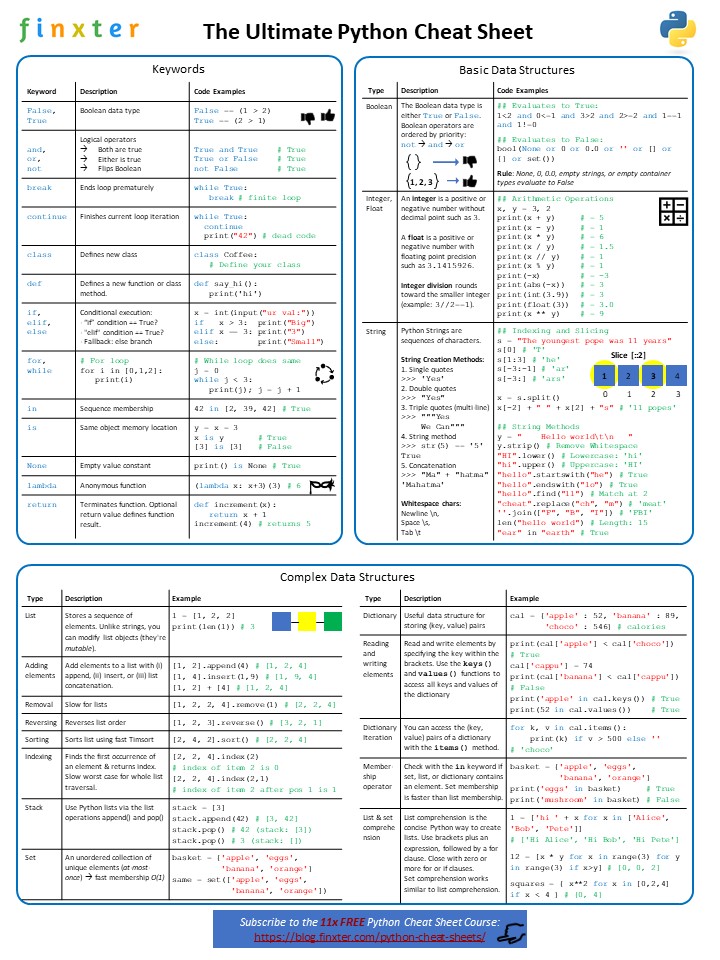
An excellent way to start learning Python is through Python cheat sheets. They focus on the relevant parts and introduce the most important concepts in the shortest possible time. Here’s such a Python cheat sheet for you:

Python Ultimate Cheat Sheet

You can download this and more cheat sheets in my interactive Python email course (that’s also 100% free). Check it out for continuous improvement in Python by reading a series of course email lessons I’ll send you into your INBOX. Free Python cheat sheets are included!

*** Join FREE Python Cheat Sheet Email Academy ***

Posted on Leave a comment

Python One Line FizzBuzz

The FizzBuzz problem is a common exercise posed in code interviews to test your proficiency in writing simple Python code.

Problem: Print all numbers from 1-100 to the shell with three exceptions:

  • For each number divisible by three you print "Fizz",
  • For each number divisible by five you print "Buzz", and
  • For each number divisible by three and five you print "FizzBuzz".

Example: The first 15 numbers of the FizzBuzz sequence are the following.

1
2
Fizz
4
Buzz
Fizz
7
8
Fizz
Buzz
11
Fizz
13
14
FizzBuzz
...

How to write a Python one-liner that solves this problem?

Here’s an interactive overview:

Exercise: Do both one-liners produce the same results? Run the code to check!

Let’s dive into those one-liners to gain a deeper understanding and improve your Python skills!

FizzBuzz One-Liner 1: Generator Expression + String Concatenation + Short Circuiting

The following one-liner solves the problem in an elegant way using a fine understanding of more advanced Python features (source).

print('\n'.join('Fizz' * (i%3==0) + 'Buzz' * (i%5==0) or str(i) for i in range(1,101)))

The one-liner creates a string using the join function with the newline character as a delimiter. Here’s a short explanation of the function:

The string.join(iterable) method concatenates all the string elements in the iterable (such as a list, string, or tuple) and returns the result as a new string. The string on which you call it is the delimiter string—and it separates the individual elements. For example, '-'.join(['hello', 'world']) returns the joined string 'hello-world'.

So, what’s the iterable, you pass into the join() function? It’s a generator expression of the form: expression for variable in context. You go over all integer values in the context 1 to 100 using the range() function. So, you obtain the remaining expression for i in range(1, 101). What’s the expression part?

It consists of three elements:

  • 'Fizz' * (i%3==0) — The modulo expression i%3==0 returns True only if the integer i is divisible by 3, otherwise it returns False. So, you multiply the string 'Fizz' either with True (=1) or with False (=0). As a result, you obtain the empty string '' in all cases except if the integer i is divisible by 3—in which case you obtain the string 'Fizz'.
  • 'Buzz' * (i%5==0)— The modulo expression i%5==0 returns True only if the integer i is divisible by 5, otherwise it returns False. So, you multiply the string 'Buzz' either with True (=1) or with False (=0). As a result, you obtain the empty string '' in all cases except if the integer i is divisible by 5—in which case you obtain the string 'Buzz'.
  • You use string concatenation to glue together the previously obtained strings. In most cases, this will be the empty string. If i is divisible by 3, you obtain the string 'Fizz'. If i is divisible by 5, you obtain the string 'Buzz'. And if i is divisible by 3 and 5, you obtain the string 'FizzBuzz'.
  • or str(i) — In the case you obtained a non-empty string in {'Fizz', 'Buzz', 'FizzBuzz'} in the previous step, the or operation simply returns this string. This is called short circuiting—and it’s used in many programming languages such as Python to improve efficiency of logical operations.
  • But if the string is empty, it is interpreted as a logical False. Thus, Python returns the second operand of the or operation. The second operand simply is the string representation of the integer i.

A very interesting implementation of the FizzBuzz problem indeed!

FizzBuzz One-Liner 2: Slicing

An alternative is given in the following nice one-liner (source):

for i in range(1, 101): print('FizzBuzz'[i*i%3*4:8--i**4%5] or i)

Wow—what a short and concise one-liner solution! But how does it work?

  • You iterate over all values from i=1 to i=100 and print a string. So far so good.
  • You use the or operation and slicing to determine the string 'FizzBuzz'[start:end] or i generates the output.
  • You use the property of short circuiting in Python: If 'FizzBuzz'[start:end] is empty, the integer i is returned, otherwise, the non-empty string is returned.
  • You carve out a substring from 'FizzBuzz' using slicing as follows.

Slicing is a concept to carve out a substring from a given string. Use slicing notation s[start:stop:step] to access every step-th element starting from index start (included) and ending in index stop (excluded). All three arguments are optional, so you can skip them to use the default values (start=0, stop=len(lst), step=1). For example, the expression s[2:4] from string 'hello' carves out the slice 'll' and the expression s[:3:2] carves out the slice 'hl'.

In the example, you have the slicing operation 'FizzBuzz'[i*i%3*4:8--i**4%5].

  • start = i*i%3*4 — Note that the multiplication * and modulo operation % have the same priority, so they are evaluated from left to right. If integer i is divisible by 3, i*i is also divisible by 3, and the start index is 0. In all other cases, the start index is 4. Thus, the slice either starts with 'Fizz' or 'Buzz'.
  • stop = 8--i**4%5 — This is 4 in all cases except if the number i is divisible by 5, in which case this is 8.

So, there are four cases:

  • The number is divisible only by 3: start=0, stop=4 –> 'Fizz'
  • The number is divisible only by 5: start=4, stop=8 –> 'Buzz'
  • The number is divisible by both 3 and 5: start=0, stop=8 –> 'FizzBuzz'
  • The number is divisible by neither 3 nor 5: start = 4, stop=4 –> ''

Phew! This was a hard nut to crack, wasn’t it?

Python One-Liner 3: Map + Lambda

You can find detailed tutorials on the map and lambda functions here:

Those two functions can be used to solve the FizzBuzz problem (source):

print(list(map(lambda i: "Fizz"*(i%3==0)+"Buzz"*(i%5==0) or str(i), range(1,101))))

It’s similar to Method 1 and by now you’re able to figure it out. Think of the different values the integer i can take.

Python One-Liners Book

Python programmers will improve their computer science skills with these useful one-liners.

Python One-Liners

Python One-Liners will teach you how to read and write “one-liners”: concise statements of useful functionality packed into a single line of code. You’ll learn how to systematically unpack and understand any line of Python code, and write eloquent, powerfully compressed Python like an expert.

The book’s five chapters cover tips and tricks, regular expressions, machine learning, core data science topics, and useful algorithms. Detailed explanations of one-liners introduce key computer science concepts and boost your coding and analytical skills. You’ll learn about advanced Python features such as list comprehension, slicing, lambda functions, regular expressions, map and reduce functions, and slice assignments. You’ll also learn how to:

  Leverage data structures to solve real-world problems, like using Boolean indexing to find cities with above-average pollution
  Use NumPy basics such as array, shape, axis, type, broadcasting, advanced indexing, slicing, sorting, searching, aggregating, and statistics
  Calculate basic statistics of multidimensional data arrays and the K-Means algorithms for unsupervised learning
  Create more advanced regular expressions using grouping and named groups, negative lookaheads, escaped characters, whitespaces, character sets (and negative characters sets), and greedy/nongreedy operators
  Understand a wide range of computer science topics, including anagrams, palindromes, supersets, permutations, factorials, prime numbers, Fibonacci numbers, obfuscation, searching, and algorithmic sorting

By the end of the book, you’ll know how to write Python at its most refined, and create concise, beautiful pieces of “Python art” in merely a single line.

Get your Python One-Liners Now!!