Posted on Leave a comment

How to Scan for Bluetooth Devices with Python Library

5/5 – (1 vote)

In today’s connected world, knowing how to interact with Bluetooth devices is a valuable skill. Python is a popular and versatile programming language that can help you scan and connect to Bluetooth devices. Using a library called PyBluez, you can easily discover nearby Bluetooth-enabled devices, making it a perfect choice for beginners and advanced programmers. πŸ“±πŸ’»

πŸ’‘ PyBluez is a popular Python library that allows developers to create Bluetooth applications and interact with nearby devices. With this library, you can scan for nearby devices, establish connections, and send and receive data. The library is compatible with various platforms, including Windows, Linux, and macOS. 🌎

To start scanning for Bluetooth devices with Python and PyBluez, you must install the required packages and import the necessary modules before writing your code. Scanning for devices is simple and intuitive, making it easy for programmers to integrate Bluetooth functionalities into their projects. So, gear up to explore the world of wireless communication with Python! 🐍✨

Prerequisites

Before diving into scanning for Bluetooth devices using Python, let’s make sure you have the necessary setup in place. This section guides you through setting up your Python environment and installing the Pybluez library. πŸ› 

Python Environment Setup

To get started, ensure that you have Python installed on your machine. For this tutorial, we recommend using Python version 3.6 or higher. You can check your Python version by running the following command in your terminal:

python --version

If you don’t have Python installed or need to upgrade, visit the official Python website to download the latest version.

Next, you’ll want to set up a virtual environment. This creates an isolated environment to install Python packages, ensuring that your projects don’t interfere with each other or with the system Python installation:

python -m venv venv
source venv/bin/activate # or "venv\Scripts\activate" on Windows

With your environment set up, you can move on to installing Pybluez. πŸš€

Installing Pybluez

Pybluez is a Python library that provides a simple interface for working with Bluetooth devices. To install it, you’ll need to use pip, the Python package manager:

pip install pybluez

πŸ’‘ If you don’t have pip installed, you can follow our full guide on the Finxter blog.

Great! Now you have a Python environment with the Pybluez library installed, you’re all set to start scanning for Bluetooth devices. In the next sections, you’ll learn how to use Python and Pybluez to detect nearby devices and manipulate Bluetooth services. πŸ’»πŸ”

Discovering Bluetooth Devices

This section will discuss how to scan for Bluetooth devices using the Python programming language. We’ll explore the Pybluez library, discover devices using the discover_devices function, and fetch device names with the lookup_names function. 🌐🐍

Using Pybluez Library

Pybluez is a popular Python library that simplifies working with Bluetooth devices. You can easily install it using pip, the Python package manager:

pip install pybluez

With Pybluez installed, you can now access various features for Bluetooth devices, such as scanning, connecting, and retrieving information. πŸ“‘

Discovering Devices with Discover_Devices

To discover nearby Bluetooth devices, use the discover_devices function of the Pybluez library. This function returns a list of device addresses.

Here is a simple example to get started:

import bluetooth nearby_devices = bluetooth.discover_devices()
print("Found %d devices" % len(nearby_devices))

This code snippet initiates a Bluetooth scan, and when the scan is complete, prints the number of devices found. πŸŒŸπŸ”

Fetching Device Names with Lookup_Names

After discovering the available devices, you can retrieve their names using the lookup_names function. Here’s a code snippet that demonstrates how to use lookup_names in combination with discover_devices:

import bluetooth print("Performing inquiry...")
nearby_devices = bluetooth.discover_devices(lookup_names=True)
print(f"Found {len(nearby_devices)} devices.") for addr, name in nearby_devices: print(f"Address: {addr}, Name: {name}")

This code initiates a Bluetooth scan and returns a list of tuples containing the address and name of each discovered device. The results are printed in a human-readable format, making it easy to identify nearby devices. πŸ“±πŸ–₯

Platform Compatibility

Next, we’ll discuss the platform compatibility of scanning for Bluetooth devices using Python libraries. We’ll cover Linux Support and Windows Support.

Linux Support

For Linux, the recommended library is pybluez2. Pybluez2 provides an easy-to-use interface for scanning and connecting to Bluetooth devices on Linux systems.

To install pybluez2, simply run the following command:

pip install pybluez2

Once installed, you can use it to scan for nearby devices and open Bluetooth sockets πŸ‘.

Windows Support

On the Windows platform, PyBluez is a popular choice for working with Bluetooth devices in Python. It works well with Windows and can be installed by running:

pip install pybluez

Additionally, you can use the pygatt library to communicate with BLE devices on Windows. Install with:

pip install pygatt

Using these libraries, you can effectively scan and communicate with Bluetooth devices on both Linux and Windows platforms πŸ–₯.

Remember to keep your code updated and use the appropriate library for your specific platform, ensuring a smooth and efficient experience while working with Bluetooth devices in Python.

Bluetooth Low Energy Scanning

This section will focus on how Bluetooth Low Energy (BLE) scanning works using Python libraries. We’ll dive into the details of BLE and its differences from Bluetooth Classic. This will help you understand how to scan for devices using Python more effectively. πŸš€

Exploring Bluetooth LE

Bluetooth Low Energy, or BLE, is a low-power wireless technology designed for short-range communication between devices.

One of the key features of BLE is its ability to send and receive advertisements, which are small packets of data broadcasted by devices that contain necessary information such as MAC addresses and service identifiers.

Scanning for BLE devices with Python can be achieved using libraries like gattlib or bleak. These libraries streamline discovering and connecting to BLE devices, giving you the power to interact with and manage Bluetooth LE connections.

Differences from Bluetooth Classic

BLE differs from Bluetooth Classic in several ways, making it a more suitable option for applications that require low power consumption and efficient wireless communication. Some key differences include:

  • ⏱ Power consumption: BLE is designed with power efficiency in mind, making it ideal for battery-operated devices or IoT applications.
  • πŸ“Ά Range: Bluetooth Classic offers a longer range, but BLE provides shorter range communication, focusing on minimizing power consumption.
  • πŸ“˜ Protocol: Bluetooth Classic uses a complex protocol stack, while BLE employs a simpler protocol, allowing for quicker and lighter device connections.
  • 🏎 Connection speed: BLE connects much faster than Bluetooth Classic, making it more suitable for applications that need frequent connectivity changes.

By understanding these differences, you’ll be better equipped to choose the appropriate technology and Python library for your specific project needs.

Whether you’re working with BLE or Bluetooth Classic, leveraging Python libraries will simplify scanning for and connecting to other devices. 🌐

Pairing and Connecting Devices

This section will explore how to pair and connect Bluetooth devices using Python libraries. We’ll provide a general understanding of the pairing process and explain how to establish connections using Python sockets.

Understanding the Pairing Process πŸ˜ƒ

Pairing is establishing a connection between two Bluetooth devices, ensuring they are authenticated and have the required permissions to interact with each other. This usually involves exchanging a passkey or using an “out-of-band” method, such as Near Field Communication (NFC).

  1. Device A initiates the process by sending a pairing request to Device B.
  2. Device B receives the request and either accepts or rejects it.
  3. If accepted, both devices exchange authentication keys and establish a secure connection.

Connecting using Python Sockets πŸš€

Python provides a powerful and flexible way to establish connections between Bluetooth devices using sockets. These are virtual communication channels enabling data exchange between devices.

First, install the PyBluez library to utilize Bluetooth functionality in Python.

pip install PyBluez

Create a socket to establish a connection between two Bluetooth devices:

import bluetooth server_socket = bluetooth.BluetoothSocket(bluetooth.RFCOMM)

You can bind the server socket to a specific address and port, and start listening for incoming connections:

server_socket.bind(("", bluetooth.PORT_ANY))
server_socket.listen(1)

To accept incoming connections and initiate data exchange, use the following code:

client_socket, client_address = server_socket.accept()
print(f"Accepted connection from {client_address}")
data_received = client_socket.recv(1024)

Close the connection once the data exchange is completed:

client_socket.close()
server_socket.close()

Advanced Topics

In this section, we will explore using a Raspberry Pi for Bluetooth device scanning and the application of Python libraries in Covid-19 contact tracing.

We will discuss the benefits, implementation, and requirements for using these advanced tools in your project.

Using Raspberry Pi for Scanning

Raspberry Pi can be a powerful tool for scanning Bluetooth devices when properly equipped with a Python library. Utilizing the pybluez library, a Raspberry Pi can search for active Bluetooth devices and expand its functionality.

Some benefits of using Raspberry Pi for scanning include:

  • Compact and portable design 🌟
  • Affordable and easy to use
  • Highly customizable with various Python libraries

However, there are a few requirements to set up your Raspberry Pi for scanning:

  1. A compatible Raspberry Pi model with Bluetooth capabilities
  2. The Pybluez library installed
  3. A Python script that uses Pybluez for scanning

After meeting these requirements, you can start exploring Bluetooth scanning capabilities with Raspberry Pi, opening up new possibilities for your projects.

πŸ’‘ Recommended: Getting Started With Thonny – The Optimal IDE for the Raspberry Pi Pico

Application in Covid-19 Contact Tracing

Python libraries and Bluetooth scanning can play a crucial part in Covid-19 contact tracing efforts.

Using Bluetooth signals to detect nearby devices makes it possible to estimate the proximity between individuals, helping to identify potential exposure risks.

Key concepts in using Python and Bluetooth scanning for contact tracing include:

  • Developing an app or software that uses a Python library for Bluetooth scanning πŸ“±
  • Collecting anonymous encrypted data from nearby devices
  • Analyzing device proximity to determine potential exposure risks

By putting these concepts into practice, Python and Bluetooth scanning can contribute to contact tracing methods, helping in the fight against the spread of infectious diseases. Implementing this technology may keep people safe and provide valuable data for health officials during a pandemic.

Licensing and Limitations

PyBluez is distributed under the GNU General Public License (GPL), which allows you to use, modify, and distribute the library as long as the same license terms are applied to your software. More information about the license can be found on the PyBluez PyPI page. Adhering to the license terms is crucial when using open-source software like PyBluez. πŸ”

Regarding limitations, it is essential to be aware of the compatibility of PyBluez with your platform.

While PyBluez supports both Windows and Linux operating systems, you might face some challenges with Mac OS.

Additionally, it is important to keep in mind that PyBluez primarily focuses on classic Bluetooth and not Bluetooth Low Energy (BLE) devices. Thus, in case your project targets BLE devices, you may need to look for alternative libraries like Adafruit’s BLE library. 🌐

Lastly, ensure that your Python version is compatible with the PyBluez library. Regular updates to the library are necessary to maintain compatibility with newer Python versions and to leverage bug fixes from the community. Staying updated ensures you have a smooth development experience with minimal issues. πŸ”„

Conclusion

Scanning for Bluetooth devices using Python is simple with the help of libraries such as PyBluez and Bleak. Following the provided examples, one can efficiently develop an application to discover nearby Bluetooth devices and even incorporate communication between them. πŸ’‘

Working with Python and Bluetooth allows for the creation of various applications, like remote monitoring or automation. It’s essential to have a solid understanding of both Python programming and Bluetooth technology to develop useful solutions. πŸ–₯

Always test your code thoroughly, ensuring it works with various Bluetooth devices and operating systems. This way, you can create a robust and reliable application. Good luck on your Python and Bluetooth journey! πŸš€

If you want to improve your skills in Python, check out our free email academy and download our Python cheat sheets:

Posted on Leave a comment

Top 20 Profitable Ways to Make Six Figures Online as a Developer (2023)

4/5 – (1 vote)

In today’s digital world, you have numerous opportunities to make money online, especially as a programmer.

With your unique skill set, there are various ways to monetize your passion and expertise to generate a six-figure income. Yeah, coders in the US make six figures on average!

The comfort and freedom of working from home have become increasingly attractive to professionals, including programmers. πŸ’» This article explores 20+ profitable avenues as you embark on your journey to achieving financial success.

Whichever idea you want to pursue, remember that consistency and dedication are key. Any idea will work — but you cannot pursue every one! Stay focused!

As you delve into the potential six-figure earning possibilities, it’s essential to always be open to learning and adapting. The world of technology constantly evolves, and you need to stay up-to-date with the latest trends and innovation such as AI and blockchain development.

You can do so by joining our free email newsletter on tech and programming:πŸ‘‡

Freelancing as a Programmer

Upwork and Fiverr

As a programmer, one of the most flexible ways to make money online is through freelancing 😊.

βœ… Recommended: Become a Python Freelancer Course

You can start your journey by creating profiles on platforms like Upwork and Fiverr. These platforms allow you to showcase your skills and attract potential clients looking for your expertise.

By bidding on projects that interest you, you can earn a substantial income while working on exciting tasks.

Remote Work and Work from Home

Embracing remote work and work-from-home opportunities can significantly boost your earnings. Many organizations prefer hiring remote developers, which means you have access to a global pool of jobs πŸ’Ό.

Searching for remote work on job boards and company websites can lead you to high-paying positions that match your qualifications.

Building a Portfolio

A crucial step in making six figures online as a freelance programmer is building a strong portfolio. Your portfolio should demonstrate your skills, past projects, and client testimonials 🌟.

Displaying your portfolio on personal websites or portfolio platforms can help you gain more visibility and attract clients. Make sure to update your portfolio regularly with your latest completed projects and achievements to showcase continuous growth in your field.

Remember, a well-maintained portfolio is your ticket to grabbing the attention of potential clients and landing those lucrative freelance gigs.

πŸ’‘ Recommended: How I Designed a Personal Portfolio Website with Django

Online Courses and Training

As a programmer, you have numerous ways to generate a six-figure income online. One of the most lucrative and rewarding options is online courses and training. You can share your programming knowledge with others while making a significant income.

This section will explore two sub-sections: creating and selling online courses and teaching on platforms like Udemy. πŸš€

Creating and Selling Online Courses

Creating your own online courses is a fantastic way to showcase your expertise and foster a loyal audience.

To ensure success, validate your course idea by asking questions, conducting polls, and tracking responses. Once you’ve gathered feedback, develop content based on the solutions you have devised, and continually test it.

Moreover, you can use affiliate programs to incentivize your most devoted fans to promote your course. You’ll not only expand your reach but also share your earnings with those who have contributed to your growth. πŸ˜„

Teaching on Platforms Like Udemy

Teaching programming courses on platforms such as Udemy offers numerous benefits. They already have an established audience, so you won’t have to invest much time or resources in marketing your courses.

Your success will depend on your ability to produce high-quality content that resonates with students.

To build a successful course on Udemy, consider the following tips:

  • Design a beautiful, engaging course that students will find valuable
  • Use the platform’s built-in support and resources to optimize your course structure
  • Launch your course, even if you don’t have a large audience, and gradually build it up

Developing and selling your programming courses will help you establish a fruitful career, earn a six-figure passive income, and share your valuable knowledge with the online community.

Now, it’s up to you to embrace the opportunities and make the most of your skills. 🌟

Blogging and Content Creation

As a programmer, you can make a substantial income through blogging and creating high-quality content. This section will cover starting a blog on WordPress, technical writing, and publishing ebooks.

All of these options let you leverage your programming expertise to potentially earn six figures online πŸ’°.

Starting a Blog on WordPress

If you want to share your knowledge and experiences as a developer, starting a blog on WordPress is a great idea. Here’s a quick guide to help you set up your blog:

  1. Choose your niche, focusing on your preferred programming languages or topics related to your field of expertise 🎯.
  2. Select a domain name relevant to your content and niche.
  3. Sign up for a WordPress hosting service, such as Bluehost or SiteGround.
  4. Install WordPress and customize your blog with a professional theme and essential plugins πŸ”Œ.
  5. Create high-quality, engaging content to attract readers and build a loyal audience.

Remember to promote your blog on social media, programming forums, and other online platforms to grow your readership πŸ“ˆ.

Technical Writing

Technical writing is another way for programmers to make six figures online. As a technical writer, you can create content like:

  • User guides for software and applications
  • Programming language tutorials
  • API documentation
  • Software release notes

To succeed in technical writing, focus on enhancing your writing skills and staying up-to-date with the latest trends and technologies in your field. You can also enroll in courses, join online communities of technical writers, and attend relevant events and webinars πŸŽ“.

Ebooks

Publishing ebooks is a fantastic way to monetize your programming knowledge. To get started, you can write ebooks on popular topics like:

  • Mastering a specific programming language
  • Building web applications or mobile apps
  • Best practices in software development
  • Tips and tricks for programmers

When writing ebooks, always aim for clarity and simplicity. Use real-world examples and practical tips to make your content more useful and engaging. You can publish your ebooks on platforms like Amazon Kindle Direct Publishing (KDP) or Gumroad for maximum exposure πŸ“š.

Keep your content fresh and relevant in all of these areas, and with persistence and dedication, you could see yourself making a substantial income from blogging and content creation as a programmer!

Affiliate Marketing and Advertising

As a programmer, you can leverage your skills and knowledge to create an income stream through affiliate marketing and advertising. This section will explore a couple of tried-and-tested ways involving Amazon and web hosting affiliate programs, and Google Adsense with ad revenue.

While finding the right approach for you may require some experimentation, the following information should provide you with some valuable insights. πŸ’‘

Amazon and Web Hosting Affiliate Programs

If you’re well-versed in the world of e-commerce or regularly recommend products to your network, consider joining the Amazon Associates Program. With their extensive selection of products, you could earn a commission for every purchase made through your affiliate links.

Web hosting services, such as Bluehost and SiteGround (these are not affiliate links πŸ˜‚), also offer affiliate programs that can help you earn impressive commissions. Promote the hosting services you genuinely trust, and watch your earnings grow. πŸ’Έ

Here are some ideas to get started with affiliate programs:

  • Write blog posts reviewing popular products
  • Share your product recommendations on social media platforms
  • Create product comparison articles
  • Develop tutorials using the hosting services you recommend

Google Adsense and Ad Revenue

Google Adsense is a popular ad network that can help you earn passive income through display advertising. This ad network serves highly targeted ads to your website visitors. To make this approach successful, you’ll need a website with substantial traffic and valuable content.

Prep your site for Google Adsense with these steps:

  1. Create engaging, SEO-optimized content ✍
  2. Apply for Google Adsense and get approval πŸ“œ
  3. Implement ads on your site and monitor your earnings πŸ“Š

Remember that while earning six figures is possible, it typically requires significant effort, dedication, and a bit of luck.

So, keep honing your skills and working tirelessly to achieve your income goals. And who knows? You could be well on your way to earning six figures online as a programmer! πŸš€

YouTube and Podcasting

As a programmer, you can leverage YouTube and podcasting platforms to make six figures online. Next, we’ll explore three strategies to help you achieve this goal: creating technical video tutorials, interviewing experts, and sharing advice.

Creating Technical Video Tutorials πŸŽ₯

You have the knowledge and talent to create informative and engaging technical video tutorials. Start by identifying programming concepts or tools that interest your audience.

Then, create a series of videos that break down complex topics into easily digestible segments. Don’t forget to optimize your video for YouTube search and use captivating thumbnails to attract viewers.

πŸ“Ή Recommended: I Use These Free Open-Source Tools to Make Professional Tutorial Videos

Interviewing Experts 🎀

Your programming expertise can open doors to conversations with prominent figures in the tech industry. Establish your own podcast to interview experts and entrepreneurs who can offer invaluable advice, unique perspectives, and innovative ideas.

By consistently producing interesting and informative content, you’ll build trust and rapport with your audience, encouraging them to subscribe and engage with your podcast.

Sharing Advice πŸ“š

Both YouTube and podcasting platforms provide immersive channels for sharing advice and knowledge with fellow programmers.

On YouTube, consider hosting live coding sessions or answering common questions in a Q&A-style format.

For your podcast, discuss trending programming topics or provide tips and tricks that can help your listeners level up their skills.

Remember, your aim is to engage, educate, and entertain both new and experienced programmers, so keep your tone friendly and your content informative.

So, get started with a YouTube channel or podcast today and leverage your programming knowledge to make six figures online! Good luck! πŸš€

Software and Plugin Development

As a programmer, you have plenty of opportunities to make six figures by developing software and plugins. With creative business models, you can turn your technical skills into profitable income streams. Here’s how.

Creating WordPress Themes and Plugins

Developing 🎨 unique and user-friendly WordPress themes or powerful plugins can skyrocket your online business.

To start, identify a niche or problem that needs solving in the WordPress ecosystem. Then, design and build your themes or plugins to cater to those needs.

You can sell your creations through marketplaces like:

Or, create your own website and sell them directly for πŸ’―% commission. Besides sales, you may also earn from additional services such as support and customization.

Building Mobile Apps

Capitalizing on the growing πŸ“± mobile app market can bring you closer to that six-figure income. As a developer, you can build mobile apps for iOS or Android platforms to solve specific problems or provide user-friendly solutions.

To monetize your mobile apps, consider:

  • Selling your app on app stores
  • Running in-app advertising
  • Offering in-app purchases or subscriptions

Remember, a unique and high-quality mobile app can generate consistent passive income. So, put your programming skills to good use and scale your online business ventures. Good luck! πŸ˜„

πŸ’‘ Recommended: Mobile App Developer β€” Income and Opportunity

Building and Flipping Websites

You, as a programmer, have a unique opportunity to make six figures online by building and flipping websites. Through buying and selling domain names, creating niche websites, and expanding your eCommerce reach, you can generate a lucrative income πŸ’°.

Let’s explore these opportunities in more detail.

Buying and Selling Domain Names

Your journey starts with purchasing valuable domain names. Look for domain names that are catchy, easy to remember, and have potential to be sought after in the market.

Then, monitor domain auctions or expired domain lists to snag great deals. Once you have a portfolio of domain names, you can sell them for profit. This will give you a head start in generating income before even creating a website 🌐.

Creating Niche Websites

As a programmer, you have the skills to build niche websites that cater to a specific audience. Identify topics, areas of interest, or industries that are in demand, and build websites focused on them.

Add unique, valuable content to your sites and optimize them for search engines to drive traffic 🚦. Don’t forget to monetize them through advertising, affiliate marketing, or selling digital products.

You can further maximize your income potential by selling these niche websites through website flipping after growing their traffic and revenue. The higher the monthly earnings, the more attractive your website will be to potential buyers πŸ“ˆ.

When it comes to eCommerce options, consider using platforms like Shopify for an easy-to-use and scalable solution. Shopify can help you create beautiful online stores, manage inventory, and handle all the details of running an eCommerce business πŸ›’. This way, you can focus on expanding your reach and exploring new niche opportunities.

πŸ’‘ Recommended: How to Earn $4000/M Passive Income as a Coder?

Coding Contests and Competitions

As a programmer looking to make six figures online, participating in coding contests and competitions can be a great way to earn some extra cash and improve your skills!

Not only can you win prizes, but you’ll also gain valuable experience and exposure to potential employers. πŸ†

Participating in Programming Contests

You may want to try participating in programming contests like Google’s Coding Competitions where you can test your skills, work through multiple rounds of algorithmic puzzles, and potentially win up to $15,000 USD.

Hone your coding abilities and compete against others in your field to make a name for yourself! As you rack up achievements, you’ll boost your online profile and increase your chances of landing high-paying jobs. πŸ’Ό

Creating and Hosting Contests

If you’re a talented programmer with an entrepreneurial spirit, consider creating and hosting your own coding contests.

By organizing and promoting programming competitions, you can draw in participants, attract sponsors, and generate income through entry fees, advertising space, and other means. Plus, you’ll be helping other coders develop their skills and build their careers, fostering a collaborative community in the process. 🌐

With coding contests and competitions under your belt, you’ll soon be on your way to making a six-figure income doing what you love as a programmer! πŸš€

Coaching and Consulting

In today’s competitive world, it’s essential to diversify your income streamsβ€”especially as a programmer. You have honed valuable skills and can provide insight in various areas.

This section will explore how you can make six figures through coaching and consulting services in fields like software development, product management, and even law or finance. 😊

Offering One-on-One Sessions

You don’t need to have decades of experience to be a valuable resource. Start by offering one-on-one coaching sessions to help clients in areas like software development, finance, or product management.

By understanding their specific needs and goals, you can tailor your guidance for maximum impact. As your client base grows, this can become a lucrative income stream πŸ’‘.

You can even take advantage of the online marketplace by offering your expertise through platforms like Appointlet and Entrepreneur.

Group Workshops and Seminars

Diversify your coaching services further by organizing group workshops and seminars.

These events can focus on areas like software development, finance, or law where you have a genuine understanding. Not only do these educational events enrich the lives of many, but they can also serve as an opportunity for participants to network with others in their industry πŸ’¬.

By providing in-depth training and facilitating discussions, you’ll be hailed as an expert in your field and have lucrative prospects πŸ‘©β€πŸ’Ό.

Not found your best money-making strategy as a developer yet? Try one of those proven strategies: πŸ‘‡

12 Bonus Ways to Make Money as a Coder

Starting a SaaS (Software as a Service) Business

This involves developing software and hosting it online where users can access it for a regular subscription fee. Examples include project management tools, CRM software, or marketing automation tools.

Working Remotely for a High-Paying Company

Many companies, especially in tech, offer remote work options. If you can land a job at one of these companies, you can make a six-figure salary without leaving your home.

Bug Bounties

Many companies offer “bounties” to individuals who can find and report bugs in their software. Some of these bounties can pay very well, though they require a high level of skill and experience.

Especially in the crypto industry, many projects provide great rewards and bug bounties because they require an incredibly high level of security! Examples of projects that provide bug bounties are Rocketpool, Uniswap, and Internet Computer. And myriads more exist!

πŸ’‘ Recommended: The State of Crypto

Algorithmic Trading

If you have a knack for data analysis and quantitative skills, you could create algorithms for trading stocks, Forex, or cryptocurrencies. This requires a solid understanding of both programming and financial markets.

Mobile Application Development

This involves creating applications for mobile platforms like iOS and Android. You can develop various types of apps, such as games, productivity tools, or social networking apps, and earn money through app sales, in-app purchases, or ads.

Offering Technical Support Services

As a skilled programmer, you can offer tech support services to businesses or individuals. This could range from software installation and troubleshooting to offering support for specific programming-related issues.

Data Analysis or Data Science Services

Businesses are constantly looking for ways to extract valuable insights from their data. If you’re skilled in data analysis or data science, you can offer your services to these businesses, helping them make data-driven decisions.

Blockchain Development or Smart Contract Writing

With the rise of cryptocurrencies and decentralized applications, there’s a high demand for developers who understand blockchain technology and can write smart contracts. This could involve working on existing blockchain platforms or creating new ones.

πŸ’‘ Recommended: Solidity Syllabus [Free Course + Video]

Game Development

Creating your own video games can be a profitable venture. Whether you’re developing for PC, consoles, or mobile platforms, well-made games can sell well and generate significant income.

AI/Machine Learning Development

As AI and machine learning continue to grow, businesses are looking for developers who can create and implement AI models. This could involve anything from creating chatbots to developing complex predictive algorithms.

πŸ’‘ Recommended: How I Created a High-Performance Extensible ChatGPT Chatbot with Python (Easy)

Custom ERP/CRM Development

Businesses often need custom Enterprise Resource Planning (ERP) or Customer Relationship Management (CRM) systems. If you can create these, you could earn significant income, either through one-time sales or ongoing support and updates.

Cybersecurity Services

With the increasing number of cyber threats, businesses and individuals are more concerned about security than ever. If you have skills in cybersecurity, you can offer services such as vulnerability assessments, penetration testing, or security system design.

Definitely check out this article if you want to become a security researcher:

πŸ’‘ Recommended: Security Engineer β€” Income and Opportunity


That’s it! There are many more ways to make money with your coding skills – be creative!

Also, feel free to check out our free Finxter newsletter for more ways to succeed and stay up to date in our rapidly changing world of tech:

Posted on Leave a comment

The World’s Most Expensive Database: $30 Million per GB

5/5 – (1 vote)

As data becomes more and more abundant, digital scarcity becomes more valuable. Let me explain.

Imagine a world where robots built houses for free. The abundance on one side (=houses) increases the scarcity on the other side (=land). Consequently, prices of land would skyrocket.

Similarly, digital bots and generative AI create floods of digital information, helpful research, and abundant knowledge multiplying the productivity of knowledge workers. As a result of this data abundance, scarce digital data infrastructure must become more valuable.

What is the most scarce digital infrastructure?

Bitcoin blockspace.

I’m not referring to the price of Bitcoin or the limited BTC supply, but rather the capacity to store data on a digital infrastructure that is so secure and robust that even the most formidable nation-states or corporations cannot erase it.

On average, Bitcoin generates a 1MB block every 10 minutes.

To store 1GB of data on the Bitcoin blockchain, you would need exclusive write access to over 1000 blocks. During the last bull market, miners earned around 1BTC per block transaction fees, meaning the cost of storing 1GB of data could reach 1000 BTC during high-demand periods.

This was before the rise in popularity of storing various types of data on Bitcoin. (Yeah, ordinals and inscriptions πŸ™„.)

With a price tag of $30k per BTC, embedding 1GB of data into the secure and durable Bitcoin database would cost upwards of $30 million – talk about prime digital real estate!

In a nutshell, humans and autonomous internet bots constantly compete to store data in each block, using their BTC as transaction fees.

Three Killer Apps for Scarce Bitcoin Blockspace

Here are three killer apps that would need this pricey distributed database:

App 1: Want to secure a place in the history books and ensure your name is remembered long after the likes of Hercules, Julius Caesar, and Achilles have faded? Embed your name in the Blockchain. You no longer need to be a great warrior to achieve immortality.

App 2: To immortalize your love, consider writing your love message in the Blockchain while it’s still affordable for ordinary people like us. (In fact, I had this idea while having coffee with my wife a year ago, and we created a simple service for it. πŸ’ Check out BitcoinVows.com.)

App 3: If you’re a nation-state looking to store encrypted GPS locations of strategic military assets in a database that could survive a nuclear war, Bitcoin blockspace is your top choice.

With all the uncertainty about the future, this is something you can bet your house on:

Data volumes and processing capabilities will continue to explode in the upcoming decade.

In this rapidly changing environment, you can either bet on change by learning about AI, staying informed on tech, and mastering topics we discuss daily at Finxter, or you can bet on what remains scarce and constant in an increasingly digital world, like blockspace.


This article first appeared in my tech newsletter:

πŸ’‘ Join our Tech Email Academy

Posted on Leave a comment

MEV Burn Ethereum: Greatest Supply Shock in ETH History?

5/5 – (1 vote)

  • Ethereum protocol developers plan a new upgrade, called MEV-Burn.
  • MEV-Burn will solve the Miner Extractable Value (MEV).
  • As a bonus, MEV-Burn will reduce ETH supply on top of the normal burn from EIP-1559 (“The Merge”)
  • Developers anticipate a surge in ETH price due to the deflationary shock.

Disclaimer: The author holds securities mentioned in this article.

I just listened to a great podcast on the MEV-burn upgrade, so I thought to contribute a blog post on the topic.

YouTube Video

This upgrade addresses the Maximum Extractable Value (MEV) issue and enhances the overall Ethereum ecosystem. The presence of MEV in Ethereum can lead to negative consequences for user experience and network finality. But don’t worry, there’s hope on the horizon with the upcoming MEV-burn upgrade.

In the expanding world of DeFi, MEV has become a growing force in the Ethereum ecosystem, resulting in toxic forms like frontrunning and sandwich attacks, which can be detrimental to transaction originators. The MEV-burn upgrade promises to mitigate these issues and further reduce Ethereum’s circulating supply, ensuring a better experience for users like yourself.

As Ethereum has completed its much-anticipated transition to Proof-of-Stake (PoS) consensus, the MEV issue becomes even more critical to address. The potential risks include validator centralization and other unforeseen challenges. Thankfully, the MEV-burn upgrade could play a crucial role in safeguarding the network, providing you and the rest of the Ethereum community with more confidence in its security and long-term stability.

Let’s start with a quick overview of the proposal — don’t worry if you don’t get it yet but keep reading. You’ll be smarter afterward! πŸ‘‡

High-Level Overview

The MEV-Burn proposal aims to reduce proposer centralization, make validator rewards smoother, and enable MEV smoothing for all ETH holders. It allows Ether to capture on-chain value and enhances its economic attributes by making ETH the currency for block building and protecting its monetary premium. MEV burning results in ETH burn of equivalent value for any extracted opportunity, regardless of the assets involved.

In this system, each validator has a chance to become an eligible proposer for a slot. The average number of eligible proposers per slot can bid to propose the next block. These bids determine how much ETH must be burned by the chosen execution block.

Proposers will likely bid up to the MEV amount, resulting in most MEV being burned. The protocol doesn’t measure MEV directly but allows a burn auction to occur every slot.

The proposal involves increasing slot time to 16 seconds, with the first 4 seconds as a “bidding period.” During this time, eligible proposers submit bids, committing to an execution block hash that must burn ETH equal to their bid.

After bidding ends, the slot proceeds, and the highest bidder reveals their block. Other bidders can also reveal blocks, but higher bidders’ blocks will be prioritized.

ETH protocol developer Justin Drake argues that the MEV Burn will have a significant impact on the number of ETH burned. It could essentially double the deflationary rate, i.e., burning 200k-400k ETH more per year on a current supply of roughly 120M ETH. This could add an additional deflationary “yield” of 0.2% per year!

For a scarce asset like ETH, the MEV-Burn could mean an absolute supply shock. In a bull market with lots of demand that would lead to exploding prices. πŸ”₯πŸ”₯πŸ”₯

Wen MEV Burn? 🐸

If you’re wondering when the MEV burn will be hard-forked into the Ethereum chain, here’s my best guess based on people more credible than me:

In a recent bankless podcast interview, the Ethereum protocol researcher Justin Drake estimated that the MEV-Burn upgrade will take three to five years. If you take the average and adjust for unforeseen protocol issues, you should not expect MEV burn to come into effect before May 2027.

Understanding MEV and Ethereum

Ethereum Ecosystem

In the Ethereum ecosystem, a key concept you should know is MEV, or Maximal Extractable Value.

MEV is the amount of profit that miners, validators, and block builders can extract from a block by rearranging or including certain transactions. This can impact transaction costs, causing higher gas fees and delays for regular users like yourself.

πŸ’‘ Recommended: Introduction to Ethereum’s Gas in Solidity Development

MEV in Decentralized Finance

The concept of MEV has become more prominent with the explosion of DeFi (Decentralized Finance) in 2020 — and particularly with the merge, i.e., the move towards proof-of-stake consensus.

πŸ’‘ Recommended: Common Consensus Mechanisms in Blockchains

In DeFi, various financial applications are built on top of blockchain networks like Ethereum. MEV plays a crucial role in these applications, as it can affect transaction costs and user processing times.

Toxic forms of MEV, such as frontrunning and sandwich attacks, can result in negative settlements, which means you, the transaction originator, may face disadvantages when trading on DeFi platforms such as Uniswap.

I highly recommend you check out our academy course on Uniswap and DeFi if you plan to get a job in crypto — it’s fun and very profitable! πŸ€‘

πŸ’‘ Academy Course: Uniswap Automated Finance for Blockchain Engineers

MEV Participants and Opportunities

The main participants involved with MEV are validators and block builders. These entities are responsible for securing the Ethereum network, validating transactions, and building new blocks. By leveraging MEV opportunities, these participants can increase their revenue.

For example:

  • Miners: They
  • Validators: Validators can reorder, include, or exclude transactions in a block to maximize their profits, i.e., rearranging transactions to benefit from MEV.
  • Block builders: In a PoS (Proof of Stake) model, block builders can also extract value from MEV by optimizing transaction ordering.

Transaction Frontrunning Example (MEV)

An example of Ethereum MEV is when a validator reorders transactions to make a profit. For instance, a validator can extract MEV by reordering transactions in a way that benefits them financially.

Suppose a user wants to trade 1 ETH for 100 DAI, and another user wants to trade 1 ETH for 200 DAI. The validator can re-order the transactions so that the second user’s trade is executed first, and then the first user’s trade.

By doing so, the validator can extract the price difference between the two trades, which is 100 DAI, as a profit.

This practice is known as “transaction frontrunning” and is a common way for validators to extract MEV (source: CoinDesk).

Impact of MEV on Gas Prices and Transactions

EIP-1559 and Gas Prices

With the introduction of EIP-1559, Ethereum aimed to make gas price estimation more predictable for users. However, it is essential to consider MEV’s influence on gas prices. When MEV bots attempt to extract value from transactions, they can drive up the gas prices in two ways:

  1. MEV bots pay higher gas fees to prioritize their transactions, creating a competitive market for the limited block space.
  2. Non-MEV users also pay higher fees to place their transactions above MEV-extracted transactions, leading to a chain reaction.

This situation might result in an unexpected spike in transaction fees for Ethereum users, even with EIP-1559 in place.

MEV Bots and Network Congestion

MEV bots compete with each other to extract value from user transactions. In times of high network activity, they can contribute to network congestion. MEV bots flood the network with transactions, hoping to exploit profitable opportunities.

In turn, this creates the following scenarios:

  • Longer transaction confirmation times
  • An increase in the number of pending or dropped transactions
  • Overall decline in the network’s performance

These factors affect the user experience for all Ethereum users, making it less predictable and, potentially, less efficient.

πŸ’‘ But it seems like MEV is a phenomenon that just comes with any complex monetary system and we just have to accept it. MEV burning at least attempts to use the energy to fuel the economic value of the ETH token.

Transaction Discrimination in MEV

One significant concern related to MEV is transaction discrimination.

MEV bots often target high-value transactions, such as those involving DeFi protocols or large trades. As a result, if your transaction falls into this category, it might be targeted and front-run by MEV bots. Also, MEV bots might sandwich your transaction, potentially causing you to receive a worse deal.

If your transaction is not considered valuable by MEV bots, they might still impact your experience indirectly.

For example, because of the increased gas prices and network congestion caused by MEV bots, your transaction might still be delayed or require higher transaction fees.

MEV-Burn: A Solution to MEV Issues

MEV-Smoothing Concept

As you dive into Ethereum, you’ll come across the concept of Maximal Extractable Value (MEV). Again, MEV refers to the profits derived from exploiting the ordering of transactions on the blockchain. The MEV-Smoothing concept aims to distribute these profits more fairly across the Ethereum ecosystem.

This innovative idea introduces mechanisms to “smooth” the revenues generated from MEV, ensuring that all participants, including ETH holders and mining pools, can benefit from the value being extracted from the network. It takes a collective approach to address the negative impacts of MEV and creates a more equitable environment for everyone involved.

Proposer-Builder Separation

As Ethereum transitions towards proof-of-stake (PoS) and staking, the proposer-builder separation is one of the key concepts introduced to help mitigate MEV-related issues.

Currently, miners have the power to both create and validate blocks, often leading to frontrunning and other malicious practices that exploit MEV.

With the proposer-builder separation, these roles are effectively split. Proposers become responsible for aggregating transactions and proposing blocks, while builders focus on executing and validating them. This separation reduces the ability of miners to exploit MEV, increasing fairness and trust in the Ethereum ecosystem.

Reducing MEV Profits and Sell Pressure

The introduction of MEV-burn aims to further align the incentives of individual miners with the rest of the Ethereum ecosystem. This innovative upgrade creates a mechanism to burn the MEV profits extracted by miners, reducing the sell pressure on ETH’s price and ultimately benefiting ETH holders.

As mining pools and stakers see their MEV profits channeled back into the system, they can expect a more equitable distribution of rewards. This process, in turn, helps strengthen the entire Ethereum ecosystem by curbing the negative effects of MEV and enabling a more sustainable growth trajectory for the network.

In conclusion, the implementation of MEV-burn, proposer-builder separation, and Mev-Smoothing concepts contribute significantly to addressing the MEV issue in Ethereum. By fostering a more equitable distribution of profits and reducing the ability of miners to exploit MEV, these solutions help ensure a brighter future for the Ethereum ecosystem and its participants.

Exploring Front-Running and Back-Running in MEV

In Ethereum and blockchain technology, front-running and back-running are common issues. As you delve into these topics, it’s important to understand how they can affect users and developers within the ecosystem.

Flashbots and Front-Running Attacks

Front-running occurs when someoneβ€”such as a miner or a nodeβ€”takes advantage of their position within the network to exploit transaction orderings for their own benefit.

πŸ€– Flashbots are a recent development that aims to address this issue by introducing a fairer environment for all participants. These bots work by transparently allowing searchers to compete for MEV rewards through order flow auctions.

To avoid being a victim of front-running attacks, familiarize yourself with the concept of MEV activity and consider using tools that safeguard your transactions. Keep in mind that Ethereum developers are already addressing this issue through various mempool design improvements.

Back-Running and Chain Reorgs

Back-running, on the other hand, involves the execution of concurrent transactions that aim to capitalize on another user’s desired transaction. It poses a similar threat as front-running and is often tied to chain reorgs where multiple transactions are reorganized within the blockchain.

Knowledge about back-running can help you stay aware of potential risks associated with certain transactions, and may encourage you to engage with projects that actively combat these issues.

The expansion of Flash Boys 2.0 and other efforts focusing on the mitigation of front-running and back-running risks indicates that the Ethereum community is dedicated to addressing these concerns.

Addressing MEV Challenges

The Merge

The Merge has offered new opportunities to address MEV challenges. Ethereum researchers are working on the proposer-builder separation, which separates the role of validators into two distinct functions:

  • πŸ’‘ Proposers: Responsible for creating blocks and providing transaction ordering
  • πŸ‘· Builders: Responsible for collecting and packaging transactions into block candidates

Separating these roles reduces the risk of validator centralization, and the incentives for harmful actions like eclipse attacks and DDoS attacks are minimized. This new structure will provide a level playing field for all validators, ensuring a healthier network for you and other Ethereum users.

Alternative Solutions to MEV Problems

Ethereum researchers are exploring alternative approaches to address MEV-related problems. One such solution is MEV smoothing.

MEV smoothing involves evenly distributing the MEV revenue to a larger group of participants, preventing any single validator from receiving a disproportionately high reward. This can help reduce validator centralization further and enhance the security of the Ethereum network.

For example, Rocketpool πŸš€ has already distributed a decentralized staking mechanism with smoothing pool for MEV.

Another solution currently under development is the MEV-burn upgrade, which aims to redistribute extracted value to Ethereum users by burning a portion of the MEV rather than passing it to validators. This upgrade is conceptually similar to EIP-1559 and aims to make the Ethereum network more equitable for its users.

Chain reorgs are another MEV-related concern. However, with the Proof-of-Stake model and the proposer-builder separation, the potential for chain reorgs should be significantly reduced. This will help maintain the integrity of the Ethereum network and protect your transactions from being manipulated.

In conclusion, addressing MEV challenges is a priority for Ethereum researchers, and various solutions are being developed to safeguard the network and improve your experience as an Ethereum user.

πŸš€ Recommended: Ethereum – Top 10 Articles to Get Started

Posted on Leave a comment

Did ChatGPT Just Kill Freelancing? 😡

4/5 – (1 vote)

πŸ’‘ I wrote this in my coding, tech, career, and artificial intelligence newsletter. Join us, we’re hundreds of thousands of ambitious techies!

If you’ve read this newsletter for some time, you know that I don’t take the disruptive power of ChatGPT lightly. Some Finxter readers asked me whether freelancing is still the future of work.Β 

While I don’t have a crystal ball, I’ll give you my best answer below. But first, let’s look at the answer of somebody more credible than me: Upwork’s CEO Hayden Brown.

Hayden spills the beans on the future of freelancing in the age of AI-driven communication and whether ChatGPT is a friend or foe in the gig economy.

[Blog] Will ChatGPT Kill Freelancing? No They’re Allies Not Enemys, Says Upwork CEO

The article shows many interesting stats and facts and glimpses into Upwork’s vast internal datasets. If you want to learn the secrets only known to large freelancing marketplaces, check out the full article on the blog.

In short, Hayden argues that brand-new job roles such as prompt engineers elicit explosive demand at the same time as virtually every single job role is now expected to integrate LLM-based generative AI tools into their own work. 

Hayden also argues that the demand for skilled labor has only increased through the advent of strong AI with ChatGPT and other LLMs.Β 

Great news! πŸ€‘ 

My take is that, like the pandemic, the emergence of AGI in the upcoming years will catapult most companies out of their traditional ways and into new ways of organizing talent. Freelancing as a way to organize labor will be winning.

Change is inevitable in the years to come, and the most flexible one has a significant advantage. I’d rather be a freelancer with a diversified business selling my specialized knowledge to companies worldwide, as compared to an employee selling my skills to a single organization/company/government.

πŸ’‘ Recommended: Should I Become a Freelance Developer?

The sovereign individual needs a high degree of mobility and independence that is only possible with a remote or online-based business.

Legions of freelancers already leverage AI tools to generate large amounts of value for their clients — and income for themselves. Income that flows independently of the prosperity of a single nation, industry, or organization.

But here’s the catch: freelancer or employee, we’ll all be disrupted eventually. And it will be sooner than many of us expect. So, even as freelancers, we’re not protected against the emergence of strong AI.Β 

What we should do, however, is shift our minds to becomeΒ investors rather than freelancers or employeesΒ so we can get our hands on some of the newly-created wealth. Because this wealth will flow to the owners first.Β 

πŸ’‘ Recommended: The Math of Becoming a Millionaire in 13 Years

A sensible approach following these considerations is to work harder, add a new income stream via freelancing (whether you already have a primary income source as an employee or not), and invest the additional proceeds. Where? In companies that benefit from AI’s emergence or in scarce assets like Bitcoin or gold.

I’m not an investment advisor though – just a random dude from the Internet.

Tomorrow, I’ll send you more exciting LLM content – stay tuned!

To your success! πŸš€

Chris


Join our free email newsletter by downloading your Python cheat sheet here:

Posted on Leave a comment

Was ist AutoGPT und Wie FΓ€ngt Man Damit An?

5/5 – (1 vote)

Schau dir das folgende ErklÀrungsvideo von AutoGPT an 🀯 (Videoquelle):

πŸ’‘ Artikel auf Englisch

Über AutoGPT

AutoGPT ist eine experimentelle Open-Source-Anwendung, die die FΓ€higkeiten des GPT-4-Sprachmodells demonstriertπŸš€. Es entwickelt und verwaltet Unternehmen autonom mit dem Ziel, ihren NettovermΓΆgenswert zu erhΓΆhen πŸ’ΌπŸ’°. Als eines der ersten Beispiele fΓΌr GPT-4, das vollstΓ€ndig autonom arbeitet, erweitert AutoGPT die Grenzen dessen, was mit KI mΓΆglich ist 🧠 Quelle.

Mit AutoGPT kΓΆnnen Sie die LeistungsfΓ€higkeit kΓΌnstlicher Intelligenz nutzen, um groß angelegte Projekte in kΓΌrzester Zeit zu erstellen und dabei viel Zeit und Geld zu sparen β°πŸ’Έ. Beispielsweise kann es die SEO Ihrer Website erheblich verbessern und sie aktiver und professioneller erscheinen lassen 🌟 Quelle.

So sieht es aus, wenn AutoGPT auf meinem Computer lΓ€uft – es ΓΆffnet automatisch den Browser, besucht Websites, fΓΌhrt webbasierte Recherchen durch und schreibt Dateien auf meinem Computer: 🀯🀯🀯

Mit AutoGPT zu beginnen ist einfach! Befolgen Sie einfach diese SchritteπŸ‘‡:

Schritt 1: Besuchen Sie das Auto-GPT-Repository auf GitHub, wo Sie alle notwendigen Dateien und Anweisungen finden πŸ“.

Schritt 2: Treten Sie der Auto-GPT-Discord-Community bei, um Fragen zu stellen und sich mit Gleichgesinnten auszutauschen πŸ™Œ.

Schritt 3: Folgen Sie dem Projekt-Ersteller, Torantulino, auf Twitter, um über die neuesten Entwicklungen und Fortschritte auf dem Laufenden zu bleiben 🐦.

Denken Sie daran, dass die anfΓ€ngliche Einrichtung zwar etwas Zeit in Anspruch nehmen kann, es sich jedoch lohnt, wenn Sie die fantastischen Vorteile sehen, die AutoGPT fΓΌr Ihren Content-Erstellungsprozess bieten kann πŸŽ‰.

Viel Spaß beim Experimentieren! πŸ˜„

EinfΓΌhrung in AutoGPT

AutoGPT ist ein fortschrittliches Sprachmodell, das auf der GPT-3.5-Architektur basiert und darauf ausgelegt ist, hochwertigen Text mit minimalem Benutzereingriff zu generieren πŸ“˜.

In diesem Abschnitt fΓΌhren wir Sie durch den Prozess der EinfΓΌhrung in AutoGPT, einschließlich der Voraussetzungen und Vorbereitung sowie der Installation und Konfiguration. Lasst uns eintauchen! πŸš€

Voraussetzungen und Vorbereitung

Bevor Sie mit der Installation beginnen, stellen Sie sicher, dass Sie die folgenden Voraussetzungen erfΓΌllen:

  • πŸ’» Ein Computer mit Internetzugang
  • 🐍 Python installiert (neueste stabile Version)
  • 🌐 Zugang zu GitHub zum Herunterladen des AutoGPT-Repositorys

Sobald Sie all diese Voraussetzungen erfΓΌllt haben, ist es an der Zeit, Ihren Computer fΓΌr die Installation vorzubereiten. Beginnen Sie, indem Sie zu dem Verzeichnis navigieren, in dem Sie AutoGPT herunterladen mΓΆchten.

Wenn Sie eine virtuelle Umgebung fΓΌr Python-Projekte bevorzugen, aktivieren Sie diese. Mit eingerichteter Umgebung sind Sie bereit, AutoGPT zu installieren.

Installation und Konfiguration

Das Installieren von AutoGPT ist ein Kinderspiel 🌬! Um zu beginnen, klonen Sie das AutoGPT-Repository von GitHub:

git clone https://github.com/Torantulino/Auto-GPT.git

Navigieren Sie anschließend zum neu erstellten Auto-GPT-Verzeichnis und installieren Sie die erforderlichen AbhÀngigkeiten. Dies kann normalerweise mit einem einzigen Befehl erledigt werden, wie zum Beispiel:

pip install -r requirements.txt

Sobald die AbhΓ€ngigkeiten installiert sind, sind Sie bereit, AutoGPT zu verwenden πŸŽ‰! Denken Sie daran, auf die AutoGPT-GitHub-Seite fΓΌr zusΓ€tzliche Informationen und Dokumentationen zu verweisen, die Ihnen helfen, das Beste aus diesem leistungsstarken Tool herauszuholen πŸ’ͺ. Von GitHub:

5 Schritte zur einfachen Installation

Um Auto-GPT zu installieren, befolgen Sie diese fΓΌnf grundlegenden Schritte:

Schritt 1: Stellen Sie sicher, dass Sie alle oben genannten Anforderungen erfΓΌllen. Wenn nicht, installieren/besorgen Sie sie.

Die folgenden Befehle sollten in einem CMD-, Bash- oder PowerShell-Fenster ausgefΓΌhrt werden. Um dies zu tun, gehen Sie zu einem Ordner auf Ihrem Computer, klicken Sie oben in den Ordnerpfad und geben Sie CMD ein, dann drΓΌcken Sie die Eingabetaste.

Ich verwende PowerShell unter Windows anstelle von CMD fΓΌr eine einfachere Navigation.

Schritt 2: Klonen Sie das Repository. Sie benΓΆtigen Git installiert, aber Sie kΓΆnnen stattdessen einfach die ZIP-Datei herunterladen, indem Sie auf die SchaltflΓ€che oben auf der GitHub-Seite klicken.

git clone https://github.com/Torantulino/Auto-GPT.git

Schritt 3: Navigieren Sie zum Projektverzeichnis: Geben Sie dies in Ihr CMD-Fenster ein, Sie mΓΆchten das CMD-Fenster zum Repository navigieren, das Sie gerade heruntergeladen haben.

cd 'Auto-GPT'

Schritt 4: Installieren Sie die erforderlichen AbhΓ€ngigkeiten: Geben Sie dies erneut in Ihr CMD-Fenster ein

pip install -r requirements.txt

Schritt 5: Benennen Sie .env.template in .env um und fΓΌllen Sie Ihren OPENAI_API_KEY aus. Wenn Sie den Sprachmodus verwenden mΓΆchten, fΓΌllen Sie auch Ihren ELEVEN_LABS_API_KEY aus. Besorgen Sie sich Ihren OpenAI-API-SchlΓΌssel von: https://platform.openai.com/account/api-keys.

Das war’s! Sie haben AutoGPT erfolgreich auf Ihrem Computer eingerichtet. Jetzt kΓΆnnen Sie das erstaunliche Potenzial dieses KI-gesteuerten Sprachmodells erkunden πŸš€.

10 Anwendungen und AnwendungsfΓ€lle aus der Praxis

AutoGPT bietet eine Vielzahl praktischer Anwendungen, die Ihre tΓ€glichen Aufgaben vereinfachen und Ihre Projekte verbessern kΓΆnnen. Hier sind zehn AnwendungsfΓ€lle aus der Praxis, bei denen Sie die MΓΆglichkeiten von AutoGPT nutzen kΓΆnnen:

  • Internetrecherche 🌐: AutoGPT kann Ihnen helfen, das Internet zu durchsuchen und SuchvorgΓ€nge durchzufΓΌhren, um relevante Informationen zu finden und Ihnen Zeit und Energie zu sparen.
  • Autonomes Programmieren und Debuggen πŸ’»: Nutzen Sie die LeistungsfΓ€higkeit der KI, um schneller und effizienter als je zuvor Code zu schreiben und zu debuggen.
  • Social Media Management πŸ“±: Setzen Sie AutoGPT als Twitter-Bot ein, der autonom ansprechende Inhalte generiert und verΓΆffentlicht, um Ihre Online-PrΓ€senz auszubauen.
  • Inhalte erstellen ✍: Verbessern Sie Ihre SchreibfΓ€higkeiten, indem Sie AutoGPT fΓΌr kreative Aufgaben wie GeschichtenerzΓ€hlen, Artikelverfassen oder sogar Dichten verwenden.
  • Bessere Entscheidungsfindung 🧠: Nutzen Sie die fundierten Vorhersagen und Erkenntnisse von AutoGPT, um Sie bei persΓΆnlichen und beruflichen Entscheidungen zu unterstΓΌtzen.
  • Individuelle Chatbots πŸ€–: Erstellen Sie intelligente Chatbots, die mit Benutzern interagieren und informative Antworten an ihre BedΓΌrfnisse anpassen kΓΆnnen.
  • SprachΓΌbersetzung 🌍: Überwinden Sie Sprachbarrieren, indem Sie AutoGPT nutzen, um Texte mΓΌhelos in mehreren Sprachen zu ΓΌbersetzen.
  • Online-Nachhilfe πŸŽ“: UnterstΓΌtzen und helfen Sie SchΓΌlern bei ihren Studien, indem Sie AutoGPT als virtuellen Lernbegleiter einsetzen.
  • E-Mail-Verwaltung πŸ’Œ: Rationalisieren Sie Ihren Posteingang, indem Sie AutoGPT beauftragen, E-Mails zu sortieren, wichtige Nachrichten zu kennzeichnen und automatisch auf Routineanfragen zu antworten.
  • Simulation und Modellierung πŸ”¬: Verbessern Sie Ihr VerstΓ€ndnis komplexer Systeme, indem Sie die FΓ€higkeit von AutoGPT nutzen, verschiedene Szenarien zu simulieren und zu analysieren.

Indem Sie AutoGPT in Ihre Arbeit integrieren, kânnen Sie neue Mâglichkeiten erschließen und Ihre Projekte auf die nÀchste Stufe heben. Legen Sie noch heute los und entdecken Sie die erstaunlichen Vorteile, die auf Sie warten! 😊

πŸ‘©β€πŸ’» Empfohlen (Englisch): The Evolution of Large Language Models (LLMs): Insights from GPT-4 and Beyond

Posted on Leave a comment

Python Async Function

5/5 – (1 vote)

As a Python developer, you might have encountered the terms async and await, wondering what they are and how to use them in your projects.

Async functions enable you to write concurrent code using the async/await syntax. This powerful duo allows you to perform multiple tasks simultaneously without blocking the execution of your code. πŸ›  Think of it as having multiple browser tabs open; while one page loads, you can continue browsing other tabs. This capability means your Python applications can become faster, more efficient, and capable of handling many I/O operations. 🌟

To get started with async functions, you’ll need to get acquainted with Python’s asyncio library, which serves as a foundation for numerous asynchronous frameworks such as high-performance network and web servers, database connection libraries, and distributed task queues. πŸ”—

Mastering async functions can truly elevate your Python programming skills and help you build powerful and responsive applications. 🐍

Python Async Function Basics

First, you’ll learn the basics of Python async functions, which can help improve the performance of your asynchronous programming.

We’ll cover

  • async functions without await,
  • an async function example, async function return, and
  • async function call.

Async Function Without Await

You might wonder if it’s possible to create an async function without using the await keyword. Well, it is!

However, without await, the async function becomes somewhat less useful, since you won’t be able to pause its execution and yield control back to the event loop.

This means your async code will not be able to achieve cooperative concurrency, and other coroutines might be stuck waiting for their turn to execute. It’s generally a good idea to use await when working with async functions for more efficient asynchronous programming.

Async Function Example

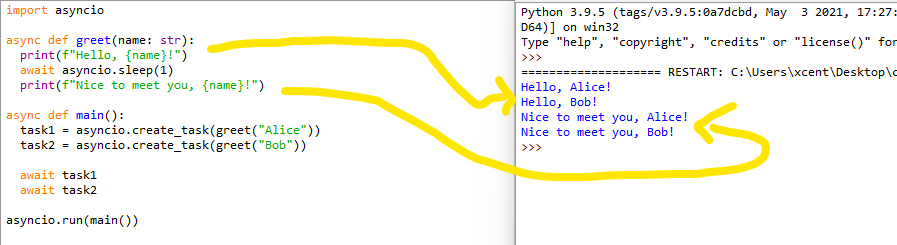
Let’s dive into a simple example of using an async function in Python with asyncio:

import asyncio async def greet(name: str): print(f"Hello, {name}!") await asyncio.sleep(1) print(f"Nice to meet you, {name}!") async def main(): task1 = asyncio.create_task(greet("Alice")) task2 = asyncio.create_task(greet("Bob")) await task1 await task2 asyncio.run(main())

In this example, an async function greet is declared, which prints a greeting message, waits for 1 second using asyncio.sleep, and then prints another message.

The main asynchronous function creates two tasks to call greet with different names, running them concurrently.

Async Function Return

When you want to return a value from an async function, just use the return statement as you would in regular functions. However, keep in mind that the returned value will be wrapped in an asyncio.Future object, not the actual value.

You’ll need to use await to get the value when calling this async function.

For example:

async def calculate_result(): await asyncio.sleep(1) return "Result!" async def main(): result = await calculate_result() print(result) asyncio.run(main())

Here, calculate_result is an async function that returns a value after asynchronously waiting for 1 second. In the main() function, you can use await to get the actual value and print it. 🌟

Async Function Call

To call an async function, you can’t simply use the normal function call syntax, because doing so would just return a coroutine object, not the actual result of the function. Instead, you have to use the await keyword to call the async function, or use asyncio.create_task or similar functions to run it concurrently:

# Using `await` to call async function
result = await async_function() # Using `asyncio.create_task` to run concurrently
task = asyncio.create_task(async_function())

Remember to always use the appropriate method to call your async functions in order to achieve efficient asynchronous programming with Python’s powerful async/await syntax.

Advanced Async Function Concepts

Next, you’ll explore advanced async function concepts to give you a better understanding of how they work in Python. 😊 Ready? Let’s dive in!

Async Function Decorator

To create an async function, you’ll use the async def syntax. This means you don’t have to use a decorator, but you can still decorate asynchronous functions with the @some_decorator syntax for better modularity in your programs.

For instance, consider using @asyncio.coroutine with a yield from syntax if you’re working with Python 3.4 or earlier. Or simply upgrade to newer versions! πŸ˜…

Async Function Type Hint

Type hints help improve the readability of your async code. Specify the input and output types of your async function using the typing module’s Coroutine and asyncio‘s Future objects.

Here’s an example:

from typing import Coroutine
import asyncio async def some_async_function() -> Coroutine[str]: await asyncio.sleep(1) return "done"

Async Function Returns Coroutine

An async function, also known as a coroutine, returns a coroutine object when called. You can use it as a direct call or pass it to an event loop to run the async function using asyncio.run() or loop.run_until_complete().

Keep in mind coroutine objects aren’t executed until you explicitly use an event loop or an await expression.

Async Function Await

When writing async functions, the await keyword is crucial. It allows you to pause the execution of a coroutine and wait for a result without blocking other coroutines.

You’ll often use await with I/O-bound operations, like reading from files, interacting with network services, or retrieving resources, which can take a significant amount of time.

⭐ Recommended: Python __await()__ Magic Method

Async Function Type

An async function’s type is coroutine. So when defining your async function, you’re essentially creating a non-blocking function that allows other functions to run while it waits for results.

To check if an object in Python is a coroutine, you can use inspect.iscoroutine(obj) or inspect.iscoroutinefunction(obj).

Async Function Return Type

Async functions return a coroutine object, but you can also specify the type of the eventual returned value. For instance, if your async function performs some networking tasks and returns JSON data, you can specify the return type as Dict[str, Any].

Here’s how you do that:

from typing import Dict, Any, Coroutine
import asyncio async def fetch_json_data() -> Coroutine[Dict[str, Any]]: # some networking tasks here await asyncio.sleep(2) return {"key": "value"}

Async Function in Different Contexts

In this section, we will explore using async functions in different circumstances, such as within classes, threads, and converting async functions to sync. We will also discuss the concepts of async function sleep and handling functions that were never awaited.

Async Function in Class

When working with classes in Python, you might want to include asynchronous methods. To achieve this, just define your class method with async def. Remember to await your async methods when calling them to ensure proper execution.

Here’s an example:

class MyClass: async def my_async_method(self): await asyncio.sleep(1) async def main(): my_obj = MyClass() await my_obj.my_async_method()

Async Function in Thread

Running async functions in a thread can be tricky due to event loop requirements. Use asyncio.to_thread() for running async functions in threads. This will ensure your async function is executed within the correct thread’s event loop.

For example:

async def my_async_function(): await asyncio.sleep(1) print("Hello from async function!") async def main(): result = await asyncio.to_thread(my_async_function)

Async Function to Sync

If you need to call an async function from synchronous code, you can use asyncio.run() or create an event loop that runs a given coroutine.

Here’s an example of how to run an async function from sync code:

def sync_function(): asyncio.run(my_async_function())

Async Function Sleep

Sometimes, you might want to introduce a delay in your coroutine using asyncio.sleep. This allows other coroutines to run while waiting for IO operations or other events.

Example:

async def delayed_hello(): await asyncio.sleep(1) print("Hello after 1 second!")

πŸ’‘ Recommended: Time Delay in Python

Async Function Was Never Awaited

In some cases, you may forget to await an async function, which leads to warnings such as "coroutine 'my_async_function' was never awaited."

To prevent these issues, always ensure you’re using await when calling async functions:

async def my_async_function(): await asyncio.sleep(1) async def main(): # Missing 'await' would lead to a warning await my_async_function()

If you got something out of this article, I’m sure you’ll learn something of this one: πŸ‘‡

πŸ’‘ Recommended: Python Async With Statement β€” Simplifying Asynchronous Code

I promise it has more beautiful pics. πŸ˜…

Posted on Leave a comment

11 Best ChatGPT Alternatives

5/5 – (1 vote)

If you’re looking for AI assistants that can help you with writing, coding, or even education, you’re in luck!

This article introduces 11 alternative and mostly open-source tools, each offering a unique set of features tailored to a different use case. By diving into these resources, you’ll discover new ways to make the most of AI in your everyday life. βœπŸ€–πŸ“š

Some noteworthy alternatives include Bard for writing, Codex for coding, and Duolingo Max for language learning.

LLaMA

Are you looking for a ChatGPT alternative? πŸ” Look no further than Meta’s LLaMA (Language Model Augmented Machine). Initially, LLaMA was designed as a text generator, but it also works well as a chatbot. It is a versatile language model pretrained on billions of texts πŸ“š from the internet and fine-tuned to provide accurate, intelligent responses. πŸ’‘

To use this alternative, you need intermediate-level programming skills, and it’s important to have the right hardware setup such as a powerful GPU. You can run a version of LLaMA, the LLaMa-13b model, on your local machine. For details on how to set it up, read this guide.

Regarding performance in natural language processing tasks, LLaMA-13b is highly capable πŸ†. It tries to produce content like poetry and stories, much like ChatGPT or OpenAI’s GPT-3 and GPT-4 models. How it behaves, though, depends on the specific tuning you apply during its setup. πŸ–₯

LLaMA supports multiple languages, providing a bilingual or multilingual experience for users. 🌎 However, if your focus is on a particular language, there are other ChatGPT alternatives you could consider like Jasper Chat.

Consider trying out LLaMA for your AI chatbot or text generation needs. Remember, though, it may require more coding and technical skills than some other alternatives.

πŸ‘‰ Ressources: Read the paper “LLaMM: Open and Efficient Foundation Language Models” and check out the GitHub

Alpaca πŸ¦™

Yeah, the naming has gotten pretty obscure in the open-source large language model (LLM) community.

πŸ’‘ Short Summary: Instruction-following models like GPT-3.5 and ChatGPT are powerful but have flaws. Academia faces challenges in researching these models due to limited access.

Stanford researchers fine-tuned Alpaca, a language model based on Meta’s LLaMA 7B, using 52K instruction-following demonstrations from text-davinci-003.

Alpaca is small, easy to reproduce, and shows similar behaviors to text-davinci-003. The team is releasing their training recipe and data, with plans to release model weights and an interactive demo for academic research.

Commercial use is prohibited due to licensing restrictions and safety concerns.

Image credit

Alpaca is a remarkable chatbot alternative to ChatGPT that you can explore. Developed by Stanford researchers, it was fine-tuned using Facebook’s LLaMA to deliver impressive language capabilities πŸ§ πŸ’¬ source.

This chatbot has the potential to enhance your SEO efforts, as it’s able to reason πŸ€”, answer questions, and tell jokes, among other things. By integrating Alpaca into your online projects, you can engage users and attract search engine attention on platforms like Google and Bing 🌐.

And it’s free and open-source! ⭐

Here’s an example run from the original launch website:

There are also other open-source alternatives to ChatGPT that you may find useful, such as GPT4All, Dolly 2, and Vicuna πŸ’»πŸš€. You can find Python code to run these models on your system in this tutorial.

Vicuna πŸ¦™

Vicuna-13B, an open-source AI chatbot, is among the top ChatGPT alternatives available today. Its impressive feature parity with OpenAI’s ChatGPT and Google’s Bard has made it a popular choice for those seeking a capable language model.

πŸ’‘ Research Paper: “GPTQ: ACCURATE POST-TRAINING QUANTIZATION FOR GENERATIVE PRE-TRAINED TRANSFORMERS”

YouTube Video

What sets Vicuna apart is its ability to write code even though it is very concise and can run on your single-GPU machine (GitHub), which is less common in other open-source LLM chatbots πŸ’». This unique feature, along with its more than 90% quality rate, makes it stand out among ChatGPT alternatives.

πŸ’‘ Reference: Original Website

Don’t worry about compatibility, as Vicuna is available for use on your local machine or with cloud services like Microsoft’s Azure, ensuring you can access and collaborate on your writing projects wherever you are.

With Vicuna, you can expect the AI chatbot to deliver text completion tasks such as poetry, stories, and other content similar to what you would find on ChatGPT or Youchat. Thanks to its user-friendly interface and robust feature set, you’ll likely find this open-source alternative quite valuable.

OpenChatKit

πŸš€ OpenChatKit is one of the ChatGPT alternatives worth exploring!

πŸ’‘ Official OpenChatKit Website (open-source)

Developed by Together Computer, OpenChatKit is an open-source variant of ChatGPT, providing users and developers the flexibility to tailor chatbot behavior to suit their specific needs.

You can use it online here in interactive mode — I tried it myself:

πŸ›  If you’re a coder or developer, you’ll appreciate OpenChatKit’s compatibility with Python, allowing for seamless integration into your projects. You can also use it with GitHub Copilot to enhance your coding experience, thanks to the open-source nature of the project.

πŸ’‘ OpenChatKit caters to a broader audience since the open-source design allows access to users and groups that might not have the means to use proprietary models. It supports functions such as reasoning and multi-tasking, giving you an extensive range of applications to use within your projects.

It can also code: πŸ‘‡

GPT4ALL

GPT4ALL is an interesting alternative to ChatGPT that you might want to explore πŸ•΅.

It is a community-driven project aimed at offering similar capabilities to those of ChatGPT through the use of open-source resources πŸ”“.

The project is trained on a massive curated collection of written texts, which include assistant interactions, code, stories, descriptions, and multi-turn dialogues πŸ’¬ (source).

πŸ’‘ Recommended: GPT4All Quickstart – Offline Chatbot on Your Computer

By choosing GPT4ALL as an alternative, you can access various resources such as:

  • Datasets
  • Model weights
  • Data curation processes

Getting Started with GPT4ALL

To get started, you’ll need to familiarize yourself with the project’s open-source code, model weights, and datasets. Information related to the project can be found through its project link provided in the search results.

Again, check out our detailed article on setting up GPT4ALL:

πŸ’‘ Recommended: GPT4All Quickstart – Offline Chatbot on Your Computer

What to Expect from GPT4ALL

While GPT4ALL may not match ChatGPT in terms of exact performance, it is a strong contender when it comes to providing a similar experience. Plus, it offloads some of the computational requirements associated with ChatGPT, possibly making it a more efficient option for youπŸš€.

BlinkDL RWKV

Looking for a faster, more VRAM-efficient alternative to ChatGPT? 🧐 Raven RWKV is an open-source chatbot that may just suit your needs! Developed by BlinkDL, this chatbot is powered by the RWKV language model which uses Recurrent Neural Networks (RNNs) 🧠 to achieve high-quality results similar to ChatGPT, but with better processing speed and lower hardware requirements πŸ’ͺ.

“RWKV is an RNN with transformer-level LLM performance. It can be directly trained like a GPT (parallelizable). So it’s combining the best of RNN and transformer – great performance, fast inference, saves VRAM, fast training, “infinite” ctx_len, and free sentence embedding.” (source)

You’ll find that the Raven RWKV model has been fine-tuned on various datasets like Stanford Alpaca, code-alpaca, and more, offering an impressive performance with diverse conversation topics πŸ€–. It has even managed to match the quality and scaling capabilities of transformer models, all while requiring less VRAM πŸ’Ύ.

You can check out an example run here:

If you’re eager to get started with Raven RWKV, head over to its Hugging Face repository for more details and relevant resources πŸ’Ό. Here, you’ll find different models like RWKV-4-Pile, which have been fine-tuned on diverse data sources to cater to various language preferences 🌍.

In short, the Raven RWKV chatbot is an excellent choice if you seek to explore an open-source chatbot alternative that balances performance and resource consumption πŸš€.

StableLM (Stability-AI)

StableLM is an open-source alternative to ChatGPT developed by Stability AI. With its goal to provide a transparent and scalable AI language model, it’s perfect for anyone looking to explore options outside of proprietary tools. 🌐

Based on a dataset called “The Pile,” StableLM aims to offer a powerful language-processing solution. You can access StableLM in its alpha form on GitHub with 3 billion and 7 billion parameter model options. This means you have the flexibility to choose the model that fits your project best. πŸ”§

As you start working with StableLM, you’ll experience:

  • A solution that rivals ChatGPT in terms of performance and capabilities πŸ’ͺ
  • Alpha access, allowing you to get your hands on the technology early
  • A GitHub-based platform for easy use and integration with your projects

When trying it on the Hugging Face interface, however, I experienced that it’s still super slow. This is probably a problem of the server infrastructure though:

Remember, as with any open-source project, StableLM is ever-evolving. This means you have the opportunity to be a part of its development and contribute to the progress of the technology. πŸš€

KoboldAI

KoboldAI is a fantastic alternative to ChatGPT that you might want to try out πŸ€–. It’s an open-source AI-powered chatbot capable of generating human-like text based on your prompts. You can find the source code and development updates on their GitHub repository.

Here’s an example run:

πŸ€– Bot : Hey!
💻 You : Hey Boyname, how have you been?
🤖 Bot : Been good! How about you?
💻 You : Been great to, excited to try out KoboldAI
🤖 Bot : KoboldAI is really fun!
💻 You : For sure! What is your favorite game?

When using KoboldAI, you’ll appreciate its easy-to-use interface that keeps things simple and clean πŸ’». Setting up the program may take a few steps, as you need to follow the instructions on their GitHub page. But worry not, they provide clear guidelines to make it easy for you πŸ”§.

In fact, it’s one of the most comprehensive README pages on an AI GitHub repository I have ever seen. πŸ˜‰

The AI behind KoboldAI is driven by various pre-trained models, which give you options to find the perfect balance between performance and quality. You can experiment with different models to see which one fits your needs best 🌟.

KoboldAI is focused on providing you with a chatbot experience that’s constantly improving. The active community of developers and users helps ensure that updates and bug fixes are addressed swiftly πŸ”§.

Flan-T5-XXL

πŸ€– Meet Flan-T5-XXL, an impressive open-source language model that serves as an alternative to ChatGPT. Developed by Google, Flan-T5-XXL is an enhanced version of the T5 language model and excels in few-shot learning tasks.

🌐 Flan-T5-XXL benefits from instruction fine-tuning, a technique that improves model performance and generalization to unseen tasks. By leveraging this technique, you can expect better outcomes from Flan-T5-XXL compared to traditional language models.

πŸ—£ This model stands out in applications involving multi-turn dialogues. Thanks to its Baize implementation, which mitigates potential risks by leveraging ChatGPT to facilitate conversations with itself, Flan-T5-XXL offers higher-quality results.

Usage

To get started with Flan-T5-XXL, you can access its model card for details on available features and implementation. Make sure to watch this YouTube video for code examples and optimization tips:

YouTube Video

And for further comparison with other language models, you can refer to this SourceForge comparison between ChatGPT, Flan-T5, and Visual ChatGPT.

πŸ’‘ Keep in mind that the open-source nature of Flan-T5-XXL offers a unique advantage because it is free to useβ€”unlike its proprietary counterpart, ChatGPT. To make an informed decision, compare the functionality of the Flan-T5-XXL and ChatGPT based on your specific needs.

For instance, I found that it’s not too advanced, GPT-4 would have figured this problem out: πŸ‘‡

By exploring Flan-T5-XXL as an alternative to ChatGPT, you can gain access to a powerful, open-source language model that offers diverse functionalities and improved performance. Happy experimenting! πŸš€

MiniGPT

MiniGPT is a lighter version of ChatGPT that you can use for various tasks. It’s perfect for those who need a simpler AI chatbot for straightforward tasks 😊. In this section, you’ll discover a few alternatives to MiniGPT.

πŸ’‘ Recommended: MiniGPT-4: The Latest Breakthrough in Language Generation Technology

This neural network model has been developed to improve vision-language comprehension by incorporating a frozen visual encoder and a frozen large language model (LLM) with a single projection layer.

MiniGPT-4 has demonstrated numerous capabilities similar to GPT-4, like generating detailed image descriptions and creating websites from handwritten drafts.

One of the most impressive features of MiniGPT-4 is its computation efficiency. Despite its advanced capabilities, this model is designed to be lightweight and easy to use. This makes it an ideal choice for developers who need to generate natural language descriptions of images but don’t want to spend hours training a complex neural network.

Image source: https://github.com/Vision-CAIR/MiniGPT-4

Additionally, MiniGPT-4 has been shown to have high generation reliability, meaning that it consistently produces accurate and relevant descriptions of images.

Google Bard

Google Bard is one of the top alternatives to ChatGPT you can tryπŸ’‘.

Built as Google’s response to ChatGPT, it utilizes a combination of two Language Models for Dialogue (LLMs) to create an engaging conversational experience (source). Offered by the search engine giant, you can expect some powerful AI capabilities from Bard. With Bard, you can enjoy a more dynamic way of searching for answers to various queries (source).

Image Credits: https://blog.google/technology/ai/bard-google-ai-search-updates/

To try Google Bard, visit the following link and sign up for access: Google Bard

Here are some key features of Google Bard:

  • It is an experimental AI conversational service, powered by Google’s LAMDA technologyπŸš€ (source).
  • Ideal for providing quick help with tasks like cover letter writing, event planning, and other needs you might haveπŸ“.(source).
  • Google Bard excels in precision and ease of use, making it a reliable alternative for those looking for a powerful AI chatbot.

Some More Resources

First, there’s GitHub Copilot, an LLM-based AI tool specifically designed to help coders increase their productivity.

Another remarkable choice is Character.AI, which focuses on natural language understanding and generation. It’s excellent for creating realistic conversations with virtual characters.

You should also consider YouChat as an alternative. It’s a powerful AI chatbot that helps you automate customer support and social media interactions.

Don’t miss SocraticπŸŽ“, as it’s designed to assist you with educational content. You can ask questions and receive detailed explanations in various subjects.

Next up is JasperChat. It’s a valuable tool for businesses looking to simplify their customer service and sales processes using AI chatbot technology.

Finally, WriteSonic is a worthy mention, especially if you need help with content writing tasks. It’s an AI-powered writing assistant that generates text for multiple purposes.

Okay, that’s it. Feel free to also download our free OpenAI cheat sheets such as this OpenAI Glossary:

OpenAI Glossary Cheat Sheet (100% Free PDF Download) πŸ‘‡

Finally, check out our free cheat sheet on OpenAI terminology, many Finxters have told me they love it! β™₯

πŸ’‘ Recommended: OpenAI Terminology Cheat Sheet (Free Download PDF)

Posted on Leave a comment

Google Says β€œWe Have No Moat, And Neither Does OpenAI”

Rate this post

Key Points

  • The leaked document is titled “We Have No Moat, And Neither Does OpenAI.”
  • It argues that open-source AI development is winning and that Google and other companies have no competitive advantage or “moat” in the field.
  • The document suggests that Google and other companies should focus on building tools and infrastructure that support open-source AI development rather than trying to compete with it.
  • The document provides a fascinating insight into the state of AI development and the challenges facing companies like Google as they try to stay ahead of the curve.
  • Open-source development is unstoppable and has never been more alive! πŸ₯³

Diving Into the Document

A leaked Google document titled “We Have No Moat, And Neither Does OpenAI” has recently garnered attention. Shared anonymously on a public Discord server, the document comes from a Google researcher and offers a frank analysis of the AI development landscape.

The document contends that open-source AI development is prevailing, leaving Google and other companies without a competitive edge.

Considering Google’s status as an AI leader and its substantial investments, this is a notable claim.

πŸ’‘ Quote: “But the uncomfortable truth is, we aren’t positioned to win this arms race and neither is OpenAI. While we’ve been squabbling, a third faction has been quietly eating our lunch.”

Here are some interesting developments in the open-source community:

  • Offline Fast LLMs: As reported in a recent Finxter article, many large language models can now be run offline. A Twitter user even shared how he ran a foundation model on a Pixel 6 at 5 tokens per second speed!
  • Scalable Personal AI: Projects like Alpaca-Lora allow you to fine-tune a personalized AI on your notebook in a couple of hours.
  • Multimodality: Researchers release new multimodal models that are trained in less than one hour and are freely available via GitHub. Here‘s the paper.
  • Responsible Release: You can find a list of pre-trained LLMs for textual data generation on myriads of new websites. Other websites now share generative art models, generated by Midjourney or DALL-E, without restrictions. See an example here: πŸ‘‡

source

The researcher suggests that instead of competing with open-source AI, Google and other companies should concentrate on creating tools and infrastructure to support it. This strategy would ensure rapid AI advancements and widespread benefits.

Check out this wonderful analysis from the article:

πŸ’‘ Quote: “Many of the new ideas are from ordinary people. The barrier to entry for training and experimentation has dropped from the total output of a major research organization to one person, an evening, and a beefy laptop.”

The leak has sparked significant debate within the AI community, with some criticizing Google for not adequately supporting open-source AI and others lauding the company for recognizing its own limitations.

LoRA – An Innovation Worth Keeping In Mind

Low-Rank Adaptation of Large Language Models (LoRA) is a powerful technique we should focus on more.

LoRA works by simplifying model updates, making them much smaller and faster to process. This allows us to improve a language model quickly on regular computers, which is great for adding new and diverse information in real-time. Even though this technology could help Google’s ambitious projects, it’s not used enough.

Retraining models from scratch is difficult and time-consuming.

LoRA is effective because it can be combined with other improvements, like instruction tuning. These improvements can be added on top of each other to make the model better over time without needing to start from scratch.

This means that when new data or tasks become available, the model can be updated quickly and cheaply. On the other hand, starting from scratch wastes previous improvements and becomes very expensive.

We should think carefully about whether we need a new model for every new idea. If we have major improvements that make reusing old models impossible, we should still try to keep as much of the previous model’s abilities as possible.

I couldn’t resist adding this interesting quote from the article:

πŸ’‘ Quote: “LoRA updates are very cheap to produce (~$100) for the most popular model sizes. This means that almost anyone with an idea can generate one and distribute it. Training times under a day are the norm. At that pace, it doesn’t take long before the cumulative effect of all of these fine-tunings overcomes starting off at a size disadvantage. Indeed, in terms of engineer-hours, the pace of improvement from these models vastly outstrips what we can do with our largest variants, and the best are already largely indistinguishable from ChatGPT. Focusing on maintaining some of the largest models on the planet actually puts us at a disadvantage.”

Timeline of LLM Developments (Overview)

Feb 24, 2023 – Meta launches LLaMA, an open-source code with various model sizes.

March 3, 2023 – LLaMA is leaked, allowing anyone to experiment with it.

March 12, 2023 – Artem Andreenko runs LLaMA on a Raspberry Pi.

March 13, 2023 – Stanford releases Alpaca, enabling low-cost fine-tuning of LLaMA.

March 18, 2023 – Georgi Gerganov runs LLaMA on a MacBook CPU using 4-bit quantization.

March 19, 2023 – Vicuna, a cross-university collaboration, achieves “parity” with Bard at $300 training cost.

March 25, 2023 – Nomic creates GPT4All, an ecosystem for models like Vicuna, at $100 training cost.

March 28, 2023 – Open Source GPT-3 by Cerebras outperforms existing GPT-3 clones.

March 28, 2023 – LLaMA-Adapter introduces instruction tuning and multimodality with just 1.2M learnable parameters.

April 3, 2023 – Berkeley launches Koala, users prefer it or have no preference 50% of the time compared to ChatGPT.

April 15, 2023 – Open Assistant launches a model and dataset for Alignment via RLHF, achieving near-ChatGPT human preference levels.

πŸ’‘ Recommended: 6 New AI Projects Based on LLMs and OpenAI

Competing with Open-Source is a Losing Game

I strongly believe in the power of open-source software development — we should build Bazaars not Cathedrals!

Open-source AI development is a better approach than closed-source AI development, particularly when considering the potential of Artificial General Intelligence (AGI). The open-source approach fosters collaboration, accessibility, and transparency, while promoting rapid development, preventing monopolies, and ensuring many benefits.

Here are a few reasons why I think open-source AI development should win in the long-term:

Collaboration is key in open-source AI, as researchers and developers from diverse backgrounds work together to innovate, increasing the likelihood of AGI breakthroughs.

Open-source AI is accessible to anyone, regardless of location or financial resources, which encourages a broader range of perspectives and expertise.

Transparency in open-source AI allows researchers to address biases and ethical concerns, fostering responsible AI development.

By building upon existing work, developers can rapidly advance AI technologies, bringing us closer to AGI.

Open-source AI also reduces the risk of single organizations dominating the AI landscape, ensuring that advancements serve the greater good.

Additionally, the benefits of AI are more evenly distributed across society through open-source AI, preventing the concentration of power and wealth.

Lastly, open-source AI development improves the security of AI systems, as potential flaws can be discovered and fixed by a larger community of researchers and developers.

Let’s end this article with another great quote from the article:

πŸ’‘ Quote: “Google and OpenAI have both gravitated defensively toward release patterns that allow them to retain tight control over how their models are used. But this control is a fiction. Anyone seeking to use LLMs for unsanctioned purposes can simply take their pick of the freely available models.”

Feel free to share this article with your friend β™₯ and download our OpenAI Python API Cheat Sheet and the following “Glossary” of modern AI terms:

OpenAI Glossary Cheat Sheet (100% Free PDF Download) πŸ‘‡

Finally, check out our free cheat sheet on OpenAI terminology, many Finxters have told me they love it! β™₯

πŸ’‘ Recommended: OpenAI Terminology Cheat Sheet (Free Download PDF)

Posted on Leave a comment

30 Reasons Bitcoin Is Superior to Real Estate

5/5 – (1 vote)

Real estate is the largest asset class in the world. The market cap of all real estate is said to be north of $327 trillion (!) USD. Bitcoin, on the other hand, is tiny in comparison and trades at roughly $0.5 trillion USD at the time of writing.

However, many real estate investors buy real estate as a store of value to protect themselves from the inflation produced by the fiat system. However, billionaire investors such as Michael Saylor argue that Bitcoin is a far better and far more scarce store of value than real estate.

🟠 There are billions of houses but only 21 million Bitcoin — let that sink in.

Store of Value Medium of Exchange Unit of Account
Bitcoin ⭐⭐⭐ ⭐⭐⭐ ⭐⭐⭐
Real Estate ⭐⭐ ⭐ ⭐
  • Store of Value: Unlike real estate, Bitcoin is truly scarce — new houses can be built at will, but Bitcoin has a hard supply limit of 21 million.
  • Medium of Exchange: Bitcoin can be transferred easily whereas real estate is highly illiquid and has significant friction costs when sold.
  • Unit of Account: Bitcoin provides a full ledger system that has perfect predictability and, thereby, it is a much better unit of account than houses.

In this post, I’ll explore Bitcoin’s most crucial, specific advantages over real estate. πŸ‘‡

Disclaimer: While we consider every point on this list true, we are not financial advisors and this should not be considered financial advice. πŸ˜…

Reason #1 – Portability

Bitcoin can be easily transferred anywhere in the world, while real estate is limited to a specific location.

Reason #2 – Liquidity

Bitcoin can be bought and sold in an instant, while selling real estate can take months or even years.

Reason #3 – Accessibility

Bitcoin can be bought with a few clicks on a smartphone, while buying real estate requires significant capital and legal processes.

Reason #4 – Transparency

Bitcoin transactions are recorded on a public ledger, providing transparency and security, while real estate transactions can be opaque and subject to fraud.

Reason #5 – Security

Bitcoin is stored in digital wallets that can be easily secured with encryption, while real estate requires physical security measures. Nobody can take your Bitcoin without your cooperation. But many could take your real estate!

Reason #6 – Divisibility

Bitcoin can be divided into small fractions, making it more accessible to smaller investors, while real estate requires significant capital investment.

Reason #7 – Inflation hedge

Bitcoin has a limited supply, making it a good hedge against inflation, while real estate can be affected by inflation.

πŸ’‘ Recommended: The Bitcoin Valuation Thesis

Reason #8 – Low transaction fees

Bitcoin transactions have lower fees than real estate transactions, which can have high closing costs.

Reason #9 – No intermediaries

Bitcoin transactions can be done peer-to-peer without intermediaries, while real estate transactions require intermediaries such as real estate agents and lawyers.

Reason #10 – Accessibility to global markets

Bitcoin can be easily traded on global markets, while real estate investment is limited to local markets. For example, Bitcoin is accessible to Nigerian farmers who cannot invest in New York prime real estate.

Reason #11 – No maintenance costs

Bitcoin does not require maintenance costs, while real estate requires ongoing maintenance and repairs.

Reason #12 – No property taxes

Bitcoin does not require property taxes, while real estate is subject to property taxes.

Reason #13 – No zoning restrictions

Bitcoin is not subject to zoning restrictions, while real estate is subject to zoning regulations.

Reason #14 – No mortgage payments

Bitcoin does not require mortgage payments, while real estate requires ongoing mortgage payments.

Reason #15 – No tenant issues

Bitcoin does not require dealing with tenant issues, while real estate investment requires dealing with tenants and property management.

Reason #16 – No depreciation

Bitcoin does not depreciate in value, while real estate can depreciate over time.

Reason #17 – No insurance costs

Bitcoin does not require insurance costs, while real estate requires insurance coverage.

Reason #18 – No legal disputes

Bitcoin transactions are irreversible, reducing the likelihood of legal disputes, while real estate transactions can be subject to legal disputes, such as property disputes and contract disputes.

Reason #19 – No inspection costs

Bitcoin does not require inspection costs, while real estate requires inspection costs before purchase.

Reason #20 – No closing costs

Bitcoin transactions do not require closing costs, while real estate transactions can have significant closing costs.

Reason #21 – No need for physical presence

Bitcoin can be bought and sold remotely, while real estate transactions often require physical presence.

Reason #22 – No need for financing

Bitcoin can be bought with cash, while real estate often requires financing through loans.

Reason #23 – No need for credit checks

Bitcoin transactions do not require credit checks, while real estate transactions often require credit checks for financing.

Reason #24 – No need for appraisals

Bitcoin transactions do not require appraisals, while real estate transactions often require appraisals before purchase.

Reason #25 – No need for property inspections

Bitcoin transactions do not require property inspections, while real estate transactions often require property inspections before purchase.

Reason #26 – No natural disaster risks

Bitcoin is not subject to natural disaster risks, while real estate can be affected by natural disasters such as floods and earthquakes.

Reason #27 – No environmental risks

Bitcoin does not have environmental risks, while real estate can be affected by environmental hazards such as pollution and toxic waste.

Reason #28 – No eminent domain risks

Bitcoin is not subject to eminent domain risks, while real estate can be subject to government seizure for public use.

Reason #29 – No zoning changes

Bitcoin is not subject to zoning changes, while real estate can be affected by changes in zoning regulations.

Reason #30 – No need for property management

Bitcoin does not require property management, while real estate investment requires property management and maintenance.

πŸ’‘ Recommended: 11 Best Bitcoin Books: Your Ultimate Guide for 2023