Posted on Leave a comment

Now Available on Steam – Overgrowth, 30% off!

Overgrowth is Now Available on Steam and is 30% off!*

Feel like the star of a martial arts film in Overgrowth, as you jump, kick, throw, and slash your way to victory. Free the rabbits from their evil overlords in the main story, then play through the prequel story, and finally, try out nine years of mods developed by the community, or create your own!

*Offer ends October 23 at 10AM Pacific Time

Posted on Leave a comment

Now’s the time to submit talks for the GDC 2018 Tutorials & Bootcamps!

If you have a great pitch for a session that would be a good fit for one of the many Tutorials and Bootcamps offered at Game Developers Conference 2018, organizers want to hear it — the sooner, the better!

That’s because many of them have put out a public call for submissions to present lectures, roundtables, panels, and tutorials. The deadline for submissions to each Bootcamp and Tutorial may vary based on the organizer, but they all close no later than Friday, November 3rd!

The Bootcamps and Tutorials scheduled during the first two days of GDC 2018 (Monday and Tuesday, March 19-20) are designed to offer attendees the chance to focus on the critical components of game development, providing them with a full day to take a deep dive into a single topic.

The organizers of these day-long workshops are constantly working to ensure they encompass the most interesting, informative, and cutting-edge sessions. With that in mind, the following Tutorials and Bootcamps are currently seeking great talk submissions:

  • Board Game Design Day: Submit talks via this form before November 1st! The Board Game Design Tutorial is a one-day deep dive into the art and science of designing non-electronic board (and card) games. Featuring multiple notable speakers from the world of board game design, this is an opportunity to get deep into the design mechanics behind innovative and popular board games, and hear about the design ethos that has shaped standouts in the resurgent world of board game development.
  • eSports Day: Submit talks via this form before November 3rd! The eSports Day is a day-long series of panels and presentations focused on cultivating a competitive game’s eSports ecosystem to attract and support professional players and teams, journalists, content creators, and grassroots player organizations. Join eSports Day and learn about growing your esports ecosystem alongside long-time developers, publishers, and esports community leaders!
  • Level Design Workshop: Submit talks via this form before November 3rd! The 2018 edition of the popular Level Design Workshop is run and organized by Joel Burgess and Clint Hocking, and will feature 5-7 speakers from around the industry talking about all aspects of level design.
  • Tools Tutorial Day: Submit talks via this form before November 3rd! The Tools Tutorial  is a deep dive into the state-of-the-art techniques and processes for building tools that enable game development teams to ship awesome games. Topics will range from usability and workflow to studio services and automated testing, and all the technology in between. Listen to experts from studios large and small talk about their experiences shipping the tools that ship awesome games.

GDC 2018 will take place March 19-23 at the Moscone Convention Center in San Francisco, California, and will again play host to thousands of game developers from all around the world for a week of learning, networking and inspiration.

This will be the 32nd edition of GDC, the world’s largest and longest-running event serving professionals dedicated to the art and science of making games, and it promises to be an exciting week of conversations and knowledge-sharing.

For more details on the submission process or GDC 2018 in general visit the show’s official website, and subscribe to regular updates via Facebook, Twitter, or RSS.

Gamasutra and GDC are sibling organizations under parent UBM Americas

Posted on Leave a comment

Blog: That magic character only French translators use

The following blog post, unless otherwise noted, was written by a member of Gamasutra’s community.
The thoughts and opinions expressed are those of the writer and not Gamasutra or its parent company.


By Adolfo Gómez-Urda and Laura Gutiérrez IGDA Localization SIG Vice-Chairs

That Magic Character Only French Translators Use

Automatic line-wrapping in video games is the source of numerous localization bugs that can only be seen by the Localization QA team. In the normal workflow, translators localize texts but don’t have access to the game itself, so they have no visibility over the size of the text box where their translation will be displayed and what it will look like on the screen once integrated into the localized version of the game. If a translation doesn’t fit into one single line within the text box where it’s used, it will be automatically split into different lines of text. Automatic line-splitting is an excellent and necessary feature, but it can introduce many localization bugs due to inappropriate line-wrapping or orphaned words.

There is one “magical” character that can help alleviate these issues, but translators are not often aware of its existence. We are of course talking about the non-breaking space (aka no-break space, non-breakable space, hard space, or fixed space), which can be typed by using the ALT+0160 key combination. Although it looks like a regular space when typed, it will behave as a very special space that will allow us to keep two or more different pieces of text together. French translators are the only ones who normally use them, due to a French punctuation rule that states that a space should be left before certain punctuation symbols, such as question marks, interrogation marks, colons, and semi-colons.


Automatic line-wrapping when a regular space is used instead of a non-breaking space 

This character is very powerful and, if used properly by the translators, it can reduce dramatically the number of localization bugs found by LQA.

In order for translators to freely use this character, the development team should ensure it is properly supported by the game fonts. Most modern fonts support this character, but some development teams may create their own custom-fonts and omit this character or intentionally reduce the number of characters supported by the game to save memory. As a senior localization project manager, it is my responsibility to always analyze the game fonts to ensure they support all the necessary characters for all the supported languages. This character is always included in my analysis and, if not supported, I flag it as a necessary character for localization as important as any other accented character.


 Some examples of the correct usage of the non-breaking space in French.

Asking if the non-breaking space is supported should be one of the first questions translators ask developers as it will avoid lots of hassle and firefighting after LQA is done.

Here are some examples of translations where this space should be used instead of the normal space (of course, only if you are supposed to use a space to follow your language’s punctuation rules):

  • In French, before the question/exclamation marks, colon, and semi-colon:

  • In German, before the ellipsis character: Warten auf Benachrichtigungen …

  • Between numeric values and units: 20 km, 30 MB, 100 %

  • Between a numeric value and the following word: 5 coins

  • Between the words “press”, “hold”, “tap”, “swipe” and button variables: To continue, please press [START_BUTTON]

English is no different, of course, and it would be great if the development teams started to use this character more often when writing the English texts and dialogues, since this would force the translators to use it and benefit from it more often.

Posted on Leave a comment

Blog: Old games, remasters, and the joy of owning your work

The following blog post, unless otherwise noted, was written by a member of Gamasutra’s community.
The thoughts and opinions expressed are those of the writer and not Gamasutra or its parent company.


It’s weird to see over four years of my life just sitting there in a lump.

I’ve been making my little indie games for a living for 23 years. Being a greybeard in such a weird and young industry comes with special privileges.

For example, while some of my peers are getting around to remastering their old games, I am remastering our most popular game, Avernum 3: Ruined World, for the SECOND time. It is only when you rewrite the same material twice that you really test your discipline and integrity.

Writing indie games has become miserably competitive lately. Most new games, even promising ones with a lot of work in them, are sinking without a trace. Yet, thanks to the grinding tedium of rewriting the same game again and again, I have a fighting chance of my business surviving enough to write cool new stuff.

So I’ll tell the story or Exile 3: Ruined World/Avernum 3/Avernum 3: Ruined World. (Also on Steam.) There are things to learn here for any young person who thinks, “I wanna’ make cool things (not just video games), and make a living doing it.”
 

Don’t laugh. It sold like crazy.

In A Previous Millenium, I Wrote A Hit

In 1997, I’d been making games full-time for a couple years. I wrote (and still write) retro, turn-based, low-budget indie RPGs with fun systems, interesting stories, and mediocre graphics.

Happily, I got started at a time when there were very few good RPGs out in the market. I got a nice computer, wanted to play a good RPG, and couldn’t find one. So I wrote one. It sold, because no competition. This is a key example of my most important business strategy: Get Very Lucky.

My first games, Exile: Escape From the Pit and Exile 2: Crystal Souls, were designed on a simple principle: I would go back to all the RPGs Iloved as a kid and steal the best idea from each one. I then carefully combined all my quality stolen ideas into a coherent whole. This is called being a game designer.

For our third game, I had a better idea. I spent months playing all the new RPGs that had come out over the previous 2-3 years. Then I stole the best idea from each one of those. Thus, I transitioned from stealing ideas from old games to stealing ideas from new games. This is how you evolve as a game designer.

I ended up with Exile 3: Ruined World, which has been our biggest success. It features a gigantic world, that is easy to get lost in. As time passed, the game world evolved. If you didn’t fight the monsters off, they would ruin towns and kill the townsfolk. (Though, no matter how slow you play, you can always still win the game.) If you didn’t want to follow the story, you could be a bounty hunter or merchant. You could buy a house.

(If you want to try it out, it’s available as freeware here. Warning: It probably won’t run on your computer. That’s one of the reasons we had to remaster it.)


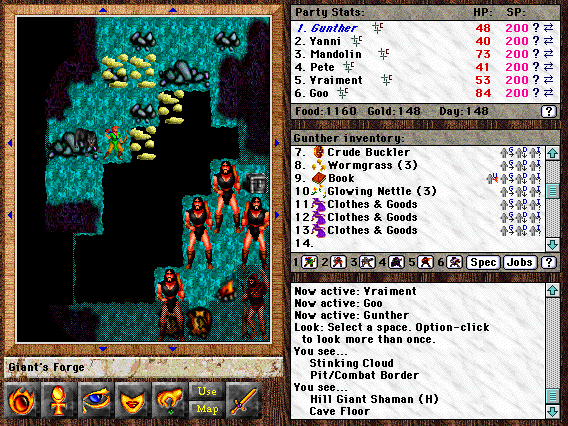
Exile 3 came out so long ago that most new computers then looked exactly like this.

It Was The Right Title At The Right Time

In 1997, it was what people wanted. It was a legit shareware hit. Now, having a hit indie game in 1997 (when the world wide web was basically nothing and most of my sales came from AOL) was different from having one in 2017.

These days, the sales of a hit indie game will buy you a mansion made of yachts. Back then, it bought me a modest house and made my parents slightly less ashamed to say what I did for a living.

I won awards, to the extent there were game awards back then. I got attention from the traditional games media, which was really worth something then. And it established me in the business for good.

But even then, I knew that the real prize was not the praise (which I don’t care about) or the money (which is nice, but then you spend it and it’s gone). What was really valuable was that I owned the game. It was mine. I could do with it whatever I wanted. Forever.
 

TREMBLE BEFORE MY MIGHTY 800×600 PIXELS!

Five Years Later, I Rewrote It For the First Time

We rewrote Exile 3 as Avernum 3 in 2002. Five years is a really short time to wait before rewriting a game, but I have a good excuse. When I started Exile 3, I’d only been making games for money for two years, and I wasn’t very good. There were a ton of ways in which the story, interface and graphics should have been improved, and I didn’t know to do it.

I spent well over a year writing Exile 3, and my wife and I spent another year turning it into Avernum 3. We went over every single location, line of dialogue, and bit of code, improving and expanding it to the best of our improved abilities. The revised version didn’t sell as well as the original, but it still made a lot of money. (Again, by early indie game standards. It was a lot of money for lone artists, but not big-shot money.)

(If you want to try it out, you can buy it super-cheap here. Warning: It probably won’t run well on your computer. That’s one of the reasons we had to remaster it.)

                         
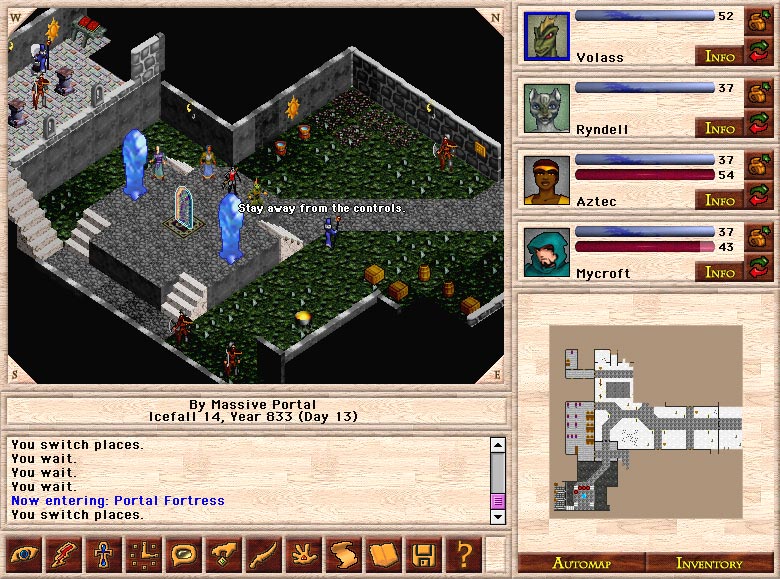
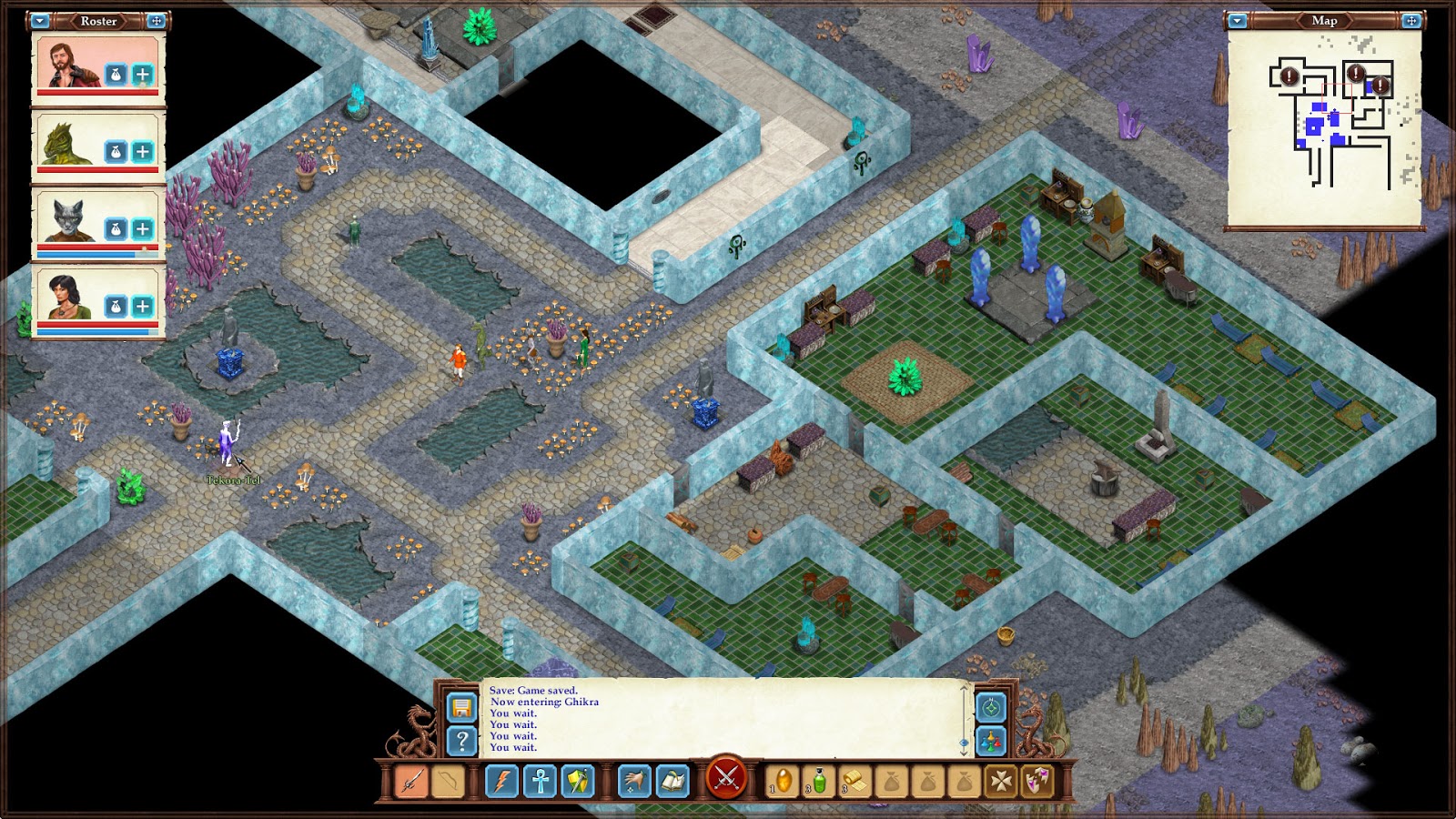
The new game. I am constantly accused by cranks of never improving my games. Look. I’m not saying this is super-fancy. But I don’t think you can say there’s been no improvement.

Now, Fifteen Years Later, We’re Doing It Again

Fifteen years is a long time in the tech industry. Our most popular game is now woefully out of date in every way, largely forgotten, and doesn’t even run on new Macs anymore. Now I can rewrite it so it actually works, and an iPad port will fall out of the process in the bargain.

Interfaces and game design have evolved in a million ways. I’m spending 18 months going over every tiny bit of the game again, redoing every single thing from scratch. I’ll release it in January or so, and it will hopefully sell. I think it will. I’ve spent over 20 years building up a loyal fan base.

The Pros and Cons of a Remaster

The good side of remasters is that they can be less work that writing a game from scratch. You can, with luck, get a full new title for 2/3 of the work, and it’s easy to market it because people already like it. (I’m assuming you’re not remastering a game everyone hated.)

The bad side of remasters is that you become the curator for your own work. It can be grinding to go over old material day in and day out. The reason a remaster is successful is because your fans like the original game. You don’t want to crap it up with too many new ideas, no matter how clever. People tend to not like change.

A Lesson For Young Creators

Never underestimate the value of owning your work. There hasn’t been a day since 1997 that I haven’t made money off of Exile 3. The reason is that I own it. It’s mine, to alter, remaster, and distribute. All according to my whims, with all the earnings going to me.

It’s a tough market out there. But suppose you release a new game and nobody ever even hears of it. Wait five years, remaster it and it really will be, as far an anyone is concerned, a new game. You can try selling it again!

And ten years from now, people will be using new consoles, new devices, new sorts of computers. Port your game to them! Each new port is an all new release. A new chance for your game to get noticed and catch on and become a hit!
 

“But Your Games Are All The Same And Look Like Crap”

I have a follow-up post about the reactions when I announced Avernum 3: Ruined World. It’s pretty funny, but this is already long so I broke it out into its own post.

When Avernum 3: Ruined World comes out (hopefully in January for Windows/Mac and March for iPad), I’ll have spent over four years of my life on it. It’s not a game for everyone. It’s mostly the product of one person, and it’ll show.

Even if you don’t like my work, I hope you take some satisfaction in this: Vidya games are still a place where one weirdo can make weird things for other weirdos and make a living at it. As long as this is possible, there’s hope. Maybe the next weird thing for weirdos will be YOUR perfect game, the Best Game Ever, and it never would have existed in a purely big-budget world.

### 

If you’re intrigued by the retro-RPG goodness of Avernum 3, you can wishlist it on Steam. News about our work and random musings can be found on our Twitter.

Posted on Leave a comment

How cyberpunk spook-’em-up Observer is built to elicit ‘catharsis 2.0’

October is upon us, and that means we’ve got spooky games on the brain. 

To that end, we asked Bloober Team’s Rafal Basaj to join us as we streamed a bit more of the studio’s latest game, the cyberpunk horror game Observer, on Twitch.

He was kind enough to acquiesce despite the fact that he was joining us from Poland, nine hours in the future. In the course of our hour-long play n’ chat, it became clear that Observer is a deeply Polish game — but Basaj told us that Bloober was quite uncertain about whether or not it should pepper the game with cultural touchstones. 

“I remember at one point were discussing whether doing all these references in the game would make it hard to understand, for a Western audience,” said Basaj. “We figured out for a lot of people, it would be aesthetics. They won’t see those things, but it will be different for them. It will feel different.”

Later in our conversation, we dug deeper into what it means to make a horror game and why Bloober pitches Observer specifically as a “hidden horror” experience.

“Hidden horror has two principles to it,” said Basaj. “One, it has to have a subject…for Observer, it was the boundaries of humanity. “

“The other part of hidden horror is something we call ‘catharsis 2.0’,” he continued. “We wanted to not only relieve fears or tensions, but also go into the emotions, and how we as people think about the world. So, catharsis 2.0…[we want to] make the players think about how would they behave in such a situation.”

You can listen to our full conversation with Basaj (and watch our playthrough of the game’s opening hour above). Also, make sure to follow the Gamasutra Twitch channel for more gameplay commentary, developer interviews and editor roundtables. 

Posted on Leave a comment

Upgraded SteamVR Tracking will support 4 base stations in 2018

This week Valve published an update regarding its plans for the 2.0 version of its SteamVR Tracking tech, detailing the ordering process for licensees and informing them of some significant changes to the system.

Most notably, Valve intends to update the new base stations sometime next year so they can work together in groups of 4, covering a play space of up to 10 x 10 meters.

That’s a significant improvement over SteamVR Tracking’s current 2-base station maximum, which tends to max out at a play space of roughly 4 x 4 meters.

This puts a hard number on Valve’s previously-stated plans to improve and expand the number of base stations supported by SteamVR Tracking, but it’s not a hard stop — the company goes on to note that it is looking at supporting even more base stations, though it won’t say when or if that will happen.

This is presumably possible because the new SteamVR Tracking 2.0 base stations are capable of providing data when hit with a tracking laser. That data can identify where the laser is coming from, which allows the system to work with more than 2 base stations.

VR devs should also know that the new SteamVR Tracking 2.0 base stations will begin shipping to licensees early next year, and won’t work with earlier versions of the system — most notably, current HTC Vive headsets.

They also won’t ship with any sort of mounting equipment, since Valve is “creating a custom wall/ceiling mounting solution” it expects to talk about next year.

Posted on Leave a comment

Get a job: Gearbox Software is hiring a UI Artist

The Gamasutra Job Board is the most diverse, active and established board of its kind for the video game industry!

Here is just one of the many, many positions being advertised right now.

Location: Frisco, Texas

Responsibilities:

  • Work closely with UI artists, programmers and Project Directors to drive interface style and function.
  • Create wireframes and mockups that visually communicate game features.
  • Create art assets like graphics, animations and icons as identified by the UI Lead.
  • Implement, animate, and maintain intuitive UI screens using engine tools.
  • Visually display complex data intuitively with an emphasis on information hierarchy.

Required Skills:

  • At least 3 years of professional experience as a UI Designer
  • At least 1 shipped AAA title
  • Proficient in Adobe CC Suite (Photoshop, Illustrator, After Effects)
  • Experience using engine level UI tools (Unity, Scaleform, Flash, etc.)
  • Ability to quickly prototype and visualize engaging user experiences.
  • Strong background in motion graphics.
  • Ability to give and receive constructive criticism and critique with a focus on improving quality.
  • Craft UI components with an emphasis on modularity.
  • Ability to rapidly prototype designs in a variety of visual styles
  • Team player with a great attitude & love for video games

Desired Skills:

  • Scaleform experience
  • Flash experience
  • Scripting (Lua, ActionScript, C#)

Interested? Apply now.

Whether you’re just starting out, looking for something new, or just seeing what’s out there, the Gamasutra Job Board is the place where game developers move ahead in their careers.

Gamasutra’s Job Board is the most diverse, most active, and most established board of its kind in the video game industry, serving companies of all sizes, from indie to triple-A.

Looking for a new job? Get started here. Are you a recruiter looking for talent? Post jobs here.

Posted on Leave a comment

Cuphead crosses 1 million copies sold

Studio MDHR’s hand-drawn throwback Cuphead has sold over 1 million copies, just two short weeks after its release.

While the quick pace at which Cuphead reached 1 million sold is noteworthy in itself, it’s especially impressive considering the game only launched on Xbox One and PC.

In a short blog post, Studio MDHR co-founders Chad and Jared Moldenhauer announced the milestone and took a moment to thank fans for the success of their visually distinctive run-and-gun platformer and talk briefly about the game itself.

“We have worked tirelessly over the past few years to deliver a game that remained true to our vision and we are both humbled and excited that so many people from around the world are playing Cuphead,” reads the post. “It truly makes it all worth it.”

The game itself was announced back in 2014 and quickly drew no small amount of attention with its 1930’s styled animation. As members of the development team have explained, the look is replicated by hand-drawing each and every frame of animation for the game, including backgrounds, characters, and effects. 

Posted on Leave a comment

Humble Bundle has been acquired by media giant IGN

Media giant IGN announced today that it has acquired Humble Bundle, the company best known for selling packs of indie games at pay-what-you-want prices. Terms of the deal were not disclosed.

This is potentially a big deal for game developers, since Humble has expanded beyond its bundling business to publish gamespay devs to make games for its subscription-based monthly game club, maintain a subscription-based online game trove, and operate an online game storefront.

However, a press release confirming the deal also noted that Humble will continue to operate independently in the wake of the acquisition, with no significant business or staffing changes. It will have some degree of support from IGN (which is itself owned by digital media giant J2 Global), specifically in terms of accelerating growth and raising more money for charity.

Humble grew out of a bundle of indie games sold to raise money for charity in 2010, and in the seven years since it has raised over $100 million for charity. In a conversation today with Gamasutra, Humble cofounder John Graham and IGN executive VP Mitch Galbraith reiterated that IGN does not intend to change the way Humble does business.

“If it’s not broken, don’t fix it,” said Galbraith, who explained that IGN started looking to make a deal like this nearly a year ago. “The idea is just to feed them with the resources they need to keep doing what they’re doing.”

“We want to stick to the fundamentals in the short term. We don’t want to disrupt anything we’re doing right already,” added Graham. “Because of the shared vision and overlap of our customer bases, there’s going to be a lot of opportunities.”

Posted on Leave a comment

Don’t Miss: Animating pups, boars & other quadrupeds in The Flame in the Flood

Many indie devs feel like they’re under pressure to make high-quality art that rivals that of big-budget studios — with the smallest team size and budget possible.

At GDC 2017 The Molasses Flood’s Gwen Frey, self-described sole animator and over-tasked generalist on The Flame in The Flood, discussed how to rapidly generate triple-A quadruped locomotion as an indie dev.

It was a video-heavy talk that focused on animation authoring and state blending for quadruped characters. According to Frey, these characters have unique foot sliding challenges and traditional solutions result in either poor fidelity motion or a bloated animator workload.

Frey shared some techniques for illustrating high-quality quadruped locomotion without the need for transition animations, using two different quadruped characters as examples – a boar with a rigid spine, and a large, gangling wolf with a procedural spine. 

It was a fascinating talk, one that you can now watch for free over on the official GDC YouTube channel!

In addition to this presentation, the GDC Vault and its new YouTube channel offers numerous other free videos, audio recordings, and slides from many of the recent Game Developers Conference events, and the service offers even more members-only content for GDC Vault subscribers.

Those who purchased All Access passes to recent events like GDC, GDC Europe, and GDC Next already have full access to GDC Vault, and interested parties can apply for the individual subscription via a GDC Vault subscription page. Group subscriptions are also available: game-related schools and development studios who sign up for GDC Vault Studio Subscriptions can receive access for their entire office or company by contacting staff via the GDC Vault group subscription page. Finally, current subscribers with access issues can contact GDC Vault technical support.

Gamasutra and GDC are sibling organizations under parent UBM Americas