Posted on Leave a comment

AI in Action

How our customers are taking advantage of AI

Microsoft’s AI tools and technologies are designed to benefit everyone at every level in every organization. Our AI tools are used in workplaces, home offices, academic institutions, research labs and manufacturing facilities around the world, and they are helping everyone from healthcare researchers to farmers, software developers and security practitioners.

Key AI stats

  • Microsoft AI powers billions of intelligent experiences every day through Microsoft products and services like Windows, Xbox, Microsoft 365, Microsoft Teams, Azure AI, Power Platform, Dynamics 365 and Microsoft Defender.
  • Azure AI is used by over 85% of Fortune 100 companies today.
  • Our customers and partners using Azure OpenAI Service represent Fortune’s Global 500 and Future 50 companies, Global Systems Integrators and startups, and span multiple industries including financial services, insurance, healthcare and manufacturing. From startups like Moveworks and Trelent, to multinational corporations like KPMG and PwC, over 1000 organizations are applying the capabilities of Azure OpenAI Service to advanced use cases such as customer support, conversational AI, summarization, writing assistance, customization, and gaining insights from data using search, data extraction, and classification.
  • A recent Microsoft survey found that 89% of employees and business decision makers that have access to automation and AI-powered tools feel more fulfilled because they can spend time on work that truly matters. As a result, 9 in 10 hope they can apply AI solutions to even more tasks and activities.
  • Less than two years since its launch, GitHub Copilot is already writing 46% of code and helps developers code up to 55% faster.
  • Over 9 billion slides have been improved by AI in PowerPoint Designer so far.
  • Editor’s AI-powered text predictions help 130 million users save 9 billion keystrokes each month, helping people express themselves more clearly and more quickly.
  • Microsoft has the largest breadth and depth of threat signals: 43 trillion signals each day. We’re using AI-based protections in Microsoft Defender and other security offerings.

Customer examples

  • EY uses Azure Form Recognizer and the Azure Custom Vision to automate and improve Optical Character Recognition and document-handling processes for its consulting, tax, audit and transactions services client, helping improve efficiency and accuracy of extracted data.
  • Lufthansa CityLine taps Azure Video Analyzer, part of Azure Applied AI Services, to leverage high-quality data insights and improve aircraft turnaround efficiency.
  • NBA uses Personalizer, part of Azure Cognitive Services, to turn billions of data points into insightful metrics to further engage fans.
  • PepsiCo uses Azure Machine Learning to identify consumer shopping trends and produce store-level actionable insights. They used Azure AI to improve predictions by more than 40% for product recommendations.
  • Progressive Insurance used Azure Text to Speech and Custom Neural Voice, part of Azure Cognitive Services, to bring their Flo chatbot to life.
  • Providence healthcare system used Azure Health Bot, part of Azure Applied AI Services, to create an assessment bot to triage patients and answer questions about COVID-19.
  • SAS Airlines uses Azure Machine Learning, its model interpretability capabilities and MLOps to build and monitor a complex fraud detection model for their EuroBonus loyalty program.
  • PwC is using Azure OpenAI Service to monitor thousands of news articles daily and classify them into 200+ environmental, social, and governance (“ESG”) topics for benchmarking purposes.
  • Trelent is using the Codex model in Azure OpenAI Service to provide intelligent source code documentation to better onboard new engineers around the world. In addition to significant performance gains (cutting down on response times), using Azure OpenAI Service has also helped Trelent protect its customers from bad actors and encourage responsible use of AI, due to the comprehensive security and regulatory compliance built into Azure.
  • CarMax used Azure OpenAI Service to help summarize 100,000 customer reviews into short descriptions that surface key takeaways for each make, model and year of vehicle in its inventory.
  • RTL Deutschland, Germany’s largest privately held cross-media company, is using Dall-E 2 in Azure OpenAI Service to create personalized content for audio book readers, tailored to their age and gender. The company recently expanded their streaming service RTL+ to offer on-demand access to millions of videos, music albums, podcasts, audiobooks and e-magazines. Combining the power of DALL∙E 2 and metadata about what kind of content a user has interacted with in the past offers the potential to offer personalized imagery on a previously inconceivable scale.
Posted on Leave a comment

AI Explained

Hear about the latest topics in AI and our unique approach

AI basics

  • Artificial intelligence (AI): Artificial Intelligence is the ability of a computer system to deal with ambiguity, by making predictions using previously gathered data, and learning from errors in those predictions in order to generate newer, more accurate predictions about how to behave in the future.
  • Machine Learning (ML): Machine learning is the process of using mathematical models of data to help a computer learn without direct instruction. It’s considered a subset of artificial intelligence (AI). Machine learning uses algorithms to identify patterns within data, and those patterns are then used to create a data model that can make predictions. With increased data and experience, the results of machine learning are more accurate.
  • Machine learning techniques:
    • Supervised learning: Addressing datasets with labels or structure, data acts as a teacher and “trains” the machine, increasing in its ability to make a prediction or decision.
    • Unsupervised learning: Addressing datasets without any labels or structure, finding patterns and relationships by grouping data into clusters.
    • Reinforcement learning: A computer program helps determine outcome based upon a feedback loop.
  • Transfer Learning: In machine learning, it is desirable to be able to transfer learned knowledge from some “source” task to downstream “target” tasks. This is known as transfer learning —a simple and efficient way to obtain performant machine learning models, especially when there is little training data or compute available for solving the target task.
  • Deep learning / neural networks: Deep learning is an advanced type of machine learning that uses networks of algorithms that are inspired by the structure of the brain, known as neural networks. A deep neural network has nested neural nodes, and each question that it answers leads to a set of related questions. Deep learning typically requires a large data set to train on; training sets for deep learning are sometimes made up of millions of data points. After a deep neural network has been trained on these large data sets, it can handle more ambiguity than a shallow network. That makes it useful for applications like image recognition, where AI needs to find the edges of a shape before it can identify what’s in the image.
  • Transformer model: A transformer is a deep learning model that adopts the mechanism of self-attention, differentially weighing the significance of each part of the input data or tracking relationships in data, like word order in a sentence. It is used primarily in the fields of natural language processing (NLP) and computer vision (CV) but can be applied to other scenarios including fraud detection or to help design new medicines. Transformer-based language models in NLP have driven rapid progress in recent years fueled by computation at scale, large datasets, and advanced algorithms and software to train these models. Language models with large numbers of parameters, more data, and more training time acquire a richer, more nuanced understanding of language. As a result, they generalize well as effective zero- or few-shot learners, with high accuracy on many NLP tasks and datasets. Researchers at Microsoft have been on the forefront of deep learning transformer-based models, including Turing for rich language and Florence for visual recognition.
  • Few-shot/zero-shot learning : Deep neural networks including pre-trained large language models like Turing-NLG and GPT-3 require thousands of labeled training examples to obtain state-of-the-art performance for downstream tasks and applications. Such a large number of labeled examples is difficult and expensive to acquire in practice, especially as you scale these models to hundreds of different languages, thousands of different tasks and domains. Microsoft has researched techniques for few-shot and zero-shot learning to obtain state-of-the-art performance while using very few to no labels for the target task.
  • Generative AI: Generative AI refers to a category of AI that uses systems called neural networks to analyze data, find patterns and use these patterns to generate or create a new output, such as text, photo, video, code, data, and more. Examples of how Microsoft is using generative AI include GitHub Copilot, the new Bing and Bing Chat experience, new Viva Sales and Dynamics 365 experiences, DALL-E in Designer and Bing Image Creator. We are also making this technology available to customers through the Azure OpenAI Service.
  • ChatGPT: ChatGPT was built by OpenAI and is fine-tuned from a model in the GPT-3.5 series, which OpenAI finished training in early 2022. ChatGPT was trained on an Azure AI supercomputing infrastructure and uses a transformer-based neural network architecture, which is pre-trained on a large dataset of text and fine-tuned on conversational interactions. When a user inputs a statement or question, ChatGPT generates a response by analyzing the input and considering the context of the conversation. ChatGPT can also be fine-tuned on specific tasks such as answering questions or providing customer service. ChatGPT is available in preview in Azure OpenAI Service, developers can integrate custom AI-powered experiences directly into their own applications, including enhancing existing bots to handle unexpected questions, recapping call center conversations to enable faster customer support resolutions, creating new ad copy with personalized offers, automating claims processing, and more, all backed by the unique supercomputing and enterprise capabilities of Azure.We’re commonly asked if we incorporate ChatGPT into our own products. We do not have any direct integrations with ChatGPT, but we do integrate GPT models. For example, we announced new versions of the Bing search engine, the Edge browser, and a new chat experience, brought together and powered by AI, to serve as your copilot for the web. This experience is powered by a new, powerful, next-generation OpenAI large language model that is more powerful than ChatGPT and customized for search.

Large AI Models

Researchers at Microsoft and elsewhere are making progress on developing large AI systems that can process information in more sophisticated ways. The recent explosion of training data, coupled with large amounts of fast compute facilitated by the cloud, has enabled new applications of neural network architectures that have allowed us to train large AI models that can accomplish a wide variety of tasks at an unprecedented scale. We’ve used our supercomputer infrastructure to train state-of-the-art AI models, including Turing for rich language understanding, Z-Code and Z-Code++ for translation and summarization across hundreds of languages, and Florence for visual recognition. OpenAI also used Microsoft infrastructure to train GPT, DALL-E and Codex.

However, these models are only valuable if they are accessible and cost-effective for others to use them and build on top of them, so we’re working to make AI technology more efficient, in both training and application. We’ve made advances with DeepSpeed, for training efficiency, and ONNX Runtime, which gives high-performance inference support for large Transformer-based models, helping to optimize cost and latency.

It’s our goal to responsibly advance cutting-edge AI research and democratize these AI models as a new technology platform. Microsoft is already using these models in a broad range of scenarios across our services like Bing, Office, Dynamics 365, Power Platform, GitHub and LinkedIn. Now, we’re making these transformational capabilities, built on cutting-edge advancements in AI, available for organizations to build upon and customize through Azure AI.

Our approach to deployment/development

We’re optimistic about AI’s potential to foster innovation, create economic progress, and accelerate productivity, satisfaction, and growth. Microsoft has been working for years to advance the field of AI, and also publicly guide how these technologies are created and used on our platforms in responsible and ethical ways. It’s our goal to democratize breakthroughs in AI, including large language models, in a responsible way, to help people and organizations be more productive, and go on to solve the most pressing problems our society faces today. Last year we shared an update on our Microsoft’s Responsible AI Standard, a framework to guide how we build AI systems. We’re committed to sharing what we have learned, invite feedback from others, and continue to contribute to the broader discussion about building better norms and practices around AI. We also believe in intentional and iterative deployment, which means we’re committed to taking the time to understand potential harms, working to mitigate them, and ongoing monitoring to ensure our standards continue to be met. For example, we took a measured approach to release Microsoft Designer, Bing Image creator, and Azure OpenAI service, which allow us to gather feedback, apply learnings and improve the experience before expanding further.

Our work with OpenAI

Microsoft and OpenAI have partnered closely since 2019 to accelerate breakthroughs in AI, forming our partnership around a shared ambition to responsibly advance cutting-edge AI research and democratize AI as a new technology platform.

Through our initial investment and collaboration, Microsoft and OpenAI pushed the frontier of cloud supercomputing technology, announcing our first top-5 supercomputer in 2020 and subsequently constructing multiple AI supercomputing systems at massive scale. OpenAI has used this infrastructure to train its breakthrough models, which are now deployed in Azure to power category-defining AI products like GitHub Copilot, DALL·E 2 and ChatGPT. As OpenAI’s exclusive cloud provider, Azure powers all OpenAI workloads across research, products and API services. We’ve also increased our investments in the development and deployment of specialized supercomputing systems to accelerate OpenAI’s groundbreaking independent AI research and have continued to build out Azure’s leading AI infrastructure to help customers build and deploy their AI applications on a global scale.

We deploy OpenAI’s models across our consumer and enterprise products, including GitHub Copilot,  DALL·E 2 in Microsoft Designer and Bing Image Creator, and PowerApps Ideas, and through Azure OpenAI Service, which empowers organizations and developers to build cutting-edge AI applications through direct access to OpenAI models backed by Azure’s trusted, enterprise-grade capabilities and AI-optimized infrastructure and tools.

These innovations have captured imaginations and introduced large-scale AI as a powerful technology platform that we believe will create transformative impact at the magnitude of the personal computer, the internet, mobile devices and the cloud.

Underpinning all of our efforts is Microsoft and OpenAI’s shared commitment to building AI systems and products that are trustworthy and safe. OpenAI’s leading research on AI Alignment and Microsoft’s Responsible AI Standard not only establish a leading and advancing framework for the safe deployment of our own AI technologies, but will also help guide the industry toward more responsible outcomes.

We’ll continue to work with OpenAI to explore solutions that harness the power of AI and advanced natural language generation, and we’re excited for future collaboration together.

Future of work

We believe that AI is going to be the ultimate amplifier. It will augment the work that people do by freeing up time for more creativity, imagination, and human ingenuity – leading to not only an increase in productivity, but satisfaction. We’re just scratching the surface on the power of these large language models. Building on the success of GitHub Copilot, we envision a world where everyone, no matter their profession, can have a copilot for everything they do.

Microsoft is focused on responsibly creating AI that enables people to achieve greater productivity, growth, and satisfaction in the work they do. When people are freed from repetitive or tedious tasks, they can tap into their human ingenuity to focus on more strategic or creative tasks.

As AI systems evolve, we expect the nature of some jobs will change, and that new jobs will be created. These shifts are similar to the changes we’ve seen with other major technological advances such as the invention of the printing press, telephone or the internet.

We expect this shift will require new ways of thinking about skills and training to ensure that workers are prepared for the future and that there is enough talent available for critical jobs.

To help people get the training and skills they need to thrive in today’s economy and prepare for the future, Microsoft is focusing on three areas:

  • Preparing today’s students for tomorrow’s jobs
  • Helping today’s workers gain the skills they need to participate in the digital economy
  • Working with nonprofits, civic organizations and government leaders to help more people access digital skills.

While we can’t say with certainty how the job market will be impacted by AI, we are committed to developing this technology responsibly with an understanding of its impact on society.

AI and education

We fundamentally believe that AI will not only amplify what people can do, but also inspire curiosity and creativity to explore new applications. As with any new paradigm shift in technology or advent of new tools, we’ll need to have conversations about how to best incorporate these technologies into areas like education and help students be able to use these tools critically. As adoption of this technology increases, we are committed to ensuring its benefits are shared equitability across society, institutions and organizations

AI offers significant opportunities in education, for example offering the prospect of a personal digital tutor to every child, helping democratize access to high-quality education. It can help children advance critical thinking and creative expression and also assist teachers in developing creative new ways to engage children as it frees them from administrative and repetitive tasks. Like any new advancements, teaching will have to modify current practices to mitigate risks and ensure that children are able to realize the benefits of AI technology.  We will have to help children learn new skills to engage with new technology, helping them develop the ability to ask the right questions and use AI to communicate in more efficient and effective ways.

Posted on Leave a comment

Building Responsibly & Societal Impact

How Microsoft AI approaches responsible AI to build a more accessible, sustainable and innovative world

At Microsoft, we believe that when you create powerful technologies, you must also ensure that the technology is used responsibly. For more than six years, Microsoft has invested in a cross-company program to ensure that our AI systems are responsible by design. Our work is guided by a core set of principles: fairness, reliability and safety, privacy and security, inclusiveness, transparency and accountability.

In 2017, we launched the Aether Committee with researchers, engineers and policy experts to focus on responsible AI issues and help craft the AI principles that we adopted in 2018, and went on to create the Office of Responsible AI to coordinate responsible AI governance. This included the first version of our Responsible AI Standard, a framework for translating our high-level principles into actionable guidance for our engineering teams. In 2021, we described the key building blocks to operationalize this program, including an expanded governance structure, training to equip our employees with new skills, and processes and tooling to support implementation. And, in 2022, we strengthened our Responsible AI Standard and took it to its second version. This sets out how we will build AI systems using practical approaches for identifying, measuring and mitigating harms ahead of time, and ensuring that controls are engineered into our systems from the outset.

As we look to the future, we will do even more. As AI models continue to advance, we know we will need to address new and open research questions, close measurement gaps and design new practices, patterns and tools. We’ll approach the road ahead with humility and a commitment to listening, learning and improving every day. But our own efforts and those of other like-minded organizations won’t be enough. This transformative moment for AI calls for a wider lens on the impacts of the technology – both positive and negative – and a much broader dialogue among stakeholders. We need to have wide-ranging and deep conversations and commit to joint action to define the guardrails for the future.

We believe we should focus on three key goals.

  • First, we must ensure that AI is built and used responsibly and ethically.
  • Second, we must ensure that AI advances international competitiveness and national security.
  • Third, we must ensure that AI serves society broadly, not narrowly.

Our goal is to develop and deploy AI that will have a beneficial impact and earn trust from society.

We are committed to sharing our own learnings, innovations and best practices with decision makers, researchers, data scientists, developers and others, and we will continue to participate in broader societal conversations about how AI should be used responsibly.

Read more here: Meeting the AI moment: advancing the future through responsible AI

Microsoft is also focused on helping organizations take full advantage of AI, and we are investing heavily in programs that provide technology, resources, and expertise to empower those working to create a more sustainable, safe, and accessible world. Microsoft AI is helping customers solve some of society’s greatest challenges, whether it’s helping make farming more sustainable, protecting vulnerable communities from climate change, studying endangered species, or cleaning up the world’s oceans. Our cloud and AI services help businesses cut energy consumption, reduce physical footprints, and design sustainable products themselves. Using AI and Azure, customers can manage their businesses in a way that protects communities, biodiversity, and the planet.

Microsoft Research is building a more resilient society through mission-driven research and applied technology, and Microsoft has committed to invest over $185 million through our AI for Good initiative, which provides funding, technology and expertise to individuals, nonprofits and organizations so they can tackle these challenges.

Posted on Leave a comment

Azure: Our AI Platform

How Azure is powering the future of AI

AI is helping organizations solve some of today’s toughest challenges, and businesses are seeking a partner to streamline adoption and rapidly apply intelligence across workloads to improve operations and drive efficiencies.

Since 2016, Microsoft has committed to building Azure into an AI supercomputer for the world, serving as the foundation of our vision to democratize AI as a platform. Through our initial investment and collaboration, Microsoft and OpenAI pushed the frontier of cloud supercomputing technology, announcing our first top-5 supercomputer in 2020 and subsequently constructing multiple AI supercomputing systems at massive scale. OpenAI has used this infrastructure to train its breakthrough models, which are now deployed in Azure to power category-defining AI products like GitHub Copilot, DALL·E 2 and ChatGPT. Today, this Azure infrastructure optimized for large language model training is available via Azure AI supercomputing capabilities in the cloud, This resource provides the combination of GPUs, networking hardware and virtualization software required to deliver the compute needed to power the next wave of AI innovation. Teams across Microsoft and Azure customers around the world are also using this global infrastructure to fine-tune the large AI models for specific use cases from more helpful chatbots to more accurate auto-generating captions. The unique ability of Azure’s AI optimized infrastructure to scale up and scale out makes it ideal for many of today’s AI workloads from AI model training to inference.

Microsoft’s AI platform, Azure AI, has a unique position with best-in-class, enterprise-scale, trusted solutions. Azure AI is the most comprehensive, open and trusted AI platform for the enterprise. Our approach to AI is built on a strong foundation of deep research and we offer customers the same proven Azure AI capabilities that power Xbox, HoloLens, Bing, Teams, and Microsoft 365 to developers and customers, empowering them to achieve more. It’s why Azure AI is used by over 85% of Fortune 100 companies today. Organizations large and small are deploying Azure AI solutions because they can achieve more at scale more easily, with the proper enterprise-level and responsible AI protections from Azure. We’ve designed Azure AI to enable developers, data scientists of all skill levels and even business users to quickly build, deploy and manage intelligent cloud-native apps so the power of AI can be utilized across an organization.

Azure AI helps empower every person in any organization to achieve more with productive, enterprise-scale, secure solutions:

  • Azure Applied AI Services offers specialized AI services to help customers use AI services more easily for time-consuming tasks, including document processing, metric monitoring, enterprise search, video analysis, chat bots and more.
  • Azure Cognitive Services is a comprehensive family of customizable cognitive APIs for vision, speech, language, and decision making.
  • Azure Machine Learning is an end-to-end platform for building, training, and deploying machine learning models at scale, while helping organizations understand, protect, and control data, models and processes.

In Azure, we offer the best tools across the machine learning lifecycle from data preparation to model management. Data scientists and machine learning engineers can use Azure Machine Learning to build, train, deploy and operate large-scale AI models at scale. We’re also scaling AI innovation through Azure OpenAI Service, Azure Cognitive Service for Language and Azure Cognitive Service for Speech — to help developers accelerate time-to-value using pre-built models as well as with customizable models to design AI applications specific to their organizations. With Azure OpenAI Service our goal is to blend the power of OpenAI’s models with the promise of enterprise-grade security, compliance, responsible AI and global availability across regions that developers expect from Microsoft Azure.

Industry partners including Meta, AMD, Hugging Face and OpenAI are choosing Azure to enable AI innovation, while customers including H&R Block, CarMax, Beiersdorf, PwC and Progressive Insurance are using Azure AI to reimagine customer experiences, remove friction in business-critical processes to help end-users and employees focus their time and energy on valuable work.

Posted on Leave a comment

AI Research

How Microsoft Research is advancing the state of the art in AI

For 30 years, Microsoft Research (MSR) has been at the forefront of advancing the foundations of computing and translating new scientific understanding into innovative technologies to create value for Microsoft customers and broad benefit to society. MSR has been a pioneer, delivering cutting-edge AI breakthroughs in vision, speech, language, decision making and machine learning, including conversational speech recognition, machine translation, image captioning, and common-sense question answering, and we translate these breakthroughs into products to help Microsoft customers. We’re not inventing for the sake of inventing, we are focused on how the AI systems of today can help people solve real-world challenges.

More recent efforts have focused on developing large-scale models that can process information in increasingly sophisticated ways while also becoming more natural and intuitive to use. Advances in deep learning, coupled with internet-scale datasets and Microsoft Azure’s increasingly powerful AI supercomputing resources, have made it possible to create AI models that perform a broad range of tasks across many different applications.

Microsoft researchers have been working on these problems for years, developing expertise in areas like parallel computation that allows people to more quickly train machine learning models at unprecedented scale. That’s led to innovations like DeepSpeed, an open-source, deep learning optimization library for distributed training that was developed by Microsoft Research and now is used by the broader computing community and ONNX Runtime, which gives high-performance inference support for large Transformer-based models, helping to optimize cost and latency.

We also know we can’t do this work alone, which is why we work across disciplines and geographies; innovate with universities, institutions and companies like OpenAI, Meta, AMD and Hugging Face, an AI community; and contribute to the open-source community to push the industry forward.

Our world-class research community, combined with advancements in deep learning, massive training data, powerful Azure computing infrastructure, dedication to responsibility and partnerships with industry leaders drive our AI evolution.

Research to product

  • Microsoft researchers in 2018 were the first to reach a significant milestone in translation, translating news articles from Chinese to English on a commonly used test set. As soon as the team achieved that historic research milestone, they began adapting the model to work in Microsoft Translator, an Azure Cognitive Service that translates a wide variety of texts ranging from historical research documents to travel websites and production manuals.
  • In June 2019, Microsoft researchers were the first to develop a machine learning model that surpassed previous benchmarks on the General Language Understanding Evaluation (GLUE) benchmark, which measures mastery of nine different language understanding tasks ranging from sentiment analysis to text similarity and question answering. Bing’s experts incorporated core principles from that research into their own machine learning model, which helped to improve answers and caption generation.
  • In 2020, Microsoft researchers built an AI system that can generate accurate image captions. The new model was made available to customers via the Azure Cognitive Services Computer Vision offering, part of Azure AI, enabling developers to use this capability to improve accessibility in their own services. It was also incorporated into Seeing AI and rolled out to Microsoft Word and Outlook for Windows and Mac, and PowerPoint for Windows, Mac and web.
  • In 2022, Microsoft researchers developed a new class of AI models called Z-code, boosting even more accuracy in Translator, an Azure Cognitive Service. Microsoft’s Z-code models consistently improved translation quality over current production models, according to common industry metrics.
Posted on Leave a comment

Unilever goes cloud-only: Accenture and Microsoft complete one of the largest cloud migrations in consumer goods industry

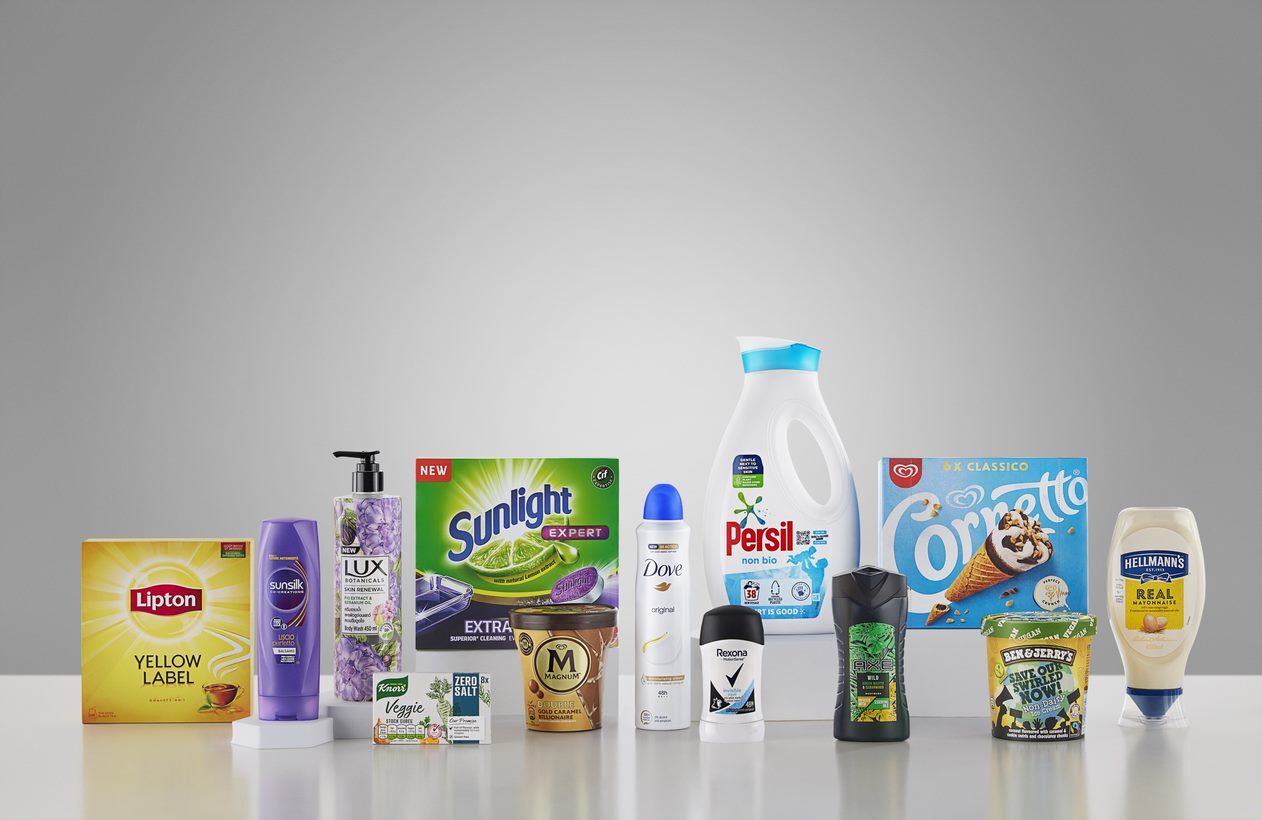
London and Redmond, Wash., April 3, 2023 – Accenture (NYSE: ACN), Microsoft (Nasdaq: MSFT) and Unilever (LSE: ULVR) have completed one of the largest and most complex cloud migrations in the consumer goods industry. The migration has helped Unilever – whose 400+ brands are used by 3.4 billion people daily – become a cloud-only enterprise.

Accenture and Microsoft, together with their joint venture, Avanade, worked closely with Unilever to deliver the transformation in just 18 months with minimal disruption to business operations. It has not only helped ensure resilient, secure and optimized operations for Unilever but also provides a platform to drive innovation and growth.

With Azure as its primary cloud platform, Unilever will be able to accelerate product launches, enhance customer service and improve operational efficiency. Additionally, the move to Azure aligns with Unilever’s sustainability commitment by helping the company to build on the progress it’s making towards curbing carbon emissions.

The creation of an agile, high-performing digital core that delivers greater efficiency will provide Unilever with increased computing power to explore new ways of working. Unilever’s adoption of a cloud-only approach will significantly improve business resilience, strengthening security and enhancing control of the IT landscape.

Accenture, Microsoft and Unilever have set a new benchmark for cloud transformation in the consumer goods industry, including:

  • Unlocking new innovation opportunities, such as utilizing industrial metaverse technologies that use real-time data from factory digital twins to accelerate (light house) factories of the future and build upon existing cloud data platform to power insights and predictions.
  • Accelerating the ability to identify trends and make decisions faster. By leveraging the power of the cloud, artificial intelligence and its strong data foundation, Unilever can forecast and adapt to changing market needs faster than ever before. For example, this will enable Unilever to achieve perpetual breakthroughs in research and development, allowing for new and innovative products to be developed faster and with greater efficiency.
  • Embracing the latest in AI to drive better experiences by applying Azure OpenAI Service across Unilever’s business to drive increased automation, enabling better customer and employee experiences.
  • Reducing its carbon footprint by exiting its datacenters and introducing Green Cloud Advisor, which facilitates Unilever’s transition to a more sustainable and efficient cloud environment.

Steve McCrystal, Chief Enterprise & Technology Officer, Unilever said, “Unilever is a truly data-powered organization. We’re using advanced analytics to make better-informed decisions quicker than ever before. Working with Accenture and Microsoft on this global transformation project, we can respond to ever-changing consumer needs faster, allocate our resources more effectively to focus on what drives growth, and bring services and products to the market faster.”

Nicole van Det, Senior Managing Director and Global Account Executive, Accenture said, “the path to business resilience now and in the future is through total enterprise reinvention – which involves the transformation of every part of the business – with cloud at the core. With access to the full continuum of cloud capabilities, including generative AI, Unilever has the elasticity to drive innovation faster, accelerate growth and continue to set the pace as a digital powerhouse and leader in its industry.”

“Together with Accenture, we’re proud to expand our longstanding partnership with Unilever,” said Judson Althoff, executive vice president and chief commercial officer, Microsoft. “With Microsoft Azure as its cloud foundation, Unilever’s end-to-end digitization will enable rapid innovation across its entire business. From embracing the industrial metaverse across its factories to reimagining how its lines of business can do more with tools like Azure OpenAI Service, Unilever’s digital-first approach will empower it to grow resiliently and exceed the industry’s pace of innovation.”

+++

About Accenture

Accenture is a leading global professional services company that helps the world’s leading businesses, governments and other organizations build their digital core, optimize their operations, accelerate revenue growth and enhance citizen services—creating tangible value at speed and scale. We are a talent and innovation led company with 738,000 people serving clients in more than 120 countries. Technology is at the core of change today, and we are one of the world’s leaders in helping drive that change, with strong ecosystem relationships. We combine our strength in technology with unmatched industry experience, functional expertise and global delivery capability. We are uniquely able to deliver tangible outcomes because of our broad range of services, solutions and assets across Strategy & Consulting, Technology, Operations, Industry X and Accenture Song. These capabilities, together with our culture of shared success and commitment to creating 360° value, enable us to help our clients succeed and build trusted, lasting relationships. We measure our success by the 360° value we create for our clients, each other, our shareholders, partners and communities. Visit us at www.accenture.com.

About Microsoft

Microsoft (Nasdaq “MSFT” @microsoft) enables digital transformation for the era of an intelligent cloud and an intelligent edge. Its mission is to empower every person and every organization on the planet to achieve more.

About Unilever

Unilever is one of the world’s leading suppliers of Beauty & Wellbeing, Personal Care, Home Care, Nutrition and Ice Cream products, with sales in over 190 countries and products used by 3.4 billion people every day. We have 148,000 employees and generated sales of €60.1 billion in 2022. Our vision is to be the global leader in sustainable business and to demonstrate how our purpose led, future-fit business model drives superior performance. We have a long tradition of being a progressive, responsible business. The Unilever Compass, our sustainable business strategy, is set out to help us deliver superior performance and drive sustainable and responsible growth, while: – improving the health of the planet; – improving people’s health, confidence and wellbeing; – and contributing to a fairer and more socially inclusive world. For more information about Unilever and our brands, please visit www.unilever.com

# # #

Media Contacts:

Unilever: [email protected]

Accenture: Tara Burns, London, UK, [email protected]

Microsoft Media Relations, WE Communications for Microsoft, (425) 638-7777, [email protected]

Posted on Leave a comment

With Microsoft Security Copilot, we’re combining advanced AI models with domain- and task-specific data, context, and skills to empower every defender and transform every aspect of SOC productivity.

LinkedIn and 3rd parties use essential and non-essential cookies to provide, secure, analyze and improve our Services, and to show you relevant ads (including professional and job ads) on and off LinkedIn. Learn more in our Cookie Policy.

Select Accept to consent or Reject to decline non-essential cookies for this use. You can update your choices at any time in your settings.

Posted on Leave a comment

With Security Copilot, Microsoft brings the power of AI to cyberdefense

Trained across security and networking disciplines and armed with trillions of data signals, Security Copilot dramatically increases the reach, speed and effectiveness of any security team

REDMOND, Wash. — March 28, 2023 — Microsoft Corp. on Tuesday announced it is bringing the next generation of AI to cybersecurity with the launch of Microsoft Security Copilot, giving defenders a much-needed tool to quickly detect and respond to threats and better understand the threat landscape overall. Security Copilot will combine Microsoft’s vast threat intelligence footprint with industry-leading expertise to augment the work of security professionals through an easy-to-use AI assistant.

“Today the odds remain stacked against cybersecurity professionals. Too often, they fight an asymmetric battle against relentless and sophisticated attackers,” said Vasu Jakkal, corporate vice president, Microsoft Security. “With Security Copilot, we are shifting the balance of power into our favor. Security Copilot is the first and only generative AI security product enabling defenders to move at the speed and scale of AI.”

Security Copilot is designed to work seamlessly with security teams, empowering defenders to see what is happening in their environment, learn from existing intelligence, correlate threat activity, and make more informed, efficient decisions at machine speed.

Simplifying complexity and accelerating responses

In a world where there are 1,287 password attacks per second, fragmented tools and infrastructure have not been enough to stop attackers. And although attacks have increased 67% over the past five years, the security industry has not been able to hire enough cyberrisk professionals to keep pace. This has led to defenders who are overwhelmed searching for well-disguised attacks within an impossibly large volume of expanding network traffic and other signals.

Security Copilot will simplify complexity and amplify the capabilities of security teams by summarizing and making sense of threat intelligence, helping defenders see through the noise of web traffic and identify malicious activity.

It will also help security teams catch what others miss by correlating and summarizing data on attacks, prioritizing incidents and recommending the best course of action to swiftly remediate diverse threats, in time.

Continually learning to augment the expertise of security teams

Security Copilot will also continually learn and improve to help ensure that security teams are operating with the latest knowledge of attackers, their tactics, techniques and procedures. The product will provide ongoing access to the most advanced OpenAI models to support demanding security tasks and applications. Its visibility into threats is powered by both the customer organization’s security data and Microsoft’s vast threat analysis footprint.

These capabilities can empower security teams of any size with the skills and abilities of much larger organizations. In addition, Security Copilot helps address skills shortages in cybersecurity by bridging knowledge gaps and enhancing workflows, threat actor profiles and incident reporting across teams.

“Advancing the state of security requires both people and technology — human ingenuity paired with the most advanced tools that help apply human expertise at speed and scale,” said Charlie Bell, executive vice president, Microsoft Security. “With Security Copilot we are building a future where every defender is empowered with the tools and technologies necessary to make the world a safer place.”

Built on the Microsoft platform and industry-leading threat intelligence

Microsoft is uniquely qualified to help customers explore and adapt AI to boost their cybersecurity defenses. Microsoft Security is actively tracking more than 50 ransomware gangs as well as more than 250 unique nation-state cybercriminal organizations, and receives 65 trillion threat signals every day. Microsoft technology blocks more than 25 billion brute-forced password theft attempts every second, and more than 8,000 security professionals at Microsoft analyze more security signals than almost any other company — on average Microsoft’s Security Operations Center analysts utilize over 100 different data sources.

Acquisitions like RiskIQ and Miburo give Microsoft breath of signal and depth intelligence on threat actors that no one else has. Security Copilot also integrates natively with a growing list of Microsoft Security products, such as Microsoft Sentinel and Microsoft Defender, to help customers create an end-to-end experience across their entire security program.

Availability

Microsoft Security Copilot is currently available through private preview. More information can be found at https://news.microsoft.com/AI-Security-2023.

Microsoft (Nasdaq “MSFT” @microsoft) enables digital transformation for the era of an intelligent cloud and an intelligent edge. Its mission is to empower every person and every organization on the planet to achieve more.

For more information, press only:

Microsoft Media Relations, WE Communications, (425) 638-7777, [email protected]

Note to editors: For more information, news and perspectives from Microsoft, please visit the Microsoft News Center at http://news.microsoft.com. Web links, telephone numbers and titles were correct at time of publication but may have changed. For additional assistance, journalists and analysts may contact Microsoft’s Rapid Response Team or other appropriate contacts listed at https://news.microsoft.com/microsoft-public-relations-contacts.

Posted on Leave a comment

Introducing the new Microsoft Teams

Today, we embark on the next chapter of the Microsoft Teams story with the public preview of the new Microsoft Teams app for Windows.

From its inception in 2017, our vision for Teams has always been to bring together all your communication and collaboration tools in one place, from chat and meetings to apps and files. Whether used for work, school, or life, over 280 million people rely on Teams every month to stay productive and connected with colleagues, partners, customers, friends, and family. Teams has also enabled amazing innovation from third-party independent software vendors (ISVs), corporate developers, and system integrators—resulting in over 1,900 apps in the store as well as over 100,000 custom apps that integrate seamlessly with the Teams platform. These applications, when combined with a broad ecosystem of Teams certified devices and rooms, help you stay productive and in the flow of work.

We have been listening to your feedback which has culminated in a reimagining of Teams from the ground up. The new app is built on a foundation of speed, performance, flexibility, and intelligence—delivering up to two times faster performance while using 50 percent less memory so you can save time and collaborate more efficiently. We have also streamlined the user experience so that it is simpler to use and easier to find everything in one place. These enhancements also provide the foundation for game-changing new AI-powered experiences, such as Copilot for Microsoft Teams, announced earlier this month.1

While we have already been making a steady stream of improvements in the existing Teams apps, the biggest breakthroughs will only be available with new Teams. Below is a summary of the most significant areas of improvement but you can deep dive into the full list in our Tech Community blog.

The new Microsoft Teams: Faster, simpler, more flexible, and smarter

Faster. Our North Star for new Teams is to make it twice as fast while using half the system resources. To achieve this, we have made a ground-up investment to overhaul the platform to optimize the data, network, chat, and video architecture for speed and performance. We are by no means done optimizing the performance of new Teams, but we have already seen very promising data even from the public preview build rolling out today. We have worked with the independent benchmarking firm GigaOm to quantify some of the performance gains, which reports that both app launch and join meeting are already twice as fast, and memory consumption has decreased by half when testing the new Teams preview compared with classic Teams.2

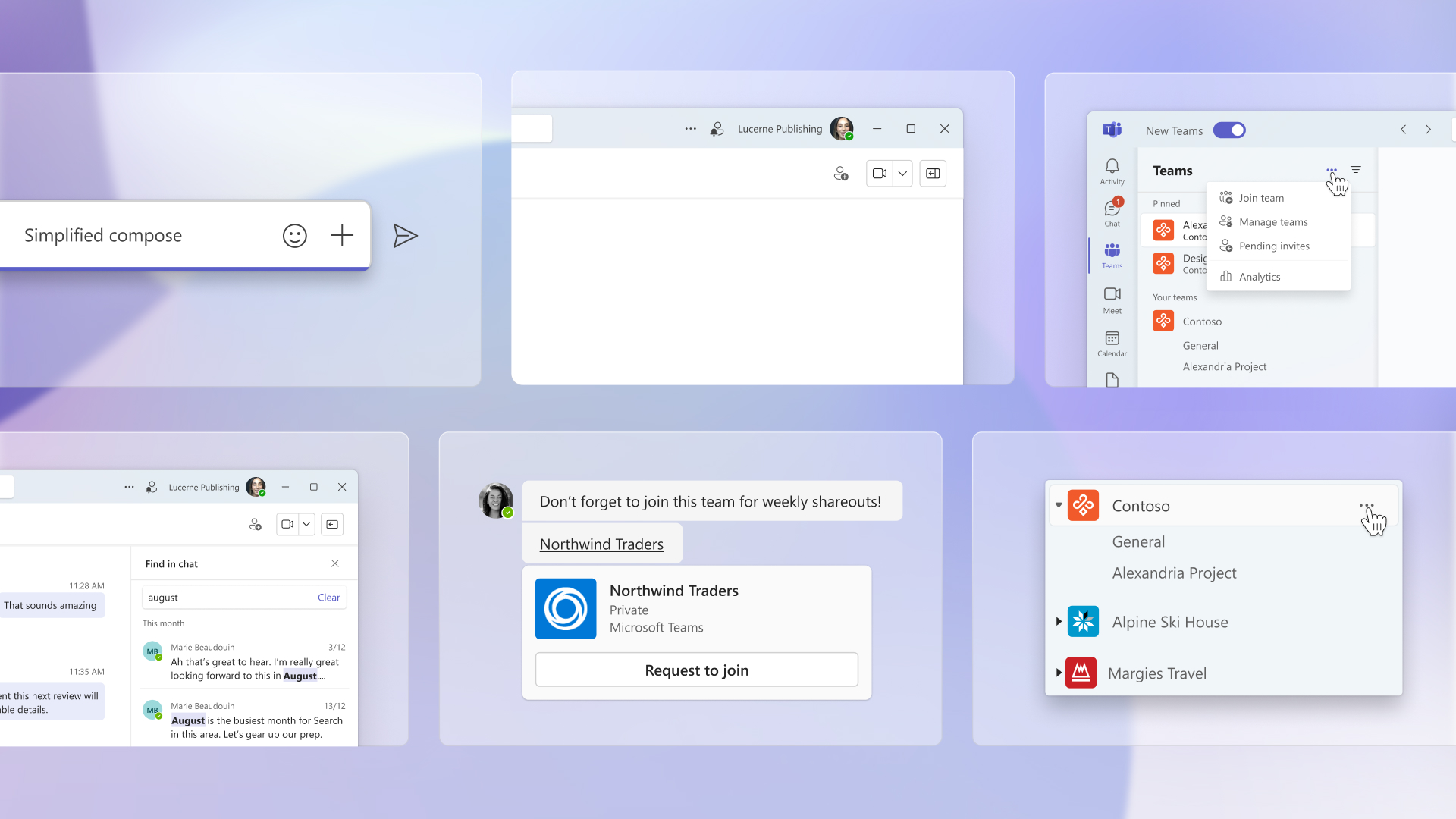
Simpler. We are always looking for ways to provide a simpler yet feature-rich experience for our diverse and growing user base. That’s why we are excited to roll out enhancements to the core Teams experience that will make it easier for you to stay on top of your notifications, search for information, manage your messages, and organize your channels—all with fewer clicks. For more information on the design journey of new Teams, take a look at this blog post from Microsoft Design.

Collage of usability improvements in new Microsoft Teams app.

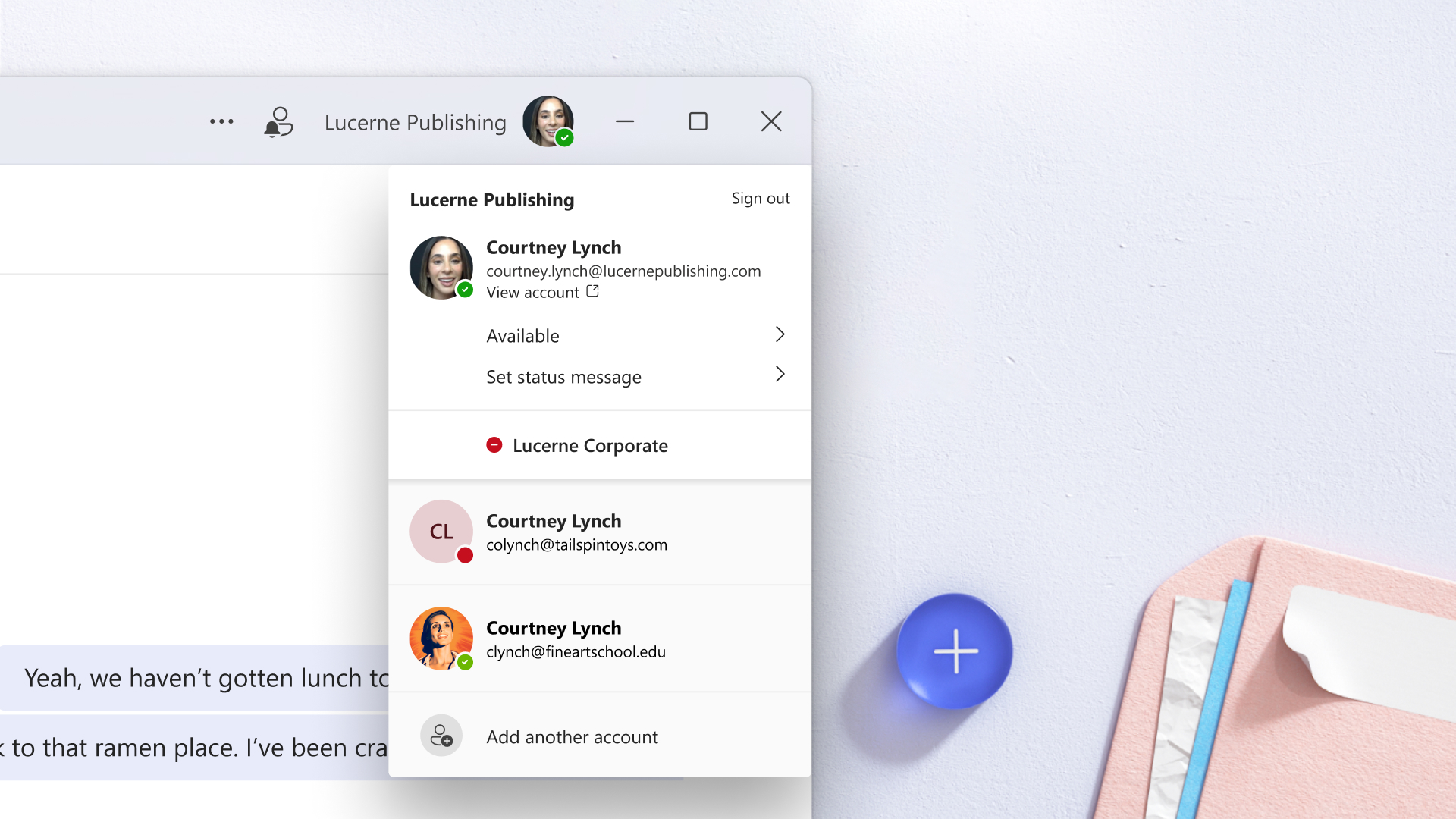
More flexible. We know that many of our customers have organizations that span multiple tenants and accounts. That’s why we have made a major investment in our support for these scenarios. We have improved our authentication model, synchronization, and notification systems to provide a seamless and consistent experience. For example, many customers need to collaborate with people across organizational boundaries, which sometimes means they use Teams across multiple tenants or accounts. Instead of logging in and out of different tenants and accounts, you can now stay signed in across them all—receiving notifications no matter which one you are currently using.

A drop-down panel within the new Microsoft Teams app showing multiple tenants and accounts.

Smarter. The new Teams will be the foundation for next-generation AI experiences, including those we’ve previously announced, such as intelligent recap and Copilot for Microsoft Teams. We will use AI to take the work out of working together by getting you up to speed on what happened before you joined a meeting or chat and answering your questions all in the flow of the discussion. We’re only just beginning to see the potential of AI inside of Teams, and we will have lots more to share in the future.

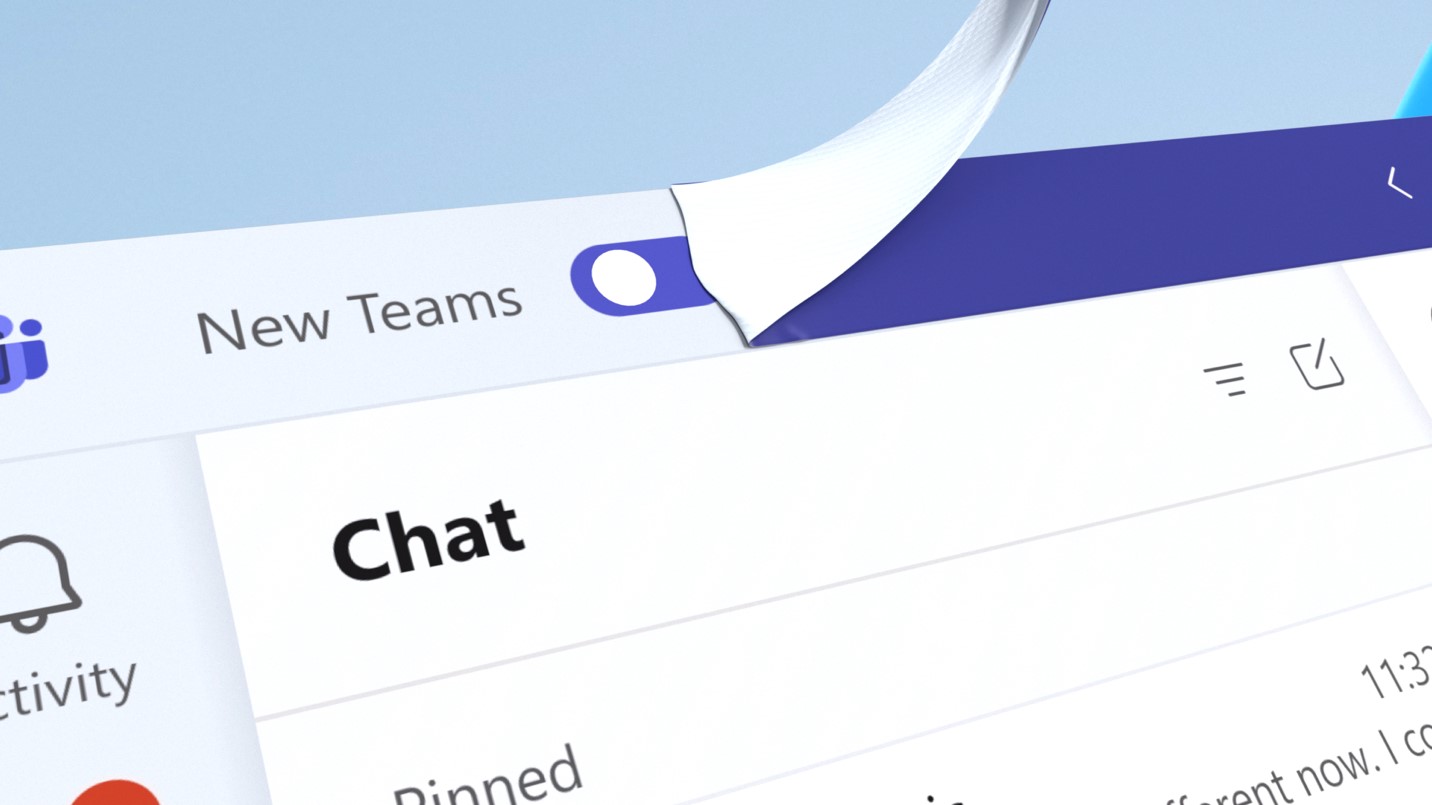
We are targeting the general availability of new Teams later this year in 2023. In the meantime, we encourage our commercial customers using Windows to try the public preview, which is rolling out starting today. We intend to extend the preview release to a broader set of customers, including those using Macs later this year. While users in our Public Preview program will have access to new Teams right away, our broader set of commercial customers will need an admin to first opt-in, after which users will see a simple toggle to switch to the new Teams. You’ll also be able to switch back to classic Teams at any time.

The Teams app showing the new Teams toggle switch and the Classic Teams user experience being peeled away.

Get started today

Today marks the new era of Microsoft Teams, and we are just getting started. As the world continues to evolve, Teams is here to be your modern workplace. For a sneak peek of all the new experiences we are building on new Teams, watch the video below.

While new Teams is a big leap forward in the Teams journey, it’s not the only thing we are announcing today. For a deep dive into the 50-plus additional new features coming to Teams, be sure to check out this Tech Community blog post which summarizes all the announcements we are making this week at Enterprise Connect.

Thank you for using Teams—we are thrilled to introduce the faster, simpler, and more flexible app starting today. I would encourage you to try it out and share your thoughts with us. We look forward to hearing from you and helping you get the most out of Teams.

If you’re an admin, learn how to enable the new Teams today.


1Introducing Microsoft 365 Copilot—A whole new way to work, Colette Stallbaumer, Microsoft 365 Blog. March 16, 2023.

Posted on Leave a comment

Internews, Microsoft, USAID to develop Media Viability Accelerator

New public-private partnership will deliver data-driven digital platform to help independent news media become financially self-sufficient

WASHINGTON — March 27, 2023 — Internews, Microsoft Corp. and the U.S. Agency for International Development (USAID) announced a new public-private partnership to develop a Media Viability Accelerator to help independent news outlets become more financially sustainable. The announcement, made in advance of the 2023 Summit for Democracy, illustrates a shared commitment among government, business and civil society to shore up democracy’s fourth estate.

“Media around the globe face a dual threat: repression and bankruptcy,” said Jeanne Bourgault, president and CEO of Internews, a nonprofit that supports independent media in 100 countries. “Thousands of media outlets have closed around the world in the past decade due to disruption of traditional media business models. In service of democracy, the Media Viability Accelerator will help reverse that trend by assisting media to survive and become more competitive.”

The Media Viability Accelerator is a web-based platform that will help news media become more financially sustainable by accessing solutions and market insights to inform effective business strategies. Participating media outlets will, free of charge, learn from a community of peers, access a multilingual tool that visualizes media performance data, and receive actionable daily alerts based on thousands of market and media sources. Media outlets, businesses, governments and nonprofits interested in participating can sign up.

“Independent journalism is essential to a healthy and vibrant democracy, but technology has unfortunately eroded traditional ad-based business models,” said Brad Smith, Microsoft’s vice chair and president. “Our hope is that this AI-powered data aggregation and visualization tool will offer media outlets the kind of market intelligence they need to be financially successful.”

In a three-way memorandum of understanding that underlies the partnership:

  • USAID agreed to support the development and growth of the Media Viability Accelerator platform, and set and monitor high-level objectives for the project.
  • Microsoft will contribute expertise in data analysis, visualization dashboards, cloud services and AI and agreed to provide in-kind technical support to develop and sustain the Media Viability Accelerator platform.
  • Internews, in concert with other media development organizations, agreed to register up to 500 media outlet users within six months, with a focus on media from low-resource countries and emerging democracies.

Other organizations supporting the effort include Free Press Unlimited, Global Forum for Media Development, IREX, SembraMedia and the Thomson Reuters Foundation.

“Independent media is both a public good and a private enterprise, but it has faced significant financial headwinds of late,” said Samantha Power, USAID administrator. “The U.S. government will use every tool at our disposal to support independent media, including by drawing on the expertise of our partners in the private sector. The Media Viability Accelerator is a model public-private partnership that will help keep independent media outlets around the world financially sustainable so they can continue their vital work.”

About Internews

Internews is a nonprofit that supports independent media in 100 countries. Internews trains journalists and digital rights practitioners, tackles disinformation, and offers business expertise to help media outlets thrive financially. For 40 years, it has helped partners reach millions of people with trustworthy information that saves lives, improves livelihoods, and holds institutions accountable.

About USAID

On behalf of the American people, the U.S. Agency for International Development promotes and demonstrates democratic values abroad, and advances a free, peaceful, and prosperous world. In support of America’s foreign policy, USAID leads the U.S. Government’s international development and disaster assistance through partnerships and investments that save lives, reduce poverty, strengthen democratic governance, and help people emerge from humanitarian crises and progress beyond assistance.

About Microsoft

Microsoft (Nasdaq “MSFT” @microsoft) enables digital transformation for the era of an intelligent cloud and an intelligent edge. Its mission is to empower every person and every organization on the planet to achieve more.

For more information, press only:

Microsoft Media Relations, WE Communications for Microsoft, (425) 638-7777, [email protected]

Massimiliano Colonna, Director of Communications for Internews, (202) 768-7539, [email protected]

Note to editors: For more information, news and perspectives from Microsoft, please visit the Microsoft News Center at http://news.microsoft.com. Web links, telephone numbers and titles were correct at time of publication but may have changed. For additional assistance, journalists and analysts may contact Microsoft’s Rapid Response Team or other appropriate contacts listed at https://news.microsoft.com/microsoft-public-relations-contacts.