Building your career is a journey filled with challenges, excitement, and forks in the road. And journeys are easier with maps. In this column, job experts answer your questions and deliver advice to help you take the next step.
Question: I’m interested in a role that I found on a job site. I reached out to a recruiter at the company through LinkedIn, but I didn’t hear back. Did I go about this the wrong way?
Answer: If you’ve spotted the perfect role on a job site, you may be tempted to run a quick LinkedIn search, identify a recruiter who works at that company, and reach out. Sometimes this approach works, but more often, you never hear anything back. Why?
While LinkedIn is a great way to connect with others during a job search, you may be going about your networking in the wrong way—or even with the wrong person.
Microsoft recruiter Mike Maglio offers a simple approach to using LinkedIn to increase your chance of getting a response and making a meaningful connection. His secret? Think like a recruiter.
It’s no surprise that recruiters use LinkedIn’s search tool to find potential candidates for their open jobs. The trick, Maglio says, is for job seekers to use the same search tool to find recruiters who might be hiring for the jobs you want.
“In their profile, a lot of recruiters will explain what they do and what organizations they cover to show up in searches more accurately,” he said. You can find them by doing your own search.
For example, if you are a software engineer who is passionate about working on Azure technology, search for “Azure AND recruiter AND Microsoft.” Maglio suggests job seekers use Boolean search logic with terms such as “AND” to yield more relevant results with a more accurate listing of recruiters in that space. “Use filters such as current company, location, etc. to get even more relevant results,” he added.
“Even within a product as big as Azure, you still want to get as specific with your search as possible,” said Maglio. “The more targeted you are, the better.”
Check out the profiles of the recruiters you found, and then choose a couple who work with your specific qualifications, such as software engineer, recent graduate, and Azure solutions.
Now that you’ve located the right recruiters, it’s time to introduce yourself. Craft a message that is concise, precise, and offers information that explains who you are. “Recruiters get many messages, so being direct and specific increases the likelihood you’ll get a response,” said Maglio.
Use a warm welcome, such as “Hello [Recruiter Name]” and then be clear about what you are seeking (e.g., referral for a role, connection to a team, information, etc.). A recruiter is going to look at your profile, so you don’t have to send a full resume or write an introduction with all of your experience.
Do you have a mutual connection? Mention that person in your introduction—or better yet ask your mutual connection to make an InMail introduction between you and the recruiters, Maglio suggested. This gives you an automatic “trust boost” because the recruiters are familiar with the connection who’s referring you.
“If you are reaching out about a role, include the link to the job posting. Let the recruiters know that you’re interested and would like to be considered for the role,” he said. It will also help recruiters connect you with other recruiters or hiring teams, in case that specific role is handled by someone else.
If you are simply wanting more information, be clear about that. If the recruiters can help, they might potentially schedule time to chat with you or even refer you to someone in the organization.
Recruiters need to understand who you are beyond your resume and LinkedIn profile, so use your chance to show them what you can bring to the company or job.
“You should be able to demonstrate your value and show you are a knowledgeable applicant, but be concise,” said Maglio.
“You could briefly speak to a relevant article or press release that ties into your passion. Or—if possible—call out a patent, applications you’ve built, or a slideshow of projects that can be viewed,” he said.
These examples show your passions and interests, beyond just your resume. “But keep it short and sweet,” Maglio said. “The last thing you want to do is bury that kind of info.”
If you’ve followed these steps and haven’t been able to connect with the first set of recruiters you’ve identified, keep applying and refining these steps.
The right connection is out there, along with the role of your dreams.
Inclusion. It’s more than just recognizing everybody. Instead, inclusion puts together the best of equality, representation, and integration. In NBA Live 19, you’ll get the chance to see female created players for the first time in NBA Live’s history. Not only will you be able to create your own player, but women will now also be included in the game and can embark on their own career mode in The Rise.
Creating Authentic Appearances
NBA Live offers a face scanning app. Through this, players get the opportunity to scan their faces into the game to make their created player as accurate as possible. This option used to only be available for men but now will be officially opened up for women. Once scanned into the game, you can then go ahead and choose from 30 different head shapes as well as hundreds of hairstyle options, stemming from different hair types, lengths, and colors.
Next, players will have the opportunity to select their position, height, and weight. There are no real limitations for height and weight other than those being shaped by natural position limits. For example, guards, regardless of gender, will sit in the five-foot-eight to six-foot-five range. Wings can be anywhere between six-foot-four to six-foot-ten, and bigs will range from six-foot-eight to seven-foot-two. This means that if you want to create a seven-foot dunking center and have her ball out, you absolutely can. If you want to create a six-foot point guard who will break some ankles, do it.
Where Can I Play with My Created Player?
As part of NBA Live 19’s featured mode, The One, you can complete the buildup to becoming The One, titled The Rise. In this mode, you travel the world receiving advice, feedback, and tips from a mentor, and WNBA and NBA players along the way. You’ll get the chance to play everywhere from Brazil to Paris and in the states as you take on the best and create your own legacy to rival that of the basketball’s elite.
In the newest feature to hit NBA Live, Build Your Squad, you’ll also get the chance to recruit players to play with you in The Streets after you beat their team. The NBA Live squad currently consists of Joel Embiid, Allen Iverson, and Candace Parker. With this feature, those are just three examples of players that you can roll out in your squad with but, beating them won’t be easy. Building the best possible squad and making sure that you can defeat your opponents is key!
Playing in the Streets with Candace Parker
Candace Parker is one of the greatest athletes to ever lace ‘em up. Doesn’t matter whether you’re looking at the basketball court, a football field, or anywhere else, she’s solidified herself as one of the greatest to ever play a professional sport. As an MVP, champion, and stone-cold competitor, Parker knows what it’s like to have to fight to build a legacy – she’s successfully done it. We sat down with her ahead of the announce of Female Create-a-Player to talk about what inclusion, and fighting for your reputation, means to her.
Candace says her main message would be that you can do anything you put your mind to. Her parents didn’t differentiate and gave her the same feedback as they gave her brothers if they didn’t play well or had a bad game. She feels the time is over when you say, “I can’t do it because I’m girl.”
She also spoke about growing up playing pick-up basketball where the first time, she would be last pick on a team. By the very next game, she was picking the teams because of how dominant she was. The WNBA has been growing and, with it, the spread of talent across the board from female ballers who are now hooping at a young age. Candace has been elated with the growth of hoops for young women and hopes to see it continue to grow.
“I think in order for it to grow, you need to see it and that’s what it’s doing now,” she started. “You see it on games, you see it on television, internet, social media, things like that. So, I think just visibility has helped our game so much and, obviously, the WNBA has been around for a very, very long time and I hope to make it better and leave it better than I came into it.”
Try Out Female Create-a-Player in NBA Live 19 Soon
On August 24, you’ll be able to go ahead and create your own female player and take her through the journey to becoming The One with the NBA Live 19 demo. With female-specific gear to unlock, and all-time greats to beat, your rise couldn’t start soon enough. The full release of the game is on September 7. Hop on the sticks and show that you have what it takes to become The One in NBA Live 19! You can pre-order the game now!
Good news for PC gamers: The Windows 10 April 2018 Update delivered a makeover to the Game bar so it’s even easier to find what you’re looking for.
New buttons on the Game bar provide easy access to your captures, themes (dark, light, or your current Windows theme) and the time (thanks to a new clock).
You can also use the bar to toggle your microphone and camera, start a Mixer stream without any extra hardware or software, and edit the title of your Mixer stream.
Chris Bishop leads Microsoft’s research lab in Cambridge, which has been at the forefront of AI, machine learning and deep learning research for 20 years. Its work contributes to many Microsoft products and features, such as the Clutter feature in Office.
Name: Chris Bishop
Role: Technical Fellow and Laboratory Director
Age: 59
Lives: Cambridge, UK
Family: Wife and two sons (both at university, studying Biology and Computer Science)
Pets: Two cats
Hobbies: Flying aeroplanes
Tell us about your current role?
I was one of the first people to join Microsoft’s Research Lab in Cambridge UK, back when the lab was first opened in 1997, before being named Lab Director two-and-a-half years ago, so I’ve been involved in growing and shaping the lab for more than two decades. Today my role includes leadership of the MSR Cambridge lab, as well as coordination of the broader Microsoft presence in Cambridge. I am fortunate in being supported by a very talented leadership team and a highly capable and motivated team of support staff.
What were your previous jobs?
My background is in theoretical physics. After graduating from Oxford, I did a PhD in quantum field theory at the University of Edinburgh, exploring some of the fundamental mathematics of matter, energy, and space-time. After my PhD I wanted to do something that would have potential for practical impact, so I joined the UK’s national fusion research lab to work on the theory of magnetically confined plasmas as part of a long-term goal to create unlimited clean energy. It was during this time that there were some breakthroughs in the field of neural networks. I was very inspired by the concept of machine intelligence, and the idea that computers could learn for themselves. Initially I started applying neural networks to problems in fusion research, and we became the first lab to use neural networks for real-time feedback control of a high-temperature fusion plasma.
In fact, I found neural networks so fascinating that, after about eight years working on fusion research, I took a rather radical step and switched fields into machine learning. I became a Professor at Aston University in Birmingham, where I set up a very successful research lab. Then I took a sabbatical and came to Cambridge for six months to run a major, international programme called “Neural Networks and Machine Learning” at the Isaac Newton Institute. The programme started on July 1, 1997, on the very same day that Microsoft announced it was opening a research lab in Cambridge, its first outside the US. I was approached by Microsoft to join the new lab, and have never looked back.
What are your aims at Microsoft?
My ambition is for the lab to have an impact on the real world at scale by tackling very hard research problems, and by leveraging the advantages and opportunities we have as part of Microsoft. I often say that I want the MSR Cambridge lab to be a critical asset for the company.
I’m also very passionate about diversity and inclusion, and we have introduced multiple initiatives over the last year to support this. We are seeing a lot of success in bringing more women into technical roles in the lab, across both engineering and research, and that’s very exciting to see.
What’s the hardest part of your job?
A core part of my job is to exercise judgment in situations where there is no clear right answer. For instance, in allocating limited resources I need to look at the risk, the level of investment, the potential for impact, and the timescale. At any one time there will be some things we are investing in that are quite long term but where the impact could be revolutionary, along with other things that have perhaps been researched for several years which are beginning to get real traction, all the way to things that have had real-world impact already. The hardest part of my job is to weigh up all these factors and make some difficult decisions on where to place our bets.
What’s the best part of your job?
The thing I enjoy most is the wonderful combination of technology and people. Those are two aspects I find equally fascinating, yet they offer totally different kinds of challenges. We, as a lab, are constantly thinking about technology, trends and opportunities, but also about the people, teams, leadership, staff development and recruitment, particularly in what has become a very competitive talent environment. The way these things come together is fascinating. There is never a dull day here.
What is a leader?
I think of leadership as facilitating and enabling, rather than directing. One of the things I give a lot of attention to is leadership development. We have a leadership team for the lab and we meet once a week for a couple of hours. I think about the activities of that team, but also about how we function together. It’s the diversity of the opinions of the team members that creates a value that’s greater than the sum of its parts. Leadership is about harnessing the capabilities of every person in the lab and allowing everyone to bring their best game to the table. I therefore see my role primarily as drawing out the best in others and empowering them to be successful.
What are you most proud of?
Last year I was elected a Fellow of the Royal Society, and that was an incredibly proud moment. There’s a famous book I got to sign, and you can flip back and see the signatures of Isaac Newton, Charles Darwin, Albert Einstein, and pretty much every scientist you’ve ever heard of. At the start of the book is the signature of King Charles II who granted the royal charter, so this book contains over three-and-a-half centuries of scientific history. That was a very humbling but thrilling moment.
Another thing I’m very proud of was the opportunity to give the Royal Institution Christmas Lectures. The Royal Institution was set up more than 200 years ago – Michael Faraday was one of the early directors – and around 14 Nobel prizes have been associated with the Institution, so there is a tremendous history there too. These days it’s most famous for the Christmas Lectures, which were started by Faraday. Ever since the 1960s these lectures have been broadcast on national television at Christmas, and I watched them as a child with my mum and dad. They were very inspirational for me and were one of the factors that led me to choose a career in science. About 10 years ago, I had the opportunity to give the lectures, which would have been inconceivable to me as a child. It was an extraordinary moment to walk into that famous iconic theatre, where Faraday lectured many times and where so many important scientific discoveries were first announced.
One Microsoft anecdote that relates to the lectures was that getting selected was quite a competitive process. It eventually came down to a shortlist of five people, and I was very keen to be chosen, especially as it was the first time in the 200 year history of the lectures that they were going to be on the subject of computer science. I was thinking about what I could do to get selected, so I wrote to Bill Gates, explained how important these lectures were and asked him whether, if I was selected, he would agree to join me as a guest in one of the lectures. Fortunately, he said yes, and so I was able to include this is my proposal to the Royal Institution. When I was ultimately selected, I held Bill to this promise, and interviewed him via satellite on live television during one of the lectures.
Chris Bishop is elected a Fellow of the Royal Society
What inspires you?
I love the idea that through our intellectual drive and curiosity we can use technology to make the world a better place for millions of people. For example, the field of healthcare today largely takes a one-size-fits-all approach that reactively waits until patients become sick before responding, and which is increasingly associated with escalating costs that are becoming unsustainable. The power of digital technology offers the opportunity to create a data-driven approach to healthcare that is personalised, predictive and preventative, and which could significantly reduce costs while also improving health and wellbeing. I’ve made Healthcare AI one of the focal points of the Cambridge lab, and I find it inspiring that the combination of machine learning, together with Microsoft’s cloud, could help to bring about a much-needed transformation in healthcare.
What is your favourite Microsoft product?
A few years ago, the machine learning team here in Cambridge built a feature, in collaboration with the Exchange team, called Clutter. It sorts out the email you should pay attention to now, from the ones that can be left to, say, a Friday afternoon. I love it because it’s used by tens of millions of people, and it has some very beautiful research ideas at the heart of it – something called a hierarchical Bayesian machine learning model. This gives it a nice out-of-the-box experience, a sort of average that does OK for everybody, but as you engage with it, it personalises and learns your particular preferences of what constitutes urgent versus non-urgent email. The other reason I’m particularly fond of it is that when I became Lab Director, the volume of email in my inbox quadrupled. That occurred just as we were releasing the Clutter feature, so it arrived just in time to save me from being overwhelmed.
What was the first bit of technology that you were excited about?
When I was a child I was very excited about the Apollo moon landings. I was at an age where I could watch them live on television and knew enough to understand what an incredible achievement they were. Just think of that Saturn launch vehicle that’s 36 storeys high, weighs 3,000 tonnes, is burning 15 tonnes of fuel a second, and yet it’s unstable. So, it must be balanced, rather like balancing a broom on your finger, by pivoting those massive engines backwards and forwards on hydraulic rams in response to signals from gyroscopes at the top of the rocket. It’s that combination of extreme brute force with exquisite precision, along with dozens of other extraordinary yet critical innovations, that made the whole adventure just breath-taking. And the filtering algorithms used by the guidance system are an elegant application of Bayesian inference, so it turns out that machine learning is, literally, rocket science.
In corporate finance and investment banking, risk analysis is a crucial job. To assess risk, analysts review research, monitor economic and social conditions, stay informed of regulations, and create models for the investment climate. In short, the inputs into an analysis make for a highly complex and dynamic calculation, one that requires enormous computing power. The vast number of calculations and the way the math is structured typically allows for high degrees of parallelization across many separate processes. To satisfy such a need, grid computing employs any number of machines working together to execute a set of parallelized tasks — which is perfect for risk analysis. By using a networked group of computers that work together as a virtual supercomputer, you can assemble and use vast computer grids for specific time periods and purposes, paying, only for what you use. Also, by splitting tasks over multiple machines, processing time is significantly reduced to increase efficiency and minimize wasted resources.
The Azure Industry Experiences team has recently authored two documents to help those involved in banking scenarios. We show how to implement a risk assessment solution that takes advantage of cloud grid computing technologies.
The first document is a short overview for technical decision makers, especially those considering a burst-to-cloud scenario. The second is a solution guide. It is aimed at solution architects, lead developers and others who want a deeper technical illumination of the strategy and technology.
When Alex Thomopoulos says “Get down, rise up,” she’s asking you what you’re passionate about and what makes you get up every day to pursue it. It’s a motto she reinforces as a Burton Girls Ambassador. The program encourages strength, independence and creativity for young women.
Food is one thing that makes Thomopoulos get down and rise up.
As a chef and entrepreneur, Thomopoulos can tell you how to make a gluten-free Meyer lemon cake, but she admits making videos that will take her business to the next level is not her forte.
“I know how to cook, but I don’t understand technology at all,” she says.
Fortunately, she gets help from Ashlie Little, a Microsoft product specialist, who shows Thomopoulos how to use the Microsoft Photos app in Windows 10 to edit existing video clips and still images into a movie that’s ready to share on social media.
Check out the tutorial, which goes over importing photos and videos; as well as adjusting lighting and cropping; syncing music; and adding text (recipe instructions and ingredients), filters and 3D effects.
FARGO, N.D., and REDMOND, Wash. — July 26, 2018 — The National FFA Organization and Microsoft Corp., on Thursday announced their collaboration to bring innovative technology, science, research and entrepreneurship to the classrooms of the more than 650,000 FFA student members nationwide through an initiative known as Blue 365.
FFA members are the future of the food industry, which is relying on this generation to meet unparalleled challenges to feed a growing world population. In a modern world where the food and agriculture industries are reliant on precision agriculture, big data, cloud technology, robotic systems, advanced communications and other sophisticated technologies, Blue 365 will serve as a catalyst for evolving sustainability, innovative efficiency and preparing the future leaders who will solve the world’s critical agricultural challenges. At an event in Fargo today, National FFA CEO Mark Poeschl and Microsoft’s Brad Smith and Mary Snapp were joined by North Dakota Governor Doug Burgum, USDA State Director Clare Carlson, and North Dakota State FFA President Brianna Maddock.
“Today’s FFA members are our future industry leaders,” Poeschl said. “The future relies on connecting diversity of innovational approach, solutions-orientation and cutting-edge technology. We are excited that Microsoft shares our vision of Blue 365. Through agricultural education and FFA, our members are evolving their skill sets for the 21st century demands; they will be the change in our industry. Blue 365 can be the spark needed to create the next big idea in agriculture.”
Blue 365 will be unveiled in Indianapolis, Indiana, this October at the 91st National FFA Convention & Expo, the nation’s largest student convention. With the vision and commitment of title sponsors Microsoft and AgriNovus Indiana, The Blue Room, a 17,000-square-foot interactive space, will showcase the cutting-edge technology, research and innovation happening across the spectrum. Through experiential learning and specific focus on the most critical challenges facing our communities — from respecting the planet to the urgent matter of feeding the world — The Blue Room experience serves to inspire and equip students to activate their potential.
“While digital technology is transforming every part of the American economy, not everyone is acquiring the skills to thrive,” said Brad Smith, president, Microsoft. “As a company, we’re focused on ensuring everyone, regardless of their geography or circumstance, has access to the digital skills they need to compete and prosper. And our partnership with the National FFA will expand this work, helping students across the country prepare for digital jobs and the farms of the future.”
Microsoft’s participation in Blue 365 is part of its commitment to helping people who may be impacted by technological advances and builds on its TechSpark initiative launched last year. TechSpark is a civic program fostering greater opportunity and job creation in smaller metropolitan areas. The initiative is in six regions, including in North Dakota, and focuses on five program areas: digital transformation, digital skills and computer science education, career pathways, rural broadband connectivity, and support for nonprofits.
“Technology is changing every job, every industry and every organization, and agriculture is no exception,” Burgum said. “Today’s announcement from Microsoft and FFA will provide a valuable tool for our educators as they work to equip students with the skills necessary to succeed in a 21st century economy. Given FFA’s long and storied history in North Dakota and Microsoft’s commitment to investing in the future of our young people, Blue 365’s potential to support student learning is undeniable.”
“FFA students across America will lead the food and agriculture industry into the future. They must have opportunities to integrate digital skills into both their classroom studies and project-based learning,” said Mary Snapp, corporate vice president and lead for Microsoft Philanthropies. “Our partnership will help ensure that curriculum is up to date so that these young leaders can use technology to drive innovation in farms of the future, sustain and renew our planet, and enrich their communities.
The National FFA Organization provides leadership, personal growth and career success training through agricultural education to 653,359 student members who belong to one of 8,568 local FFA chapters throughout the U.S., Puerto Rico and the U.S. Virgin Islands.
About National FFA Organization
The National FFA Organization is a national youth organization of 653,359 student members as part of 8,568 local FFA chapters in all 50 states, Puerto Rico and the U.S. Virgin Islands. The FFA mission is to make a positive difference in the lives of students by developing their potential for premier leadership, personal growth and career success through agricultural education. The National FFA Organization operates under a federal charter granted by the 81st United States Congress and it is an integral part of public instruction in agriculture. The U.S. Department of Education provides leadership and helps set direction for FFA as a service to state and local agricultural education programs. For more, visit the National FFA Organization online at FFA.org and on Facebook, Twitter and the official National FFA Organization blog.
About National FFA Foundation
The National FFA Foundation builds partnerships with industry, education, government, other foundations and individuals to secure financial resources that recognize FFA member achievements, develop student leaders and support the future of agricultural education. Governed by a 19-member board of trustees composed of educators, business leaders, individual donors and FFA Alumni, the foundation is a separately registered nonprofit organization. About 82 percent of every dollar received by the foundation supports FFA members and agricultural education opportunities. For more, visit FFA.org/Give.
About Microsoft
Microsoft (Nasdaq “MSFT” @microsoft) enables digital transformation for the era of an intelligent cloud and an intelligent edge. Its mission is to empower every person and every organization on the planet to achieve more.
For more information, press only:
Microsoft Media Relations, WE Communications for Microsoft, (425) 638-7777,
Kristy Meyer, National FFA Organization, (800) 293-2387, KMeyer@FFA.org
Note to editors: For more information, news and perspectives from Microsoft, please visit the Microsoft News Center at http://news.microsoft.com. Web links, telephone numbers and titles were correct at time of publication but may have changed. For additional assistance, journalists and analysts may contact Microsoft’s Rapid Response Team or other appropriate contacts listed at http://news.microsoft.com/microsoft-public-relations-contacts.
If you haven’t already, use LinkedIn to connect with all the people you worked with in a meaningful way during your time as an intern—your manager, other people on your team, employees you collaborated with in other parts of the company, and fellow interns. Make recommendations and give endorsements where appropriate—this is good professional etiquette, and it will also help you obtain those endorsements from others. If there are connections doing work that interests you, follow their progress and consider engaging with and sharing their content or updates.
In addition to strengthening your LinkedIn network, consider setting up an in-person or Skype check-in session with anyone who was particularly influential or impactful to you—a mentor, an advisor, or a manager. This will give you a chance to build the relationship.
Follow up on projects
Did you work on a project that taught you something valuable during your internship? Ask for an update after your internship ends. This shows the people who you worked with that you are interested and invested in the project’s outcome and success and that you value following up. It also gives you a reason to reach out, give them an update about what you are doing or working on, and perhaps nurture relationships that can help your career down the road. Also, learning what the outcome of the project was will help you incorporate the work you did into your resume and LinkedIn profile and allow you to tell the full story, including the impact of the work.
Showcase your work
Speaking of telling the full story . . . you put in the hard work, built new skills, and had a successful internship. Now you want to make sure that you showcase it so that others, such as recruiters and hiring managers, can clearly see your experience.
Before or soon after your internship is over, update your resume and LinkedIn profile to reflect the role. As you think about what you accomplished during your internship and frame it for your resume, include projects that you worked on, focus on transferable skills, incorporate appropriate terms and keywords, and put some thought into your social media presence.
Keep these tips in mind as you move through your internship adventure, and of course don’t forget to have fun!
Microsoft MakeCode (makecode.com) is a web-based learning environment for kids and teens to create with technology. MakeCode takes a unique approach to computing education by combining the magic of making with the power of code as a way to make learning about computers and technology more accessible and interesting to a wider audience.
The MakeCode team at Microsoft is small, but mighty! We are passionate about making technology fun, exciting and accessible for all kids. We work in a fun office space at Microsoft campus in Redmond, Washington and love coming to work every day!
Over the next few weeks, we’ll be publishing some easy MakeCode projects that you can do with your kids at home over the summer using a different MakeCode product each week.
Grab your kids and a glue gun and come on the Summer of MakeCode tour with us!
– The MakeCode Team
MakeCode Office Space
Week 1: Micro:Pet
If your kids are like mine, they’ll spend a few minutes playing with their fancy toys, and a few hours playing with good old-fashioned cardboard boxes, string and markers in the garage!
Micro:Pet is a fun project that gets your kids’ creativity flowing using materials you can find around the house while incorporating electronics and coding concepts and activities with the micro:bit.
For the Micro:Pet project, you’ll need:
A computer with internet connection and USB port
A micro:bit Go Kit (available at Microcenter.com) that includes a micro:bit, a USB cable, a battery pack and batteries
Small cardboard boxes, toilet paper rolls, paper cups/bowls or anything you have around the house to construct your pet with
Markers, pipe cleaners, googly eyes, colored paper, feathers and anything else you have on hand to decorate your pet!
Check out our fun video about our micro:pets!
[embedded content]
Step 1: What’s your dream pet?
The first thing you’ll want to do is think about what kind of pet you want to create. It could be something you’ve always wanted to have as a pet, but couldn’t – say a unicorn, a dragon or a skunk.
Step 2: Make your pet
Using the materials at hand, create your dream Pet. Remember to include enough space in your design to attach your micro:bit and the battery pack.
You can use your micro:bit in many different ways on your pet. Here is an example of a program for your Micro:Pet, but be creative and come up with your own unique project!
You can add audio and play sounds through your micro:bit by connecting it to headphones, earbuds or an external speaker. Note: there is only one volume level at which the micro:bit plays – and it is very loud! Don’t put earbuds in your ear when you run your program. In addition to the micro:bit, you will need:
You can add motion to your Micro:Pet – for example, wagging its tail when your pet is fed. To do this, you will need to attach a servo motor to your micro:bit. You will need:
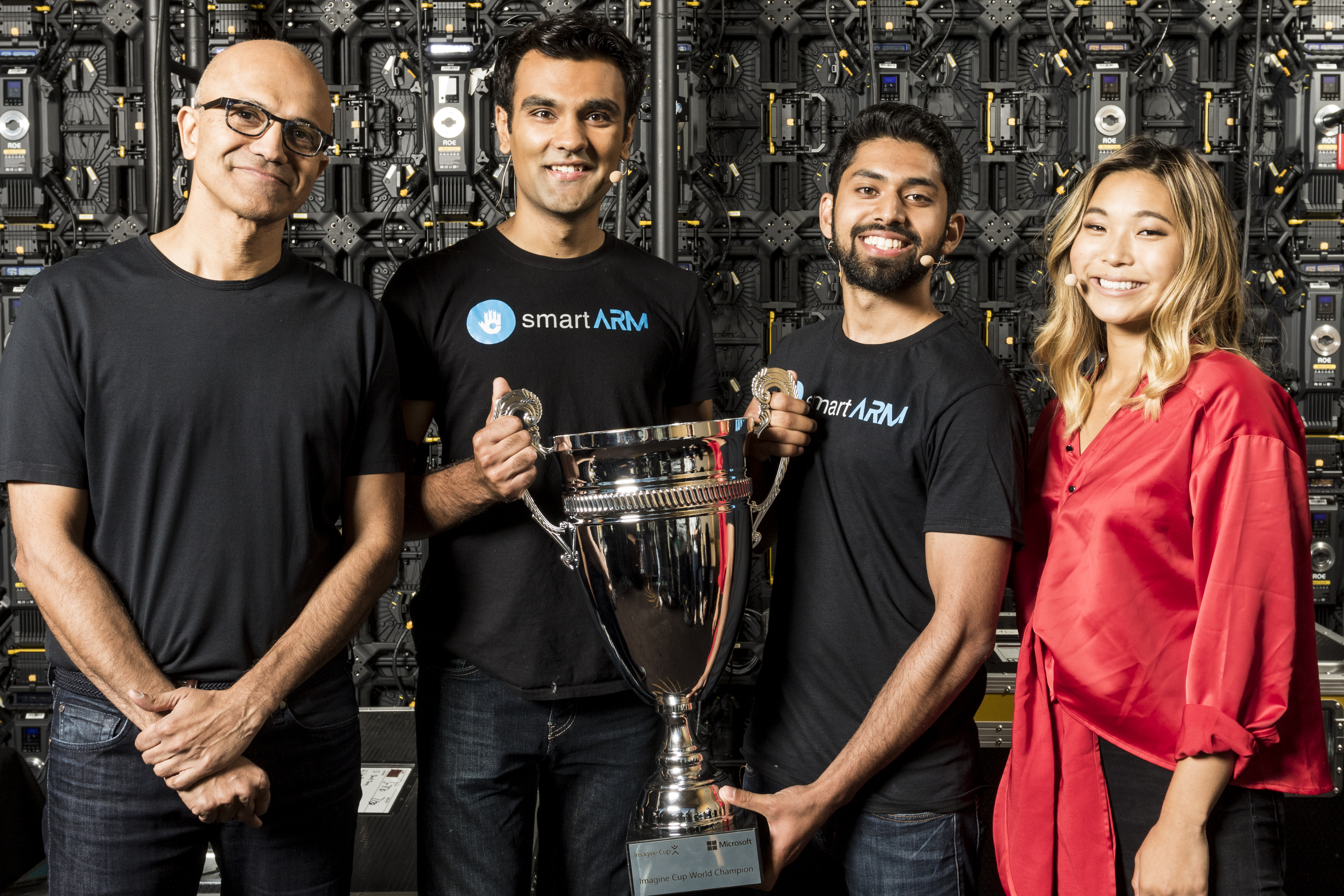
Satya Nadella with smartARM team members, the 2018 Imagine Cup World Champions, along with Chloe Kim, special guest and Olympic snowboarding gold medalist.
At its heart, the Imagine Cup is all about bringing students together from across the globe, inspiring them to usher in our collective future using cloud-based technologies of today and tomorrow, including artificial intelligence (AI), big data, mixed reality and more. Since its inception 16 years ago, the Imagine Cup has motivated nearly 2 million students from over 190 countries around the world to bring their biggest, boldest ideas to life.
Today, we are excited to announce smartARM of Canada as the 2018 Imagine Cup champions! smartARM created a robotic hand prosthetic, using Microsoft Azure Computer Vision, Machine Learning and Cloud Storage, that uses a camera embedded in its palm to recognize objects and calculate the most appropriate grip for an object. Based on machine learning, the more the model is used, the more accurate it becomes. As the victors, smartARM wins a mentoring session with Microsoft CEO Satya Nadella, $85,000 in cash and a $50,000 Azure grant. Team iCry2Talk of Greece earned second place with a low-cost and non-invasive intelligent interface between infant and parent that translates in real time the baby’s cry, and associates it with a specific physiological and psychological state, depicting the result in a text, image and voice message. Third place went to Team Mediated Ear of Japan for its project, Mediated Ear, software for hearing-impaired individuals to focus on a specific speaker among a multitude of conversations. Mediated Ear can relay specific sounds in audio waveforms through deep learning.
For the winners, and for their competitors, the road to the World Finals started with a single idea on how to change the world through innovative use of technology. Tens of thousands of students walked this road, spending months coding their solutions and dreaming up go-to-market plans to bring their ideas to life. From there, and through fierce competition at the national and regional level, 49 teams from 33 countries were selected to compete in the World Finals.
This year, we’ve added special Imagine Cup awards of $15,000 for three key areas of digital transformation: AI, big data and mixed reality. On Tuesday, we crowned the winners. SochWare from Nepal, won the AI award for designing a solution to help farmers identify plant diseases, suggest mitigation strategies, connect with experts and get updated with recent agriculture findings. Drugsafe from India won the big data award for their solution to validate genuine drugs and decrease illness from counterfeit substances. Pengram from the United States won the mixed reality award for allowing engineers from around the world to be holographically “teleported” into a workspace when needed.
The 2018 winners emerged from a strong field of competitors featuring projects that utilized leading-edge cloud technologies with the promise of improving the way we live and work. Throughout it all, the next generation of innovators put their creativity on display in addressing some of humanity’s most pressing issues.
This year’s participants weren’t just developing unique and potentially game-changing technology experiences, but they are also actively sharpening the skills that will boost their success as developers, technologists and entrepreneurs for the next generation. They follow in the footsteps of a long line of dreamers driven to succeed. For example, 2017 year Imagine Cup alumni Declan Goncalves of Canada was featured in Betakit’s “Canada’s Developer 30 Under 30” list for developing a platform which allows medical practitioners to better quantify their patient’s progress and detect neurodegenerative disease onset with the help of AI. Another alumni team, Kobojo, began their journey making Facebook games at Imagine Cup 2008 and has since raised $6 million in venture capital for their startup.
I’d like to thank this year’s championship judges: Co-founder and COO of Bitnami, Erica Brescia; CEO of Glitch, Anil Dash;, and Microsoft’s own Peggy Johnson, Executive Vice President of Business Development at Microsoft. Special thanks also to Microsoft Corporate Vice President of Azure Compute Corey Sanders, who hosted the championship and announced this year’s winner. Last but certainly not least, on behalf of Microsoft, I’d like to congratulate our new Imagine Cup champion, team smartARM, and all of the students who worked so hard to make this 16th anniversary Imagine Cup the most inspiring one yet. If you haven’t had a chance, be sure to view the championship video above to see some of the best student developers in the world envision a brighter, bolder future for us all.
— Charlotte
P.S. Follow me on Twitter for updates on Imagine Cup and other news and noteworthy information in the cloud and ecosystem space.