Building on our 2015 announcement Three years ago, we announced that we would require a wide variety of suppliers that do business with Microsoft in the United States to provide their employees with the important benefit of paid time off. Today we are announcing that over the next year we will take a further step, to ensure that these suppliers also provide their employees who handle our work with paid parental leave.
We have long recognized that the health, well-being and diversity of our employees helps Microsoft succeed. That’s why we provide industry-leading benefits for our employees, including comprehensive health and wellness programs for families, paid vacation, paid sick leave and paid time off for new parents.
We also know that we rely on a wide array of other companies to supply us with goods and services that reflect their core competencies, and that the people who work for our suppliers also are critical to our success. That is why we took the step three years ago to require our U.S. suppliers doing substantial business with Microsoft to provide paid time off for their employees. Paid time off is good both for employers and employees, and it was the right step for our business. By implementing that requirement, we were able to focus our resources on businesses that share with us a commitment providing employees with important benefits such as paid time off. We believe now is the time to work with our suppliers to take a next important step.
What we’re doing Over the next 12 months we will work with our U.S. suppliers to implement this new paid parental leave policy. It will require that suppliers offer their employees a minimum of 12 weeks paid parental leave, up to $1,000 per week. This change applies to all parents employed by our suppliers who take time off for the birth or adoption of a child. The new policy applies to suppliers with more than 50 employees and covers supplier employees who perform substantial work for Microsoft. This minimum threshold applies to all of our suppliers across the U.S. and is not intended to supplant a state law that is more generous. Many of our suppliers already offer strong benefits packages to their employees, and suppliers are of course welcome to offer more expansive leave benefits to their employees.
Our new supplier parental leave requirement is informed by important work on paid parental leave done in states, including Washington. In 2017, Washington state passed family leave legislation, including paid parental leave. This new law will take effect in 2020. As we looked at this legislation, however, we realized that while it will benefit the employees of our suppliers in Washington state, it will leave thousands of valued contributors outside of Washington behind. So, we made a decision to apply Washington’s parental leave requirement more broadly, and not to wait until 2020 to begin implementation.
Microsoft will work with our suppliers to understand the impacts of this change, and we will make these changes in a thoughtful way. We appreciate that this may ultimately result in increased costs for Microsoft, and we’ll put a process in place for addressing these issues with our suppliers. Our first step will be reaching out to our suppliers to discuss the impact of this policy change.
The case for paid parental leave We recognize today’s announcement comes during an ongoing national dialogue about the importance of paid parental leave. The case for paid parental leave is clear. Studies show that paid parental leave enriches the lives of families. Women who take paid maternity leave are more likely to be in the workforce a year later and earn more than mothers who do not receive paid time off. Employers who offer paid time off for new mothers experience improved productivity, higher morale and lower turnover rates. And, paid parental leave is not solely a benefit for women. Data from California’s paid family leave program shows that men take paternity leave at twice the rate and for longer periods of time when the leave is paid. This increased bonding and time spent caring for young children is correlated with positive outcomes such as higher test scores for these children. Further, when men and women have the opportunity to take paid leave, it can help counteract gender caregiving stereotypes, neutralize stigmas and promote equity in the home and office.
Despite these clear benefits, just 13 percent of private sector workers in the U.S. have access to paid parental leave. And the lack of access to parental leave cuts broadly across professions – according to the Bureau of Labor Statistics, 22 percent of professional positions and 7 to 8 percent of workers in service and maintenance jobs have access to paid parental leave.
Like many large employers, we welcome the opportunity to engage in the important national conversation about how all U.S. workers, regardless of where they work, can access paid parental leave. In the meantime, we will continue to focus our resources on doing business with companies that share our commitment to increase workforce inclusion and support employees and their families. As we gain experience with this new approach, we’ll share what we learn with others. And as always, we’ll look forward to learning more ourselves.
We’re proud to see more and more customers using Azure IoT Hub to control and manage billions of devices, send data to the cloud and gain business insights. We are excited to announce that IoT Hub integration with Azure Event Grid is now generally available, making it even easier to transform these insights into actions by simplifying the architecture of IoT solutions. Some key benefits include:
Easily integrate with modern serverless architectures, such as Azure Functions and Azure Logic Apps, to automate workflows and downstream processes.
Enable alerting with quick reaction to creation, deletion, connection, and disconnection of devices.
Eliminate the complexity and expense of polling services and integrate events with 3rd party applications using webhooks such as ticketing, billing system, and database updates.
Together, these two services help customers easily integrate event notifications from IoT solutions with other powerful Azure services or 3rd party applications. These services add important device lifecycle support with events such as device created, device deleted, device connected, and device disconnected, in a highly reliable, scalable, and secure manner.
Here is how it works:
As of today, this capability is available in the following regions:
As we work to deliver more events from Azure IoT Hub, we are excited for you to try this capability and build more streamlined IoT solutions for your business. Try this tutorial to get started.
We would love to hear more about your experiences with the preview and get your feedback! Are there other IoT Hub events you would like to see made available? Please continue to submit your suggestions through the Azure IoT User Voice forum.
As a former educator, I’ve always been conscious of the parent’s role – essentially as their child’s first teacher – and their unique, valuable perspective on learning. Parents remember the ways they were taught in school and often have valid questions and thoughts on the new ways children learn, and about the curriculum being taught.
With summer coming to an end and parents sending their children back to school, Microsoft wanted to understand how parents felt about technology in the classroom. What did they really think of the importance of learning digital skills? Microsoft Education partnered with YouGov and surveyed parents in the U.S. with children aged 18 and under and found most parents are hopeful about what technology will do for their kids. [Download the accompanying infographic here.]
Parents optimistic about technology
The survey asked parents how they felt about the role of technology in their child’s life as that child grows up. In reply, 60 percent said they felt “optimistic” or “hopeful.”
Understandably, parents felt differently about tech depending on where it’s being used. When asked about tech use between home and school, 63 percent of parents cited concerns about their kids spending too much time on devices at home, while 86 percent of parents believed tech in school – including computers and educational software – would be helpful to their child’s education.
When I was teaching I would often talk to parents about screen-content, not just screen-time, and whether the engagement with digital content was active (like creating an animation) or passive (viewing a movie). It’s encouraging seeing parents understand that, when used in the right way, technology can help prepare their children for the jobs of the future and help them succeed.
The importance of Computer Science and learning digital skills
Using technology to learn isn’t the only way to prepare children for the future, however. According to The Bureau of Labor Statistics, 52 percent of job growth by the year 2020 will be in the fields of computing and mathematics, which shows a great importance in teaching Computer Science and digital skills in classrooms today.
According to the survey, half (50 percent) of parents believed coding and computer programming to be the most beneficial subject to their child’s future employability.
Another promising result: Parents felt strongly about the positive role federal and state governments can play in ensuring their children are learning these subjects. The survey sample indicated strongly that parents would like to see increased government support to help schools build kids’ digital skills.
When asked about the technology industry’s involvement, 75 percent of parents said they believe big tech companies should be involved in helping schools build kids’ digital skills. Many companies, including Microsoft and organizations like Code.org, are working to do just that. Programs like TEALS, which is supported by Microsoft Philanthropies, pairs trained Computer Science professionals from across the technology industry with classroom teachers to team-teach the subject.
Tech tips for teachers this school year
With parents seeing the importance of their children learning with technology and being taught Computer Science, coding and digital skills, the survey points to good news for teachers who work every day to ensure the children in their classrooms are prepared for the future.
Teachers work incredibly hard to bring the best and most inspiring learning opportunities to their classrooms. We celebrate and thank them.
For those teachers just starting to explore the potential of Computer Science in their classroom, I’d recommend these three simple approaches:
Open up the conversation with your students. What do they understand CS to mean? What jobs are unlocked with CS?
All figures, unless otherwise stated, are from YouGov Plc. Total sample size was 3927 adults, of which 1011 were parents of children under 19. Fieldwork was undertaken between 2nd – 6th August 2018. The survey was carried out online. The figures have been weighted and are representative of all US adults.
Xbox is bringing games, gear, and more to downtown Seattle for PAX West August 31 – September 3. Whether you’re joining us in person or following along on social media and Mixer, here’s what you can expect:
Xbox Booth North Hall, 4th Floor, Booths 403, 411, 417
Experience a few of the games that make up Xbox One’s diverse line-up at the Xbox booth. We’ll have playable demos of Forza Horizon 4, The Division 2, Shadow of the Tomb Raider, Devil May Cry 5, NBA 2k19, Metro Exodus, Kingdom Hearts III, Tunic, Ooblets, Kingdom Two Crowns, Generation Zero, Bendy and the Ink Machine, Supermarket Shriek, My Time Portia, and some new DLC from State of Decay 2. You will also have the opportunity to earn a Cuphead Pinny Arcade pin, participate in a Tomb Raider-themed scavenger hunt, guess the amount of Nuka Cola caps in a Fallout 76 experience, visit the Game Pass vending machine, and pick up exclusive Xbox Official Gear for the first time at PAX. (PAX Badge required)
Mixer North Hall, 4th Floor, Booth #425
Drop by booth #425 in the North Hall to meet up with some of your favorite broadcasters and Mixer Partners, and for a chance to win swag in the HypeZone LIVE! In addition to that, there’s also going to be a main stage at PAX featuring our Mixer Partners, developers, and so much more. Can’t make it to PAX West in person? No problem! Watch all the action happening at PAX West via Mixer.com/Mixer and Mixer.com/HypeZoneLIVE!
Find out more about streaming and the Xbox Adaptive Controller at these panels featuring Xbox and Mixer members. (PAX West badge required.)
Building Your Streaming Community Wyvern Theater, Saturday, September 1 from 3:00 p.m. – 4:00 p.m.
Building a community comes with many challenges and hurdles, good news is we’re here to help! We’ve gathered a council of content creators to discuss the ins-and-outs of building a great online community in your own livestreams. We’ll be smashing myths and sharing the facts about streaming to help you set a foundation for a positive and effective community.
The Xbox Adaptive Controller: Designed with the Community Sasquatch Theater, Sunday, September 2 from 12:30pm-1:30pm
The Xbox Adaptive Controller is the newest controller by Xbox, created to help people with limited mobility play. Larry Hryb will lead a conversation with pivotal community experts and representatives of game accessibility organizations like AbleGamers and Stack Up, along with one of the controller’s creators. We’ll describe the journey of designing the controller leveraging the input of gamers with disabilities from the start… and where we need to go next.
Xbox One Summer of PUBG Tour
The Xbox One Summer of PUBG tour will be making their final stop in Westlake Center during PAX West. No badge required to visit! Check out the PUBG bus and enter to win it or one of many other prizes. More information can be found here.
Xbox PAX West Sweepstakes
Enter for a chance to win one of 11 Xbox Design Lab controllers, influenced by some of our favorite games. Xbox Design Lab allows you to create your own personal controller from over a billion different color combinations, metallic finishes, and rubberized grips. Check it out and design your own controller at xboxdesignlab.xbox.com.
There are two ways to enter:
Take a photo of your favorite Xbox Design Lab controller in the Xbox booth and share via Twitter using #XboxPAX #XboxDesignLab #Sweepstakes. Don’t forget to follow @Xbox while you’re at it!
Follow @Xbox or @XboxCanada on Twitter and retweet one of their tweets mentioning the sweepstakes and including #XboxPAX #XboxDesignLab #Sweepstakes.
You have until September 3rd to enter. The contest is open to anyone from the US or Canada. Click through for the Official Rules.
See you at PAX West! For more Xbox news, follow @Xbox on Twitter, visit the Xbox PAX West website, and stay tuned to Xbox Wire.
The birth was seconds away. The mother rested on her back while a medical student sat at the foot of the bed, blue surgical gloves on her hands – a scene common to delivery rooms everywhere. Except the mom was a manikin, her fetus was a manikin and the student wore Microsoft HoloLens.
Using the device, the student looked at the mother’s abdomen and saw a hologram of the fetus inside the womb before it rotated and descended the birth canal. Then, her mixed-reality training session got tricky.
Suddenly, the baby’s shoulders became stuck inside the mother, a risky complication – but an emergency purposely triggered by a classroom instructor. The student had to act fast. She placed her hands on the tiny manikin and gently freed the shoulders, safely completing another digital delivery.
CAE LucinaAR – the first human-patient simulator augmented with HoloLens – simultaneously delivered another digital lesson. The technology comes from CAE, a Canadian company that offers virtual-to-live training solutions to assess human performance, improving overall safety from health care to civil aviation to defense operations.
A medical student practices delivering a baby with CAE LucinaAR and HoloLens.
“CAE operates in three sectors where the stakes are high, where there’s no room for error and where the people need to be properly trained to be ready for unlikely situations that could lead to catastrophes,” says Dr. Robert Amyot, president of CAE Healthcare, one of CAE’s three business segments.
“On-the-job training is dangerous and costly,” adds Amyot, a cardiologist by trade. “So, we train pilots to make flying safer. We train the forces in our defense and security division to make them more prepared for their missions. And we train clinicians and health care providers to improve patient safety.”
By going digital, each of those training regimens is becoming more precise at pegging and addressing human vulnerabilities, says Marc Parent, the CEO at CAE.
In the realm of aviation, CAE guides pilots to prep for potential airborne adversities by using individualized simulations built with artificial intelligence and the Internet of Things (IoT).
A new pilot trains on a CAE flight simulator.
“Although it’s the safest mode of transportation in the world, pilots have long been assessed in a subjective way,” Parent says. “But now, by leveraging the data that our simulators are giving us – powered by the cloud – we can give them an objective assessment in real time. That’s invaluable.
“When the pilots go into our simulator, we are able to give them personalized insights into their skills, into how they perform different operational practices. This raises their level,” Parent says. “And practice makes perfect.”
Being an informed consumer of the news is more challenging today than it used to be. We live in a busy world where dozens of headlines compete for our attention every day. On top of that, it’s difficult to know if you’re getting all sides of a story or just leaning into an echo chamber, and it can feel like a full-time job to seek out various points of view.
At Bing, we want to empower users to get an overview of the news in less time. That’s why we built the Bing spotlight that provides overviews of news topics that you can see right in the Bing search results when you search for major developing news stories.
Spotlight shows users the latest headlines, a rundown of how the story has developed over time, and relevant social media posts from people around the web. Spotlight also shows diverse perspectives on a given topic so users can quickly get a well-rounded view on the topic before deciding what they want to go deeper on and read by clicking on any of the articles.
Spotlight is currently available on Bing desktop and mobile web in the US.
Users’ trust in the news we present is of the utmost importance to Bing, and we’re committed to providing a well-rounded view of news from diverse, quality sources.
To start, Bing monitors millions of queries and news articles every day and identifies impactful stories that evolve over a period of weeks or months. We look at various user signals such as queries and browser logs, and document signals from publishers such as how many publishers cover a story, their angles, and how prominently they feature the story on their site. For controversial topics, in the Perspectives module, we show different viewpoints from high-quality sources. For a source to be considered high quality, it must meet the Bing News PubHub Guidelines, which is a set of criteria that favors originality, readability, newsworthiness, and transparency. Top caliber news providers identify sources and authors, give attribution and demonstrate sound journalistic practices such as accurate labeling of opinion and commentary. Behind the scenes, we leverage our deep learning algorithms and web graphs of hundreds of millions of web sites in the Bing index to identify top sources for national news, per category, query, or article. Our goal is to provide broader context for impactful stories, from politics to business to major disasters, and much more.
Providing different perspectives in our spotlight experience is part of a broader effort to help our users be more informed with various perspectives on a range of topics, from news to common health questions. We’re working hard to expand the range of topics covered by this approach, including expanding the numbers of topics spotlight covers, to help you become more informed in less time and effort. We hope you’re as excited about these updates as we are!
What does hybrid cloud mean to IT professionals, and why are so many companies using it? Microsoft conducted a survey with research firm Kantar TNS in January 2018, asking more than 1700 respondents to chime in. Surveys were collected from IT professionals, developers, and business decision makers to identify how they perceive hybrid cloud, what motivates adoption, and what features they see as most important. Survey participants in the United States, the United Kingdom, Germany, and India were asked their thoughts about hybrid, which for the survey was defined as consisting of “private cloud or on-premises resources/applications integrated with one or more public clouds”. We’ve created a summary infographic of the survey that you can review. A few survey highlights:
Hybrid is common, with a total of 67 percent of respondents now using or planning to deploy a hybrid cloud. Many of those hybrid users have made the move recently, 54 percent of users in the past two years.
Cost, a consistent IT experience, and the ability to scale quickly were all given as important reasons for moving to hybrid cloud.
The perceived benefits of hybrid cloud, as well as some of the challenges, vary by the geographic location of respondents. For example, increased security was the top benefit cited in the United Kingdom and Germany, while the top United States benefit was better scalability of compute resources.
The top use case given for hybrid cloud was controlling where important data is stored at 71 percent. Using the cloud for backup and disaster recovery was a close second at 69 percent.
Participants for this online survey were recruited from (non-Microsoft) local market lists selected by Microsoft and the international research firm Kantar TNS, which was hired to conduct the outreach. Survey participants included IT professionals, professional developers, and business decision makers/influencers who use, are planning, or have considered a hybrid cloud deployment. Surveyed company sizes were from mid-market to enterprise (250+). The survey was conducted January 4 – 24, 2018. For the purposes of this survey, hybrid cloud was defined as follows. Hybrid cloud consists of private cloud or on-premises resources/applications integrated with one or more public clouds.
Students, parents and teachers attended a recent literacy kick-off event at Microsoft to see how Learning Tools improve reading.
More than 36 million adults in the United States cannot read, write, or do basic math above a third grade level. And children whose parents have low literacy levels have a 72 percent chance of being at the lowest reading levels themselves. These kids are more likely to get poor grades, display behavioral problems, have high absentee rates, repeat school years, or drop out1.
In a majority of classrooms today, teachers have students reading at up to four different grade levels, trying to keep the same pace on curriculum2.
Workshops will be offered at different times throughout the year at all Microsoft Stores in the US, Canada and Puerto Rico, so be sure to check out the local Store programming near you to find the right workshop for your needs. Workshops will be catered to students’ age range, including:
Empowering students affected by Dyslexia
Educators and parents/caregivers working with students of any age; and children in 8th grade or above who are accompanied by an adult, will get hands-on experience with Microsoft applications and tools – including Learning Tools, the Ease of Access menu and accessibility and productivity features of Office 365. Teachers will be empowered to create inclusive classrooms that support students of all abilities, while parents/caregivers will gain skills to support learners outside of the classroom.
The workshop covers why it’s important to create an inclusive classroom, tools to empower different learning styles and abilities, and tools to support students with disabilities.
Boost your reading confidence and literacy skills ages 8-12
This workshop introduces students, with foundational literacy skills, to the Immersive Reader in the OneNote app. Participants will build confidence and improve their reading comprehension through grade-level–appropriate activities with Immersive Reader features. Activities include demonstrations, playing “Mad-Lib” style games, and building and reading stories in pairs to gain hands-on experience using the tools.
Literacy skills for emerging readers ages 6-8
This workshop introduces emerging readers to Learning Tools for OneNote via age–appropriate activities with Immersive Reader features. Activities include discussions, demonstrations, and playing word and story games to gain hands-on experience using the tools. At the end, participants will share what they learned with their parent or caregiver. Throughout the workshop, participants will learn how to build confidence and improve their reading comprehension, and should leave prepared to continue using Learning Tools to further develop reading skills at home and at school.
Two students celebrate during the literacy kickoff event at Microsoft.
With free software like Microsoft Learning Tools and heroic educators like Merlyne Graves, we are encouraged by the progress that’s happening every day. More than 13 million teachers and students are already using Microsoft Learning Tools for free as part of Office 365 Education, including tools like Immersive Reader, Picture Dictionary and Dictation. These are proving to increase reading and writing skill successfully, as evidenced by the recent 3rd party study from RTI International, Leveling the Playing Field with Microsoft Learning Tools.
Through these workshops, we hope to give anyone who may have challenges with reading and writing skills the tools they need to feel empowered and to personalize their learning experience, especially those in underserved communities, or with learning differences like ADHD, Dyslexia, Dysgraphia or Autism.
Decoding Dyslexia, a parent-led movement to raise awareness around Dyslexia, is partnering with Microsoft on these workshops. “We need to get technology like Learning Tools into the hands of more students with Dyslexia and other learning differences before they fall behind,” said Rachel Berger, CEO of Decoding Dyslexia, “so I’m excited about the reach Microsoft Stores will have this fall. It’s truly empowering software that can make any classroom more inclusive.”
To kick off the program, Microsoft recently hosted more than 400 students, parents and teachers from across Washington and Oregon to be the first to try the new workshops. The event also included a keynote from former NFL cornerback Robert Tate, who shared his experience with dyslexia at a young age. “My friends didn’t know I had dyslexia,” Robert said. “I would hide within myself and make sure I wasn’t the one putting my hand up to ask questions or the one reading in class. You just have to keep moving forward and never go backwards.”
Ales Holecek, corporate vice president at Microsoft who helped spark discussions that led to Learning Tools, also spoke to the group, telling the audience of parents, teachers and students about his reading comprehension issues that started at a young age and continue today. “I take a long time to read anything and hate emails. I tell my team to send short emails; or better still, come speak to me in person,” said Holecek. For Ales, the turning point came in coding, which he felt operated on a simpler vocabulary.
How Microsoft is cutting through the noise to create a more useful, beautiful ‘sound world’
You might never have thought about the sounds your computer emits when an email arrives, your battery runs low or a meeting reminder pops up on your screen. Matthew Bennett has. A lot.
Bennett personally composed, performed and digitally manipulated more than 400 versions of the Windows 10 calendar alert sound before choosing the perfect one.
“That’s just how long it took to get it right,” Bennett said with a shrug during a recent visit to his Redmond, Washington sound studio. The ambiently lit, sound-damped room features a mixer, multiple high-end studio monitors and large LCD screens, and, front and center, a multi-octave synthesizer keyboard.
As audio creative director for a large portfolio of Microsoft software and devices, Bennett has played a key role in the company’s sound design for 15 years. He has strong opinions and well-developed philosophies about sound, as well as a highly specialized vocabulary to discuss it.
2:06
Video: How I composed the Windows 10 calendar alert
Summarizing his role, he reflected, “Our responsibility to customers is, first, do no harm – no annoying audio! Second, make it functional, and third, make it beautiful. Beauty and function go hand in hand. The more beautiful the design, the better it will support the experiences we’re creating.”
The Windows 10 family of sounds took many months to perfect, as he collaborated closely with key members of his team, including visual designers, researchers, project managers and engineers. “We iterate a lot to be sure every sound is just right,” he said.
A composer of classical and improvised music who has done extensive research on non-Western music cultures, Bennett carried out Ph.D. work in ethnomusicology (the anthropology of music) at the University of Washington, before leaving the program to accept his first full-time position at Microsoft. After a five-year stint, he struck out to form his own agency, and for the next decade devoted himself to creating scores for film and television, as well as brand sound design for Fortune 500 companies. But he eventually became dissatisfied with the music he was creating.
Seeking new inspiration, he quit composing to study medieval chant and the musical cultures of West Africa, India, the Middle East and Indonesia. When he gradually resumed composing, his goal was to create a personal musical language – “a sound world that I could live with,” as he describes it. These examples show the results.
Once back at Microsoft, Bennett dug in hard. Now his work can be heard not only throughout the Windows platform, but also in the Xbox operating system and products including Office, Surface, Cortana and Skype. Having a strong sound design philosophy and creative point of view at the center is intended to help unify the soundscape of Microsoft products, just as the company’s user-interface design principles attempt to create a company-wide visual and functional continuity among its products.
We want to orchestrate harmony across devices and senses.
Beyond that, Microsoft’s Fluent Sound and Sensory Design development environment seeks to influence sound design in the technology industry more broadly.
“We use sound to shape the rhythm and emotional texture of the user experience,” Bennett said. “Sound is an element that’s integrated with other sensory experiences like touch, texture and movement. We’re shifting the way we think about sound design at Microsoft, and hopefully the industry at large. Our goal is to help orchestrate harmony across devices and senses.”
Rick Senechal, a Microsoft media solutions architect, has worked with Bennett for 20 years. Senechal directs a worldwide music service for company teams and agencies. Each year the service provides 4,000 songs for events, videos, podcasts and products.
Bennett takes his time and is extremely deliberate, Senechal said.
“Matthew is the most focused person I’ve ever worked with,” he said. “He takes a long, in-depth view of his craft and really thinks things through. He’s not just making sounds and saying, ‘Oh, that sounds good.’ There’s a logic and intelligence behind the sounds and textures he creates.”
Bennett is quick to declare what Microsoft sounds are not.
There’s a logic and intelligence behind the sounds and textures he creates.
“We’re not sound effects, game sounds, generic sounds (beeps and bloops), novelty sounds (dogs and fog horns), futuristic sounds, wall-to-wall music or alarms,” he said. “Our product sounds are not live musicians or sampled bits of real instruments, like a piano or guitar or analog synthesizer, because those evoke specific musical styles and emotional memory, which is very subjective between individuals and across cultures. Those design approaches don’t make sense for the kinds of modern digital experiences our teams are creating. Our goal is to develop a sound design language that feels unique and authentic and deeply integrated with our products and devices.”
Sounds in older versions of Windows were quite different from those in Windows 10, Bennett noted. For one thing, there were a lot more of them. Triumphant sounds denoting a successful boot-up “aren’t necessary anymore,” he said. “We no longer need to celebrate the fact that our devices are turned on. That’s something we can take for granted at this point.”
Many modern product sounds tend to be shorter. Earlier sounds, such as the shutdown signal in Windows NT Workstation 4.0 (1996), lasted 8 seconds – interminable by today’s standards, which call for less intrusive sounds measured in milliseconds (1/1,000 of a second). And, like start-up sounds, shut-down sounds are a thing of the past, deemed just another needless contributor to tech-induced noise pollution.
The start-up sound in Windows NT Workstation 5 (2000), nearly 12 seconds long, sounded like a squadron of fighter jets taking off, followed by twinkling marimbas. Today’s sounds are “more deeply integrated with the product and as calm, quiet and non-intrusive as possible,” Bennett said.
Gone are sounds that specialists call skeuomorphic – those that replicate their real-world counterparts, like a piece of paper being crumpled up when a document is deleted or the clacking of 19th century, mechanical typewriter keys denoting on-screen keystrokes.
Matthew Bennett at Microsoft Production Studios with audio engineer Dan Charette.
“In earlier stages, those sounds helped people get familiar with technology, but we don’t need them anymore. They no longer add to the experience, and they tend to feel more like clutter now,” Bennett said. “For many years now, the visual design world has been reducing clutter and using more space,” he observed. “Now sound is starting doing the same.”
Windows 7 had about 40 sounds. Windows 10 has about eight, though legacy sounds are included with the OS to ensure backwards compatibility, he said. “When I started, there were seven different system error sounds. They had accrued over years and no one knew what they meant. There were no clear guidelines for partners or for ourselves. We got rid of the whole set and replaced them with two much more focused sounds – one gentle background notification and another more urgent sound.”
One design technique Bennett has developed involves the extensive recording and comparison of vocal contours – the melodic and rhythmic aspects of speech – from many different languages, to identify universal patterns that can help create a sound design language. For example, a statement that means “Ready to go?” can have a very similar pitch pattern when spoken in English, French, Japanese, Mandarin, Spanish or Russian. It’s basically “up, down, and a small leap,” he says.
Bennett took that particular vocal contour and replicated it musically, so that it can be heard underlying the 2.5-second Windows 10 calendar alert prompt. This technique has shaped the entire set of Windows 10 sounds. “The language contours are deeply integrated, not intended to be heard literally, or consciously,” he said. “They should just be felt intuitively to create an emotional connection that feels natural, instinctive.”
Bennett believes the best operating system sounds should be deeply integrated with the events they support. For example, texting is more time-sensitive than emailing, so the Windows 10 text messaging sound “pulls you forward a bit and is a little more alertful,” he said. For a new email, “you still want to know something’s come in, but the sound pulls back a bit. It’s a little more relaxed.”
Does he call his creations “music”?
We design sound with silence in mind.
“In the broadest sense, yes. I would describe them as paramusical,” he said. “They utilize musical elements – rhythm, melody and harmony – to make sounds that feel beautiful, but they should never call attention to themselves as a piece of music,” he said.
Musical concepts certainly play a major role in Bennett’s design thinking.
“The error-message tone uses a minor 9th interval, which is definitely a little dissonant and says, ‘You really need to pay attention to this,'” he said.
While more tech companies are now employing audio directors like Bennett, “as a discipline, sound design still lags a little behind hardware and visual design,” he said. “We traditionally haven’t been deeply integrated into product design teams, aside from games. Microsoft was one of the first companies to realize the value of embedding sound designers with product teams.”
In addition to influencing Microsoft and technology design more broadly, Bennett thinks the discipline of sound design has an obligation to the world at large. The New York Times, in a Feb. 9, 2018 story, noted the cacophony produced by today’s ubiquitous electronic devices, asserting that “bombastic, attention-grabbing inorganic noises are become the norm [and] disruptive sonic alerts trigger Pavlovian feedback.”
Bennett hears that.
“There are so many device sounds in our environment now. Windows sounds alone are heard hundreds of millions of times a day around the world,” he said. “That’s a lot of sound affecting a lot of lives. Even if they are relatively short, every sound has an emotional impact, whether we’re aware of it or not. We have a responsibility to approach this as a system and to help create an audio ecology that supports healthy relationships between people and technology.”
The World Health Organization has recognized that unexpected loud sounds can cause stress and anxiety which are detrimental to public health, and that unnecessary sounds and excessive volume are just another form of pollution.
“In a rainforest, there’s an incredible amount of information being communicated through sound, with many layers in motion simultaneously – birds, insects, trees, plants, water and wind. And it’s all very intelligible because the acoustic design of a rainforest has evolved to be naturally orchestrated, with a deep harmony that let’s all the layers breathe and function together. That’s a powerful metaphor for how we should be designing sound.”
Toward the end of our conversation, I made a confession to Matthew: I haven’t operated my Windows computer with the sounds turned on since, oh, about 1990. I found them unnecessary and even irritating.
I asked him what I’d been missing – whether there is some subtle aspect of the OS that is being lost on me.
He answered, “The right sounds at the right time, can support a more efficient and more pleasant user experience. They can convey important information and improve the rhythm and flow of attention, which is really our most important resource. They can convey crucial information when we’re away from a screen. They can improve the way our technology feels. We want people to know it’s OK to turn your sounds back on. Our modern approach to sound design is deeply respectful. We’re not going to boot up loudly in a meeting or in the library, we’re not going to disturb the people around you. It’s not going to be random noise. It’s going to be a small set of beautiful sounds that are carefully curated to communicate important information very efficiently and to sit well in your environment.”
A Gentle Reminder
Matthew Bennett on creating the Windows 10 calendar alert sound
A lot of people feel anxiety over their calendar sounds, because it means there’s something they have to do. Some of them say it’s like responding to fire alarms all day. We needed something that was alertful but not anxiety-producing. And we wanted to get the right amount of optimism and energy, pulling the user forward to their next activity, but with the feeling of a calm, supportive friend.
This sound is meant to be heard at lower volumes and to be more felt than heard. It has a beginning, middle and end. If you listen closely, you’ll hear that it’s a rhythm of seven equal pulses. It starts low and slow, with three pulses that are designed to be felt more than heard. And it lasts a long time for a user-interface sound – 2.5 seconds – but at normal volume you only really hear part of the sound because those first three tones are so soft. They’re like a breath, a musical pick-up, to let you know something is about to happen. Then the volume swells a bit, it blooms, to make the middle section more audible. And at the end there’s a long reverb tail, falling off, that feels very transparent and light but can also improve audibility in certain loud contexts or when users are away from their device.
So it’s long sound, but very open. It’s definitely not alarming. It feels lightweight and pleasant and has a nice emotional texture.
There’s also a subtle left-to-right movement in the sound field that you can hear through headphones or decent speakers, like those on a good laptop to tablet.
There are foreground and background layers baked into the finished sound. The foreground is digitally sculpted plucks and tuned percussion. The textures sound familiar but they aren’t real-world instruments.
There’s a triplet feel to this sound and to a lot of the others in Windows 10. Over the years, the sounds that usually feel the most fluid, and that can balance the right qualities of energy and calmness, have tended to be resolved to an underlying triplet rhythm. So that pulse, that rhythmic substructure, has become part of our DNA.
We want to sound organic, and integral. That means we definitely don’t want the sounds to feel like they’ve been programmed on a computer. But we also don’t want to sound like a human being performing a little piece of music inside your device. So we resolve to a subtle temporal grid, to feel a little machine-like, while still keeping a little soulfulness.
When you’re watching high dynamic range (HDR) video on your PC, colors are more vivid. You find more details in the darkest and brightest parts of a scene, such as dimly lit rooms or a blazing fire. You notice more contrast, with a pronounced difference between lights and shadows.
To see how HDR video compares to traditional content (SDR), look at the images below. The SDR version, in general, is more flat and washed out. With an actual video on an HDR-capable PC, the difference is like night and day – literally.
HDR video still
SDR video still
Simulation of HDR content vs. SDR content
Windows HD Color is a set of features bringing HDR content to Windows PCs. Our team works hard to improve the quality of every pixel on your display, including better colors and more vivid scenes. The goal is to help you get ultra-realistic movie, gaming and creative experiences in Windows 10.
To enjoy HDR video, you need the right content, hardware and software. As more HDR hardware and content come to market, we’re committed to giving you the best HDR experiences.
In settings, you’ll be able to choose “Stream HDR Video” in the Video Playback if your display supports HDR video
HDR is a dramatic improvement over traditional SDR (standard dynamic range) content in two ways: light and color.
When it comes to light, HDR video takes advantage of new hardware that can show much higher contrast between the brightest whites and the darkest blacks on your screen. HDR video encodes additional information into your content (and allows for a much higher peak brightness) so you can see much more detail across the entire spectrum of display capabilities. For example, in a single frame of HDR video, the sun will appear distinctly brighter, details on the brightest surfaces will be sharper, and the darkest shadows will appear with terrific detail.
With respect to color, HDR video also improves over traditional content in two ways. First, it typically uses wider color gamut (WCG) when encoding information, meaning that it shows a wider range of colors compared to traditional SDR content. This results in, for example, increasingly saturated hues of color. Second, color is more precise with HDR. This is because it can represent many more unique shades even within the same range of color. On new HDR-capable hardware, these two color-related improvements result in much deeper and more vivid reds, greens, and blues, and allows for more gradations of color in-between.
How can I get HDR video?
With Windows HD Color, our goal is to make HDR video look as good as possible using the fullest extent of your PC’s capabilities. Since fully HDR-capable, built-in displays aren’t on laptops today, our efforts are focused on:
1. Playing HDR video on external HDR10displays
In the Windows 10 Fall Creators update, Windows supports external HDR TVs and monitors. Among other features, this allows Windows to consume HDR video and show full HDR quality (i.e., HDR features described above like higher peak brightness, wider color gamut, and more accurate color). You will also need a modern graphics card and updated drivers.
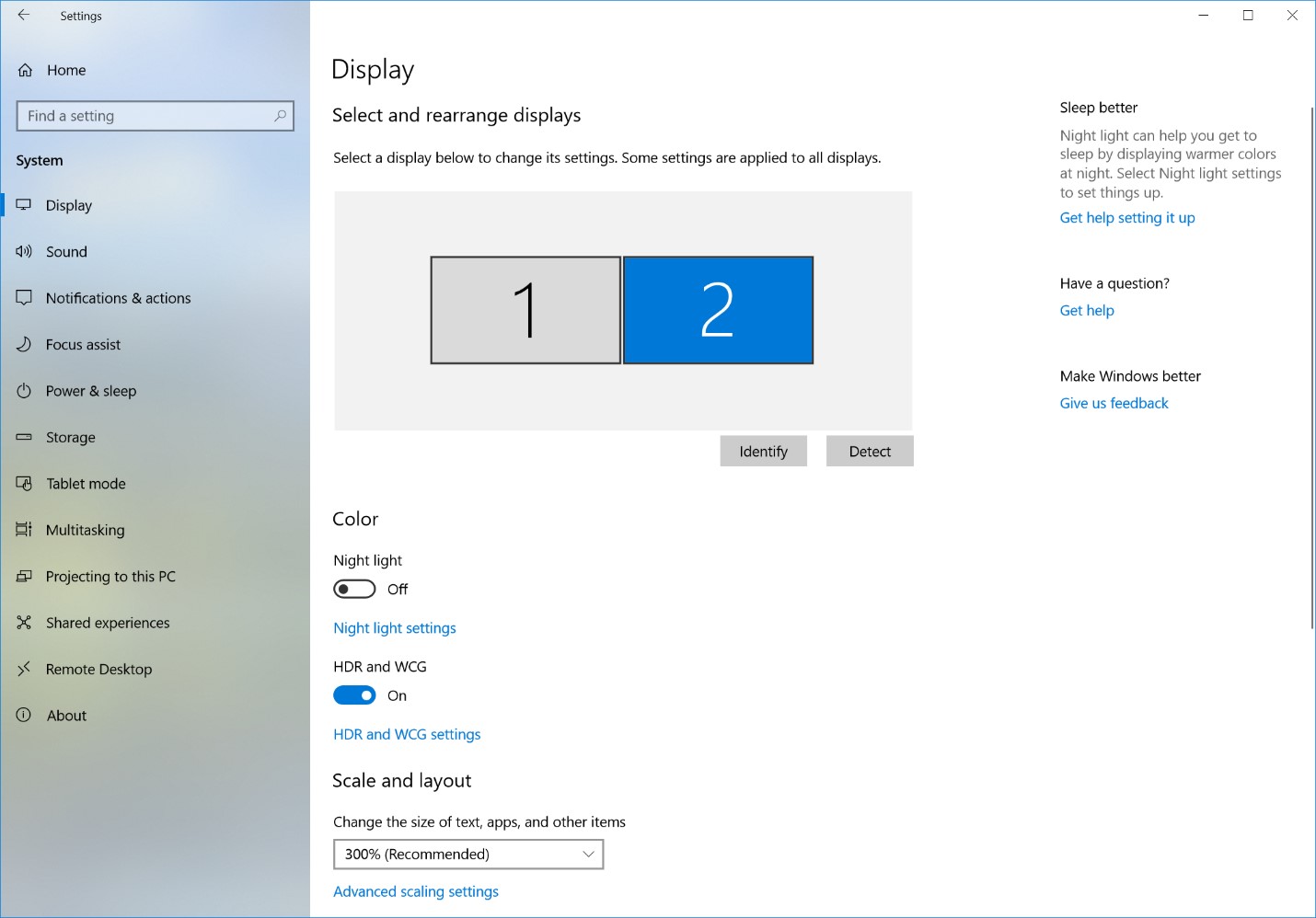
To get HDR, go to Settings > System > Display, and turn on “HDR and WCG.”
2. Improving video on current generation built-in displays (i.e., laptops)
Currently, most laptop displays don’t truly support HDR content, particularly when it comes to color (they do not have wider color gamuts nor higher color precision). Nevertheless, medium- to high-end models tend to have bright screens. We can combine these bright screens with the expanded range of brightness information available in HDR video formats so that Windows plays HDR video at its best for that display.
Playback quality of HDR content on these devices is noticeably better than the SDR version of the same content. This is particularly apparent in scenes where movie creators have mastered their content to fully exploit new HDR technologies.
While this update for built-in displays focused on the better brightness of HDR content, in the future we are working on bringing you better color.
Only devices that meet certain hardware requirements will be capable of playing HDR video.
There is a lot of free HDR content available online. You can find some good examples if you open Microsoft Edge on your Windows 10 PC, go to YouTube, and then search for “HDR.”
Netflix has HDR content as well, but you need to be on the “Premium” tier plan to have access. If you are on this plan, either download the Netflix app from the Store or go to Netflix.com in Microsoft Edge and search for “HDR.” Check out “Chef’s Table: France.”
(Side effects of this last show in HDR include uncontrollable hunger and impulse-purchase plane tickets to Paris.)
We are working with other content providers to expand the scope of HDR content on Windows.