Posted on Leave a comment

Adobe, Microsoft and SAP announce the Open Data Initiative

Industry leaders team up to help customers connect data across their organizations, find powerful insights and deliver intelligent services with AI
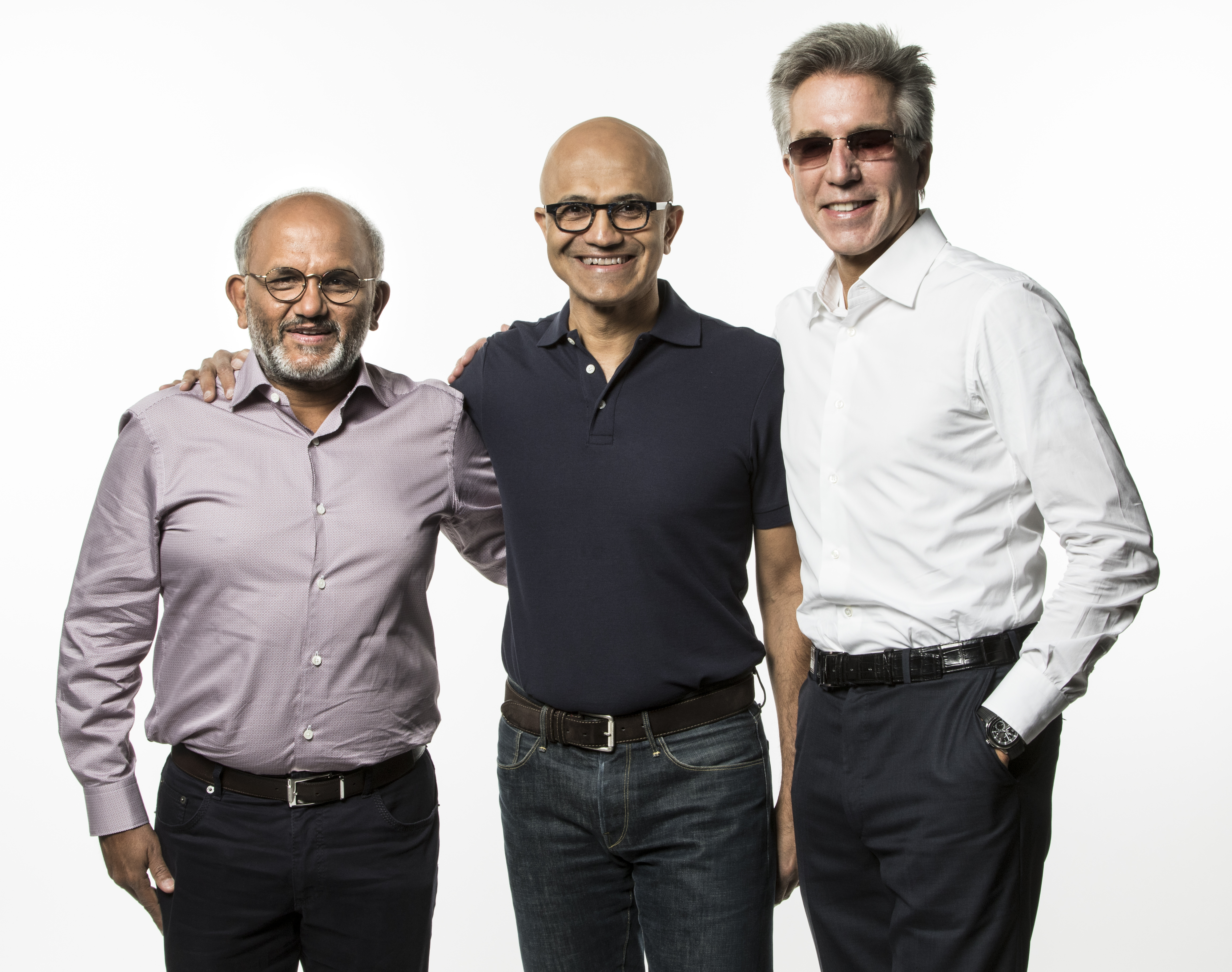
Shantanu Narayen, CEO, Adobe, Satya Nadella, CEO of Microsoft, and Bill McDermott, CEO of SAP
Shantanu Narayen, CEO, Adobe (left), Satya Nadella, CEO of Microsoft (center), and Bill McDermott, CEO of SAP (right), introduced the Open Data Initiative at the Microsoft Ignite conference.

ORLANDO, Fla. — Sept. 24, 2018 On Monday, the CEOs of Adobe (Nasdaq: ADBE), Microsoft (Nasdaq: MSFT) and SAP (NYSE: SAP) introduced the Open Data Initiative at the Microsoft Ignite conference. Together, the three longstanding partners are reimagining customer experience management (CXM) by empowering companies to derive more value from their data and deliver world-class customer experiences in real-time.

In today’s world, data is a company’s most valuable asset. However, many businesses struggle to attain a complete view of their customer interactions and operations, because they are unable to connect information trapped in internal silos. At the same time, important customer information also resides in external silos with intermediary services and third-party providers, limiting a company’s ability to create the right connections, garner intelligence and ultimately extract more value from its own data in real time to better serve customers.

Companies around the world use software and services from Adobe, Microsoft and SAP to run product development, operations, finances, marketing, sales, human resources and more. Today, Adobe, Microsoft and SAP are joining forces to empower their mutual customers with the Open Data Initiative, which is a common approach and set of resources for customers based on three guiding principles:

  • Every organization owns and maintains complete, direct control of all their data.
  • Customers can enable AI-driven business processes to derive insights and intelligence from unified behavioral and operational data.
  • A broad partner ecosystem should be able to easily leverage an open and extensible data model to extend the solution.

Based on these principles, the core focus of the Open Data Initiative is to eliminate data silos and enable a single view of the customer, helping companies to better govern their data and support privacy and security initiatives. With the ability to better connect data across an organization, companies can more easily use AI and advanced analytics for real-time insights, “hydrate” business applications with critical data to make them more effective and deliver a new category of AI-powered services for customers.

“Adobe, Microsoft and SAP are partnering to reimagine the customer experience management category,” said Shantanu Narayen, CEO, Adobe. “Together we will give enterprises the ability to harness and action massive volumes of customer data to deliver personalized, real-time customer experiences at scale.”

“Together with Adobe and SAP we are taking a first, critical step to helping companies achieve a level of customer and business understanding that has never before been possible,” said Satya Nadella, CEO of Microsoft. “Organizations everywhere have a massive opportunity to build AI-powered digital feedback loops for predictive power, automated workflows and, ultimately, improved business outcomes.”

“Microsoft, Adobe and SAP understand the customer experience is no longer a sales management conversation,” said Bill McDermott, CEO of SAP. “CEOs are breaking down the silos of the status quo so they can get all people inside their companies focused on serving people outside their companies. With the Open Data Initiative, we will help businesses run with a true single view of the customer.”

To deliver on the Open Data Initiative, the three partners are enhancing interoperability and data exchange between their applications and platforms — Adobe Experience Cloud and Adobe Experience Platform, Microsoft Dynamics 365, SAP C/4HANA and S/4HANA — through a common data model. The data model will provide for the use of a common data lake service on Microsoft Azure. This unified data store will allow customers their choice of development tools and applications to build and deploy services.

With the Open Data Initiative, companies will be able to:

  • Unlock and harmonize siloed data to create new value
  • Bi-directionally move transactional, operational, customer or IoT data to and from the common data lake based on their preference or needs
  • Create data-powered digital feedback loops for greater business impact, while also helping to enable their security and privacy compliance initiatives
  • Build and adopt intelligent applications that natively understand data, relationships and metadata spanning multiple services from Adobe, SAP, Microsoft and their partners

Technology leaders at top retail and consumer products companies, such as The Coca-Cola Company, Unilever and Walmart, have expressed support and excitement about the Open Data Initiative.

“This initiative from Adobe, Microsoft and SAP is an important and strategic development for the Coca-Cola System,” said Barry Simpson, chief information officer at the Coca-Cola Company. “Our digital growth plans centered around our customers are fueled by these platforms and open standards. A more unified approach to the management and control of our data strengthens our ability to support our growth agenda and our ability to satisfy security, privacy and GDPR-compliance requirements. The industry needs to follow these leaders.”

“Every day, 2.5 billion people use a Unilever product in over 190 countries around the world,” said Jane Moran, CIO, Unilever. “The Open Data Initiative from Adobe, Microsoft and SAP is an important undertaking that will help us reimagine customer experience management by bringing together data across our entire organization to build more direct, meaningful relationships with consumers in real time.”

“We’re excited about the Open Data Initiative and the value it will unlock for Walmart,” said Clay Johnson, executive vice president and enterprise chief information officer, Walmart Inc. “With greater ability to connect and harness the power of our data, we can enhance the associate experience and create entirely new ways to serve our customers online and in our stores.”

More information is available at https://www.microsoft.com/opendatainitiative, https://www.adobe.com/experience-platform/open-data-initiative.html and http://www.sap.com/opendatainitiative.

About Adobe

Adobe is changing the world through digital experiences. For more information, visit www.adobe.com.

About Microsoft

Microsoft (Nasdaq “MSFT” @microsoft) enables digital transformation for the era of an intelligent cloud and an intelligent edge. Its mission is to empower every person and every organization on the planet to achieve more.

About SAP

As market leader in enterprise application software, SAP (NYSE: SAP) helps companies of all sizes and industries run better. From back office to boardroom, warehouse to storefront, desktop to mobile device – SAP empowers people and organizations to work together more efficiently and use business insight more effectively to stay ahead of the competition. SAP applications and services enable more than 404,000 business and public sector customers to operate profitably, adapt continuously, and grow sustainably. For more information, visit www.sap.com.

For more information, press only:

Microsoft Media Relations, WE Communications for Microsoft, +1 (425) 638-7777,

rrt@we-worldwide.com

Stefan Offerman, Adobe, (408) 536-4023, sofferma@adobe.com

Rajiv Sekhri, SAP, +49 6227 7-74871, rajiv.sekhri@sap.com

Note to editors: For more information, news and perspectives from Microsoft, please visit the Microsoft News Center at http://news.microsoft.com. Web links, telephone numbers and titles were correct at time of publication, but may have changed. For additional assistance, journalists and analysts may contact Microsoft’s Rapid Response Team or other appropriate contacts listed at http://news.microsoft.com/microsoft-public-relations-contacts.

Posted on Leave a comment

Microsoft unveils AI capability that automates AI development

The tedious but necessary process of selecting, testing and tweaking machine learning models that power many of today’s artificial intelligence systems was proving too time-consuming for Nicolo Fusi.

The final straw for the Microsoft researcher and machine learning expert came while fussing over model selection as he and his colleagues built CRISPR.ML, a computational biology tool that uses AI to help scientists determine the best way to perform gene editing experiments.

“It was just not a good use of time,” said Fusi.

So, he set out to develop another AI capability that automatically does the data transformation, model selection and hyperparameter tuning part of AI development – and inadvertently created a new product.

Microsoft announced Monday at the Microsoft Ignite conference in Orlando, Florida, that the automated machine learning capability is being incorporated in the Azure Machine Learning service. The feature is available in preview.

Learning service reimagined

Automated machine learning is at the forefront of Microsoft’s push to make Azure Machine Learning an end-to-end solution for anyone who wants to build and train models that make predictions from data, and then deploy them anywhere – in the cloud, on premises or at the edge.

Microsoft also announced Monday that the Azure Machine Learning service now includes a software development kit, or SDK, for the Python programming language, which is popular among data scientists. The SDK integrates the Azure Machine Learning service with Python development environments including Visual Studio Code, PyCharm, Azure Databricks notebooks and Jupyter notebooks.

“We heard users wanted to use any tool they wanted, they wanted to use any framework, and so we re-thought about how we should deliver Azure Machine Learning to those users,” said Eric Boyd, corporate vice president, AI Platform, who led the reimagining of the Azure Machine Learning service. “We have come back with a Python SDK that lights up a number of different features.”

These features include distributed deep learning, which enables developers to build and train models faster with massive clusters of graphical processing units, or GPUs, and access to powerful field programmable gate arrays, or FPGAs, for high-speed image classification and recognition scenarios on Azure.

Nicolo Fusi in a conference room having a side conversation in a conference room with four others, while two men look at a white board
From left, Microsoft’s Paul Oka, Sharon Gillett, Nicolo Fusi, Evan Green, Gilbert Hendry, Francesco Paolo Casale and Rishit Sheth discuss the algorithm and different ways to choose the next machine learning pipeline. Photo by Dana J. Quigley for Microsoft.

Recommender system

The automated model selection and tuning of so-called hyperparameters that govern the performance of machine learning models that are part of automated machine learning will make AI development available to a broader set of Microsoft’s customers, noted Boyd.

“There are a number of teams and companies that we work with that are now just going to make predictions based on the models that automated machine learning comes up with for them,” he said.

For machine learning experts, Boyd added that automated machine learning offers advantages as well.

“For trained, specialized data scientists, this is a shortcut. It automates a lot of the tedium in data science,” he said.

Automated machine learning homes in on the best so-called machine learning pipelines for a given dataset in a similar way to how on-demand video streaming services recommend movies. New users of a streaming service watch and rate a few movies in exchange for recommendations on what to watch next. The recommendations get better the more the system learns what movies users rate highest.

Likewise, automated machine learning runs a few models with hyperparameters tuned various ways on a user’s new dataset to learn how accurate the pipeline’s predictions are. That information informs the next set of recommendations, and so on and so forth for hundreds of iterations.

“At the end, you have a very good pipeline. You don’t have to do anything on top of it. And, the system never needs to see the data, which is attractive to a lot of people these days,” said Fusi, explaining that a user’s dataset remains on their local machine or in a virtual machine in Azure backed by Microsoft’s privacy policy.

A smiling Nicolo Fusi outside leaning against a building, looking at the camera
Nicolo Fusi, a Microsoft researcher and machine learning expert, developed the automated machine learning capability for his own research purposes. Photo by Dana J. Quigley for Microsoft.

From lab to product

Fusi described the research behind automated machine learning in an academic paper. The Azure Machine Learning team saw an opportunity to incorporate the technology as a feature in the machine learning service, noted Venky Veeraraghavan, group program manager for the machine learning platform team.

Over the process of validating the technology, product testing and benchmarking with customers, the Azure team discovered several novel ways customers could use it.

For example, customers who have hundreds or thousands of pieces of equipment in different geographic locations, such as windmills on wind farms, could use automated machine learning to fine tune predictive models for each piece of equipment, which would otherwise prove cost and time prohibitive.

In other cases, data scientists are turning to automated machine learning after they’ve already selected and tuned a model as a way to validate their handcrafted solution. “We have found they often get a better model they hadn’t considered,” Veeraraghavan said.

For Fusi, the capability has eliminated the most tedious part of developing AI, freeing him to focus on other aspects such as feature engineering – the process of extracting useful relationships from data – and to get some rest.

“I can start an automated machine learning run, go home, sleep, and come back to work and see a good model,” he said.

Top image: Nicolo Fusi presents a graphic that shows models identified by automated machine learning. Photo by Dana J. Quigley for Microsoft.

Related:

John Roach writes about Microsoft research and innovation. Follow him on Twitter.

Posted on Leave a comment

How AI is building better gas stations and transforming Shell’s global energy business

In one part of the solution, they applied a machine teaching framework developed by Bonsai, which was acquired by Microsoft last summer, that allows subject matter experts with little background in data science or AI to tell the system what it wants the intelligent agent to do and what key information it needs to know to do that job successfully.

This Microsoft team works on combining this subject matter expertise with deep reinforcement learning — a branch of AI that enables models to learn from experiences much like a person does, rather than from meticulously labeled data.

The Bonsai platform performs much of the machine learning mechanics in the background — translating instructions into algorithms, creating neural networks and teaching the model the desired behavior. Using this approach, it produced an intelligent agent that, in a proof-of-concept test, learned how to optimally steer the drill using a simplified simulated 2D virtual well environment.

“What excites us about Bonsai is that it gives us a reinforcement learning platform that allows us to scale quickly and takes away the engineering effort involved in stitching together the open-source capabilities so our data scientists can focus on what they’re best at, which is figuring out what the model needs to do,” Jeavons said. “It’s early days still, but we’re extremely excited about the potential.”

Improving employee engagement

But Shell’s digital transformation isn’t just limited to its physical wells, pipelines and plants. It’s also changing the way employees working around the globe communicate with each other.

When Shell’s internal communications team started looking for ways to boost employee engagement and empower everyone across the organization to share information, they settled on a combination of intelligent tools offered as part of Microsoft Office365: Yammer, Stream and SharePoint Online.

Leaders started using Stream, an enterprise video service, to connect with employees more authentically and personally. Now, in addition to leadership communications, employees can easily find or create videos to promote safety, share best practices or analyze a successful project. Stream features like automatic closed captioning and deep search ensure communications are accessible and help employees quickly find the most useful content.

Those videos can be easily posted on SharePoint, a collaboration repository, and Yammer, a corporate social network that allows employees to have conversations with peers across the organization and give leaders insights into what employees are experiencing. More than three-quarters of Shell employees now use Yammer, with an average of 4,000 joining each month. The discussions help unify teams that are dispersed across the globe, solve problems together and foster open communication between groups that had little contact before.

For instance, employees working the night shift on a rig off the cost of Australia might use Yammer to alert the incoming crew to any issues they’ve experienced, and they can now ask if someone working at another location around the world might have a solution.

“These tools allow people to connect with each other, to learn from each other, to see opportunities quicker and build off of each other’s skills,” Sebregts said. “I lead a global organization, and in the past someone doing my type of job might travel around the world and hold a traditional town hall everywhere and once a quarter they would send an email with some thoughts. This is a new era of communication — it’s open, instantaneous, it’s modern, it’s fast, and I love it.”

Related:

Jennifer Langston writes about Microsoft research and innovation. Follow her on Twitter.

Posted on Leave a comment

Unlock limitless learning with Microsoft Education at Microsoft Ignite

Ignite 2018.png

Microsoft Ignite is just around the corner, and we are so excited to have thousands of education tech professionals from around the globe join us to learn about the latest tools, technology and ideas from Microsoft.

At Ignite, we’ll share how Microsoft Education can help your institution achieve better learning outcomes for all your students, transform classroom time, and get all of this accomplished on affordable, easy to manage technology.  

Microsoft Education will have an interactive booth and 5 sessions where you can learn about the latest updates, connect with experts, and get your questions answered. Check out our curated guide below for education customers.

Not going to be at Ignite? No problem! All breakout sessions will be available to view via live stream and available 24-hours afterwards to view on-demand. Simply click on the breakout session link below to get viewing. If you want to explore more sessions at Ignite, log into  https://myignite.techcommunity.microsoft.com/ and find your sessions to add to your schedule to tune in live or on-demand.

BRK2403 – Demystifying Microsoft 365 Education

Tuesday September 25, 2-2:45pm

Microsoft 365 Education is designed to simplify IT with a single, secure solution that unlocks creativity and promotes teamwork in your school. Come learn how Microsoft 365 Education creates a path to transforming classroom time and modern IT management, and how the student use benefit can help you provide all your students with the very best in collaboration and productivity tools while keeping your entire organization protected and safe with intelligent security.

BRK2444 – Meeting the challenges of modern IT management for school

Wednesday September 26, 4:30-5:15pm

In order to meet the needs of teachers and students in the classroom, enable better teamwork with staff, and meet rigorous privacy and security standards, schools require solutions to be simple and impactful without overburdening IT or over extending on budget. In this session, learn how Microsoft cloud services makes it easy for a school to implement a full cloud solution. From managing user identity, automatically synced to the school’s Student Information System, to zero-touch device management that’s 84% faster to deploy than traditional methods and can provide a personalized experience to every student, even on shared devices.

BRK2296 – Microsoft Teams+OneNote+Forms+Flipgrid=Student achievement

Thursday September 27, 2-2:45pm

In this session, we share stories about schools and universities that are increasing student achievement by making learning more engaging, accessible, and fun. Join us as we demo a set of new and not-yet-released capabilities in Microsoft Teams, OneNote, Forms, and Flipgrid. We also show you other products that are designed to save educators time and to provide all students with opportunities to learn, collaborate, and develop their authentic voices.

BRK3126 – What’s New in EDU?: Updates to Microsoft Teams in Office 365 Education 

Thursday September 27th – 3:15pm-4:00pm

In the past year, teachers and students from around the world have used Microsoft Teams to engage student voice, streamline staff collaboration, and connect in new, fun, and meaningful ways. Learn about new experiences in Microsoft Teams for education, from teacher controls to updates to assignments. Also hear how education customers from throughout the world have leveraged Teams for collaborative learning and for streamlining staff communication.

BRK2443 – Transform classroom time with Microsoft Education

Friday September 28, 10:15-11am

Every moment a teacher spends away from connecting with and teaching their students is a moment lost. Learn how Microsoft Education helps unlock teachers from the busywork of managing day-to-day tasks and gives them more time and tools to teach, because when teachers have more time to teach and more tools to help engage with students, they don’t just do more things, they do amazing things.

Microsoft Education Booth

Catch us at the Microsoft Education booth (MW 313), where we’ll be showing a variety of education specific technology and devices.  We encourage you to stop by and share your questions and your feedback, which we count on in helping to make the best tools for education customers.

See you in Orlando!

– Microsoft Education team 

This post was originally published on this site.

Posted on Leave a comment

Skype calling is coming to Alexa devices

Today’s post was written by Gaurav Sareen, Corporate Vice President for Microsoft.

We are excited to bring Skype calling to Alexa devices, so users can easily communicate with their friends and family from their Echo devices, simply using voice.

Users can make outgoing Skype voice and video calls, accept incoming Skype calls, and even make SkypeOut calls to most phone numbers around the world. For example, simply say, “Alexa, call Jimmy on Skype,” or if Jimmy is calling you on Skype, say, “Alexa, answer.”

Alexa users will soon be able to take advantage of the high-quality Skype network across the globe to easily connect with others from any device type such as PC, mobile phone, and Xbox.

Image of a father and daughter enjoying a Skype call to a woman from an Alexa-enabled device.

This is the next step in the collaboration between Microsoft and Amazon to deliver delightful customer experiences through voice, which began with joining Cortana and Alexa. Since then, we’ve added Alexa integration on Xbox and are continuing to work together to bring the best of Skype and Alexa together to enable intelligent communications for our users.

We’re excited to continue bringing the best of Microsoft and Amazon together.

Skype calling on Alexa will begin rolling out later this year. Feel free to share your feedback and get the latest news and tips by following us on TwitterFacebook, and Instagram. Also, please join us in the Skype Community.

Posted on Leave a comment

Bid on custom Xbox One X Consoles from top celebrities to support Make-A-Wish

Back in 2007, to celebrate the first anniversary of Xbox 360, our Xbox team down under kicked off a program called Konsoles [sic] for Kids.

The idea was simple. Tap a local designer to jazz up some custom Xbox 360 consoles, get them autographed by some of the country’s top talent and auction them off for charity. Back then, we partnered with the likes of Peter Jackson, Russell Crowe, The Wiggles and a few others with a goal to raise $30,000 for Make-A-Wish.

This year, with the same great cause at heart, we’re taking this idea to a whole new level. Rallying some of the biggest names in sports, entertainment and the Internet at large, Xbox and Make-A-Wish have teamed up for the 2018 “Consoles for Kids” Charity Auction. Think Ninja, Post Malone, Ronda Rousey, iJustine, Dwayne Johnson. Charlie Puth, Carmelo Anthony and some of the squad of Liverpool FC. Jack Black, Prince Royce, Wiz Kahlifa. And on. And on. Some of our favorite gaming studios are even getting in on the action – the Master Chief and the team at 343 Industries, Todd Howard and the team at Bethesda and our Minecraft friends at Mojang. Each has inspired, signed and some even helped design custom Xbox One X consoles* that are being auctioned off to help raise money for Make-A-Wish.

From September 19 to October 3, Charitybuzz.com/makeawish is hosting the Xbox and Make-A-Wish “Consoles for Kids” Charity Auction. 100% of the proceeds go to Make-A-Wish. Check out who else has signed up and joined the cause:

Sports and Entertainment

  • Caleb McLaughlin – Caleb is all about self-motivation and believing in yourself, this console is inspired by his motto #beyourbiggestfan.
  • Carmelo Anthony – What’s better than a signed console by Melo himself? A signed console AND signed pair of sneakers 😉
  • Charlie PuthATTENTION: How long can you resist this signed console by singer, songwriter and multi-instrumentalist, Charlie Puth?
  • Dwayne Johnson & Emily Blunt– You can’t get any more solid than this custom Jungle Cruise Xbox One X signed by The Rock and Emily!
  • Justine Ezarik (iJustine) Justine is all about expressing herself in the tech space in creative and unique ways, she hopes this custom console will inspire others to get creative!
  • Jack Black – This console is inspired by Jack Black’s passion for live music performances…whether shredding on guitar, blazing a high pitched vocal or blowing a classic sax solo…JB always gives it 💯
  • Ludacris – Our most Ludacris Xbox One X console yet – signed by the man himself.
  • Liverpool F.C. – “You’ll never walk alone” with this exclusive Liverpool FC Xbox One X console and copy of PES 2019.
  • Ninja & Marshmello – It’s a bird, it’s a plane it’s a…Fortnite glider?! Streaming legends Ninja and Marshmello teamed up to sign this all-things Fortnite custom console signed with love, (X_X) and celebrating their E3 2018 Pro Am victory!
  • Post Malone – This console is inspired by Post Malone’s epic and inspirational performances from all around the world!
  • Prince Royce – This console is fit for a Prince (or Princess), inspired by Prince Royce’s iconic sound and style!
  • Ronda Rousey – Feel like a champion with this WWE Superstar’s one of a kind console!
  • SMOSH – America’s most popular comedy YouTube channel partners with Xbox to bring you this custom signed Xbox One X.
  • Usain Bolt – The fastest man and the most powerful console in the world come together for one gold-featured, signed console.
  • Wiz Khalifa – Show your true colors by adding our dopest Xbox One X to your collection, signed by Wiz!

Game Development Teams

  • Battlefield V – Join the action on the front lines in Battlefield V with this custom Xbox One X console, signed by the team at DICE in Sweden.
  • Fallout 76Signed by Todd Howard at Bethesda, this console features a tricentennial artwork befitting the brave pioneers of Vault 76.
  • HaloJoin the Master Chief on his quest to save humanity with this Xbox One X console, signed and designed by the team at 343 Industries.
  • Minecraft – Enjoy this Limited Edition Xbox One S console in all of its blocky goodness, signed by the team at Mojang.
  • Rocket League – Go for the goal and celebrate more than three years of Rocket League with this unique Xbox One X, signed by the team at Psyonix!

This is a special opportunity to make donations that can transform lives of kids with critical illnesses while also showing support for the games, entertainers, and athletes you love. Never before have I seen such an array of talent come together to support such a cause, and on behalf of Team Xbox, we’re privileged to support it. Thanks to Charitybuzz for hosting and to Make-A-Wish for letting us play a small part in granting wishes to help kids build strength to fight illnesses and improve their quality of life. We know it’s a game changer and together we want to help change the game.

To learn more about the “Consoles for Kids” Charity Auction, go to charitybuzz.com/makeawish. To learn more about donating to Make-A-Wish, visit wish.org.

*With the exception of the Limited Edition Minecraft Xbox One S, all consoles are Xbox One X

Posted on Leave a comment

Telstra empowers its employees to do their best work from anywhere with Microsoft Office 365

The Telstra logo.

Today’s post was written by Gregory Koteras, general manager of digital workplace solutions at Telstra in Melbourne, Australia.

Image of Gregory Koteras, general manager of digital workplace solutions at Telstra in Melbourne, Australia.At Telstra, our mission is to connect people. We’re Australia’s leading telecommunications and technology company, providing mobile phone and internet access to 17.6 million retail customers.

We’re currently fundamentally re-engineering how we operate through our new T22 strategy, designed to remove complexity and management layers, decrease the focus on hierarchical decision making, and increase the focus on empowered teams making decisions closer to the customer.

The strategy leverages the significant capabilities already being built through Telstra’s up to $3 billion strategic investment announced in August 2016 in creating the Networks for the Future and digitizing the business.

The key to any successful organizational change is having engaged and empowered people. One of the ways we’re doing this is by providing new tools and systems that our employees can use to connect across more than 20 countries around the world. This includes outfitting our employees and contractors with Microsoft Office 365 to provide state-of-the-art collaboration and conferencing tools needed to design better services and transform our customers’ experience.

We also know how important it is to give our people a voice, and we use Yammer to let all employees connect with each other, ask questions, and get the answers they need. Conversely, Telstra executives use Yammer to engage with our global staff and rally support for corporate initiatives. Yammer is our corporate living room. There are thousands of work-related conversations happening there, but also book club groups, fitness groups, Brilliant Connected Women groups, and technical interest groups.

We’re also proud to be a corporate leader in serving customers with disabilities and addressing barriers to accessibility and inclusion. And that extends to our people. With the built-in accessibility features in Office 365 ProPlus, such as screen reader support, voice alerts, and keyboard shortcuts, all Telstra employees can use these new tools to be part of company conversations.

In March 2014, Telstra adopted a flexible workstyle model called All Roles Flex, which recognizes the need for flexible hours and modes for different job roles. It includes part-time work, working outside normal nine-to-five business hours, and working from different locations. To support this way of working, our people need to have access to the best tools and services, so they can connect anywhere, anytime. Office 365 gives them the flexibility and functionality to do that.

As we focus on transforming our company, the tools we provide our people will play a critical role. By greatly simplifying our structure and ways of working, we empower our people and better serve our customers.

Read the case study to learn how Telstra is creating a simpler and productive workplace with Microsoft Office 365.

Posted on Leave a comment

AI and preventative healthcare: Diagnosis in the blink of an eye

In his office in suburban Beijing, Zhang proudly demonstrated the physical part of Airdoc’s system – a small desktop device that looks similar to a scanner a neighborhood optometrist might use for a routine eye exam.

You sit on a stool, lean forward, place your chin on a padded brace, and stare into the darkness of an eyepiece. The algorithm then takes over, precisely adjusting the angle of your head until a green cross comes into focus in the gaze of your right eye. A moment later there’s a bright, but not uncomfortable, flash of white light. The process is repeated for your left eye.

The machine has just taken high-resolution medical-grade images of both your retinas. It instantly sends them to the cloud where it takes 20 to 30 milliseconds (about the same time as an eye blink) of computation to analyze both.

Above: Taking a test at Airdoc’s Beijing office.

Moments later an impressively detailed diagnostic dashboard is sent to your smartphone. It rates from low to medium to high your susceptibility to a long list of diseases. If there is a problem, it urges you to seek professional medical help.

Right now, it can search for 30 diseases. More machine learning will soon boost that number to 50, and eventually, it could go beyond 200.

Zhang regards his system as a gamechanger because of its potential to deliver at scale and relieve stretched medical resources. To date, it has scanned more than 1.12 million people, mostly in China, but also in the United States, India, Britain, and parts of Africa. “Airdoc users are all over the world.  We hope our deep learning technology can prevent all kinds of disease.”

China, with a population of 1.3 billion, only has about 1,100 eye doctors who are qualified to analyze retinal images. So, the challenge of providing adequate diagnostic services is truly massive – and perhaps no more so than for the epidemic of diabetes.

Authorities estimate as many as 114 million Chinese have diabetes – but only 30 percent of them know that. The other 70 percent are unaware and, without early detection, will eventually be struck down with serious maladies, like blindness, strokes and other potentially fatal conditions.

“Diabetic retinopathy, or DR, is one of the most common and serious complications of diabetes. Once patients feel symptoms, they are already in a severe stage of DR and will go blind without proper treatment,” says Dr. Rui Li Wei (pictured in top image) of Shanghai’s Changzheng Hospital, one of several major medical institutions that now routinely uses Airdoc’s technology as a quick, accurate, and simple diagnostic tool.

Posted on Leave a comment

Microsoft Hackathon 2018 winning team: ‘Think bigger – and believe you can change the world’

The Hackathon, a company-wide event in its fifth year, had more than 23,500 global participants this year – twice the number from the first Hackathon in 2014. Hackers teamed up on more than 5,850 projects this year, up from 4,760 projects last year.

Winning projects have led to successes, including Seeing AI, the Xbox Adaptive Controller and Learning Tools, just a sampling of the projects initially driven by a team’s spark of passion. Motivation to participate in what is now the world’s largest private hackathon often comes from employees with family members or friends who are coping with various physical hardships, and who can be helped by technology.

The Hackathon began – and has continued – as a way to engage employees worldwide in both a learning culture and in a growth mindset, and to encourage great ideas from people in all roles  across the company.

“We’re getting better at hacking as a company, and we’re seeing a higher percentage of the projects that come out of the Hackathon that have potential business value to our company, which is exciting,” Ramos says.

While many people think hackathons are “just for dreaming up flying cars or smart toasters,” he says, many of the hackers say having fun is the No. 1 reason why they participate.

The winning team’s project “is a product that is a natural for Microsoft,” Ramos says. “It leverages our commitment as a platform and productivity company, and it capitalizes on something that we feel is unique to us.”

It’s “also an idea that this team has a passion for,” he says. “There are a lot of great ideas in the Hackathon – and so, when a great idea also meets up with a great team of people, that’s a nice combination as well.”