Posted on Leave a comment

2022 brought improved experiences for the Xbox app on PC

2022 has been an incredible year for PC gaming. We have been so fortunate to have partners bringing amazing games to PC Game Pass like A Plague Tale: Requiem (on day one!), Persona 5 Royal, and rolling out the full game release of Grounded. All these games and hundreds more are in the Xbox app on PC, and I’m excited to share our final update for the Xbox app on PC as the year comes to a close.

Before we get to what’s new, I want to thank everyone in our community for your continued feedback and discussions to make the PC gaming experience even better. We’ll be back with more updates and more games in 2023, but for now let’s recap what updates you can see right now!


Riot Games Now Available with Xbox Game Pass


As we shared earlier today, exclusive benefits for Riot Games are now available for all Xbox Game Pass members. You can find Valorant, League of Legends, Teamfight Tactics, and Legends of Runeterra in the Xbox app on PC. To get started, pick which game to download and play, then follow the prompts to link your Game Pass and Riot accounts. We’re excited members can start playing Riot games with your Game Pass benefits on PC!

Riot Games Now Available with Xbox Game Pass Ultimate

Delivering a Faster and More Responsive App


This year, we continued to improve the performance and reliability of the Xbox app. With recent updates, the app now launches up to 40% faster. We have also made fixes to the Game Pass tab so that it loads up to 30% faster and is more responsive as you browse games.


Game Installation and Management Features


In February, we introduced a series of features to make installing PC Game Pass games better to meet the expectations of PC players. This includes features like accessing local game files, installing to any directory, moving games between drives, easier ability to mod games, and verifying and repairing installs.

In June, we rolled out the PC Bootstrapper, which provides a consistent and simple way for developers to integrate capabilities like Xbox services and game saves, as well as communicate game launch status, ensure the installed game is up to date, and more. This helps deliver the best experiences for players.

We’re also committed to improving the reliability of game downloads and installs with every update. With the September update, we saw player reports of games that didn’t download or didn’t install successfully reduced by nearly half, and we continue to see success rates trending up month after month for players downloading, installing, and launching games. We’ve also added notifications when Gaming Services updates are required so that the app will always be fresh for the best game play.


Making it Easier to Discover Great Games


We’ve continued to update the app to make it easier to discover the games you’ll love. You can see how well a game will run on your PC before you download it with the game performance fit indicator, and we partnered with HowLongToBeat so that you can view estimates for how long it will take you to complete a game for most PC Game Pass games. 

We’ve also made updates to make it easier to find your next game. Trailers, screenshots, and game descriptions are available at a glance right at the top of the Game Details pages and also show news from developers for most games. We changed the layout of the Xbox app on PC to make it easier to find new games, including more collections to explore, games front and center at the top of the tab, and improved accuracy of search. We also rolled out navigation improvements to find more games to play. All navigation is on the sidebar and the queue helps you easily track game installations so you can jump right in and play.

Thank you from our team for another great year of gaming. Please keep sharing your comments in the Feedback Hub, via Twitter, or the Xbox Insiders Reddit.

Posted on Leave a comment

Accelerating innovation in computational chemistry

Scientists from Microsoft, ETH Zurich, and the Pacific Northwest National Laboratory have recently presented a new automated workflow to leverage the scale of Azure to transform R&D processes in quantum chemistry and materials science. By optimizing the simulation code and re-factoring it to be cloud native, the team has achieved a 30 times acceleration and 10 times cost reduction for the simulation of a catalytic chemical reaction. Moreover, these powerful automation capabilities free scientists from navigating a complex web of heterogeneous hardware and software packages, allowing them to focus on the development of new products such as sustainable production of fertilizer, more eco-friendly paints and coatings, new methods for carbon fixation, and many others.

Solving the world’s most complex and pressing challenges requires significant breakthroughs in chemical and materials sciences

Predicting chemical synthesis and catalytic processes is a key endeavor in chemistry but also poses as one of the science’s most pressing challenges. Reactions occur in a very complicated chemical space. It is almost impossible to identify the comprehensive mechanisms of chemical reactions through laboratory experiments alone. Computer simulation provides an alternative and complimentary route to elucidate reaction mechanisms, but the human time involved to date has been so high that researchers have only been able to consider a few key reaction pathways that typically ignore crucial side reactions in a conventional setting. This is because the modeling of reactions requires chemical intuition and manual trial and error, and the accurate simulation of the modeled system will become intractable when the reactions are considered in full depth, including all options possible.

This reality is what motivates the Azure Quantum team every day to build a fully scalable quantum machine. Since quantum mechanics explains the nature and behavior of matter at the atomic level, quantum computers will be inherently capable of understanding and predicting the complexities of nature. While we’re making progress towards this vision, we’re simultaneously helping innovators accelerate progress in chemical and materials science today with new workflows leveraging state-of-the-art research and the power of Azure’s high-performance computing (HPC).

Introducing AutoRXN for automated reaction exploration

AutoRXN is a new automated workflow designed to empower scientists to explore reaction networks virtually using HPC in the Azure cloud. With this advancement, discovering and evaluating chemical reactions becomes extraordinarily more accessible in the cloud, which in turn will enable organizations to transform their R&D processes and speed development of new products. Using the AutoRXN workflow, scientists can expand the number of chemical reaction pathways explored from dozens to thousands of configurations with higher than conventional accuracy. The central workhorse behind the AuthoRXN orchestration is the chemical network exploration software Chemoton developed by our collaborators at ETH Zurich. We have adapted the chemistry simulations used today to be cloud-native for the modern hardware and network topology in Azure data centers, ensuring autonomy, stability, and minimum operator interference across all components of the workflow.

Reaction network view indicating scope of the exploration (branches omitted for clarity).

This automation enabled the research outlined in our recent paper, where we applied it to study mechanisms of an asymmetric hydrogenation catalyst. The AutoRXN workflow carries out a huge number of comparatively cheap quantum chemical calculations for exploration, automatically refines the results obtained by a vast number of expensive correlated ab initio calculations, and automates collection and evaluation of data—including back-checking of results by alternative simulation approaches. The team has been able to orchestrate highly accurate computational chemistry calculations at an unprecedented rate, which is critical for high-throughput tasks. 

The AutoRXN workflow opens a new avenue of modeling and understanding chemical reactions where many side reactions can be found and studied to inform the actual performance of catalysts. The exploration scrutinizes expected reaction mechanisms and reveals the general reactivity of different atoms and functional groups in the catalyst, which enables one to improve the catalyst. 

We have already identified more than five hundred reactions and more than two thousand elementary steps that reveal a comprehensive overview of the iron-complex catalyzed asymmetric hydrogenation reaction. This is far beyond the reach of conventional manual reaction modeling, as many side reactions and catalyst degradations cannot be captured by a chemist’s intuition today. Leveraging the modern hardware heterogeneity on Azure makes the process significantly faster and more cost effective. Results from the simulations help us understand the reactivity of a catalyst and accelerate R&D into exciting new discoveries in chemical and materials science. 

Exploring the catalytic reactions on Azure high-performance computing provides researchers with a robust and reliable platform for hyper-scale chemistry and materials simulations without having to physically build out the system and infrastructure. 

Start your path to accelerated innovation today

It’s estimated that chemistry directly touches over 96 percent of all manufactured goods.1 That means the opportunity for organizations to make new chemical and materials science discoveries to solve society’s most intractable problems and generate new growth is tremendous. New technologies and methodologies like AutoRXN are emerging from advancements in cloud computing and computational chemistry. Innovation in cloud capabilities and automation enables unprecedented scalability and hardware heterogeneity, and deep collaboration between industry and academic research is fostering the development of cloud-optimized simulation codes and methodologies. These technologies have advanced computational chemistry to a stage where it can solve the challenging problems scientists have been working on for decades.

We’re excited to see how innovators leverage the hyperscale of the cloud today and a scaled quantum machine in the future to discover new materials to solve today’s seemingly unsolvable problems and launch the next wave of technological and societal progress.

Learn more

See the publication: High-throughput ab initio reaction mechanism exploration in the cloud with automated multi-reference validation.

Explore the benefits of Azure high-performance computing in the cloud.

If you are interested in co-innovation opportunities, please contact us at QuantumInnovation@microsoft.com.


1Source : https://www.americanchemistry.com/chemistry-in-america/news-trends/press-release/2021/us-specialty-chemical-markets-start-third-quarter-on-a-strong-note

Posted on Leave a comment

Microsoft and Bing Maps add 3D to this year’s NORAD Santa tracker

The North American Aerospace Defense Command (NORAD) is preparing for their annual tradition of tracking Santa across the map, all the way from the freezing Nordic North to the Sunny South. As NORAD conducts its primary mission of defending Canadian and United States airspace, they take on the supplementary mission of tracking Santa’s journey for the holidays with Bing Maps APIs.

Much like Santa and his Elves, NORAD gets help from volunteers, partners and Microsoft Employees who will be joining the crew at the Peterson Airforce Base to ensure Santa’s safe travels around the globe!

Track Santa on a 3D Map with NORAD

Working with Cesium, a platform for developers to build web-based 3D map apps, NORAD has built a 3D tracker that displays Santa’s whereabouts. The 3D tracker app uses Bing Maps satellite imagery to give a realistic texture to the 3D globe rendered by the CesiumJS library.

NORAD Santa Tracker

For devices that do not support 3D, the app falls back to a 2D map using Bing Maps API’s intuitive features. That tracker map displays a pin marking Santa’s current location for you to follow. You can also learn more about each location Santa visits by clicking on an icon that brings up Wikipedia articles and Santa Cam videos that you can play. Never miss a jolly move with our Santa tracker – even if he’s flying through a Nordic blizzard.

Join the world-wide countdown to the big trip with NORAD, play some games and see Santa’s location on a Bing Map by visiting https://www.noradsanta.org/.

Wishing you and yours a wonderful holiday season!

– The Bing Maps Team

Posted on Leave a comment

Accessibility Conformance Reports show standards Microsoft uses to develop products and services

Reinforcing our commitment to accessibility
New Accessibility Conformance Report site supports customers

Microsoft thrives on diversity because we believe in the power of engaging many perspectives. With diversity and inclusion among our corporate values, we strive to design products and services that work for everyone, including the over one billion people with disabilities. That’s why we are excited to launch an Accessibility Conformance Report (ACR) site to better support customers working toward their standards conformance, diversity and inclusion goals.

Microsoft provides ACRs describing how our products and services support recognized accessibility standards, including Section 508 of the U.S. Rehabilitation Act of 1973, the Web Content Accessibility Guidelines (WCAG) and European ETSI EN 301 549. Microsoft recognizes these standards are a good starting point for accessibility professionals to evaluate technology and enable employees in their organizations to achieve more for people with disabilities. Additional information about accessibility standards and ACRs is available at the new site.

Making it easier to find and analyze ACRs

Last year we made it possible to find ACRs for popular suites such as Office 365 or Microsoft 365, and we wanted to extend this capability to related products. The following improvements will make it easier to find and analyze ACRs:

  • Alias and name change ACR searching: Our updated Accessibility Conformance Report site now enables “alias” searching for products that are covered but have a new name or technology features. Users also can find “product suites” if they want to fully move to Azure and need to evaluate the entire platform consisting of over 300 ACRs.
  • Custom reports: To support customers who want to organize our ACRs in a format and order they prefer or need, users can now download, customize and use the XML and JSON formats.

More new features

We’re also introducing a number of new ACR features to streamline common tasks, including:

  • Quick reviews: To facilitate review of Microsoft ACRs—especially helpful for anyone newer to the field—we have created a summary report to create a simple overview. These summaries can make it easier to digest and gain a broad vision of the product before diving into particular sections or criteria.
  • Language translations: Section 508 summary reports are in English while EN 301 549 summary reports continue to be available in English, French, German, Italian and Spanish.
  • Smart mapping: Given Microsoft’s goal of building better platforms and integrated solutions, some user interfaces and accessibility features are enabled by another underlying product. We have created an alias that users can select for “applies to” products without knowing anything about the technology. For example, if a customer wants to evaluate Microsoft Defender for the Internet of Things as a new way to increase security, they can simply search for that term and find the Azure Security Center includes all Azure Defender product user interfaces.
  • Bulk downloads: With so many ACRs for the variety of Microsoft platforms, another issue has been downloading all relevant documents. To address this scenario, users can select products via suite or custom-select products and download them all as a package.

Our commitment

In addition to reinforcing our commitment to accessibility, we hope the ACR improvements benefit those responsible for evaluating accessibility on behalf of their organizations. We will continue to enhance access and capabilities of our ACR site and look forward to working together to create a more accessible world.

As always, we welcome organizations to provide feedback on the ACR site or direct inquiries about the accessibility of our enterprise products or services via email to Microsoft Enterprise Disability Answer Desk.

Posted on Leave a comment

Jenny Lay-Flurrie: Build in inclusion to build better products

In this episode of “Digital Now,” Jenny Lay-Flurrie, Microsoft chief accessibility officer, explains that organizations and executives are beginning to infuse accessibility into their products and services, but often at a slower pace than at Microsoft, where disability inclusion is built into everything. “We’re on the journey, but we’ve got to speed up,” she says.

Lay-Flurrie also discusses why the core principles of privacy, security and accessibility should be equally prioritized within every company, and shares a valuable lesson from her experience: “If you don’t know if it’s accessible, it’s not.”

“Digital Now” is a video series hosted by Andrew Wilson, chief digital officer at Microsoft, who invites friends and industry leaders inside and outside of Microsoft to share how they are tackling digital and business transformation, and explores themes like the future of work, security, artificial intelligence and the democratization of code and data.

Visit Digital Now on YouTube to view more episodes.

Posted on Leave a comment

Microsoft Soundscape to be available as open-source software

For more than six years, Microsoft Research has been honored to develop the Soundscape research project, which was designed to deliver information about a person’s location and points of interest and has guided individuals to desired places and in unfamiliar spaces using augmented-reality and three-dimensional audio. While not a traditional turn-by-turn navigation mobile app, the Soundscape research project allowed us to explore ways that audio can enhance mobility and expand navigation experiences without the need to follow directions on a small display.

Beginning January 3, 2023, the Soundscape code will be available as open-source software, so that anyone can continue to build on, and find new ways to leverage, this novel feature set for the growing navigation opportunities in today’s world. As Microsoft Research continues to expand into new accessibility innovation areas, we hope the open-source software release of the Soundscape code supports the community in further developing confidence and utility of spatial audio navigation experiences.

Also on January 3, 2023, the Microsoft Soundscape iOS app will no longer be available for download from the App Store, although existing installations can continue to be used until the end of June 2023. We are grateful to all of those who have tried and found value in the Microsoft Soundscape app and appreciate all the feedback and stories you have shared with us over the years.

Through the Microsoft Soundscape journey, we were delighted to discover the many valuable experiences Soundscape enabled, from empowering mobility instructors, to understanding the role of audio in adaptive sports, to supporting blind or low-vision individuals to go places and do essential activities for their lives. By making the Soundscape code available as open-source software, we hope the interest and potential continues to grow. Documentation on how to build and use the system from the new GitHub Soundscape page will be shared on January 3, 2023.

Frequently asked questions on Soundscape

Q: What is changing for Microsoft Soundscape?
A: It is now time to transition the Soundscape research project to the next phase, where we will share it to allow for broader development. Soundscape code will be available on GitHub as open-source software on January 3, 2023.

Q: What will happen to the Microsoft Soundscape app on iOS?
A: As of January 3, 2023, the app will not be available for download. Existing installations can continue to be used until the end of June 2023.

Q: Will the Azure services that enable the Microsoft Soundscape app continue to be supported?
A: Yes, until the end of June 2023. Beyond that, entities can build new cloud-based services from our open-source release.

Q: Will user feedback on the Microsoft Soundscape app continue to work?
A: Yes, until the end of June 2023. We will focus on bug fixes and repairing service disruptions, but we will not address requests for new features or capabilities.

Q: Will the Soundscape open-source release run only on iOS, or will it also support Android?
A: The original Microsoft Soundscape app only supports iOS, and that is also true for the open-source release.

Q: Why has Microsoft Research decided to release Soundscape as open-source?
A: As we evolve our research portfolio, it is natural to end or transition some projects. We feel the community can benefit from the novel experiences we developed for the Soundscape research project, and that is why we are releasing the code as open-source software.

Q: What will happen to the Microsoft Soundscape Authoring app?
A: Use of the Microsoft Soundscape Authoring app will end on January 17, 2023.

Q: Are other Microsoft offerings implicated in this change for Soundscape or following a similar path at this time?
A: No, this change is specific to Soundscape. There is no impact or implication on other Microsoft offerings.

Posted on Leave a comment

5 easy ways to be more sustainable with Xbox this holiday season

This holiday season, you can play with the planet in mind. In the spirit of this season of giving, we want to share our tips for how you can be kinder to the planet while doing what you love most, playing.


Buying a new device? Reduce your impact with refurbished consoles and ground shipping


Xbox now offers Xbox Series X|S (Refurbished) as a lower waste alternative to buying a brand-new console. These refurbished consoles undergo a rigorous certification process, are tested to confirm they’re working properly, and inspected for hardware and cosmetic quality to deliver the high-quality gaming experience our fans love, while improving the circularity of our consoles.

Buy your console or Xbox accessories through the Microsoft Store and choose ground shipping. Microsoft Store offers the option of free ground shipping (3-7 business days) on eligible orders in the contiguous US, which is a lower-carbon emission solution compared to standard airfreight expedited and express shipping.


Trade-in your used device for cash


If you’re upgrading your own console, you can trade in eligible devices through the Microsoft Store to give them a new life and get cash back. The Microsoft Store Trade-in Program is powered by Teladvance, a company that specializes in electronics reuse and recycling. You get cash back and your used device gets a new home — or it’s recycled in a responsible way. Click here to learn more about this program and where it’s available.


Use the power-saving setting, shutdown (energy saving), on Xbox Series X|S to reduce energy consumption


One of the quickest ways to reduce emissions from gameplay (and your energy bill!) is to make sure you have the latest energy saving features enabled. You’ll use up to 20x less power when your console is turned off using shutdown (energy saving) mode and your system and games will stay updated.

Turn on Shutdown (energy saving) in three easy steps:

1. Press the Xbox button on your controller.

2. Navigate to Profile & system > Settings > General > Power options.
3. Choose Shutdown (energy saving).


Learn more about the environment with Minecraft’s new Frozen Planet II maps.


A recent Xbox survey showed that more than 50% of games played during the holiday season were family-friendly, such as Minecraft. This holiday, explore five amazing Minecraft maps inspired by the new Frozen Planet II television series from BBC Earth. Play as eight different animals, learning what it takes to survive and thrive in some of the world’s harshest conditions. Protect your polar bear cubs, hunt as a killer whale, and gather nectar as a bumblebee in beautiful frozen worlds. The Frozen Planet II maps are available for Minecraft: Education Edition and Bedrock in the Minecraft Marketplace.

[youtube https://www.youtube.com/watch?v=T4iE-_bHaCg?version=3&rel=1&showsearch=0&showinfo=1&iv_load_policy=1&fs=1&hl=en-US&autohide=2&wmode=transparent&w=640&h=360]

Donate Microsoft Rewards points to an environmental nonprofit.


Through Microsoft Rewards with Xbox, you can earn points while you play, complete your Quests and offers, and make select purchases on the Microsoft Store! Players in the United States can donate points in a few easy steps: turn on your console, go to the Microsoft Rewards app on Xbox, scroll over to Redeem, and navigate down to Donate your points. On the web, you can simply visit Microsoft Rewards (bing.com) to Donate. You can then select between one of the many nonprofits, including the three environmental causes we partner with to donate your points. Read about them below:

World Wildlife Fund ​– As the world’s leading conservation organization, WWF works in nearly 100 countries to build a future in which people live in harmony with nature. To deliver on this mission, they work to conserve and restore biodiversity, reduce humanity’s environmental footprint, and ensure the sustainable use of natural resources to support current and future generations

Water.org – 1 in 10 people lack access to safe water and 1 in 4 people lack access to a toilet. Water.org is a global nonprofit organization working to change this. They help people living in poverty get access to safe water and sanitation at home – giving women hope, children health and families a bright future. 

The Nature Conservancy – The Nature Conservancy is a global environmental nonprofit working to create a world where people and nature can thrive. Their mission is to conserve the lands and waters on which all life depends.

Posted on Leave a comment

App Innovation Report: Prioritizing human pain points to build high-impact experiences

In October, our Microsoft Ignite event drove incredible dialogue around how organizations can navigate a challenging market. Digital perseverance as encapsulated so well by Judson Althoff, our executive vice president, and chief commercial officer, resonates deeply with us across the Azure business and is sharpening how we think of strategic innovation in the face of headwinds.

There’s that word: Innovation. It continues to mean so many things to so many and, honestly, innovation becomes harder to distill amid constrained resources and near-term pressure. As we close 2022, reflecting on our own transformation, we remain inspired by a holistic cloud strategy; one which balances what’s coming around the corner with what lies ahead. Now more than ever, continuing to innovate in the right places is essential to maintaining a productivity edge internally, and strengthening differentiation externally. Your app estate is on the front lines of it all.

Last week, we shared insights from a range of cloud customers who plan to concentrate on migration and modernization plans for business resilience. Now I want to hone in on what kinds of modern experiences are in high demand to help organizations prioritize. Today, we’re releasing our first App Innovation Report, which identifies where digital investments can root innovation in human pain points. It all comes back to what problems need solving and looking at return on investment from another critical angle: the people who technology serves. As different as we are and as complex as our digital world has become, we psychologically seek a lot of the same things. We each value flow, integration, simplicity, efficiency, protection, freedom and fulfillment. By tapping into these common threads, businesses can deliver experiences people enjoy and keep coming back to.

Foundational security and integration concerns rise to the top

This fall we studied over 1,500 people working on the front lines of business challenges in healthcare, manufacturing and retail, and while we spoke to them as employees, we considered their perspectives as patients and shoppers too; the business-to-business-to-consumer (B2B2C) duality to our application expectations is pretty fascinating. Through interviews and surveys in five innovation hubs — the United States, Norway, Brazil, Japan and India — we applied social science to the state of the digital experience. It felt good to take a step back and ask our customers’ customers one simple question: What do you want and need from apps today? The answers surprised us — not because they were grandiose or futuristic but because they were foundational.

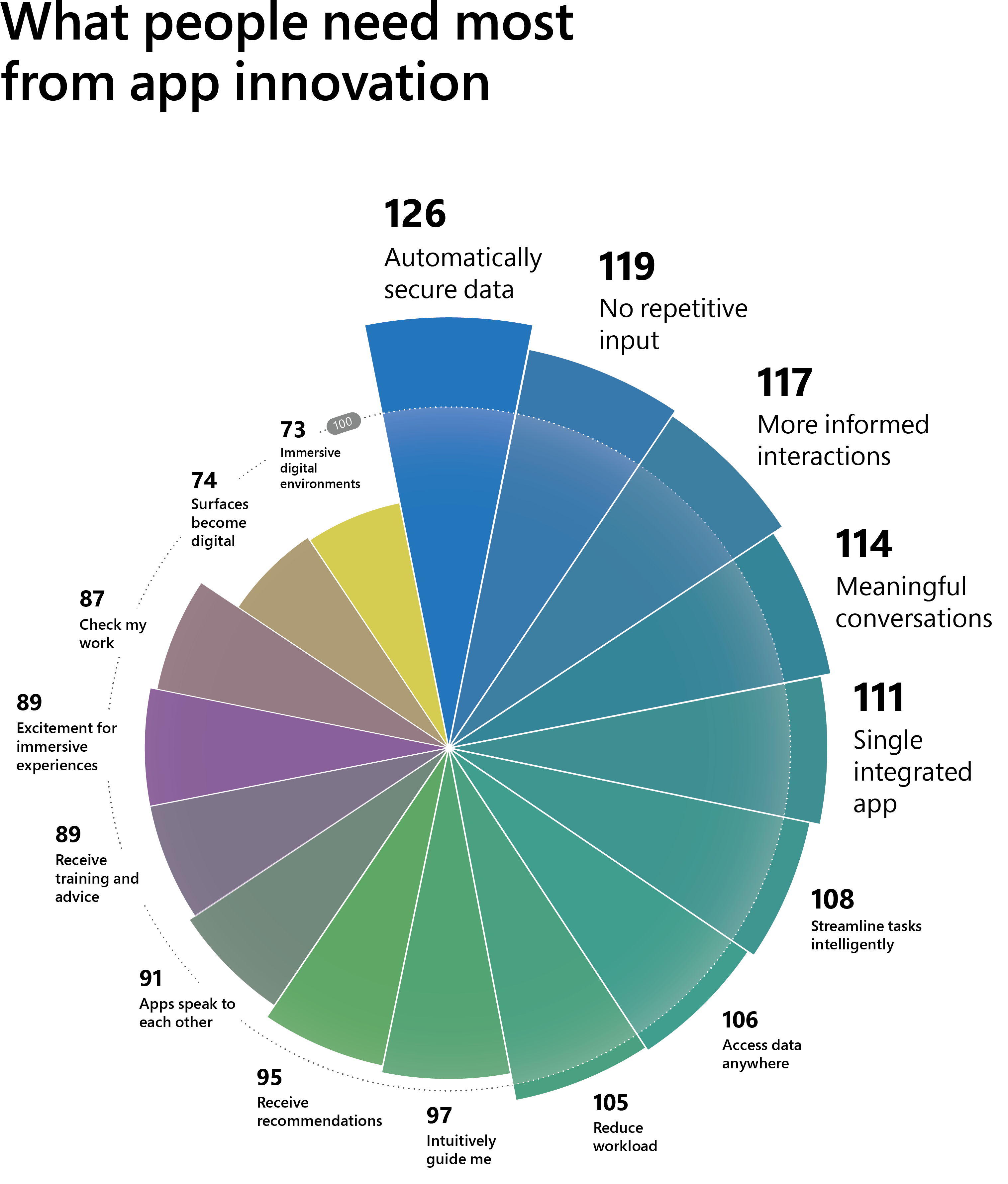
App Innovation Report graphic
Top 16 forces of app innovation: “Promise scores” above reflect a combination of people’s rational preference and emotional passion. Scores are indexed against an average of 100, so scores above 100 represent the most promising innovation areas.

People feel stuck, frustrated and lost because of disjointed apps

People around the world in a vast range of roles expressed the most passion about disruption to their workflow. On the receiving side of apps of all kinds, there’s palpable frustration from having to manually patch together disparate tasks and tools. We learned people are struggling to secure data automatically, to streamline repetitive input, and to have well-informed interactions with others. While we heard desire for immersive technologies bubbling to the forefront, it wasn’t as prominent as pragmatic everyday realities and, from an Azure lens these areas signal opportunities to help advance AI automation, API management and app intelligence. Whether you’re migrating workloads, modernizing or building something new for flexibility and scale, the cloud can architecturally address so many of the trends we found.

Fear of compromising company data weighs on workers too

In the industries we researched, people share their companies’ concerns about data breaches on a personal, day-to-day level. In healthcare, they spoke about pressures surrounding HIPAA requirements when handling patient data. A sense of nervousness about security was also expressed in manufacturing, a highly targeted industry for ransomware, and retail workers worry about their accountability in handling customers’ financial information. Security is so incredibly important to us in Azure, so hearing from the usage and functionality side of this space emboldens us to partner on app development that can continue to advance confidence up and down organizations.

The cloud investments we make and the customization we code affect so many layers of a company and, in the applications space, innovation boils down to experiences people can count on and even enjoy using — it’s one of the most fulfilling aspects of the business we’re in. Well-architected workloads don’t only enable cost optimization, they provide a foundation of innovation where business leaders, technology and developer teams can adapt quickly to deliver secure, intelligent and intuitive apps people keep coming back to.

The need for more meaningful conversations stands out in retail

In light of the season, one industry-specific breakdown is especially timely. We see experience needs rank differently in retail compared to other cross-industry averages, with repetitive input surpassing automatic security, and desire for meaningful conversations breaking through in a way we don’t see elsewhere. Because shoppers today do so much research before visiting stores, retail workers want digital solutions that can help them provide information about product features, pricing, discounts and availability without breaking their connection to the customer. A sales engagement that feels jarring or closed off today could become warmer and interactive tomorrow.

App Innovation Report graphic
Retail-specific needs: “Promise scores” from retail workers above are also indexed against an average of 100. Scores as high as 141 and 133 indicate exceptionally strong rational preference and emotional passion.

Business leaders agree with worker concerns but need help prioritizing

Rounding out the research, we put our report in front of business leaders — those who choose Azure services and customers of other cloud providers. We also wanted to understand how chief technology, digital and operations officers are thinking about app design, and the themes voiced by workers were equally important to them. So, if workers have unmet needs like this and leadership is aligned, what’s next? Prioritization.

How we each define innovation is as unique as the cloud journeys we’re on but giving app experiences more shape helps us see strategic pockets in new ways and grounds cloud investments in the people who run your business, in the people you’re selling to. What kinds of inefficiencies are draining resources most immediately? Which growth territories will you target to compete? Organizations can’t tackle every app innovation project at once, but together, we can carve out data-driven spots that present the most promise.

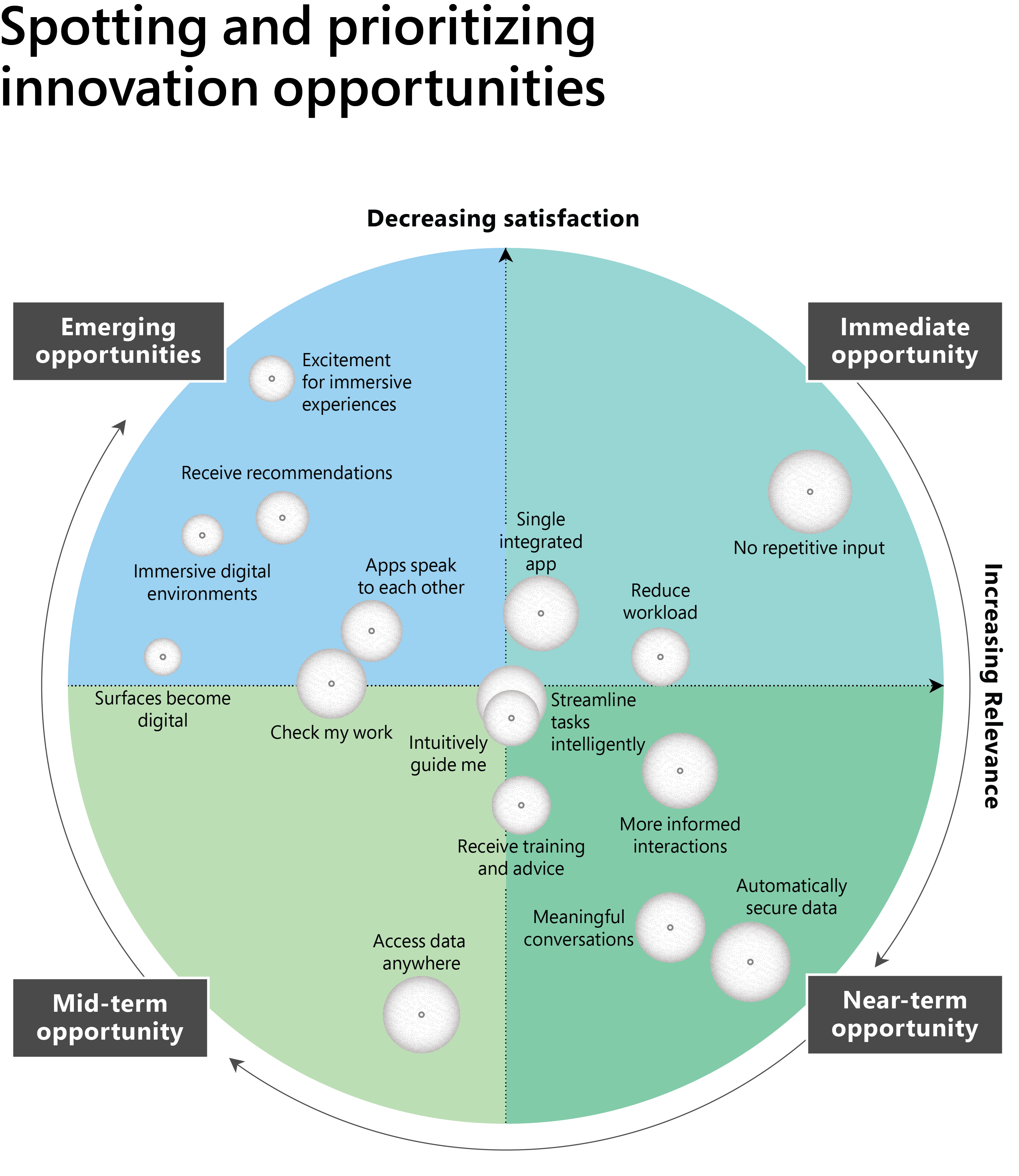
App Innovation Report graphic
Spot the opportunities: People’s rational preference and emotional passion for different app innovation areas are mapped above in the context of satisfaction with existing solutions in the market and relevance in their lives. Clockwise from the top-right quadrant, the urgency of each innovation area is broken out for planning.

One of the many things that drew me to Azure’s business is how many people it touches. When we look at Azure customers like the NBA, H&M or Starbucks, we see how very tangible outcomes are in the palm of our own hands as consumers and suddenly, what the cloud makes possible begins to click no matter who you’re talking to. When I watch real-time data on my Boston Celtics, when I’m able to shop for loved ones in a single click, and I can enjoy an iconic red cup without waiting in line, I am experiencing cloud-first app investments that pay off in spades. From the back end to the front end of app design, we’re reminded that business impact of everything digital is highly human.

On behalf of the Azure team, we hope the App Innovation Report inspires your work going into the new year. And no matter how or what you celebrate, I wish you and your loved ones a safe and happy season.

Source: Future of App Innovation study conducted by Ipsos between July and September 2022 among 1,500 workers in healthcare, manufacturing and retail in the U.S., Brazil, India, Japan and Norway.

Tags: , , ,

Posted on Leave a comment

Empowering the future of financial markets with London Stock Exchange Group

Microsoft looks to generate $5 billion in revenue from LSEG and the financial services sector through 10-year strategic partnership.

Today, we announced a 10-year strategic partnership with the London Stock Exchange Group (LSEG), a world-leading financial markets infrastructure and data provider. Following LSEG’s acquisition of Refinitiv, a market leader in data services, LSEG has differentiated itself in the market with an end-to-end proposition across trading, execution, data and analytics solutions. Together we look forward to empowering the future of financial markets by delivering next generation data, analytics and workspace solutions that transform how firms connect, research, analyze, collaborate and transact across the entire financial markets value chain.

YouTube Video

Organizations across the capital markets value chain are facing an increasingly complex operating environment with macroeconomic headwinds, stricter regulatory controls and traditional revenue sources becoming more challenging. These conditions are putting greater pressure on firms to reinvent business models and do more with less. However, their legacy platforms, siloed information, limits on scale and data overload hinder their ability to deliver the best client experience, insights and tools. This requires a digital transformation approach underpinned by modern cloud and AI technology. LSEG has already started to address these issues for their customers, and through this strategic partnership, we will accelerate that transformation.

Additionally, capital markets run on data and by investing in the co-creation of new solutions, we will capitalize on the incremental opportunity we have together and support clients in their transformation.

“This strategic partnership is a significant milestone on LSEG’s journey towards becoming the leading global financial markets infrastructure and data business and will transform the experience for our customers,” said David Schwimmer, CEO of London Stock Exchange Group.

Democratizing financial markets data
Foundational to the partnership will be the digital transformation of LSEG’s technology infrastructure and data and analytics platforms onto the Microsoft Cloud. This will include Refinitiv platforms that power over 40,000 financial institutions in 190 countries with data, analytics and insights across millions of active time series databases, daily evaluations, exchange trades and derivatives, equity quotes and significant research on public and private companies.

With this foundation, we will co-create an open, centralized, financial data platform enabling seamless data democratization, collaboration and new monetization opportunities across the financial services ecosystem. This will unlock new offerings for customers to generate more sophisticated and timely insights.

Delivering next-generation workspace experiences
The financial markets community spends a large part of their day working across multiple terminals and platforms, disparate data sets and siloed analytical tools with limited collaboration capabilities. To enhance productivity and time to value, we will work together to co-create an open all-in-one data, analytics, workflow and collaboration solution that will reimagine client experiences for the first time.

This will be realized through the next generation of LSEG Workspace on Microsoft Teams platform that will support in-application rich experiences for understanding trends and analyzing risk and building scenarios while meeting strict security, privacy and compliance requirements.

Additionally, with enhanced Excel integration, customers will be able to create financial models, run data analytics and visualizations using LSEG content delivered in Excel and work seamlessly between LSEG Workspace and Microsoft 365.

The initial focus will be on delivering interoperability between LSEG Workspace and Microsoft Teams, Excel and PowerPoint with other Microsoft applications and a new version of LSEG’s Workspace, accessed entirely within the Microsoft 365 suite, to be added in the future.

Creating intelligent analytic solutions
Today, firms can experience duplicated costs and complexity in harnessing the full power of analytics to unlock models that garner intelligent insights for business decision making. To address this need, we will work together to co-create next generation analytics and modeling solutions which are cloud-based and will enable powerful model construction, validation, diagnostics and deployment using Microsoft Azure AI, Synapse, Power BI, Excel and Teams with LSEG’s advanced analytics and modeling capabilities.

It will empower investment bankers, traders, wealth and asset managers, as well as risk, compliance, strategy and advisory managers to run hyperscale analytics models against data efficiently and seamlessly. Built on top of Azure Synapse, Azure Machine Learning and Azure Purview, the new cloud-based analytics and modeling solutions will enable users to expose, share and collaborate across proprietary and third-party data securely and confidently, meeting stringent data privacy, security and compliance requirements, eliminating the need to move or copy the data to another location (which can be expensive, time-consuming and introduce security and compliance concerns).

Additionally, quantitative analysts, data scientists and engineers will be able to build custom models to drive their analysis and decision making seamlessly. Both can help organizations spend less time, money and effort building and maintaining their own infrastructure.

“Bringing together our leading data sets, analytics and global customer base with Microsoft’s comprehensive and trusted cloud services and global reach creates attractive revenue growth opportunities for both companies” said David Schwimmer, CEO of London Stock Exchange Group.

Additionally, we will explore the development of digital market infrastructure based on cloud technology, with a goal to transform how market participants interact with capital markets across a broad range of asset classes.

This partnership represents a significant milestone for the future of financial markets and builds on Microsoft’s investments across capital markets and more broadly across the financial services industry. Microsoft estimates this partnership, and broader market opportunity, could generate an additional $5 billion in revenue for the company over the next 10 years, including the $2.8 billion minimum spend commitments from LSEG for cloud services and support.

Microsoft will also purchase an approximately 4% equity stake in LSEG through the acquisition of shares from the Blackstone/Thomson Reuters Consortium.

“We are delighted to welcome Microsoft as a shareholder. We believe our partnership with Microsoft will transform the way our customers discover, analyze and trade securities around the world, and create substantial value over time. We look forward to delivering on that potential,” said David Schwimmer, CEO of London Stock Exchange Group.

To learn more about our partnership, please see the press release. For broadcast-quality footage, please contact [email protected]. To learn more about our work in this space, please visit our capital markets site.

Tags: , , , , ,

Posted on Leave a comment

Microsoft acquires Lumenisity, an innovator in hollow core fiber (HCF) cable

Today, Microsoft announced it has acquired Lumenisity® Limited, a leader in next-generation hollow core fiber (HCF) solutions. Lumenisity’s innovative and industry-leading HCF product can enable fast, reliable and secure networking for global, enterprise and large-scale organizations. The acquisition will expand Microsoft’s ability to further optimize its global cloud infrastructure and serve Microsoft’s Cloud Platform and Services customers with strict latency and security requirements. The technology can provide benefits across a broad range of industries including healthcare, financial services, manufacturing, retail and government.

Organizations within these sectors could see significant benefit from HCF solutions as they rely on networks and datacenters that require high-speed transactions, enhanced security, increased bandwidth and high-capacity communications. For the public sector, HCF could provide enhanced security and intrusion detection for federal and local governments across the globe. In healthcare, because HCF can accommodate the size and volume of large data sets, it could help accelerate medical image retrieval, facilitating providers’ ability to ingest, persist and share medical imaging data in the cloud. And with the rise of the digital economy, HCF could help international financial institutions seeking fast, secure transactions across a broad geographic region.

Lumenisity HCF benefits

Lumenisity’s next generation of HCF uses a proprietary design where light propagates in an air core, which has significant advantages over traditional cable built with a solid core of glass, including:

  • Increased overall speed and lower latency as light travels through HCF 47% faster than standard silica glass.[1]
  • Enhanced security and intrusion detection due to Lumenisity’s innovative inner structure.
  • Lower costs, increased bandwidth and enhanced network quality due to elimination of fiber nonlinearities and broader spectrum.
  • Potential for ultra-low signal loss enabling deployment over longer distances without repeaters.

Lumenisity was formed in 2017 as a spinoff from the world-renowned Optoelectronics Research Centre (ORC) at the University of Southampton to commercialize breakthroughs in the development of hollow core optical fiber. In 2021 and 2022, the company won the Best Fibre Component Product for their NANF® CoreSmart® HCF cable in the European Conference on Optical Communication (ECOC) Exhibition Industry Awards. As part of the Lumenisity acquisition, Microsoft plans to utilize the organization’s technology and team of industry-leading experts to accelerate innovations in networking and infrastructure.

To learn more visit https://lumenisity.com/.

[1] Speed of Light in Transparent Materials, Matthew J. Parry-Hill and Michael W. Davidson – National High Magnetic Field Laboratory, 1800 East Paul Dirac Dr., The Florida State University, Tallahassee, Florida, 32310, Sept. 10, 2018

Tags: , , , , , , , ,