Posted on Leave a comment

Apple’s latest iPhone privacy ad touts iMessage encryption


Apple on Friday published a third installment to an ad series focusing on iPhone privacy, with the latest commercial throwing a spotlight on the company’s end-to-end encrypted iMessage platform.

iPhone

The ad posted to Apple’s YouTube page, titled “Inside Joke,” centers around a woman reading an iMessage conversation on her iPhone XR. Echoing the privacy theme, viewers are not privy to the contents of the conversation which, judging by the woman’s reaction, is immensely humorous.

A majority of the minute-long spot consists of a single uninterrupted shot of the iPhone owner reading incoming texts. Each new message is funnier than the last and what begins as a chuckle soon turns into hysterical laughter.

The ad cuts to a wide shot, showing the woman in a salon getting a pedicure with other customers and staff nearby. A closing shot puts iPhone XR front and center as the woman continues to cackle.

A tagline reads, “iMessage encrypts your conversations [b]ecause not everyone needs to be in on the joke,” and is followed by the campaign’s slogan, “Privacy. That’s iPhone.”

[youtube https://www.youtube.com/watch?v=T-fXzUsPZtM&w=560&h=315]

Friday’s commercial is the third in a series touting iPhone’s various privacy features. The first debuted in March and served as a general introduction to Apple’s new iPhone advertising thrust. A second spot, also aired in March, highlighted anti-ad tracking measures in Safari.

Apple’s campaign arrives amidst a wider push for data privacy in the tech sector. Over the past few weeks, serial offenders Facebook and Google have attempted to recast their respective public images as born-again reformers, promising transparency and offering user tools to manage collected information. Both, however, continue to operate business strategies reliant on customer data.

Posted on Leave a comment

Rare Apple-1 hits auction block next week, estimated to fetch more than $600,000

An extremely rare Apple-1 computer is scheduled to go up for auction on May 16 as part of a special online-only sale from British auction house Christie’s, which estimates the unit will sell for between 300,000 and 6500,000 pounds ($378,000 to $630,000).

Apple-1

An interesting example, Apple-1 motherboard serial number 01-0053 is housed in the bottom section of a briefcase, hidden by a makeshift aluminum control panel featuring a Datanetics keyboard.

Built by hand in 1976, the board is thought to be among an original batch of Apple-1 units sold through Mountain View, Calif., computer store Byte Shop. It sports a white ceramic MOS Technologies 6502 microprocessor, selected by Steve Wozniak to power Apple’s first computer, as well as 8K bytes RAM split between two 4K chips and two original Triad power supply modules.

According to a Twitter account cited as the computer’s official resource by the Apple-1 Registry, the Triad supplies are non-functional, though the auction lot includes a modern test supply that last powered up the board in 2014.

Christie’s believes the briefcase Apple-1 was acquired by Rick Conte in 1977, donated to a non-profit in 2009 and purchased in 2010 for a private collection before landing in the hands of its current owner in 2014. The unnamed custodian has since collected a number of related and miscellaneous items to go along with the historic computer.

Along with the components in the briefcase, the lot includes a modified cassette interface card, Panasonic RQ-309DS cassette tape recorder, SWTPC PR-40 printer alphanumeric printer, Sanyo VM4209 monitor and Motorola M6800 microprocessor.

Documentation bundled with the Apple-1 hardware includes an Apple-1 operation manual, original green “Preliminary” Apple BASIC Users manual dated 1976, “tan” Apple-I manual from 1977 and early schematics papers.

Other paraphernalia includes a slide of Apple’s original logo, various documents from the Apple-1 Owners Club, early computing magazines with article Apple ads and an article penned by co-founder Steve Jobs, a Specimen bond note for Apple Computer, stock certificates from Apple, Atari, Hewlett-Packard and Pixar, a license plate bearing the iconic rainbow-colored Apple logo and business cards of co-founders Jobs, Wozniak and Ron Wayne. The lot also features drawings of the Apple-1 (in a briefcase, no less) by Wayne.

Christie’s last Apple-1 auction brought in $355,500 . in 2017, landing on the low end of a $300,00-to-$500,000 estimate range. Previous Apple-1 sales have raked in far higher numbers, however, with bidders parting with up to $905,000 to own the historic machine that originally sold for $666.66.

Of the approximately 200 Apple-1 boards made, only 80 units are known to still exist.

The briefcase Apple-1 hits the block as part of Christie’s “On the Shoulders of Giants: Making the Modern World” online auction on May 16.

Posted on Leave a comment

LG UltraFine 5K display sold out on online Apple store


Apple this week appears to have halted sales of the LG UltraFine 5K display, potentially signaling a near future launch for a branded high-resolution monitor expected to launch alongside a new modular Mac Pro.

LG UltraFine

The LG display is now listed as sold out on Apple.com, while in-store supply is exhausted at many U.S. brick-and-mortar locations.

A similar situation occurred late last year when domestic Apple stores, as well as a few international locales, showed wide unavailability of the 5K display. At the time, however, the monitor could still be ordered for delivery.

The UltraFine 5K stockout follows Apple’s discontinuation of the LG UltraFine 4K display in April. With both LG UltraFine models no longer available from Apple, it can be speculated that the tech giant is readying a successor device for launch.

LG’s UltraFine 4K and 5K displays were introduced in October 2016, designed as part of a collaborative effort with Apple to complement then-new MacBook Pro models.

Apple announced work on a professional-grade standalone monitor in 2017, initially promising release alongside an all-new Mac Pro in 2018. The company later pushed back the Mac debut into 2019, but failed to offer a release timeline for its new monitor, leaving some to believe it would see unveiling at an earlier date.

While Apple has yet to detail hardware specifications, analyst Ming-Chi Kuo in February said the device will measure 31.6 inches on the diagonal and house a 6K3K panel boasting “outstanding picture quality thanks to its adoption of the Mini LED-like backlight design.” Kuo in a separate note to investors issued in April predicted Apple to launch the display in the next few months.

Most recently, a report this week claims Apple might preview both the Mac Pro and display at this year’s Worldwide Developers Conference in June. AppleInsider will be covering the event live.

Though the LG UltraFine 5K is no longer available from Apple’s online store, those in the market can still find the display at various retailers like B&H Photo.

Posted on Leave a comment

Apple’s Tim Cook meets WWDC 2019 scholarship winner in Florida


While in Florida for SAP’s annual Sapphire user conference, Apple CEO Tim Cook took time out of his schedule to visit meet Worldwide Developers Conference scholarship winner Liam Rosenfeld at an Orlando Apple store.

Cook Florida

Apple CEO Tim Cook meets WWDC scholarship winner Liam Rosenfeld. | Source: Tim Cook via Twitter

At the SAP conference, Cook was on hand to introduce an expansion to an existing partnership that will see the German software corporation roll out new enterprise apps infused with Apple technology.

Following the conference, Cook stopped by Apple Store Millenia for a brief sit-down with Rosenfeld, one of 350 U.S. students selected to receive a scholarship to attend WWDC 2019 in June, reports the Orlando Sentinel.

“I was not expecting that at all,” Rosenfeld said. “It was such an amazing surprise.”

Along with coding his own iOS apps, Rosenfeld, 16, started a coding club at Lyman High School that has grown to 16 members. The sophomore has one app in the App Store, Image to ASCII Art, and is developing two more projects including a game that teaches musicians how to tune their instruments.

Rosenfeld was able to show Cook his work in a short meeting held in the Apple store’s conference room. The CEO was impressed with what he saw.

“He has a quality that I think is on a short list of characteristics that drive success, and that is curiosity,” Cook said of Rosenfeld.

Speaking to the Sentinel, Cook took the opportunity to push Apple’s coding in education agenda, noting WWDC scholarships are doled out in an effort to fill the need for tech savvy workers. The awards are handed out to students and members of STEM organizations and include free access to the event and lodging.

“You need public, private, non-governmental organizations working together because this is not a trivial transformation that needs to happen here,” Cook said. “We have an obligation. We are fortunate to have had some success.”

Rosenfeld agrees with Apple’s take on the importance of learning to code in school, a skill set that could prove particularly beneficial to K-12 students.

“There aren’t many things you can get into in high school and use it to move toward a career path,” Rosendfeld said. “Computer science is what is driving change.”

Cook tweeted about his meeting with Rosenfeld on Tuesday and included a link to the Sentinel’s report.

Posted on Leave a comment

B&H Payboo Card to refund sales tax on all orders


B&H Photo just unveiled the Payboo Card, which offers shoppers a tax-equivalent loyalty reward to counteract sales tax assessed on purchases. This new marketing initiative sets B&H apart from competitors, such as Best Buy and Amazon, that collect sales tax on purchases in all applicable states without the reward, potentially putting hundreds of dollars back in the pockets of consumers.

BH Payboo no sales tax card


B&H Photo Payboo Credit Card with tax incentive

Shoppers subscribed to B&H emails began receiving a message describing Payboo as “the solution to the sales-tax challenge,” which references the South Dakota vs Wayfair ruling that allows states to collect sales tax on purchases made from out-of-state sellers, even when said sellers do not have a physical presence in the state. As we reported in October 2018, B&H began collecting sales tax in additional states after the ruling, with even more states added to the list during the remainder of 2018. As it stands now, B&H collects sales tax in a total of 26 states and reports purchases in several more, due to local taxation laws.

Shortly after 6 p.m. Pacific, B&H launched the Payboo Credit Card page, with a message reading “you pay the tax, we pay you back.” Shoppers in eligible states will receive a reward equivalent to the amount paid in sales tax on every purchase with the B&H Payboo Card. At press time, the tax-equivalent loyalty reward is not valid in Alabama, District of Columbia, Indiana, Iowa, Nebraska, North Dakota, Vermont, West Virginia and Wyoming, although other Payboo Card incentives may be available.

Payboo comes on the heels of Apple’s own Apple Card announcement, which offers 3% cash back on purchases made at Apple and 2% back on purchases using the Apple Card via Apple Pay.

This story is developing. Stay tuned for more details following B&H’s official announcement.

Posted on Leave a comment

Amazon, Best Buy knock up to $100 off iPads, $200 to $300 off MacBook Pros, plus $199 Apple Watches back in stock


Those looking for a last-minute gift for Mom or a budget-friendly gift for a graduating student can take advantage of cash discounts on Apple’s current 9.7-inch iPad to the tune of $80 to $100 off, or up to $300 off current 13- and 15-inch MacBook Pros. Prices start at just $249 for the hardware with free shipping.

Up to $100 off iPads

Apple authorized resellers Amazon.com and Best Buy are both offering the lowest prices anywhere on the budget-friendly 9.7-inch iPad, which offers support for Apple’s first generation Apple Pencil. Prices start at $249 for the standard model, with the 128GB version priced at $329 after a $100 discount.

$249 iPads

$100 off 128GB models

MacBook Pros are also on sale

Apple 2018 MacBook Pro


Apple’s current 15-inch MacBook Pro

Those looking for the lowest prices on current 13- and 15-inch MacBook Pros can also save up to $250 on the Mid 2018 models. Prices start at $1,649.99 as shown below, with deals on every single model found in our 13-inch MacBook Pro with Touch Bar and 15-inch MacBook Pro Price Guies.

$200 off 2017 13″ MacBook Pro with function keys

$150 to $200 off 2018 13″ MacBook Pros with Touch Bar

$200 to $300 off 15″ MacBook Pros

These Apple Watch deals are back

Apple Watch Series 4


Apple Watch Series 4

After previously selling out, both Amazon and Best Buy also have Series 3 Apple Watches back in stock for just $199. Fresh price drops are also available on the Apple Watch Series 4, with prices starting at a record low $349.

$199 Apple Watches

Apple Watch Series 4 price drops

Additional Apple Deals

AppleInsider and Apple authorized resellers are also running a handful of additional exclusive promotions this month on Apple hardware that will not only deliver the lowest prices on many of the items, but also throw in discounts on AppleCare, software and accessories. These deals are as follows:

Posted on Leave a comment

Editorial: The new Services – How will Apple Arcade’s exclusivity, privacy affect Android & Google Play?

Apple has built a very strong position in mobile gaming in its iOS App Store. With Apple Arcade, it is working to create a new pipeline of fun, original, attractive, exclusive games, without ads and where privacy is protected. How will this impact Android and Google Play?

Arcade bridges Apple’s platforms

Bridging Apple’s platforms, leaping others

As the previous article in this series outlined, Apple’s App Store changed the game in mobile software and established iOS as a commercially important platform over the last decade. Apple Arcade expects to double down on the App Store’s success in gaming with an investment worth hundreds of millions of dollars, setting a new stage for the next decade.

However, it has become common to claim that Apple’s iOS is losing its importance as a platform because Huawei sells smartphones for $400, or because there are Androids with four cameras, or because people in China are using WeChat as a platform, or various other stories that celebrate commodity and cheap hardware.

None of those media narratives explain Apple’s leading position in the corporate enterprise, or as the maker of the vast majority of all premium phones globally—even in China where WeChat is popular—or of the iOS App Store leading mobile app development in a world where there are so many “good enough” Androids being sold each quarter.

Apple does have a platform problem to address, but it’s not iOS. It’s the Mac—which has an installed base of around 100M, compared to nearly one billion iOS devices—and Apple TV, which has a hardware potential that original interactive content, novel apps, and games are clearly not fully exploiting.

Apple Arcade promises to not only underscore the commercial relevance of iOS as the premier platform for mobile gaming, but also intends to become the tide that lifts the boats attached to Apple’s other platforms: tvOS and macOS.

At the same time, it appears that Arcade will further parch the conspicuous drought that affects Android gaming. Despite having a vast sea of users, Google Play simply can’t fish out as much economic activity as the App Store.

Arcade’s exclusive games won’t run on Huawei phones no matter how many cameras they have, and won’t run on commodity Androids on top of WeChat because rich games require more work to develop than a middleware social network can host. Further, cheap mobile hardware isn’t very good at playing involving, cinematic, or technically advanced games.

Apple’s new Services are all about creating new applications for Apple’s premium hardware, and it threatens to become a strong mobile platform differentiator. Within days of its announcement, Scott Adam Gordon of Android Authority was already asking “Is it bad news for Android?

His piece noted “Oceanhorn is a popular mobile game available on Google Play, but Apple has confirmed the upcoming sequel, Oceanhorn 2: Knights of the Lost Realm will be an Arcade launch title. Android fans could be saying goodbye to future Oceanhorn titles if Apple Arcade proves far more lucrative than the Play Store ever did.”


The sequel to Oceanhorn is exclusive to Apple Arcade

Google Play’s fake games and real malware are the YouTube of apps

Gordon pointed out that “Google Play is also rife with video game clones and re-skins, which Apple Arcade would avoid completely,” a reference to the knockoffs and copyright infringement titles on Android, including Google Play titles loaded with ads pretending to be games that are actually exclusive to iOS. Joe Hindy outlined the issue for Android Authority in the article “Google Play still has a clone problem in 2019 with no end in sight“.

Gordon’s initial article contemplating Apple Arcade’s impact on Android also noted the “weird selling point” of “touting a commitment to user privacy with Arcade games,” stating that “Google does a comparatively excellent job of protecting Android users given the volume of apps that appear in the Play Store, but privacy and security issues do crop up from time to time.”

He specifically linked that to a story describing malicious titles in the Google Play store that appeared to be benign, laid dormant, then later pretended to be a trusted app requesting permissions to enable their latent malware to exploit the device. Google removed the titles but they popped back up again from different developers using the same code.

He could also have noted a recent incident specifically related to gaming, where more than a dozen malicious titles in Google Play appeared to crash at launch while loading a malicious payload designed to give outside parties access to the phones’ network activity.

Why did Google Play accept and begin distributing broken games that didn’t even work? Because just like its YouTube videos exploiting children and radicalizing extremists, Google can just wait until the complaints get loud enough and then be hailed as a hero for eventually taking them down. And right until that happens, Google can potentially turn a profit from monetizing “the engagement” of bad content.

“Scores of people inside YouTube and Google, its owner, raised concerns about the mass of false, incendiary and toxic content that the world’s largest video site surfaced and spread… Each time they got the same basic response: Don’t rock the boat.”

Google Play’s most recent batch of malware posing as fake games were downloaded by over half a million Play users, causing TechCrunch to describe it as “another embarrassing security lapse by Google, which has long faced criticism for its backseat approach to app and mobile security compared to Apple, which some say is far too restrictive and selective about which apps make it into its walled garden.”

So there’s problems on both sides, because Apple is actively blocking the exploitation of children with MDM tactics, while Google is doing “a comparatively excellent job in protecting Android users” if you just set your expectations really low and think of privacy and security as a “weird selling point.”

Android’s curation-free surveillance is a dangerous game

Beyond the kind of criminal malware exploitation that regularly erupts on Android and which Google is sort of half-struggling to contain in Google Play, Apple Arcade’s commitment to privacy and security also involves elimination of advertising and the surveillance tracking that optimizes the monetization of ads.

There’s a “both sides” argument here, too. What about people who like advertising, particularly advertising that’s tailored just for them, so they don’t have to see generic, irrelevant ads? Ads can make basic content available for free, and surveillance tracking dramatically increases the value of advertising.

Google’s paid placement search worked fantastically well because it put ad messages right in the context of people looking for a specific thing. Advertisers were willing to pay far more for that than to simply plaster their message in ignored and mostly worthless display banners.

While Google certainly doesn’t like malware, it has absolutely no interest in containing ads and the customized nature of tracking at all. The entire point of Android is to attract a platform of users Google can sell to its advertisers. But many users do not fully understand how sophisticated modern ad surveillance is, and therefore have no way to understand the risks that this unrestricted tracking exposes them to.

Modern ad tracking goes well beyond just profiling users into various demographics to show them “relevant ads.” Ad networks exist to find cross-app and cross-site web browsing correlations they can market to ad buyers.

So when their user surveillance notices, for example, that a large number of users who install a specific workout app and also use a food delivery service are also statistically likely to pay for a subscription to Grindr, they can offer strategic ad placement to the vendor of that gay hookup app within every app that particular population of users will see.

This correlation discovery can be done anonymously, and may even represent a mysterious behavioral link that’s not fully understood. Advertisers trust ad networks because they see results for their money. That’s why Facebook could suddenly thrust itself in front of Google’s paid placement search ads as being more attractive because it could deduce more about audiences via the social graph than Google could interpolate simply by tracking queries and website visits.

The specific example above of an attempt at “relevant advertising” is potentially valuable to an advertiser seeking to target their ad budget at gay men willing to pay for a cruising tool, but it may make faulty assumptions about the user of a device. That could end up being embarrassing at best and plausibly even cause a person to lose their job in any number of states or countries where there is no legal protection from discrimination launched in the mere suspicion of a person’s private life details.

That targeting could also destroy a relationship. And if you’re traveling in some countries, it could potentially threaten you with detainment and even persecution at the border. All because your private behaviors were interpreted by an algorithm to imply a potential interest that others might notice. Targeted advertising can appear to reveal private things about you that may not even be accurate, yet with such confidence that it makes you look like you’re hiding something.

Surveillance advertising is like a credit report conjured up by inherently biased algorithms with a wide margin of error, which you have no real control over, and it goes far beyond the dossier that Google will share with you if you request it. It’s a mechanism that can even reveal things about you before you know them.

Seven years ago, a story by Charles Duhigg for the New York Times described how Target raised eyebrows by sending women ads for newborn merchandise before their families even realized that they were pregnant, all simply based on robotically observing correlations in what other things they were buying.

When sophisticated ad surveillance jumps to the conclusion that you may be pregnant, or looking for a different job, moving, leaving an abusive relationship, seeking help with a addiction, considering medical treatment, supporting a particular political cause, or any number of other personal matters, anyone else who sees the carefully targeted ads that are being custom picked for you has good reason to think that Google and its ad network partners may be revealing something about you that you’re hiding.

Of course, Google and other ad networks have absolutely no malicious interest in outing a person’s sexuality, or incorrectly implying a person is gay, or promiscuous, or radically nationalist, or in inadvertently exposing anyone to discrimination, or in revealing any other personal details or status for which they aren’t getting paid to make public.

But Google also has a vested interest in controlling Android’s malware, and yet it’s repeatedly done an absolutely incompetent job of keeping even overtly dysfunctional, obviously fake garbage and malicious apps off Google Play. It waits until the damage becomes untenable to ignore. Given that Google didn’t care about its own Pixel C buyers or even vulnerable children on YouTube, you can be pretty confident it doesn’t care about your privacy in the slightest.

Users shouldn’t have to trust that Google won’t make an algorithmic mistake about them that could expose them to potentially serious life repercussions. And they honestly can’t, because Google hasn’t earned any trust in handling users privacy or security.

Why is Apple emphasizing a commitment to privacy?

Android enthusiasts routinely view concerns about privacy as a “weird selling point,” but Apple specifically made a “commitment to privacy” a major bullet point feature of its new Arcade, alongside another shot taking direct aim Google: “no ads.”

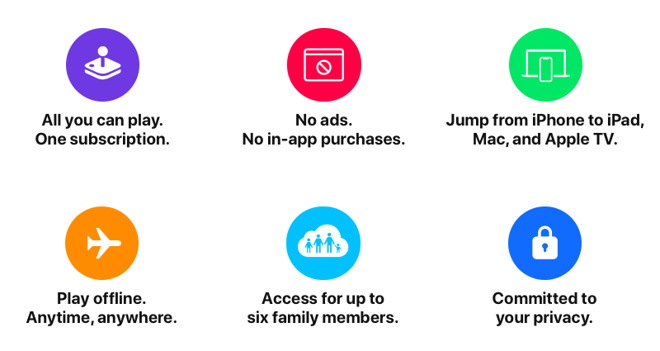
Two of the six primary features of Apple Arcade took direct aim at Google: “no ads” and “privacy”

The Wall Street Journal publicly railed against Apple for failing to keep up with the massive user data collection efforts of Google and Facebook to surveil users and calculate the most effective exploitation possible with targeted advertising, because this could also be used to deliver “a smarter iPhone.”

“While I applaud and appreciate your assurance of privacy,” Joana Stern advised Apple’s Tim Cook in a 2016 opinion, “my worry is that you simply can’t afford to maintain that mentality when the competition has such a great advantage.”

Is Apple also naively leaving money on the table by working to avoid exposing its users and the environment to lead or mercury poisoning, just because such issues may be of little concern to companies in China operating on a razor-thin profit margin?

Do we simply live in a post-privacy world where anything that ad surveillance can algorithmically assume about us is fair game to use against us, simply because that’s the cost of “free”? Apple is betting that users will prefer to pay for a private, premium experience, rather than “get what they pay for” without directly paying anything upfront. The more users know about the real costs involved, the better Apple’s deal appears.

Privacy by design

Apple Arcade provides a clear assurance of privacy in that no secret, automated system will be watching the games you play and trying to find correlations between the games you like, your behaviors while playing, the other apps you use, and how you communicate, so that it can sell possibly-accurate insights into who you are or what other things you might like to advertisers looking to target a narrowly specific audience with their messaging.

And nobody has to trust that Apple won’t be making mistakes, or inadvertently leaking its algorithmic assumptions about you, because the plumbing to watch what you do and try to monetize the exploitation of your privacy simply doesn’t exist in Apple Arcade. It’s like a bathroom without any cameras pointed at you.


Beyond a Steel Sky lets you play inside a fantasy world spied upon by AI, but doesn’t actually force you to live within such a dystopian reality

As more details leak out about the extent to which Android is effectively allowing Google, Facebook, and even purely malicious developers to rifle through your contacts, see your app installations, and track together every website you load and every search you make, the issue of privacy and data security is gaining greater attention.

Apple Arcade’s privacy by design highlights what other app platforms are refusing to do: respect your assumption of privacy. And that’s worse news for Android than just missing out on new exclusive game titles.

The question remains: no matter how much more appealing and secure and private Apple can make its ecosystems, is there any realistic hope of iPhone sales ever growing in the future? The next article in this series will examine the topic.

Posted on Leave a comment

Apple Pay now accepted for some UK government services, wider rollout planned for 2019


The UK government is now accepting Apple Pay and Google Pay payments for select services through its gov.uk website, a change in policy that is expected to reach local governments and other institutions later this year.

Apple Pay

UK citizens with access to compatible devices can use Apple Pay and Google Pay to pay fees related to the country’s Global Entry Service, basic online disclosure and barring service (DBS) checks, the Registered Traveller Service and the Electronic Visa Waiver (EVW) service, reports ITV.

Additional integration with local government, police and the National Health Service systems are due to follow later this year.

“Allowing people to pay for Government services through Apple Pay and Google Pay means they won’t have to enter their credit or debit card information when making payments,” said Till Wirth, lead product manager of gov.uk Pay. “This innovation will increase the convenience and security of gov.uk Pay for users and hopefully make their experience online a lot easier.”

The gov.uk online payment system launched in 2016 with support for credit and debit cards and has so far logged more than 2.9 million transactions, the report said.

Minister of Implementation Oliver Dowden notes mobile payments integration enhances transaction security. Apple Pay, for example, is protected by fingerprint or facial recognition underpinned by an on-device passcode.

The new capability also delivers a streamlined user experience, as users can speed through transactions without filling out credit card or debit card authorization fields.

Apple Pay launched in the UK in 2015 with support for eight participating banks. Since then, the country’s government has slowly adopted the payment system and underlying technology.

Most recently, Apple in April agreed to open iPhone’s NFC stack for use with the Home Office’s Brexit app, which confirms citizen status by scanning embedded passport security chips.

Posted on Leave a comment

No, Adobe did not cancel its popular $10 Creative Cloud Photography plan


A number of visitors to Adobe’s website recently noticed the popular $9.99 a month Creative Cloud Photography plan replaced by a $19.99 option, but the company says the change only impacts some customers and is not permanent. At least not yet.

Adobe

For some users, Adobe’s Photography webpage does not display a $9.99 plan option.

The removal of Adobe’s cheapest CC Photography plan, which includes Lightroom CC, Lightroom CC Classic, Photoshop CC and 20GB of cloud storage, was spotted by PetaPixel on Thursday.

Without an announcement from Adobe, it was speculated that the popular photography toolkit subscription option was no longer available for purchase, leaving customers with a $19.99 per month replacement that covers the same applications and 1TB of cloud storage. Some users are being presented with both the $19.99 a month Photography plan and a $9.99 per month Lightroom-only plan, the latter of which comes with the app, a dedicated website to display user work, social media tools and 1TB of storage.

Confusingly, the changes do not apply to all Adobe.com shoppers, as some are presented the new $19.99 Photography plan, while others still have access to the legacy $9.99 choice.

Clarifying the situation, Adobe in a statement to AppleInsider said it is evaluating a modification of product pricing.

“From time to time, we run tests on Adobe.com which cover a range of items, including plan options that may or may not be presented to all visitors to Adobe.com,” an Adobe spokesperson said. “We are currently running a number of tests on Adobe.com. The plan can be purchased at http://www.adobe.com/go/photo18sptst, via phone at 1-800-585-0774 or via major retailers.”

Adobe first launched the $9.99 a month Photography plan in 2013 as a limited time promotional deal, but has kept the tier active. Reflected pricing affords photographers access to the latest Lightroom and Photoshop technologies for approximately $120 a year, a substantial savings over Adobe’s $20.99 per month single-app rate.

Adobe did not specify when the current testing period s scheduled to expire, or whether the $9.99 plan will be reinstated at that time. Users concerned about a potential rate hike can guarantee cheaper pricing for at least another year by prepaying through Adobe’s special site. Alternatively, customers can lock in three years of access by purchasing multiple 12-month product keys from an authorized reseller like Adorama.

Posted on Leave a comment

Parental control apps clap back at Apple statement on MDM technology

Parental control and screen time monitoring apps are fighting back against Apple’s decision to strike the titles from the App Store over alleged security risks, saying in separate blog posts that the tech giant’s reasoning is flawed and its statement on the matter misleading.

OurPact

One of the apps banned from distribution, OurPact, argued for its reinstatement in a post to Medium on Tuesday. As noted by CNET, which spotted the entry, OurPact also calls for Apple to allow parental control apps access to device management APIs.

Last week, a New York Times report highlighted Apple’s targeted removal of popular apps created to help users cut down on device usage or monitor their children’s screen time. Over the past year, the company pulled apps, sometimes without adequately notifying developers, or forced the removal of features that left titles stripped of key functionality.

Developers interviewed as part of the report implied the crackdown was prompted by Apple’s release of a competing iOS feature called Screen Time which debuted in iOS 12 and includes a number of tools designed to encourage iPhone and iPad owners to spend less time on their devices. Screen Time also incorporates parental control features similar or identical to those offered by the now banned apps.

Responding to fallout from The Times article, Apple over the weekend issued a statement in an attempt to explain the app removals. According to Apple, the apps in question used “highly invasive” Mobile Device Management (MDM) technology to accomplish their advertised tasks and thus posed a risk to user privacy and security.

MDM allows wide access to device functions and potentially sensitive data, Apple said. The technology was designed for use in large-scale enterprise device deployments, not public-facing apps available on the App Store. As such, integration of MDM by screen monitoring and parental control apps was a violation of the company’s App Store guidelines.

OurPact disagrees. In its blog post, the developer attempts to undermine Apple’s statement by comparing it with official Apple support documentation on MDM technology. A point-by-point rebuttal suggests properly vetted MDM apps pose little to no risk to end users, even those offered through public channels.

“Unfortunately, Apple’s statement is misleading and prevents a constructive conversation around the future of parental controls on iOS,” the company said. “We want to take the opportunity to set the record straight about MDM for our loyal users and the many families looking for solutions to guide healthy digital habits. Our hope is that Apple will work with developers in this space so that families continue to have a wide selection of parental controls to choose from.”

OurPact also includes a detailed timeline of events leading up to its dismissal from the App Store, noting four years of submission approvals before an abrupt removal in October 2018 “without any prior communication.”

OurPact suggests Apple provide developers with open APIs if it “truly believes that parents should have tools to manage their children’s device usage, and are committed to providing a competitive, innovative app ecosystem.” The call for appropriate screen time monitoring and device management tools was echoed by other app makers mentioned in the original NYT report.

As noted by MacRumors on Wednesday, the co-founders of Kidslox and Qustodio in separate Medium posts asked Apple to release the APIs it used to create the iOS Screen Time feature.

Kidslox and Qustodio last week filed a joint complaint with the European Union’s anti-competition office on allegations that Apple’s forced changes had a negative impact on Kidslox’s business.