How Apple Silicon Macs can supercharge computing in the 2020s
Before this year ends and the decade of the 2020s gets underway, Apple is poised to unveil a dramatic new architecture for its venerable Macintosh computing platform. Here’s why new Apple Silicon hardware is an important step in the future of the Mac.
Why Apple is moving to new silicon
Across the last four decades, Apple has uniquely made a series of radical moves to shift its Mac hardware to entirely new and materially different chip architectures.
No other computing platform has successfully performed such a complex undertaking on a similar scale even once, let alone attempting the three major platform shifts Apple has made on the Mac, from Motorola’s 68000 in the 1980s to PowerPC in the 90s and then to Intel x86 in the 2000s.
Each migration involved massive efforts to not only deliver new hardware, but also transform vast software platforms and create new development tools to minimize the transition pain of users and developers. When Apple migrated to PowerPC in the early 90s, other platforms of the day were supposed to complete parallel transitions of their own, including Microsoft’s Windows NT, IBM’s OS/2, the Commodore Amiga, and many others.
Apple’s unique ability to successfully complete the shift to PowerPC was complicated by other firms’ failing to do the same, resulting in Apple eventually ending up the only major PowerPC user. The difficulty of that transition and its unexpected result might suggest that in hindsight, it was ultimately a mistake to have attempted such a complex and risky task.
On the other hand, Apple’s migration to Intel Macs about a decade later was hailed as a masterful strategic move, enabling Apple to enter new markets and eventually expand its Mac platform dramatically. Yet Apple’s move to Intel’s chips starting in 2006 was largely enabled by the company’s previous PowerPC experience in learning how to execute such a transition.
An Apple Silicon transition that’s been underway for a decade
It’s useful to examine what benefit there is for Apple to again shift to an all-new chip architecture this year, this time using a custom silicon architecture of its own design rather than buying off-the-shelf chips available to any PC maker.
In a variety of ways, the Mac-maker’s move to new “Apple Silicon” isn’t entirely new. The company has been developing customized “System on a Chip” silicon since 2008, an effort which resulted in the A4 chip that powered iPhone 4, the original iPad, and the first iOS-based Apple TV.
Starting in 2016, Apple began shipping Macs equipped with T1, a custom SoC designed to handle Touch ID security and to provide the System Management Controller features that differentiated Apple’s Intel Macs from commodity Intel PCs. Even before the T1, Apple’s custom SMC microcontroller managed Macs’ power management, battery charging, sleep and hibernation, video display modes, and other features that customized and enhanced the Mac experience.
Apple’s T2 SoC
Since 2017, new Macs have included an even more advanced T2 SoC. This 64-bit chip handles everything from disk encryption to image processing, and enabled features ranging from iPad Sidecar to Hey Siri. The last few years of T2 Macs have effectively been Apple Silicon Macs with an Intel processor providing native x86 software compatibility!
How Macs got hooked on Intel chips
Apple’s Intel Macs currently use the same Intel x86 architecture as industry-standard PCs running Windows or Linux. In fact, the Intel chips in today’s Macs are inherently what made it so easy for Macs to run Windows software or run an instance of a Linux server.
That commonality and compatibility were originally touted as a major reason for Apple moving to Intel chips back in 2006.
Before that shift, Apple’s Macs used PowerPC chips that could boast a number of technical advantages over x86 chips. However, PowerPC increasingly struggled to keep up with the pace of Intel’s competitive x86 developments simply due to economic factors.
By 2004, Apple was the only significant vendor left using PowerPC chips. The rest of the desktop computing world had largely converged on x86 chips from Intel, creating vast economies of scale that supported Intel’s continued investment in future generations of its x86 chips.
With sales of Macs only growing incrementally and no remaining prospects for expanding the demand for PowerPC chips, the manufacturing partners behind the PowerPC architecture lacked any similarly secure financial backing needed to maintain parity with Intel’s relentless pace of ongoing silicon development.
Developing new generations of chips is vastly expensive work that simply couldn’t be competitively financed by a single PC maker shipping only around 3.3 million Macs per year. In 2004, Windows PCs were outselling Macs by a factor of 56. PC makers collectively sold 182.5 million units that year, creating a massive gulf between the PowerPC Mac platform and the Intel PC platform.
Apple’s jump from PowerPC to Intel erased that chasm and brought Intel’s economies of scale to the Mac, making it dramatically easier for Apple to not only keep up with its hardware rivals, but to innovate in other ways that contributed to Macs being more valuable than a bog-standard PC. Apple’s macOS itself was a major example of that, adding unique value to Apple’s platform in usability, security, and attractiveness.
In 2012, Horace Dediu described for Asymco how Apple turned around Microsoft’s dominant position in PCs, detailing how its differentiated Intel Macs rapidly shifted the ratio of Macs to PCs sold.
Windows units sold as a multiple of Apple devices. Source: Horace Dediu
Apple built a new non-Intel platform larger than the Mac
Another very significant shift began to occur immediately after Steve Jobs first debuted Apple’s initial Intel Macs back in 2006. The next year, Apple launched the iPhone, followed by its iOS-based iPad tablet in 2010.
Over the next decade, Apple’s new iOS mobile software platform (based on macOS) becomes at least as large and arguably an even more influential software and development platform than Windows, Linux, ChromeOS, or anything else— certainly within the emerging explosion of the mobile market.
Importantly, that new Apple platform didn’t need Intel chips. Rapidly expanding iPad sales drove Apple into the role of the world’s leading personal computing maker, even as an army of industry marketing groups desperately tried to portray iPad as nothing more than a “media consumption device.”
The reality was that iPads and iPhones were commonly replacing the historical roles of PCs while creating new markets for mobile computing that Intel-based PCs couldn’t match. It was a case of classic disruption: an innovative new product that could effectively compete against an existing, more complex, and expensive alternative that was “over-serving” the market.
Despite Microsoft’s various efforts to make its own “mobile Windows;” Intel’s various attempts to drive sales of its mobile x86 chips by Linux and Android makers; and Google’s efforts to copy Apple’s iPad using Android and also counter it with its own web-based “Chrome” PCs or netbooks, no other company has been able to develop a mobile computing apps platform capable of commercially rivaling Apple’s iOS and iPad OS on a similar scale, and with similar commercial results.
Rival mobile platforms supported the economies of scale that benefitted iOS
In fact, no one else has been able to achieve Apple’s success because nobody actually copied what Apple was doing. ChromeOS came closest: like Intel Macs, it launched a unique OS on relatively standard hardware.
Google just failed to gain any adoption for ChromeOS outside of U.S. schools looking for very cheap hardware.
Android licensees have collectively shipped lots of smartphones, but the value of the Android platform has splintered between app stores and hardware platforms. Rather than driving economies of scale that Apple couldn’t match, the commonality of Android licensees has largely just supported a more important industry-standard: ARM architecture hardware.
Because Apple was also using ARM chips in its iOS devices, it benefitted tremendously from the industry’s common use of the ARM architecture, including all the collective efforts poured into ARM silicon development and ARM architecture software tools, compilers, and other efforts.
So while Macs were leveraging Intel’s PC commonality to advance the unique value in macOS over Windows or Linux, Apple’s mobile device sales were leveraging the ARM architecture to support iOS and iPadOS as superior alternatives to Android.
But there was also a difference: while Intel’s desktop x86 represented a proprietary processor platform, the mobile ARM architecture was a technology Apple could license and independently develop on its own, adding unique value on the silicon level in the same way it had been doing in software with macOS, iOS and iPadOS.
Apple’s A4 leveraged ARM’s economies of scale while adding additional custom value
Embrace, extend, extinguish
By moving future generations of its Macs to its own uniquely enhanced silicon, Apple is again able to benefit from both common economies of scale and proprietary advancements that add unique value. It’s noteworthy that other competitors in the PC and mobile space have tried but failed to similarly do this.
Both Samsung and LG have attempted to acquire and develop their own unique software development platforms with Tizen and webOS. Yet outside of the smaller markets for smart TVs and watches, Android has effectively blocked their ability to drive volume sales of differentiated software on standard hardware, whether in phones or tablets or notebooks.
Huawei has similarly claimed that it is close to introducing its own internal OS platform out of necessity after the U.S. blocked it from using Google’s Android. But this has been merely disruptive to Huawei’s sales, because existing Android buyers don’t want a non-standard, non-compatible Android alternative.
Android was supposed to unite the industry against Apple. Instead, it has locked its licensees into a dependence upon Google and its policies, while effectively preventing those licensees from freely innovating on their own with their own software platforms.
In the other direction, Microsoft has made multiple attempts to shift Windows PCs and mobile devices from Intel to ARM, leveraging the mobile advantages of the ARM architecture. But Microsoft lacks Apple’s ability to decisively shift its entire platform to a new chip architecture because the majority of Microsoft’s Windows platform is delivered by PC licensees.
The minority of Windows-on-ARM devices that Microsoft and its partners ship simply splinters the Windows platform without offering significant added value. Unlike Apple, Microsoft also has no silicon expertise of its own, simply leaving it newly dependent on Qualcomm rather than Intel, and straddling both chip architectures the same way that Google’s support for both ARM and Intel in Android was a splintering liability rather than a real advantage.
Apple Silicon gives Macs a new platform advantage
In shifting from Intel x86 chips to its own Apple Silicon SoCs, Macs will lose some of the hardware compatibility they gained back in 2006. However, two things have changed since then.
First, the need to run Windows has fallen dramatically for many people for whom it was once very important. Secondly, Microsoft itself has developed the native ability to run Windows on ARM.
In parallel, Apple Silicon Macs will gain the ability to natively run ARM software developed for iOS. That not only means it will be a bit easier to develop for iOS on Macs and to migrate iOS apps to run on Macs, but also that it will be easier for both Apple and third-party developers to develop software tools and specialized code that uses not just ARM Architecture CPUs, but also the other silicon engines Apple has developed, including its custom Apple GPU, the Neural Engine, and features like its AMX machine learning accelerators.
For most users, these new advantages from Apple Silicon will be far more valuable than running the x86 version of Windows natively.
Note also that all of these custom silicon processor engines, each tuned to specific types of operations, are only a few years old. Driven by continued sales of iPhones, iPad, and Apple Silicon Macs, future development of Apple Silicon SoCs can adapt to handle specialized new functions that evolve in the near future.
By using its own silicon designs everywhere, Apple can not only enhance the Mac but also more rapidly bring advanced new technologies to other new products ranging from new types of wearables to home devices.
Rather than being stuck with the basic Intel x86 architecture that is optimized to deliver a classic PC experience, Apple can enhance its Apple Silicon Macs to deliver notebook and desktop machines that share more of its own vision for devices that don’t just calculate but blur the line between hardware and software in the model of Apple Watch, and seamlessly integrate with other devices in the model of Continuity.
T2 Apple Silicon
Apple has already pursued these goals by integrating large parts of its existing A-series chips into recent Macs by way of the T2, which brought Apple’s custom codecs, storage controllers, and security features such as the Secure Enclave to Macs.
In going one step further to replace Intel’s CPU, its integrated GPU, and other features currently handled by an x86 chip and the supporting hardware developed around Intel’s x86 architecture, Apple can radically take future Macs in a new direction that will leave behind standard PCs the same way that iPad has left simpler Android tablets in the dust, or the way iPhone silicon has rapidly advanced beyond what is even available in an Android phone.
Custom T2 Apple Silicon has already brought differentiating features to Intel Macs, including Touch ID, SideCar, Touch Bar and Hey Siri
Over the past ten years, Macs have increasingly been held back by Intel’s x86 architecture more than they have benefitted from its economies of scale. It’s now the perfect time to shift mobile Macs to the much more power-efficient, graphically powerful, and broadly sophisticated imaging and machine learning silicon that shares economies of scale with Apple’s own iOS hardware.
Additionally, Apple will gain another major benefit: leveraging the advanced 5nm silicon manufacturing technology of TSMC that is far ahead of Intel’s current 10nm chip manufacturing capacity in its tenth generation Ice Lake x86 chips.
This is also a big loss for Intel, as Apple represents one of its most valuable and technologically demanding clients. With Microsoft and other PC makers also shifting some of their production to various alternative chip makers, the Intel x86 platform will suffer a major weakening of its economies of scale, something that will also detriment every PC maker relying on Intel to help them keep parity with Apple.
Recall that it was Intel that drove industry-wide efforts to get PC makers to deliver ultralight notebooks that could compete with Apple’s MacBook Air.
With Intel increasing unable to help PC competitors copy Apple’s work, we’re likely to see Macs peel ahead of commodity PCs at a pace closer to iPads advancing beyond other tablets, or Apple Watch leaving behind other smartwatches, or iPhones advancing while Android phones scale back their ambitions to instead reach lower price points.
That will be an important development because PCs under the control of Intel have not previously advanced as fast as mobile devices have. It’s also a development that could spur other companies to try new approaches rather than just cranking out more generic PC boxes wrapped around an Intel platform and running a Microsoft OS.
If they are unable to compete, we’re likely to see a major new bloom in Mac sales that brings more advanced, connected, and broadly powerful computing to creative users, to businesses, to education, and elsewhere, driving similar advancements in desktop computing as we’ve already seen in phones and tablets.
And if anyone else is able to complete, we’ll see even broader technical advancements driving the state of the art even faster.
Feature: Best Point And Click Adventure Games For Nintendo Switch
In the years since launch, Nintendo Switch has hosted games from across the genres, including an array of old-school point and click adventure games — a genre which flourished on PCs in the old days and one which Nintendo’s hybrid console offers a convenient way to play. The system’s touchscreen makes it an ideal match for games which would have traditionally been best paired with a mouse, but many adventure games these days function just as well whether you’re playing docked to your TV with a pad or you’re out and about with your Switch in handheld mode.
Below you’ll find our recommendations — in no particular order — for the best adventure games on Switch; games less swashbuckling and more navigating conversation trees and tapping verbs and objects. Of course, some of the very best point and clicks ever made are swashbuckling adventures, although the infamous Mr Guybrush Threepwood hasn’t swung to Switch in a Monkey Island port just yet. It’s only a matter of time, surely?
If you prefer first-person narrative games, we’ve got another list of the best Switch ‘walking simulators’ and environmental narrative adventure games for you to peruse, and we’ll cover visual novels at some point in the future, too. Due to the large Venn diagram of adventure game types, you’ll find a few edge cases in the list below but we wanted to cast our net wide, even if that means stretching the definition in order to get more quality games under your nose — games which otherwise might not sit comfortably on any of our Switch essentials genre collections.
So, sit back and prepare to scroll through the best point and click adventure games on Switch.
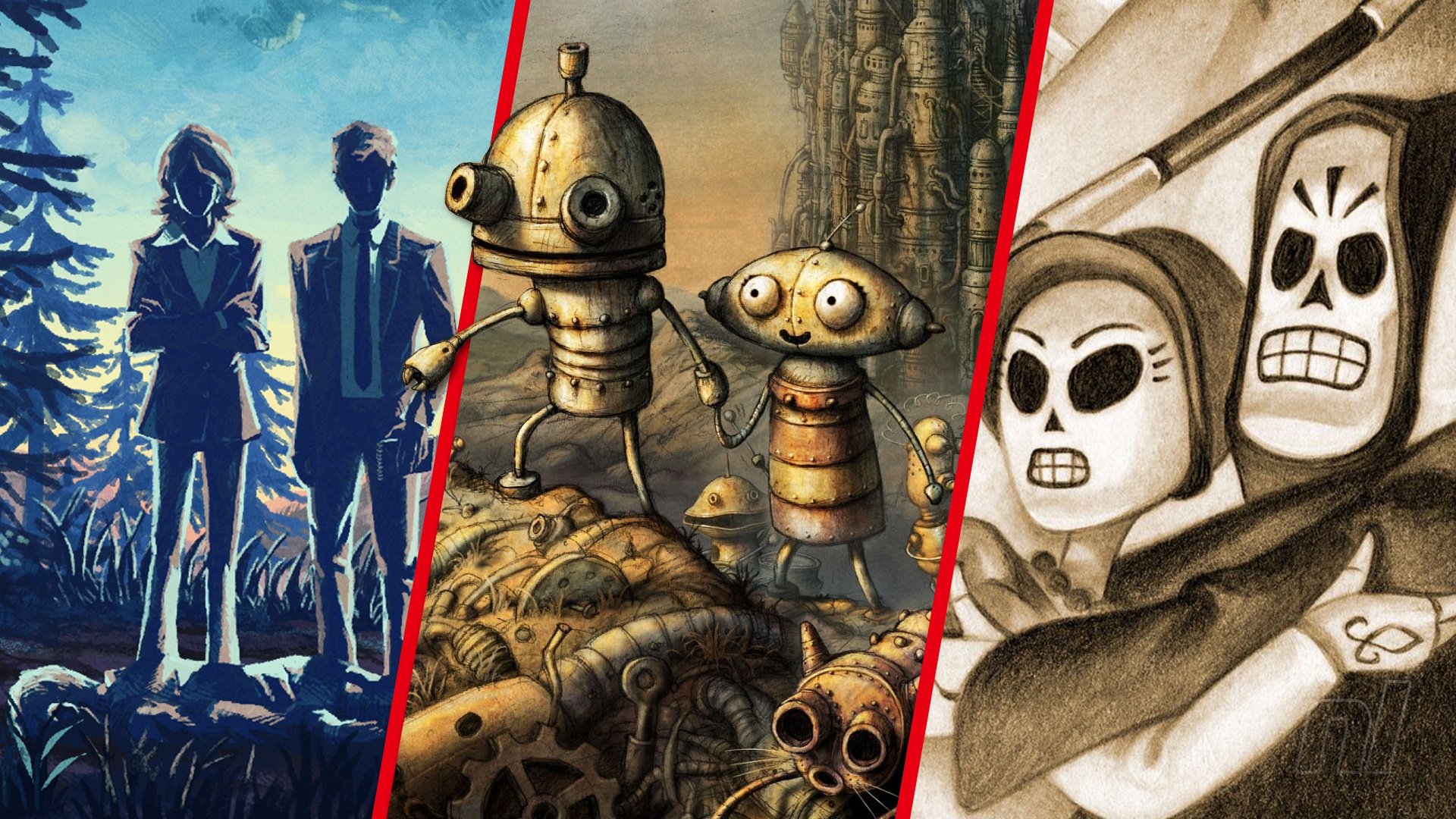
Point-and-click beginners may struggle with the myriad puzzles Thimbleweed Park lays across its curiosity-piquing plot, but its developers have rightfully made it possible to get ahead even when all you see are dead ends, with the inclusion of the tips line. This is a love letter to the LucasArts adventure games of old, updated to be as convenient as possible without stripping away the challenge or the charm. These updates mean that what would have been an essential only for a very specific audience is, with no explicit fail states, easy for anyone to not just enjoy, but actually finish. And going around for a second time is still a treat, much as Monkey Island et al were, as you can clearly see all the pieces of the grander picture coming together to comprise a fascinating whole, climaxing with one of gaming’s better twists.
Bulb Boy won’t stay in your memories forever; it is a relatively small game that shouldn’t take too long to complete, but whilst it lasts it offers nicely designed puzzles and an underlying humour that offers a different experience. It is clearly lovingly put-together and refreshingly manages to make horror cute and fun, rather than taking itself seriously. Bulb Boy appeal comes in the form of its characters, craziness and toilet humour – a deadly combination that deserves to be played.
2064: Read Only Memories INTEGRAL takes the classic point-and-click genre of old, strips out many of the annoyingly exacting puzzle systems, and injects a refreshingly positive and progressive outlook. A cast of memorable characters and some spot-on retro presentation should seal the deal for fans of a good story and snappy dialogue.
Publisher: Headup Games / Developer: Studio Fizbin
Release Date: 3rd Aug 2018 (USA) / 3rd Aug 2018 (UK/EU)
The first Inner World introduced the entertaining, eccentric world of Asposia and the naïve flute-nose Robert, but its lack of touchscreen support left us feeling frustrated. This sequel, however, addressed our primary issue with the original and improved things no-end, making The Last Wind Monk a much easier recommendation. Experimentation is a breeze with touch controls and the expanded possibilities offered by character-switching mean puzzles feel more varied. It maintains the original’s great writing and presentation, but offers a far better all-round experience, making it the best entry point for Switch owners. We’ve still got our fingers crossed for a part three.
Publisher: Another Indie Studio / Developer: HomeBear Studio
Release Date: 29th Nov 2018 (USA) / 29th Nov 2018 (UK/EU)
There’s a good chance you’ve probably never heard of NAIRI: Tower of Shirin, but that doesn’t mean this hidden gem should pass you buy. Sure, it doesn’t have the pedigree of a Double Fine game or the licence exposure of something from TellTale’s back catalogue, but it still offers up a safe and engaging world full of quirky characters, challenging puzzles and all the screen-tapping backgrounds you could ask for. It’s no great reimagining of the genre, but it’s still a curio worth playing nonetheless.
Publisher: Night School Studio / Developer: Night School Studio
Release Date: 6th Oct 2017 (USA) / 6th Oct 2017 (UK/EU)
A genuinely creepy creation, Oxenfree combines a clever story and smart dialogue mechanics with superbly sinister music to leave a deep and lasting impression on the player, one that should encourage an all-important second playthrough. Fans of Stranger Things and Poltergeist will love the direction this game takes – if not to hell and back, exactly, then absolutely to some other place where horrors abound, just waiting for an invitation into our world. It’s yet another Switch essential, and playing with a touchscreen gives it a more point-and-click flavour.
Release Date: 28th Jan 2020 (USA) / 28th Jan 2020 (UK/EU)
Kentucky Route Zero: TV Edition is the full and complete Kentucky Route Zero experience. A magical realist point-and-click adventure that takes you on a beguiling journey to a place that exists both below and beyond. It’s a trip to be savoured, ruminated on; no need to rush. Each act here brings with it some new perspective, new places and people to forge deep connections with. You may be confused, even bewildered by your initial steps down into the subterranea that exists somewhere beneath this version of Kentucky but, by the end of your journey, you’ll have made friends and memories and been escorted through a rich and beautiful experience that will stay with you much longer than you may expect.
Release Date: 29th Aug 2019 (USA) / 29th Aug 2019 (UK/EU)
A point-and-click aventure game with a cool ’60s styling and an intriguing story, we missed out on reviewing Agent A: A Puzzle in Disguise, although Nintendo Life readers brought it to our attention. It’s a stylish little adventure and well worth investigation if you’re a fan of non-serious secret agent puzzling with the classic (or should that be cla-shic) James Bond flavour.
GTA 5, Red Dead Redemption 2 PS5 And Xbox Series X Compatibility Detailed
Rockstar Games has detailed how some of its big games, including Grand Theft Auto 5 and Red Dead Redemption 2, will work on the new PS5, Xbox Series X, and Series S. Those games will be backward compatible on both next-gen consoles upon launch next week. This also includes the most recent version of LA Noire, and the PlayStation VR La Noire: The VR Case Files.
The backwards compatibility includes cross-saves, so you can pick up right where you left off by transferring your save file or downloading from the cloud. All of your online progress in GTA Online or Red Dead Online will come across too, as long as you're using the same account information that's linked to your game profiles.
Rockstar also noted that all the previous Xbox One backward compatible games would continue to work on Series X and Series S, and compatible PS2 games will be playable on PS5:
Posted by: xSicKxBot - 11-07-2020, 11:08 AM - Forum: Lounge
- No Replies
Do You Need The PS5's Pulse Headset To Access 3D Audio?
The first things you'll notice on the PlayStation 5 when playing games are the console's graphical and performance upgrades over its predecessor. But while it's a little less obvious, the PS5 makes major strides in audio as well, boasting its own 3D audio technology to make games as immersive as possible. The trouble is, at launch, PS5's Tempest 3D AudioTech won't work through your TV or speakers--it'll only work with headphones.
Sony is offering its Pulse 3D wireless headset as a launch peripheral, which raises the question: Do you need to buy the Pulse 3D to get the most out of your PS5?
The answer to that question, thankfully, is no--although the Pulse 3D is a pretty good set of headphones with some added benefits for gaming, like a noise-cancelling microphone. But other headphones can get the same benefits as well.
Spending reaches $384 million in post-apocalyptic games this year
The latest Sensor Tower report has revealed that post-apocalyptic mobile games have performed exceptionally well this year. Despite the global pandemic currently plaguing the world, games featuring a post-apocalyptic setting have seen the fastest growth in the U.S. for Q1 to Q3.
Player spending in these games has risen by 106%, reaching approximately $384 million. The standout post-apocalyptic games that saw the fastest growth across all game settings were State of Survival from FunPlus and Last Shelter: Survival from Long Tech. If people are playing these games because of our current global climate, there’s almost no doubt this trend will continue into next year.
Plague Inc. became one of the top-selling iOS games in January when news about the coronavirus outbreak started to become more widespread. The game’s sales prompted Ndemic Creations, the developers behind Plague Inc. to release a statement: “We specifically designed the game to be realistic and informative, while not sensationalising serious real-world issues. However, please remember that Plague Inc. is a game, not a scientific model and that the current coronavirus outbreak is a very real situation which is impacting a huge number of people.”
Unsurprisingly, the fastest growing art style during the same Q1 to Q3 period was Retro – Low Poly, accounting for games like Minecraft and Roblox. As two of the biggest games in the world, we aren’t surprised to see this category make large gains as these games continue to grow extensively.
Our website is currently offline due to very high player numbers. I’m copying our statement on the coronavirus outbreak here so people can still see it.https://t.co/pA6CUS7nJIpic.twitter.com/StXP6aemDe
If you’d like to brush up on your Plague Inc. skills, be sure to check out our Plague Inc. tips which highlights everything you’ll need on your virus spreading quest. Looking for something a little more strategic? Head on over to our best mobile strategy games list for all the tactical challenges you could ask for.
Mini Review: YesterMorrow – A Time-Travelling Novelty Which Grows Old, Fast
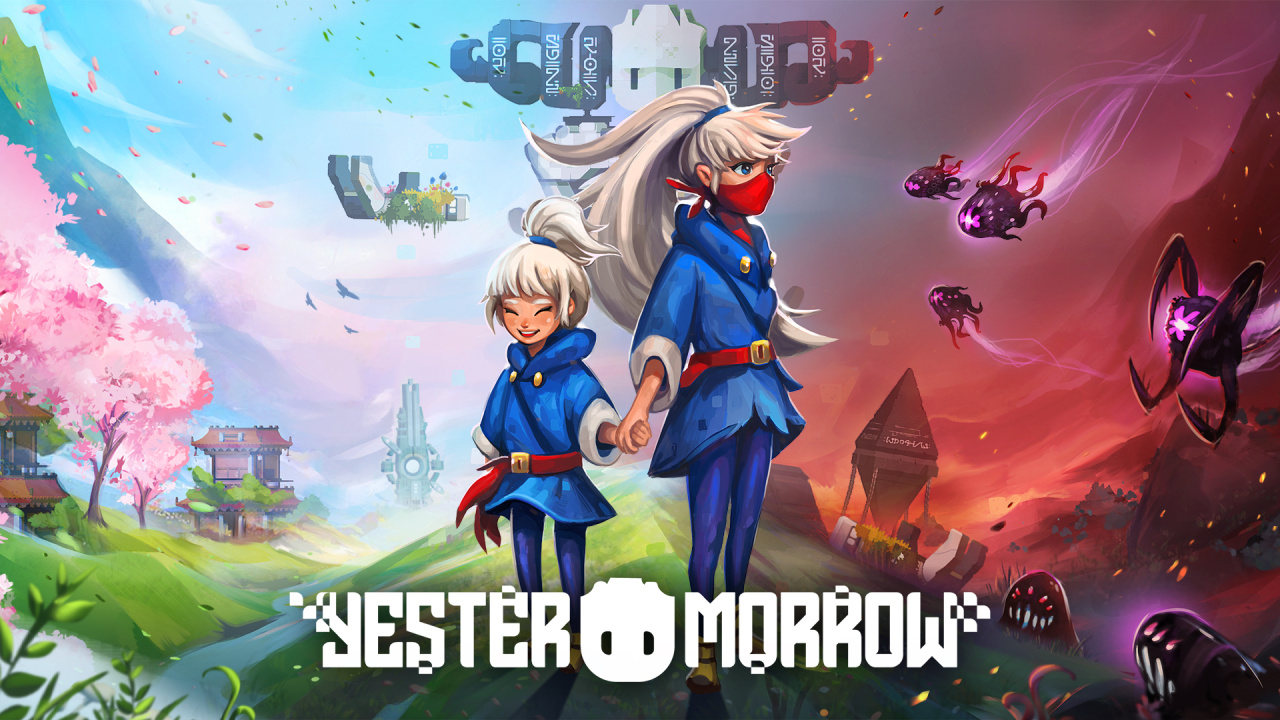
On paper, YesterMorrow is a really neat concept for a game. A side-scrolling adventure, its main twist is the ability to jump between two separate timelines, spaced several years apart. You play as Yui, a young girl whose life is thrown into disrepair after her home is destroyed and her family kidnapped by ‘Shadows’ during the Festival of Light. Wracked with guilt for failing to act quick enough, she sets off on an adventure to reverse her misfortunes, save her family, and fix her past.
What’s immediately striking with YesterMorrow is its visuals; the game looks really slick right from the start. It’s not pixelated, but the art style utilised certainly gives off a pixelated effect. The characters are ‘chunky’ in an endearing, adorable way, and the environments are bursting with colour and personality. There are lots of little details, from the way water ripples when you walk through it, to how Yui’s hair swishes about as you jump across platforms. Oh, and you can pet lots of animals.
The gameplay is – surprisingly – largely devoid of any combat. It focuses more on the platforming and puzzle aspects, utilising the time travel mechanic to alter your immediate surroundings; so for example, boulders might be blocking a passageway in the future timeline, but hopping into the past will remove this pesky obstacle. It works both ways, too: you can flip a switch in the past, go back to the future (come on, we had to get that in there) and whatever the switch activates in the past will, somehow, still be ticking along in the future.
Unfortunately, the novelty of time travel wears thin pretty quickly. It’s really the only unique aspect to YesterMorrow, and the game’s heavy reliance on the mechanic means that you’re going to be constantly backtracking trodden ground, switching between timelines at such frequency, it soon becomes quite repetitive. In addition, the rest of the game’s mechanics – from the platforming to puzzle-solving – are very much a case of ‘been there, done that’. We’ve seen it all before, and YesterMorrow ultimately fails to inject enough originality to hold our attention.
To make matters worse, YesterMorrow on the Switch is a bit of a disaster from a technical standpoint. It strives to hit 30fps most of the time, but there are far too many occasions where it plummets to a snail’s pace; so much so that it even causes input lag when you’re jumping about and avoiding enemies. We also came across a frankly bizarre technical hiccup in which flashes of light would come across the screen, flickering with such intensity that it would give Pokémon’s infamous ‘Dennō Senshi Porygon’ TV episode a run for its money. Check out the screenshots above, and you’ll see what this issue looks like in a static image; it’s much worse in motion, mind.
It’s a real shame that YesterMorrow performs so poorly, because visually it’s a real treat, and it’s backed up by a pretty great soundtrack. More importantly though, its gameplay – while functional – can’t hold a candle to a game like Celeste, and we feel it really should have nailed this aspect if it’s to be successful. YesterMorrow may be worth a go if the severe technical issues get ironed out, but it’s by no means a must-buy.
Adorable Multiplayer Brawler Cake Bash Cooks Up A November Release On Switch
Publisher Coatsink and developers High Tea Frog have announced that Cake Bash, a four-player party game where you quite literally bash each other as cakes, will launch on Nintendo Switch on 19th November.
The game launched on a variety of other platforms last month and was received fairly well by critics, so it’s good to see it making the jump to Switch. It’ll be priced at $19.99 when it arrives on the eShop, but a demo is already available should you want to give it a try.
In Cake Bash, you fight to be the tastiest cake, it’s a frantic four-player party game where adorable drawn-to-life cakes beat the crumbs out of each other! Pick your favourite cake and battle in a variety of lifelike places with unique goals – cover yourself in sweeties or hurl fruit into a pie, there’s plenty for everyone!
To cool down, try an assortment of minigame treats – roast perfect marshmallows, pipe the finest frosting, or be the last flan standing in Fork Knife.
Guide your cakes through the bakery as they dress to impress the customer in Get Tasty! Buy delicious toppings in a series of games to be the chosen one…
Compete on the same screen, find challengers online or battle well-baked bots. It’s time to get out of the oven and into the fray!
We must say, the whole thing looks pretty delightful – and tasty, too.
Will you be giving this one a go when it launches on Switch later this month? Let us know with a comment.
Posted by: xSicKxBot - 11-07-2020, 04:55 AM - Forum: Lounge
- No Replies
PS5 Review: A Promising Start To The Next Generation
The PS4 was a fantastic console, a platform that both indie and AAA games flocked to and shined on. Bolstered by a varied lineup of first-party exclusives, Sony's fourth console commanded the attention of gamers over the past seven years. While the PS4's success was undeniably a good thing for Sony, it leaves the company with the tough challenge of topping itself.
With the PS5, instead of simply releasing a new console with more horsepower, Sony has taken a bolder step to clearly establish that this is a brand-new generation. The PS5's console design speaks to this, looking less like a PlayStation and more like an evil megacorp's cyberpunk headquarters. It's a brash design that looks nice when standing tall and a little strange when resting on its side, but in either orientation it's undeniably eye-catching. The next-generation machine is big, bold, and next to stablemates like the PS4 Pro, downright intimidating.
Though it may be a cold behemoth in its stature, the PS5 is also warm and inviting when turned on. The menus are all reminiscent of the PS4, creating a sense of familiarity that helps users get their feet planted, but it's also stripped down and streamlined to only the necessities. Installed games stand in a line of up to nine titles on the homepage, capped off by a library button that reveals your full collection. This is similar to the PS4, though unfortunately, there's currently no way to organize these games at launch--whatever was used most recently shows up first, and there are no folders. Sorting sizable libraries by the platform is easy, though, allowing you to parse which games are native to the PS5 in just a few button presses.
Posted by: xSicKxBot - 11-07-2020, 12:58 AM - Forum: Python
- No Replies
How to Get MD5 of a String? A Python One-Liner
Rapid Answer: The following one-liner calculates the MD5 from the string 'hello world':
import hashlib as h;print(h.md5(b'hello world').hexdigest())
Background: MD5 message-digest is a vulnerable cryptographic algorithm to map a string to a 128-bit hash value. You can use it as a checksum on a given text to ensure that the message hasn’t been corrupted. However, you shouldn’t use it as a protection against malicious corruption due to its vulnerability. With modern hardware and algorithms, it’s easy to crack!
Problem: How to generate an MD5 sum from a string?
Example: Say, you have the following string text:
text = 'hello world'
And you want to convert it to the MD5 hash value:
5eb63bbbe01eeed093cb22bb8f5acdc3
We’ll discuss some methods to accomplish this next.
Method 1: hashlib.md5() — Multi-Liner
The hashlib library provides a function md5() that creates an object that can calculate the hash value of a given text for you via the method update():
# Method 1: hashlib.md5()

import hashlib m = hashlib.md5()

text = 'hello world'

m.update(text.encode('utf-8')) print(m.hexdigest())

# 5eb63bbbe01eeed093cb22bb8f5acdc3
Make sure to encode the string as a Unicode string with the string.encode('utf-8') method. Otherwise, Python will throw an error.
I also initialized the md5 object with the Unicode string directly rather than using the update() method. The one-liner now has minimum number of characters—I don’t think it can be made even more concise!
Python One-Liners Book
Python programmers will improve their computer science skills with these useful one-liners.
Python One-Linerswill teach you how to read and write “one-liners”: concise statements of useful functionality packed into a single line of code. You’ll learn how to systematically unpack and understand any line of Python code, and write eloquent, powerfully compressed Python like an expert.
The book’s five chapters cover tips and tricks, regular expressions, machine learning, core data science topics, and useful algorithms. Detailed explanations of one-liners introduce key computer science concepts and boost your coding and analytical skills. You’ll learn about advanced Python features such as list comprehension, slicing, lambda functions, regular expressions, map and reduce functions, and slice assignments. You’ll also learn how to:
• Leverage data structures to solve real-world problems, like using Boolean indexing to find cities with above-average pollution • Use NumPy basics such as array, shape, axis, type, broadcasting, advanced indexing, slicing, sorting, searching, aggregating, and statistics • Calculate basic statistics of multidimensional data arrays and the K-Means algorithms for unsupervised learning • Create more advanced regular expressions using grouping and named groups, negative lookaheads, escaped characters, whitespaces, character sets (and negative characters sets), and greedy/nongreedy operators • Understand a wide range of computer science topics, including anagrams, palindromes, supersets, permutations, factorials, prime numbers, Fibonacci numbers, obfuscation, searching, and algorithmic sorting
By the end of the book, you’ll know how to write Python at its most refined, and create concise, beautiful pieces of “Python art” in merely a single line.