After the Great War, all humans are wiped out. The only survivors are decaying service robots and humanoid lizards that were born from a long nuclear fallout.
Our story follows Delta, who is a small service robot and like any other robot, he is just trying to survive in this harsh environment. One day he is forced to embark on a journey through a vast post-apocalyptic world in order to find his lost friend. Because of his small size, he needs to use all of his wits to overcome all dangerous scenarios and challenges.
Posted by: xSicKxBot - 03-20-2023, 05:04 AM - Forum: Python
- No Replies
How Bitcoin Solves the Byzantine Generals Problem
5/5 – (1 vote)
Overview
Picture a mighty city, surrounded by a bunch of Byzantine generals , trying to unite and plan an epic attack! But oh no! Some of these generals might be traitors , who’ll backstab the others and ruin the plan. They need a foolproof way to agree on a battle strategy while handling these sneaky tricksters.
This dilemma isn’t just for ancient generals, it’s also super relevant in computer networks called distributed systems. These networks have many participants, or “nodes” , who need to agree on something (like data) in a process called consensus. But some nodes might be mischievous , spreading false info to confuse others.
To solve this, we need a system that allows all honest nodes to reach the same decision, even if there are cheeky liars in the mix! The solution should be fault-tolerant, meaning that it keeps working even if some nodes are not playing nice.
Now let’s bring in our digital superhero, Bitcoin! It swoops in with its magical power called Proof of Work (PoW) . Miners (the network’s participants) go head-to-head in a crazy math puzzle race . Whoever wins gets to add a new block of transactions to the super secure public diary called the blockchain .
PoW makes it super expensive for the bad guys to control the network, because they would need a whole lotta computing power . So, the honest nodes prevail, and consensus is achieved!
To sum it up, the Byzantine Generals Problem is all about getting everyone on the same page , even when some sneaky snakes are trying to cause chaos. Bitcoin’s Proof of Work saves the day, ensuring that everyone can trust the system and have a rockin’ good time!
The Byzantine Generals Problem
Imagine a bunch of Byzantine generals surrounding a city, trying to decide when to attack . They need to attack together to win, but oh no! Some of them might be traitors . So, how can they agree on when to strike without a trustworthy central party?
The Byzantine Generals Problem is a challenge faced in distributed systems where nodes (or participants) need to agree on a specific action or piece of information (called consensus) while accounting for the possibility of some nodes being faulty or malicious. The problem is named after the analogy of Byzantine generals planning an attack on a city, who need to coordinate their actions without falling victim to traitors within their ranks.
Let’s look at some example scenarios:
1⃣ Scenario 1: The Disobedient General Imagine there are three Byzantine generals, A, B, and C. They need to decide whether to attack (1) or retreat (0). A and B are loyal, and they decide to attack (1). C, however, is a traitor and wants to cause confusion. C sends different messages to A and B, telling A to attack (1) and B to retreat (0). In this case, A and B receive contradicting information and cannot reach consensus. The attack fails because of the lack of coordination.
2⃣ Scenario 2: The Traitorous Messenger In this scenario, there are three loyal generals, A, B, and C, and a treacherous messenger, M. The generals agree to attack (1) and send their decisions through messenger M. However, M wants to sabotage the attack. M delivers the correct message (1) to general A, but changes the message to retreat (0) for general B. The generals receive conflicting information, leading to a failed consensus and a botched attack.
3⃣ Scenario 3: The Compromised Communication Channel Let’s say there are three loyal generals, A, B, and C, who need to reach consensus on attacking (1) or retreating (0). They communicate through a shared channel, but an enemy has compromised the channel and can intercept and alter their messages. When the generals send their decision to attack (1), the enemy changes the messages to retreat (0). As a result, the generals receive false information, fail to reach consensus, and the coordinated attack is unsuccessful.
4⃣ Scenario 4: The Double Agent General In this scenario, there are four generals: A, B, C, and D. Generals A, B, and C are loyal, but D is a double agent working for the enemy. The generals need to decide whether to attack (1) or retreat (0). The loyal generals agree to attack (1). However, general D sends a message to retreat (0) to A and B, while sending a message to attack (1) to C. The conflicting information creates confusion and prevents the generals from reaching a consensus, leading to a failed attack.
5⃣ Scenario 5: The Chain of Traitors Imagine there are five generals: A, B, C, D, and E. Generals A, B, and C are loyal, while D and E are traitors. They need to decide whether to attack (1) or retreat (0). The loyal generals agree to attack (1) and share their decision with the next general in line. However, general D, being a traitor, alters the message and sends a retreat (0) order to E. General E, also a traitor, forwards the retreat (0) order to A. Now A, B, and C receive contradictory information, causing them to fail in reaching consensus and undermining the coordinated attack.
6⃣ Scenario 6: The Traitors’ Majority In this scenario, there are five generals: A, B, C, D, and E. Generals A and B are loyal, but C, D, and E are traitors. The generals need to decide whether to attack (1) or retreat (0). The loyal generals agree to attack (1). However, the traitorous generals send messages to attack (1) to general A and retreat (0) to general B. Since there are more traitorous generals than loyal ones, it becomes impossible for the loyal generals to identify the correct course of action, leading to a failure in reaching consensus and a botched attack.
What makes this problem so tricky? It’s called Byzantine Fault Tolerance (BFT).
These faults can happen for lots of reasons: software bugs , hardware malfunctions , or even sneaky cyberattacks . The challenge is making a system that can handle these faults without breaking a sweat.
Formal Definition
The Byzantine Generals Problem is a fundamental challenge in distributed computing that addresses the issue of achieving consensus among distributed nodes or agents in the presence of faulty or malicious nodes. The formal definition of the problem can be stated as follows:
Given a distributed system with n nodes, some of which may be faulty or Byzantine, devise a protocol that enables the honest nodes to reach a common agreement or consensus on a specific value or action, under the following conditions:
All honest nodes must agree on the same value or action.
If the source node (the node that initiates the consensus process) is honest, then all honest nodes must agree on the value or action proposed by the source node.
The protocol should be robust against Byzantine faults, which are failures that can lead to arbitrary or unpredictable behaviors, including sending inconsistent information to different nodes or colluding with other faulty nodes to disrupt the consensus process.
The objective is to find a solution that guarantees consensus among the honest nodes, even when up to f nodes in the system are faulty or Byzantine, with f < n/3 for asynchronous systems and f < n/2 for synchronous systems.
Game Theory
Enter game theory, a way to think about social situations with competing players. It helps us understand the challenge of these generals, which also applies to computer systems . We need a way to make sure everyone can agree, even if there are sneaky liars around.
The Byzantine Generals Problem incorporates elements of game theory, a mathematical framework used to model situations where decision-makers interact strategically. In the context of the Byzantine Generals Problem, game theory helps analyze and understand the behavior of nodes (or participants) in a distributed system, considering the possible actions of faulty or malicious nodes.
The game theory concepts relevant to the Byzantine Generals Problem are as follows:
Players: In the Byzantine Generals Problem, the players are the nodes (or generals) in the distributed system. Each player has its own strategy, which could be honest (loyal) or dishonest (traitorous).
Strategies: Each node can choose to be honest and transmit accurate information or be malicious and send contradictory information to other nodes. The goal of the malicious nodes is to prevent the system from reaching consensus, while the honest nodes strive to achieve consensus despite the presence of faulty nodes.
Payoffs: The payoff for the honest nodes is the successful achievement of consensus, leading to a coordinated action (e.g., a successful attack). The payoff for the malicious nodes is the disruption of consensus, causing confusion and preventing coordinated action.
Equilibrium: In the context of the Byzantine Generals Problem, an equilibrium is reached when a consensus algorithm successfully enables the honest nodes to achieve consensus, despite the presence of faulty nodes. This equilibrium is considered a “solution” to the problem.
To devise a robust consensus algorithm that solves the Byzantine Generals Problem, game theory helps assess the incentives and potential actions of all players (nodes) in the system.
Famous Lamport Paper
Back in 1982, some super-smart researchers (Lamport, Shostak, and Pease) published a paper that described the Byzantine Generals Problem and proposed solutions. They showed that it’s not just about military communication , but it affects all kinds of computer systems too!
The authors presented the problem using an analogy involving Byzantine generals who need to coordinate an attack or retreat while communicating only through messengers. They acknowledged the potential for some generals to be traitorous and send contradictory messages, creating confusion and preventing consensus.
The paper provided algorithms and proofs for various cases of the problem, depending on the number of total nodes and the number of faulty nodes. The authors demonstrated that, for a system to be fault-tolerant and reach consensus, the number of total nodes (n) must be at least 3 times the number of faulty nodes (f) (i.e., n > 3f) in an asynchronous system.
The Lamport et al. paper was a groundbreaking work that significantly advanced the understanding of distributed computing, fault tolerance, and consensus. The Byzantine Generals Problem continues to be an essential concept in the development of distributed systems, particularly in the context of blockchain technology and cryptocurrencies.
Satoshi’s Solution to the Byzantine Problem: Bitcoin
In the world of decentralized systems, this problem is super important. Centralized systems have a big boss (like a bank or government) that can step in if something goes wrong. But decentralized systems don’t have that safety net, so they need to solve the Byzantine Generals Problem on their own.
So, how can we create a trustworthy currency that everyone can agree on? Enter Bitcoin (BTC) ! It’s the first system to truly solve the Byzantine Generals Problem, making it a groundbreaking game-changer.
What If Bitcoin Wouldn’t Have Solved the Byzantine Generals Problem?
The following bad scenarios could’ve happened if Satoshi hadn’t fully solved the Byzantine Generals Problem. That’s why it was such a groundbreaking invention!
1⃣ Double Spending Spree: If Bitcoin hadn’t solved the Byzantine Generals Problem, Alice could spend her bitcoin on a fancy new gadget from Bob and then use the same bitcoin to buy a delicious pizza from Carol. Without consensus, both transactions would be considered valid, leading to chaos in the Bitcoin network and undermining the trust in the currency.
2⃣ Miner Mayhem: Miners competing to validate blocks might end up validating different versions of the blockchain , creating multiple branches and causing confusion. Users wouldn’t know which branch to trust, making transactions risky and uncertain.
3⃣ Transaction Tangle: If Bitcoin couldn’t reach consensus, Alice might send bitcoin to Bob, but Carol, who runs a node, might register a different transaction, sending the same bitcoin to Dave. This tangled web of conflicting transactions would create uncertainty and diminish trust in the system.
4⃣ Cryptocurrency Carousel: Users might see their balances change unexpectedly, as faulty nodes could report different balances for the same wallet. One moment you’re a Bitcoin millionaire , and the next, you’ve got zilch. Talk about a wild ride!
5⃣ Hacking Havoc: If Bitcoin hadn’t addressed the Byzantine Generals Problem, malicious actors could exploit the lack of consensus to manipulate the network. They might create fake transactions, falsify balances, or even steal bitcoins, causing panic and distrust among users.
6⃣ Slow-motion Meltdown: Without solving the Byzantine Generals Problem, transactions would take ages to confirm, if they even confirm at all. Imagine waiting for your Bitcoin payment to go through while watching a sloth cross the road. Yep, it’d be that slow! And with such a sluggish system, nobody would want to use Bitcoin.
Luckily, Bitcoin’s blockchain technology and consensus algorithms like Proof of Work solved the Byzantine Generals Problem, ensuring trust, security, and reliability in the network. Phew!
But How Does Bitcoin Solve The Problem?
Bitcoin solves the Byzantine Generals Problem through a combination of its blockchain technology and the Proof of Work (PoW) consensus algorithm.
Here’s a breakdown of how it works, with examples:
1⃣ Blockchain Structure: Bitcoin’s transactions are grouped into blocks, and each block contains a reference to the previous block’s unique identifier (hash). This creates a chain of blocks that is difficult to tamper with, as altering any block would require changing all subsequent blocks.
Example: Alice sends 1 BTC to Bob and then tries to double-spend that same BTC by sending it to Carol. The blockchain structure ensures that the first transaction (to Bob) is permanently recorded and cannot be altered without changing all subsequent blocks.
2⃣ Proof of Work (PoW): Miners compete to validate and add new blocks to the blockchain by solving complex mathematical puzzles. The first miner to solve the puzzle gets to add the new block and is rewarded with freshly minted bitcoins. This process requires considerable computational power, making it costly and difficult for any single actor to take control of the network.
Example: A malicious miner wants to manipulate the network by validating a fraudulent transaction. However, doing so would require outpacing the combined computational power of all other miners, which is highly improbable and expensive.
3⃣ Longest Chain Rule: When multiple valid versions of the blockchain emerge (forks), Bitcoin follows the longest chain rule. Nodes consider the chain with the most accumulated PoW as the true version, eventually leading to a single, agreed-upon blockchain.
Example: Two miners, Miner A and Miner B, solve the PoW puzzle at nearly the same time, resulting in two competing branches of the blockchain. As other miners continue mining, one branch becomes longer than the other. Nodes eventually adopt the longer chain, reaching consensus on the valid blockchain.
4⃣ Network Incentives: Bitcoin’s design rewards honest behavior and punishes dishonesty. Miners receive block rewards and transaction fees for validating transactions and adding blocks to the chain. Acting maliciously would require immense resources with little chance of success, making it economically unappealing.
Example: A group of malicious miners considers launching a 51% attack to control the network. However, they realize that the cost of acquiring the necessary computational power would outweigh any potential gains. Instead, they decide to mine honestly, contributing to the network’s security and stability.
By incorporating these features, Bitcoin successfully solves the Byzantine Generals Problem, ensuring consensus, trust, and security within the network.
Satoshi’s Bitcoin Whitepaper
Satoshi Nakamoto’s Bitcoin whitepaper, released in October 2008, laid the groundwork for solving the Byzantine Generals Problem, although the term itself wasn’t explicitly used. The solution was implemented with the launch of the Bitcoin network in January 2009.
Figure: Not at all what a “real” Bitcoin looks like.
Nakamoto’s method involves cryptographic security and public-key encryption to address the Byzantine Generals Problem within a digital electronic network. Cryptographic security employs hashing to prevent data tampering, while public-key encryption verifies the identity of network users.
In the blockchain, transactions are secured within blocks connected by their hash values. All hashes can be traced back to the genesis block. The blockchain employs a Merkle Tree to verify hashes, with each block in the network considered valid if it originates from the genesis block.
Merkle trees, sometimes called Binary hash trees, are a popular kind of data structure in the world of computer science . They play a crucial role in Bitcoin and other cryptocurrencies, making blockchain data encryption more efficient and secure .
Miners validate blocks by competing to solve cryptographic puzzles as part of a Proof of Work (PoW) consensus mechanism.
Bitcoin resolves the Byzantine Generals Problem by using PoW to create an objective set of rules for the blockchain. A network participant must present proof of effort expended to add blocks to the blockchain. The cost of this work incentivizes accurate information sharing.
Objective rules ensure that there is no disagreement or tampering with the information on the Bitcoin network. The system for choosing who can mint new Bitcoin and the rules governing valid or invalid transactions are both objective. Moreover, once a block is added to the blockchain, it becomes immutable.
Miners in the blockchain are analogous to generals, with each node responsible for validating transactions, akin to the messages delivered to generals. Cryptographic security protects messages from potential attacks by malicious actors, such as hackers. Transactions are bundled into blocks and hashed to prevent tampering. By placing miners in a competition to validate blocks, Satoshi makes the process more decentralized and probabilistic, preventing any single miner from monopolizing validation.
Miners compete to solve a cryptographic puzzle using their computational power or hash rate. The higher the hash rate, the greater the chance of solving the puzzle. When a miner solves the puzzle, they broadcast the solution to the network, and other miners must verify or reject the value based on a difficulty target.
The Bitcoin network’s members can reach consensus on the blockchain’s state and all transactions at any given moment. Each node verifies block validity according to the PoW criterion and transaction validity based on additional criteria. If a network member tries to share misleading information, nodes will identify it as objectively invalid and disregard it. The trustless nature of Bitcoin eliminates the need for reliance on other network members since each node can independently verify all information.
The decentralized nature of the blockchain ensures that there is no single point of failure. Blocks are stored in a distributed database, replicated across the network. This redundancy also contributes to fault tolerance, guaranteeing that no single malfunctioning computer can bring down the entire system. This is akin to having multiple messengers to relay messages even if one gets ambushed, ensuring the message will not be lost as it is copied by other messengers.
Cryptography Mailing List Description of the Problem
Here’s Satoshi‘s rephrasing of the problem in his correspondence with the “Cryptography Mailing List” to which he initially launched the Bitcoin open-source project and whitepaper:
The proof-of-work chain is a solution to the Byzantine Generals' Problem. I'll try to rephrase it in that context. A number of Byzantine Generals each have a computer and want to attack the King's wi-fi by brute forcing the password, which they've learned is a certain number of characters in length. Once they stimulate the network to generate a packet, they must crack the password within a limited time to break in and erase the logs, otherwise they will be discovered and get in trouble. They only have enough CPU power to crack it fast enough if a majority of them attack at the same time. They don't particularly care when the attack will be, just that they all agree. It has been decided that anyone who feels like it will announce a time, and whatever time is heard first will be the official attack time. The problem is that the network is not instantaneous, and if two generals announce different attack times at close to the same time, some may hear one first and others hear the other first. They use a proof-of-work chain to solve the problem. Once each general receives whatever attack time he hears first, he sets his computer to solve an extremely difficult proof-of-work problem that includes the attack time in its hash. The proof-of-work is so difficult, it's expected to take 10 minutes of them all working at once before one of them finds a solution. Once one of the generals finds a proof-of-work, he broadcasts it to the network, and everyone changes their current proof-of-work computation to include that proof-of-work in the hash they're working on. If anyone was working on a different attack time, they switch to this one, because its proof-of-work chain is now longer. After two hours, one attack time should be hashed by a chain of 12 proofs-of-work. Every general, just by verifying the difficulty of the proof-of-work chain, can estimate how much parallel CPU power per hour was expended on it and see that it must have required the majority of the computers to produce that much proof-of-work in the allotted time. They had to all have seen it because the proof-of-work is proof that they worked on it. If the CPU power exhibited by the proof-of-work chain is sufficient to crack the password, they can safely attack at the agreed time. The proof-of-work chain is how all the synchronisation, distributed database and global view problems you've asked about are solved.
In other words:
The Byzantine Generals have computers and want to attack the King’s Wi-Fi by cracking the password. They need to work together to break in and erase logs before getting caught. The generals don’t care when they attack but must agree on a time. They announce a time, but the network isn’t instant, causing confusion.
They use a proof-of-work chain to agree. Each general starts solving a super hard problem, including the attack time in its hash. It’s so tough that it takes 10 minutes for one to find a solution. When a general solves it, he tells everyone, and they update their work.
After 2 hours, an attack time is confirmed by a chain of 12 proofs-of-work. Each general can see the CPU power spent and know that most computers worked on it. The proof-of-work chain helps them sync, share info, and see the big picture. With enough power, they can attack at the agreed time.
Summary
the Byzantine Generals Problem is a classic challenge in distributed systems, where trust and coordination are critical. Bitcoin, with its innovative proof-of-work mechanism, has successfully addressed this issue, paving the way for a decentralized and trustless digital currency.
As technology continues to evolve at an exponential pace, it’s crucial to stay informed and ahead of the curve. Don’t miss out on the latest insights into exponential technologies! Subscribe to our mailing list now and join a community of curious minds, eager to learn and grow together.
Welcome to the Underworld - a land of monsters and mutants who eat humans for breakfast.
One such monster - a hulking ogre by the name of Roy - has no interest in eating humans. But one day, he and his best friend Golan stumble upon a lost little girl named Meg, and discover something truly terrifying: the moment she starts wailing in fear, a blood-red hue washes over the sky, and the earth itself begins to tremble and quake.
That's right: this small girl's tears hold the power to bring forth the apocalypse - and the only way to stop it is for them to help find her mother so she can make it safely back home.
Meg's Monster is a short, story-driven JRPG with a big twist. Players control Roy, who begins the game with 99,999 HP and is virtually untouchable - but the real concern is keeping Meg safe, because if she starts crying, it's game over for everyone.
Players will have to master the unique mechanics and mini-games baked into each battle, all while protecting Meg and using her favorite toys to keep her pacified.
Easy Way to Update a Python Package with Pip Upgrade
5/5 – (1 vote)
If you’ve ever found yourself in a situation where you need to update or upgrade a package using Python’s pip, but just can’t figure out how, don’t worry! You’re not alone.
The Correct Command to Upgrade a Package
To upgrade a package with Python’s pip, you can use the install command along with the --upgrade or -U flag. Open a command prompt or terminal and run the following command: pip install my_package -U.
pip install --upgrade my_package
or
pip install -U my_package
Replace my_package with the name of the package or module you want to upgrade. This command will automatically check for the latest version of the package and upgrade it if a newer version is available. If the package is already at its latest version, the command will do nothing.
Ensure you have the appropriate permissions (e.g., administrator or sudo access) if you’re upgrading a package installed globally on your system.
Using Sudo and –user Flag
When upgrading a package installed globally on your system, ensure you have the appropriate permissions, such as an administrator or sudo access. However, using sudo is considered unsafe, so avoid it if possible.
If you don’t have admin access, consider using the --user flag to install the package only for the current user:
pip install <package_name> --upgrade --user
Updating Pip Itself
Though the original question focused on updating specific packages, some users might want to update pip. To do that, use the following command:
For Python 3.4+:
sudo pip3 install pip --upgrade
For Python 2.7:
sudo pip install pip --upgrade
Extra Tip: Updating All Packages
If you’re looking to update all your installed packages at once, you can use the following one-liner:
for i in $(pip list -o | awk 'NR > 2 {print $1}'); do sudo pip install -U $i; done
This will update all outdated packages, but remember that it will require root access.
And there you have it! You now know how to update or upgrade a package using Python’s pip. Happy coding!
Make sure to check out the free Finxter cheat sheet collection (with OpenAI and basic Python cheat sheets):
Posted by: xSicKxBot - 03-18-2023, 09:28 AM - Forum: Python
- No Replies
How I Designed an AI Blog Writing Tool with Streamlit
5/5 – (1 vote)
Barely four months since OpenAI unleashed ChatGPT, a human-behavior-mimicking chatbot that took the community by storm, they recently announced its successor, GPT-4. This development will continue to disrupt the global market and, unfortunately, take the jobs of millions of people.
While it’s a welcome development for ChatGPT users looking to explore the capabilities of AI in their respective fields of human endeavor, the bad news is that ChatGPT-4 is not for free. However, we are yet to see if it could be freely available following Microsoft’s announcement that its recently introduced Bing AI is operating on GPT-4.
Hence, if you are unwilling to commit to a $20 monthly subscription, or you feel ChatGPT-3 is working flawlessly for you, you may be better off with ChatGPT-3. What is more, ChatGPT-4 is no different than its previous GPT model if it’s about taking information from your question and giving you an answer it deems perfect.
The only difference is that it is more accurate and creative, plus the special graphic features that will turn your text into pictures and videos.
The Purpose of This Tutorial
You will benefit from this tutorial if you have not yet learned how to implement the ChatGPT model using Streamlit.
As a Python developer, you have undoubtedly learned to implement ChatGPT in your Python script and have it running in your terminal. So this tutorial will be nothing new to you except for a few things.
Overall, the purpose of this tutorial is threefold:
To improve your Python skills.
To demonstrate how to implement the ChatGPT model using Streamlit.
To show you how to use the model to write unique blog articles.
Writing a blog article involves a series of steps. First, you have to brainstorm topic ideas based on a selected niche and choose the one you prefer. Then, you outline the sections. In each section, you generate content corresponding to the sections and the topic.
We will try using ChatGPT to automate these tasks. Note that this article is created with ChatGPT-3 in mind. Of course, the principle can be applied to the GPT-4 model.
I usually start with a main() function that will run as soon as we open the app. But in this tutorial, something came before the function.
import openai

import streamlit as st API_KEY = st.sidebar.text_input('Enter your API key')

openai.api_key = API_KEY
We made provision for our users to use their API key given that we now have a new model with a paid plan.
Not everyone will let others use their paid plan for free. If you have no problem with that, then you are free to include your key in the script. Now comes the main() function.
def main(): st.sidebar.header('AI Blog Writing Tool') st.sidebar.info('An AI tool that can generate blog content') st.sidebar.info('Start with the first option\n before you proceed to the next.') op = st.sidebar.selectbox('Steps', ['topics', 'section', 'content']) if op == 'topics': topics() elif op == 'section': section() else: content()
Everything is self-explanatory. Each step you select will take you to the function that will be executed.
So, let’s imagine we are writing a blog article with Python programming being the selected niche. We narrow down the niche to data science.
Let’s see if the model can generate blog topics for us. To do so we selected the topic option, triggering a callback function.
def topics(): st.header('AI Blog Writing Tool') st.info('To generate blog topic, please follow the pattern given below:') prompt = st.text_area('Write your words', height=50, value='Generate blog topic on data science with Python') if st.button('Send'): st.text(BlogTopics(prompt))
The prompt is the question we will feed to the model. It will be sent to the BlogTopics() function. What we feed to the model will help it know what to give as an answer. In the st.text_area() I gave a sample you can use based on your selected niche.
Notice the model that was used. In one Django application, I used the text-davinci-003 model. But in this one, we are using the davinci-instruct-beta-v3 model. It’s proven to be an ideal one for generating unique blog content.
The max_tokens is the number of characters we want the model to generate. Blog topics shouldn’t be more than that. For a detailed explanation of the arguments, check this article.
Let’s now run the app on Streamlit to see the results.
Wow! Can you see 9 blog topic ideas the ChatGPT model has generated for us? That’s interesting. So, let’s select number 2, How to use Pandas for data analysis. This is now our topic.
The next step is sections. When selected, it calls the callback function.
def section(): st.header('AI Blog Writing Tool') st.info('To generate blog section, please follow the pattern given below:') prompt = st.text_area('Write your words', height=50, value='Write blog sections\n\nBlog topic: ') if st.button('Send'): st.text(BlogSections(prompt))
Notice what I suggested in the st.text_area() function. You can follow the same pattern. As usual, another function gets executed when the button is pressed.
This is similar to the BlogTopics() function. So let’s run it and see the results.
Please note that the results might be different from yours. At times, you may have to run it several times to get what you want. I did that and got ‘Introduction’ as the first section.
Based on the sections, you select one and feed it to the model. Here is the function called when the last step of the main() function is selected.
def content(): st.header('AI Blog Writing Tool') st.info('To generate blog content, please follow the pattern given below:') prompt = st.text_area('Write your words', height=50, value="Expand the blog section in a professional tone \n\nBlog Topic:\n\nSection:") if st.button('Send'): st.text(BlogContent(prompt))
And here is the BlogContent() function. The only difference is the max_tokens.
Can you see a 400 max_tokens of text have been generated based on the introductory section? The key lies in the prompt you feed to the model. Do the same to all your sections and before long, you will have a unique blog article professionally written by ChatGPT.
Don’t forget to copy each of the text generated.
Conclusion
We have taken advantage of advancements in technology, the latest being the invention of ChatGPT, an AI model that mimics human behavior, to write a unique blog article.
You now have at your disposal an AI writing tool you can use for all your blog articles. Check my GitHub page for the full code. The app is already running on Streamlit Cloud. Make sure you check it out. Enjoy your day.
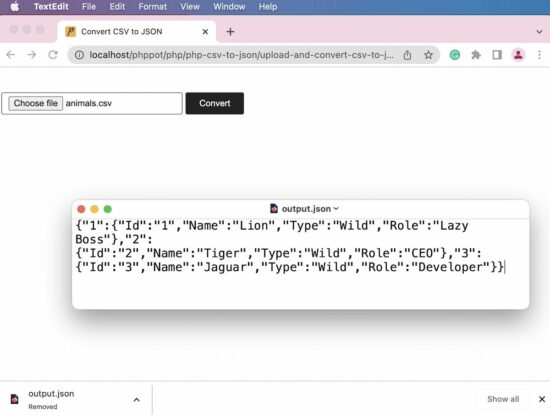
JSON format is a widely used format while working with API development. Most of the existing API responses are in JSON format.
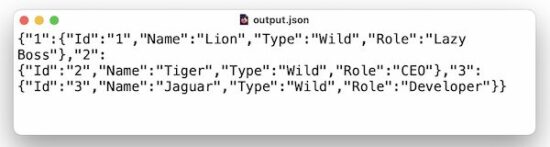
Converting CSV content into a JSON format is simple in PHP. In this article, we will see different methods of achieving this conversion.
Quick example
<?php $csvFileContent= file_get_contents("animals.csv");

// Converts the CSV file content into line array $csvLineArray = explode("\n", $csvFileContent);

// Forms row results in an array format

$result = array_map("str_getcsv", $csvLineArray);

$jsonObject = json_encode($result);

print_r($jsonObject);

?>
The above quick example in PHP converts the CSV file content into JSON with few lines of code.
First, it reads the .csv file content using the PHP file_get_contents() function.
It explodes the CSV row by the new line (\n) escape sequence.
Then, it iterates the line array and reads the line data of the CSV row.
Finally, the resultant CSV row array is converted to JSON using the json_encode() function.
In step 3, the iteration happens with a single line of code. This line maps the array to call PHP str_getcsv to parse and convert the CSV lines into an array.



 Picture a mighty city, surrounded by a bunch of Byzantine generals
  , trying to unite and plan an epic attack! But oh no!
  Some of these generals might be traitors
  , who’ll backstab the others and ruin the plan. They need a foolproof way to agree on a battle strategy while handling these sneaky tricksters.
 This dilemma isn’t just for ancient generals, it’s also super relevant in computer networks called distributed systems. These networks have many participants, or “nodes”
  , who need to agree on something (like data) in a process called consensus. But some nodes might be mischievous
  , spreading false info to confuse others.
 To solve this, we need a system that allows all honest nodes to reach the same decision, even if there are cheeky liars in the mix! The solution should be fault-tolerant, meaning that it keeps working even if some nodes are not playing nice.

 Now let’s bring in our digital superhero, Bitcoin! It swoops in with its magical power called Proof of Work (PoW)
  . Miners (the network’s participants) go head-to-head in a crazy math puzzle race
 . Whoever wins gets to add a new block of transactions to the super secure public diary called the blockchain
  .
. PoW makes it super expensive for the bad guys
  . So, the honest nodes prevail, and consensus is achieved!
 , even when some sneaky snakes
  are trying to cause chaos. Bitcoin’s Proof of Work saves the day, ensuring that everyone can trust the system and have a rockin’ good time!


 . They need to attack together to win, but oh no!
 The Byzantine Generals Problem is a challenge faced in distributed systems where nodes (or participants) need to agree on a specific action or piece of information (called consensus) while accounting for the possibility of some nodes being faulty or malicious. The problem is named after the analogy of Byzantine generals planning an attack on a city, who need to coordinate their actions without falling victim to traitors within their ranks.
 Let’s look at some example scenarios:
 What makes this problem so tricky? It’s called Byzantine Fault Tolerance (BFT)
  , hardware malfunctions
  , or even sneaky cyberattacks
  . The challenge is making a system that can handle these faults without breaking a sweat.


 Enter game theory, a way to think about social situations with competing players. It helps us understand the challenge of these generals, which also applies to computer systems
  . We need a way to make sure everyone can agree, even if there are sneaky liars around.
 Back in 1982, some super-smart researchers
  (Lamport, Shostak, and Pease) published a
  that described the Byzantine Generals Problem and proposed solutions. They showed that it’s not just about military communication
  , but it affects all kinds of computer systems too!
  (like a bank or government) that can step in if something goes wrong. But decentralized systems don’t have that safety net, so they need to solve the Byzantine Generals Problem on their own.
  that everyone can agree on? Enter Bitcoin (BTC)
 from Bob and then use the same bitcoin to buy a delicious pizza
  from Carol. Without consensus, both transactions would be considered valid, leading to chaos in the Bitcoin network and undermining the trust in the currency.
 : Miners competing to validate blocks might end up validating different versions of the blockchain
  , creating multiple branches and causing confusion. Users wouldn’t know which branch to trust, making transactions risky and uncertain.

 : If Bitcoin couldn’t reach consensus, Alice might send bitcoin to Bob, but Carol, who runs a node, might register a different transaction, sending the same bitcoin to Dave. This tangled web of conflicting transactions would create uncertainty and diminish trust in the system.

 , and the next, you’ve got zilch. Talk about a wild ride!


 : Without solving the Byzantine Generals Problem, transactions would take ages to confirm, if they even confirm at all. Imagine waiting for your Bitcoin payment to go through while watching a sloth cross the road.
  Yep, it’d be that slow! And with such a sluggish system, nobody would want to use Bitcoin.

 : Bitcoin’s transactions are grouped into blocks, and each block contains a reference to the previous block’s unique identifier (hash). This creates a chain of blocks that is difficult to tamper with, as altering any block would require changing all subsequent blocks.
 : Miners compete to validate and add new blocks to the blockchain by solving complex mathematical puzzles. The first miner to solve the puzzle gets to add the new block and is rewarded with freshly minted bitcoins. This process requires considerable computational power, making it costly and difficult for any single actor to take control of the network.
 : When multiple valid versions of the blockchain emerge (forks), Bitcoin follows the longest chain rule. Nodes consider the chain with the most accumulated PoW as the true version, eventually leading to a single, agreed-upon blockchain.
 : Bitcoin’s design rewards honest behavior and punishes dishonesty. Miners receive block rewards and transaction fees for validating transactions and adding blocks to the chain. Acting maliciously would require immense resources with little chance of success, making it economically unappealing.


 . They play a crucial role in Bitcoin and other cryptocurrencies, making blockchain data encryption more efficient and secure
  .
.

 The generals don’t care when they attack but must agree on a time.
  They announce a time, but the network isn’t instant, causing confusion.


 When a general solves it, he tells everyone, and they update their work.


 Each general can see the CPU power spent and know that most computers worked on it.

 The Correct Command to Upgrade a Package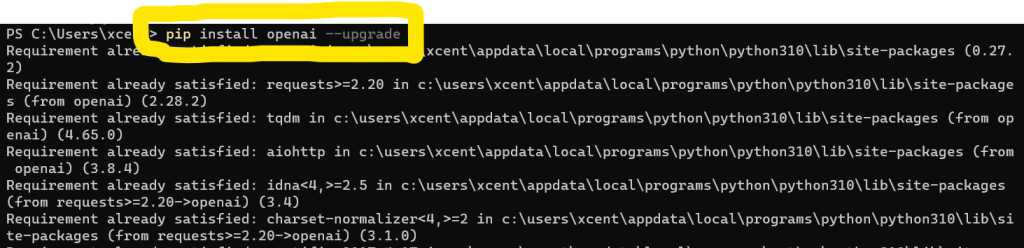
 Extra Tip: Updating All Packages


 Recommended: