Posted by: xSicKxBot - 06-30-2018, 06:31 AM - Forum: Windows
- No Replies
Digital civility highlighted at child online protection event
Last week, I organized a workshop on digital civility at the Marie Collins Foundation annual conference, “From Discovery to Recovery – Online Sexual Abuse of Children.” Microsoft is a sponsor of the foundation, a U.K.-based charity that directly supports children who have been sexually abused online, as well as their families.
Our session included representatives from UNICEF, The Diana Award (also representing NoBully.org), and the academic sector, in addition to Microsoft. The interactive session examined definitions and nomenclature surrounding digital civility, as well as examples from audience members of advice and guidance they’ve given to their own children and students about exercising decorum and engaging constructively online.
During the workshop, we asked participants a series of questions about the level of safety and respect on the internet; the most common and serious online risks; the chief differences between risk and harm; and as global practitioners and preventers of online harm to children (and indeed all individuals), where we should be putting our collective efforts. The responses were wide-ranging. For some, digital civility is about courtesy, respect and digital intelligence; compassion and empathy; and being mindful and aware of other people’s feelings, views and frames of reference. Others see a need to interact with a degree of politeness and to instill a “please-and-thank-you” culture into the digital realm. Still others saw civility as springing from deep-seated human values and morality and emphasized that teaching children enduring values in the real-world will see them carried through to online spaces.
Meanwhile, participants pointed to a redefining of what it means to have and to be a “friend” as a rather unwelcome by-product of life online. “Internet addiction,” a deterioration of communications skills, and an absence of parental responsibility for teaching young people good digital habits and practices were other concerns.
One leading online safety advocate said digital civility implied a rather “low bar” for positive digital interactions. Pointing to the all-too-familiar parental intervention of addressing squabbling siblings in the back seat of a car, he said the admonishment of telling them to “at least be civil to each other” was clearly a low hurdle.
Microsoft’s efforts to foster digital civility
At Microsoft, we view digital civility as leading with empathy, inclusion and kindness in all online interactions, and we aim to foster safer and healthier online behavior using our Digital Civility Challenge as a starting point. In our view, digital civility is in no way about limiting or stifling online discussion and debate. Rather, it’s about ensuring that robust exchanges and disagreement take place minus any name-calling, harassment or abuse.
We continue to champion digital civility and are in the process of fielding yet another round of research, this time in 22 countries. We’ve conducted similar studies released earlier this year and last year, both in conjunction with international Safer Internet Day in February. Our studies survey teens and adults in multiple geographies and ask about their exposure to some 20 online risks.
For the past two years, we also calculated our Digital Civility Index – a measure of the perceived level of civility in each country based on attitudes and perceptions of respondents from those countries. The current Digital Civility Index stands at 65 percent, unchanged from Year 1, despite the addition of nine countries and three risks to the Year 2 report. Accordingly, in Year 3, our research will drill down into the most common risks and concerns for respondents, namely unwanted contact – overwhelmingly the most common risk in the first two studies, as well as hoaxes, fraud and scams, which was the runner-up most common risk in Year 2, the first time it was included.
We will begin releasing Year 3 results in the autumn and make the full set of findings available on international Safer Internet Day 2019 in February.
Working together to grow a culture of digital civility
Since its inception in 2016, we’ve regarded our focus on digital civility as a broad platform and concept for others to evangelize and embrace. Indeed, we’ve encouraged partners and collaborators among civil society organizations, academics, others in industry and governments to adopt the notion and to develop their own related initiatives, projects and programs. In its short existence, we’ve already seen follow-on research projects for other age groups and demographics, the creation of related indices and other efforts.
Our most significant development to date has been the formation and growth of our inaugural Council for Digital Good, a group of 15 teens from across the U.S., brought together to champion digital civility and safer and healthier online interactions.
For the past year, the teens have been learning about online safety issues, sharing their views and perspectives with Microsoft and our partners, and serving as youth ambassadors eager to grow a safer and more respectful online world. Everywhere I go – including last week’s conference – I highlight the informed views, unique perspectives and deep insights these teens continually impart. Next month, we will hold a more public event in Washington, D.C., featuring council members and some of the work they’ve been driving over the past several weeks. Summaries of the council’s earlier work can be found here and here.
Last week’s conference also featured government officials, law enforcement personnel, educators and other members of civil society, noting their efforts in working to prevent online child sexual exploitation and abuse and their commitment to child online protection generally.
For more about the Marie Collins Foundation, see the organization’s website. To learn about online safety and digital civility, visit our website and resources page, as well as our pages dedicated to digital civility. For more regular news and information, connect with us on Facebook and Twitter. And, consider taking our Digital Civility Challenge and tell us on social media that you’ve done so, using the hashtags #Challenge4Civility and #Im4Civility.
Here's Battlefield 5 Closed Alpha Multiplayer Gameplay In Action
The closed alpha for Battlefield 5 has kicked off, and we're diving helmet-first into the multiplayer. The alpha is only available on PC, and it’s limited to a small group of players. It includes two multiplayer offerings. Conquest is a traditional control point mode, while Grand Operation is a narrative meta-mode that spans various maps and game types.
This particular Grand Operation will be "Fall of Norway," set on the Arctic Fjord map. It encompasses two different game modes, Airborne and Breakthrough. The alpha will also include one Special Assignment and several daily orders. Completing your Special Assignment tasks will net you a special dog tag for your profile in the full game.
To participate, you'll need to get into the alpha and then download the client through Origin, and naturally, your specs will need to be up to snuff. If you didn’t get in this time around, just relax and watch some multiplayer gameplay above. We’ll be putting each of the modes through their paces. Battlefield V is set to launch on October 19 for PC, PS4, and Xbox One. Purchasing the Deluxe edition will get you access on October 16.
LibreOffice is the most popular free and open source office suite. It’s included by default in many Linux distributions, such as Fedora Workstation. Chances are that you use it fairly often, but how many of its features have you really explored? What hidden gems are there in LibreOffice that not so many people know about?
This article explores some lesser-known features in the suite, and shows you how to make the most of them. Then it wraps up with a quick look at the LibreOffice community, and how you can help to make the software even better.
Notebookbar
Recent versions of LibreOffice have seen gradual improvements to the user interface, such as reorganized menus and additional toolbar buttons. However, the general layout hasn’t changed drastically since the software was born back in 2010. But now, a completely new (and optional!) user interface called the Notebookbar is under development, and it looks like this:
LibreOffice’s (experimental) Notebookbar
Yes, it’s substantially different to the current “traditional” design, and there are a few variants. Because LibreOffice’s design team is still working on the Notebookbar, it’s not available by default in current versions of the suite. Instead, it’s an experimental option.
To try it, make sure you’re running a recent release of LibreOffice, such as 5.4 or 6.0. (LibreOffice 6.x is already available in Fedora 28.) Then go to Tools > Options in the menu. In the dialog box that appears, go to Advanced on the left-hand side. Tick the Enable experimental features box, click OK, and then you’ll be prompted to restart LibreOffice. Go ahead and do that.
Now, in Writer, Calc and Impress, go to View > Toolbar Layout in the menu, and choose Notebookbar. You’ll see the new interface straight away. Remember that this is still experimental, though, and not ready for production use, so don’t be surprised if you see some bugs or glitches in places!
The default Notebookbar layout is called “tabbed”, and you can see tabs along the top of the window to display different sets of buttons. But if you go to View > Notebookbar in the menu, you’ll see other variants of the design as well. Try them out! If you need to access the familiar menu bar, you’ll find an icon for it in the top-right of the window. And to revert back to the regular interface, just go to View > Toolbar Layout > Default.
Command line tips and tricks
Yes, you can even use LibreOffice from the Bash prompt. This is most useful if you want to perform batch operations on large numbers of files. For instance, let’s say you have 20 .odt (OpenDocument Text) files in a directory, and want to make PDFs of them. Via LibreOffice’s graphical user interface, you’d have to do a lot of clicking to achieve this. But at the command line, it’s simple:
libreoffice --convert-to pdf *.odt
Or take another example: you have a set of Microsoft Office documents, and you want to convert them all to ODT:
libreoffice --convert-to odt *.docx
Another useful batch operation is printing. If you have a bunch of documents and want to print them all in one fell swoop, without manually opening them and clicking on the printer icon, do this:
libreoffice -p *.odt
It’s also worth noting some of the other command line flags that LibreOffice uses. For instance, if you want to create a launcher in your program menu that starts Calc directly, instead of showing the opening screen, use:
libreoffice --calc
It’s also possible to launch Impress and jump straight into the first slide of a presentation, without showing the LibreOffice user interface:
libreoffice --show presentation.odp
Extra goodies in Draw
Writer, Calc and Impress are the most popular components of LibreOffice. But Draw is a capable tool as well for creating diagrams, leaflets and other materials. When you’re working with multiple objects, there are various tricks you can do to speed up your work.
For example, you probably know you can select multiple objects by clicking and dragging a selection area around them. But you can also select and deselect objects in the group by holding down the Shift key while clicking.
When moving individual shapes or groups of shapes, you can use keyboard modifiers to change the movement speed. Try it out: select a bunch of objects, then use the cursor keys to move them around. Now try holding Shift to move them in greater increments, or Alt for fine-tuning. (The Ctrl key comes in useful here too, for panning around inside a document without moving the shapes.)
LibreOffice 5.1 added a useful feature to equalize the widths and heights of multiple shapes. Select them with the mouse, right-click on the selection, and then go to the Shapes part of the context menu. There you’ll see the Equalize options. This is good for making objects more consistent, and it works in Impress too!
Equalizing shape sizes in Draw
Lastly, here’s a shortcut for duplicating objects: the Ctrl key. Try clicking and dragging on an object, with Ctrl held down, and you’ll see that a copy of the object is made immediately. This is quicker and more elegant than using the Duplicate dialog box.
Over to you!
So those are some features and tricks in LibreOffice you can now use in your work. But there’s always room for improvement, and the LibreOffice community is working hard on the next release, LibreOffice 6.1, which is due in early August. Give them a hand! You can help to test the beta releases, trying out new features and reporting bugs. Or get involved in other areas such as design, marketing, documentation, translations and more.
Posted by: xSicKxBot - 06-29-2018, 08:30 PM - Forum: Windows
- No Replies
New to Microsoft 365 in June—streamlining teamwork and security
This month, we introduced several new capabilities that improve user experience, streamline the management of common tasks, and enhance identity-driven security measures. We also want to hear your feedback, so that we can make sure these updates are relevant and useful to you.
Streamlining the way you work
Updates to the Office 365 user experience—We announced updates for Word, Excel, PowerPoint, OneNote, and Outlook that are designed to embrace the breadth and depth of Office 365 features, while simplifying the user interface and improving accessibility. These updates include a simplified ribbon to encourage focus and collaboration, modern colors and icons to improve rendering and accessibility, and AI-powered search to quickly surface relevant information. These changes will start to roll out to Microsoft 365 and Office 365 subscribers over the next few months.
Connect Office 365 Groups to SharePoint sites—Office 365 Groups can now connect to existing SharePoint sites, allowing newly created Office 365 groups to integrate with your existing SharePoint infrastructure. Connecting a group to a site provides a single starting point to find content, team news, and communications with modern pages, libraries, and lists—without losing any previous content or permissions.
Reduce distractions with Outlook for Android—We introduced “Do Not Disturb” in Outlook for Android to help you reduce distractions and get more done. Now, subscribers can set timed or scheduled periods when email and calendar notifications will be paused. For those with multiple Outlook accounts, Do Not Disturb settings can be customized for each email address—enabling granular control over how you spend your focus-hours.
Manage progress in Microsoft To-Do—This month, we introduced “Steps” in Microsoft To-Do—a new feature that allows you to break down tasks into smaller, incremental steps—making large projects more manageable. Now, when a you create a To-Do item, you can add a range of detailed steps that are tracked through to completion. We also introduced the ability to share your To-Do lists, enabling you to work together on tasks and complete projects with colleagues and friends.
Dictation in OneNote—Office 365 subscribers with Windows 10 can now take advantage of hands-free dictation using nine languages in OneNote. Dictation provides a simple, yet transformational, way to express ideas and capture notes using only your voice. You can also make edits using your keyboard without having to pause the recording. Simply click or tap the Dictate icon and start speaking.
Adobe PDF integration in Office 365—Last September, we expanded our strategic partnership with Adobe to focus on integrations between Adobe Sign and Office 365 products, like Microsoft Teams, SharePoint, and Outlook. This month, the Adobe Document Cloud team announced new capabilities for OneDrive and SharePoint that provide improved fidelity when working with PDF documents. Once integrated by your administrator, PDF services provide rich previews of PDF documents in OneDrive and your SharePoint sites, and allow you to combine several files into a single PDF in your document library.
Securing the modern workplace
We introduced several new important capabilities that strengthen your organization’s identity-driven security, and ensure important data is kept safe.
Secure your organization with baseline security policy in Azure Active Directory—We introduced the preview of a baseline security policy in Azure AD that enforces multi-factor authentication for privileged accounts. This new policy will apply to all organizations that have Azure Active Directory and help secure the most important accounts in your tenant. Customers can opt in to the baseline protection policy in preview, and at general availability will be opted in by default with the ability to opt out at any time.
Block legacy authentication using Azure Active Directory conditional access—This month, we introduced the preview of conditional access support for blocking legacy authentication, which enables organizations to stop users from authenticating to legacy apps. Identity attacks such as password spray almost exclusively target these older client apps. This feature improves the overall security of your IT environment by getting users to move to more modern clients that support modern authentication mechanisms.
Enhance data classification across your organization—The new Label Activity Explorer in Office 365 provides a quick overview of how the data in your organization has been labeled—allowing you to investigate risky or abnormal activity. To help you manage labeling across the lifecycle of your organization’s content, we enhanced the Data Governance dashboard with new features like the Data Governance toolbox, added links and tools for common data governance tasks, and provided a single resource for guidance.
Visio Online is now available in Microsoft Teams. Coworkers can now collaborate on Visio Online diagrams from within their team or channel without toggling between apps.
SharePoint Swoop—our new enterprise reality show—features a team of MVP experts with just three days to help a Microsoft 365 customer modernize their intranet.
At Computex 2018, we outlined our vision for how partners can build intelligent edge devices and solutions.
Review: Elgato’s Eve Aqua water controller is for HomeKit diehards
As the British might say, the Eve Aqua “does what it says on the tin,” even if it could stand refinements in some areas.
When Apple launched iOS 11 last year, one of the key additions it made to HomeKit was support for sprinklers and faucets. People have been automating these products for years, especially in hydroponics, so it’s only natural that Apple would join in.
The Eve Aqua is one of the first products made with this support in mind. Elgato describes it as a “smart water controller,” and that’s as good a description as any. It sits between an outdoor faucet and a self-supplied hose, turning water on and off on command.
Installation is simple overall, but tricky in its first step: inserting two bundled AA batteries, of all things. You wouldn’t think that would be trouble, but the Aqua’s design requires you to press on a panel that slides up not just the battery compartment but the entire front panel of the accessory. It puts up a lot of resistance, such that we had to fight for a few minutes to make it work.
With that overcome, the next step is to open the Eve app on an iPhone or iPad, and use it to add the accessory to both that software and HomeKit. You can then connect the Aqua to a hose and faucet, lastly making sure the faucet is left on.
We connected our hose to a rotating sprinkler, but conceivably you can hook one up to anything or nothing depending on your needs.
If you really want to, you can abandon the Eve app entirely at this point. Siri or the iOS Home app will turn the Aqua on and off, and going into the Home app’s Details panel will let you set a shutoff delay. Oddly enough, you can’t add the Aqua to any HomeKit scenes or automations. This seems to be Apple’s fault, not Elgato’s, but may be something worth considering for potential buyers.
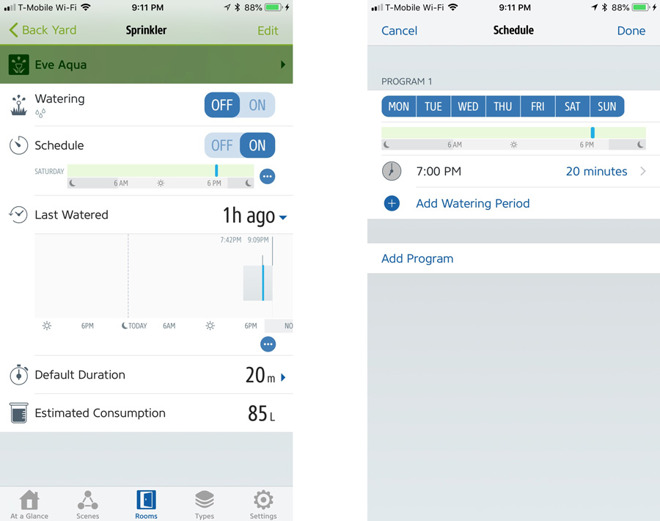
This is why you probably will end up using the Eve app, since it’s necessary to configure schedules. You can assign an Aqua to run for 10 minutes at 6:15 a.m. and 10 minutes at 7 p.m on Wednesday and Saturdays, for example. This is particularly useful in regions with severe watering restrictions like Texas.
Elgato’s app also lets you check battery levels, activity history, and estimated consumption. Some people might be shocked to learn how much water a sprinkler can put out, in which case the Aqua would be handy for lowering utility bills and helping the environment.
In our testing the device proved semi-reliable with Siri or app-based requests, but fully dependable with locally-saved schedules. We wish it were a little more responsive, especially since water is involved, but we don’t have any major complaints. In a pinch a physical button can be used to toggle water manually.
This ties into a recurring problem with the Eve line, which is Elgato’s insistence on using Bluetooth instead of Wi-Fi. To change the programming on the Aqua you have to bring your iPhone or iPad within close range, which may mean having to go outside depending on where your faucet is. It’s not a huge hassle, but does feel a little silly given that you can get water controllers that don’t depend on phones, tablets, or the internet.
For even basic control outside of Bluetooth range you’ll need an Apple TV, iPad, or HomePod that is within range, operating as a Home hub. That may be a tall order for some people — even if you’re rocking multiple hubs, you may not have one near your yard. We were lucky to have an Apple TV 4K near the backyard of our test house.
Admittedly, Wi-Fi may not be best option for an outdoor product either. It does tend to have better range though, and it wouldn’t require you to be deeply invested in the Apple ecosystem.
Elgato’s strict focus on HomeKit is beginning to feel myopic. The Aqua lacks integration with platforms like Amazon Alexa, Google Assistant, or even Android. In 2018 many of us mix and match devices rather than stick to a single manufacturer, and can’t afford to change things up for one or two accessories.
Conclusions
If you’re certain you’ll have an iPhone, iPad, and/or a Home hub for years, the Eve Aqua will get the job done. Yes, you may potentially have to stand outside in the hot sun to change your watering schedule, but chances are you’ll set it once and forget about it until it’s time to change batteries or bring things inside for the winter.
The greater concern, as we’ve suggested, is how the product fits into your lifestyle. If Alexa or Google Home devices are as integral to your smarthome setup as HomeKit, you may want to think twice. Likewise if remote access is essential and you can’t see situating a Home hub where it’s needed. IFTTT integration would be fantastic, letting you prevent a sprinkler from going off when frost or snow is forecast.
Elgato is generally on the right track with its smarthome gear, but if it’s not going to switch to built-in Wi-Fi, it should at least follow Belkin’s lead and put out a bridge.
Score: 3.5 out of 5
Where to buy
Retailing for $99.95, the Aqua can be purchased directly from Eve. Or if you’re willing to wait, Amazon.com is also accepting backorders for the smart water controller.
We’re always looking for ways to make developing with Visual Studio faster. One of the tasks developers do many times a day is launching debugging sessions. We identified that script debugging added about 1.5s per F5, but only about 15.5% of people actively debugged script using Visual Studio.
Based on the above, in Visual Studio 15.7 we made the decision to turn off script debugging by default to improve the overall experience for most users. If you want to turn the capability back on, you can do it from Tools | Options | Debugging | and check “Enable JavaScript debugging for ASP.NET (Chrome, Edge, and IE):
We also added the following dialog when you attempt to set a breakpoint with script debugging disabled:
When script debugging is ON, Visual Studio automatically stops debugging when the browser window is closed. It will also close the browser window if you stop debugging in Visual Studio. We added the same capability to Visual Studio when script debugging is OFF under Tools | Options | Project and Solutions | Web Projects:
With this option enabled:
Visual Studio will open a new browser window when debugging starts
Visual Studio will stop debugging when the browser window is closed
The following matrix shows you all the available options and the expected behavior for each combination:
Enable JavaScript debugging for ASP.NET (Chrome, Edge and IE)
Stop debugger when browser window is closed
What happens when you start debugging
What happens when you stop debugging
What happens when you close the browser window
TRUE
TRUE
New browser window always pops up
New browser window always goes away, with all open tabs
Debugging stops
TRUE
FALSE
New browser window always pops up
New browser window always goes away, with all open tabs
Debugging stops
FALSE
TRUE
New browser window always pops up
New browser window always goes away, with all open tabs
Debugging stops
FALSE
FALSE
Opens new tab if browser window already exists
Browser tab/window stays open
Debugging continues
If you want Visual Studio to return to its default pre-15.7 behavior, all you have to do is enable script debugging in Tools | Options | Debugging | and check “Enable JavaScript debugging for ASP.NET (Chrome, Edge, and IE). If you notice any unexpected behavior with these options please use report a problem in Visual Studio to let us know. If you have any feedback or suggestions regarding this change please let us know on uservoice or simply post a reply to this post.
Welcome to the Weekender, your weekly look at the best new games, sales, and updates. It’s a big week with one of my most-anticipated games of the year hitting the App Store along with a couple tabletop to digital conversions. Oh, and a healthy dose of discounted games. Have a great weekend.
King of Dragon Pass is an iOS classic. With elements of RPG, tribal management, turn-based tactics, and interactive fiction it plays like a really in-depth choose-your-own-adventure book. You operate at both a colony level, managing your tribe and its interactions with the world, and an individual level as the chieftain where you make decisions that have a big impact on the story. A sequel to this classic has been in the works for four years and this week we get to play it.
Six Ages: Ride Like the Wind is the spiritual successor to King of Dragon Pass and returns us to the rich fantasy world of Glorantha. Rather than playing as the Viking-inspired Orlanthi we take the reins of riders of the steppe, clearly meant to evoke the Mongols, and must steer them through a great migration and settling of a new home. Gameplay hasn’t changed much from King of Dragon Pass which makes sense: it wasn’t exactly broken. You still consult your circle of advisors and make important decisions season after season. You still worship a diverse and interesting pantheon of gods and seek their blessings and magic. You must navigate through diplomacy and war with other tribes, as well as domestic and economic concerns closer to home.
[embedded content]
The story is interesting, the choices are meaningful, and the artwork is once again top-notch. You should definitely read Matt’s 4-star review of the game if you haven’t already, but I’m happy to add my recommendation. It’s an easy pick for fans of the original and most RPG aficionados.
Card Quest – Card Combat Game (iOS Universal and Android) – Full review coming soon!
Dungeon crawler style, roguelike gameplay, an undead menace, and card-based combat…Card Quest has the elements of a good tactical game. You pick a character, customize your deck, and go battle the bad guys. The game was ported from Steam where it has a ‘very positive’ rating. I wasn’t able to play it, but it looks pretty promising and might be worth a look for those deck-building roguelike fans out there.
[embedded content]
Quarto (iPhone (?) and Android) – Full review coming soon!
Quartro is a pretty simple abstract board game where one’s opponents dictate their pieces, and therefore choices. You’re given a piece and must play it on the game board. The ultimate goal is the same as, you know, Connect Four, though there are four different piece characteristics (color, shape, size, and hollow or solid) which adds another dimension to the strategy. The digital presentation of the game is attractive and the game plays fast, making it ideal for quick games here and there. There’s a decent amount of strategy and the AI isn’t bad. Quatro is mostly a solo game against the AI, but there is a pass-and-play option for use by co-located humans. You can take on specific challenges to spice up the single-player experience, which is a cool way to introduce techniques and build expertise in the game.
Istanbul either won or was nominated for a bunch of board gaming awards back in 2014 when it came out. Now, like many stand-out tabletop favorites, it gets the digital treatment. Istanbul: Digital Edition was converted by Acram Digital, the folks behind Eight-Minute Empire and Steam: Rails to Riches. The game plays the same as the physical version and sets up you the player as a sales team—one merchant and four assistants—in a busy roughly Medieval Istanbul bazaar. The goal is to collect a certain number of rubies earned through making wise sales choices. You can play a solo game versus the AI or online with others. The online game offers both real-time and asynchronous options.
A quick and clever puzzle game, Hexologic offers loads of challenging and fun levels for anybody that doesn’t mind a little simple addition. Hexologic puts a little spin on sudoku rules. Each level has several groups of hexes running horizontally, vertically, or diagonally each with an associated number. You must assign a value of 1 to 3 to empty hexes within these groups in order to sum up to the number. It’s just the right amount of tactical thinking for a relaxing game-play experience and I’d recommend it to puzzle fans.
[embedded content]
New Pre-Orders
Pre-ordering seems to be a thing now, at least on iOS. There’s two games this week we think you’ll want to take note of…
Long awaited Sim City-like city building sensation Pocket City is now available to pre-order, and we finally have an expected release date! The game that’s set to “re-imagine classic city building simulation gameplay” is due to release on July 31st, and you can pre-order for $4.99 on iOS.
The sequel to classic strategy game Battleheart is finally within our sights, although a few months later than we originally thought. You can pre-order for $3.99 and the game is expected to release on July 12th.
Kicking off our sales today is one of the best games of 2017 and one of the better solitaire-style mobile games period. Miracle Merchant is the perfect game for short play sessions and is on sale for just a buck (although it’s free with IAPs on Android, if you’re wondering).
Flip tiles to match and remove color groupings in the challenging puzzle game Dissembler. It came out earlier this year and is on sale in the App Store for the first time for just a dollar.
It’s the best cat-based RPG ever made. Ok, and also of the better games of 2017 in its own right. It’s normally $5 and isn’t on sale often, if you’re an RPG fan and looking for a game to play now’s the time.
Get your smash on and play a pissed off dwarf in Runic Rampage, an action RPG full of combos. It’s not as fun as Cat Quest, but gets the job done if you’re looking for more from the genre.
Firaxis’ 4X behemoth is a great port of the classic turn-based strategy game, and Aspyr have done a great job bringing it up to speed with its PC counter-part. If you’ve never been happy with the pricing structure, the ‘Full Game’ unlock is now at its cheapest ever price since launch.
Seen anything else you like? Played any of the above? Let us know in the comments!
The Raspberry Pi 3 Model B+ won our 2018 reader survey as the most popular community-backed, Linux/Android hacker board under $200. The survey, run in partnership with LinuxGizmos.com, asked readers to select their favorite boards from among 116 community-backed SBCs that run Linux or Android and sell for under $200. All 116 SBCs are summarized in LinuxGizmos’ recently updated hacker board catalog and feature comparison spreadsheet. (Downloadable versions of the spreadsheet may be found here.)
The sample of 683 fell far short of the 1,705 survey respondents for the June 2017 survey and the 1,721 voters in 2015, but it beat out the 473 total for the 2016 survey. Considering the modest sample, the survey may not be highly representative of market share, but it’s still indicative of enthusiasm.
To rank the boards, we used Borda Count scoring, in which we tripled the number of first choices, then doubled the number of second place selections, and added the two results to the unadjusted third-choice amount. The top 10 boards are shown in the chart below:
The Raspberry Pi 3 Model B+, which builds upon the RPi 3 Model B design with a faster Broadcom SoC, faster WiFi and Ethernet, and optional PoE, earned a Borda score of 811. This was about twice the score of the second place (414) UDOO X86, which is one of the most powerful of the handful of x86 based hacker boards.
There was a big drop to the next three boards, including the Odroid-XU4 (278), the Raspberry Pi 3 Model B (277), which was last year’s runaway winner, and the tiny Raspberry Pi Zero W/WH (255). The remainder of the top 10 list includes the venerable sixth place BeagleBone Black (126) and the Raspberry Pi like Asus Tinker Board (112) and Odroid-C2 (95). The Raspberry Pi Zero (85) came in 9th and the BeagleBone Black Wireless (67) was 10th.
If you prefer a top 10 list based on first choice only, the top 7 rankings would stay the same, but the Odroid-C2, RPi Zero, and BB Black Wireless would drop lower. This would make way for the UP Squared, Odroid-N1, RockPro64, Orange Pi Zero H2+/Zero Plus 2 H3/Zero Plus 2 H5, and the Rock64, all of which had higher first-pick scores.
Although the small size of the sample makes it difficult to read too much into the rankings, two trends seem clear: First, SBCs with Raspberry Pi like dimensions and 40-pin expansion connectors continue to do well. Second, it’s tough for a new board to break into the top ranks, at least among LinuxGizmos readers. Seven of the top 10 Borda-ranked boards were also in last year’s top 10, and the RPi 3 B+ was the only top 10 board that was not available a year ago.
A few newcomers did, however, break into our 11-20 ranked group, including the RockPro64, Orange Pi Zero H2+, and DragonBoard 820c. The top 10 list also includes a board that will never see the light of day. We included the Odroid-N1 with the expectation that it would ship on time in June, but Hardkernel’s Odroid project just announced that the Rockchip RK3399 based SBC has been cancelled in favor or an Odroid-N2 model with an unnamed new SoC within 5-6 months.
Reader buying priorities and goals
In addition to asking survey participants to list their favorite boards, we asked about buying criteria and intended applications. The year-to-year consistency we’re seeing in the answers suggests that a 683 sample may be more significant than we thought. In ranking buying criteria, for example, the rankings were very similar. High-quality open source software again led the list as the top priority, while networking/wireless I/O swapped with community ecosystem for second and third places.
When asked about intended applications, home automation was again on top, but the previous second-ranked education category dropped several levels. Home multimedia and special function servers advanced to second and third place, and data acquisition and control also jumped considerably, suggesting a growing role for hacker boards in industrial settings.
In a separate question about more general usage, the maker/hobbyist segment once again led the way, but by a smaller margin. The other three categories increased, with the research and commercial categories seeing the largest gains.
Fifteen randomly selected survey participants will receive a free hacker board in the coming weeks. Many thanks to all the participants who voted, as well as the vendors who donated boards.
Move Over Steam Sale, Some Games Are Cheaper At GMG Right Now
The Steam Summer Sale isn't the only deal in town for PC gamers. Green Man Gaming is also running a sale, and if you enter promo code JUNE20 at checkout, you'll get an extra 20% off most of the already-discounted games. That amounts to some serious savings on a number of worthy games. You can find the full list of games on sale here, or read on for the highlights.
That extra 20% off bumps many of these deals in to best-ever territory. PUBG, for instance, normally sells for $30, but it's on sale for $20. Take 20% off of that, and you're looking at a final price of $16. Not bad at all. Cuphead has a similar thing going on, landing it at $13.
You can get the intense multiplayer cooking game Overcooked for just $5, and you can pre-order Overcooked 2 for $20 instead of its usual $25. Ori and the Blind Forest is also getting a sequel this year, but you can grab the Definitive Edition of the original for just $8. Also $8 is Playdead's dark puzzle-platformer Inside. For just a buck more, you can grab Rocket League to engage in some automotive soccer action. We have even more picks listed below.
Just remember to enter promo code JUNE20 at checkout, or you'll miss out on the extra 20% savings. The code doesn't work on all of the games--there are some exceptions--but it works on most of them. Happy deal hunting.
Posted by: xSicKxBot - 06-29-2018, 12:37 PM - Forum: Windows
- No Replies
How to ‘come out’ as an LGBTQ+ ally at work
Building your career is a journey filled with challenges, excitement, and forks in the road. And journeys are easier with maps. In this column, job experts answer your questions and deliver advice to help you take the next step.
Question: I want to help my coworkers feel respected for who they really are. But sometimes I’m not sure what to do or say to show that I’m an ally, and I don’t want to mess up or hurt anyone’s feelings. How can I be a better ally?
Answer: The first step to becoming a better ally is wanting to be one—so you’re on the path already! There are many ways to be an ally in your professional realm, including connecting with coworkers to learn what they face and care about, stepping in when someone isn’t being treated with respect, and educating others. These Microsoft employees, who are all allies or members of the LGBTQ+ community, have some advice.
Know what an ally is and why you should be one
An LGBTQ+ ally is someone who respects equal rights, gender equality, and LGBTQ+ social movements; stands up for members of the LGBTQ+ community; and challenges homophobia, biphobia, and transphobia. Allies increase protection, safety, and equality.
“Coming out” as an ally in the workplace sends a powerful message of affirmation and support to LGBTQ+ employees, which can help them feel more respected and able to do their work.
Spend a little time thinking about why you want to be an ally—and think about why allies are needed and how you could make a difference, said Andrea Llamas, a senior human resources advisor.
Often, the motivation to be an ally comes from personal stories and connections.
“Everyone has a friend or family member that is part of the LGBTQ+ community,” Llamas said. “To make the world a better place for the people in that community, [we need to get to the place where] sexual orientation or gender identity is not important.”
Once you know why you want to be an ally and what you might want to accomplish by being one—whether it’s as simple as making another person feel comfortable or as big as becoming a vocal advocate for change—you can figure out how to do it.
Set out to learn more
Many people feel unsure of their role as allies in part because they aren’t familiar with the experiences or realities of LGBTQ+ people. Don’t worry if you don’t know what a term means or if you aren’t familiar with an issue. Research is where to start, Llamas said.
“If you don’t have the information you need and if you are curious, ask,” she said.
If you do ask a coworker who is a member of the LGBTQ+ community, make sure that you pose your question in a respectful way and perhaps in private. First and foremost, communicate your openness and desire to learn so that you can support.
If you’re worried about saying the wrong thing to LGBTQ+ coworkers—such as using the wrong pronoun—respectfully ask them how they prefer to be addressed or how you should refer to something. You might also ask how they would prefer that people address mistakes when they happen, suggested Michael Tan, a Microsoft manager of a transgender employee.
But don’t rely on LGBTQ+ people to educate you on everything; do your own research. Morty Scanlon, a business program manager, suggests using resources from Straight for Equality, The Human Rights Campaign, and Outstanding to learn more.
Members of Microsoft’s LGBTQ+ employee resource group GLEAM, which stands for Gay and Lesbian Employees at Microsoft, have helped create resources and workshops for coworkers who want to be allies. Find out whether your company has similar resources, suggest that they be created, or even help compile them, said Scanlon, cochair of GLEAM.
“When people have resources at their disposal, they can see a path toward their own allyship to materialize,” he said.
As you do your research, look at your own assumptions. Take the opportunity to recognize and move past bias. Use these questions as guides:
What assumptions have you made?
Do you know if they are true?
How could you find out?
Show support and speak up
Some gestures by allies might seem small, but they can mean a lot. For example, Llamas said, “Don’t hide any relations you have to someone in the LGBTQ+ community, such as friends or family members.” Talking about your gay brother or transgender cousin the same way that you talk about any family member or friend shows that you value people equally regardless of their identities.
You can also communicate your support in simple ways, such as by putting stickers on your computer or signs at your desk, by attending LGBTQ+ support events, or by joining an advocacy effort. These actions show people who have faced challenges or who have previously not been accepted for who they are that they have your support in little and big ways.
“Remember that there are many ways to let people know that you are an ally,” said Llamas, who serves as the GLEAM Mexico lead.
Being an ally also means speaking up when some voices aren’t heard, when someone is excluded, or when something harmful is said. Listen fully to others’ ideas, contributions, and stories. Intervene when someone is being discounted or ignored or if harmful language is used. If someone has been treated with harm, approach them to see what they need and offer support.
And people who need allies themselves can also be an ally to others, Scanlon said.
“In the same way that allies are essential to the LGBTQ+ community, we also have a responsibility to be allies for others. The lessons I’ve learned in working to be a better ally to the transgender community are lessons that I can apply to evolve my allyship beyond my own community and apply more broadly to the workplace: examining my assumptions, listening to understand, identifying and addressing my blind spots, and being brave.”
Let empathy lead
When Michael Tan, director of strategy, learned that a member of his team was transgender and would be transitioning, he set out to determine how he could help.
“My first role was trying to make sure that the work environment would respond appropriately and that people were respectful,” he said.
But he didn’t immediately know how to be an ally.
“I was in the camp initially where you’re so afraid of saying the wrong thing. I saw other people also so afraid of saying the wrong thing or using the wrong pronoun that they took the path of least resistance and didn’t reach out at all.”
Tan invited the Ingersoll Gender Center to talk to his group. The speakers shared firsthand experiences, background about the transgender community in the workplace, common challenges transgender employees often face, and guidance on how to be supportive.
Listening directly to people’s experiences sparked empathy, Tan said. However you can, seek out others’ stories—they will help you feel connected.
Try to understand the emotional journey that someone else goes through, he said. It’s a powerful display of support “to find out, and then do, what they need to feel comfortable.”