| |
| Finding Interesting Documents with grep |
|
Posted by: xSicKxBot - 07-20-2018, 10:53 AM - Forum: Linux, FreeBSD, and Unix types
- No Replies
|
 |
Finding Interesting Documents with grep

Learn the basics of grep with this tutorial from our archives.
The grep command is a very powerful way to find documents on your computer. You can use grep to see if a file contains a word or use one of many forms of regular expression to search for a pattern instead. Grep can check the file that you specify or can search an entire tree of your filesystem recursively looking for matching files.
One of the most basic ways to use grep is shown below, looking for the lines of a file that match a pattern. I limit the search to only text files in the current directory *.txt and the -i option makes the search case-insensitive. As you can see, the only matches for the string “this” are the capitalized string “This”.
$ cat sample.txt

This is the sample file.

It contains a few lines of text

that we can use to search for things.

Samples of text

and seeking those samples

there can be many matches

but not all of them are fun

so start searching for samples

start looking for text that matches $ grep -i this sample.txt

This is the sample file.
The -A, -B, and -C options to grep let you see a little bit more context than a single line that matched. These options let you specify the number of trailing, preceding, and both trailing and preceding lines to print, respectively. Matches are shown separated with a “—” line so you can clearly see the context for each match in the presented results. Notice that the last example using -C 1 to grab both the preceding line and trailing line shows four results in the last match. This is because there are two matches (the middle two lines) that share the same context.
$ grep -A 2 It sample.txt

It contains a few lines of text

that we can use to search for things.

Samples of text $ grep -C 1 -i the sample.txt

This is the sample file.

It contains a few lines of text

--

and seeking those samples

there can be many matches

but not all of them are fun

so start searching for samples
The -n option can be used to show the line number that is being presented. Below I grab one line before and one line after the match and see the line numbers, too.
$ grep -n -C 1 tha sample.txt

2-It contains a few lines of text

3:that we can use to search for things.

4-Samples of text

--

8-so start searching for samples

9:start looking for text that matches
Digging through a bunch of files
You can get grep to recurse into a directory using the -R option. When you use this, the matching file name is shown on the output as well as the match itself. When you combine -R with -n the file name is first shown, then the line number, and then the matching line.
 $ grep -R sample .

./subdir/sample3.txt:another sample in a sub directory

./sample.txt:This is the sample file.

./sample.txt:and seeking those samples

./sample.txt:so start searching for samples

./sample2.txt:This is the second sample file $ grep -n -R sample .

./subdir/sample3.txt:1:another sample in a sub directory

...
If you have some subdirectories that you don’t want searched, then the –exclude-dir can tell grep to skip over them. Notice that I have used single quotes around the sub* glob below. The difference can be seen in the last commands where I use echo to show the command itself rather than execute it. Notice that the shell has expanded the sub* into ‘subdir’ for me in the last command. If you have subdir1 and subdir2 and use the pattern sub* then your shell will likely expand that glob into the two directory names, and that will confuse grep which is expecting a single glob. If in doubt, enclose the directory to exclude in single quotes as shown in the first command below.
$ grep -R --exclude-dir 'sub*' sample .

./sample.txt:This is the sample file.

./sample.txt:and seeking those samples

./sample.txt:so start searching for samples

./sample2.txt:This is the second sample file $ echo grep -R --exclude-dir 'sub*' sample .

grep -R --exclude-dir sub* sample . $ echo grep -R --exclude-dir sub* sample .

grep -R --exclude-dir subdir sample .
Although the recursion built into grep is handy, you might like to combine the find and grep commands. It can be useful to use the find command by itself to see what files you will be executing grep on. The find command below uses regular expressions on the file names to limit the files to consider to only those with the number 2 or 3 in their name and only text files. The -type f limits the output to only files.
$ find . -name '*[23]*txt' -type f

./subdir/sample3.txt

./sample2.txt
You then tell find to execute a command for each file that is found instead of just printing the file name using the -exec option to find. It is convenient to use the -H option to grep to print the filename for each match. You may recall that grep will give you -H by default when run on many files. Using -H can be handy in case find only finds a single file; if that file matches, it is good to know what the file name is as well as the matches.
$ find . -name '*[23]*txt' -type f -exec grep -H sampl {} +
For dealing with common file types, like source code, it might be convenient to use a bash alias such as the one below to “Recursively Grep SRC code”. The search is limited to C/C++ source using file name matching. Many possible extensions are chained together using the -o argument to find meaning “OR”. The “$1” argument passed to the grep command takes the first argument to RGSRC and passes it to grep. The last command searches for the string “Ferris” in any C/C++ source code in the current directory or any subdirectory.
$ cat ~/.bashrc

...

RGSRC() {

 find . \( -name "*.hh" -o -name "*.cpp" -o -name "*.hpp" -o -name "*.h" -o -name "*.c" \) \

 -exec grep -H "$1" {} +

}

... $ RGSRC Ferris

...

./Ferris.cpp:using namespace Ferris::RDFCore;

...
Regular Expressions
While I have been searching for a single word using grep in the above, you can define what you want using regular expressions. There is support in grep for basic, extended, and Perl compatible regular expressions. Basic regular expressions are the default.
Regular expressions let you define a pattern for what you are after. For example, the regular expression ‘[Ss]imple’ will match the strings ‘simple’ and ‘Simple’. This is different from using -i to perform a case-insensitive search, because ‘sImple’ will not be considered a match for the above regular expression. Each character inside the square brackets can match, and only one of ‘S’ or ‘s’ is allowed before the remaining string ‘imple’. You can have many characters inside the square brackets and also define the an inversion. For example, [^F]oo will match any character than ‘F’ followed by two lower case ‘o’ characters. If you want to find the ‘[‘ character you have to escape it’s special meaning by preceding it with a backslash.
To match any character use the full stop. If you follow a character or square bracketed match with ‘*’ it will match zero or more times. To match one or more use ‘+’ instead. So ‘[B]*ar’ will match ‘ar’, ‘Bar’, ‘BBar’, ‘BBBar’, and so on. You can also use {n} to match n times and {n,m} to match at least n times but no more than m times. To use the ‘+’ and {n,m} modifiers you will have to enable extended regular expressions using the -E option.
These are some of the more fundamental parts of a regular expression, there are more and you can defined some very sophisticated patterns to find exactly what you are after. The first command below will find sek, seek, seeek in the sample file. The second command will find the strings ‘many’ or ‘matches’ in the file.
$ grep -E 's[e]{1,3}k' sample.txt

and seeking those samples $ grep -E 'ma(ny|tches)' sample.txt

there can be many matches

start looking for text that matches
Looking across lines
The grep command works on a line-by-line basis. This means that if you are looking for two words together, then you will have some trouble matching one word at the end of one line and the second word at the start of the next line. So finding the person ‘John Doe’ will work unless the Doe happens to be the first word of the next line.
Although there are other tools, such as awk and Perl, that will allow you to search over multiple lines, you might like to use pcregrep to get the job done. On Fedora, you will have to install the pcre-tools package.
The below command will find the string ‘text that’ with the words separated by any amount of whitespace. In this case, whitespace also includes the newline.
$ pcregrep -M 'text[\s]*that' sample.txt

It contains a few lines of text

that we can use to search for things.

start looking for text that matches
A few other things
Another grep option that might be handy is -m, which limits the number of matches sought in a file. The -v will invert the matches, so you see only the lines which do not match the pattern you gave. An example of an inverted match is shown below.
$ grep -vi sampl sample.txt

It contains a few lines of text

that we can use to search for things.

there can be many matches

but not all of them are fun

start looking for text that matches
Final words
Using grep with either -R to directly inspect an area of your filesystem or in combination with a complicated find command will let you search through large amounts of text fairly quickly. You will likely find grep already installed on many machines. The pcregrep allows you to search multiple lines fairly easily. Next time, I’ll take a look at some other grep-like commands that let you search PDF documents and XML files.
Learn more about Linux through the free “Introduction to Linux” course from The Linux Foundation and edX.
|

|
|
| News - Comic-Con 2018: Krypton -- Everything We Know So Far |
|
Posted by: xSicKxBot - 07-19-2018, 09:03 PM - Forum: Lounge
- No Replies
|
|
Comic-Con 2018: Krypton -- Everything We Know So Far
Krypton follows the story of Superman's grandfather, Seg-El, long before Krypton is destroyed. Seg-El is trying to clear his name after the whole family is ostracized due to the actions of his own grandfather. After a grim conclusion to the first season, many fans are wondering how Krypton will turn things around. In preparation for Comic-Con 2018, we're here to give you the skinny on everything we know about the upcoming second season. What It's About Season 1 left a ton of unfinished storylines for Season 2 to follow. Seg and Brainiac are both in the Phantom Zone, Adam is trapped in one of Brainiac's cities, which featured a concerning statue of Commander Dru-Zod, and Doomsday is on the loose--no big deal. So despite Syfy not releasing any major plot details, the Season 1 finale gives the writers plenty to work with. Who's Who Crew - David S. Goyer is the show creator.
- Cameron Welsh is the showrunner.
- The show is executive produced by Welsh, David S. Goyer, and Damian Kindler.
Cast - Cameron Cuffe (Florence Foster Jenkins) plays Seg-El, and even though he got stuck in the Phantom Zone last season, we're pretty sure he will come back for Season 2.
- Georgina Campbell (Murdered by my Boyfriend) plays Lyta Zod, a military commander and Seg's secret girlfriend.
- Shaun Sipos (Texas Chainsaw 3D) plays Adam Strange, the man who warns Seg about Krypton's impending doom.
- Elliot Cowan (Lost in Austen) plays Daren-Vex, the chief Magistrate.
- Ann Ogbomo (Wonder Woman) plays, the leader of Krypton's military and Lyta's mother.
- Ian McElhinney (Game of Thrones) plays Val-El, Seg-El's grandfather who discovered Krypton's impending doom and was punished for it.
What's Been Released So Far So far a teaser for the show has been released which shows no footage from the upcoming season, but it does show the El family crest/Superman's logo changing into the Zod family crest, which contradicts the established narrative for the future of Krypton. The show has always been very clear that this is an alternative storyline to the story of Krypton that we know, which means anything is possible for Season 2. What We Want From Comic-Con Syfy will have a Hall H panel and presentation for Krypton at Comic-Con on Saturday at 12 which will feature Cameron Welsh as well as many of the central cast members, including Cameron Cuffe, Ann Ogbomo, Wallis Day, and Shaun Sipos. No confirmation on a trailer yet, but we're crossing our fingers. Krypton does not have an official release date for Season 2, but it's set to open in the fall of 2019.
|
|
|
|
| Machine Learning: A Micro Primer with a Lawyer’s Perspective |
|
Posted by: xSicKxBot - 07-19-2018, 09:03 PM - Forum: Linux, FreeBSD, and Unix types
- No Replies
|
|
Machine Learning: A Micro Primer with a Lawyer’s Perspective

What Is Machine Learning
I am partial towards this definition by Nvidia:
“Machine Learning at its most basic is the practice of using algorithms to parse data, learn from it, and then make a determination or prediction about something in the world.”
The first step to understanding machine learning is understanding what kinds of problems it intends to solve, based on the foregoing definition. It is principally concerned with mapping data to mathematical models — allowing us to make inferences (predictions) about measurable phenomena in the world. From the machine learning model’s predictions, we can then make rational, informed decisions with increased empirical certainty.
Take, for example, the adaptive brightness on your phone screen. Modern phones have front- and rear-facing cameras that allow the phone to constantly detect the intensity of ambient light, and then adjust the brightness of the screen to make it more pleasant for viewing. But, depending on an individuals taste, they might not like the gradient preselected by the software, and have to constantly fiddle with the brightness by hand. In the end, they turn off adaptive brightness altogether!
What if, instead, the phone employed machine learning software, that registered the intensity of ambient light, and the brightness that the user selected by hand as one example of their preference. Over time, the phone could build a model of an individuals preferences, and then make predictions of how to set the screen brightness on a full continuum of ambient light conditions. (This is a real thing in the next version of Android).
As you can imagine, machine learning could be deployed for all kinds of data relationships susceptible to modeling, which would allow programmers and inventors to increasingly automate decision-making. To be sure, a perfect understand of the methodology of machine learning is to have a fairly deep appreciation for statistical sampling methods, data modeling, linear algebra, and other specialized disciplines.
I will instead try to offer a brief overview of the important terms and concepts in machine learning, and offer an operative (but fictional) example from my own time as a discovery lawyer. In closing, I will discuss a few of the common problems associated with machine learning.
Nuts & Bolts: Key Terms
Feature. A feature represents the the variable that you change in order to observe and measure the outcome. Features are the inputs to a machine learning scheme; in other words, a feature is like the independent variable in a science experience, or the x variable on a line graph.
If you were designing a machine learning model that would classify emails as “important” (e.g., as Gmail does with labels), the model could take more than one feature as input to the model: whether the sender is in your address book (yes or no); whether the email contains a particular phrase, like “urgent”; whether the receiver has previously marked emails from the sender as important, among potential measurable features relating to “importance.”
Features need to be measurable, in that they can be mapped to numeric values for the data model.
Label. The label refers to the variable that is observed or measured in response to the various features in a model. For example, if a model meant to predict college applicant acceptance/rejection based off two features — SAT Score & GPA— the label would indicate yes (1) or no (0) for each example fed into the model. A label is like the dependent variable in a science experiment, or the Y variable on a line graph.
Example. An example is one data entry (like a line on an excel spreadsheet) that includes all features and their associated values. An example can be labeled (includes the label, i.e., the Y variable, with it’s value), or unlabeled (the value of the Y variable is unknown).
Training: Broadly, training is the act of feeding a mathematical model with labeled examples, so that the model can infer and make predictions for unlabeled examples.
Loss. Loss is the difference between the models prediction and the label on a single example. Statistical models aim to reduce loss as much as possible. For example, if you are to fit a line through a cloud of data points to show the linear growth on the Y-axis as X varies, a model would want a line that fits through all the points such that the sum of every loss is minimized as much as possible. Humans can do this intuitively, but computers can be automated to try different slopes until it arrives at the best mathematical answer.
Generalization/Overfitting: Overfitting is an outcome in which a model does not accurately predict testing data (i.e., doesnt “generalize” well) because the model tries to fit the training data too precisely. These problems can occur from poor sampling.
Types of Models
Regression. A regression model is a model that tries to predict a value along some continuum. For example, a model might try to predict the number of people that will move to California; or the probability that a person will get a dog; or the resell price of a used bicycle on craigslist.
Classification. A classification model is a model that predicts discrete outcomes — in a sense, it sorts inputs into various buckets. For example, a model might look at an image and determine if it is a donut, or not a donut.
Model Design: Linear, or…?
Conceptually, the simplest models are those in which the label can be predicted with a line (i.e., are linear). As you can imagine, some distributions cannot naturally be mapped along a continuous line, and therefore you need other mathematical tools to fit a model to the data. One simple machine learning tool to deal with nonlinear classification problems is feature crosses, which is merely adding a new feature that is the cross product (multiplication) of other existing features.
On the more complex side, models can rely on “neural networks”, so called because they mirror the architecture of neurons in humans cognitive architecture, to model complex linear and non-linear relationships. These networks consists of stacked layers of nodes, each represented a weighted sum with some bias from various input features (with potentially a non-linear layer added in), that ultimately yields an output after the series of transformations is complete. Now onto a (simpler) real life example.
Real Life Example: An Attorney’s Perspective
Perhaps only 20+ years ago, the majority of business records (documents) were kept on paper, and it was the responsibility of junior attorneys to sift through literal reams of paper (most of it irrelevant) to find the proverbial “smoking gun” evidence in all manner of cases. In 2018, nearly all business records are electronic. The stage of litigation in which documents are produced, exchanged, and examined is called “discovery.”
As most business records are now electronic, the process of discovery is now aided and facilitated by the use of computers. This is not a fringe issue for a businesses. Every industry is subject to one or more federal or state stricture relating to varied document retention requirements — prohibitions on the destruction of business records — in order to check and enforce compliance with whatever regulatory schema (tax, environmental, public health, occupational safety, etc.)
Document retention also becomes extremely important in litigation — when a dispute or lawsuit arises between two parties — because there are evidentiary and procedural rules that aim to preserve all documents (information) that are relevant and responsive to the issues in the litigation. Critically, a party that fails to preserve business records in accordance with the court’s rules is subject to stiff penalties, including fines, adverse instructions to a jury, or the forfeit of some or all claims.
A Common but High-Stakes Regulatory Problem Solved by Machine Learning
So, imagine the government is investigating the merger between two broadband companies, and the government suspects that the two competitors engaged in illegal coordination to raise the price of broadband service and simultaneously lower quality. Before they approve the merger, the government wants to be certain that the two parties did not engage in unfair and deceptive business practices.
So, the government commands the two parties to produce for inspection, electronically, every business record (email, internal documents, transcripts of meetings…) that include communications directly between the two parties, has discussions relating to the merger, and/or is related to the pricing of broadband services.
As you might imagine, the total corpus of ALL documents controlled by the two companies borders on the hundreds of millions. That is a lot of paper to sift through for the junior attorneys, and given the government’s very specific criteria, it will take a long time for a human to read each document, determine its purpose, and decide whether its contents merit inclusion in the discovery set. The companies lawyers are also concerned that if they over-include non-responsive documents (i.e., just dump 100’s of millions of documents on the government investigator), they will be deemed to not have complied with the order, and lose out on the merger.
Aha! But our documents can be stored and searched electronically, so maybe they can just design a bunch of keyword searches pick out every document that has the term “pricing”, among other features, before having to review the document for relevancy. This is a huge improvement, but it is still slow, as the lawyers have to anticipate a lot of keyword searches, and still need to read the documents themselves. Enter the machine learning software.
With modern tools, lawyers can load the entire body of documents into one database. First, they will code a representative sample (a number of “examples”) for whether the document should or should not be included in the production of records to the government. These labeled examples will form the basis of the training material to be fed to the model. After the model has been trained, you can provide unlabeled examples (i.e., emails that haven’t been coded for relevance yet), and the machine learning model will predict the probability that the document would have been coded as relevant by a person from all the historical examples it has been fed.
On that basis, you might be able to confidently produce/exclude a million documents, but only have human-coded .1% of those as a training set. In practice, this might mean automatically producing all the documents above some probability threshold, and having a human manually review anything that the model is unsure about. This can result in huge cost savings in time and human capital. Anecdotally, I recall someone expressed doubt to me that the FBI could not have reviewed all of Hillary Clinton’s emails in a scant week or two. With machine learning and even a small team of people, the task is actually relatively trivial.
Upside, Downsides
Bias. It is important to underscore that machine learning techniques are not infallible. Biased selection of the training examples can result in bad predictions. Consider, for example, our discovery example above. Let’s say one of our errant document reviewers rushed through his batch of 1000 documents, and just haphazardly picked yes or no, nearly at random. Now, we might no longer expect the prediction model will accurately identify future examples as fitting the government’s express criteria, or not.
The discussion of “bias” in machine learning can also relate to human invidious discrimination. In one famous example, a twitter chatbot began to make racist and xenophobic tweets, which is a socially unacceptable outcome, even though the statistical model itself cannot be ascribed to have evil intent. Although this short primer is not an appropriate venue for the topic, policymakers should remain wary of drawing conclusions based on models whose inputs are not scrutinized and understood.
Job Displacement. In the case of our junior attorneys sequestered in the basement sifting through physical paper, machine learning has enabled them to shift to more intellectual redeeming tasks (like brewing coffee and filling out time-sheets). But, on the flip side, you no longer need so many junior lawyers, since their previous scope of work can now largely be automated. And, in fact, the entire industry of contract document review attorneys is seeing incredible consolidation and shrinkage. Looking towards the future, our leaders will have to contemplate how to either protect or redistribute human labor in light of such disruption.
Links/Resources/Sources
Framing: Key ML Terminology | Machine Learning Crash Course | Google Developers — developers.google.com
What is Machine Learning? – An Informed Definition — www.techemergence.com
The Risk of Machine-Learning Bias (and How to Prevent It) — sloanreview.mit.edu
This article was produced in partnership with Holberton School and originally appeared on Medium.
|
|
|
|
| Microsoft - Xbox is coming to gamescom next month in Cologne; here’s what to plan for |
|
Posted by: xSicKxBot - 07-19-2018, 09:03 PM - Forum: Windows
- No Replies
|
|
Xbox is coming to gamescom next month in Cologne; here’s what to plan for

It’s a great time to be an Xbox gamer! Hot on the heels of our record-breaking E3 briefing, and the amazing reaction we’ve had from our fans, we’re excited to let you know that Xbox will be coming to gamescom in Cologne, Germany this August. We’ll be bringing a great line up of games from developers around the world that we can’t wait for gamers in Europe to get their hands on.
Here’s a quick overview of what we’ll be getting up to at the show this year:
Inside Xbox
This year at gamescom, we will be hosting a special episode of Inside Xbox, broadcast live from our Xbox booth in the Koelnmesse. Tune in on Tuesday, August 21, at 4:30 p.m. CEST (7:30 a.m. PDT) for lots of news, new Xbox One bundles and accessories, and features on upcoming titles that we can’t wait to tell you more about and perhaps even a few surprises!
You can catch the show on xbox.com, Mixer, Twitch, YouTube, Facebook, and Twitter.
Xbox FanFest: gamescom 2018
Xbox FanFest will return to gamescom once again this year, this year on the Rhein River! FanFest will happen for one incredible night on Thursday, August 23. More information on tickets and all the special activities happening on this day will be revealed very soon. Be sure to track #XboxFanFest for all updates.
Xbox Booth
The Xbox booth will feature a fantastic line up of 25 games across a diverse range of genres – we’ll be making sure everyone has a way to play and have fun! If you’re coming to the show, do make sure you pay us a visit – we’re in Hall 8 of the Koelnmesse (North entrance).
This is the first time that European gamers will have the chance to jump in and try out many of our newest gameplay experiences including the open world freedom of driving through stunning beautiful historic Britain in Forza Horizon 4 or embarking on a journey to unravel Ori’s true destiny in this emotionally engaging, hand-crafted, story-driven adventure in Ori and the Will of the Wisps. Gamers will also have the opportunity to get the first ever hands-on with State of Decay 2’s Daybreak Pack, an all-new mode set to release in September.
And you won’t want to miss the PlayerUnknown’s Battlegrounds experience, featuring a new mode for Xbox One, playable for the first time at gamescom – and only in the Xbox booth.
Mixer Booth
Microsoft’s livestreaming service Mixer will also be at gamescom, located right next to the Xbox booth in Hall 8, where they will be bringing back the always popular HypeZone LIVE experience! Attendees will have the chance to earn victory in battle royale matches and even walk away with big prizes, while everyone at home can watch the turmoil unfold. Get a head start on the competition by watching some HypeZone action on Mixer.com now.
Visit the Xbox Official Gear Shop
Making our European debut and in partnership with Game Legends, come and visit the Xbox Official Gear Shop in the Gamescom fanshop arena. Fly your gaming colors and show off your fandom for Xbox and award-winning franchises like Halo, PUBG, and Gears of War with all new apparel and collectibles. We will have more information on this exciting new initiative over the coming weeks.
Show opening times are as follows:
- Tuesday, August 21 – 9:00 a.m. until 7:00 p.m. CEST (press/trade only day)
- Wednesday, August 22 – 9:00 a.m. to 8:00 p.m. CEST
- Thursday, August 23 – 9:00 a.m. – 8:00 p.m. CEST
- Friday, August 24 – 9:00 a.m. – 8:00 p.m. CEST
- Saturday, August 25 – 9:00 a.m. – 8:00 p.m. CEST
Remember to keep your eyes on Xbox social channels all gamescom week for the latest – Mixer, Facebook, Twitter – we’ll keep you updated with all the great activity happening from the show. Can’t wait to see you there!
|
|
|
|
| Microsoft - Microsoft announces the public preview of Windows 10 IoT Core Services |
|
Posted by: xSicKxBot - 07-19-2018, 09:03 PM - Forum: Windows
- No Replies
|
|
Microsoft announces the public preview of Windows 10 IoT Core Services

The Internet of Things (IoT) is transforming how businesses gather and use data to develop competitive insights and create new financial opportunities. As IoT technology matures and our partners gain more experience, they are evolving their business models to increase the overall return on investment of their IoT solutions. This includes adding recurring revenue, enhancing security, and reducing support costs.
At Computex a few weeks back, we announced Windows 10 IoT Core Services, which enables our IoT partners to commercialize their solutions running on Windows 10 IoT Core. We are now excited to announce the public preview of this service along with details on purchasing and pricing. As described in our previous blog, IoT Core Services provides 10 years of operating system support along with services to manage device updates and assess device health.
Windows 10 IoT Core Services helps our partners monetize their solutions by creating a business model that provides ongoing long-term value. IoT devices are often in service for many years, so device support costs are important considerations that are either included in the initial purchase cost or often paid over time through a service contract. Windows 10 IoT Core Services provides our partners with the ability to distribute maintenance costs over the life of the device while also giving them tools to streamline and reduce maintenance overhead. This service can be purchased up front with a device or through a recurring subscription and provides 10 years of operating system support, including updates for security and reliability.
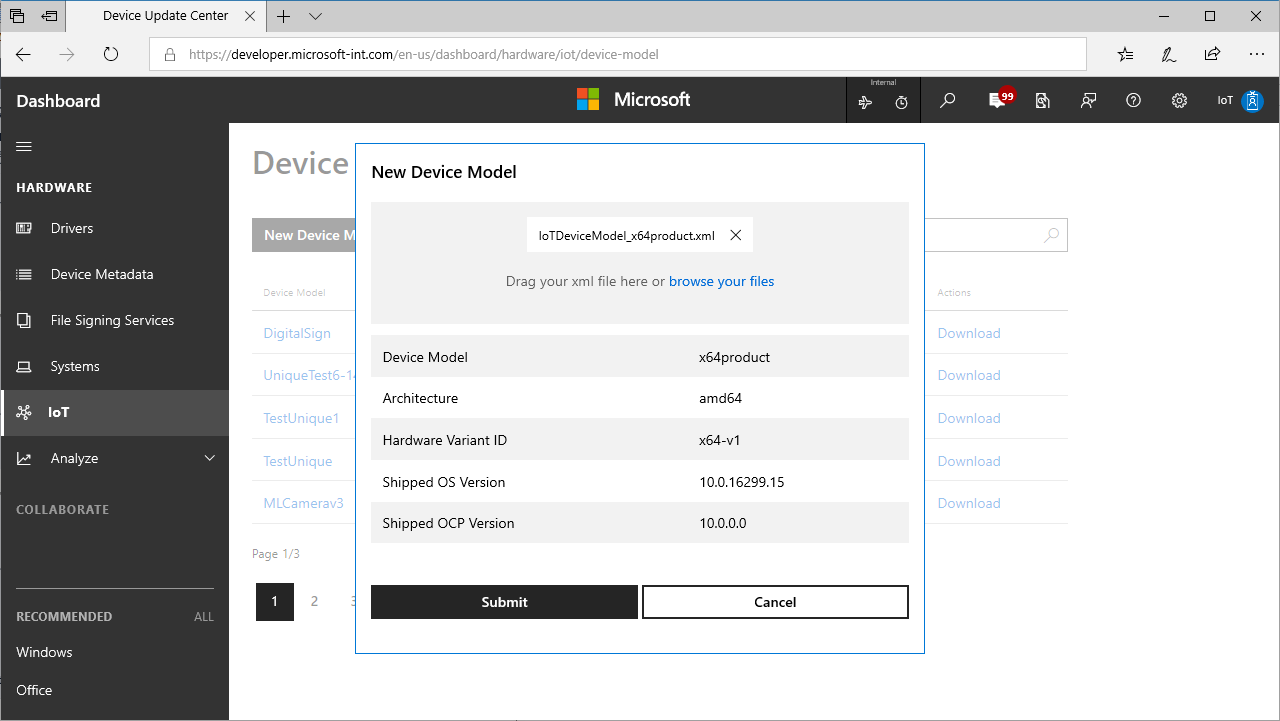
Device Update Center is part of the Windows Hardware Device Center and is used to create, control, and distribute device updates for the OS, custom apps, drivers, and other files. The steps to register a new Windows 10 IoT Core device are described in the Device Update Center User Guide. Entries can be created in Device Update Center for each unique device model as shown below.

Device Update Center
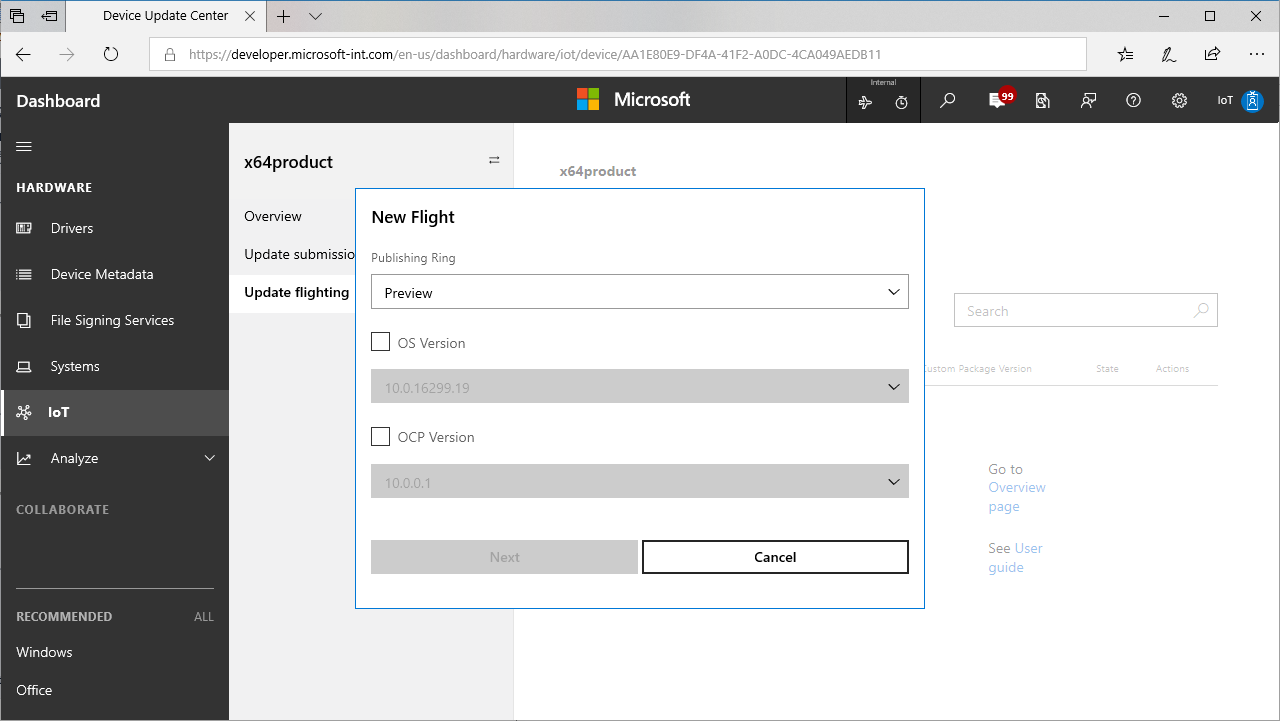
OS updates and custom updates (apps, drivers and files) are delivered through the same content distribution network that is used daily by hundreds of millions of Windows users around the world. Updates can be flighted in three distinct rings – Preview (test devices), Early Adopter (self-host devices) and General Availability (production devices) to have a controlled roll-out process where new changes can be validated with smaller sets of devices before broader deployment.

In addition to long-term support and device update control, Windows 10 IoT Core Services includes rights to commercialize with Device Health Attestation. This cloud-based service evaluates device health and can integrate with a device management system to improve the security of an IoT solution. These features give our partners the foundation to build sustainable business models based on Windows 10 IoT Core.
The Windows 10 IoT Core operating system remains royalty-free. Windows 10 IoT Core Services is a paid offering that can easily be added depending on the scenario.
- Businesses and solution integrators can purchase IoT Core Services through an Azure subscription. The subscription price will be $0.30 per device per month when the product releases later this fall. During the preview period, the price is $0.15 per device per month.
- Partners enrolled in our Cloud Solution Provider (CSP) program will be able to resell the service and establish ongoing relationships with their customers. They can sell a flexible, pay-as-you-go subscription as needed to meet device requirements. This option will be available later in the year.
- OEMs can license the service with a device by pre-paying for the service. This option will be available later in the year.
Microsoft is committed to offerings to help our partners provide compelling solutions and achieve their business goals. Along with our recently announced support for NXP silicon platforms, long-term support, and the Windows AI Platform, Windows 10 IoT Core Services is another step in meeting our partners’ needs.
To learn more about developing with Windows 10 IoT, enroll in our Early Adopter Program at EEAPIOTPartner@microsoft.com and to learn more about Windows 10 IoT Services, see the technical details at the Windows IoT Core Dev Center.
|
|
|
|
| Mobile - Review: Fighting Fantasy Legends Portal |
|
Posted by: xSicKxBot - 07-19-2018, 09:03 PM - Forum: New Game Releases
- No Replies
|
|
Review: Fighting Fantasy Legends Portal
 Back in the 1980’s the Fighting Fantasy books were a true phenomenon. These choose your own adventure tomes with their distinctive illustrations and atmospheric branching narrative enjoyed incredible success. In addition to selling millions of copies, they also gave many their first taste of fantasy role-playing games. This may not be the first time that the series has made an appearance on mobile devices, but Nomad Games have taken a different approach, maintaining the core plots of the books but replacing the page turning with a map and a deck of cards.
The main frustration with the Fighting Fantasy books was that death often felt arbitrary, take a right instead of a left and splat; it was back to the character creation sheet and a return to page one. Well, there was another option – cheat. Yes, I’m ashamed to admit it but like many others, I often backtracked my fatal decisions and selected a different option. Stuffing my fingers between the pages to mark my progress to the extent that I was using up digits faster than a drunken knife juggler. At the time, I didn’t even feel that guilty, convincing myself that if the story could so easily send me to my doom then I needed some way to level the playing field. In spite of the frustrations, I loved these books and have fond memories of spending hours lost amongst their evocative black and white drawings and twisty-turning passages.
The long-windedly entitled Fighting Fantasy Legends Portal consists of a trilogy of linked stories, with access to the latter ones being reliant on success in the earlier parts. The trilogy begins with Deathtrap Dungeon in which your adventurer will take on the challenge of the Labyrinth of Fang. Designed by Baron Sukumvit, the labyrinth is brimming with fiendish traps and fearsome creatures, can you be the first to survive and earn the reward of 10,000 gold pieces? The twist is that you are not alone in your quest as five other contestants, including a dour barbarian and a dark assassin, also have their eye on the prize. Trials of Champions is the second part, it begins with a murder mystery and a few rounds of gladiatorial combat before you even reach Fang Labyrinth 2.0. The final part of the adventure, Armies of Death, sees Agglax the Shadow Demon amassing an army of undead warriors. Our hero must travel from Fang with his band of veteran fighters to take on this new threat. Along the way, you will need to acquire the powers required to defeat Agglax, but do not take too long about it because his power grows ever stronger.
At the start of each adventure you choose a character class; Rogue, Paladin or Chaos Warrior and select a difficulty level. In a nod towards the sensibilities of modern gaming, the difficulty level determines how many chances you will have to complete the story. Thus, you will begin the game with three, six or nine lives. Die and you will lose one of your lives and be forced to return to the dungeon entrance. However, you restart with full health and all of your equipment and experience gains intact. You also won’t replay any of the main set pieces that you may have already overcome.

Before entering the dungeon, you must allocate points between three statistics. Skill determines your likelihood of success in combat and other actions like leaping pits. Luck determines such things as your chance of avoiding traps and finding valuable items. Stamina reflects how much damage you can take. Finally, you get to select a special skill. Naturally skilful and naturally lucky characters have a chance of automatic success when taking a skill or luck test. Alternatively, your adventurer could choose to be resistant to curses, have an increased knowledge of traps or maybe they are a quick learner.
During the game you will have to make numerous rolls. The number of dice you roll is determined by your ability rating in either skill or luck. All dice are six-sided and at the beginning of your quest, they will each have five blank faces. If my maths is correct this means that each die only has a one in six chance of achieving a successful roll. As your level increases, you can modify the dice; each die has the potential to be improved twice, thus increasing the chance of success to 50%. However, adventurers can also suffer long-term injuries and curses, which will affect your dice and may lead to you automatically failing.

The action is viewed from a forced overhead view with some moody graphics, a rousing fantasy themed soundtrack and a smattering of sound effects. Icons clearly show the directions you can move and the items you can interact with. As you progress through the story you will encounter several set pieces that remain true to the books, but there are also random encounters that are drawn from a deck of cards. These may lead to you having to fight a monster, finding an item, discovering a trap or triggering a special event.
Even making allowances for numerous deaths, the stories do not take that long to complete, but as well as the overriding quest there are also numerous sub-quests to keep you interested. In a neat touch, after completing the game you get to learn the fate of the various characters that you encountered and helped during your journey. Completing every quest will certainly take some time and for the completest, there is also a codex of monsters to compile.

The experienced designers have clearly made a sterling effort to reinvent Fighting Fantasy for a modern market. It sticks to the winning mix of tense combat, interspersed with classic riddles and puzzles. The modified dice system is fast paced and works well. It can lead to some nail-biting moments as your handful of dice ricochet across the screen before tethering, tantalisingly on the edge of success or failure. However, the game can be frustrating – there are still those instant death situations, made worse by having to restart from the very beginning every time you die. Granted, with the extra life failure isn’t as harsh as it used to be but having to trudge back from the entrance every time you fail feels like one trait from the past that is best left there.
|
|
|
|
| XONE - Bomber Crew |
|
Posted by: xSicKxBot - 07-19-2018, 10:45 AM - Forum: New Game Releases
- No Replies
|
|
Bomber Crew
Take to the skies in this immersive flight simulation where each mission is a high-risk expedition. Manage everything from fuel, ammo, hydraulics and more in your very own physics-based bomber, which can be customized with an array of liveries and paint jobs. Publisher: Curve Digital Games Release Date: Jul 10, 2018
|
|
|
|
| News - Comic-Con 2018: Hellboy -- Everything We Know About The Movie Reboot So Far |
|
Posted by: xSicKxBot - 07-19-2018, 10:45 AM - Forum: Lounge
- No Replies
|
|
Comic-Con 2018: Hellboy -- Everything We Know About The Movie Reboot So Far
Hellboy began as a comic book series about a salty red demon with a talent for violence, before being adapted by Guillermo Del Toro into two movies. The comic books are known for being fairly dark, while Guillermo Del Toro's adaptation toned it down a bit and put his signature creative spin on it. Fans of the comic, however, should be excited to know that another adaptation is coming, which should stay a little closer to the comic's roots and will feature an entirely new cast and crew. The movie may not have a significant presence at San Diego Comic-Con 2018, but with the major event upon us--it starts on Thursday, July 19--let's review what we know about the film, as well as what we're hoping to learn about it (be it at SDCC or some later date). What It's About Very few plot details have been released about Hellboy, but what we do know is that it will have nothing to do with Guillermo Del Toro's Hellboy universe, and instead will be an entirely different interpretation of the series. Hellboy will be facing a sorceress called the Blood Queen from the comics. It's also rated R, so that allows it to be darker and more violent than previous adaptations have been. Who's Who Crew - The film will be directed by Neil Marshall (The Descent).
- The screenplay was written by Andrew Cosby (Eureka).
Cast - David Harbour (Stranger Things) will be playing Hellboy, the surly but well intentioned half-human, half-demon, summoned to earth from hell by the Nazis. He's following in the footsteps of Ron Perlman, who played the character in the first movie franchise.
- Milla Jovovich (Resident Evil) will play the Blood Queen.
- Ian McShane will play Professor Broom, Hellboy's surrogate father from the comics.
- Daniel Dae Kim (Lost) plays Ben Daimio, a former Marine and commander at the Bureau for Paranormal Research and Defense, where the Hellboy squad works. In the comics, he can also turn into a jaguar in a tight spot. Interestingly, Ed Skrein was initially tapped for this role, but not wanting to contribute to Hollywood whitewashing, he dropped out after learning that the character in the comics has Asian heritage.
What's Been Released So Far So far, very little has been released. No teasers, no full length trailers, not even a cast photo. There has only been a poster which was put up as a promotional banner. It depicts an artist's rendition of Hellboy and his enemy in the movie, the Blood Queen. There was also a photo of Harbour as Hellboy released on Twitter. It's a pretty similar interpretation to Del Toro's Hellboy; neither director seems to want to change much from Hellboy's comic book look, which fans are likely to thank them for. What We Want At Comic-Con Even though Lionsgate has a couple movies coming out, the studio has no Hall H schedule planned, just a booth. This means no panel and likely no major news or trailers for the film. We don't know for sure, though. This year is the 25th anniversary of the Hellboy comics and creator Mike Mignola has a panel. Perhaps he'll have some information to share. There are many unanswered questions surrounding Hellboy but mostly, it would be great to get some information on the plot other than the name of the antagonist. The Blood Queen is an important part of a storyline from the Hellboy comics, but who knows how faithful the adaptation will be to the source material. And, of course, it would be great if they dropped a trailer, but that seems unlikely. Hopefully we'll get some new information at Comic-Con that will keep us satisfied until a trailer drops, or until the film opens on January 11, 2019.
|
|
|
|
| News - Get a job: Amazon Game Studios is hiring a Gameplay Animator |
|
Posted by: xSicKxBot - 07-19-2018, 10:45 AM - Forum: Lounge
- No Replies
|
|
Get a job: Amazon Game Studios is hiring a Gameplay Animator
 The Gamasutra Job Board is the most diverse, active and established board of its kind for the video game industry!
Here is just one of the many, many positions being advertised right now.
Location: Seattle, Washington
The Crucible Team at Amazon Game Studios is looking for a talented animator to help give emotion and life to our games. The perfect candidate is hardworking, self-motivated, and works well in a fast-paced team environment. We want animators who have a passion for performance, a strong sense of vision, and add personality into their work.
In this role, you will work closely with the Animation Lead and team to execute high-quality animations that help define the artistic vision and gives life to our games.
The perfect candidate will have strong knowledge of the animation principles and the ability to animate both human and non-human characters in a wide range of styles. You will be a hardworking self-motivated team player that brings future heroes and worlds to life. You should demonstrate strong character combat animations for triple-A third-person action games. You should have a strong sense of vision and passion to create high-quality performances that delight our customers.
In this job you will:
- Work closely with animation lead to execute the artistic vision of the game.
- Provide high-quality animations on main and secondary characters that display strong personality and mechanics.
- Be accountable for delivery of individual assets, ensuring that they meet the highest quality, defined objectives, and scheduled requirements.
- Follow direction and react to animation critique in a timely manner.
- Maintain defined animation style through regular critique and feedback.
- Collaborate with the concept, character and gameplay teams.
- Increase the team’s skills through mentorship of learned skills, process, and artistic techniques.
Basic qualifications:
- Demo Reel demonstrating thorough understanding of animation theory and technique as applied to 3D human bipedal figures as well as other organic forms.
- 2+ years of experience
- Experience with Maya or equivalent 3D Animation package
Preferred qualifications:
- Has been responsible for or animated assets on at least one AAA title from beginning to end or have shipped AAA PC or console titles in an animator position.
- Experience working with high-end game engines
- Experience working with mocap and key framed animation techniques
- Has demonstrated understanding of next-generation asset creation pipelines, tools, software and customization systems, with the ability to identify and troubleshoot in-engine issues.
- Has strong communication and organizational skills.
- Has a solid knowledge of staging and cinematography.
- Proven ability to learn new tools and techniques.
- Able to accurately estimate the time to complete individual tasks.
- Passion for making and playing great games, with an awareness of current titles and industry trends.
- Meets/exceeds Amazon’s leadership principles requirements for this role.
- Meets/exceeds Amazon’s functional/technical depth and complexity for this role.
Amazon is an Equal Opportunity – Affirmative Action Employer – Minority / Female / Disability / Veteran / Gender Identity / Sexual Orientation
Interested? Apply now.
Whether you’re just starting out, looking for something new, or just seeing what’s out there, the Gamasutra Job Board is the place where game developers move ahead in their careers.
Gamasutra’s Job Board is the most diverse, most active, and most established board of its kind in the video game industry, serving companies of all sizes, from indie to triple-A.
Looking for a new job? Get started here. Are you a recruiter looking for talent? Post jobs here.
|
|
|
|
|