Feature: EGX Rezzed Proved Nintendo Is Winning The Indie War
Last week, EGX Rezzed – an indie-flavoured off-shoot of Gamer Network’s EGX show – took place in London. The event’s aim has always been to celebrate small-scale games and give indie developers a chance to get their titles in front of a receptive audience, and this year’s show certainly did that. Established names such as Cuphead, The Messenger, Inmost and Untitled Goose Game rubbed shoulders with more left-field releases, a great many of which are coming to Switch in the fullness of time.
We know this because, during our time at the show, we feel we may have annoyed a few of the developers present by starting each chat with “Is it coming to Switch?” The difference this year is that the answer was mostly positive, which shows just how effectively Nintendo has charmed the indie sector with its latest console.
If you’ve not attended one of the recent EGX Rezzed shows, it’s probably worth explaining the venue. Unlike most shows of this type, which traditionally take place in massive, featureless exhibition halls, Rezzed’s home is a Grade I listed warehouse in Wapping, East London known as Tobacco Dock. Constructed in 1811 to store – you guessed it – tobacco, it’s a totally unique setting for a games show. Set across two floors and crammed into cosy brick-vaulted rooms, EGX Rezzed is a lot more intimate than your typical game show.
The fact that Tobacco Dock is sub-divided into so many different rooms allows the organisers to create focused areas for each platform holder or developer. For example, Microsoft’s successful [email protected] indie brand had a sizeable room boasting titles such as Game Freak’s Giga Wrecker Alt., Dead Mage’s Children of Morta and Pathea Games’ My Time at Portia, all of which are also (haha!) Switch-bound. Sony had a smaller room, but devoted the majority of the space to Dreams, Media Molecule’s upcoming spiritual successor to LittleBigPlanet. While it’s not an indie title, this game-building tool was almost terrifying in its scope and potential; we imagine it will create a whole new generation of indie game makers, so we’ll let it slide.
But we weren’t at EGX Rezzed to look at things that aren’t coming to Switch – we were there to pester developers about games that are. Bloodstained was playable, and the massive indie room was packed with titles that proudly had Switch listed as one of their target platforms. The mech-based strategy title Warborn caught our eye, as did the utterly adorable Cat Quest II. In Devolver Digital’s room, Katana Zero certainly impressed, as did the delightfully silly My Friend Pedro. However, it was Nintendo’s stand which predictably drew us in for the longest amount of time.
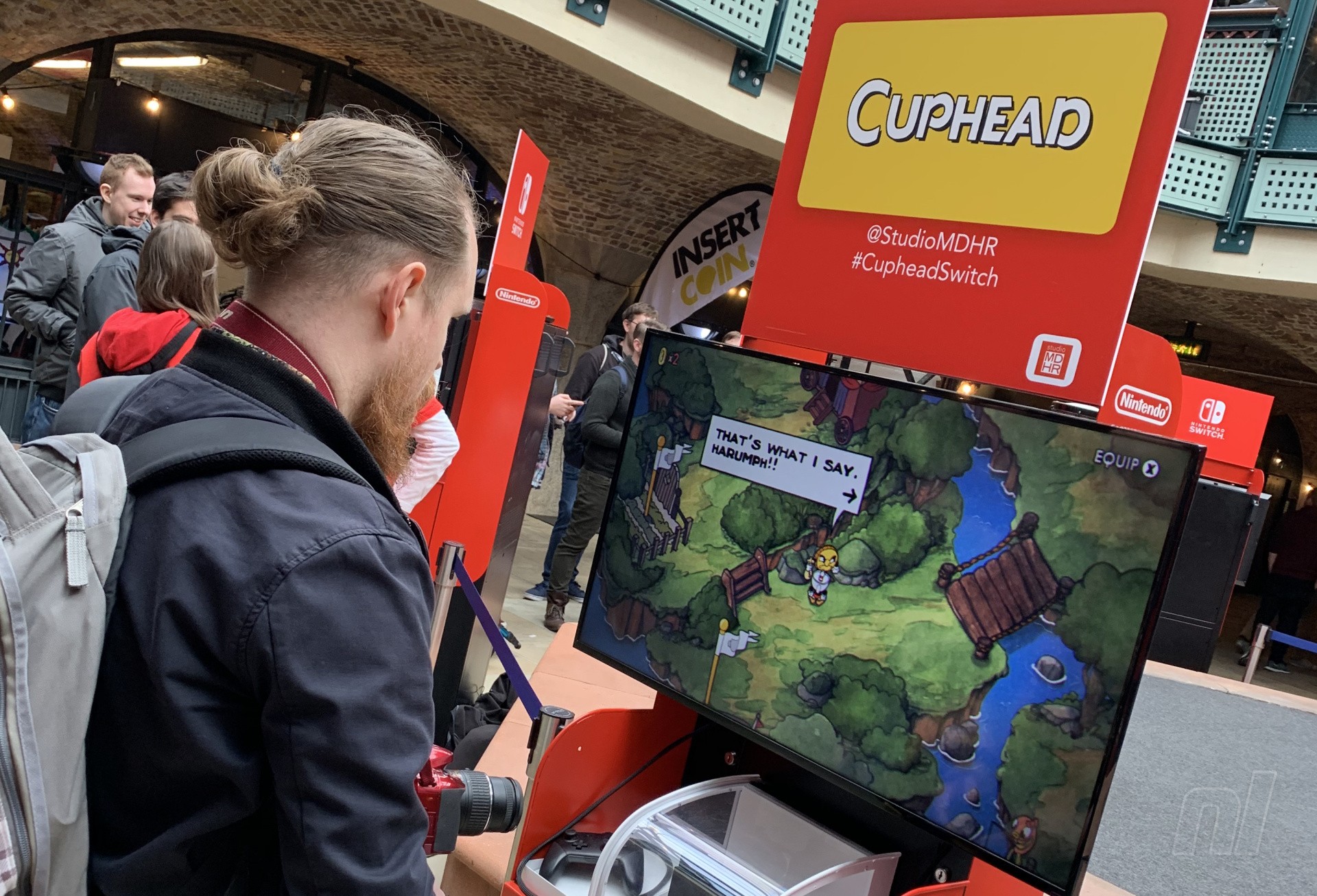
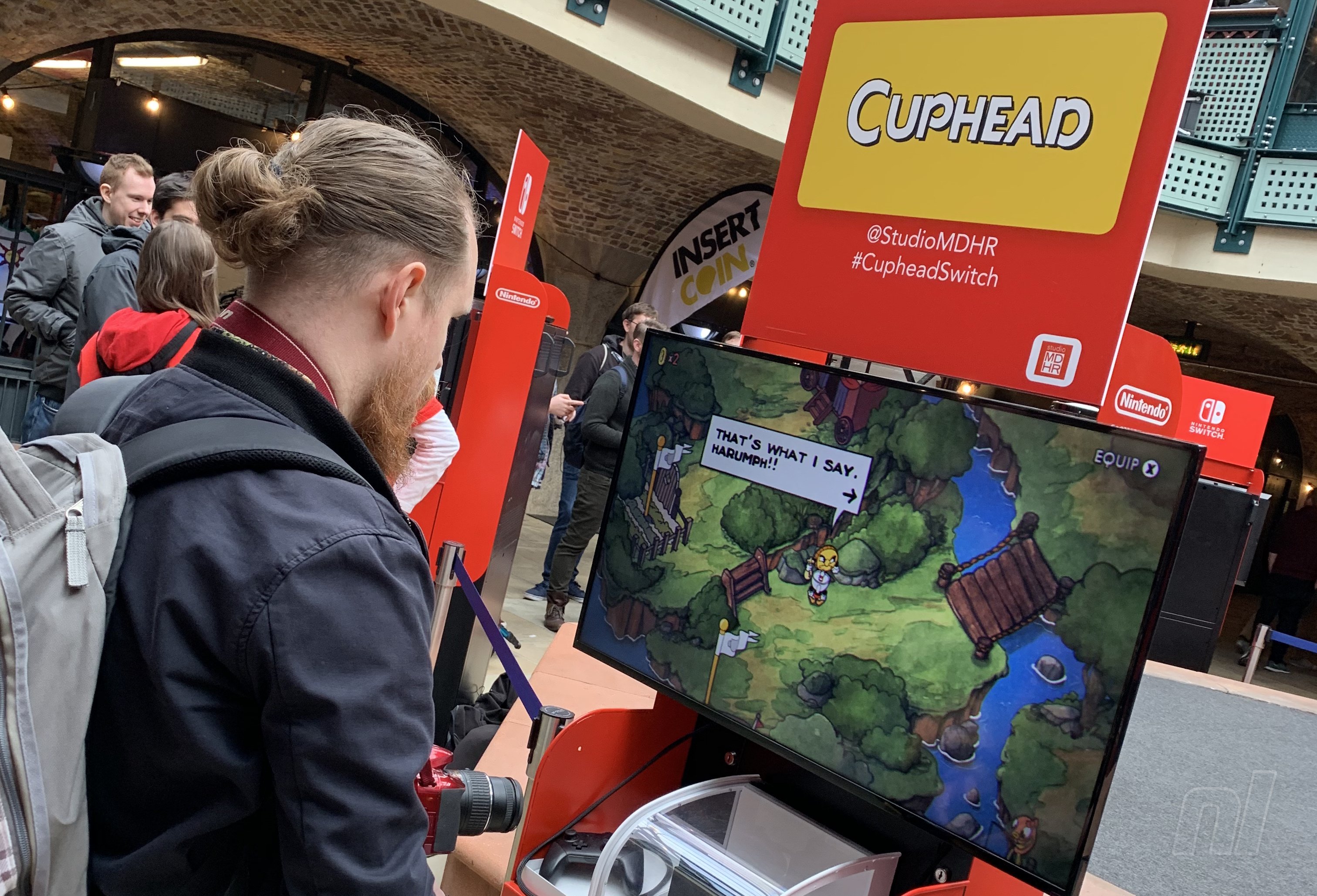
Rather than taking up one of the snug rooms, Nintendo had opted for a courtyard in the middle of Tobacco Dock, and had arranged a series of Switch demo pods around this central structure. We got some hands-on time with Cuphead, which we’re happy to report runs absolutely beautifully on the console; it really does feel like a match made in heaven. The long-awaited Untitled Goose Game was present too, and looks better every time we see it in motion. We also got to sample SteamWorld Quest, which looks incredibly polished and very interesting indeed. Given the amount of interest in Nintendo’s stand, it’s fair to say that its policy of snapping up the finest indie offerings is working.
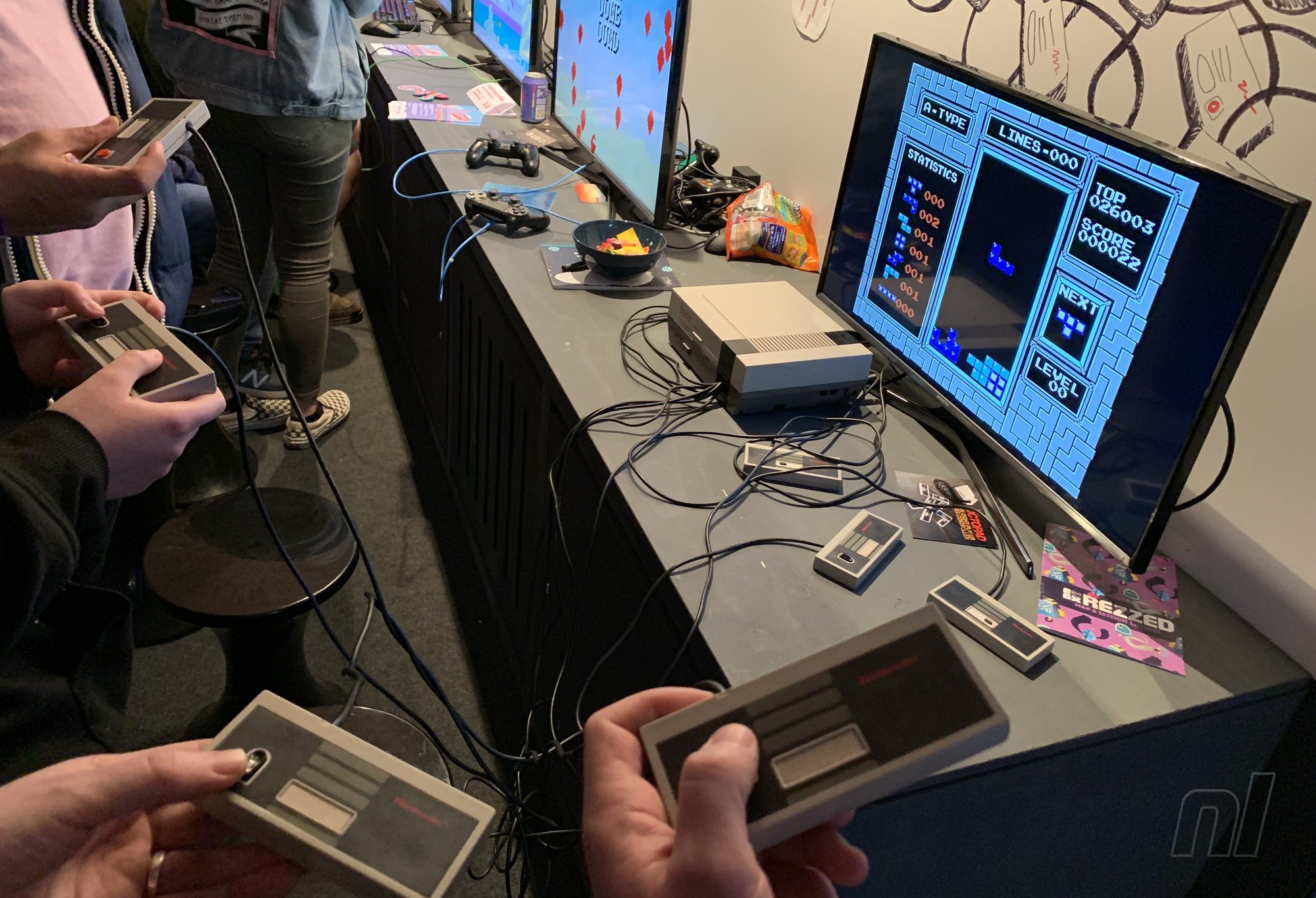
As a Nintendo-related footnote, we were fortunate enough to have a quick go on the Octopad, a unique creation by Patrick LeMieux. Billed as an ‘alternative interface’ for the NES, the Octopad is effectively an eight-player controller where each pad has only one option – A, B, Up, Down, and so on. We had a go on Tetris with some complete strangers, and it’s fascinating to see how a frantic dialogue is fostered when there are falling blocks at stake. Located in Rezzed’s Sega-sponsored Leftfield Room, Octopad is an intriguing social experiment which we hope we have a life beyond this single demo unit.
The Octopad proved to be a highlight of the show for us personally
During the event, a series of talks took place covering a wide range of topics, including individual games (‘Nutshots & Nazis: The Sniper Elite Story’ wins the award for best title), pop culture (Nintendo Life contributor Mike Diver’s ‘Video Games Journalists vs The Transformers Movie was a highlight) and more pressing matters in game development (Designing Sex in Games). Many of these sessions overlapped with one another so it wasn’t physically possible to attend them all, but there was certainly plenty of stuff happening, even if you don’t include the actual games you could play.
EGX Rezzed certainly presents a much different atmosphere to the ‘normal’ EGX event, which is due to take place in London this October. It’s less about glitz, glamour and free energy drinks, and more about interacting with the people who actually make these games; the venue is also perfect, offering its own unique character which somehow feels perfectly attuned to the often wacky indie titles on display. There were some odd inclusions (Borderlands and Forza 7 aren’t really indie, are they?) but what really struck us this year is how good a job Nintendo is doing when it comes to winning the hearts and minds of the independent gaming scene; a far cry from the rather tempestuous relationship the company has had with indies in the past.
Posted by: xSicKxBot - 04-09-2019, 06:29 AM - Forum: Windows
- No Replies
Ann Johnson: Demystifying cybersecurity starts with the language we use
As the cybersecurity industry has evolved, one dynamic has remained consistent: our industry-“speak”. We use a language that is very unique, difficult for new folks to understand, and oftentimes just plain sensationalistic. While any industry has its own technical terms, our language can also be a barrier to recruitment for many. This should be of concern to all of us in cybersecurity as we look to become more inclusive, rather than exclusive.
Language often reflects and supports a culture. Culture is defined by language norms and values of its people. It is easy to become conditioned to the way we speak and use terminology. As we look to how we can encourage industry growth and maturity, we should strive to evolve the way we use our industry’s nomenclature to be more open and consider how we are defining and shaping our industry’s culture through language. The exciting thing is, the opportunity is right before us, because cybersecurity is constantly evolving.
There are many examples of words that are part of the InfoSec culture – words that do not easily translate to people without a deep industry background. My approach is to avoid hyper technical or sensationalistic terms, and to create a language baseline that is simple and inclusive. Then, I put it to the test: Is the cyber language we’re speaking something my family can understand? Are there other terms we could use to simplify unique technical terms? Can we all agree to search for new words and try them out?
Let’s consider terms like sandboxing, detonation chamber, whitelists, blacklists, and so forth. While each have specific purposes, we should ask ourselves: are there different ways of saying the same things or defining these terms? What would the synonym be for “blacklist” and would “filtering known bad sites” or “risk lists” suffice?
We must also examine and test whether ways that are more easily understood help to make the industry appear more open and accepting to a broader, more diverse audience or talent population. This is not a matter appearing politically correct – it is a matter of being pragmatic and understanding we will not solve the talent shortage in cybersecurity if we do not make some fundamental changes to the industry. One of the simple changes we could make is to make our common industry vernacular less intimidating.
Testing the waters, I fielded this very topic about whether our industry terms are terrifying and/or confusing to those not in the industry. While many shared examples of cyber terms we should explore, there was agreement that most of our vernacular leans to weaponized or militaristic language.
As a technology professional with 30 years of experience working for companies that are not pure security focused, I have spent many hours creating glossaries and explaining InfoSec language to my colleagues. Quite often there are raised eyebrows and snickers at some of the things we consider common language – as well as questioning and commentary on how unique security people are. I have no issue with uniqueness or deep skills, but that does not mean everything the industry does needs to be unique. The days of security by obscurity are dead.
The cyber insiders club we have created for ourselves is not what makes us special. What makes us special is that we are required to adapt quickly, evolve, and grow. If we don’t, we will become extinct. Bad actors are continually changing and modernizing their tools and methods. They recognize the evolution of InfoSec as an opportunity of scale. By allowing more people to easily understand the fundamentals of security and take an active role in shaping its culture, we can and will build better defenses. Imagine how much easier your job would be if you didn’t spend the first 30-minutes of every InfoSec-related meeting developing a common understanding of language.
If we are to truly influence and shape our industry’s culture, I am asking everyone in the industry to examine how and what we communicate, how we can make cybersecurity easier to understand by the language we use. Thus we will become more open and inclusive. We can do so much if we embrace change and growth, and open our arms to those who have so much to contribute, but who may not “speak” our language.
For the first time, players take control of Noctis's greatest foe in this brand-new episode of FINAL FANTASY XV. Delve into the dark tale of scorned saviour Ardyn Lucis Caelum and unravel the secrets surrounding his mysterious past.
A visceral, jeckpack-fueled VR Arcade Shooter through which you fly through deadly Orbital Arenas in Hostile Space, facing off in extreme battles. [Ubisoft]
From the creative talent behind the genre-defining Burnout series, Dangerous Driving puts aggression back into the racing genre, recapturing the spirit of the past and taking it to a new place. Dangerous Driving is a game about real driving. The sort of driving you want to do when no one else is looking. The sort of driving you?d love to do if only everyone else would get OUT OF THE DAMN WAY! This game gives you the chance to live out that fantasy. To floor it in everyday cars, at high speeds, weaving in and out of traffic and slamming the other cars right off the road. This is a game built in the spirit of the classic arcade racing games of the 80?s and 90?s. It?s about speed, driving skill and beautiful powerslides around epic corners. It?s also about all out aggression, instant retaliation and sweet, sweet revenge. The more dangerously you drive, the faster you can go.
Game Of Thrones Star Explains How The Show Has Changed TV
Game of Thrones returns for its eighth and final season in less than one week. The show's stars are making the press rounds, talking about the final season and what it means. John Bradley, who plays Samwell Tarly, told Collider that as the show ends, he sees that Game of Thrones has helped TV stand taller and rival cinema in some regards.
"A lot of the TV that comes after [Game of Thrones] is taking lessons from it and using it as a springboard in terms of what can be achieved through the medium of television and how, given the right set of people and the right circumstances, it can rival cinema," Bradley said. "And it's got a right to be ambitious. It's created a whole new sense of ambition in TV that wasn't really there before. There has never been anything on this visual scale before. And I think TV is no longer seen as a kind of poor cousin of cinema. I hope that TV going forward feels that we've empowered it to be as ambitious as we've been."
The final season of Game of Thrones was a massive effort, according to Gwendoline Christie, who plays Brienne of Tarth and is also featured in the Collider video.
"This season has really outdone all the others in all regards," she said. "The production values, and the way in which everyone was pushed is much further than anything they've ever done on the show before. The scale is so much bigger."
In regards to special effects specifically, VFX producer Steve Kullback recalled that Seasons 2 and 3 had about 600-800 VFX shots in each season. Season 8, meanwhile, has "multiples of that" in a single episode, so it is no small undertaking.
Game of Thrones Season 8 premieres on HBO April 14. Soon we'll know who lives and dies, and everything else there is to know. While the show is ending, a prequel series is on the way.
Panty Party Is Receiving A Switch Release Outside Of Japan
No, you’re not misreading the above headline. A retail version of Panty Party for the Nintendo Switch is indeed on its way to the west.
The game’s publisher Cosen has announced the Switch eShop version will be made available in late April or early May for $14.99, and a physical release is also “planned” for outside of Japan.
Panty Party is described as a fast-paced battle game where you fly about “as a panty” on the street searching for fights against “enemy” panties. It promises plenty of comedy, love, passion and a dance-inspired soundtrack.
As badass as it all sounds, don’t expect this game to be filled with adult imagery. As noted by the official game page:
“All you get is funny and stupid panties!”
The Switch version of this title will also include multiplayer battles for up to four players. Below is a trailer leaving very little to the imagination:
What do you think about a local retail release for a game like this? Will you be picking it up yourself? Tell us in the comments section.
The Linux startup process goes through several stages before reaching the final graphical or multi-user target. The initramfs stage occurs just before the root file system is mounted. Dracut is a tool that is used to manage the initramfs. The dracut emergency shell is an interactive mode that can be initiated while the initramfs is loaded.
This article will show how to use the dracut command to modify the initramfs. Some basic troubleshooting commands that can be run from the dracut emergency shell will also be demonstrated.
The InitRAMFS
Initramfs stands for Initial Random-Access Memory File System. On modern Linux systems, it is typically stored in a file under the /boot directory. The kernel version for which it was built will be included in the file name. A new initramfs is generated every time a new kernel is installed.
A Linux Boot Directory
By default, Fedora keeps the previous two versions of the kernel and its associated initramfs. This default can be changed by modifying the value of the installonly_limit setting the /etc/dnf/dnf.conf file.
You can use the lsinitrd command to list the contents of your initramfs archive:
The LsInitRD Command
The above screenshot shows that my initramfs archive contains the nouveau GPU driver. The modinfo command tells me that the nouveau driver supports several models of NVIDIA video cards. The lspci command shows that there is an NVIDIA GeForce video card in my computer’s PCI slot. There are also several basic Unix commands included in the archive such as cat and cp.
By default, the initramfs archive only includes the drivers that are needed for your specific computer. This allows the archive to be smaller and decreases the time that it takes for your computer to boot.
The Dracut Command
The dracut command can be used to modify the contents of your initramfs. For example, if you are going to move your hard drive to a new computer, you might want to temporarily include all drivers in the initramfs to be sure that the operating system can load on the new computer. To do so, you would run the following command:
# dracut –force –no-hostonly
The force parameter tells dracut that it is OK to overwrite the existing initramfs archive. The no-hostonly parameter overrides the default behavior of including only drivers that are germane to the currently-running computer and causes dracut to instead include all drivers in the initramfs.
By default dracut operates on the initramfs for the currently-running kernel. You can use the uname command to display which version of the Linux kernel you are currently running:
$ uname -r
5.0.5-200.fc29.x86_64
Once you have your hard drive installed and running in your new computer, you can re-run the dracut command to regenerate the initramfs with only the drivers that are needed for the new computer:
# dracut –force
There are also parameters to add arbitrary drivers, dracut modules, and files to the initramfs archive. You can also create configuration files for dracut and save them under the /etc/dracut.conf.d directory so that your customizations will be automatically applied to all new initramfs archives that are generated when new kernels are installed. As always, check the man page for the details that are specific to the version of dracut you have installed on your computer:
$ man dracut
The Dracut Emergency Shell
The Dracut Emergency Shell
Sometimes something goes wrong during the initramfs stage of your computer’s boot process. When this happens, you will see “Entering emergency mode” printed to the screen followed by a shell prompt. This gives you a chance to try and fix things up manually and continue the boot process.
As a somewhat contrived example, let’s suppose that I accidentally deleted an important kernel parameter in my boot loader configuration:
# sed -i ‘s/ rd.lvm.lv=fedora\/root / /’ /boot/grub2/grub.cfg
The next time I reboot my computer, it will seem to hang for several minutes while it is trying to find the root partition and eventually give up and drop to an emergency shell.
From the emergency shell, I can enter journalctl and then use the Space key to page down though the startup logs. Near the end of the log I see a warning that reads “/dev/mapper/fedora-root does not exist”. I can then use the ls command to find out what does exist:
# ls /dev/mapper
control fedora-swap
Hmm, the fedora-root LVM volume appears to be missing. Let’s see what I can find with the lvm command:
Ah ha! There’s my root partition. It’s just inactive. All I need to do is activate it and exit the emergency shell to continue the boot process:
# lvm lvchange -a y fedora/root
# exit
The Fedora Login Screen
The above example only demonstrates the basic concept. You can check the troubleshooting section of the dracut guide for a few more examples.
It is possible to access the dracut emergency shell manually by adding the rd.break parameter to your kernel command line. This can be useful if you need to access your files before any system services have been started.
Check the dracut.kernel man page for details about what kernel options your version of dracut supports:
Posted by: xSicKxBot - 04-08-2019, 11:17 PM - Forum: Windows
- No Replies
Hybrid storage performance comes to Azure
When it comes to adding a performance tier between compute and file storage, Avere Systems has led the way with its high-performance caching appliance known as the Avere FXT Edge Filer. This week at NAB, attendees will get a first look at the new Azure FXT Edge Filer, now with even more performance, memory, SSD, and support for Azure Blob. Since Microsoft’s acquisition of Avere last March, we’ve been working to provide an exciting combination of performance and efficiency to support hybrid storage architectures with the Avere appliance technology.
Linux performance over NFS
Microsoft is committed to meeting our customers where we’re needed. The launch of the new Azure FXT Edge Filer is yet another example of this as we deliver high-throughput and low-latency NFS to applications running on Linux compute farms. The Azure FXT Edge Filer solves latency issues between Blob storage and on-premises computing with built-in translation from NFS to Blob. It sits at the edge of your hybrid storage environment closest to on-premises compute, caching the active data to reduce bottlenecks. Let’s look at common applications:
Active Archives in Azure Blob – When Azure Blob is a target storage location for aging, but not yet cold data, the Azure FXT Edge Filer accelerates access to files by creating an on-premises cache of active data.
WAN Caching – Latency across wide area networks (WANs) can slow productivity. The Azure FXT Edge Filer caches active data closest to the users and hides that latency as they reach for data stored in data centers or colos. Remote office engineers, artists, and other power users achieve fast access to files they need, and meanwhile backup, mirroring, and other data protection activities run seamlessly in the core data center.
NAS Optimization – Many high-performance computing environments have large NetApp or Dell EMC Isilon network-attached storage (NAS) arrays. When demand is at its peak, these storage systems can become bottlenecks. The Azure FXT Edge Filer optimizes these NAS systems by caching data closest to the compute, separating performance from capacity and better delivering both.
When datasets are large, hybrid file-storage caching provides performance and flexibility that are needed to keep core operations productive.
Azure FXT Edge Filer model specifications
We are currently previewing the FXT 6600 model at customer sites, with a second FXT 6400 model becoming available with general availability. The FXT 6600 is an impressive top-end model with 40 percent more read performance and double the memory of the FXT 5850. The FXT 6400 is a great mid-range model for customers who don’t need as much memory and SSD capacity or are looking to upgrade FXT 5600 and FXT 5400 models at an affordable price.
Azure FXT Edge Filer – 6600 Model
Azure FXT Edge Filer – 6400 Model
Highest performance, largest cache
High-performance, large cache
Specifications per node:
Specifications per note:
1536 GB DRAM
768 GB DRAM
25.6 TB SSD
12.8 TB SSD
6×25/10Gb + 2x1Gb Network Ports
6×25/10Gb + 2x1Gb Network Ports
Minimum 3-node cluster
Minimum 3-node cluster
Uses 256 AES encryption
Uses 256 AES encryption
Key features
Scalable to 24 FXT server nodes as demand grows
High-performance DRAM/memory for faster access to active data and large SSD cache sizes to support big data workloads
Single mountpoint provides simplified management across heterogeneous storage
Hybrid architecture – NFSv3, SMB2 to clients and applications; support for NetApp, Dell EMC Isilon, Azure Blob, and S3 storage
The Azure FXT Edge Filer is a combination of hardware provided by Dell EMC and software provided by Microsoft. For ease, a complete solution will be delivered to customers as a software-plus-hardware appliance through a system integrator. If you are interested in learning more about adding the Azure FXT Edge Filer to your on-premises infrastructure or about upgrading existing Avere hardware, you can reach out to the team now. Otherwise, watch for update on the Azure FXT Edge Filer homepage.
Azure FXT Edge Filer for render farms
High-performance file access for render farms and artists is key to meeting important deadlines and building efficiencies into post-production pipelines. At NAB 2019 in Las Vegas, visit the Microsoft Azure booth #SL6716 to learn more about the new Azure FXT Edge Filer for rendering. You’ll find technology experts, presentations, and support materials to help you render faster with Azure.
By Andrew O’Hara Monday, April 08, 2019, 01:00 pm PT (04:00 pm ET)
AppleInsider is going hands-on with the latest beta of iOS 12.3 which includes the newly revamped TV app and several other smaller tweaks.
iOS 12.3 TV app with EPIX channel
The first beta of iOS 12.3 contained the first iteration of the brand new TV app, future home of Apple’s original content. The second beta we saw the app get a new, though sparse, intro screen that signifies the TV app as the home to all of your content.
Apple also added Epix as an Apple TV channel alongside Showtime, Starz, Tastemade, and the Smithsonian. Apple TV channels are services you can subscribe to right from the TV app, though during the beta period they still kick you out to the third-party apps to watch anything. Once launched, this content will be available to watch right from within the TV app.
We’ve been using the TV app quite extensively since it launched in the first beta and were pleased to see how much more stable the app is here in beta two. In beta one, it would freeze constantly, making usage difficult.
The second beta also has more tweaks to the Wallet app in preparation for Apple Card’s launch. The empty icons to the left of your transactions has now been removed in this beta, with just the text available to designate where a purchase was made. This applies to third-party cards. On the Apple Pay Cash card —and forthcoming Apple Card —each transaction has an icon to the left that lines up with the person, business, or category a purchase falls into.
iOS 12.3 beta 2
Lastly, the palm rejection bug on iPad has been corrected. Prior, the screen would jump around at the detection of your palm while using Apple Pencil. This has been fixed and it works as you’d expect in this latest beta.
Be sure to catch up with everything that changed in the first beta of iOS 12.3 on iPhone, iPad and Apple TV.