Today the GNOME project announced the release of GNOME 3.34. This latest release of GNOME will be the default desktop environment in Fedora 31 Workstation. The Beta release of Fedora 31 is currently expected in the next week or two, with the Final release scheduled for late October.
GNOME 3.34 includes a number of new features and improvements. Congratulations and thank you to the whole GNOME community for the work that went into this release! Read on for more details.
GNOME 3.34 desktop environment at work
Notable features
The desktop itself has been refreshed with a pleasing new background. You can also compare your background images to see what they’ll look like on the desktop.
There’s a new custom application folder feature in the GNOME Shell Overview. It lets you combine applications in a group to make it easier to find the apps you use.
You already know that Boxes lets you easily download an OS and create virtual machines for testing, development, or even daily use. Now you can find sources for your virtual machines more easily, as well as boot from CD or DVD (ISO) images more easily. There is also an Express Install feature available that now supports Windows versions.
Now that you can save states when using GNOME Games, gaming is more fun. You can snapshot your progress without getting in the way of the fun. You can even move snapshots to other devices running GNOME.
The Fedora 31 Workstation Beta release is right around the corner. Fedora 31 will feature GNOME 3.34 and you’ll be able to experience it in the Beta release.
Poll: Daemon X Machina Is Out Today, Are You Getting It?
Today sees the launch of Daemon X Machina, which has perhaps unintentionally become of the most intriguing Switch releases this year.
We say that because the last few months have been quite the rollercoaster for the game and developer Marvelous Entertainment. Back in February, a demo was released with the intention of gaining player feedback; plenty of players took the time to give it a go, but the reaction wasn’t exactly positive.
Since then, changes have been made to satisfy fan requests, and the game has absolutely seen a significant turn for the better. Despite this, there seems to have been a general, ‘put-off’ kind of vibe surrounding the game ever since, and we suspect that a lot of the initial hype may have deteriorated.
So, to settle it once and for all and see if we’ve got the wrong end of the stick here, we’re throwing things over to you. Feel free to chuck a vote in our poll and stick around to see the results as more votes come in – are you picking up a copy?
If you’re interested, we found the game to be pretty enjoyable when playing it for review, even if it does feel quite repetitive at times. You can read our full thoughts here (including why we think you should try out the new and improved free demo), but we’ve got a snippet for you below:
At its core Daemon X Machina is a solid mech action game that controls well and gives the player a generous helping of customisation options. Its mission structure can get repetitive, and its plot is so difficult to grasp it may as well be soaked in grease, but as long as you’re willing to put up with these and get through its initially bewildering array of gauges and icons you should have a good time with it.
Thanks to anyone who took the time to vote! Feel free to share any additional thoughts with us on this one in the comments below.
Review: Super Kirby Clash – Monster Hunter Meets The Cute Pink Puffball
When Kirby: Planet Robobot launched in 2016, one of the sub-games included was a neat little RPG-lite take on a boss rush mode called Team Kirby Clash. A year later, HAL opted to expand on the concept further in a free-to-play release on the 3DS eShop called Team Kirby Clash Deluxe, which added in several more bosses, weapon sets, and underlying mechanics to the experience. Unfortunately, this latter release largely flew under the radar, as the Switch had launched only a month earlier and the entirety of Nintendo fandom was far too busy fawning over The Legend of Zelda: Breath of the Wild to care about yet another random Kirby spin-off on yesterday’s hardware.
Not ones to let a good game go to waste, HAL opted to bring Team Kirby Clash Deluxe into its Kirby Star Allies engine, replaced all the assets with HD equivalents, and added in a hefty dose of new bosses and equipment sets on top of it, releasing it to the world again on the Switch as (drum roll, please) Super Kirby Clash. By the director’s own admission, this is the ‘complete’ version of the game he envisioned, so the question remains: how does it measure up to the Kirby series’ lofty standards?
Super Kirby Clash takes place in a parallel universe to the mainline Kirby series in a place called the Dream Kingdom, where a travelling Kirby forms a team of… well, other Kirbies to fight off the raging tide of savage beasts that threaten the peace of the kingdom’s virtuous citizens. Though it technically does fit into the Kirby series’ surprisingly dark and detailed lore, the story for a multiplayer beat ‘em up such as this obviously is being used as little more than a framing device for the countless battles to come.
At its heart, Super Kirby Clash is essentially a Kirbyfied take on the tried-and-tested formula of the Monster Hunter series. You’ve got a small hub village where you can purchase new equipment pieces and, when you’re all geared up, you can head over to the job board and choose to take on various boss monsters one at a time in gradually more difficult battles. After every fight – win or lose – you’ll be granted XP which raises your character level and bolsters your stats, while occasionally unlocking access to higher rank gear once you pass certain milestones.
One would think that applying such mechanics to the relatively simple setup of the mainline Kirby series combat would seem contrived or awkward, but it’s surprising how well it works in practice. There are four different character classes you can play as, and while there aren’t any advanced mechanics like skill trees to speak of, each one nonetheless has a unique role that fills a different niche.
The Beam Mage class, for instance, is the de facto ranged unit and his main contribution to a fight is the ability to completely disable the boss for a brief period of time using a charged beam attack. The Hammer Lord, on the other hand, is a far slower, melee-focused character, but what he lacks in mobility he makes up for in the incredible damage output of his Hammer Flip swing.
Every fight will always have four Kirbies – AI takes over if you haven’t got anyone else to play with – and your success will be largely dependent upon how well you plan out your teams and equipment setups. If you’re going up against a highly mobile boss, for example, it might be a good idea to replace your Sword Hero with another Time Mage so you can have more of those time-stop windows to work with. Decisions like that matter, yet at the same time, HAL has smartly kept the RPG mechanics nice and simple. We never find ourselves bogged down with tons of choices at the outset of another fight – this is a Kirby game, after all – but we were pleasantly surprised by the flexibility offered by these RPG-lite systems. There’s just enough free choice and player progression offered up to give you the feel of an RPG, without going too far into those depths that Super Kirby Clash stops feeling like a Kirby game first and foremost.
In typical series fashion, the early to mid-game is mostly easy and painless, but the difficulty ramps up considerably as you push ever deeper into the substantial endgame on offer. By the time you’ve started getting into more of the new content for this HD re-release, learning the various move-sets and hit-boxes for the bosses becomes an absolute must, as only a few hits will knock your character out and cost your team some precious seconds to revive you.
Super Kirby Clash pulls from all across the long history of the Kirby series, with plenty of old nemeses returning to take a crack at the super tuff pink puff. It goes without saying that longtime fans will get a lot more out of this boss variety in the long run, but even newcomers will no doubt appreciate the diversity of the rogue’s gallery here. Aside from the palette swap variations, no two bosses play the same, which keeps the experience feeling fresh and interesting as you grind ever deeper. There’s a certain rush to each new boss you unlock, to the struggle of learning their move-sets and finding the gaps in them, that keeps Super Kirby Clash engaging throughout and keeps you coming back.
A big part of this loop, too, is the overarching achievement system, called “Heroic Missions”, which pushes you to play in challenging and sometimes unconventional ways. There are 900 of these missions to complete, and they can range from being as simple as buying a single piece of gear at the shop to as difficult as beating a boss encounter in under twenty seconds. There’s more to these than just bragging rights, however, as the rank of gear you have access to is directly tied to how many missions you’ve completed; you have no hope of touching those higher-level bosses if you haven’t put in the work and filled out a lot of the missions on the lower level foes so you can get those better weapons.
What’s nice about this system is how it keeps you rotating through all the roles and trying different playstyles, squeezing extra replayability out of the already lengthy boss roster as you’re encouraged time and again to go above and beyond the minimum. It’s an extra incentive to do better and push your limits, but most importantly, these missions also serve as your main income for Gem Apples.
See, Super Kirby Clash is completely free to play, but just about everything in-game is dictated by a currency called Gem Apples. Gem Apples unlock new bosses. Gem Apples buy you new equipment sets. Gem Apples can revive you if your team wipes. Virtually every facet of Super Kirby Clash is tied to this currency, and this is where the main squeeze of the free to play mechanics is felt.
A small tree in the town will give you a measly payout of Gem Apples every twelve hours, so you’re otherwise left with the options of either grinding out Heroic Missions or opening your wallet and shelling out some cash for them on the eShop. In typical mobile game fashion, you’re all but drowned in Gem Apples at the start as you knock out Heroic Missions left and right, but that torrent quickly slims down to a drizzle as the requirements for Heroic Missions are raised ever higher. Bear in mind, too, that every attempt at a quest – win or lose – will cost you some “Vigor”, which recharges over real-world time.
It would be easy to decry all these mechanics as greedy cash-grab moves from Nintendo, but Super Kirby Clash proves to be remarkably generous, all things considered. For one thing, the microtransactions have a hard cap of forty bucks. If you pay up to this cap, the free to play elements are essentially removed. Even if you don’t hit the cap, the Gem Apple tree ‘upgrades’ after you buy certain amounts from the eShop, giving you bigger payouts when it refreshes every twelve hours.
In the baseline game, there certainly are areas where the Gem Apple bottleneck is felt, but patient gamers will have no problem navigating these, and those of you that want it all right now can rest assured that the pricing feels far from unreasonable or predatory. And the issue with the time-gating stamina system is largely negated by the fact that there are actually two separate bars depending on which kind of mission you’re playing. Your stamina is refilled and the cap is upgraded every time you level up, which conveniently can usually be achieved before you’ve completely emptied both your stamina bars. All of this is to say, the free to play elements certainly are a noticeable and ever-present fixture of Super Kirby Clash, but there’s nothing here that feels like Nintendo is overstepping its bounds.
New to Super Kirby Clash is the ability to play in online multiplayer, and while it’s a welcome and enjoyable feature if you happen to be playing with friends, performance ranges from shabby to downright unplayable when you go with random players. A large part of this poor performance is down to Nintendo’s peer-to-peer setup for the underlying online services for Switch, but the issue nonetheless rears its ugly head here.
In our experience, the best connection we had in a random match had about half a second of input lag, while the worst was easily over a second. There were several times, too, where the connection dropped partway through a battle, kicking us back to the job board while still costing the full amount of Vigor we spent to attempt the quest. In a game as timing intensive as Super Kirby Clash, this laggy online performance is simply unacceptable and stands as a harsh negative on this otherwise excellent release. Playing locally – whether on the same Switch or with others in the room – is fortunately as snappy as it needs to be, which softens the blow and somewhat salvages the multiplayer options for this release.
In terms of presentation, Super Kirby Clash adopts the same art style and design of Kirby Star Allies, meaning it runs in 30 FPS, but it looks quite pretty as it does so. The chunky models are simple, but coloured with an impressively versatile palette that’s quite the visual treat, while the fantasy-themed backgrounds are slightly blurred to give a depth of field effect.
It’s far from the most visually interesting release on the Switch, but it holds its ground well, especially compared to past entries in the series, and this is all supported well by the catchy soundtrack. A few new tracks and several remixes of old favourites make an appearance here, and the frantic, slightly goofy vibe of the music does a great job of matching up with the pace of the cartoonish action. Like the visuals, the music is nothing to write home about, but you’ll hardly be disappointed by what’s on offer.
While at the Tokyo Game Show, DBZ: Kakarot producer Ryosuka Hara told GameSpot about additional details about the game, as well as what players can expect for pre-ordering it. Previous descriptions for DBZ: Kakarot have made it sound like Goku, Kid Gohan, and Future Trunks would be the only playable characters in the game, but you'll also be able to take control of adult Gohan and explore the world as the Great Saiyaman during the Majin Buu Saga.
For pre-ordering DBZ: Kakarot, you'll get access to the side quest "A Competitive Party With Friends," an ultra-special meat that can be used while cooking, and early access to Bonyu's training. Bonyu is a new character designed by Dragon Ball Super writer Akira Toriyama, and you normally fight against her in a virtual training match during the Cell arc. Pre-ordering DBZ: Kakarot allows you to face her as early as the Android Arc.
There are a few different editions of DBZ: Kakarot that you can pre-order. The standard edition just includes the game. The Deluxe edition also gets you a special deluxe cooking item. The Ultimate edition includes the base game, a special ultimate cooking item, the season pass, a music pack, and an in-game vehicle for Goku. The Collector's Edition is composed of the game, an 8x8x8 diorama figure, and a collectible steelbook.
DBZ: Kakarot is a video game retelling of Goku's adventures in Dragon Ball Z--the latter half of the popular manga/anime series, Dragon Ball. Dragon Ball follows the life of Goku, one of the last survivors of his destroyed planet. As an alien, Goku possesses enhanced reflexes, strength, and speed in comparison to humans, but his human-like appearance allows him to blend in with society. Also there's lots of cool fighting.
Gallery: A Closer Look At Ring Fit Adventure, Nintendo’s Shiny New Switch Toy
Nintendo has unveiled its latest, non-traditional gaming experience for Nintendo Switch, and just like with Nintendo Labo before it, we’re full of intrigue, curiosity, and have been left with several questions.
Yes, this is Ring Fit Adventure, something Nintendo has described as “a new type of adventure game”. It uses two accessories – the Ring-Con and the Leg Strap – to let players save the world using actual, real-life exercise routines. Nintendo has truly out-Nintendo’d itself once again.
Feel free to catch up on the lengthy trailer and press release info if you missed it, but for those ready for more, let’s take a closer look with these new screenshots and images. We’ll start with the lifestyle image collection, so that you can get a good look at what you’ll actually be doing with the thing when you pick it up next month.
As for the gameplay itself? Well, you can see some of the action right here, including a cameo from a bodybuilding dragon which, apparently, will stand between you and your goal of saving the world in the adventure portion of the game.
Finally, let’s take another look at what you’ll find waiting for you in-store. Both accessories come included with the game, all wrapped up in this neat looking box.
Are you liking the look of this? We’ve got to say, a lot of what we’ve seen does look like it should be good fun. Let us know in the comments below.
Posted by: xSicKxBot - 09-13-2019, 01:12 AM - Forum: Lounge
- No Replies
No Office Reboot Yet, But Two Stars Are Reuniting For A Podcast
The American version of The Office is one of the most popular TV shows ever. It went off the air in 2013, and while there are rumors about a potential reboot, nothing has been confirmed. While fans wait, the actors who played Pam Beesly and Angela Martin on the show are starting an Office-themed podcast.
Podcast company Sticher announced a new show called "Office Ladies," which features Jenna Fischer (Pam) and Angela Kinsey (Angela) sharing stories about the production of the iconic TV show.
The first episode premieres on October 16 through Sticher's Earwolf network, and it can be heard on Stitcher, Apple Podcasts, Spotify, and other places. Earwolf is the same network that produces popular podcasts like Comedy Bang! Bang! and Conan O'Brien Needs a Friend.
From the sound of it, Office Ladies will be a can't-miss podcast for fans of The Office.
"Each week, Fischer and Kinsey break down an episode of The Office and give exclusive behind-the-scenes stories that only two people who were there would know," reads a line from the show's official description. "While watching the show that made them best friends, they will reminisce, share memories and answer questions from fans."
In a statement, Fischer said it's the right time to revisit the office now as it approaches its 15th anniversary. In addition to discussing the show, Fischer and Kinsey will talk about their own close personal friendship.
One of Fischer's biggest TV roles after the office was a starring part on the ABC show Splitting Up Together, which was canceled in May this year after two seasons. She also does theatre work; in 2016, Fischer played a lead role in comedy legend Steve Martin's musical, Meteor Shower.
As for Kinsey, she starred in the Netflix show Haters Back Off! while she also has a starring role in Hulu's Hotwives of Orlando. Her next big production is the Netflix movie Tall Girl which premieres September 13.
The Office, which was adapted from the Ricky Gervais BBC show of the same name, ran for nine seasons from 2005 to 2013. The American show was developed by Saturday Night Live and The Simpsons writer Greg Daniels, who recently teamed up with Carell for a new Space Force show for Netflix.
OK. When I started writing this Director’s Cut, I figured it would be an easy couple-thousand-word post. My plan was to rapidly look back at the past six months of Destiny 2 and lay out a simple outline of where we want to go this Fall. I think I still did that, but I ended up wanting to talk more about the “why”, the team, and share how we are thinking about Destiny. I remember following games when I was younger and being excited to dig in to the messages the developers put together, like Tigole’s posts on raids and dungeons back in my WoW days.
And I loved it. And I loved reading those posts.
Maybe this was all a love letter to long-form communication—a relic from a time before it was all hot takes, 140/280-character posts, and upvotes.
I didn’t think this would add up to something longer than almost every paper I wrote in college. But here we are.
Before we get to today’s programming, I want to circle back on reloader mods and also about mods more generally in Armor this fall, in case you missed my Twitter thoughts.
These general mods–which provide the exact same effect as Hand Cannon reloader (but also affects other small arms weapons)–cost 4-5 energy (depending on the mod) and do not have an elemental affinity associated with them.
These general mods — of which there are 11 — are unlocked for everyone automatically, so you can start to tinker right away.
Basically, when you want to specialize your weapon, it requires matching your armor’s energy type.
And then you get an energy discount on socketing the mod.
Thanks for the questions on this.
Let’s finish this series by looking at combat—where the action game and RPG collide—and begin the conversation about the “single evolving world” portion of our vision. (We’ll have more on the evolving world later this month after the feeling has returned to my fingers.)
Combat: The Inevitable Collision of Action and RPG
We want the game to be an awesome power fantasy where challenge can push back on its players. As we discussed in Part I, the game started to bend in Year 2 under the weight of this Power and Destiny’s imperative that it ride the line between action game and RPG. This section is going to explore that collision across a variety of places: the UI, the player character, and of course PvP.
Part I: Damage Numbers and the 999,999 Problem
Destiny 2 was built with very different goals in mind than was the much-improved version of the game we’re playing today. Some parts simply weren’t meant to last for several years. One of those parts is the displayed-damage values relative to the player’s Power level.
This problem most clearly manifests to players as the frequency of “999,999” showing up in your HUD. As the post-Forsaken year continued, the curve that dictates the value of displayed damage sharpens into a hockey stick. The display values for Shadowkeep rocket off the graph and become almost vertical!
This inflation for damage is getting retooled this Fall. It will look like a UI numbers squish, but more crucially, behind the scenes we’re setting up the damage-display system to last. It’s important that you understand we are not nerfing your outgoing damage; rather, we’re refactoring the displayed number game wide.
We’ve also had something that, over the years, the team has come to call “The Immunity Wall.” This is a value where players cannot damage AI. In the game today, if you’re 50 Power below an enemy and you shoot it, you deal a big ol’ donut. Another change we’ve made for fall is that we’ve lowered (raised?) the immunity wall to 100. This means you can now deal damage to enemies you are up to 100 Power below. The at-Power (you and an enemy are the same Power) experience isn’t changing. This isn’t a nerf. This is a way for folks to take on greater challenges by fighting further below the Power curve.
Part II: Buffs, Debuffs, and Stacking Rules
You know it, I know it, and Gladd knows it: The way damage stacking works in the game right now is busted. Multiplicative damage combines with the exponential damage inflation above to send damage numbers to soaring heights of “we cannot continue this way.”
We’ve taken all the weapon damage buffs (these enhance the player’s outgoing damage) that can appear on the character and stack-ranked their damage effects (these are effects like Empowering Rift, Well of Radiance, Lumina’s buff, and top-tree Void Titan’s Weapons of Light). We’ve also overhauled the system under the hood, so the damage calculations use only the most powerful buff on a player at a given time. It’s got nuance to it, though: If you’re under the damage effect of something stronger than Well of Radiance, you will still receive the healing effect from the Well, but the damage bonus would come from the other buff (e.g., Lumina or Weapons of Light).
We’ve made some changes to debuffs as well (a debuff is an effect that weakens the enemy). We’ve touched the effects and durations of a number of them. These effects include Hammer Strike, Shattering Strike, Tractor Cannon, and Shadowshot (Shadowshot will now work on powerful weapons as well).
In general, only one ability buff can be active on a player at a given time, and enemies can be affected by only one debuff at a time. There are notable exceptions in the form of Exotics and weapon amplification perks (Kill Clip, Rampage, et cetera). The Exotics and weapon amplification perks will remain multiplicative increases to damage above the ability buff values.
Here’s a simple version: Buffs that apply to a single weapon (Rampage, Kill Clip, Exotics) can still stack. But buffs that affect all your weapons no longer stack. The most powerful of those buffs will be applied to your damage. I’m sure someone is gonna make a video that shows this in action on October 1st.
Part III: Supers Everywhere
Masterworked guns. Super mods. Orbs everywhere.
Right now, for a pretty decent player running Super mods, the time it takes to gain a Super is under two minutes in PvP. If you compare the duration and damage of roaming Supers in Destiny 2 to roaming Supers in Destiny 1, you’ll see they’re more powerful now than ever before. We didn’t even have roaming Arc Titans in Destiny 1, but every time I play PvP, I get killed by one twice in the same Super. Similar to the way that deep down, we all know the damage-dealing capabilities of Guardians has gotten out of control, we know the Supers have too. Destiny 2 was overly restrictive at launch, but now the pendulum has swung too far in the other direction. We’ll start bringing this back toward center in Shadowkeep.
On a livestream a couple months ago, I mentioned that we’re lowering roaming Super damage resistance. And we are. Seeing someone pop a Super should not instinctively make us want to run away, give up, or float off the map. We want Super kills to feel earned, and we want players on the business end of a Super to feel like they can make a big play and put down that Striker Titan. Being able to challenge someone in their Super is important, and right now, many of the Supers are very, very hard to challenge.
On top of that, more things than ever now contribute to players getting their Supers back, so we’re doing some tuning there as well. Supers will be just as powerful, but they will be a more strategic choice. As such, we’re reducing the effectiveness of orbs on refilling the Super meter and reducing the Super energy gained from kills and assists.
This isn’t just a PvP problem. Remember that series on the Reckoning in Part I? It’s all related. Supers are still very, very powerful in the PvE game—players will just need to be slightly more specific with their timing and positioning than in the past. This kind of tuning is a pendulum: We’ve swung it hard in different directions, and we’re all hopeful that these changes will begin to find a better middle ground for Destiny 2.
I know you’ll let us know your thoughts (once you’ve played it this Fall).
Part IV: Heavy Ammo Available
In Destiny 1, Heavy ammo became an in-match rally point in 6v6 matches. Once opened, players nearby would all get some Heavy ammo. In Destiny 2, Heavy ammo is a jockey-for-position speed-before-need looting game that gets played all the time. In Destiny 1, Heavy ammo felt metered, and in Destiny 2 you can defeat a team (but not an Arc Titan) multiple times with a brick for a Hammerhead.
See where is this heading?
We’re making some changes to Heavy ammo in Destiny 2: Heavy ammo will be communal in 6v6 playlists. We’re also reducing the amount of ammo per brick in PvP for certain 6v6 archetypes. It’s not exactly the same as D1 though—when a player cracks open the Heavy crate, other players have a window of time to interact with it to get their Heavy ammo.
Part V: Let’s Talk About PvP
There has been a lot of conversation (internally and externally!) at different points during the year around the support Bungie provides PvP. On one hand, we have continued to tune the game each quarter, added pinnacle PvP weapons (that somehow ended up as pinnacle PvE weapons), tried out a ranking system in the Crucible, and returned the game to its 6v6 roots. On the other hand: We haven’t released a new permanent game mode, many game modes from Destiny 1 are nowhere to be seen, there isn’t a public-facing PvP team, and the last real thing we said was Trials is staying on hiatus indefinitely.
Let’s get some of this sorted out.
Trials of the Nine wasn’t the hero we wanted it to be. We made too many changes to a formula that—while it had begun to decline in Destiny 1—wasn’t as flawed as we thought. When we were making Destiny 2, we talked a lot about making sure it felt like a sequel, bringing in new players, and simplifying the game—and Trials of the Nine created another casualty there. It happened on my watch, and if I could turn back time, I’d challenge us to do many things differently. If nothing else, I hope it’s clear we are committed to learning from the mistakes we make and making it right.
There were some really cool parts to the Emissary. Some of the gear was pretty potent (Sup, Darkest Before), but the theme felt weaker, the Trials card was less important, and the stakes felt lower. Trials of the Nine didn’t work the way we’d hoped, and Trials of the Nine is on hiatus indefinitely.
So why have we been so quiet about PvP? Well, we didn’t have a lot to say. We weren’t actively developing something to hype up. We knew PvP was going to be something everyone got for free in New Light, so it wasn’t really a part of the Shadowkeep core offering. What are we doing about PvP became a question we were asked internally, too. A bunch of folks on our team are passionate about PvP and wanted to know where it was heading.
PvP is in need of some quality-of-life improvements and restructuring. This Fall, with New Light (hopefully) bringing a bunch of new folks into Destiny and with our existing players looking for some updates to PvP, we will start by making significant changes to the PvP portion of the Director.
Today, it’s a fine balance between adding playlists and maintaining healthy populations when we’re looking at changes to playlist structures. We want to achieve a couple of goals: First, we want players to have some more agency with respect to “pick a playlist, play a mode.” And second, we want the playlists to drift back to the “everything is a factor of 3” that Destiny 1 used (and that the rest of the game mostly uses).
Player counts being based on a common number (like 3) is important. It enables a bunch of activity options for groups of friends to engage with. In Destiny 1, players could run a couple strike groups, team up for a raid, go play 6v6 PvP, split up and go to 3v3 PvP, et cetera. At launch, Destiny 2’s 4v4 PvP completely broke this pattern, and we want to reset that bone with PvP this Fall.
We’ve revised the playlists a lot, and here’s how it’s going to work:
We’ve removed the Quickplay and Competitive nodes from the Director.
If you’re looking for an experience like Quickplay, we’ve added Classic Mix (a connection-based playlist [like Quickplay today]). Classic Mix includes Control, Clash, and Supremacy.
Competitive is replaced by 3v3 Survival (which now awards Glory).
We’ve also added a Survival Solo Queue playlist that also awards Glory.
We’ve added 6v6 Control as its own playlist.
With the potential influx of new players this Fall, we want to have a playlist that signals to new players that this is where to start.
We feel like 6v6 Control is the right starting place when introducing new friends to Destiny.
We’ve added a weekly 6v6 rotator and a weekly 4v4 rotator.
These rotator playlists are where modes like Clash, Supremacy, Mayhem, Lockdown, and Countdown will appear.
We’ve removed some underperforming maps from matchmaking, too.
We’ve also been working on four variants of 3v3 Elimination. They include different approaches to revives (token resurrection or not) and variations on how Heavy ammo works. Elimination is going to make its return in Crucible Labs. However, Elimination is very much unfinished. It’s missing VO, and there are no unique medals associated with it. Between the missing polish and the four variants we’d like your feedback on, Elimination—for the time being—is a great fit for Crucible Labs. We fully expect it to graduate out of Labs and find a warmer home.
We wanted to make sure we could test Elimination on some familiar maps, so we’ve brought back Widow’s Court and Twilight Gap. We want to play with you, and watch you play Elimination in this combat sandbox and see how it all fits together.
We’re also changing how we do matchmaking. With a bunch of potential new players entering Destiny via New Light, we don’t want PvP to feel like you’re being told it’s time to learn to swim as the helicopter door opens over the Pacific Ocean. So, we’ve made some changes to separate the new swimmers from the Olympians.
Additionally, we’ve also taken a longer look at matchmaking and overhauled the skill-matching system. In the game today, Quickplay is the only playlist that doesn’t have some version of skill matching in the game. We’re preserving that behavior (connection matchmaking) in the 6v6 Classic Mix playlist. Here’s what gets really annoying about skill match:
When it’s overly restrictive, it’s fatiguing when every single game feels like a sweat fest.
When it’s overly loose, a player can get an entire evening of unlucky matchmaking RNG where they’re getting dumped on by squads of Terminators shredding Kinderguardians. A bad time (for the Kinderguardians)!
There’s much more complexity and nuance to an evening of PvP than those two statements above, but they do accurately capture the core problem: a lack of match-to-match variety. Sure, for a bunch of Terminators, a night of stomping might be a blast, but what about the folks on the receiving end of that business? This is where it gets tricky to improve matchmaking—people generally tend to focus on their own experience in their feedback.
We think variety across an evening of PvP is important. This Fall, skill match should ensure a wider variety of matches, regardless of player skill. Some matches should be tense and thrilling, while other matches should be stomps. This philosophy should also apply to the top players, so they don’t feel like every match is a sweatshow, either.
We’ve refactored how players gain Glory ranks with these skill match changes—we’re factoring in your skill value to Glory gains and losses, so that number can more effectively represent skill.
We’ve also made a number of quality-of-life changes to Glory, Valor, and Infamy to make losses less punishing to your streaks.
Once the above changes go live in October, we’ll be watching, listening, and reading as you check them out.
An Evolving World
There’s an aspirational vision for what “evolving” could mean for Destiny. Someday, Destiny could become a dynamic world, where the world changes each season. We want playing Destiny to feel like you’re playing in a game world with true momentum, a universe that is going somewhere. A game where things are happening—not just in terms of new items and activities but also in terms of narrative. It’s frequently seemed like Destiny was treading water in terms of moving the world’s narrative forward. We want to tackle this in Destiny 2’s third year.
During Season 8, a new situation will unfold on the Moon (I’m being cagey here only because I am reluctant to spoil anything). Over the course of the season, parts of the game will change before the situation culminates in an event that will ultimate resolve it, and its content will be exhausted. But this resolution sets up the events of Season 9, which again adds something new to the game and resolves it, something that too will go away, but not before setting up Season 10, et cetera.
This differs from last year’s Annual Pass, which permanently added activities to the game. This year will see events that last for three months and offer new rewards to chase, although at the end of that period, some of the activities will go away. For a time, the rewards will too. But we also acknowledge that part of playing Destiny is collecting all of the stuff, so in future seasons the weapons and Legendary armor associated with these seasonal activities will be added to other reward sites.
I alluded to some of this when we were Looking Back. The game continuing to grow forever isn’t something we can support. Destiny’s simulation, fidelity, and architecture fundamentally make it a big game. I’ve seen a lot of “game X does it, why can’t Destiny?” but the referenced games and ours have very different technical profiles.
Technical limitations aside, we also don’t think making a game that grows forever is Destiny’s path forward. It’s why the second component of the vision is a single, evolving world (to clarify, that single evolving world doesn’t mean there’s only one destination on the Director—that’s not where we’re heading!).
You were there with your friends, got the gear and weapons to remember it by, made the memories, and changed alongside Destiny.
In late August, we’re going to talk more about the Annual Pass and how it’s continuing to evolve.
Closing Time
If you’ve made it this far, thanks. I think I could probably write another 10,000 words about this game. This Fall is my ninth working on Destiny. And at times it’s felt way longer than nine years. There have been dark, dark days. For you. For us here, and certainly for me. But this year has been special—it’s been a lot of fun talking with you all and getting to try some different things (whether they are a stream where I turned up unshowered because my hot water went out the morning of [yep] or a Twitter promise that turned into way too many words [this]).
The Bungie team has worked incredibly hard, and we’re excited to get Shadowkeep onto your hard drives in October. Big thanks to them for their hard work and also for helping me put this together on a comically tight timeline. Many, many emails and work-related IMs were sent during the construction of this message.
Thanks for playing, reading, and being a part of this community.
Mojang has pushed out 2 pre-release builds for 1.14.4. Below is the changelog. I would share more with you, but my eardrums are still ringing from the fireworks.
You can find the full announcement on minecraft.net.
Fixed a few bugs
Villagers now stock more items
Villagers will now remember their gossip after becoming a Zombie Villager
Improved performance of Villager pathfinding
Villagers can now work without also restocking at the same time
Gossip about players who converted a zombie villager will now last longer
The Player Activity button on the Realm screen has been removed
MC-136318 – Floatable mobs are unable to walk when in waterlogged blocks
MC-151150 – Entities (Villagers) cause massive lag when attempting to pathfind
MC-151376 – Villagers are not pathfinding towards their POI; POI detection range is too small
MC-151810 – Mobs don’t try to avoid fall damage anymore
MC-154214 – Chunks refusing to unload due to incorrect player ticket additions
MC-155147 – Mouse acceleration with the new 1.14.3 update
MC-155906 – Failed to save debug dump if the destination location contains a space
Fixed bugs
Suspicious stew made from poppies now gives you night vision instead of speed
Some performance optimisations
Added /debug report for getting more detailed information. Please include this while making bug reports about performance!
MC-100946 – Bow with mending undraws when receiving XP while drawed
MC-113968 – Zombies of village siege spawn despite gamerule doMobSpawning being false
MC-113970 – Zombies of village siege do not spawn centered on a block
August 31st : New Preview Alpha Ring 1910 Update (1910.190829-1945)
Starting at 6:00 PM PST today, members of the Xbox One Preview Alpha Ring will begin receiving the latest 1910 Xbox One system update (Build: 19H1_RELEASE_XBOX_DEV_1910\18363.7132.190829-1945).
DETAILS:
OS version released: 19H1_RELEASE_XBOX_DEV_1910\18363.7132.190829-1945
Available: 6:00 PM, August 31, 2019
Mandatory: 3:00 AM September 1, 2019
FEATURE UPDATES:
Home (Experiment)
Thank you all for the great feedback on the experimental home update. The first round of our home experiment concludes this week, and Alpha and Alpha Skip-Ahead users who have it will start to see the current dashboard again. This is in preparation for additional testing to the Xbox One dashboard. We’ll let everyone know when to keep an eye out for the next round of testing based on your initial feedback.
FIXES:
Dashboard
Various fixes to UI and navigation.
When the console goes idle, users can now navigate the tabs with a USB keyboard.
My Games & Apps
Fixes to the download ETA timer reliability when downloading content.
Notifications
Fixed an issue where some users would receive duplicate notifications at the same time.
Users should no longer receive notifications while in a game asking for feedback.
Settings
Fixed an issue where users are unable to access certain areas of System Settings pages.
Fixed an issue where Users were unable to set their Home console in Settings.
Store
When navigating to a product page, trailer playback will respect content restrictions.
KNOWN ISSUES:
System
Some users have reported the console shutting down unexpectedly while using Netflix.
Some users have reported the console shutting down while playing games.
Dolby Access
Users are unable to complete the setup for Dolby Atmos in the app and the app is not recognizing Dolby Atmos headphones
Note: This is an issue with the Dolby Access app and the app developers are aware and investigating.
Audio
Users who have Dolby Atmos enabled and console display settings set to 120hz with 36 bits per pixel (12-bit) are experiencing loss of Dolby Atmos audio in some situations.
Workaround: Disable 120hz or set Video Fidelity to 30 bits per pixel (10-bit) or lower.
Gamertag
Customers attempting to change their GT using the new Gamertag features on the console will not yet see those changes reflected on the console.
Profile Color
Sometimes users may encounter the incorrect Profile color when powering on the console.
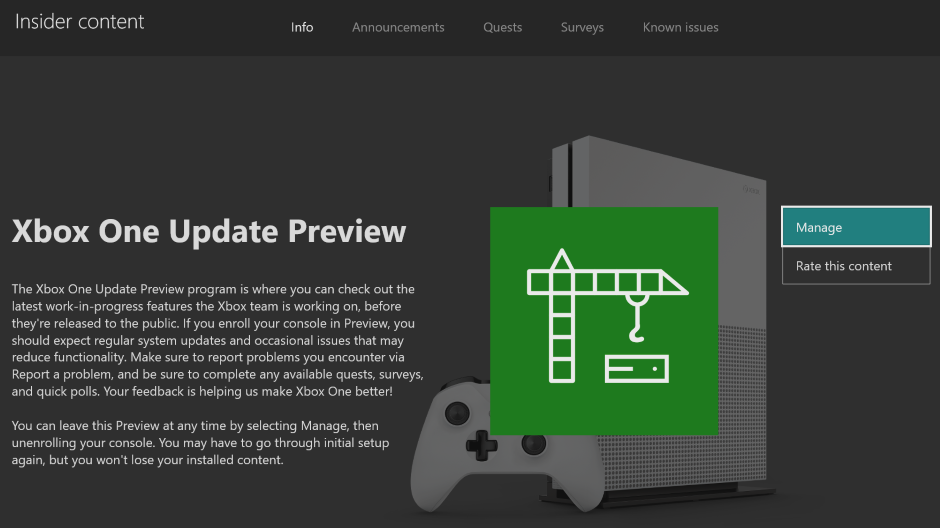
Thank you for being part of the Alpha Skip Ahead ring! For more information regarding the Xbox One Update preview rings, check out our blog post here.
Nintendo wins UK court case over Nintendo Switch piracy and modification
Nintendo has walked away from a UK lawsuit victorious, a win that ultimately means five of the country’s major ISPs are now required to “block or at least impede access” to certain websites that facilitate piracy on the Nintendo Switch.
The ruling, picked up by Eurogamer early this morning, specifically requires ISPs to shut off access to four websites that either distribute pirated Switch games or help modify Switch consoles to play pirated games.
“Today, the UK High Court found the sale and distribution of ‘circumvention’ devices for the Nintendo Switch unlawful. Nintendo is pleased that the UK High Court has confirmed that dealing in devices or software that enable piracy on Nintendo Switch systems is unlawful,” a Nintendo spokesperson tells Eurogamer.
Specifically, the court found that the websites in question targeted people within the UK, infringed on Nintendo’s copyrights, and had no legal justification for the modifications being offered.
The legal ruling is the latest in Nintendo’s saga against piracy purveyors, a battle that has tried to snuff out both Switch piracy and piracy of older classic games. Leading up to this lawsuit, the company moved to ban Switch consoles that took advantage of a hardware exploit found on older systems, and has been attempting to curb hackers’ efforts to crack the system since.