



07-03-2022, 04:55 AM
Python foreach Loop
5/5 – (1 vote)
 Question: Does Python have a or loop? If so, how does it work? If not, what is the alternative?
This article will shed light on these questions. I’ll give you the summary first and dive into the details later:

Python has three alternatives to the “for each” loop:
You’ll learn about those alternatives in the following paragraphs, so keep reading!
Let’s get started with the most important question:
What is a “Foreach Loop”?
Definition: A or loop is a programming control flow statement for iterating over elements in a sequence or collection. Unlike other loop constructs, the loop iterates over all elements rather than maintaining a counter, loop variable, or checking a condition after each loop iteration.
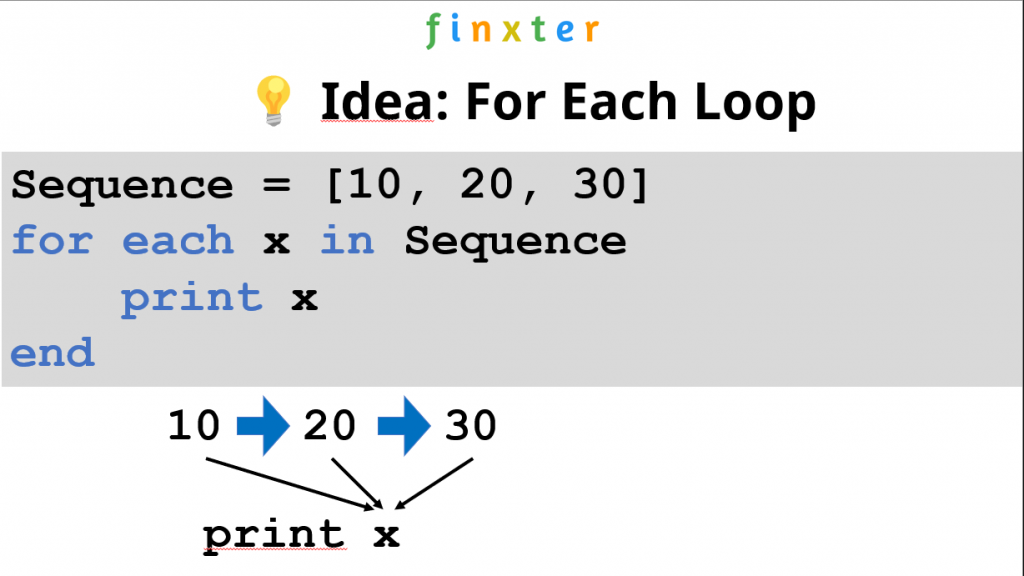 [i]Figure: Example of a for each loop (pseudocode) that iterates over elements 10, 20, and 30 and prints their value.[/i]
Here are three examples of a loop in three different programming languages PHP, C#, and Perl:
Does Python have a foreach Loop?
The Python language doesn’t support the keywords or loops in a literal syntactical way. However, “for each” in Python is done using the “for … in …” expression. For example, to iterate over each element in the list in Python, you’d write .
Here’s a full Python code example with semantical equivalence to a “foreach” statement:
Output:
 Learn More: Feel free to check out our full article on Python loops on the Finxter blog.
“For Each” Meaning “Apply Function to Each Element”
If you’re reading this and you haven’t been satisfied with the answers provided so far, chances are that you’re really searching for the map function functionality in Python.
Many programming languages with “for each” support provide a syntax that applies a function to each element of an iterable like so:
This can be done in Python by means of the function:
Here’s a simple example of how you’d use the function in Python that applies the function to each element of the list , incrementing each of its elements by 1 to obtain :
You can watch my explainer video on in the following video:
Learn More: Feel free to check out our full article on on the Finxter blog.
“For Each” as Python List Comprehension
Python’s list comprehension feature is syntactical sugar to create a new iterable by applying a (possibly identity) function to each element of an existing iterable.
Many coders would view the list comprehension feature as Python’s way to provide a functional “foreach” statement because it enables you to perform a function “for each” element of an iterable such as a sequence.
List comprehension is a compact way of creating lists. The simple formula is.
The example creates the list .
You can watch my explainer video on list comprehension in case you’re interested in how it works:
Learn More: Feel free to check out our full article on Python list comprehension on the Finxter blog.
Programmer Humor
 [i]It’s hard to train deep learning algorithms when most of the positive feedback they get is sarcastic. — from xkcd[/i]
5/5 – (1 vote)
Question: Does Python have a Code:
for eachCode:
foreachThis article will shed light on these questions. I’ll give you the summary first and dive into the details later:
Python has three alternatives to the “for each” loop:
- A simple loopCode:
for ... in ...
- A functionCode:
map()
- A list comprehension statement.
You’ll learn about those alternatives in the following paragraphs, so keep reading!
Let’s get started with the most important question:
What is a “Foreach Loop”?
Definition: A
Code:
foreachCode:
for eachCode:
foreach[i]Figure: Example of a for each loop (pseudocode) that iterates over elements 10, 20, and 30 and prints their value.[/i]Here are three examples of a
Code:
foreachCode:
// PHP
foreach ($set as $value) { // Do something to $value;
} // C#
foreach (String val in array) { console.writeline(val);
} // Perl
foreach (1, 2, 3, 4) { print $_;
}The Python language doesn’t support the keywords
Code:
foreachCode:
for eachCode:
[10, 20, 30]Code:
for x in [10, 20, 30]Here’s a full Python code example with semantical equivalence to a “foreach” statement:
Code:
# 'foreach' or 'for each' in Python is done using 'for'
for x in [10, 20, 30]: print(x)
Output:
Code:
10
20
30
Learn More: Feel free to check out our full article on Python loops on the Finxter blog.“For Each” Meaning “Apply Function to Each Element”
If you’re reading this and you haven’t been satisfied with the answers provided so far, chances are that you’re really searching for the map function functionality in Python.
Many programming languages with “for each” support provide a syntax that applies a function to each element of an iterable like so:
Code:
# Other programming languages:
foreach(function, iterable)
This can be done in Python by means of the
Code:
map()Code:
# Python:
map(function, iterable)
Here’s a simple example of how you’d use the
Code:
map()Code:
fCode:
[1, 2, 3]Code:
[2, 3, 4]Code:
lst = [1, 2, 3] def f(x): return x + 1 print(map(f, lst))
# [2, 3, 4]
You can watch my explainer video on
Code:
map() Learn More: Feel free to check out our full article on Code:
map()“For Each” as Python List Comprehension
Python’s list comprehension feature is syntactical sugar to create a new iterable by applying a (possibly identity) function to each element of an existing iterable.
Many coders would view the list comprehension feature as Python’s way to provide a functional “foreach” statement because it enables you to perform a function “for each” element of an iterable such as a sequence.List comprehension is a compact way of creating lists. The simple formula is
Code:
[expression + context]- Expression: What to do with each list element?
- Context: What elements to select? The context consists of an arbitrary number of andCode:
forstatements.Code:if
The example
Code:
[x+10 for x in [1, 2, 3]]Code:
[11, 12, 13]Code:
lst = [1, 2, 3]
new_lst = [x+10 for x in lst]
print(new_lst)
# [11, 12, 13]
You can watch my explainer video on list comprehension in case you’re interested in how it works:
Learn More: Feel free to check out our full article on Python list comprehension on the Finxter blog.Programmer Humor
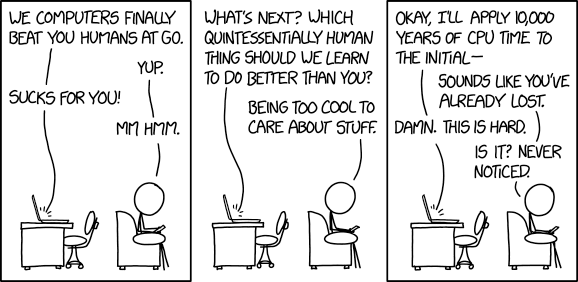 [i]It’s hard to train deep learning algorithms when most of the positive feedback they get is sarcastic. — from xkcd[/i]