2018 Oracle Code One - Java, Java...and more Java!
The inaugural Oracle Code One conference will shortly take place (Oct 22-25). And so many of you have wondered, asked, and contemplated, “Will Java still be featured in the content?” The answer is: Absolutely, YES! This year’s conference has multiple Java related tracks among the entire collection. ...
Problem Statement: How to define a method outside of class definition in Python?
Example:
# Given Class

class Demo:

# Given Method def foo(self): x = 10 return x
Can we create foo() outside of the class definition or maybe even in another module?
Introduction
We all know Python is an object-oriented programming language, and in Python, everything is an object including properties and methods. In Python, the class is like an object’s constructor for creating the objects. Thus, the variables can be defined inside the class, outside the class, and inside the methods in Python. The variables defined outside the class can be accessed by any method or class by just writing the variable name. So, in this article, we are going to learn how to define a method outside of the class definition.
What are Methods in Python?
As Python is an object-oriented programming language, it has objects that consist of properties. The attributes define the properties of these objects, and the behavior is defined using methods. Methods are reusable pieces of code called at any point in the program and are defined inside the class. Every method is associated with the class and can be invoked on the instances of that class.
For example, we can consider a class named ‘Students’ that contains properties like name, id , and rank. The class also holds behaviors like run, jump , and swim. Suppose an object Stud1 has the following properties:
Name- Finxter
Id – 1020
Rank- 1
Here’s how you can assign the values:
class Student: def __init__(self, name, id, rank): self.name = name self.id = id self.rank = rank def run(self): print(f'{self.name} is a cross country champion!') def jump(self): print(f'{self.name} with the following ID: {self.id} is a high jumper!') def swim(self): print(f'{self.name} secured rank {self.rank} in swimming.') stud1 = Student('Finxter', 1020, 1)

stud1.run()

stud1.jump()

stud1.swim()
Output:
Finxter is a cross country champion!
Finxter with the following ID: 1020 is a high jumper!
Finxter secured rank 1 in swimming.
The above example demonstrated the traditional way of adding functionality (methods) to a Python class. Here, the methods were defined inside the class body. Now, let’s say that you want to define a method outside the class body. How will you do so? Let’s dive into the different approaches to unearth the answers to this question.
Define The Method Outside and Use Inside Class Body
The idea here is to define the method outside the class and then use it inside the class body, as shown below.
Example 1:
# Defining the method outside the class

def foo(self): print("Method foo executed") x = 10 print("Value of x = ", x)

# Using the method inside the class body

class Demo: my_method = foo
You can also define a class first and then add a method or function to it from outside its body, as shown below.
Example 2:
# Define the class

class Demo: pass # Define the method outside the class def foo(self): print("Method foo executed ") # Pass the method to the class

Demo.method1 = foo
Caution: We can even define the functions, methods, and classes in different modules if we want to. However, it is advisable to use example 1 rather than example 2 (defining the class in one module, then importing it into another module and further adding methods to it dynamically) because the class objects may behave differently depending on whether the module has been imported or not.
There’s another way to define the function outside of a class and then further add it. But there is a difference in assigning the function to the instance object or the class. Look at the following example to understand the subtle difference:
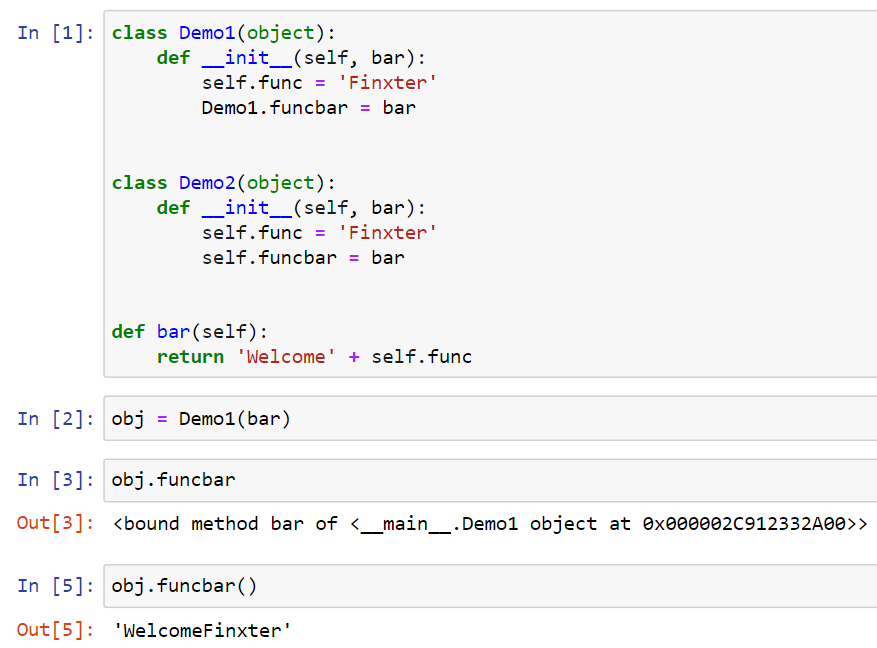
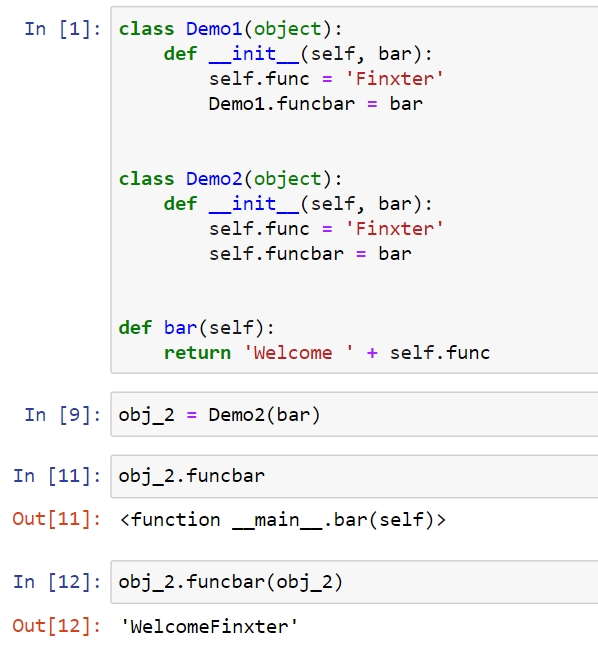
class Demo1(object): def __init__(self, bar): self.func = 'Finxter' Demo1.funcbar = bar class Demo2(object): def __init__(self, bar): self.func = 'Finxter' self.funcbar = bar def bar(self): return 'Welcome' + self.func
In case of class Demo1 , funcbar is just like any other normal method that is bound to the instance of the class. Let’s have a look at what this looks like –
In case of class Demo 2, funcbar is simply a reference to the bar function, i.e., it is not abound function. Thus, we must pass the instance for this function for it to work properly.
You can even use the methods of a class in another class. In the following example we have a class Helper with certain methods defined within it. All the methods of the class Helper can be inherited by the class Demo as shown below.
class Helper(object): # Subtraction function def subs(self, a, b): return a - b # Addition function def add(self, a, b): return a + b # Multiplication function def mul(self, a, b): return a * b # Division function def div(self, a, b): return a / b

# Given class

class Demo(Helper): def __init__(self): Helper.__init__(self) print("The addition of numbers is", self.add(10, 5)) print("Subtraction of numbers is", self.subs(60, 15)) print("Multiplication of numbers is", self.mul(5, 9)) print("The division of numbers is", self.div(100, 50))

# Main method

if __name__ == '__main__': obj = Demo()
Output:
The addition of numbers is 15
Subtraction of numbers is 45
Multiplication of numbers is 45
The division of numbers is 2.0
To sum things up, it is absolutely possible to have functions outside classes in Python. If you want to gather a group of functions in one box then you can simply put them together in the same module. Further, you can nest modules within packages. It is recommended that you should use classes when you have to create a new datatype and don’t just use it to group functions together.
That’s it for this discussion and I hope it helped you. Please stay tuned and subscribe for more interesting articles and discussions in the future. Happy learning!
[www.indiegala.com] Check out our new Jazz Hop Café bundle full of relaxing tracks to vibe/study to, tunes brought by Prithvi, Grisp, Haru Pandi, HoKø, Refeeld, Kissamilé, Rakuyou, ayeon & lofty. Accept lofi into your life, start an audio romance and go on a journey of discovery.
Back 4 Blood: Tunnels Of Terror Trailer Showcases New Cleaners And Ridden
Warner Bros. Games and Turtle Rock Studios have released a launch trailer for Tunnels of Terror, the first post-launch expansion for Back 4 Blood. The trailer showcases the DLC's new playable Cleaners, enemy Ridden, and Ridden Hives PvE activity.
Tunnels of Terror adds two melee-focused Cleaners: the defensive Sharice and aggressive Heng. Sharice is a former firefighter who wields an axe--her passive buff strengthens armor plates. She also has extra trauma resistance and provides increased health for the entire squad.
Heng utilizes his knife against the Ridden with the skills he learned when he owned a restaurant. He can sense gear through walls and nearby Hive entrances, while also providing a team buff that allows anyone in the squad to reuse their accessories and keep on the offensive.
Due to regional restriction, the ASF codes have separate subID's, visit https://steamdb.info/app/582660/subs/ and get the respective subID for the named "Black Desert Limited Free Promotional Package" with the "No Cost" billing time, clicking the code will show the countries available to each of them. Alternatively check the comments for each code.
We are welcoming everyone to join our discord[discord.gg]. We are more active there on finding giveaways, small or large, and there are daily raffles you can participate.
Break into the snowboarding event of the year in the hope of scoring a wildcard entry to an exclusive invitational. To prove you’re up to the challenge, master the art of park riding, buttering, rails and massive kickers and earn your place in the world of snowboarding.
Advanced Management Console (AMC) 2.12 Release is Now Available
The Advanced Management Console (AMC) 2.12 release is now available. This release of AMC 2.12 is primarily a bug fix release. AMC offers system administrators greater and easier control in managing Java version compatibility and security updates for desktops within their enterprise and for ISVs with...
Before we learn about the money, let’s get this question out of the way:
What Is Puppet?
Let’s have a look at the definition from this Puppet website (highlights be me):
“Puppet is an open source software configuration management and deployment tool. It’s most commonly used on Linux and Windows to pull the strings on multiple application servers at once. But you can also use Puppet on several platforms, including IBM mainframes, Cisco switches, and Mac OS servers.”
Now that you know about what it is, let’s have a look at what it earns next!
Annual Income
How much does a Puppet Developer make per year?
The average annual income of a Puppet Developer in the United States is $92,000 per year according to PayScale (source). Top earners make $160,000 and more in the US!
Here are different job descriptions using the Puppet skillset:
If you decide to go the route as a freelance Puppet Developer, you can expect to make between $25 and $60 per hour on Upwork (source). Assuming an annual workload of 2000 hours, you can expect to make between $50,000 and $120,000 per year.
Note: Do you want to create your own thriving coding business online? Feel free to check out our freelance developer course — the world’s #1 best-selling freelance developer course that specifically shows you how to succeed on Upwork and Fiverr!
But is there enough demand? Let’s have a look at Google trends to find out how interest evolves over time (source):
Work Description
So, you may wonder: Puppet Developer – what’s the definition?
Puppet Developer Definition: A Puppet Developer is a DevOps engineer who automates repetitive administrative tasks in cloud and distributed environments (servers).
Learning Path, Skills, and Education Requirements
Do you want to become a Puppet Developer? Here’s a step-by-step learning path I’d propose to get started with Puppet:
But don’t wait too long to acquire practical experience!
Even if you have little skills, it’s best to get started as a freelance developer and learn as you work on real projects for clients — earning income as you learn and gaining motivation through real-world feedback.
Tip: An excellent start to turbo-charge your freelancing career (earning more in less time) is our Finxter Freelancer Course. The goal of the course is to pay for itself!
Related Video
You can find more job descriptions for coders, programmers, and computer scientists in our detailed overview guide:
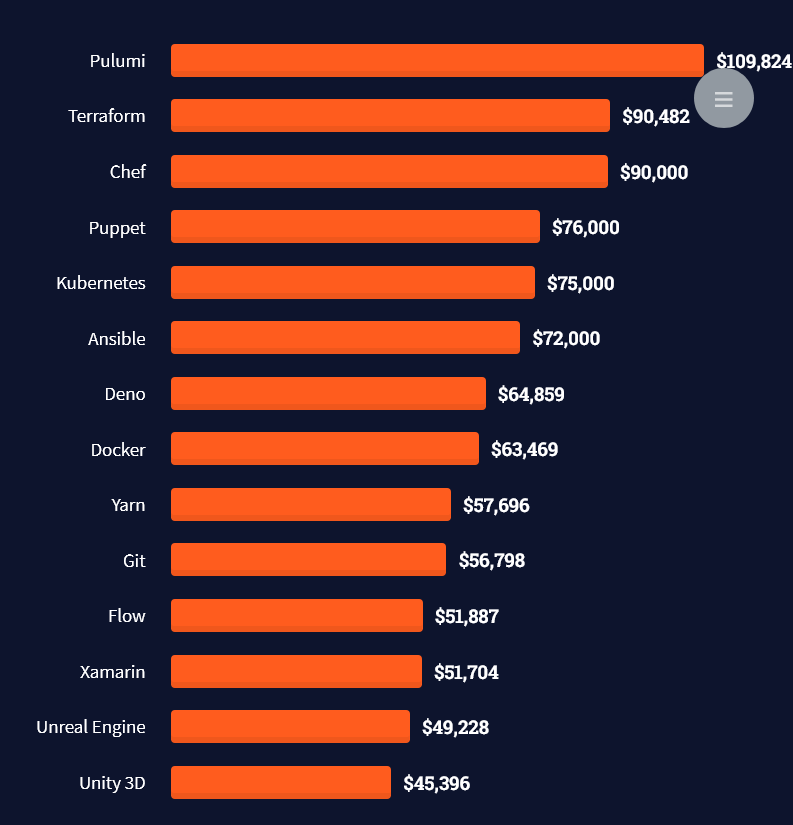
The following statistic shows the self-reported income from 9,649 US-based professional developers (source).
The average annual income of professional developers in the US is between $70,000 and $177,500 for various programming languages.
Question: What is your current total compensation (salary, bonuses, and perks, before taxes and deductions)? Please enter a whole number in the box below, without any punctuation. If you are paid hourly, please estimate an equivalent weekly, monthly, or yearly salary. (source)
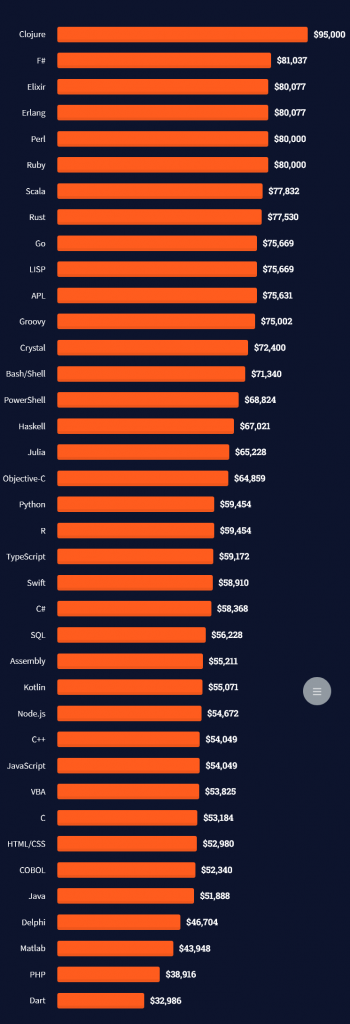
The following statistic compares the self-reported income from 46,693 professional programmers as conducted by StackOverflow.
The average annual income of professional developers worldwide (US and non-US) is between $33,000 and $95,000 for various programming languages.
Here’s a screenshot of a more detailed overview of each programming language considered in the report:
Here’s what different database professionals earn:
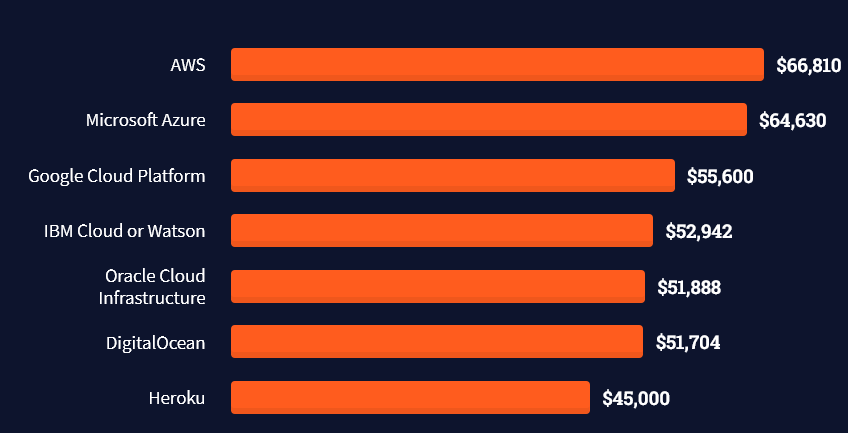
Here’s an overview of different cloud solutions experts:
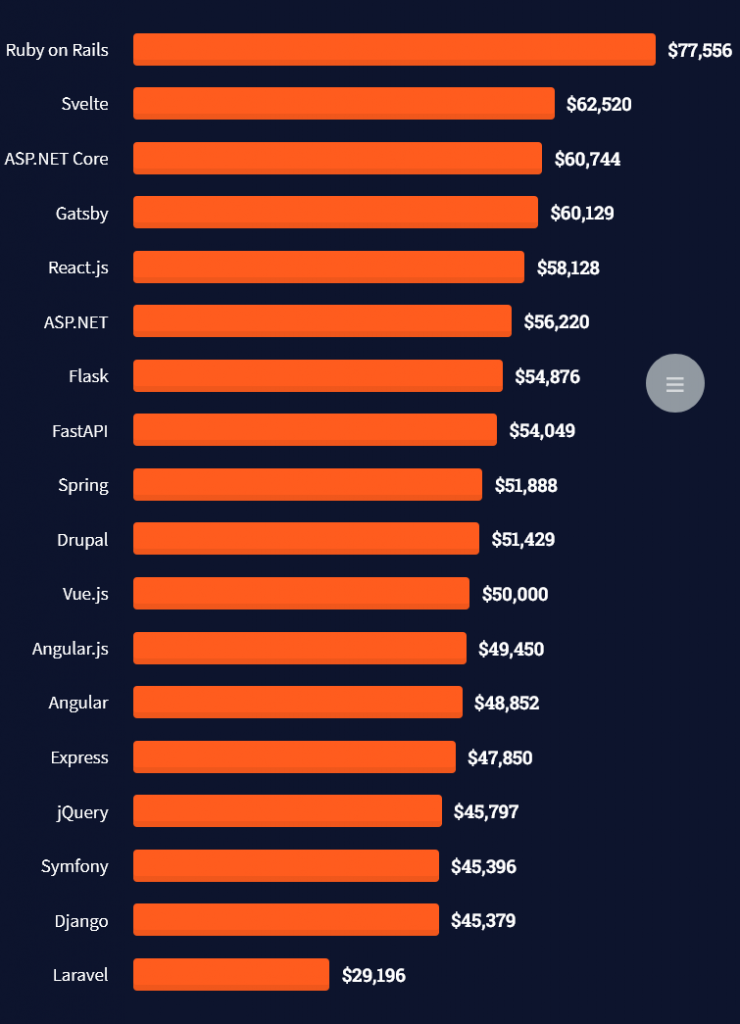
Here’s what professionals in web frameworks earn:
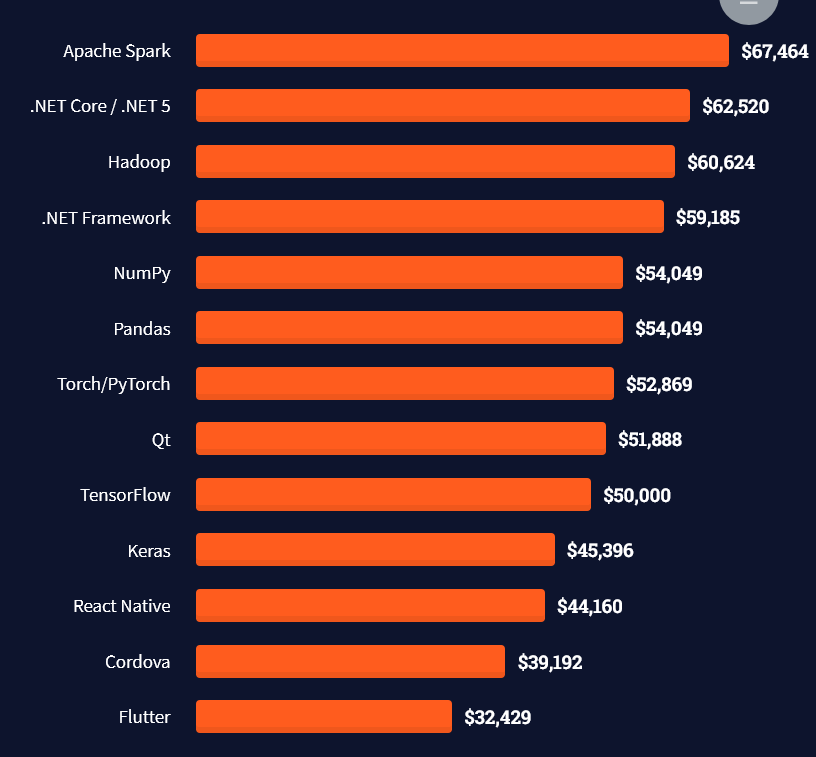
There are many other interesting frameworks—that pay well!
Look at those tools:
Okay, but what do you need to do to get there? What are the skill requirements and qualifications to make you become a professional developer in the area you desire?
Let’s find out next!
General Qualifications of Professionals
StackOverflow performs an annual survey asking professionals, coders, developers, researchers, and engineers various questions about their background and job satisfaction on their website.
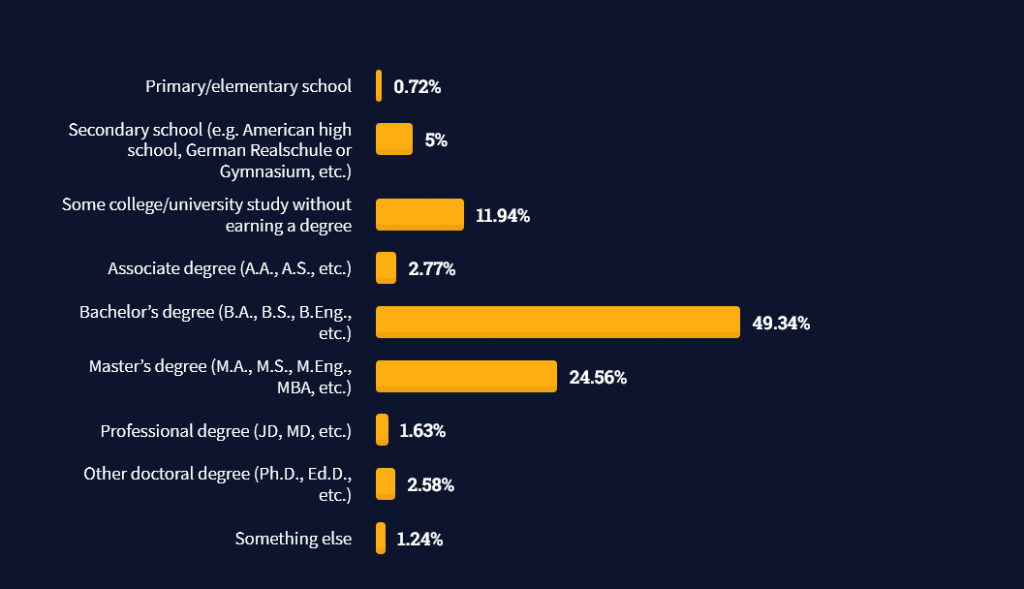
Interestingly, when aggregating the data of the developers’ educational background, a good three quarters have an academic background.
Here’s the question asked by StackOverflow (source):
Which of the following best describes the highest level of formal education that you’ve completed?
However, if you don’t have a formal degree, don’t fear! Many of the respondents with degrees don’t have a degree in their field—so it may not be of much value for their coding careers anyways.
Also, about one out of four don’t have a formal degree and still succeeds in their field! You certainly don’t need a degree if you’re committed to your own success!
Freelancing vs Employment Status
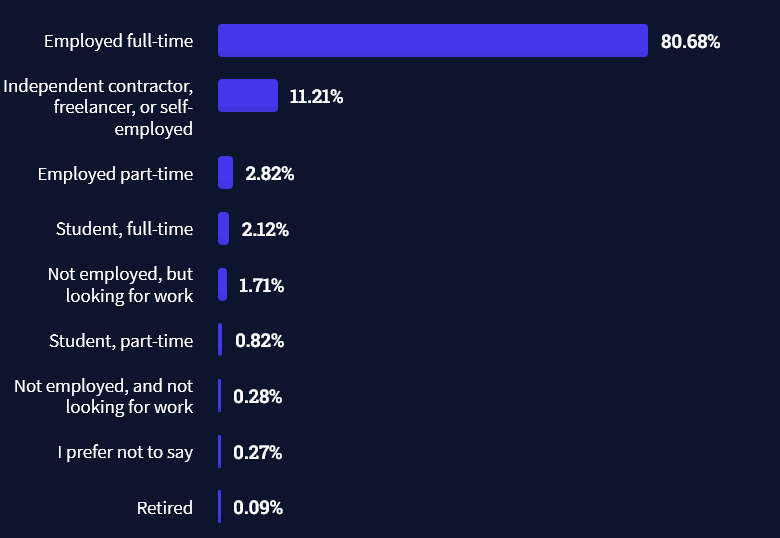
The percentage of freelance developers increases steadily. The fraction of freelance developers has already reached 11.21%!
This indicates that more and more work will be done in a more flexible work environment—and fewer and fewer companies and clients want to hire inflexible talent.
Here are the stats from the StackOverflow developer survey (source):
Do you want to become a professional freelance developer and earn some money on the side or as your primary source of income?
Resource: Check out our freelance developer course—it’s the best freelance developer course in the world with the highest student success rate in the industry!
Other Programming Languages Used by Professional Developers
The StackOverflow developer survey collected 58000 responses about the following question (source):
Which programming, scripting, and markup languages have you done extensive development work in over the past year, and which do you want to work in over the next year?
These are the languages you want to focus on when starting out as a coder:
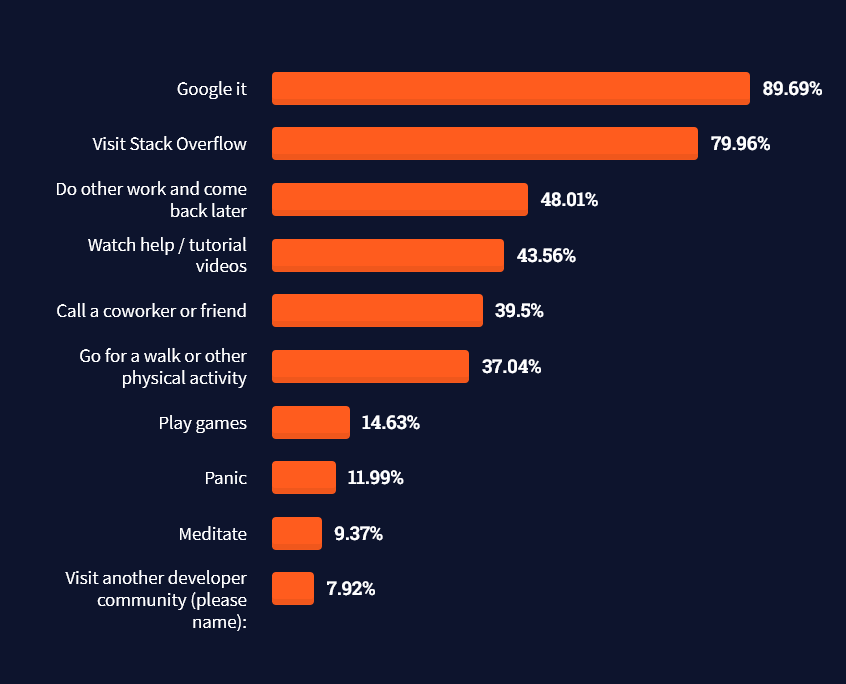
And don’t worry—if you feel stuck or struggle with a nasty bug. We all go through it. Here’s what SO survey respondents and professional developers do when they’re stuck:
What do you do when you get stuck on a problem? Select all that apply. (source)
Related Tutorials
To get started with some of the fundamentals and industry concepts, feel free to check out these articles:
Coders get paid six figures and more because they can solve problems more effectively using machine intelligence and automation.
To become more successful in coding, solve more real problems for real people. That’s how you polish the skills you really need in practice. After all, what’s the use of learning theory that nobody ever needs?
You build high-value coding skills by working on practical coding projects!
Do you want to stop learning with toy projects and focus on practical code projects that earn you money and solve real problems for people?
If your answer is YES!, consider becoming a Python freelance developer! It’s the best way of approaching the task of improving your Python skills—even if you are a complete beginner.
If you just want to learn about the freelancing opportunity, feel free to watch my free webinar “How to Build Your High-Income Skill Python” and learn how I grew my coding business online and how you can, too—from the comfort of your own home.
We want to thank you all once again for your support and patience. It has been a long time since we last shared an update about the progress of our internal development team.
Vorax aims to interpret survival horror in a modern and innovative way.
Our Request
We are making solid progress and know that there is a committed and passionate team that is working hard behind the scenes.
We will slowly but surly release more and more about the game, so to stay updated follow us [voraxgame.com] and lastly, but not least, wishlist Vorax on Steam to get informed about its future release.
Available until Apr 2nd. !addlicense asf s/705132 for ASF users.
We are welcoming everyone to join our discord[discord.gg]. We are more active there on finding giveaways, small or large, and there are daily raffles you can participate.





 Note: Do you want to create your own thriving coding business online? Feel free to check out our
 Tip: An excellent start to turbo-charge your freelancing career (earning more in less time) is our
  The average annual income of professional developers in the US is between $70,000 and $177,500 for various programming languages.