| |
| PS4 - DOOM VFR |
|
Posted by: xSicKxBot - 12-10-2017, 10:28 PM - Forum: New Game Releases
- No Replies
|
 |
DOOM VFR
Available for PlayStation VR and VIVE platforms, this DOOM adventure will bathe you in virtual carnage. Developed by id Software, the studio that pioneered the first-person shooter genre and modern VR, DOOM VFR brings the fast-paced, brutal gameplay fans of the series love to virtual reality. Immerse yourself in the UAC facility on Mars and the depths of Hell, as your skills are put to the test through intense combat and challenging puzzle-solving. Play as a cybernetic survivor who is activated by the UAC to fight the demon invasion, maintain order, and prevent catastrophic failure at the Mars facility. Lay waste to an army of demonic foes as you explore and interact with the outlandish world of DOOM from an entirely new perspective. Publisher: Bethesda Softworks Release Date: Dec 01, 2017
|

|
|
| PC - Ode |
|
Posted by: xSicKxBot - 12-10-2017, 10:28 PM - Forum: New Game Releases
- No Replies
|
|
Ode
Control and transform Joy, a fallen star who lands in a beautiful land of light and sound. Navigate this mesmerising musical garden in this unique experience completely at your own pace. Bring the world around you to life and return fallen stars to the sky. Publisher: Ubisoft Release Date: Nov 27, 2017
|
|
|
|
| PC - Total War: Rome II - Empire Divided |
|
Posted by: xSicKxBot - 12-10-2017, 10:28 PM - Forum: New Game Releases
- No Replies
|
|
Total War: Rome II - Empire Divided
The year is 270 AD. A string of inept emperors and usurpers vying for power has led the Roman Empire into near-total economic collapse. This is its gravest crisis yet. Eager to capitalise on Rome?s instability, barbarian tribes gather like a storm on the borders, to plunder the riches of civilisation. To the east, the Sassanids set out on a grand conquest that culminates with an assault against Roman lands. They are held back only by a staunch defence led by Palmyra. Queen Zenobia holds fast ? but for how long? Publisher: Sega Release Date: Nov 30, 2017
|
|
|
|
| News - The Game Awards 2017 on Steam! |
|
Posted by: xSicKxBot - 12-10-2017, 06:57 PM - Forum: Lounge
- No Replies
|
|
The Game Awards 2017 on Steam!
Watch The Game Awards 2017 live on Steam! The stream begins Dec 7th at 5:30pm PST.
In addition to the show, there are a number of nominated titles on sale right now until Dec 9th at 10am PST. Also, to celebrate The Game Awards 2017, we will randomly drop 150 free copies of nominated titles every 15 minutes during the show. Click here for details on how to participate.
|
|
|
|
| News - Bayonetta 3, The Legend of Zelda DLC news revealed during The Game Awards |
|
Posted by: xSicKxBot - 12-10-2017, 06:57 PM - Forum: Lounge
- No Replies
|
|
Bayonetta 3, The Legend of Zelda DLC news revealed during The Game Awards
Bayonetta 3, The Legend of Zelda DLC news revealed during The Game Awards
Nintendo received a number of honors at The Game Awards in Los Angeles, winning the awards for Game of the Year for The Legend of Zelda: Breath of the Wild, Best Family Game for Super Mario Odyssey and Best Handheld Game for Metroid: Samus Returns. The Legend of Zelda: Breath of the Wild also won the awards for Best Game Direction and Best Action/Adventure Game.
But that’s not the only Nintendo news from the annual awards show. During the event, Nintendo revealed a trailer announcing that the Bayonetta 3 game is currently in development exclusively for the Nintendo Switch system. In addition, the critically acclaimed Bayonetta 2 game, originally a Wii U exclusive, will be launching for Nintendo Switch on Feb. 16. Players who purchase the game in stores at a suggested retail price of $59.99 will receive a free download code for the original Bayonetta game. Consumers looking to purchase the digital versions of the games for Nintendo Switch can do so via Nintendo eShop or Nintendo.com.* Bayonetta, Bayonetta 2 and Bayonetta 3 are developed by PlatinumGames.
Fans of The Legend of the Zelda: Breath of the Wild game got a new look at the game’s second DLC pack, The Champions’ Ballad, as well as the surprise news that it launched shortly after The Game Awards livestream. In this second of two DLC packs that are part of the game’s Expansion Pass, players are granted access to a large new adventure featuring a never-before-seen dungeon, new insights into the background of the game’s four Champions, as well as a new high-mobility means of transportation. Once players complete the adventure, they will have the opportunity to traverse the enormous world of Hyrule on top of a motorcycle called Master Cycle Zero. The DLC will also grant access to nine new armor items for players to find, as well as the Ancient Saddle and Bridle items. Players who purchase the Expansion Pass for $19.99 receive The Champions’ Ballad DLC Pack 2, as well as The Trial of the Sword DLC Pack 1, which launched earlier this year. For more information about what is included in the Expansion Pass, visit http://www.zelda.com/breath-of-the-wild/expansion-pass.
Players who have yet to experience the game can purchase The Legend of Zelda: Breath of the Wild – Explorer’s Edition, a limited bundle that includes the critically acclaimed Nintendo Switch game, a 100-page explorer’s guide and a two-sided map at a suggested retail price of $59.99.
In addition, some of the games that were nominated for awards this year are from franchises featured in the Cyber Deals sale currently featured in Nintendo eShop and at Nintendo.com. Fans can save on select games featuring Mario, Link and more fun characters at https://nintendo.com/tga.
The event also featured a live performance of the “Jump Up, Super Star!” song from the Super Mario Odyssey game, with vocals by the game’s original singer.
“We are absolutely humbled that voters chose Nintendo for these awards,” said Reggie Fils-Aime, Nintendo of America’s President and COO. “We plan to continue this strong momentum as we head into 2018.”
The Game Awards can be viewed in their entirety by visiting http://thegameawards.com/.
Games Rated:

|
|
|
|
| Xbox Wire - New Preview Alpha and Beta System Update – 11/30/17 |
|
Posted by: xSicKxBot - 12-10-2017, 06:57 PM - Forum: Xbox Discussion
- No Replies
|
|
New Preview Alpha and Beta System Update – 11/30/17
We’re continuing to put out new 1711 builds this week focused on general stability and performance. Our latest system update (1711.171128-1839) will be made available to Alpha and Beta Insiders starting today at 2 p.m. PST and becoming mandatory tomorrow at 1 a.m. PST. This update includes a fix to various streaming apps, such as Twitch, YouTube and HBO Go. We’ve also expanded our Known Issues list, which can be found below with current workarounds included for several items.
FIXES:
Apps
- Fixed an issue which would sometimes cause streaming video content to unexpectedly crash. This issue affected multiple apps including Twitch, YouTube and HBO Go.
KNOWN ISSUES:
Wi-Fi
- We are investigating reports of degraded Wi-Fi- performance. Current workaround, which has been successful for some users, is to hard reboot the console by holding the power button for 10 seconds.
Games/apps not installing/updating
- We are investigating reports that some users cannot install games or apps. Current workarounds that have proven effective for some users include changing Wi-Fi networks quickly, plugging in an Ethernet cable and disabling IPV6 on your home network.
Sound
- AVRs with HDMI-passthrough will break Dolby Atmos for Home Theater if the TV and console is turned on before the AVR . Current workaround is to power on your receiver before turning on your Xbox One console.
Display
- We are investigating reports of inaccurate RGB colors when displaying in 4K HDR mode while playing a UHD disc.
Tournaments
- The left and right navigation for selecting date and time during Tournament creation is currently reversed when the console language is set to Arabic or Hebrew.
- Left and right navigation in Tournament twists is reversed when the console language is set to Arabic or Hebrew.
- Left and right navigation in the bracket view of Tournaments is reversed when the console language is set to Arabic or Hebrew.
Avatars on Home
- Users wishing to represent themselves as an avatar can do so by changing their settings under My profile > Customize profile > Show my avatar.
Narrator
- Narrator may stop performing when reading large amounts of text.
|
|
|
|
| News - Bayonetta 1 And 2 Are Getting A Special Edition Bundle With All The Trimmings |
|
Posted by: xSicKxBot - 12-10-2017, 06:57 PM - Forum: Nintendo Discussion
- No Replies
|
|
Bayonetta 1 And 2 Are Getting A Special Edition Bundle With All The Trimmings
Who knew The Game Awards would drop so much Nintendo love, eh? Not only are we getting Bayonetta 3 – a Switch exclusive, we might add – but the first two entries in the PlatinumGames series are getting the handheld treatment, too.
Better yet, Nintendo even showcased a glitzy new Special Edition that’s bound to make any witch in training run to their nearest retailer. The Special Edition will include (drum roll, please): a download code for Bayonetta, a physical case and Switch game card for Bayonetta 2, a steelbook with artwork from both games, three sheets of stickers and 22 highly collectible Verse Cards.
Holy moly that’s a lot of bang for your Bayonetta buck. There’s also a regular edition that includes a physical copy of Bayonetta 2 and a download code for the first game. Oh, and if you purchase either game from the eShop, you can buy the second at a reduced price. Bargain!
Japan is getting the same bundle, only its one is called the ‘Non-Stop Climax Edition’. Nope, you really did just read that.
Bayonetta 1 and 2 will launch on Nintendo Switch on 16 February 2018. Bayonetta 3, unsurprisingly, doesn’t have a release date yet. No word on the official price point for the Special Edition just yet, but expect it to be north of £50/$65.
So what do you make of this Special Edition? Will this be your first time unleashing magical mayhem or will you be double dipping in 2018? Comments ahoy!
|
|
|
|
| Steam - Now Available on Steam Early Access – RIOT – Civil Unrest, 10% off! |
|
Posted by: xSicKxBot - 12-10-2017, 06:57 PM - Forum: PC Discussion
- No Replies
|
|
Now Available on Steam Early Access – RIOT – Civil Unrest, 10% off!
RIOT – Civil Unrest is Now Available on Steam Early Access and is 10% off!*
As civil crisis deepens and inequality tears the very fabric of society the discontentment of the masses manifests itself in violent public disturbances and civil disorder. Play as the police or the angry horde as RIOT – Civil Unrest places you in some of the world’s most fractious disputes.
*Offer ends December 13 at 10AM Pacific Time
|
|
|
|
| News - The State of Destiny 2 |
|
Posted by: xSicKxBot - 12-10-2017, 06:57 PM - Forum: Lounge
- No Replies
|
|
The State of Destiny 2
 Hey everyone,
With Destiny 2’s console and PC launches behind us, we want to take some time to talk with you about Destiny 2 – specifically where it’s at today, and where it’s going. Our team has been reading feedback and working on updates to improve the game. We’ve also been reading some tough criticism about our lack of communication, and we agree we need to be more open.
Going forward, Destiny 2’s post-launch game systems, features, and updates are being designed specifically to focus on and support players who want Destiny to be their hobby – the game they return to, and a game where friendships are made. We want Destiny to be a game that fits into your life, providing you with reasons to log in and play with your friends, clans, and families. We want Destiny to be a world you want to be a part of.
A month ago, we published a list of improvements on the blog. Today, we’re going to revisit that list and update its status, and share some of the work the team is readying for December, January, and beyond.
We know it’s frustrating when there isn’t enough of a dialog with the development team. You have our commitment that we’re going to do a better job going forward.
– Luke Smith & Chris Barrett
Upcoming Updates Overview
- New systems and rewards to give our most engaged players additional, optional pursuits, including:
-
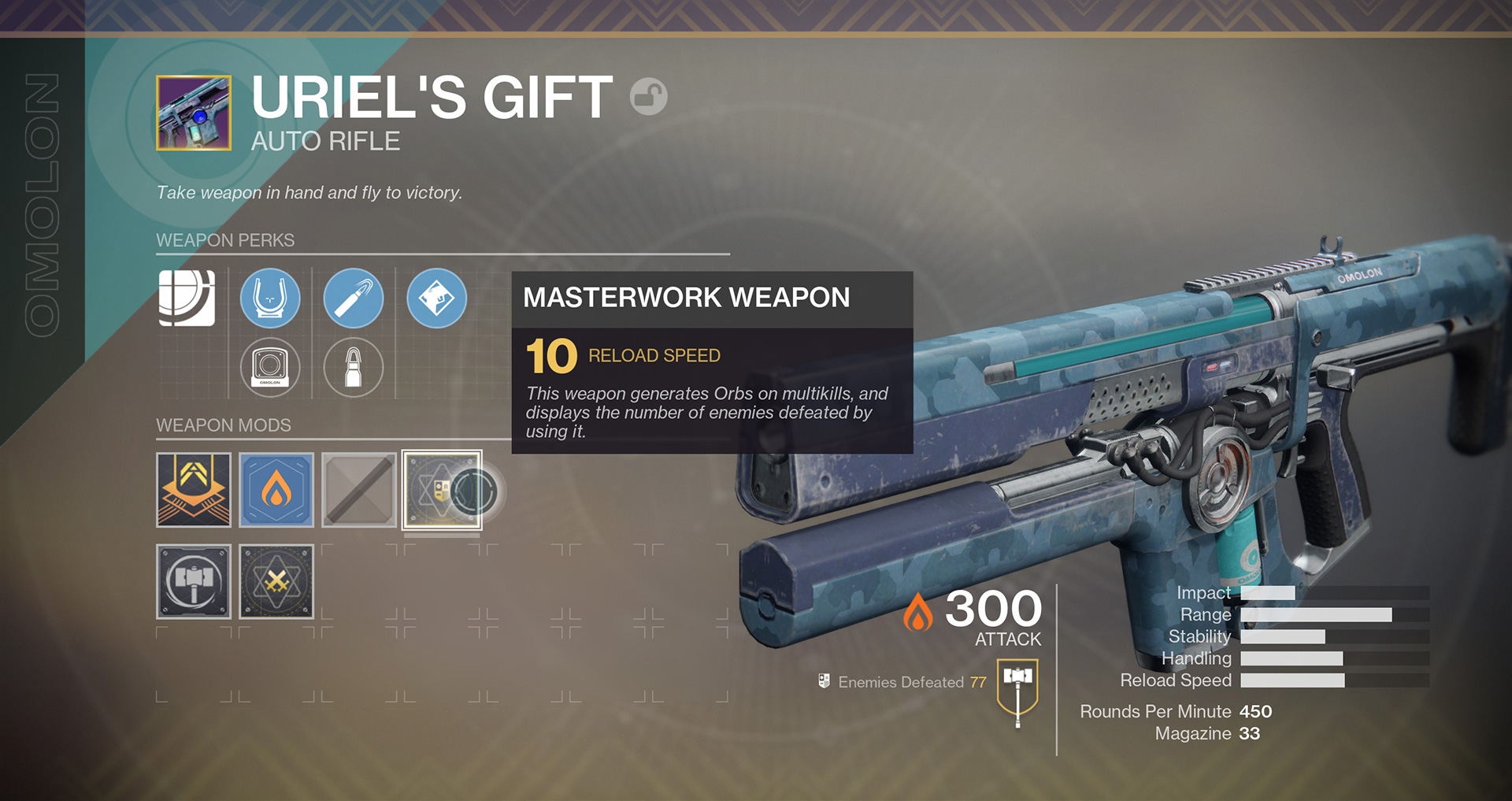
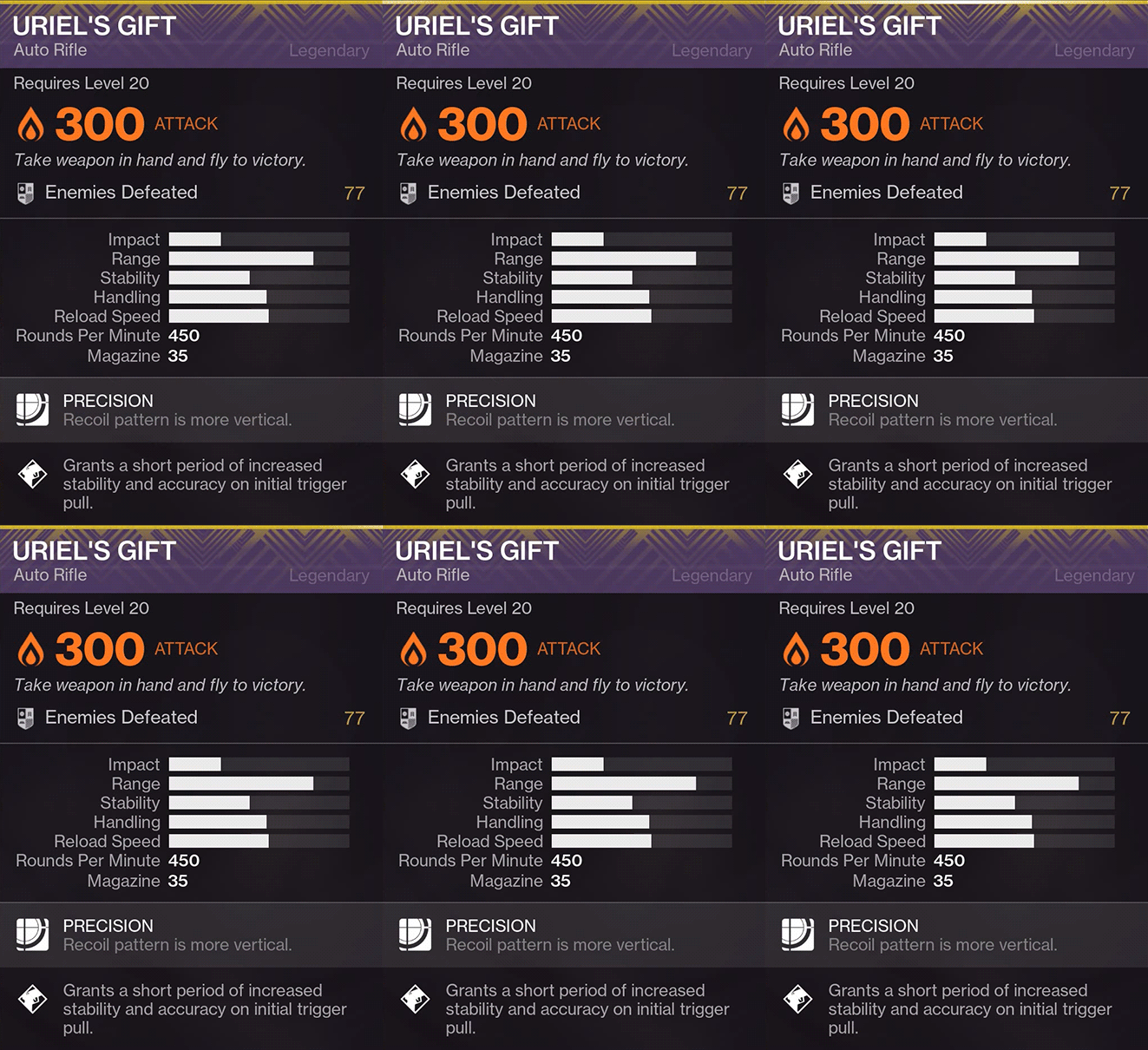
- A new Weapon Tier: Masterworks, which will feature stat trackers, random, re-rollable stat bonuses, unique item tooltips, and item details screens (see the December Update Details section below for more info)
- Improved vendor rewards, adding ways for people to purchase items directly with their Legendary Shards and Tokens (see the December Update Details section below for more info)
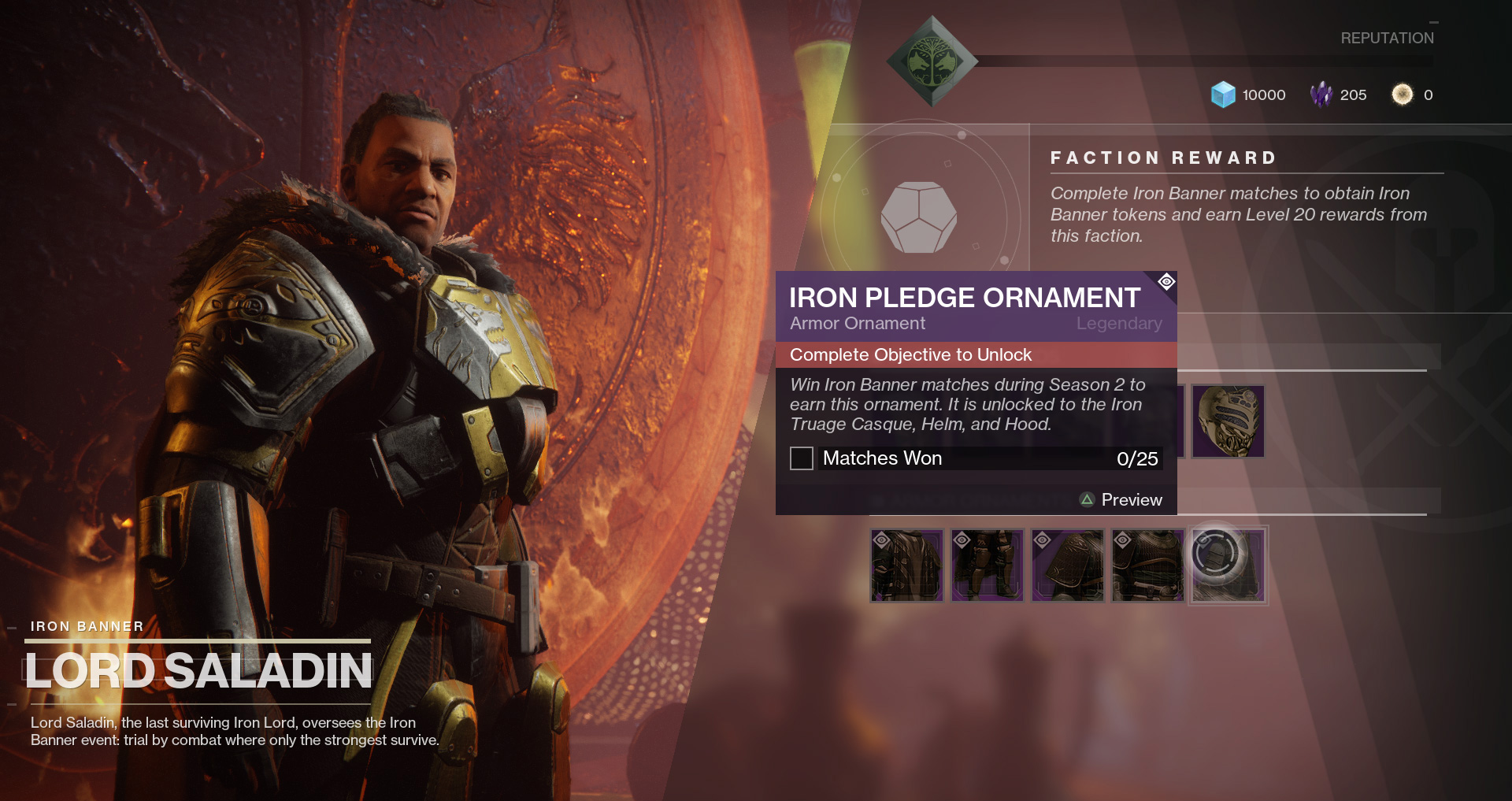
- Adding Armor Ornaments that grant visual permutations of armor as players complete specific Challenges (see the December Update Details section below for more info)
- Better incentives for players who complete challenging Prestige activities
-
- We’re targeting a January update to provide better incentives to complete Prestige activities
- Better rewards and replay value for Strikes, Adventures, and Lost Sectors
-
- In December, we will be introducing a Heroic Strikes playlist and more generous Strike rewards
- Rewards for Adventures and Lost Sectors are still on our radar, but will not be delivered for our December updates
- Private matches for the Crucible
-
- Still targeting early 2018 and expect to have better insight into exact timing in the New Year
- We are also moving Ranked PVP to the top of our priority list for next year to support the competitive community
- Crucible tuning like adjusted Supremacy scoring and better spawning rules
-
- In December, we will introduce additional updates and bug-fixes intended to improve these areas of the Crucible
- Better incentives for completing Crucible matches (and penalties for quitting competitive games)
-
- A “Quitter Penalty” system is currently in development, and you can expect an update on the deployment of this system in the New Year
- Continued improvements to Iron Banner and Faction Rallies, including uniqueness of rewards
-
- The next Iron Banner and Faction Rally will introduce improvements in both these areas (see the December Update Details section below for more info)
- Changes to make the mod economy more interesting and impactful
-
- The Gunsmith will have some updates to how Mods are acquired (see the December Update Details section below for more info)
- We are exploring more updates to this system in the New Year
- Ongoing improvements to Exotics, including adjustments to reduce instances of duplication
-
- We plan to tune under-performing Exotics and will continue to make targeted updates and improvements
- Duplication protection will be added for Exotics in the New Year
- New ways to spend surplus currency and materials (looking at you Legendary Shards)
-
- Players will be able to spend Tokens and Legendary Shards on Vendor inventory (see the December Update Details section below for more info)
- Xur will have new items, as well (see the December Update Details section below for more info)
- An emote interface that allows players to equip Salty, Spicy Ramen, Six Shooter, and Flip Out all at the same time
-
- Emote interface improvements are still on the list, and you can expect an update on the development of this system in the New Year
We will continue to revisit and update this list in the weeks and months ahead to keep you up to speed on what we’re working on. Below, you’ll find more specific detail about each of the features and updates you can expect to land in December.
December Update Details
There are four key areas we’re targeting for improvements in December. Some of these updates will arrive with the December 5 update, and some additional updates will be included in a patch that will be deployed the following week on December 12.
Both updates combined include improvements set against the following goals:
- Deepen Rewards for advanced players
- Provide More Player Control over obtaining rewards
- Make Shards Useful by adding things to use them for
- Provide General Quality fixes wherever possible
The following changes are the first steps towards achieving these goals, with more planned for our next release in January. Here is a preview of impending changes to Destiny 2. Each category is marked with a forecast delivery date.
Masterworks
- [DEC 12] Legendary Weapons will drop as or be upgraded to become Masterworks versions
-
- Masterworks will have a few advantages over the baseline Legendary weapon:
-
- Track and display the number of kills with that weapon (with choice between total count or Crucible-only count)
- Generate orbs for you and your allies on multi-kills
- Add weapon stat bonuses that are selected randomly from a small pool and are re-rollable
- Masterworks drop from any source of Legendary weapons for characters above 250 Power
-
- Unwanted Masterworks can be dismantled into materials that can upgrade an existing Legendary Weapon into a Masterwork
- Raid and Trials of the Nine Weapons will have a very high chance to be Masterworks
- We have future plans to extend Masterworks to other gear and expose your kill counts in more places (e.g. Crucible kill screen)
Armor Ornaments
- [DEC 5] Armor Ornaments will be added to some existing Armor sets for more visual customization without losing your Shaders or Mods
-
- These ornaments will be unlocked by completing objectives specific to each set, and are permanently unlocked account-wide, just like Exotic Weapon ornaments
- They will be applied to the base pieces that you may already have collected, and can now unlock on Vendors if not
- In Season 2, the following sets have ornaments unlocked in their respective activities:
-
- Vanguard Faction Armor
- Crucible Faction Armor
- Trials of the Nine Armor
- Iron Banner Armor
- Dead Orbit Armor
- Future War Cult Armor
- New Monarchy Armor
- Eater of Worlds Raid Lair Armor
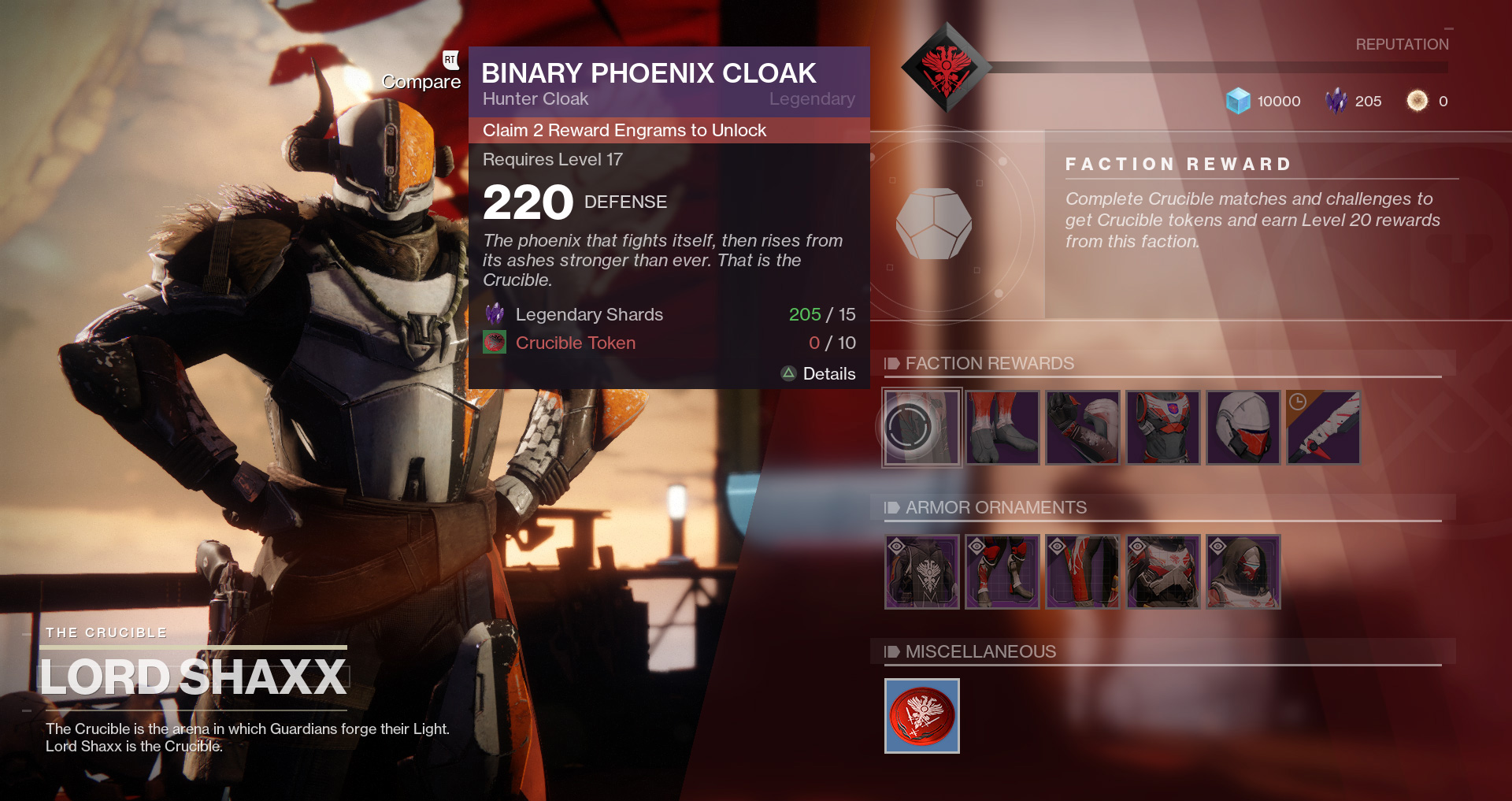
- [DEC 12] Faction Armor and Weapons will be unlocked for purchase for Legendary Shards and Faction Tokens on most Faction Vendors
-
- All five Armor Slots will always be present, and Weapons will rotate weekly on Factions that have them
- Slots will be unlocked by claiming Reward Engrams from the respective Faction
- You will get credit for engrams you may have already claimed since launch
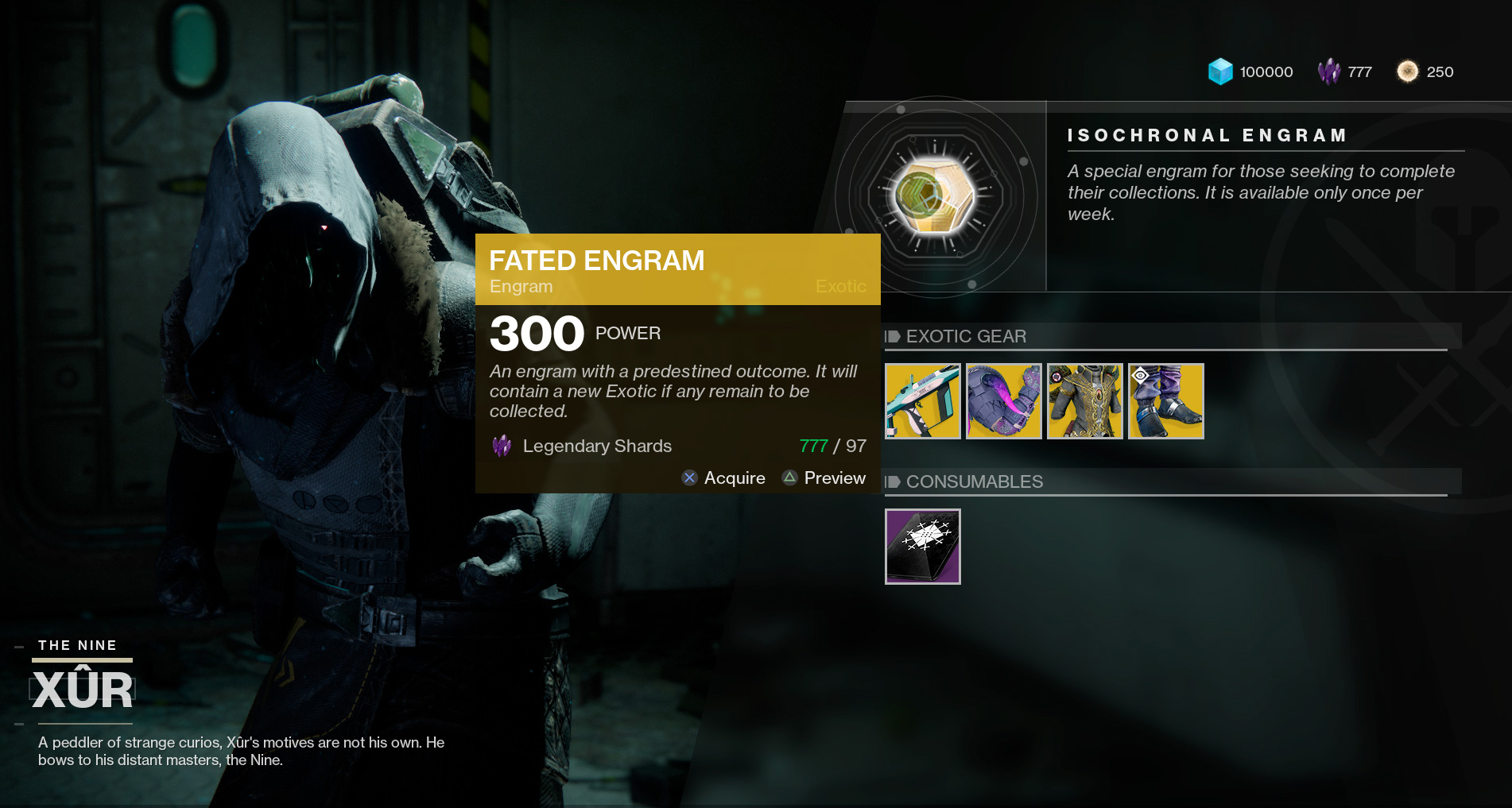
- [DEC 12] Xur has some new offerings for players collecting Exotics:
-
- Every week, you’ll be able to acquire one of the new Fated Engrams using Legendary Shards that will decrypt as Exotics that aren’t already in your collection
- A simpler Three of Coins that boosts Exotic drop rates from any source for 4 hours
-
- No obscure stacking mechanics or need to re-apply before every boss
- These cost Legendary Shards and you can have as many as you like
General Investment
- [DEC 5] Banshee has some updates on the Weapon and Armor Mod front:
-
- For players wanting to clear some Mod inventory space, Rare quality Mods will dismantle into Gunsmith Materials and have a chance to produce Legendary quality Mod Components
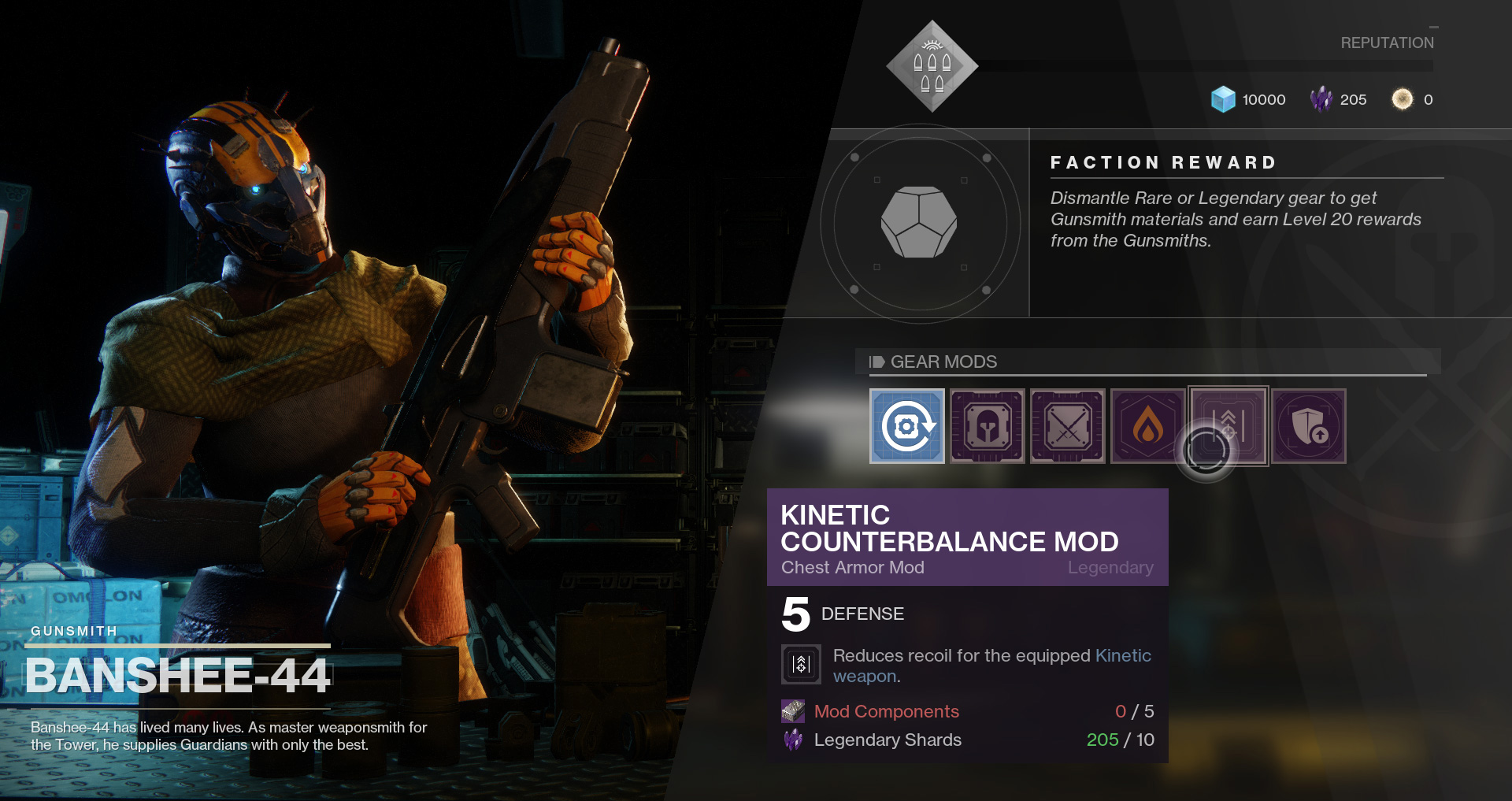
- For players chasing specific Legendary Mods (including Legendary Kinetic Mods), Banshee will offer a selection of specific Legendary Mods for direct purchase, with a selection that will rotate daily and cost Legendary Shards and Mod Components
- [DEC 5] For players chasing a world Legendary or looking for Masterworks, Master Rahool will sell some of his rumored hoard of Legendary Engrams for Legendary Shards
- [DEC 12] Commander Zavala and Lord Shaxx will sell Gift consumables for Legendary Shards that can be used during a Strike or Crucible Match that will serve the following functions:
-
- Grant bonus rewards to everyone in that activity upon completion, friend or foe alike
- Award anything from Faction Tokens to a round of Exotics for everyone in the match
- [DEC 12] Exploit safeguards on Chests and Resource Nodes are greatly relaxed and players should encounter them less frequently
-
- Even if they do, drop rates for Tokens is only reduced to 30% instead of 0%, and Glimmer will be unaffected
- We want to associate a visual indicator with this in a future update, but we weren’t able to pull that off in this update (but we hear you!)
- [DEC 12] Vendors will now beckon you to hand in your Reputation Tokens only when you’re carrying enough to earn a Reward Engram
- [DEC 5] Changes affecting Reputation Tokens:
-
- Daily Challenges will have Reputation Token awards increased across the board
- Cayde’s Treasure Chests still offer variable rewards, but now guarantee (at minimum) a payout of destination appropriate Reputation Tokens
- Strikes will drop a larger number of Vanguard Reputation Tokens
- Common quality Destination Resource Tokens will have their drop rates increased to 100%, and values per Token increased as well (by 50% for common quality Tokens and 250% for rare quality Tokens)
- On the balance, Reputation required per Reward Engram will increase for Destination Factions (+37%) and Gunsmith (+50%)
- Leviathan Raid Tokens will be redeemed at Benedict immediately upon obtaining a Token, instead of requiring a full clear before unlocking
With the launch of Curse of Osiris, and the beginning of Season 2, you can expect to see a full suite of patch notes that will document all of the changes outlined above, as well as additional gameplay and sandbox tuning changes the team is making to improve Destiny 2. We’ll also soon be providing pre-load and launch day details, as well as a roadmap for our Season 2 content, which includes The Dawning in mid-December.
XP Mechanics
Last weekend, we disabled a scaling mechanism that adjusted XP gains up and down without reflecting those adjustments in the UI. Our intention was to keep slower-paced activities as rewarding as high intensity grinding without confusing variations in displayed XP values, but the silent nature of the mechanic betrayed the expectation of transparency that you have for Destiny 2.
We were able to disable the system with a server-side change, but a new solution is now needed to rebalance XP in Destiny 2. We have begun that work, and will continue to provide updates to you about timelines and specifics. The values coded into our website API are being updated today (and may already have been as you read this post) to reflect the removal of this scaling mechanism. In a future update, we intend to link these internal and display-only values together for greater consistency, and to ensure that when changes are made they are accurately reflected everywhere we report them.
We already see that the newly adjusted 160K XP per level value means that leveling is too slow for some activities, and we have begun the process of collecting data and recalibrating XP earn rates to improve them as quickly as possible.
XP boosts, including both consumable items and passive bonuses like the Well Rested 300% bonus, were always applied after this system and never resulted in early slowing of XP. They should be unchanged by the disabling of this system and will continue to provide their stated increase in XP gain.
Expect to see a lot of conversation from our team on this front, as XP rewards are updated and brought back in-line with player expectations.
The Future
Going forward, we plan to continue this dialog as openly and frequently as possible. This will be an ongoing process, but one that we are committed to.
This week we’ll be publishing a new episode of the Bungie Podcast where we will sound off on the current state of Destiny 2, how we think about our communication challenges, and what it takes to update the game in the wild. You’ll be able to listen on both Apple and Android devices.
Thank you for playing, for being passionate about the Destiny 2 experience, and for working with us as we look to continuously improve our game and studio communication.
|
|
|
|
| PS4 - It's Quiz Time |
|
Posted by: xSicKxBot - 12-10-2017, 06:57 AM - Forum: New Game Releases
- No Replies
|
|
It's Quiz Time
Go head to head with the brand-new quiz game on PS4. Featuring our witty and devious AI game host Salli, take on It?s Quiz Time?s catalogue of over 25,000 questions. Face off against up to 8 players using your smartphone, or grab your controller and put yourself to the test. Publisher: Vision Games Publishing LTD Release Date: Nov 28, 2017
|
|
|
|
|