Posted by: xSicKxBot - 06-27-2018, 05:45 AM - Forum: Lounge
- No Replies
Life Is Strange 2: Episode 1 Release Date Unveiled
Life is Strange is returning for a second season, and now we know when to expect it. The episodic narrative-driven adventure game will release its first episode on September 27. We don't have any details on the new storylines, other than the game will be divided into five episodes, but developer Dontnod says more details are coming in August. Check out the announcement tweet below.
Meanwhile, pre-orders of the game will go live next week, and will be timed alongside the release of The Awesome Adventures of Captain Spirit; it's a free, standalone game that was announced at E3 2018. Captain Spirit takes place in the same timeline and universe as Max and Chloe in Life is Strange. Some story elements and player choices will carry over in Life Is Strange 2. Get a look at the trailer for The Awesome Adventures of Captain Spirit in the video above. It comes out June 26 for PS4, Xbox One, and PC.
Episode 1 of #LifeisStrange2 will release on September 27th 2018.
In other Life is Strange news, the franchise is getting a comic book series. Publisher Titan is partnering with Square Enix to release a comic line based on Life Is Strange, which is set to debut on December 4. It is available for pre-order now.
Life Is Strange's first episode was first released in 2015 and revolved around the story of Max Caulfield, who discovers she has the ability to rewind time. It was followed by a prequel called Life Is Strange: Before the Storm, which takes place three years before the original and focuses on Chloe Price. GameSpot reviewed all five of Life is Strange's episodes, and you can read them all starting with Episode 1.
Posted by: xSicKxBot - 06-27-2018, 05:45 AM - Forum: Windows
- No Replies
New team assembled to unlock the innovation potential in healthcare data
From left, Peter Lee, Joshua Mandel and Jim Weinstein of Microsoft Healthcare. Photo: Dan DeLong for Microsoft
It’s an exciting time to be working shoulder-to-shoulder with our healthcare partners and customers, who represent some of the brightest minds in this important industry. We have been approaching the complexities of the healthcare industry with a growth mindset, and for the past two years our team has worked across Microsoft to accelerate healthcare innovation through artificial intelligence and cloud computing, with our initiative Healthcare NExT (New Experiences and Technologies). We shared some updates earlier this year on our work in cloud architectures, empowering clinicians and care teams, and precision medicine, and I’ve been thrilled to see the progress and reaction across the industry.
Today we are building on that progress. I’m very pleased to welcome two prominent experts in the science, technology and practice of value-based healthcare to the team. Jim Weinstein and Josh Mandel will be joining Microsoft Healthcare – which integrates Healthcare NExT and its research-driven efforts – with an added focus of creating strategic partnerships, and driving the cross-company strategy for healthcare and life sciences.
Jim Weinstein, Vice President, Microsoft Healthcare, Head of Innovation and Health Equity
Jim Weinstein will work closely with organizations on the front lines of healthcare delivery as we aim to support health systems, empower clinicians and enable the systems of care as they move to the cloud. He will be my partner in developing the strategic vision for Microsoft Healthcare, and will provide leadership that is grounded in decades of health industry experience. A widely respected visionary, author, surgeon and leader in the future of healthcare delivery who has advised three administrations on healthcare policy, Jim most recently served as CEO and president of Dartmouth-Hitchcock and the Dartmouth-Hitchcock Health system, and is the past director of the Dartmouth Institute, home of the Dartmouth Atlas of Health Care. Jim is also the co-founder and inaugural executive director of the national High Value Healthcare Collaborative, which brings together some of the nation’s top healthcare systems to share data, develop insights and advance the causes of better healthcare outcomes. He recently chaired the “Communities in Action, Pathways to Health Equity” report for the National Academy of Medicine. His book “Unraveled” looks at the broken healthcare system and how it might be repaired with patient-based clinical insights.
Joshua Mandel, Chief Architect, Microsoft Healthcare
Joshua Mandel will work closely with customers, partners and the open standards community to lay the groundwork for an open cloud architecture to unlock the value of healthcare for the entire health ecosystem. As a tireless evangelist for the importance of open standards, Josh will continue his work to help systems across the industry become more agile and interoperable. Josh’s impressive background as a physician and brilliant software architect has set him apart as a leader in the development of next-generation standards for healthcare data interoperability. In his most recent role, Josh led the health IT ecosystem work at Verily (Google Life Sciences). He is a member of the research faculty at the Boston Children’s Hospital Computational Health Informatics Program where he served as lead architect for SMART Health IT, and is a visiting scientist at the Harvard Medical School Department of Biomedical Informatics. Josh earned his bachelor of science degree in electrical engineering and computer science from Massachusetts Institute of Technology, and his M.D. from Tufts University of Medicine.
Jim and Josh join us at an exciting time, as healthcare processes undergo a digital transformation. This transformation has created a wealth of healthcare data that has potential to help identify diseases earlier, create and improve treatments and improve the lives of patients across the globe. Unfortunately, even with advances in data protection and governance, healthcare data is not easily accessible by the researchers and doctors who need it to help us all realize the potential. And so, for a variety of regulatory, technological and political reasons, we see what is called the “health data funnel,” which holds back the case of scalable innovation in healthcare.
At Microsoft, we’re confident that many aspects of the IT foundations for healthcare will move from on-premise doctors’ offices and clinics to live in the cloud. We ask the questions: Can we take advantage of this huge sea change in healthcare to unlock the innovation potential in healthcare data? Can we work as a community to ensure that we don’t simply re-create the same data silos that we have today?
We think that together, we can solve these problems. We are taking concrete steps with an initial “blueprint” intended to standardize the process for the compliant, privacy-preserving movement of a patient’s personal health information to the cloud and the automated tracking of its exposure to machine learning and data science, for example to support external audit. This is a small first step, but progress toward an open architecture that ultimately will benefit doctors, nurses and clinicians in how they interact with patients, and also allow more time for patients to spend face-to-face with their care providers. It also opens up research opportunities for this data to be shared, and to be done under the same compliance and regulatory standards which protect your health data today; all with the goal of leading to advancements in medical science.
We have our work cut out for us but know that we have the right team in place. We’re looking forward to sharing more later this year about what we’re doing to help unlock the power of healthcare data and create opportunities for the entire health ecosystem.
Linux Professionals Hard to Find, Say Hiring Managers
It’s a very good time to be a Linux professional. Linux is back on top as the most in-demand open source skill and hiring these professionals has become a higher priority for 83% of hiring managers this year compared to 76% in 2017, according to the newly released 2018 Open Source Jobs Report.
That’s not surprising when you consider how popular cloud and container technologies have become, as well as DevOp practices, all of which typically run on Linux. What’s also not surprising is that Linux professionals are in high demand:
87% of hiring managers experience difficulties recruiting enough open source talent. This is similar to last year, when 89% said it was a challenge finding the right mix of experience and skills.
44% of respondents rated it very difficult to recruit open source pros, a percentage that jumped from 34% in 2017.
At the same time, 52% of hiring managers say they are planning to hire more open source professionals in the next six months than they did in the previous six months. And, hiring of open source professionals will also increase more than hiring for other areas of the business for 60% of hiring managers, the report found. That’s down slightly from last year when 58% projected more hiring in six months and 67% predicted more open source hiring than other areas of the business.
This high demand has prompted many companies to pay premiums above base salary, especially for professionals with skills in cybersecurity, big data and process management.
And companies are finding that supporting open source projects can be a valuable recruiting and retention tool. This year, 57% of hiring managers reported that their organization contributes to open source projects, up from 50% in 2017. Nearly half (48%) of hiring managers report that their organization has decided to financially support or contribute code to an open source project specifically with the goal of recruiting developers who work on that project.
The role of the economy
The strong global economy is encouraging half of hiring managers to hire more staff this year, up from 43% in 2017. Only 6% said the economy is leading them to decrease their open source hiring.
The report found 55% of open sources pros say it would be easier to find a new open source job — a slight increase compared to 52% in 2017 and 50% in 2016. Only 19% reported not receiving a recruitment call in past six months. This is a significant decline from the 27% who said they didn’t receive a recruitment call in 2016 and 2017 job surveys.
The overall unemployment rate for tech professionals is on the decline – in April it dropped to 1.9%, compared to 3% one year ago.
The 2018 Open Source Jobs Report is an annual partnership between The Linux Foundation and IT career site Dice. This year’s survey includes responses from more than 750 hiring managers at corporations, small and medium businesses (SMBs), government agencies and staffing firms worldwide, plus more than 6,500 open source professionals.
Meet Chris, a creative and imaginative 10-year-old boy who escapes reality with fantastical adventures as his alter ego, the Awesome Captain Spirit. Hearken back to your childhood and play a touching narrative experience from the directors and development team behind the BAFTA award-winning game Life is Strange. The Awesome Adventures of Captain Spirit is an original story set in the Life is Strange Universe that contains links to the brand-new story an characters of Life is Strange 2.
An HD remake of the classic hit puzzler Lumines, LUMINES REMASTERED comes shinin' back from the creators of Rez Infinite. Groove to this stylish, puzzle-action game where the fusion of light and sound sets the stage for a two-color falling block experience.
World of Warcraft Classic is coming; we may not know exactly when, but we are getting a better idea of some of the challenges and achievements of the developers trying to make it happen. In a "Dev Watercooler" blog post, Blizzard revealed more details about the prototyping of the game, and reassured excited fans that the re-creation would do the vanilla version of the game justice.
"The process of restoring the classic game is not straightforward, and it's important to us to take the time and effort to get it right--this includes poring over numerous game versions, data, and code; meticulously scrutinizing all the changes we've made over the years," Blizzard's dev team wrote.
"All the work we're doing will ultimately allow us to recreate an authentic classic experience on a platform that is much more optimized and stable, helping us avoid latency and stability issues. Additional improvements will include modern anti-cheat/botting detection, customer service and Battle.net integration, and similar conveniences that do not affect the core gameplay experience."
Blizzard shares that the initial WoW Classic prototype essentially rebuilt Patch 1.12: Drums of War from various archives and source code. This revealed some substantial problems: game crashes, issues with modern video cards, incompatibility with Blizzard's current login system, and more. The developers said they've built a second prototype, using the game's modern code with all its structural enhancements, which will allow them to build a 1.12 version of the game that is stable on modern machines and compatible with Blizzard's current infrastructure. You can read more about the developments in the full blog post.
Blizzard first announced World of Warcraft Classic at Blizzcon 2017, where it revealed the trailer above. GameSpot interviewed production director John Hight about the ambitious project, where he shared more details about how the game will work. "[Making World of Warcraft Classic] has been an ongoing internal debate. I'm sure that this has happened off and on throughout the years, right? But last year this reached a fever pitch, and we really had a lot of internal discussions because we want to make sure that we provide a great experience for our players," he said.
"I think our concern was gonna be our ability to execute Blizzard quality going back so many years. You don't want to ruin the experience. It has to be an authentic experience. But by the same token, people don't want some of the funky bugs that we had back then," he added. You can read the full interview here.
Review: Amazon’s Fire TV Cube isn’t that much better than older models
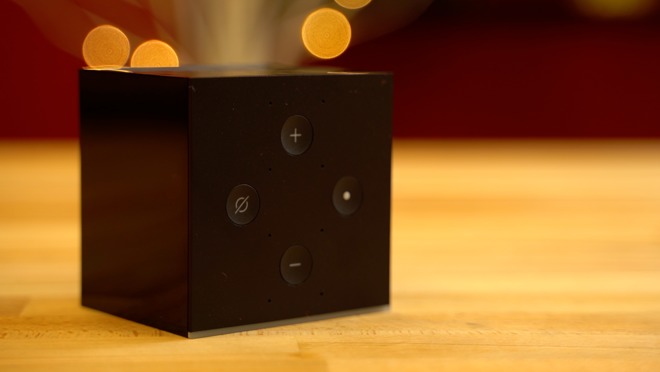
Amazon has started shipping the Fire TV Cube, a media player aiming at the Apple TV 4K. But, can it bring as much to the table as Apple’s device does, for just a little bit less money?
[embedded content]
Quite literally, the device is Amazon’s 2017 Fire TV with more storage and a built-in Echo Dot. At regular price, those two items come out to $120, exactly what the Cube costs. Amazon is currently offering the combo for only $95.
Last year’s Fire TV and the Cube share the same exact hardware specs, other than a bump to 16GB of storage. The regular 2017 Fire TV has the same exact processor, the same 2GB of RAM, the same MIMO WiFi, and can support the same 4K Ultra HD resolution, HDR10, and Dolby Atmos surround sound.
Where wired Ethernet is an add-on for the Fire TV, the Cube does include an Amazon Ethernet Adapter in the box.
Most of the Fire TV Cube Reviews out there focus on the basics surrounding the device, how it works, and what it can do, but unfortunately, a lot of them fail to mention some of its biggest problems.
For those of us who already have an Echo device in our homes, buying the Cube makes little sense.
The previous Fire TV models can also do pretty much everything the Cube can do if you’ve got an Echo in the same room as your TV, with one addition —the Cube is able to control many third-party devices with just your voice, including your TV.
Google Home and Chromecast allow users to turn supported TV’s on and off, but the Cube shines because you can control other devices like an Xbox, Playstation, cable boxes, and more through Alexa integration, HDMI CEC, or an IR Blaster repeater.
This leads us to our first problem, if you’ve already got an Echo in your living room, is being able to control some of your other devices worth the extra money? Plus, if you do have an Echo, it might cause problems with Cube. Amazon recommends you relocate your Echo to another room or change its wake word.
One of our testers had no problem with the same wake word between devices. Another kept having a problem with the Fire TV Cube picking up commands intended for the Echo.
If you have the more expensive $100 Echo, or the Echo Plus, and prefer to play music on it instead of the tv, this could be a problem.
The Fire TV Cube’s iron
Cube’s second major issue is cheap and outdated hardware. It uses the same 1.5GHz quad-core processor from the 2017 Fire TV, as well as the Mali 450 MP3 graphics that’s based on architecture from 2012! The reviews of the Fire TV are littered with people complaining about an overall slow and buggy experience. Some even decided to go back to an older generation Fire TV because of it.
In our experience, Cube’s UI animations on the main screen seemed fairly smooth, although it took a bit for them to start at times. Loading certain apps took longer than we expected them too, like Netflix for example. More on this in practice, in a bit.
The Apple TV 4K is $40 more expensive than the Cube, but at least it’s using one the most powerful mobile chips available, the A10X. That’s the same chip powering last year’s iPad Pro.
With performance like that, you know the Apple TV 4K will remain current for years, but you can’t say the same for Amazon’s Fire TV Cube.
Video Playback, and app shopping
The Amazon Fire TV Cube does what it says it will do. After it buffers, it will play back your Amazon Prime Video either through a wired Ethernet connection with the dongle, or on Wi-Fi.
On Ethernet, speeds hit around 11 megabytes per second from the router. While we’d prefer Gigabit on the Fire TV Cube, both speeds are more than enough for 4K streaming with no buffering breaks in the middle of the event. The 802.11ac Wi-Fi speeds started better, at about 80 megabytes per second, but prone to big dips down to less than 5 megabytes per second for reasons we couldn’t pin down.
Because of the strange speed excursions on Wi-Fi, we had a better streaming experience with the wired Ethernet connection than we did on the Wi-Fi. Looking at Amazon’s customer reviews for the Fire TV, we don’t seem to be alone in that regard.
But, again, our biggest issue is the janky interface. A dropped frame now and again isn’t a giant problem with interfaces. But, with half-second lock-ups of the interface while scrolling through a list, you wonder if Amazon should have charged $10 more and used a beefier processor.
The Fire TV Cube has a robust app selection, rivaling the Apple TV in many ways. This isn’t really a credit to Amazon, but a ding on Apple. We’ve said it before, and we’ll say it again —Apple had an opportunity to lock-down the TV-based apps market when it launched the fourth generation Apple TV, and it blew it because of an assortment of choices about limitations on developers.
Alexa Voice Remote isn’t any better on the new hardware
Moving on to our third problem, you get basically the same old Alexa Voice Remote that comes with the old Fire TV.
The Cube has Alexa built-in, so Amazon says you don’t really need the remote, but in our experience, it takes so much longer to navigate. It also can be kind of awkward when you have guests over, so for those reasons, we would much rather use a standard remote control.
Looking at the remote’s reviews on Amazon, however, reveals yet another snag. The device has almost as many 1 star ratings as it does 5 star. Users complain of corroded batteries or extreme battery drain. There’s also more than a fair share of users who had their remotes completely stop working, forcing them to get a replacement.
The fourth issue is related to remote issues. Let’s say your Alexa Voice Remote stops working or you lose it, you can just use the Cube’s built-in voice controls. At least in theory.
When AppleInsider tried in two different locations, we had Alexa misunderstand our commands in both environments multiple times, and when searching for certain categories of movies, it gave us different results than it did when we used the remote. We would try to search for Prime movies, for example, but the UI would mix in shows that are only available for purchase or rent.
The worst is when you’re using your voice to manually navigate the UI. You have to constantly repeat, “Alexa, scroll right,” over and over again. It just takes forever!
The situation only got worse when we had the volume cranked up on the TV. I had to yell “Alexa” multiple times at the Cube after she didn’t hear my first couple of attempts, and that happened quite a few times.
Amazon says they added an extra microphone into the Cube to help hear your commands, but in my experience, it doesn’t seem any better than the other Echo devices.
With those problems aside, Cube works fairly well for its core purpose, playing video. We’ll do a long-term review and talk about any problems we run into as we use it in a few months.
Alexa home automation status
Having Alexa built-in definitely has its perks, but if you have any smart home accessories, you probably already own an Echo device.
Visually seeing the weather and other information that Alexa gives you on the big screen is definitely a plus, and probably one of the best things about it, right next to the ability to turn on your TV and control all of your devices with just your voice.
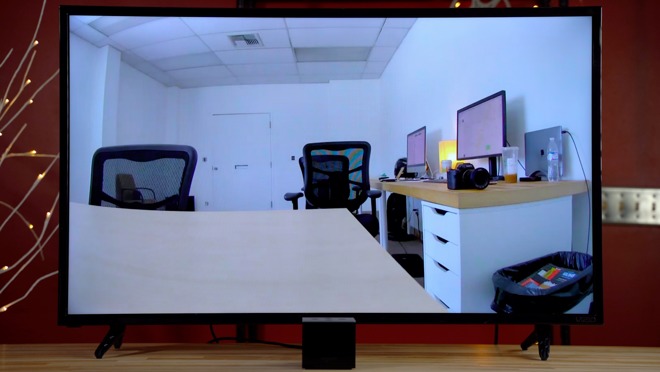
Amazon is currently offering the Fire TV Cube in a bundle with their Cloud Cam, and upon installation, it syncs up instantly with the Cube. So, you can just ask Alexa to show the cloud cam, and it’s up after that same delay that seems to infect every other action on the device.
However, when your TV is off, it takes even longer to appear as the device wakes. We were seeing almost half a minute for the cam to show up.
But, once it gets going, the lag between what’s going on in front of the camera and what you see on the TV isn’t too bad —and you have audio as well.
Amazon Fire TV Cube and the Apple TV
We’ll be doing a more direct comparison to the Apple TV 4K on AppleInsider soon to help you decide which streaming box is right for you, but in short, if you’re just looking at Amazon Prime Video or Netflix, either device will do. But, if you need iTunes streaming, the Apple TV 4K is the only way to go.
Otherwise, the Amazon Fire TV Cube is a decent device, but not a great one. If you’ve got a home server set up at home, you can point something like Plex or Infuse at your iTunes library to get them to stream to your Cube —but it isn’t a native solution and will require a little fiddling on your end.
What would have made it great? Charging $10 more and opting for a faster processor.
Overall, if you’re embedded in the Apple ecosystem, we give the Amazon Fire TV a:
Score: 3 out of 5
Amazon has continued its trend of “good enough” devices at a relatively low cost, with little panache or flair again in the Amazon Fire TV Cube. If that’s okay, and you have no need for iTunes streaming at all, and don’t care about the UI jank, it’s a bit better at 4 out of 5.
Heart of the Cardboard: Exploring the future of app-driven board games
By Anna Blackwell26 Jun 2018
With the smartphone proliferation of the past decade there’s been an inevitable, (but so far restrained) trend developing in the world of board games. Depending on who you’re talking to, this new development is causing a bit of stir.
No, we’re not just talking about ports-to-digital – we’re being well served there – what we rather mean is the slow creep of digital being hard-coded into board game design. That’s right, we’re talking about board game that are largely driven by companion apps.
At their most base level these companion apps are a digital component that interacts with the boardgame/card game in some way. Whether this is a digital narrator, augmented reality, or an AI that controls the movement of the other pieces, these apps change the way we think about boardgame design. This is in contrast to utility apps, which simply enhance or assist in gameplay but are not required to actually play the game in question.
Leading the charge
Let’s take Rudy Games’ Cold War strategy game Leaders as our first example. At first glance. Leaders looks like a Risk spin-off except with a realistic world map that actually includes New Zealand. You wouldn’t be far wrong with that summary either. What allows Leaders to stand apart from its classic counterpart is its virtual headquarters. From the app you can conduct espionage and sabotage, complete missions, and forge secret alliances. All of which is done through your device which – now this is important – records that you have made these decisions.
A couple of years back while I was studying computer game design I tried making an alien invasion boardgame where one player played the aliens and the other played the humans trying to mount a resistance. One of the mechanics I had planned was a fog of war where players could stash units in buildings without the other player seeing what units were or even where they were. The main problem with this was that without gimmicky board design it all came down to player trust. Players would have to admit to each other that “yeah, that grenade you tossed through the window would have totally got my guards.” Which was never going to happen. However, with Leaders tracking your moves through an impartial digital referee, there’s no need for that trust. If my army gets sabotaged right before a key invasion and I lose because of it, then I can’t rightfully complain; the app knows all.
Bridging the Gap
Another take on app-driven games is XCOM: The Board Game, the cardboard adaptation of Firaxis’ XCCOM: Enemy Unknown. The main selling point is that the alien invasion is controlled by the accompanying app. You and your friends control the elite military organization XCOM as you fight against the invaders and the app also also dictates turn order, resolution and pacing of the player actions.
XCOM: The Board Game somewhat blurs the line between analogue and digital. Is it a boardgame with a companion app or a mobile game with a physical board? The answer is both and that annoys some purists. But putting them to the side for a minute, this new combined medium offers up a lot of new potential to developers on both sides of the divide.
App developers can now work with physical components. Take Sensible Object’s Beasts of Balance, a boardgame where you balance animals, elements, and interaction pieces atop a plinth and try to evolve and grow your app-side creatures as much as possible without the tower falling. Purely as a boardgame it would be mildly entertaining at best. Purely as an app it would have flopped and died. But put both of the elements together, where you physically tap the animal to the reader and see it come to life in the game world? Brilliant! And the tension it creates by having the app give you a few seconds to put a fallen tower back together again takes away the Jenga finality and adds in a strangely wonderful air of desperation that has kept me coming back for more. And while these represent large physical investments, not all games have to be.
By now, it’s fair to say that most people (never mind gamers specifically) have some kind of smart device; be that phone, tablet or something else. Provided developers make sure they hit the key beats of iOS and Android (and Amazon, if there’s time), then there’s no danger to your potential player base. Furthermore, provided you design the game well enough you only need one person out of a potential group of 4-6 to actually need a smartphone or tablet. There’s never been a better opportunity to go high-tech.
Games to Life
Lightseekers by TOMY is a great example here. Part trading card game, part mobile RPG, and part augmented reality game. The card game itself serves as a way to enjoy collecting the various cards that you want for the mobile RPG. Every card is scannable and provides your characters with spells, boosts, or even summonable pets that fight for you. It’s pretty clear to see the Skylanders influence but this shows an important step in game design with useable, physical microtransactions. These are cards you’re going to buy anyway and with the booster pack culture of TCGs, you’re going to be seeing a lot of cards over and over again so why not put them to use? Also, the little augmented reality moment where your hero appears atop the card to get their new bonus is pretty nifty. Sort of like the ARG cards that shipped with the Nintendo 3DS but with a purpose.
So, we’ve established that companion apps can be used as rules arbiters for high strategy games like Leaders, as opponent-components in games like XCOM: The Board Game, and as a way to bridge the gap between the digital and physical like in Lightseekers. But what about physical games that have an app-based teaching component?
Mensa award nominee Colour Chess by DogEared Games is an interesting new take on dusty fan favourite Chess. Its colour mechanics add a new layer of strategy that are pretty simple to learn but difficult to master and like all good remix games, it comes with a couple other variants packed in with it. The problem is, you might not have someone to play with. Or you might need to practice and are sick of your Chess buff friends calling you a dumb-ass. Well Colour Chess has your back with its companion app that allows you to practice against an AI and play with players online (in a digital only sense, but you could set the board up and copy the moves for better spatial awareness).
Like them or not, companion apps are expanding the potential of boardgames and apps and as technology progresses and gets cheaper to produce, we can expect more to come. Even party games like One Night Werewolf are getting in on the action with an app that handles the night time narration and turn order, meaning everyone can play at once.
And if that means that I can view my Yu-Gi-Oh battles through an augmented reality app and actually see them fight, then I’m happy with this new futureOh, wait, they already made that too.
What are your thoughts on app driven boardgames? Let us know in the comments!
Xbox One's Free Games With Gold For June 2018 Still Available
The month is half over, which means Xbox Live Gold subscribers can now download two more freebies. As usual, one is an Xbox One game, and the other is an Xbox 360 game you can play on Xbox One thanks to backwards compatibility.
The new free Xbox One game is the Smite Gold Bundle, which will be available between now and July 15. Smite is a free-to-play game, but the Gold Bundle includes 20 additional gods, plus skins, announcer packs, and other extra content. Seeing as it normally sells for $100, that's a good deal for anyone interested in this MOBA-of-the-gods.
The Xbox 360 game Gold members can download for free is Lego Indiana Jones 2: The Adventure Continues. Available until June 30, it's an action game that lets you play through Lego versions of all four Indiana Jones films. And if you haven't picked it up yet, you can still download the side-scrolling Xbox One game Assassin's Creed Chronicles: Russia, which is available until June 30.
Posted by: xSicKxBot - 06-26-2018, 05:31 PM - Forum: Windows
- No Replies
A legend reborn: Microsoft brings back the iconic Classic IntelliMouse
Microsoft IntelliMouse. Originally launched in 1996, it became instantly famous with gamers and highly regarded as a great gaming mouse. The IntelliMouse 3.0 had exceptional ergonomics due to its the asymmetric from, and sculpted buttons and finger rests, making it fit perfectly into your hand.
It also used long life Omron switches, and coupled with a low force to fire and low key idle, the buttons were easy to press, and activated with minimal slack before engaging the switch. At the time, it also had a very good low DPI optical sensor with very low error rates and good smoothing – all key elements for a great gaming mouse.
Known for always innovating, the IntelliMouse range continued to push the boundaries and offer advances in mouse technology and features until the last model launched in 2003.
Microsoft IntelliMouse Explorer 3.0 from 2003
Inspired by the Microsoft IntelliMouse Explorer 3.0 from 2003, Microsoft has recently released the new Microsoft Classic IntelliMouse. Offering the same classic ergonomic look and feel, the new Microsoft Classic IntelliMouse offers improved performance and additional features made possible by technology today.
In remembering the classic mouse, we sat down with Simon Dearsley, Devices Design Director at Microsoft, to discuss the legacy of the Microsoft IntelliMouse and what you can expect from the newest version of the iconic IntelliMouse range.
Can you tell us a little bit about the heritage of the IntelliMouse range from Microsoft?
“Microsoft as a long and rich history of designing incredible mice. The first Microsoft IntelliMouse was released in 1996 and was based on the Microsoft Mouse 2.0 from 1993 and introduced the innovation of the scroll wheel to our users. We saw it as a game changer in terms of ergonomics, tactility and mouse precision.
In 1999 we continued to innovate and refine the IntelliMouse by introducing the first mass market optical tracking sensor and the iconic tail light.
This all culminated in 2003 when we introduced the IntelliMouse 3.0: it had incredible ergonomics with its light weight, sculpted finger rests, and elastomer skirt for amazing comfort and rapid movement and repositioning. The sensor really set the standard at the time for precision and accuracy. This all made the IntelliMouse 3.0 a huge hit with gamers and creative professionals alike.
What many people may not know, is the majority of gaming mice in the world are still patterned off the IntelliMouse 3.0. If you compare almost any modern gaming mouse you’ll see they have the same ergonomic DNA and form as the IntelliMouse. It’s a really significant contribution to the industry that we’re really proud of.”
Why has there been such a long break between IntelliMouse models and why is now the right time to bring it back?
“The timing of the release of the Classic IntelliMouse is really interesting. We’ve reached a point where tracking and switch technology and price has matured immensely. We saw this as an opportunity to improve on an icon by updating it with modern technology. We know how important the IntelliMouse range has been and wanted to take a moment to reflect on the history of it and do something special for our fans.”
What has changed since the 2003 design?
“We improved two really important factors, the tracking sensor and the tactility and feel of the buttons. What we know our fans will see and feel is that it’s the exact same shape and size of the IntelliMouse Explorer 3.0 from 2003. However, underneath the hood it’s all brand-new technology, brand new mechanical engineering and brand-new structures so it’s a lot more rigid than the original. The build quality is really excellent.
We were really careful to keep the same Omron switches for the left and right click, and have added three Kailh switches for the middle wheel button and side buttons. We also made a huge improvement to the two side buttons. They now feel snappy and crisp and have just the right force and click to them.”
What would you say is the defining feature of the new Classic IntelliMouse?
“I would say it’s the shape and the form. The shape was originally sculptured by hand by some of the most experienced mouse designers in the world, which has proven to last the test of time. We felt we should honour this design in the new Classic IntelliMouse and focus on performance updates.”
This slideshow requires JavaScript.
What’s next in terms of new mice from Microsoft?
“We were one of the original companies to introduce the scroll wheel, which changed how people navigate webpages and documents, and helped with aspects of gaming we now take for granted such as zooming and inventory management. Continuing to innovate is really key for us as we want to build products that make a meaningful difference. Take for instance the Precision mouse scroll wheel and the magnetic detent. From the outside, they might look like minor changes, but they really make a difference to the way you use the mouse.
It’s performance innovations like these and working closer with the community to understand the needs of our consumers that will help influence future Microsoft mice.
We have some exciting products in development and can’t wait to hear the response from fans.”
The Microsoft Classic IntelliMouse is available now through the Microsoft Store and select retailers for $39.99/£39.99/ €44.99.
A legend reborn: Microsoft brings back the iconic mouse, the Classic IntelliMouse