It’s been a few months since we talked about how we want to approach shipping games with controversial content. In that blog post we talked about some of the tools we felt we needed to build and we thought it would be good to give you an update on where we are. We’ve done a number of things since that post, some which may seem unrelated, but if we are going to maintain an open view of what gets onto the Store, then you’ll need good tools to find the games you want, as well as avoid the things you don’t.
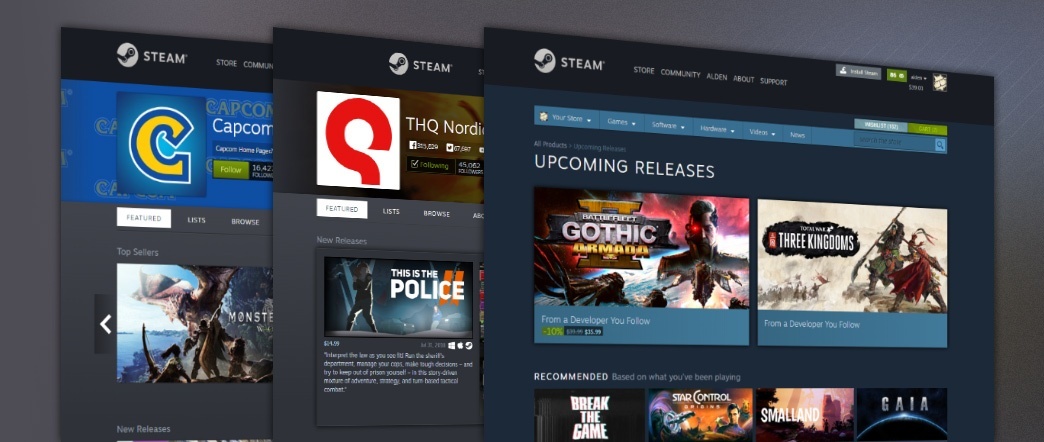
The first set of our changes focused on improving how you can find new games. We’ve added Developer & Publisher homepages so you can easily get from a game you love to others made by the same creators, or follow them if you want to be notified whenever they say or make something. We significantly reworked how our Upcoming Games Lists functioned, so they’re much better at showing you upcoming games that you might be interested in, or upcoming extra content for a game you’ve been playing a bunch.
A second set of changes was focused on improving how you can ignore things you’re not interested in. In the past you’ve been able to ignore individual games or product types (like VR, or Early Access) you didn’t want to see again. But now we’ve added ways for you to also easily ignore individual developers, publishers, and curators.
We’ve also improved the game tag filters on your account preferences. Previously, it was a list of 3 game tags that you wanted to see less of. We’ve now increased the number of tags you can list to 10, and made them into a harder filter – in short, the Store now assumes you want to ignore all the games that feature any of those tags in their most popular tags, instead of just using them as suggestions to our recommendation engine.
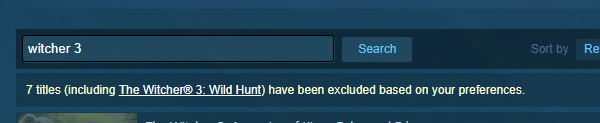
We did our best to ensure you can safely ignore swaths of games in the store, but still find them if you look directly via the search tool. If the game that we think you’re searching for is hidden due to your mature content settings, we identify that and let you know in a safe way. For example, if you have your preferences set to hide mature games with violence, but you search for The Witcher 3, you’ll see this:
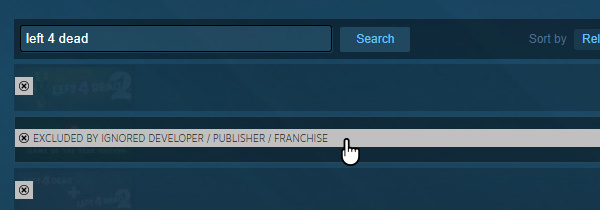
If there are games that your search should contain that you’re ignoring for other reasons (due to its developer, or game tags, for instance), we’ll still include it in the list, but we’ll blur it out and when you hover over it you can see why it is darkened. For example, if you’ve chosen to ignore games by Valve, and then search for Left 4 Dead, you’ll see this:
A third set of changes focused on allowing you to have better control over the kinds of mature content you see. So far, the Store has allowed you to filter out games that feature Frequent Violence/Gore or Nudity/Sexual Content. After looking at the mature content in submissions we’re receiving, and at some games that are already in the Store, we’ve added two more options. The first is a general Mature Content filter. We often see developers who tell us their game contains mature content, but not sex or violence, and you can now filter those games out if you wish. The second is an Adults Only filter, which allows you to filter out games that feature explicit sexual content.
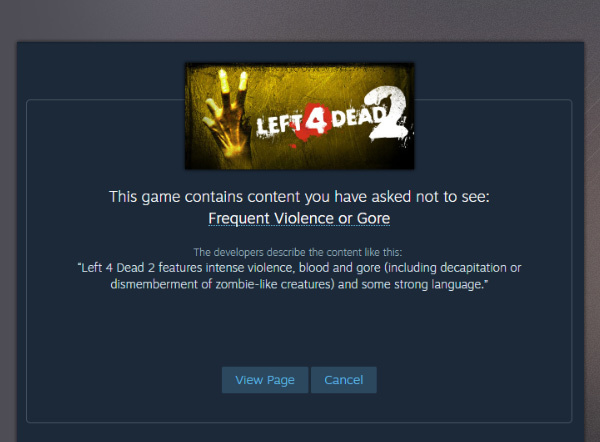
We’re also now requiring developers of games with violent or sexual content to describe the content of their game, and we’re using that information to help you decide whether a game is something you’re comfortable with. We think the context of how content is presented is important and giving a developer a place to describe and explain what’s in their game gives you even more information when browsing and considering a purchase. When you’re looking at the store page of a game with mature content, we’ll display that developer-written description to you. We’re also displaying it on the interstitial page we show you if you ever follow a direct link from outside steam to a game that should be filtered for you:
Finally, we’ve continued our efforts in removing bad actors from the Store. Last year we made changes to Trading Cards to address the ways a small set of developers were producing ‘games’ that generated revenue without anyone actually buying and playing them. Recently we made more changes to address other ways these bad actors were continuing to do it. We’ve also permanently banned several developers of games that we felt fit the “straight up trolling” description of games we’re not going to allow onto the Store. There’s actually a surprisingly small number of individuals behind almost all of these games, and their bans have been a straightforward series of decisions, thus far. You can read more about the shorthand of “straight up trolling,” and the process of making those decisions in the Q&A below.
With these sets of changes, we hope you have a better sense of how we’re approaching building a store that works for all developers and players. There’s still plenty of work to do. In our previous post we identified a range of things, from parental controls to tools for developers to manage their communities. In addition, some of the changes described in this post will require more options when we see new kinds of content in game submissions. Going forward, we aim to continue this strategy of shipping features as they’re finished, and posting periodic updates as to the nuts and bolts and the thinking behind their development.
Q&A
Q: What about games that are already in the store that include mature content?
A: Every developer will be encouraged to update their game with the customer-facing descriptions outlined above but in most cases Valve moderators will going back through the catalog and making sure games are complying with the new requirements.
Q: What do you mean, in practice, when you say you won’t ship games that are “outright trolling?” That seems vague.
A: It is vague and we’ll tell you why. You’re a denizen of the internet so you know that trolls come in all forms. On Steam, some are simply trying to rile people up with something we call “a game shaped object” (ie: a crudely made piece of software that technically and just barely passes our bar as a functioning video game but isn’t what 99.9% of folks would say is “good”). Some trolls are trying to scam folks out of their Steam inventory items, others are looking for a way to generate a small amount of money off Steam through a series of schemes that revolve around how we let developers use Steam keys. Others are just trying to incite and sow discord. Trolls are figuring out new ways to be loathsome as we write this. But the thing these folks have in common is that they aren’t actually interested in good faith efforts to make and sell games to you or anyone. When a developer’s motives aren’t that, they’re probably a troll.
Our review of something that may be “a troll game” is a deep assessment that actually begins with the developer. We investigate who this developer is, what they’ve done in the past, their behavior on Steam as a developer, as a customer, their banking information, developers they associate with, and more. All of this is done to answer the question “who are we partnering with and why do they want to sell this game?” We get as much context around the creation and creator of the game and then make an assessment. A trend we’re seeing is that we often ban these people from Steam altogether instead of cherry-picking through their individual game submissions. In the words of someone here in the office: “it really does seem like bad games are made by bad people.”
This doesn’t mean there aren’t some crude or lower quality games on Steam, but it does mean we believe the developers behind them aren’t out to do anything more than sell a game they hope some folks will want to play.
Q: Sometimes I see blurred out games on my Store front page. Why is that?
A: There are a number of sections on the front page that we fill with games, and to ensure the servers behind it don’t melt down as everyone tries to use it, we do a lot of data caching. This works great for data sets that we can easily pre-compute – so if there’s a game you shouldn’t see due to your mature content filters, you’ll never see it on the front page. But if you’ve chosen to do some more personal filtering of particular developers, or specific games, we can’t do that pre-computation as easily. As a result, it’s possible you’ll see a blurred out game on the front page because your personal filters should cause it to be hidden. In practice, though, this will only happen if you’ve filtered out so many games that it can’t find enough to fill a section of the front page, and again, like the search results, we’ll blur that game out and tell you why.
Q: Why do you KEEP asking my damn age throughout the store?
A: We’re with you on this. Unfortunately, many rating agencies have rules that stipulate that we cannot save your age for longer than a single browsing session. It’s frustrating, but know we’re filling out those age gates too.
“VR” is an industry buzzword right now. And the majority of the technology that has been created in this space has been focused on the development of hardware and content for spaces such as gaming and entertainment, ignoring the range of possibilities available in retail. At our core, we are merchandisers and storytellers which drives us to believe that virtual reality has the potential to reinvent the consumer experience—with an experience we call contextual commerce.
We are looking for an experienced Lead Technical Artist with a skill set that includes some Unity expertise. You will be part of an amazing team helping to shape the future of immersive experiences, global V-Commerce, and interactive media.
This is the opportunity to get in early at a stealth company currently being incubated in Los Angeles by Walmart’s tech incubator, Store No 8. Spatialand was acquired by Store N° 8, Walmart’s incubation arm for developing capabilities that will transform the future of commerce. At Store N° 8, the Spatialand team will develop and explore new products and uses of VR through immersive, interactive, and hyper-real VR environments. Our new venture is currently operating in stealth mode as we work out of our beautiful Venice, CA office.
In this role, you will:
Work with in-house multidisciplinary teams of artists and engineers to build high-end retail focused real-time experiences for VR
Develop tools, pipeline, and workflows for utilizing game engine technology for VR, AR, and other interactive platforms
Provide technical supervision and support on multiple projects
Use Unity’s framework to create tools to improve asset pipeline and automation
Factoring external direction and team feedback into design decisions
Work with emerging technologies to create new tools and systems for interactive real-time production
Lead a group of 3-6 3D artists, and (at times) multiple contractors. Provide mentorship, advice, and feedback towards final goals
Requirements:
Experience and vast knowledge of real-time graphical and rendering pipelines
Advanced knowledge of Unity
Keep up to date with the technological advancements
Expert proficiency with Maya
Experience with shader creation for real-time content
Ability to create hard surface and/or organic models with a high level of realism
Basic knowledge of programming and scripting languages such as C# and Python
Superior eye for lighting, value, color, details, and the ability to use them in creating efficient and impactful visual elements
Understanding of performance and optimization requirements and experience diagnosing and profiling content costs
Ability to juggle multiple projects simultaneously, work against a deadline, and have a high degree of comfort with constant change
Self-motivated and proactive.
Exceptional problem-solving skills
Excellent interpersonal and communication skills
Proven ability to work successfully within and across teams
Bachelors in related field or equivalent experience
Experience with VR and/or shipped at least one AAA game
Additional Skills (not essential to the position but assists in choosing candidates):
Fluent in at least one programming language such as C#
Whether you’re just starting out, looking for something new, or just seeing what’s out there, the Gamasutra Job Board is the place where game developers move ahead in their careers.
Gamasutra’s Job Board is the most diverse, most active, and most established board of its kind in the video game industry, serving companies of all sizes, from indie to triple-A.
PES 2019 Launches Today: Embrace “The Power of Football”
Throughout its celebrated history, Konami’s award-winning Pro Evolution Soccer series has consistently captivated players by providing an unmatched realistic recreation of the sport of soccer, and this year is no exception. You can finally experience the “power of football” for yourself in Pro Evolution Soccer 2019 (PES 2019), which launches today in the Americas on Xbox One, and will launch globally on August 30.
Off the pitch, there’s been a major shift to Konami’s licensing strategy for this year’s edition, which focused on delivering exciting and fresh content to the series. As a result, PES 2019 boasts more licenses than ever before in its franchise history. This year’s iteration continues to build on past titles and bring new experiences to players with an extended portfolio of all-new, fully licensed leagues, stadiums, partnerships and Legends, on top of its existing premier partnership with FC Barcelona.
New and renewed team partnerships include: Brazilian clubs Corinthians, Palmeiras and São Paulo FC; national teams from Chile and Peru; Scottish clubs Celtic and Rangers; German club FC Shalke 04; French clubs AS Monaco and AC Milan; and the International Champions Cup (ICC) to name a few.
Not to mention, there’s a handful of exciting new leagues that will be featured in the 2019 edition: Superliga Argentina, Chile’s Campeonato Scotiabank, Danish Superliga, Portugal’s Liga NOS, Swiss Super League, Scotland’s Ladbrokes Premiership, Turkish Süper Lig, and new and exclusive to PES 2019, the Russian Premier Liga.
You can get your copy of PES 2019 in one of two editions: Standard Edition with FC Barcelona star Philippe Coutinho on the front cover; and a special David Beckham Edition featuring England’s all-time greatest footballer. Also available now is a digital-only Legend edition. Check out all the details for each edition at: www.konami.com/wepes/2019.
For all the latest PES 2019 news, reveals and updates, be sure to follow @OfficialPES on Twitter and Instagram.
Turn-Based Strategy Game Civilization VI Is Headed To Switch This November
Civilization VI, a turn-based strategy game developed by Firaxis Games, will be available on Nintendo Switch this November, it has been confirmed.
Civilization is a turn-based strategy series which has typically seen releases on PC over the years, with the occasional title finding its way to a Nintendo platform in the process such as Civilization Revolution on Nintendo DS. This latest entry to the franchise sees you build an empire to stand the test of time; you’ll be exploring a new land, researching technology, conquering your enemies, and going head-to-head with history’s most renowned leaders as you attempt to build the greatest civilization the world has ever known.
Sid Meier’s Civilization VI – to give it its full title – will include the latest game updates and improvements on Switch, as well as four pieces of additional content which adds four new civilisations, leaders, and scenarios. These are the Vikings Scenario Pack, the Poland Civilization & Scenario Pack, the Australia Civilization & Scenario Pack, and the Persia and Macedon Civilization & Scenario Pack.
We hope you like your game feature lists because we’ve got a pretty hefty one for you today courtesy of the game’s website. Here are some of the things you can expect to get up to in the game:
Game Features:
– PLAY YOUR WAY: The path to victory is the one you determine. Become the most scientifically advanced civilization, dominate through sheer military power, or become the foremost destination for the cultural arts. – THE WORLD’S GREATEST LEADERS: Play as one of 24 different leaders from various countries around the world and throughout history. Build an empire of lucrative trade routes with Cleopatra of Egypt, flex the military might of your legions with Trajan of Rome, or develop a powerhouse of culture with Hojo Tokimune of Japan. Each of the leaders can be played any way you prefer, with unique abilities, units, and infrastructure in their quest for victory. – EXPANSIVE EMPIRES: See the marvels of your empire spread across the map. Settle in uncharted lands, improve your surroundings, build new districts, and see your cities – and your civilization – prosper. – ACTIVE RESEARCH: Unlock boosts that speed your civilization’s progress through history. To advance more quickly, use your units to actively explore, develop your environment, and discover new cultures. –DYNAMIC DIPLOMACY: Interactions with other civilizations change over the course of the game, from primitive first interactions where conflict is a fact of life, to late game alliances and negotiations. – EXCITING AND UNIQUE SCENARIOS: Civilization VI for Nintendo Switch includes four playable scenarios, each with a different setting and style of gameplay inspired by history. Be part of the colonization of Australia in “Outback Tycoon,” defend Poland from invaders in “Jadwiga’s Legacy”, choose a Viking leader to plunder Europe in “Vikings, Raiders, and Traders!”, or conquer the known world in the “Conquests of Alexander.” – COOPERATIVE AND COMPETITIVE MULTIPLAYER: Up to 4 players can cooperate or compete for supremacy via a wireless LAN.
Civilization VI will find its new home on Switch on 16th November.
Feel free to share your thoughts on this one with us in the comments. Have you played any games from the Civilization series before?
* Buyback respawn time penalty changed from +25% of remaining time to +25s always
* Level 2 XP requirement changed from 200 to 230 (in a scenario where Team A gets 2 melee denies per wave, and team B gets 1 melee deny per wave: Team A wave requirement for level 2 increases from 2 waves to 3 waves. Team B wave requirement remains at 3 waves. Total XP needed for other levels unchanged. )
* Glyph is now on cooldown until the 3 minute timer in-game
* Stout Shield: Damage block for melee heroes increased from 18 to 20 * Ring of Aquila: Bonus damage reduced from 10 to 7 * Mekansm: Heal increased from 250 to 275 * Guardian Greaves: Heal increased from 250 to 275 * Urn of Shadows: Heal rate reduced from 35 to 30 * Spirit Vessel: Heal rate reduced from 35 to 30 * Spirit Vessel: Movement speed bonus reduced from 30 to 20 * Scythe of Vyse: Manacost increased from 100 to 250 * Phase Boots: Speed bonus on ranged heroes reduced from 16% to 13% * Phase Boots: Instant turn ra te is now a melee only feature
* Alchemist: Greevil’s Greed bounty rune multiplier rescaled from 3.5x to 2/2.5/3/3.5x * Bloodseeker: Bloodrage heal rate reduced from 19/21/23/25% to 16/19/22/25% * Broodmother: Base agility reduced by 3 * Chen: Penitence duration reduced from 8 to 5/6/7/8 * Clinkz: Base strength reduced by 2 * Crystal Maiden: Crystal Nova manacost increased from 130/140/150/160 to 130/145/160/175 * Dark Willow: Shadow Realm damage reduced from 120/200/280/360 to 90/180/270/360 * Dark Willow: Cursed Crown cast point increased from 0.1 to 0.2 * Drow Ranger: Base agility reduced from 26 to 19 (base damage unchanged) * Drow Ranger: Agility gain increased from 1.9 to 2.2 * Drow Ranger: Base attack animation time improved from 0.7 to 0.65 * Enchantress: Base movement speed reduced by 15 * Gyrocopter: Base agility reduced by 5 (base damage and armor unchanged) * Huskar: Base damage reduced from 42-51 to 40-45 * Huskar: Level 10 Talent increased from +175 Health to +225 * Io: Spirits cooldown from 20/18/16/14 to 26/22/18/14 * Io: Level 10 Talent reduced from +25% XP to +20% * Mirana: Level 15 Talent reduced from +100 Leap Attack Speed to +80 * Nature’s Prophet: Base damage reduced by 3 * Necrophos: Agility rescaled from 15 + 1.2 to 12 + 1.3 * Necrophos: Base movement speed reduced by 5 * Phantom Lancer: Level 25 Talent reduced from -7s Doppelganger CD to -6s * Silencer: Arcane Curse manacost increased from 75/95/115/135 to 105/115/125/135 * Spectre: Spectral Dagger linger duration reduced from 2 to 1 * Spectre: Dispersion max reflection range reduced from 1000 to 700 * Spectre: Desolate single hero range check increased from 325 to 375 * Tiny: Tree Grab manacost increased from 20/30/40/50 to 50 * Tiny: Avalanche cooldown increased from 20/19/18/17 to 23/21/19/17 * Ursa: Overpower manacost increased from 45/55/65/75 to 75 * Vengeful Spirit: Wave of Terror cooldown increased from 10 to 16/14/12/10 * Weaver: The Swarm manacost increased from 70/80/90/100 to 110 * Wraith King: Wraithfire Blast cooldown increased from 11/10/9/8 to 14/12/10/8
Players from around the world have said their final goodbyes to Cayde-6 and are hunting for Uldren Sov and his Barons. They’re finding collectibles in the farthest corners of the Reef, and some Guardians have already become notorious in a new season of Crucible.
This launch has been a rollercoaster of emotions, and we’re thankful to share it with this community. Everyone at Bungie, High Moon Studios, and Vicarious Visions has been watching as you invade the lawless frontier. We thank you for playing, and for being heroes in the worlds we’ve built together.
New experiences and secrets have yet to be discovered, and some are still on the way. Season of the Outlaw has just started. The full calendar for year 2 content can be previewed in the roadmap that was released last week. The dust hasn’t even begun to settle.
The Pinnacle
Guardians have made their way to the Tangled Shore, and some of you have already reached the Dreaming City. The pursuit of powerful loot has taken hold, in preparation for new doors to open…
The race for World First is coming up soon. The field just got a little more competitive, with our new friends from Korea joining us on the starting line. This time, there’s more than just bragging rights on the line.
When “Last Wish” becomes available, the first fireteam of six to complete the raid will have the opportunity to acquire real-world trophies for each teammate, commemorating their accomplishments. We’ll have more details next week, so stay tuned.
A Treat for Your Ears
Composers Michael Salvatori, Skye Lewin, Rotem Moax and Pieter Schlosser also have a few words for you as you continue your hunt in the Reef, accompanied by the music they’ve created.
The Destiny 2: Forsaken original soundtrack is now available on the Bungie Store, and includes the Curse of Osiris and Warmind soundtracks. All purchases through November 22, 2018, will also include the Pursuit of Dreams emblem.
Challenges and Resets
With the release of Destiny 2: Forsaken, challenges have become a new avenue for players to acquire powerful rewards.
There are two types of challenges: daily and weekly. Now, these types behave a bit differently when it comes to resets.
Weekly challenges follow the weekly reset each Tuesday at 10 AM PDT.
Daily challenges, on the other hand, offer a unique challenge each day, and they reset every four days. Here are some examples:
The first daily strike challenge was offered on Tuesday, September 4. So, the next daily strike challenge will arrive with a reset on Saturday, September 8.
The first daily Gambit challenge was offered on Wednesday, September 5. So, the next daily Gambit challenge will arrive with a reset on Sunday, September 9.
However, players will retain daily challenges until they’re completed.
If a player completes the daily strike challenge on Friday, September 7, the challenge will be offered once more on Saturday, September 8.
If a player does not complete the daily strike challenge by Saturday, September 8, they will not receive a duplicate challenge. Instead, the challenge will be reset and progress will be cleared.
Fear not! We’ll be creating a calendar to be featured on help.bungie.net to lay out how the system works. Stay tuned to @BungieHelp for details. Speaking of Player Support…
Making a List, Checking It Twice
Forsaken has landed, and Destiny Player Support is here to make sure your time in the Reef is stable. They’ve been in the trenches, providing troubleshooting steps for various known issues and passing along information for investigations. Would you like to know more?
This is their report.
Destiny 2 Hotfix 2.0.2
On Tuesday, September 11, Destiny 2 will undergo maintenance to receive Hotfix 2.0.2. For the deployment schedule, please see the times listed below or check out our Server and Update Status help article.
On Tuesday, September 11:
9 AM PDT: Hotfix 2.0.2 will begin rolling out across all platforms and regions
10 AM PDT: Online players who have not installed Hotfix 2.0.2 will be removed to the login screen at the next activity completion
2 PM PDT: All remaining online players who have not yet installed Hotfix 2.0.2 will be removed to the login screen to install the patch
For Hotfix 2.0.2 patch notes on September 11, players should keep an eye on our Updates page or follow @Bungie on Twitter for live announcements.
Bungie Rewards
Players wishing to participate in the Bungie Rewards program will need to make sure their Bungie.net profiles meet the following requirements:
Have their Destiny 2 account linked with their Bungie.net profile
Set their notification options to receive news, updates, promotions, and exclusive content by email
For more information on the exclusive rewards to earn and purchase for your moments and triumphs, please see the Bungie Rewards page. Players who are encountering issues with the program should check this help article.
Forsaken Editions and Incentives
Destiny Player Support is monitoring reports of purchase issues and confusion around the various Forsaken editions, incentives, and other items. Please see below for a brief list of known issues or read our help article here for a more detailed explanation.
Standalone Forsaken Expansion: We are working with our platform partners to investigate issues that may be preventing players from purchasing the Destiny 2: Forsaken standalone expansion on PlayStation®4 and Xbox One. Please stay tuned to @BungieHelp for more updates as we investigate the issue.
Digital Deluxe Items: Players will receive the items from the Destiny 2: Forsaken Digital Deluxe Edition after completing the final Forsaken campaign mission and then returning to orbit.
Cayde’s Exotic Stash: Players who pre-order any edition of Destiny 2: Forsaken from participating retailers will be eligible to receive the Cayde’s Exotic Stash pre-order bonus. These items can be retrieved from Amanda Holliday in the Tower after you complete the final mission of the Forsaken campaign.
Forsaken Annual Pass: Players who purchase a Destiny 2: Forsaken edition that includes the Forsaken Annual Pass, or who purchase a standalone Forsaken Annual Pass, will receive 1,000 bonus Silver as part of their purchase. This Silver will be automatically added to their account’s Silver balance the first time they log in after purchasing the Forsaken Annual Pass. Players can see their Silver balance and Eververse purchase history from their Bungie.net profiles. Players who encounter issues with Silver purchases should see the Silver and Eververse Guide for more information.
Destiny 2: Forsaken Known Issues
The Player Support team is monitoring, tracking, and investigating a number of issues reported by players in the #Help forums. Here are some of the issues we are tracking:
Cayde’s Will Quest: To receive proper Gambit kill credit for the Aces of Spades quest line, players must defeat an invader five times with a Hand Cannon.
Traveler’s Chosen Sidearm: We are investigating an issue where the Traveler’s Chosen Sidearm cannot be dismantled or stored in the vault. Players are encouraged to not retrieve this weapon, as it will remain in their Kinetic weapon slot until a fix is deployed.
“Limited Edition” Triumph: We are investigating reports of players being unable to claim the “Limited Edition” Triumph.
Character Boost – Year 1 Adventures and Triumphs: Players who use the character boost may not be able to access Year 1 adventures and won’t be able to unlock previous campaign Triumphs on that character.
We keep an updated list of issues we are actively tracking in our Forsaken Known Issues Thread. Players who are encountering an issue that has not yet been included in our Known Issues thread should report to the #Help forums with a description of the issue they are encountering, any known repro steps, and any video or picture evidence they may have of the issue.
Could I Get Some Hype in Chat?
Last Saturday (September 1), Gambit was made available to all. It was a blast seeing players take their first footsteps through an invasion portal. Thanks to all who jumped in and took the mode for a spin before launch! That said, let’s get to watching some sweet clips. Never forget, DEATH HEALS PRIMEVAL.
Movie of the Week: IT’S A TRAP!
Honorable Mention: Don’t Get Comfortable with That Lead
Honorable Mention: Fowl Play
If you’d like a chance to earn the Lens of Fate emblem, make sure to submit your video to the Creations page on Bungie.net and include #MOTW in your title.
A few weeks back, we sent out a thank-you to some of our community artists. To see players bring their Guardians to life through content that’s handcrafted is always a pleasure. To further cement our appreciation for these talented Guardians, we’ve crafted our own gift of gratitude. Starting today, any artists who are featured in the Bungie Blog or through @Bungie on social media will be granted the Artist in Residence emblem.
Thank you all for an amazing launch week, and we’ll see you in the wild.
JEHUTY lives. And there, ANUBIS thrives. Zone of the Enders: The 2nd Runner returns with 4K and VR support on Steam.
Relive the experience Zone of the Enders: The 2nd Runner MARS as a full-length remaster of the classic fast-paced 3D robot action game, recreated in VR, native 4K and in full surround sound. Enter JEHUTY's cockpit and fly through Martian skies!
The year is 2174 and the despotic BAHRAM military organisation is using new Orbital Frames robot technology to secure its grip on Mars and Earth. Seizing control of the JEHUTY Orbital Frame, the player is the last hope for the stricken planets. Strike deep at the heart of the BAHRAM army with unrivalled powers! Written and directed by Shuyo Murata, The 2nd Runner MARS is recognised as a masterpiece among space action titles.
A teenager who has lost her sight and a mysterious cat team up in a surreal fantasy adventure into the unexpected, weaving a tale that brings together some of the world?s greatest minds: Monet, Tesla, Edison and other historical cultural icons.
There's a single rule that could save the protagonists of horror movies a whole lot of trouble: If a demon, ghost, or otherwise evil/otherworldly antagonist is very clearly trying to lure you somewhere, run the other direction. The characters in The Nun are painfully unaware of that general rule, which makes for some admittedly great scares in the latest entry in the Conjuring universe. It also helps make The Nun just a little bit goofy--chances are, the fifth time the brave but hapless Father Burke gets lured down a dark hallway or into a spooky graveyard, it might elicit a laugh rather than the dreadful trepidation that was likely intended.
But The Nun embraces all horror tropes, not just that one. Its tributes and homages to past horror movies are countless. There's the hyper masculine alpha priest, Father Burke, played by Demián Bichir, and his companion, the virginal, white-clad nun-in-training Irene (Taissa Farmiga), who travel together at the Vatican's behest to investigate a suicide at a remote Romanian convent. There are exorcisms and jump scares, crosses flipping upside-down, moving shadows and demons in mirrors, pentagram-shaped gashes slashed by invisible claws into pious, white flesh.
It's not all tropes. The Nun's rules are wishy-washy--within the confines of this movie and with the larger Conjuring universe. But that gives it freedom to be whatever it wants from scene to scene, as well. Entire stretches turn out to be hallucinations, delusions, or dreams; sometimes the demon can affect the physical world, and other times it's all psychological. Sister Irene is anything but helpless, while Jonas Bloquet's character Frenchie--part action hero and part comic relief--gets to deliver one of the goofiest and best one-liners in recent memory. It all blends together to make a funny, super terrifying movie that works despite its inconsistencies.
The setting is a large part of that. There's something deeply unsettling about The Nun's Cârța Monastery, a dark, sprawling heap of cobblestones, statues, and tombs where the candles are always fitfully flickering, but no one's ever home. The place's geography is never fully established, which adds to the disorientation as Farther Burke, Irene, and Frenchie run around chasing/fleeing from various demonic apparitions.
The Nun herself--AKA the demon Valak, as established in previous Conjuring movies--is also quite scary. She's a constant presence, whether she's flitting by in the background or baring her splintery teeth in full, feral terror. She especially loves to appear directly behind people or at the opposite ends of long, shadow hallways. That the movie's laborious exposition dumps and backstory explanations don't detract from these scares is a testament to the fundamental effectiveness of the Nun as a movie monster.
Some of the funnier dialogue can seem out of place, although the movie's funnier moments often serve as welcome reprieve from the tension. There are also some weird tacked on clips from other Conjuring movies at the beginning and end--they ensure you don't need to be caught up on the series to enjoy The Nun, but they also blow the creature's reveal in the first 10 seconds, ruining any build-up the movie might have made toward it. And these awkwardly inserted clips make explicit a connection to the first Conjuring movie that fans would easily have figured out anyway, which suggests a mistrust in the audience's ability to put two and two together.
The Nun takes a weird turn in its third act as our heroes follow various clues toward a holy relic that will supposedly save them, when an encroaching Indiana Jones vibe starts to clash with what the rest of the movie tries to do. There's also a terribly clunky reveal in the vein of "swing away, Merrill" in the M. Night Shyamalan movie Signs. This final act is predicated on something Father Burke says: "There's a time for prayer and a time for action. This is a time for action," which I can't help but read as a denunciation of the "thoughts and prayers" front of America's current culture war.
In the end, The Nun's most gripping scenes relate to that as well--as far as Sister Irene is able to discover, the Cârța Monastery's nuns are trapped in a constant vigil, forced to pray in continuous, overlapping shifts to keep the demon at bay. As Valak grows stronger, their prayers grow less effective, until Irene finds herself in very real danger with no means of defense against evil. That's when the action really begins.
Although The Nun can be inconsistent, silly, and predictable, it's also terrifying and atmospheric, with a great monster, phenomenal setting, and likable characters you'll never stop rooting for. It doesn't quite hit the highs of The Conjuring 1 and 2, but it's definitely a fun, scary ride that horror fans will enjoy.
Posted by: xSicKxBot - 09-08-2018, 10:32 AM - Forum: Windows
- No Replies
Meet green warriors from India enabling a sustainable future
With a trained AI algorithm, the team hopes to classify the urban and rural areas, identify forest cover, river beds and other water bodies from satellite images, and create a precise grid map for the region. The team hopes to apply computer vision to create a comprehensive database of biodiversity in the region to help policymakers and local communities make better-informed economic, ecological, and infrastructure-related decisions.
“You can’t save an ecosystem if you don’t fully understand it,” exclaims Dr. Mariappan. “That’s where our data along with Microsoft’s AI resources can help.”
Tracking the monkey population in urban areas using AI-powered image recognition
The monkey population in urban India has spiraled out of control in recent years. India’s capital city, New Delhi, alone reports at least five cases of monkey bites daily that can cause rabies and be fatal. It is estimated that 7,000 monkeys prowl the streets of the capital, damaging public property and attacking people. With their natural habitat shrinking owing to urbanization, authorities are struggling to avoid monkey attacks.
Managing the growth of the population is critical. Currently, there is no way to identify which monkeys have already been given birth control or sterilized without further handling such as tattooing a code or embedding a microchip in the monkeys. Ankita Shukla, a PhD student at Indraprastha Institute of Information Technology Delhi (IIIT Delhi), aims to use computer vision as a non-invasive alternative for identifying and tracking monkeys as it is safer and less stressful for the animals, as well as humans.
Shukla, a native of a small town near Lucknow, had earlier worked with the Wildlife Institute of India on a project to classify endangered tigers in a nature reserve with machine learning and distance-object recognition algorithms. She wants to combine this experience in wildlife monitoring with machine learning to create a tangible solution for the simian problem in cities.
She is creating an AI-enabled app that can help the community tag monkeys in photographs and upload it to a cloud where authorities can track the simian population’s growth, vaccination history, and movements. “With a bird’s eye view of the monkey population, we can deploy contraceptives more efficiently,” she says. “Training a deep neural network with image recognition to identify a monkey and its species, and whether it’s already been sterilized could go a long way towards solving this crisis,” Shukla adds.
Having teamed up with Saket Anand, a professor at IIIT Delhi, she pitched the idea to the AI for Earth panel earlier this year. The team plans to leverage the Microsoft Azure platform for the processing power required to train the AI model.
“The Microsoft resources and technical assistance helped us develop a genuinely useful app,” says Shukla. “We’re now trying to take things to the next level so that we can find a solution to the monkey menace in a scientific and humane manner.”