4 cool new projects to try in COPR for February 2019
COPR is a collection of personal repositories for software that isn’t carried in Fedora. Some software doesn’t conform to standards that allow easy packaging. Or it may not meet other Fedora standards, despite being free and open source. COPR can offer these projects outside the Fedora set of packages. Software in COPR isn’t supported by Fedora infrastructure or signed by the project. However, it can be a neat way to try new or experimental software.
Here’s a set of new and interesting projects in COPR.
CryFS
CryFS is a cryptographic filesystem. It is designed for use with cloud storage, mainly Dropbox, although it works with other storage providers as well. CryFS encrypts not only the files in the filesystem, but also metadata, file sizes and directory structure.
Installation instructions
The repo currently provides CryFS for Fedora 28 and 29, and for EPEL 7. To install CryFS, use these commands:
Cheat is a utility for viewing various cheatsheets in command-line, aiming to help remind usage of programs that are used only occasionally. For many Linux utilities, cheat provides cheatsheets containing condensed information from man pages, focusing mainly on the most used examples. In addition to the built-in cheatsheets, cheat allows you to edit the existing ones or creating new ones from scratch.
Installation instructions
The repo currently provides cheat for Fedora 28, 29 and Rawhide, and for EPEL 7. To install cheat, use these commands:
Setconf is a simple program for making changes in configuration files, serving as an alternative for sed. The only thing setconf does is that it finds the key in the specified file and changes its value. Setconf provides only a few options to change its behavior — for example, uncommenting the line that is being changed.
Installation instructions
The repo currently provides setconf for Fedora 27, 28 and 29. To install setconf, use these commands:
Reddit Terminal Viewer, or rtv, is an interface for browsing Reddit from terminal. It provides the basic functionality of Reddit, so you can log in to your account, view subreddits, comment, upvote and discover new topics. Rtv currently doesn’t, however, support Reddit tags.
Installation instructions
The repo currently provides Reddit Terminal Viewer for Fedora 29 and Rawhide. To install Reddit Terminal Viewer, use these commands:
sudo dnf copr enable tc01/rtv
sudo dnf install rtv
The RISC-V Foundation will be hosting a free, Getting Started with RISC-V event in Austin. This 1 day event will showcase innovative RISC-V implementations from members of the Foundation.
The half-day Austin event on April 2 will feature engaging presentations, demos and networking opportunities.
Posted by: xSicKxBot - 03-05-2019, 09:08 PM - Forum: Windows
- No Replies
Announcing the Microsoft Quantum Network
Creating a scalable quantum computer will require the collective effort ofmany skilled and diverse teams.To reach that goal, over the past few years we havebuilt acoalition ofpartners, universities, customers, and developers, all with the goal of sharing knowledge and collaborating with the best quantum innovators.
Today –at our inaugural Startup Summit –we’re formalizing that coalition as the Microsoft Quantum Network. This global community of individuals and organizations will workdirectly with Microsoft to advance quantum computing, develop practical applications, and build the quantum workforce of the future.
“The Microsoft Quantum Network is our commitment to establishing the partnerships required to build the quantum workforce and the quantum economy,”Todd Holmdahl, Corporate Vice President of Azure Hardware Systems Group at Microsoft,said during the summit.“We believe both are vital to solving some of the world’s toughest problems.
Todd Holmdahl, Corporate Vice President of Azure Hardware Systems Group at Microsoft, speaking to the Microsoft Quantum Network
We’ve previously announced partnershipswith some of the world’s leading startup talent in quantum software and algorithm development.Today we welcome two new partners:
HQS Quantum Simulationsdevelops quantum algorithms for predicting molecular properties for the chemical and pharmaceutical industries.
Rahkois a quantum machine–learning company developing scalable quantum chemistry solutions for near-term quantum computers and beyond.
HQSQuantum Simulations and Rahko will join other quantum startups who are working closely with Microsoft to build practical applications and accelerate the adoption of quantum computing. Quantum Networkstartups also benefit from a partnership with Microsoft for Startups to help them grow their businesses, build innovative solutions, and connect to valuable resources.
Other segments of the Microsoft Quantum Network are:
Affiliate organizations have engaged directly with Microsoft to advance their expertise in quantum computing and jointly develop solutions that benefit their organization and industry.Case Western Reserve University (CWRU), the Dubai Electricity and Water Authority (DEWA), and Pacific Northwest National Labs (PNNL)are examples of organizations collaborating with us on many solutions in the areas of optimization and chemistry.
Centers dedicated to research, development, and educational excellence have partnered with Microsoft to pursue the advancement of quantum computing. Today we’re performing quantum research alongside some of the best and brightest minds atPurdue University, UC Santa Barbara, the University of Copenhagen, TU Delft, and the University of Sydney. At these locations, we’ve established Microsoft Quantum Labs where ourresearch teams are advancing Microsoft Quantum research goals while also serving as scientific collaborators and partners with the quantum community.
Developers and organizations have created their own quantum algorithms and applications with our free resources, including the Microsoft Quantum Development Kit, tutorials, Q# libraries, samples, and workshops. Developers have now downloaded the Quantum Development Kit more than 100,000 times.
If you or your organization are interested in becoming a member of the Microsoft Quantum Network as a startup or affiliate, click here to tell us about yourself.
It will take a diverse set of skills across academia and industry to help develop the world’s first scalable quantum computer and quantum applications. We are excited to bring together the best minds in quantum computing. Together, we will bring this vision to life and shape the future of the quantum workforce and economy.
Posted by: xSicKxBot - 03-05-2019, 09:08 PM - Forum: Windows
- No Replies
Imagine Cup: From students to technology’s next superheroes
Imagine this: A problem impacts you, or maybe your family, your friends, your community, your country, or even the whole world. You and your student peers form a smart and passionate team that not only thinks up a great solution – it also accesses amazing new technologies to make that fix a reality.
You work hard, collaboratively, and creatively for months. Along the way, you get high-powered technical and practical advice on how to refine your solution, start a business, win over investors, and bring in customers. Having learned and achieved much along the way, you come together and compete with other great teams from around the world and face expert judges who are eager to hear about the next big thing.
Welcome to Imagine Cup: an annual global student competition akin to a youth Olympics of technology. It’s prestigious, innovative, entrepreneurial, and impactful as a first step toward changing the world.
More than 2 million students from around 190 countries have competed in Imagine Cup since it started in 2003, including hundreds of thousands from across Asia Pacific. Using the latest technologies – which nowadays include artificial intelligence (AI), machine learning, the internet of things (IoT), and cloud computing – they have taken on some of society’s toughest challenges.
Team RailinNova’s Nan Wang presenting his team’s Rail Component Inspection Robot
With the contest now in its 17th year, 12 teams of impressive young women and men from 10 countries converged on Sydney for its Asia regional finals. To qualify, they had to move through a series of online competitions and national playoffs that ran from late last year.
Annie Parker, Global Head of Microsoft for Startups
“You are all superheroes. You have done amazing work to get here,” Annie Parker, the Global Head of Microsoft for Startups, said in a welcome address made just before each team pitched their solutions to a panel of five judges.
“These are young people wanting to solve the world’s problems, wanting to take on the big issues, and they are not afraid of that at all,” says Jennifer Ritzinger, Senior Director of Microsoft’s Academic Ecosystems and Reactors, whose team manages the competition. “They understand it is about having the right idea, and the dream, and the passion.”
Underscoring the importance of Imagine Cup’s mission, the Asia finals in Sydney were held just before Ignite the Tour – a premier Microsoft event for tech professionals and developers.
What surfaced through a day of presentations and demonstrations by the students was a sophisticated, inspirational, and eclectic mix of solutions for all sorts of sectors from the environment to disabilities, business, transport, security and more.
Team SUFECS explaining their Smart Urban Farming with Automated Environmental Controlled System to Judge Mark Pesce, Author, Inventor & Futurist
Among the entries were: an augmented reality solution for wheelchair users to navigate city streets (Singapore’s Team InclusiveAR); a social media sales tool to empower small businesses (Indonesia’s Team CodeSell); and a better way for people with dyslexia to use the internet (New Zealand’s Team LookUP).
Sri Lanka’s Team Straw Hats had a solution that reads the brain waves of people with debilitating neural disorders to help them communicate. Team Alpha-India created an augmented reality solution that discerns ingredients in packages foods while compatriots RVSAFE developed a one-stop communications and management solution to cope with natural disasters. Thailand’s Team Maker Playground came up with a software package to create IoT products.
“They all sat in a sweet spot where the technology, the application, and the thoughtfulness came together,” said futurist and entrepreneur Mark Pesce, who was on the jury.
Team Fisherman presenting their application, FishingPhishing
Some teams had personal reasons for deciding to tackle specific problems. For instance, the distress of friends and relatives losing money to phone scammers prompted South Korea’s Team Fisherman to create an app that has machine-learned voice analysis capabilities to detect suspicious cold calls.
Team SUFECS from Malaysia won the “People’s Choice Award” for developing a smart urban farming system that monitors and controls artificial environments best suited for growing crops in crowded cities.
Third-placed Team AidUSC from the Philippines wanted to help poor rural communities when they created an app that uses Azure Custom Vision to check the safety levels of water samples via a smartphone camera. Second-placed Team RalinNova of China came up with a robotic solution to automatically inspect train lines for defects with multi-sensor fusion capabilities.
The eventual winners, India’s Team Caeli, pulled their idea out of thin, or rather, polluted, air. Tired of choking on traffic fumes and industrial smog on their daily commute to their college in Delhi, they asked a simple question: If they were finding it hard to breathe, how were people with asthma and other chronic conditions coping?
At first, they launched a research project on air pollution, but soon decided “to develop a product to help all those patients who are suffering from respiratory issues and need it the most,” said team member Aakash Bhadana. They came up with #breathefreely – an AI and data-driven personal anti-pollution system that dispenses medications with the use of a smart face mask. They hope to launch their product to market by the end of this year.
Members of Team Caeli celebrate after they are named winners of the Asia Finals.
Team Caeli will represent Asia at the World Final at Microsoft’s headquarters in Redmond, near Seattle, in May. They will compete against the winners of two other soon-to-be-held regional finals for Europe, the Middle East, and Africa, and the Americas.
Ritzinger regards the global nature of Imagine Cup as one of its most valuable attributes. As well as bringing forward new ideas in the application of technology, the experience of competing internationally at such a high-level also changes the lives of participants who come from incredibly diverse backgrounds. Everyone is exposed to new ideas, viewpoints, and experiences that open new lines of communication and collaboration. “Some students have never been on a plane before. They have never had a passport before. They never thought that they could be so empowered.”
Jennifer Ritzinger, Senior Director of Microsoft’s Academic Ecosystems and Reactors
She and colleague, Keith Loeber, Director in Academic Ecosystems, work at the forefront of Microsoft’s investment in emerging talent through a series of student programs and initiatives. “We are really all about preparing students for the future,” Loeber says. “Imagine Cup gives them an opportunity to innovate on their own and to showcase that innovation. It is about empowering students to make that next great technology.
“We understand that today’s students are tomorrow’s entrepreneurs. They will also become technology decision makers. Whatever we can do to help make them better for tomorrow, we want to invest in that.”
Parker, who is also a former Imagine Cup judge, regards the competition as a wise long-term bet for the not-too-distant future. “If you invest in smart people – and give them the skills and the knowledge they need to build and innovate for themselves – they will become the startups of tomorrow,” she explains.
Over the past two decades, Apple has proven capable of exercising its rapidly lithe, innovating ability to take its existing technologies and create new computing forms that retain its influence over the most commercially successful and strategically important markets. That winning strategy of the past also appears to be the best suited for the future of PCs.
Source: Statistica.com
Apple’s innovative growth during legacy PC stagnation
IDC, Gartner and other firms have valiantly tried to minimize Apple’s real position in the PC industry, building unit sales charts like the one above, which make it appear that Apple is just a bit player in the computing industry dominated by HP, Lenovo, and Dell. These are created by adding up every computer these other vendors build and comparing them only against Apple’s Mac-branded systems, notably leaving out iPads.
However, the reality is that Apple’s unique ability to take its conventional Mac platform and simplify it into the more approachable and broadly usable iPad has paid off dramatically, both in the consumer and enterprise markets.
It’s also something that PC rivals haven’t been able to successfully do. Over the past four quarters, Apple sold 61.74 million iPads and Macs, making it the leader in PC unit shipments, ahead of second-place HP’s 57.16 million PCs shipped.
Apple not only created the only commerically successful tablet, but also maintained its Mac sales while PCs shrank
But Apple also brought in greater PC revenues and profits, enabling it to invest billions to radically enhance its own macOS and iOS platforms and develop custom A12 and T2 silicon that enhances and differentiates its offerings. In the future, Apple’s higher unit sales, revenues, and profits from PC sales will keep making it easier for Apple to innovate in the computing space while HP, Lenovo, Dell and others will continue to be stuck waiting on Microsoft and Intel to chart out their futures. Over the past decade, WinTel has been failing its hardware partners, with no sign of any turnaround on the horizon.
The ARM processors that will likely power an increasing number of PC devices in the future are not held back by Intel, but no other maker apart from Apple is benefitting from the vast economies of scale that iPads are contributing to mobile chips. So while Apple will be able to leverage its existing, highly profitable production of high-end ARM processors for iPads, PC and mobile makers will be starting from scratch, fragmenting the market for PC processors and diluting Intel’s existing x86 economies of scale.
Nobody else is selling premium tablets in volume. Apple’s iPad ARM chips are erasing the economies of scale that once propelled x86 PCs
One honest thing that you can see from the chart is that demand for conventional PCs has receded dramatically in the years since iPad appeared, with industry-wide shipments falling by about 25 million units quarterly. In part, that’s because conventional uses of PCs have been replaced by smartphones and other mobile technologies. But certainly, the roughly ten million iPads that Apple ships each quarter are also eroding into that demand. Note that Apple’s Macs are not suffering the same falloff in sales, meaning that Apple is indeed successfully targeting PCs with iPads, not pursuing a strategy of weaning its Mac users onto iPads.
Apple is currently pursuing a strategy that positions iPads as its accessible, affordable entry-level computing product; iPad Pro as a higher end version of that same computing model; Macs as its familiar, yet increasingly iOS-integrated version of conventional computing; and Mac Pro models delivering the high-end version of the Mac experience. Pundits pretend to be befuddled by why they can’t plug a mouse or a hard drive into an iPad, but consumers seem to have figured out which products fit their needs best and are having no problem buying them.
Microsoft’s Surface unable to say “no”
So who is troubled in PCs as the world enters 2019? Certainly Microsoft, which has proven unable to move beyond the conventional PC in either smartphones or mobile tablets or other form factors. Its PC platform shrank twice as fast as Apple’s iPad grew, and its own Surface vision of hybrid computing has remained tepidly flat for a decade at a number that’s only about a twelfth of the revenue Apple is generating from its range of non-phone computing hardware.
Yet the Surface lineup includes so many various experiments—Microsoft seems almost unable to say no—that the cost of developing and maintaining all those SKUs is significant, crushing any hope of profitability. That makes Surface a profit sink, a distraction away from things Microsoft could be doing.
Microsoft is spending tons of money to look cool but isn’t creating a viabile business
That’s the very types of projects that Jobs canceled when he took over Apple in 1997, yet today’s pundits demand that Apple take note of the whimsical things being done under the Surface brand and follow Microsoft, rather than pursuing the strategies that Jobs used to turn Apple around. Since 2011, Tim Cook has exercised the same strategies to dramatically grow Apple’s sales even as the industries around it continue to slide sideways with distractions that were a waste of resources.
Chrome OS, Android and ARM
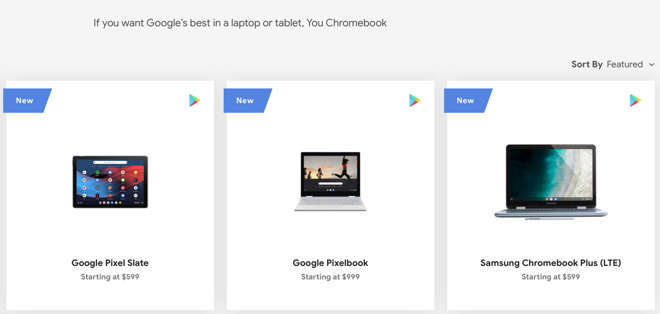
Google has similarly shown that it has no real insight into building a PC platform, with Chromebook and Android both failing to deliver a conventional PC, a modern mobile tablet, or some other hybrid experience that any customers want to pay anything for. All it has done is spend tons of money building devices that nobody buys: Chromebook Pixel, Nexus 9, Pixel C, and PixelBook have all been flops.
Everyone else in the PC industry is lined up behind Microsoft and Google, waiting for one or both of them to provide the software needed to drive their hardware. They’re also largely waiting on Intel to provide the silicon to power it. Efforts to move conventional computing to ARM chips, where there’s more competition, have suggested the potential of a new wave driving PC demand. However, overall interest in PCs is clearly waning despite the latest attempts at ARM laptops and netbooks, and Apple is far ahead of anyone else in developing custom ARM silicon to power the next generations of PCs.
Pretty clearly, nobody wants “Google’s best in a laptop or tablet”
It’s also worth noting that any significant movement from PCs to ARM processors will come at the cost of fragmentation of the Windows platform. Those expenses will be incurred by software developers trying to target multiple platforms, as well as two sets of chip designers—Intel and ARM—spending resources to build the future of Windows PCs. On Apple’s side, the differences between Macs and iPads are narrowing, both for developers as Apple prepares to introduce the ability to bring iOS AppKit apps to the Mac, and for chip development as Apple moves more of its proprietary tech to custom T2 silicon and as the Ax architecture nears the point where Apple’s own SoCs will have the ability to power Macs.
Isn’t it curious that in 2019, a decade after iPad launched to the howls of embittered naysayers, Apple has continued to grow its Mac sales while at the same time building iPad into an equally large enterprise? And yet all pundits can think about is how Apple desperately needs to choose between them, pontificating about how Apple should either give up Macs, or turn iPads into a Mac in order to move Mac users to iPads, or some equally bizarre advice that makes no sense at all.
Meanwhile, they saw nothing but huge potential in Google’s parallel failures of Chromebooks and Android tablets, and still see some glimmer of hope for Microsoft’s stagnant Surface hobby and a new crop of ARM Windows machines. Microsoft’s in it for the long haul, they insist, just like Microsoft said it was for Zune and Windows Phone. The reality today is that Windows has never been less important, and grows ever more irrelevant every year even as Microsoft continues to expand support for its users on iOS and Macs.
It doesn’t matter if pundits refuse to acknowledge this. It does matter, however, that Apple is lining up broad industry support behind building custom enterprise software for iOS, software that will soon be easy to port to the Mac as well.
Even if absolutely nothing were to change across the next ten years in terms of market share shifts, Apple’s Mac and iPad businesses would continue to generate nearly half a trillion dollars in revenues for Apple while supporting the development of highly advanced silicon, OS, development frameworks and apps. Windows remains in maintenance mode, getting occasional patches as the market forces driving Intel chips and Windows development slow to a crawl.
I’m happy to announce that ASP.NET Core 2.2 is available as part of .NET Core 2.2 today!
How to get it
You can download the new .NET Core SDK (2.2.100) for your dev machine and build servers from the .NET Core 2.2 download page. New Windows Server hosting, runtime installers and binary archives are also available from this page for updating servers.
This release updates .NET Core, ASP.NET Core, and Entity Framework Core to version 2.2.0. The new SDK version is 2.2.100. Visual Studio requirements are as follows:
The main theme for this ASP.NET Core release was to improve developer productivity and platform functionality with regard to building Web/HTTP APIs. As usual, we made some performance improvements as well. We’ve posted about these features as part of the preview releases and you as such you can read about them by following the links below:
Health Checks integration with BeatPulse
We’re happy to announce that the BeatPulse project now supports the new Health Checks API, which means you can easily add checks for dozens of popular systems and dependencies using their great support. Here’s a message from the BeatPulse team about their support for our new Health Checks API:
BeatPulse is a community driven project that was created to provide health checking mechanisms for systems, networking and a wide variety of services that are common within the enterprise, e.g. SqlServer, MySql,Postgress, Redis, Kafka and many more . When Microsoft announced ASP.NET Core Health Checks for the 2.2 roadmap, the BeatPulse team ported all the existing liveness packages and features to work with the new Microsoft Health Checks abstractions at the repository AspNetCore.Diagnostics.HealthChecks. Apart from all the health checking packages, the BeatPulse team also incorporates other features like pulse tracking (Application Insights and Prometheus), failure notifications and a UI interface were we can configure different monitored systems and have a global view of health status. This UI is available as a Docker image published in Docker Hub.
More coming soon
When we announced planning for ASP.NET Core 2.2, we mentioned a number of features that aren’t detailed above, including API Authorization with IdentityServer4, Open API (Swagger) driven client code generation, and the HTTP REPL command line tool. These features are still being worked on and aren’t quite ready for release, however we expect to make them available as add-ons in the coming months. Thanks for your patience while we complete these experiences and get them ready for you all to try out.
Migrating a project to ASP.NET Core 2.2
To migrate an ASP.NET Core project from 2.1 to 2.2, open the project’s .csproj file and change the value of the TargetFramework element to netcoreapp2.2. You do not need to do this if you’re targeting .NET Framework 4.x.
Finish by updating your NuGet package references to the latest stable versions. Note that projects targeting .NET Core (rather than .NET Framework) should not have a package version specified for the Microsoft.AspNetCore.App package reference as this will be managed automatically by the SDK. Doing so will now result in a build warning.
ASP.NET Core 2.2 is the latest release in the “Current” .NET Core train. This represents the first release since the declaration of 2.1 LTS that reestablishes a separate LTS and Current train. The Current train is where new features, enhancements, and regular bug fixes are applied and is recommended for most customers. Note that both LTS and Current releases receive servicing updates for security and critical stability fixes. It is currently expected that 2.2 will the last non-servicing release in the 2.x life cycle, and as such customers not using an LTS release will need to migrate to 3.0 GA, within 3 months of its release in the second half of 2019 in order to remain supported.
The .NET Core 2.2 SDK, runtime, and updated ASP.NET Core IIS Module are in the process of being deployed to Azure App Service regions around the world. We expect this to be completed before the end of December 2018.
Some regions may receive the updated runtime before the updated ASP.NET Core IIS Module (ANCM), which is required by default for projects targeting ASP.NET Core 2.2. It’s also a requirement for the new in-process hosting feature. If you receive startup errors after deploying to Azure App Service, try configuring your project to use the existing version of ANCM by setting the AspNetCoreModule property to the value “AspNetCoreModule”, e.g.:
Once the target region has been updated with the latest ANCM version, you can remove that property altogether and redeploy the application to have it switch to using the new ANCM.
This release also adds better 64-bit support for .NET Core in Azure App Service. If you’re running your ASP.NET Core application on .NET Core 2.2 with in-process hosting, you can simply enable the 64-bit option in the Azure Portal and the site will now run in a 64-bit process. For other information on how to run your ASP.NET Core application in a 64-bit process in Azure App Service with other configurations, see this article.
You may never read another app description as resigned as Partia 3’s. The developer, Dustin, laments the financial failures of the previous two entries, the cost of his vacations and weekends to the creation of this final chapter in the trilogy, and the likely mediocre response the new game will generate. Declaring it the ‘last app store description he will ever write,’ he signs it: “For the lovers only.”
The Parthia series is the creation of a devoted two-person team who have been making console-style strategy RPGs with no IAP for seven years with little reward to show for it. For that alone it’s worth a look – although unless you’re a strategy RPG die-hard, maybe not much more than a look.
The first Partia came out in 2012 and Partia 2 followed in 2014. Five years later, the labor of love is finally complete. Unfortunately, in that time, not much has advanced in the games’ design. Many of the criticisms given in PT’s review of the first game in the series still hold true even seven years later. Now, you do have touch controls rather than an on-screen controller, and the field isn’t pillarboxed into an approximation of a Game Boy Advance aspect ratio. But the UI is still frustrating, and the graphics and animations are limited. It would be nice if the gameplay made up for that.
The Parthia series has always been a devoted homage to Fire Emblem , which is known for its handheld titles on Nintendo platforms. Now there is an official Fire Emblem game on mobile, and a very popular one, albeit not the one fans were probably hoping for. Fire Emblem: Heroes reduced the size of the battlefield and dropped the series’ signature character permadeath. Parthia, on the other hand, is orthodox in its presentation of traditional strategy RPG gameplay. Your units move freely around the large battlefields. They can carry different equipment, gain levels, and have their individual advantages and weaknesses. In between battles, you can manage your army, buying and selling equipment and recruiting new soldiers. Most importantly, permadeath remains a threat, encouraging you to play carefully with your favorite characters.
However, battles are tedious. First, it takes a dozen taps to enter a simple command. Tap to select the unit. Tap to choose move. Tap to choose attack. Tap to choose the weapon. Tap to choose the target. Tap to confirm. Watch the animation. And that’s after turning off the default setting that requires double taps for each of those commands! Then, units too-frequently miss their targets or do little damage, making each battle a war of slow attrition. The AI does little to help the pace, preferring to wait to be attacked or otherwise being easily lured into bottlenecks and slowly whittled down one by one. Further, Parthia 3 doesn’t do a good job of teaching the player the capabilities of the units, instead leaving the education up to trial and error. I’m still not 100% sure which units are supposed to be strong against which, or if there even is a big difference between them. The AI is never a threat unless a story event demands overwhelming enemy forces.
Battles are often driven by story events, which push some drama onto the map by suddenly manifesting new enemy or allied units. The story remains forgettable, although commendable in its ambition. It’s trying to tell an epic tale of war and justice, but the large and thinly-drawn cast makes it hard to get a handle on why you should care. Not helping the narrative is the poor English used, which features grammatical or spelling errors in every other dialogue box. It’s not enough to make comprehension impossible, but it is enough to be frustrating to read and drop you out of the tale.
Devotees of the console strategy RPG style of Fire Emblem may find a lot to like in Parthia 3 and its prequels, especially those disappointed by Nintendo’s limited Fire Emblem: Heroes. This series was created by someone with a lot of love for a very particular kind of game. Now that the creator is freed of this obsession, I hope his next project can find the audience it deserves.
Earlier today Improbable released the following statement regarding their cloud based networking service SpatialOS:
Today we must regretfully inform our community of the following developments.
Unity’s block of SpatialOS: The game engine provider Unity recently changed (Dec 5) and then clarified directly to us (9 Jan) their terms of service to specifically disallow services like Improbable’s to function with their engine. This was previously freely possible in their terms, as with other major engines.
What this means: Unity has clarified to us that this change effectively makes it a breach of terms to operate or create SpatialOS games using Unity, including in development and production games.
Ongoing negotiation: Worryingly, this change occurred during an open commercial negotiation with the company to find a way to do more together.
Revoked Unity license: In addition, Unity has revoked our ability to continue working with the engine for breaching the newly changed terms of service in an unspecified way. This will affect our ability to support games.
Continuing service for all other engines: Users of all other engines remain completely unaffected and we are working with other engine providers to see if they can help support engine transitions for customers hit by this change.
You may not directly or indirectly distribute the Unity Software, including the runtime portion of the Unity Software (the “Unity Runtime”), or your Project Content (if it incorporates the Unity Runtime) by means of streaming or broadcasting so that any portion of the Unity Software is primarily executed on or simulated by the cloud or a remote server and transmitted over the Internet or other network to end user devices without a separate license or authorization from Unity. Without limiting the foregoing, you may not use a managed service running on cloud infrastructure (a “Managed Service”) or a specific integration of a binary add-on (for example, a plugin or SDK) or source code to be integrated in the Unity Software or Your Project Content incorporating the Unity Runtime (an “SDK Integration”) to install or execute the Unity Runtime on the cloud or a remote server, unless such use of the Managed Service or SDK Integration has been specifically authorized by Unity. Additionally, you may not integrate the Unity Runtime with a Managed Service or SDK Integration and offer that integration to third parties for the purpose of installing or using the Unity Runtime on the cloud or a remote server. For a list of Unity authorized streaming platforms, Managed Services and SDK Integrations, click here.This restriction does not prevent end users from remotely accessing your Project Content from an end user device that is running on another end user device. You may not use a third party to directly or indirectly distribute or make available, stream, broadcast (through simulation or otherwise) any portion of the Unity Software unless that third party is authorized by Unity to provide such services.
In a nutshell, the new ToS seem to prevent running any portion of the Unity runtime on a cloud based install without prior licensing of the cloud hosting company and Unity directly. The timing of this is quite interesting following on the heels of a partnership between Unity and Google to provide cloud based networking services.
In the meantime, developers that built their game around Unity and SpatialOS are going through a bit of a rollercoaster ride of emotions right now, such as Spilt Milk Studio:
Followed by:
Unity have not yet released a public content although their forums are quite… lively.
UPDATE: Tim Sweeney, founder and owner of Epic Games was quick to comment upon Unity’s gaff here and to reassure Unreal Engine developers that this wont happen to them:
The local lakes and ravines have been infected by a toxic outbreak! Pair up with your friends in co-op mode and take on the deadly ooze and its disgusting dwellers.
Nintendo Reveals How Much Its Employees Make In Japan And Other Key Statistics
Nintendo has shared some intriguing new information about its workforce in Japan. As spotted by analyst Daniel Ahmad, the Nintendo of Japan recruitment page contains some statistics about the people who work for Nintendo of Japan, including their average age, salary, length of employment, and more.
Nintendo of Japan employees more than 2,000 people, and their average age is 38.6. On average, a Nintendo of Japan employee makes $80,000 per year, and has worked at Nintendo for 13.5 years. Also notable is 7hrs, 45mins, which is the average length of a work day for a Nintendo of Japan employee.
Not sure if new info but noticed this after the update on the Nintendo (NCL) recruitment page. Stats for Japan only- No of Employees - 2,271 Avg age - 38.6 Avg length of employment - 13.5 yrs Avg work day - 7hrs, 45mins Avg annual salary - $80,000https://t.co/e0qKxJzqAKpic.twitter.com/Z0LTFEQ6I4
As mentioned, this information only pertains to Nintendo of Japan. The Mario maker has subsidiaries in other places around the world, including Nintendo of America and Nintendo of Europe, among other locations. Recruitment statistics do not appear to be available for those places.
In other Nintendo corporate news, Nintendo of America boss Reggie Fils-Aime recently announced that he is retiring in April.
"Thank you for your never-ending support, and for your passionate love of Nintendo. And personally, for giving me a Mushroom Kingdom full of incredible memories that I will never forget, ever.
In another piece of news, the Nintendo Switch was released two years ago today, on March 3, 2017. The console has been a huge success; Nintendo has sold more than 32 million Switch units as of December 31, 2018, which is a massive improvement over the Wii U.