Back at GDC 2019, Unity announced Havok Physics would be coming soon. Yesterday, Havok for Unity was released as a preview package in the Unity Package manager. The Havok physics implementation is built on the DOTS framework therefore you will require Unity 2019.1 for higher to run it.
When we first set out to define what the future of physics would look like with our Data-Oriented Technology Stack (DOTS), we sought a partner that shared the same core concepts and values as us. Through our partnership with Havok, we were able to leverage DOTS to deliver the highly optimized, stateless, entirely C#, and performant Unity Physics. We also knew that some of you would have more complex simulation requirements, needing a stateful physics system. For that reason, we knew Havok would be the perfect solution to integrate into Unity for those high-end simulation needs.
Some of you might be asking, “Ok, but why did you make two systems instead of just one?” We know that our users have a plethora of different use cases, and we wanted to give everyone a choice based on what their needs are. For some, Unity Physics will suffice, while others will want the benefits and enhanced workflows of Havok Physics. Ultimately, there is no right or wrong choice, as we illustrate later in this blog post. You can switch between either solver without having to reauthor all of your content completely.
An obvious question you may have is, why should I choose Havok over the new Unity physics engine? This is explained in the Havok documentation:
Higher simulation performance : Havok Physics is a stateful engine, which makes it more performant than Unity.Physics for scenes with significant numbers of rigid bodies, due to automatic sleeping of inactive rigid bodies and other advanced caching techniques (typically 2x or more faster).
Higher simulation quality : Havok Physics is a mature engine which is robust to many use cases. In particular, it offers stable stacking and a solution for smoothing out contact points when rigid bodies slide quickly over each other (known as “welding”).
Deep profiling and debugging of physics simulations using the Havok “Visual Debugger” standalone application (available on Windows only).
You can learn more about the Havok preview in the video below. In addition to an overview of what Havok physics is all about, it also covers the installation process and illustrates how to configure and run the Havok Visual Debugger. The example repository used in the video is available here.
The latest Nintendo Download update for North America has arrived, and it’s bringing new games galore to the eShop in your region. As always, be sure to drop a vote in our poll and comment down below with your potential picks for the week. Enjoy!
New Super Lucky’s Tale(Fri 8th November, $39.99) Run, jump, climb incredible heights, burrow deep underground, overcome enemies, and explore amazing worlds on an epic quest to rescue the Book of Ages from the mysterious Jinx and his nefarious Kitty Litter! Experience an incredible variety of gameplay, ranging from 3D open-world hubs to story-based adventure levels to 2D side-scrolling challenges, rewarding mini-games, mind-bending puzzles, thrilling boss battles, and a memorable cast of characters!
Disney TSUM TSUM FESTIVAL(Disney Interactive, Fri 8th November, $49.99) The ever-popular Disney’s Tsum Tsum makes its debut on the Nintendo Switch! The cute little characters from Disney’s Tsum Tsum step foot into a toy store, where they can have a blast playing ten different party games, including curling, hockey, and more! Enjoy many modes of play such as cooperative and versus play.
Jumanji: The Video Game(Outright Games, Fri 8th November, $39.99) Unite in adventure and laughter in the action-packed game of Jumanji, the ultimate challenge for those who seek to leave their world behind. Play online, split-screen or with AI teammates, and combine the unique abilities of Dr. Bravestone, Ruby, Mouse and Prof. Oberon to defeat your foes and save the day!
Switch eShop
ANIMUS: Harbinger(TROOOZE, Today, $7.99) These are the days before Ire: Blood Memory, the days when Kerr the Breaker’s evil slipped its way into Cadmeia. You, Forlorn — follower of the Resonant, and caught out of time and place — are called upon by the shadow of the late King Cadmus to bring judgement to those that have betrayed the land.
Arcade Archives T.N.K III(HAMSTER) “T.N.K III” is a vertically scrolling shooting game released by SNK in 1985. In the last years of the great war, when authorities get word that an enemy nation is developing weapons on a small island, they order a special task force to destroy the enemy’s development facilities.
Asdivine Kamura(KEMCO, Today, $14.99) After everything is upended when a transcendent being named Zaddes appears and begins altering the world, the Spirit Deity, Shiki, sets out to gather the Mystic Orbs scattered throughout the various regions, and restore his world.
Bee Simulator(Varsav Games Studio, Tue 12th November, $39.99) See the world through the eyes of a bee! Explore a world inspired by Central Park where you can take part in bee races, collect pollen from rare flowers and defy dangerous wasps. Play with friends or family in three game modes, including co-op and PvP on split-screen.
Blindy(Ultimate Games, Fri 8th November, $7.99) It is not an unfair platformer but it’s very challenging. Play 60 unique levels in 4 game modes! Each level requires skill, death and practice. Blindy is a hardcore platformer, an exciting, challenging game for anyone. Still want more? Find a coin hidden in every level! Try to not smash your device.
Desktop Rugby(SAT-BOX) All the excitement of rugby in the palm of your hand! Enjoy hair-raising scrums and dramatic conversions all through a casual control system! A whole field awaits on one school desk! Customize your team with individual player strengths and lead them to victory!
Draw Chilly(HYPETRAIN DIGITAL, Tue 12th November, $9.99) DRAW CHILLY is a hell of an arcade game where you take on the role of Vladimir and raise a city from the depths of Purgatory at the request of your employers, the Horsemen of the Apocalypse.
Football Game(Ratalaika Games, Fri 8th November, $4.99) Tommy is the local high school football hero in the small town of East Bend, USA. It’s game night for the Purchase County Turbines and his sweetheart is waiting in the bleachers. However, something is amiss… Inspired by classic ’80s and ’90s point and click adventures, get ready for a night you won’t forget in this twisted Lynchian thriller.
Headsnatchers(Iceberg Interactive, Today, $14.99) Headsnatchers is a stupidly hectic party game for up to 4 players, local or online! Challenge your friends to insane brawls, steal their heads and do dumb stuff with them – anytime, anywhere on Nintendo Switch!
holedown(webbfarbror, Wed 13th November, $9.99) Dig deep underground by shooting balls and breaking blocks to traverse your way to the core of planets. With only a certain number of shots per round and some blocks firmly fixed to the wall, thoughtfully strategize and aim the balls for maximum impact.
House of Golf(Atomicom, Fri 8th November, $9.99) An arcade sports game with full 3D graphics, physics and easy pick-up-and-play game mechanics for all the family to enjoy. House of golf is the golfing dojo you always dreamed of.
Incredible Mandy(CIRCLE Entertainment, Today, $14.99) Throughout Incredible Mandy you will explore the memories of a brother and sister that are buried deeply within their dreams; every dream represents an untold secret. Mandy looks for lost memories, challenging and seeking to overcome her fears.
Juicy Realm(X.D. Network, Today, $14.99) Juicy Realm is a roguelite game in which players must square off against bizarre fruits all across the world. The line between the animal and the plant world has become blurred, and the food chain has been completely disrupted.
Mad Games Tycoon(Toplitz Productions, Tue 12th November, $39.99) In Mad Games Tycoon you build your own Gaming Empire. Start your own game studio in the early ’80s. The journey begins in a small garage with little money and limited resources. Create new game concepts, set up your team and develop the next million hit.
Meanders(Undefined, Today, $4.99) 40+ levels of instant play with no loading times: relax or speedrun to the exit! Jump, bounce, slide, teleport!
Monkey Barrels(Good-Feel, Today, $14.99) In a world ruled by the consumer electronics giant Crabbenwold Electro, a pair of brave monkeys set out on a journey to rescue their kidnapped friends from an evil army of robot appliances!
One Person Story(Drageus Games, Fri 8th November, $2.99) You will evolve and grow up in a minimalist and beautiful environment full of characters, objects and events that represent life situations. Sometimes there is pain, like when our little hero crushes on spikes.
puzzlement(gamebra.in, Today, $1.99) Puzzlement is a minimal puzzle game based on walking/jumping between plane surfaces. The goal is simple; collect all red squares.
REKT! High Octane Stunts(QubicGames, Fri 8th November, $5.99) Ever wanted to kickflip a car? Get behind the wheel in this high octane stunt driving game and get REKT! With REKT doing tricks is incredibly smooth and easy, and with realistic physics, it’s easy to learn and hard to master.
Ritual: Crown of Horns(Feardemic, Today, $19.99) Ritual: Crown of Horns is a slaughterhouse: a fast-paced action game set in an alternate Wild West, a demonic version of a hellish frontier. This arcade-inspired title unravels a tale about an unlikely duo: a bounty hunter who comes back from beyond the grave, yearning to exact revenge on his killers and a witch who aids him with a series of powerful rituals to further her own agenda. Read our Ritual: Crown of Horns review.
Romancing SaGa 3(Square Enix, Mon 11th November, $28.99) The celebrated RPG classic comes West for the first time! Developed by industry veterans including the legendary developer Akitoshi Kawazu, Romancing SaGa 3 was originally released in Japan in 1995. This HD remaster of the legendary RPG masterpiece introduces optimized graphics, a new dungeon to explore, new scenarios and a new game+ function.
Skybolt Zack(GMG Label, Today, $24.99) A New Generation of arcade game Skybolt Zack is the result of a unique way of mixing platformer mechanics and color matching gameplay.
Stay Cool, Kobayashi-san!: A River City Ransom Story(Arc System Works, Today, $13.99) A short while after the events of “Downtown Nekketsu Monogatari”… Reiho High School, where the battle took place, has these Big Four, who are feared by all the other schools around. And at the top of the Big Four, reigns only one man: Masao Kobayashi.
Strange Telephone(PLAYISM, Today, $9.99) A 2D adventure game where you explore a mysterious realm. Jill is trapped in a dark world, and in front of her floats a large mysterious door. To her aid comes Graham, a strange entity in the form of a telephone. By typing 6 numbers into Graham, Jill can cause the realm to transform.
Sturmwind Ex(b-alive, Fri 8th November, $12.99) STURMWIND EX is a shoot-em up in the tradition of old arcade games. If it moves – shoot it! You can play mission mode with all 16 levels with saving your progress with every finished level or arcade mode with 6 levels and no continues.
Super Street: Racer(Lion Castle Entertainment, Today, $49.99) A NEW ERA OF STREET RACING STARTS NOW In Super Street: Racer, you don’t just buy your car, you build it. Use hundreds of car parts from the biggest aftermarket brands to customize your exterior, interior and performance to go from scrap to supercar! Take your build to the streets and tear up the roads in breathtaking landscapes or world cities.
The Grisaia Trilogy(PROTOTYPE, Today, $59.99) For the first time since its humble beginnings as a PC game, and after the handheld, manga, and anime adaptations that followed, the complete “The Fruit of Grisaia” Trilogy is now available on the Nintendo Switch system in one complete collection!
The Manga Works(Kairosoft, Today, $14.00) It’s the manga artist experience you’ve been waiting for! Create a manga masterpiece and draw your way into the nation’s heart.
The Mims Beginning(Ultimate Games, Mon 11th November, $8.99) Experience the mysterious and mystical by taking on a journey with Mims in this strategic god-like video game. Create structures, plant vegetation, breed animals, take care of your minions, use divine PSI powers, triumph in face of natural disasters, fight monsters, predict the future, reveal secrets and so much more. Assume the lead over Mims as they journey across the galaxy in their epic quest!
Thief of Thieves: Season One(Rival Games, Tue 12th November, $19.99) Season One contains all four volumes of this award-winning game from Rival Games in one single purchase. (Voice acting and subtitles in English.) Based on the best-selling comic by Robert Kirkman, Thief of Thieves: Season One is a story of heists and the people behind them.
Tokyo Dark – Remembrance –(Unties, Today, $19.99) Detective Ito’s partner is missing, but what starts as a straightforward case soon spirals into a twisted nightmare that causes Ito to confront her past and question her own sanity. Tokyo Dark places the narrative in your hands.
Truck Simulator USA(SC Ovilex Soft, Fri 1st November, $13.99) Want to know what driving an 18 Wheeler feels like? Truck Simulator USA offers a real trucking experience that will let you explore amazing locations.
Twister Road(Dispatch Games, Fri 1st November, $4.99) Random twisting roads every time you play so you’ll never play the same game twice!
Yaga(Versus Evil, Tue 12th November, $24.99) Smash, clobber and bash the murderous legends of Slavic mythology in this darkly funny action role-playing game that changes every time you play.
Zen Chess Collection(QUByte Interactive, Tue 12th November, $3.99) Zen Chess Collection. A collection of four minimalist chess puzzle games to test your skills in a series of 600 challenges, designed for experienced chess players and newcomers alike.
Rally Road – (Nov 8, Info TBC)
Nintendo Mobile
Take in the Sights at the City of Lights with Mario Kart Tour – Blast through the scenic streets of grand Paris during the Paris Tour event, which runs exclusively in the Mario Kart Tour game until Nov. 19. Racers can zoom past the Eiffel Tower while playing as Shy Guy dressed as a pastry chef, or as Peach, looking positively resplendent in her stylish vacation outfit as she explores Paris.
Activities
Don’t Miss Your Last Chance to Enter the My Nintendo Luigi’s Mansion 3 Sweepstakes! – Celebrate the spookiest game of the year with the My Nintendo Luigi’s Mansion 3 Sweepstakes, exclusively for My Nintendo members. Redeem your My Nintendo Platinum Points for a chance to win fun prizes, including a Luigi’s Mansion 3 PVC Statue. These statues are incredibly detailed – seriously, check out the design of the Poltergust G-00 in all its ghost-slamming glory.
So that’s your lot for this week’s North American Nintendo Download. Go on, be a sport and drop a vote in the poll above, and comment below with your hot picks!
Posted by: xSicKxBot - 11-08-2019, 01:51 AM - Forum: Lounge
- No Replies
Stranger Things Season 4 Kicks Off With An X-Men Reference
Stranger Things Season 4 is coming. We may not have any real idea when, unfortunately, but it has been announced and, based on a tweet sent out by the official writer's room twitter account, some level of production or pre-production has officially started. And in true Stranger Things fashion, the first episode of Season 4 is an 80s-flavored pop culture reference: A nod to the classic X-Men villains, The Hellfire Club.
For the uninitiated, The Hellfire Club was introduced in 1980 as part of Chris Claremont and John Byrne's now-legendary run on the main X-Men title. A secret society of mutants, the Hellfire Club's goals are usually economic and political. They function somewhat like a mutant Illuminati, with membership passed down through generations of the wealthy elite, working in the shadows to extend their influence and power. Famously, they worked to kidnap Jean Grey, a powerful psychic (who's story bears some pretty obvious connections to Eleven) only to have their plans blow up in their faces upon the revelation that Jean was, in fact, the human conduit for The Phoenix, an uncontrollable cosmic entity.
Of course, there's no real way to be absolutely certain if the actual comic book Hellfire Club will have any bearing on Season 4, given how things were left off in Season 3. We've still got to deal with Hopper's "death" and subsequent (or at least, probable) abduction by the Russians and the fact that El's apparently lost her powers and moved out of Hawkins with the Byers family.
Whatever happens, given how little we know right now, it seems like investigating the X-Men angle is as good a call as any. Time to dust off your comics and start spinning up some theories while we anxiously await more news.
Here’s why your iPhone may have received strange texts last night
By Malcolm Owen Thursday, November 07, 2019, 10:56 am PT (01:56 pm ET)
A batch of text messages sent months ago were delivered to iPhones and other mobile devices in the United States early in the morning of November 7, with the mysterious message delivery most likely linked to the rollout of the recently-launched Cross-Carrier Messaging Initiative.
In the early hours of Thursday morning, a number of US mobile users discovered they were receiving text messages at an unusual time of day. The messages, which included both texts from companies and from people the recipients know, all appear to have been originally sent around the time of Valentine’s Day in February.
The messages were not limited by mobile device producer or operating system, which effectively rules out services like Apple’s iMessage that are limited to iOS devices like the iPhone. The affected users were also not limited to a specific carrier, with customers of all the major mobile networks in the US seemingly falling victim to the problem.
The out-of-context nature of the messages led to posts on Twitter and Reddit complaining about their occurrence, reportsPopular Mechanics. As the messages seemed like they were legitimately sent by the sender, this caused some confusion between the two parties, and with many not necessarily keeping messaging logs that go as far back as February, many are left without the ability to check if the messages were originally received correctly.
While there is no official statement from any of the carriers explaining why the event took place, radio station 92 Mooseadvises U.S. Cellular confirmed there was an issue with an update to the Cross-Carrier Messaging System. According to the representative, the glitch affected several carriers, and is unlikely to result in any more messages from Valentine’s Day reappearing.
Some customers have also reported similar responses from the support teams of other carriers via social media.
Officially announced in October, the Cross-Carrier Messaging Initiative is based on GSMA’s Rich Communications Service industry standard to improve messages between customers on the different carriers. AT&T, Sprint, T-Mobile, and Verizon have all signed up for the venture, which aims to develop and deploy the interoperable messaging service in 2020, initially to Android devices.
CCMI is expected to enable an enhanced experience to privately send individual or group chats across carriers with high-quality pictures and videos, as well as to help customers interact with brands and perform transactions, such as paying bills or scheduling appointments. Most importantly, it aims to create a “single seamless, interoperable RCS experience across carriers, both in the US and globally.”
Given the large number of people who would be affected by the system’s implementation, it seems likely Apple would have to include support for it in Messages in the future.
Posted by: xSicKxBot - 11-07-2019, 07:43 PM - Forum: Windows
- No Replies
En garde! Wearable IoT and AI keep fencers on point
“I can immediately address weaknesses I didn’t even know that I had. I’m feeling more confident about performing my best.”
RaceFit’s solution has also been extended to other sports like high-intensity interval training (HIIT) training, cycling and tennis. Soon, RaceFit plans to expand the usability of its app to team sports, like football.
Beyond fencing
The technology is not just for coaches and high-end competitors. Anyone can use RaceFit in their regular lives. It comes with an exercise app with customizable routines. The app lets you know immediately if any of your movements need improvement, like if your hip position is too high while planking. It can keep track of your progress over time and prescribe new exercises to help you reach your fitness goals.
Additional sports, like cycling and running, are supported by downloadable modules.And more sports and exercises are being added to the list.
RaceFit co-founder and CEO Graham Mak says, “We are not limited to those exercises. We are only limited to human motion. If a customer says, ‘I’m in a canoe club and I want a canoe program,’ then we can do something like that.”
When a problem is identified, coaches can develop a training regimen to address it. They can also monitor an athlete’s progress remotely.
Mak also has plans to aid physical therapists. Wearing a simpler version of the sensor contained in a single band, patients can perform exercises as instructed by the therapists. The device will help the physical therapist determine if they do it correctly. “This will save a lot of time and it can be done with multiple patients at the same time.”
Dennis Poon, the company’s Chief Experience Officer, says physiotherapists who use the RaceFit system “can definitely take care of more patients and, more importantly, they will be able to monitor their recovery.”
A similar use is applicable to older people, especially those who live alone. According to the Hong Kong government, around 20% of adults over 65 have a fall at least once a year. Most of those report some kind of injury and nearly 10% break a bone. Since the RaceFit sensors give a complete picture of human movement, the system would know, for example, if a person has fallen down and needs assistance.
The company has been able to change its business model by being nimble as it embraces new technologies.
“What is the active and inactive times in a day? And, what about the time walking or sitting or lying on the bed? What does it represent? And, how can it affect health outcomes?” Mak says.
A long way from the garment industry
RaceFit’s journey to understanding human movement began with a much more pedestrian goal. According to Mak, his team just wanted to make a smart garment to revitalize the traditional apparel industry.
After three years of R&D, they decided to change direction and were inspired by the kind of motion-capture suits you see used in a Hollywood special effects production.
That led Mak to ask: “What if we understand motion and make recommendations afterwards?” They realized that by using Microsoft Azure cloud, they could build their own AI solution to focus on fitness ability management. “For example, when you do a push-up, did you do it correctly or incorrectly?”
By being nimble, changing direction, and embracing new technologies, Mak and his team have created new business models that have transformed the company.
Poon sums it up this way, “We started our company focusing on Sports and Fitness, but we’ve gone way beyond that already.”
Tuning your bash or zsh shell on Fedora Workstation and Silverblue
This article shows you how to set up some powerful tools in your command line interpreter (CLI) shell on Fedora. If you use bash (the default) or zsh, Fedora lets you easily setup these tools.
Requirements
Some installed packages are required. On Workstation, run the following command:
On Workstation, install using the following command:
sudo dnf install fontawesome-fonts
On Silverblue, type:
sudo rpm-ostree install fontawesome-fonts
Powerline
Powerline is a statusline plugin for vim, and provides statuslines and prompts for several other applications, including bash, zsh, tmus, i3, Awesome, IPython and Qtile. You can find more information about powerline on the official documentation site.
Installation
To install powerline utility on Fedora Workstation, open a new terminal and run:
Note: On Silverblue, before proceeding you need restart.
Activating powerline
To make the powerline active by default, place the code below at the end of your ~/.bashrc file
if [ -f `which powerline-daemon` ]; then powerline-daemon -q POWERLINE_BASH_CONTINUATION=1 POWERLINE_BASH_SELECT=1 . /usr/share/powerline/bash/powerline.sh

fi
Finally, close the terminal and open a new one. It will look like this:
Oh-My-Zsh
Oh-My-Zsh is a framework for managing your Zsh configuration. It comes bundled with helpful functions, plugins, and themes. To learn how set Zsh as your default shell this article.
Once installed, you can select your theme. I prefer to use the Powerlevel10k. One advantage is that it is 100 times faster than powerlevel9k theme. To install run this line:
Close the terminal. When you open the terminal again, the Powerlevel10k configuration wizard will ask you a few questions to configure your prompt properly.
After finish Powerline10k configuration wizard, your prompt will look like this:
If you don’t like it. You can run the powerline10k wizard any time with the command p10k configure.
Enable plug-ins
Plug-ins are stored in .oh-my-zsh/plugins folder. You can visit this site for more information. To activate a plug-in, you need edit your ~/.zshrc file. Install plug-ins means that you are going create a series of aliases or shortcuts that execute a specific function.
For example, to enable the firewalld and git plugins, first edit ~/.zshrc:
plugins=(firewalld git)
Note: use a blank space to separate the plug-ins names list.
Then reload the configuration
source ~/.zshrc
To see the created aliases, use the command:
alias | grep firewall
Additional configuration
I suggest the install syntax-highlighting and syntax-autosuggestions plug-ins.
Colorls is a Ruby gem that beautifies the terminal’s ls command, with colors and font-awesome icons. You can visit the official site for more information.
Because it’s a ruby gem, just follow this simple step:
sudo gem install colorls
To keep up to date, just do:
sudo gem update colorls
To prevent type colorls everytime you can make aliases in your ~/.bashrc or ~/.zshrc.
alias ll='colorls -lA --sd --gs --group-directories-first'

alias ls='colorls --group-directories-first'
Also, you can enable tab completion for colorls flags, just entering following line at end of your shell configuration:
source $(dirname ($gem which colorls))/tab_complete.sh
New Game-Changing Features Revealed For Pokémon Sword And Shield
Several new details have been revealed for Pokémon Sword and Shield today, all of which showcase new features that will have a rather significant impact on the way players train.
You can see a brief summary of the features in the video above, but we also have the full rundown for you below, directly from The Pokémon Company. The list includes new items – such as the Mint – which can help a Pokémon’s stats to grow quickly, and changes in the way that Egg moves work.
New Items and Features for Training Pokémon New items that will help Trainers raise their Pokémon will be introduced in Pokémon Sword and Pokémon Shield.
Each Pokémon has a Nature that can impact which of its stats are likely to grow faster or slower than average. Using a Mint on a Pokémon seems to change these stat-growth patterns and will impact which stats of a Pokémon are likely to grow faster than usual. Mints will not change a Pokémon’s Nature.
Special supplements Nutritious drinks like Protein and Iron raise a Pokémon’s base points, which in turn help raise that Pokémon’s stats. If two Pokémon are of the same species but one has more base points, the Pokémon with more base points will grow stronger. Until now, there has been a limit on how many special supplements could be used on a Pokémon. In Pokémon Sword and Pokémon Shield, Trainers will be able to max out a Pokémon’s base points using only these supplements. Normally, Pokémon earn Exp. Points through battling. If a Trainer uses an Exp. Candy, they will be able to give their Pokémon Exp. Points directly. Exp. Candy can be earned in Max Raid Battles. Changes to Egg Moves Sometimes, a Pokémon hatched from an Egg will know unusual moves called Egg Moves. Egg Moves are moves that a Pokémon normally wouldn’t be able to learn through more common means, like leveling up or using TMs. In Pokémon Sword and Pokémon Shield, if two Pokémon of the same species are placed at a Pokémon Nursery together, an Egg Move that one them knows can be passed on to the other Pokémon. A Pokémon can only learn an Egg Move in this way when it knows three or fewer moves.
The announcement also includes a couple of welcome tweaks to the norm:
Pokémon Boxes Pokémon that aren’t on a Trainer’s team can be deposited into Pokémon Boxes. In these games, Trainers will not only be able to access their Pokémon Boxes in various towns and facilities but also while they’re on the road or even when exploring tall grass. Pokémon can be swapped in and out of a Trainer’s team whenever the Trainer wants, though there are a few places, such as mission areas where a Trainer takes on a Pokémon Gym, where Trainers won’t be able to access their Pokémon Boxes. Nicknames If a Pokémon that has been received in a trade doesn’t have a nickname, Trainers will now have the chance to give it a nickname—but only once. This can be achieved by speaking to the man standing behind the left-hand counter in any Galar region Pokémon Center. Like previous Pokémon video games, the name of a traded Pokémon that already has a nickname cannot be changed.
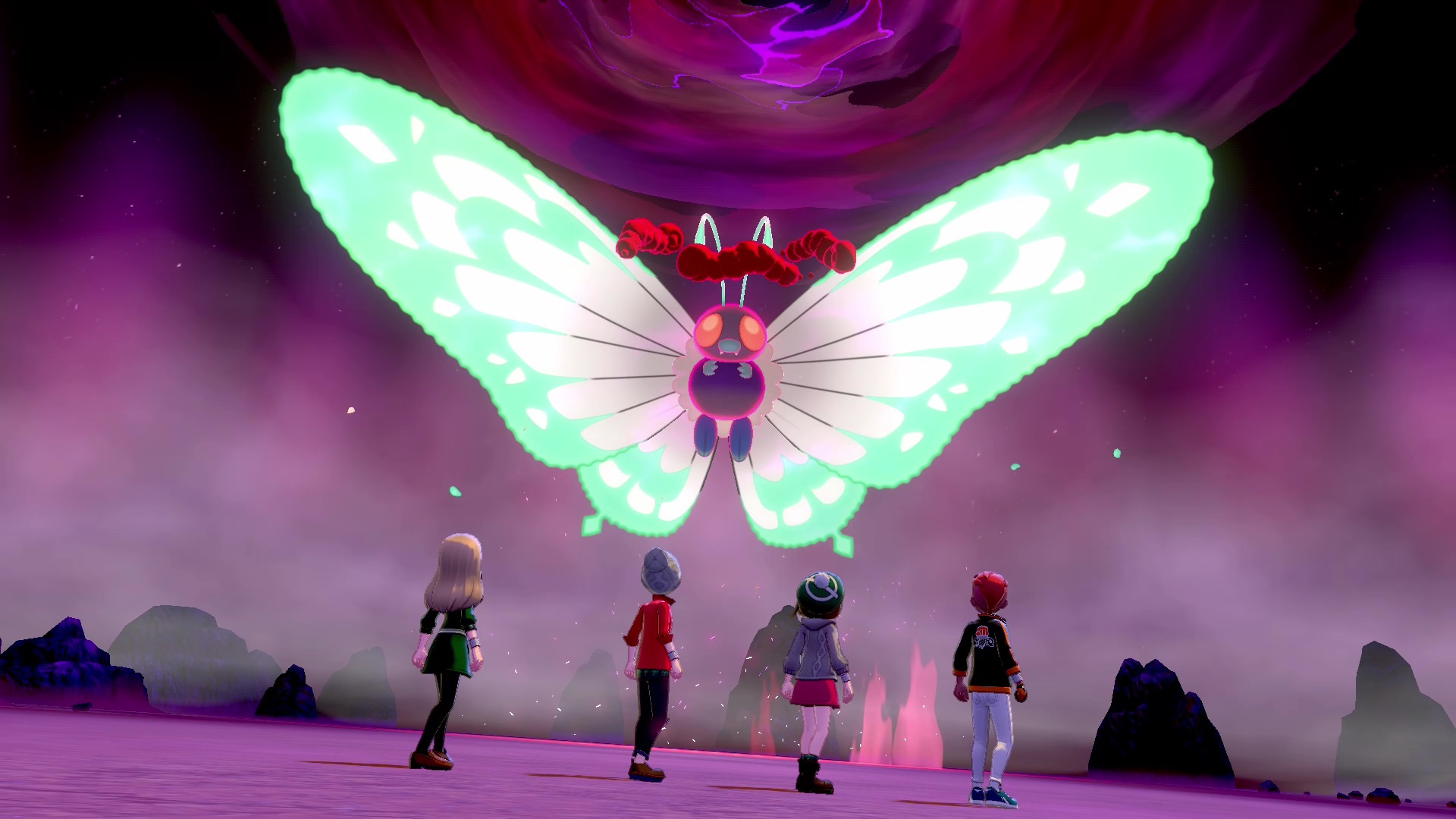
That’s not all, either, as it has also been revealed that from launch day – Friday, 15th November – until early January 2020, players will be more likely to encounter Gigantamax Butterfree in Max Raid Battles. Presumably, this signifies that other Gigantamax Pokémon may also receive similar ‘boosted’ periods where you’ll be more likely to encounter them.
Earlier today, it was also revealed that Pokémon Sword and Shield will host their first online battle competition this December.
Hardware Review: Go-tcha Evolve – The Pokémon GO Plus Killer
Accessory maker Datel has had two attempts at making the ultimate Pokémon GO companion device: the Go-tcha and the Go-tcha Ranger. Both mimic the functionality of the Pokémon GO Plus (and the later Pokéball Plus) but with one massive advantage – they automate functions such as swiping nearby Pokéstops and catching ‘mon, so you don’t have to interact with the device at all; it does all of the busy work for you.
We really like both of the previous Go-tcha devices, but with one huge caveat – both of our review units completely failed after a few months (we actually had two of the original Go-tcha units die on us). Reliability is clearly a big problem with these devices, which makes reviewing the Go-tcha Evolve a little tricky; as much as we like it (and believe us, we do), we can’t be entirely sure it will still be ticking over in six months. But for the time being, let’s approach this latest accessory with a fairly open mind.
Go-tcha Evolve Review: Design And Functions
Like the original Go-tcha, the Go-tcha Evolve resembles a fitness tracker. It’s a much larger unit than the original, but its design is arguably less obnoxious, so you don’t need to feel self-conscious about wearing it in public (it’s certainly a lot less obvious than the Pokémon GO Plus with its flashing multicolour LED). The strap is available in four colours – Dynamic Grey, Trailblazer Blue, Globetrotter Green and Daredevil Red – and is pretty comfortable. The main unit has a reasonably bright colour screen which displays information and cute little animations, and can be interacted with via a single touch-sensitive button.
Charging is handled by a full-size USB port which is accessed by removing the upper part of the strap. This is quite a tough process (so much so that the unit comes with an instruction sheet focused purely on how to charge the device) and it often feels like you’re going to break something; Datel recommends that you remove it by pulling it at a 45-degree angle. This connection also means that the Go-tcha Evolve isn’t water-resistant, so you’ll want to make sure you remember to take it off before having a bath or shower. The unit takes about 1 and-a-half hours to fully charge, and a charge lasts a fair few days, depending on how much you use the device. For example, after a week of fairly casual use, our unit still has a single bar of battery remaining.
Tapping the single button on the front of the unit wakes it from sleep, and subsequent taps move you through the menu system one option at a time. You can choose to toggle things like auto-catching (of both known and unknown monsters – you can choose to ignore ones you already have in your Pokédex) and auto-swiping of Pokéstops, as well as vibration alerts. The unit will also show if your Go-tcha Evolve is currently connected to your phone, and you can choose to have it display the time and date when it wakes from sleep, instead of the standard startup animation. You can choose to turn off the automatic processes if you so wish, and manually tap the device to execute a catch or Pokéstop swipe.
But that’s not all! There’s a pedometer that tracks how many steps you’ve taken, and it’s pretty accurate from what we can ascertain – it kept pace with our Apple Watch, at least. You can also choose to totally silence the device so no alerts come through, which is handy when you’re in a quiet environment and don’t want it constantly flashing and vibrating. Speaking of the latter, the motor inside the Go-tcha Evolve is a little bit feeble and unless you’re standing totally still, you often can’t feel when it’s vibrating.
The Go-tcha Evolve is listed as being compatible with the iPhone 5s, iPhone 6, iPhone 6 Plus, iPhone 6S, iPhone 6S Plus, iPhone SE, iPhone 7, iPhone 7 Plus, iPhone 8, iPhone 8 Plus, iPhone X, iPhone XS, iPhone XS Max, iPhone XR devices with iOS 10.0 or later installed. We’d also assume that the latest iPhone 11 models are supported. On the Android side of things, the requirement is a device with 2 GB RAM or more, Bluetooth Smart (Bluetooth Ver. 4.0 or higher) capability, and Android 5.0 or higher. There’s a dedicated app available for both iOS and Android which allows you to toggle various settings more easily, as well as download firmware updates for the device itself. To connect the Go-tcha Evolve to the app, you’ll need to make sure it’s not currently connected to Pokémon GO itself.
As you might expect, the Go-tcha Evolve behaves very much like a Pokémon GO Plus, albeit with the ability to automate functions. Pokémon GO sees the device as a Pokémon GO Plus, so there’s no way that Niantic can ‘disable’ it from the app (it’s worth stressing that this product is 100% unofficial and not sanctioned by Nintendo, The Pokémon Company or Niantic). However, it also means that the Go-tcha Evolve is subject to the same limitations as the Pokémon GO – namely, it won’t stay connected forever and often disconnects at seemingly random times. We assume this has much to do with how your phone handles RAM management (we were using an iPhone XR, which has a rather pathetic 3GB of memory), but it’s hardly a deal-breaker; when it happens, you just open the app, tap the Pokémon GO Plus icon, wake the Go-tcha Evolve and the connection is re-established.
Go-tcha Evolve Review: The Verdict
Right now, we can’t fault the Go-tcha Evolve. It improves on the original model and the full-colour screen is a real bonus. It’s slightly larger, but it’s not what we’d call an ugly product – so there’s no real shame in being seen wearing it when you’re out and about. Battery life is good, and the fact that it tracks your steps as well as helps your monster hunting makes it even more appealing (especially as the process of playing Pokémon GO is sure to boost your daily step count).
The real question is: how long will this thing last? Datel’s track record in this regard leaves something to be desired, and while we can’t say for sure that the Go-tcha Evolve will suffer the same fate as its flaky predecessors, we can only offer a cautious recommendation at present. We’ll update this review if the situation changes over the next few months, but for the time being, this appears to be the dream device for dedicated Pokémon GO players.
Please note that some links on this page are affiliate links, which means if you click them and make a purchase we may receive a small percentage of the sale which helps support the site. Please read our FTC Disclosure for more information.
4K Gaming Is "Useless," Says Former Limbo And Inside Dev
Dino Patti thinks that 4K gaming is of little consequence to developers, and is just yet another PC and console upgrade being advertised to help sell hardware. Patti is the co-founder and former CEO of Playdead--the developer behind Limbo and Inside--who left the studio in 2016 and went on to start new companies.
"I think [4K gaming] is useless," Patti said at Reboot Develop, according to VG247. "It's something that's being pushed by tech vendors to push the next console." Both Microsoft and Sony's next-gen consoles--Project Scorpio and PS5 respectively--will support 4K and have a max output resolution of 8K.
"[Manufacturers] don't respect the natural evolution of games and you force technology," he added. "Microsoft with Kinect, they paid studios to make a lot of s***ty games."
After leaving Playdead, Patti went on to be the co-founder for both Coherence and Jumpship. Coherence is working to create a cloud-based, open-source development platform. Jumpship is in the midst of developing its first game, Somerville, which tells a science fiction story about the lives of people who survive a global catastrophe. In terms of both tone and graphics, it looks a lot like Limbo and Inside--games that don't necessarily require 4K graphics to convey their unsettlingly eerie atmosphere.
"I want to select a path by myself and not be drawn in by money from tech vendors," Patti said. "There's a lot of people that see something shiny and follow that. You can definitely see all the herd walking one way and falling."
Back at Playdead, the studio is currently in the midst of developing its third game, which is still unannounced. Playdead has been teasing the project since January 2017, when the studio tweeted an image from the new game. Since then, Playdead has included additional images and concept art in tweets and job postings for the new game--the latter of which have also implied that this third title will take place in a 3D space as opposed to the 2D side-scroller format seen in Limbo and Inside.
Posted by: xSicKxBot - 11-07-2019, 08:41 AM - Forum: Lounge
- No Replies
On the Power Climb
Since the release of Shadowkeep, we’ve been watching the community climb in Power as they’ve embraced the Seasonal Artifact to take on the Nightmares of the Moon. The Gate Lord’s Eye provides not only unique perks for players to earn, but additional Power to give Guardians an edge when taking on pinnacle content.
A few among you have been hard on the grind, looking to reach heights in Power that some may only dream of achieving. [I am Savathûn, ravenous!] Last night, Bagel4k was the first to reach Power level 999. [I have set the snare and baited the trap] Following the guidance of a lore piece, they’ve also taken on the Shattered Throne dungeon, solo, in hopes of breaking the curse of the Dreaming City. [Is victory so easy, hero?] The claims made in the “Truth to Power” lore book were ambiguous. Now that they have been put to the test, the curse has yet to be broken… [I am the finality, the reward—I am the true ending]
To our friend Bagel4k,
[This is another gift]
You’ve spent countless hours defeating the enemies of the Last City, steadily increasing your Power to challenge the darkness that is consuming the Dreaming City. [Your strength is my strength] We’ve been watching, alongside the community, as you’ve come to the doorstep of being the first Guardian in Destiny history to have a four-digit Power level. [Your victory is my victory] We are humbled by your dedication, and while this may not have broken the curse… we can say without question that you have become Legend. [My jaws are wide and I am waiting]
Thank you for playing, and we can’t wait to see how high you climb each season.