
+- Sick Gaming (https://sickgaming.net)
+-- Forum: Programming (https://sickgaming.net/forum-76.html)
+--- Forum: Python (https://sickgaming.net/forum-83.html)
+--- Thread: [Tut] How to Find a Partial String in a Python List? (/thread-99938.html)
[Tut] How to Find a Partial String in a Python List? - xSicKxBot - 09-12-2022
How to Find a Partial String in a Python List?
5/5 – (1 vote)
Problem Formulation
 Challenge: Given a Python list of strings and a query string. Find the strings that partially match the query string.
Example 1:
- Input: andCode:
['hello', 'world', 'python']Code:'pyth'
- Output: Code:
['python']
Example 2:
- Input: andCode:
['aaa', 'aa', 'a']Code:'a'
- Output: Code:
['aaa', 'aa', 'a']
Example 3:
- Input: andCode:
['aaa', 'aa', 'a']Code:'b'
- Output: Code:
[]
Let’s dive into several methods that solve this and similar type of problems. We start with the most straightforward solution.
Method 1: Membership + List Comprehension
The most Pythonic way to find a list of partial matches of a given string
Code:
queryCode:
lstCode:
inCode:
[s for s in lst if query in s]Here’s a simple example:
Code:
def partial(lst, query): return [s for s in lst if query in s] # Example 1:
print(partial(['hello', 'world', 'python'], 'pyth'))
# ['python'] # Example 2:
print(partial(['aaa', 'aa', 'a'], 'a'))
# ['aaa', 'aa', 'a'] # Example 3:
print(partial(['aaa', 'aa', 'a'], 'b'))
# []
In case you need some background information, feel free to check out our two tutorials and the referenced videos.
 Recommended Tutorial: List Comprehension in Python
 Recommended Tutorial: The Membership Operator in Python

Method 2: list() and filter()
To find a list of partial query matches given a string list
Code:
lstCode:
filter()Code:
list(filter(lambda x: query in x, lst))Here’s an example:
Code:
def partial(lst, query): return list(filter(lambda x: query in x, lst)) # Example 1:
print(partial(['hello', 'world', 'python'], 'pyth'))
# ['python'] # Example 2:
print(partial(['aaa', 'aa', 'a'], 'a'))
# ['aaa', 'aa', 'a'] # Example 3:
print(partial(['aaa', 'aa', 'a'], 'b'))
# []
Beautiful Python one-liner, isn’t it?

I recommend you check out the following tutorial with video to shed some light on the background information here:
Recommended Tutorial: Python Filtering
Generally, I like list comprehension more than the
Code:
filter()Method 3: Regex Match + List Comprehension
The most flexible way to find a list of partial query matches given a string list
Code:
lstCode:
[x for x in lst if re.match(pattern, x)]The following examples showcase this solution:
Code:
import re def partial(lst, query): pattern = '.*' + query + '.*' return [x for x in lst if re.match(pattern, x)] # Example 1:
print(partial(['hello', 'world', 'python'], 'pyth'))
# ['python'] # Example 2:
print(partial(['aaa', 'aa', 'a'], 'a'))
# ['aaa', 'aa', 'a'] # Example 3:
print(partial(['aaa', 'aa', 'a'], 'b'))
# []
In this example, we use the dummy pattern
Code:
.*query.*Code:
queryAgain, I’d recommend you check out the background info on regular expressions:
Recommended Tutorial: Python Regex Code:
match()
Regex Humor
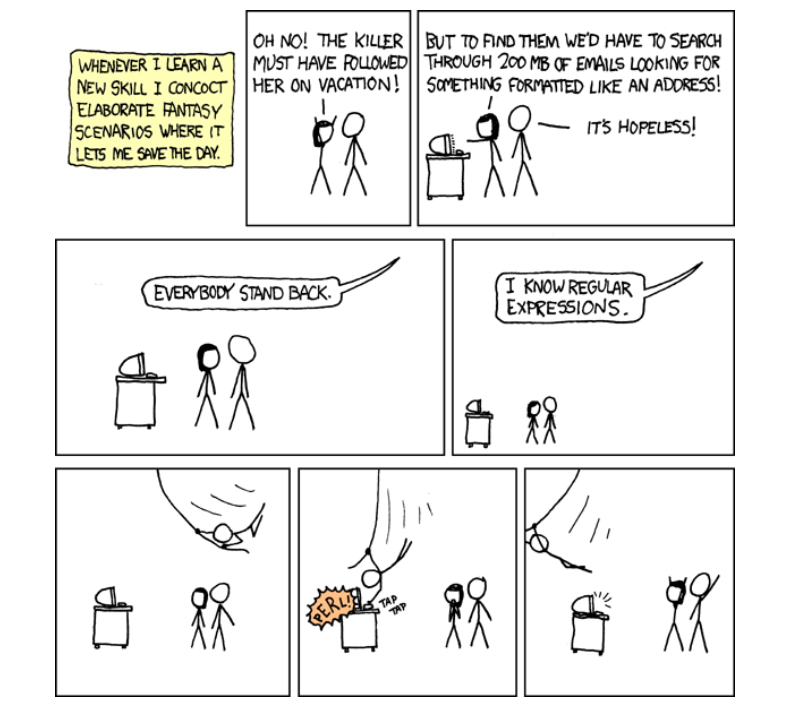 [i]Wait, forgot to escape a space. Wheeeeee[taptaptap]eeeeee. (source)[/i]