
+- Sick Gaming (https://sickgaming.net)
+-- Forum: Programming (https://sickgaming.net/forum-76.html)
+--- Forum: Python (https://sickgaming.net/forum-83.html)
+--- Thread: [Tut] Python Async Function (/thread-101113.html)
[Tut] Python Async Function - xSicKxBot - 05-08-2023
Python Async Function
5/5 – (1 vote)
As a Python developer, you might have encountered the terms
Code:
asyncCode:
awaitAsync functions enable you to write concurrent code using the
Code:
asyncCode:
await Think of it as having multiple browser tabs open; while one page loads, you can continue browsing other tabs. This capability means your Python applications can become faster, more efficient, and capable of handling many I/O operations.

To get started with
Code:
asyncCode:
asyncio
Mastering async functions can truly elevate your Python programming skills and help you build powerful and responsive applications.

Python Async Function Basics

First, you’ll learn the basics of Python
Code:
asyncWe’ll cover
- async functions without ,Code:
await
- an async function example, async function return, and
- async function call.
Async Function Without Await
You might wonder if it’s possible to create an async function without using the
Code:
awaitHowever, without
Code:
awaitThis means your async code will not be able to achieve cooperative concurrency, and other coroutines might be stuck waiting for their turn to execute. It’s generally a good idea to use
Code:
awaitAsync Function Example
Let’s dive into a simple example of using an async function in Python with
Code:
asyncioCode:
import asyncio async def greet(name: str): print(f"Hello, {name}!") await asyncio.sleep(1) print(f"Nice to meet you, {name}!") async def main(): task1 = asyncio.create_task(greet("Alice")) task2 = asyncio.create_task(greet("Bob")) await task1 await task2 asyncio.run(main())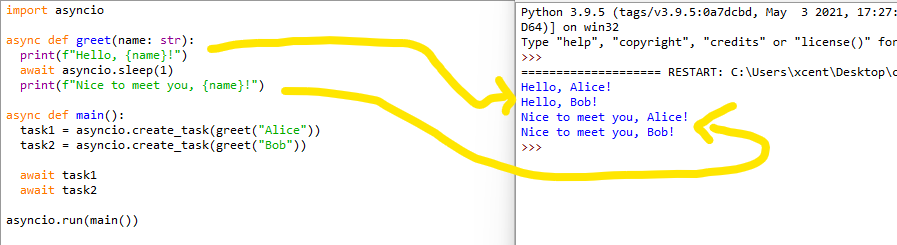
In this example, an async function
Code:
greetCode:
asyncio.sleepThe
Code:
mainCode:
greetAsync Function Return
When you want to return a value from an async function, just use the
Code:
returnCode:
asyncio.FutureYou’ll need to use
Code:
awaitFor example:
Code:
async def calculate_result(): await asyncio.sleep(1) return "Result!" async def main(): result = await calculate_result() print(result) asyncio.run(main())Here,
Code:
calculate_resultCode:
main()Code:
awaitAsync Function Call
To call an async function, you can’t simply use the normal function call syntax, because doing so would just return a coroutine object, not the actual result of the function. Instead, you have to use the
Code:
awaitCode:
asyncio.create_taskCode:
# Using `await` to call async function
result = await async_function() # Using `asyncio.create_task` to run concurrently
task = asyncio.create_task(async_function())
Remember to always use the appropriate method to call your async functions in order to achieve efficient asynchronous programming with Python’s powerful
Code:
async/awaitAdvanced Async Function Concepts

Next, you’ll explore advanced async function concepts to give you a better understanding of how they work in Python.
 Ready? Let’s dive in!
Async Function Decorator
To create an async function, you’ll use the
Code:
async defCode:
@some_decoratorFor instance, consider using
Code:
@asyncio.coroutineCode:
yield from
Async Function Type Hint
Type hints help improve the readability of your async code. Specify the input and output types of your async function using the
Code:
typingCode:
asyncioHere’s an example:
Code:
from typing import Coroutine
import asyncio async def some_async_function() -> Coroutine[str]: await asyncio.sleep(1) return "done"An async function, also known as a coroutine, returns a coroutine object when called. You can use it as a direct call or pass it to an event loop to run the async function using
Code:
asyncio.run()Code:
loop.run_until_complete()Keep in mind coroutine objects aren’t executed until you explicitly use an event loop or an
Code:
awaitAsync Function Await
When writing async functions, the
Code:
awaitYou’ll often use
Code:
await Recommended: Python
Code:
__await()__Async Function Type
An async function’s type is
Code:
coroutineTo check if an object in Python is a coroutine, you can use
Code:
inspect.iscoroutine(obj)Code:
inspect.iscoroutinefunction(obj)Async Function Return Type
Async functions return a
Code:
coroutineCode:
Dict[str, Any]Here’s how you do that:
Code:
from typing import Dict, Any, Coroutine
import asyncio async def fetch_json_data() -> Coroutine[Dict[str, Any]]: # some networking tasks here await asyncio.sleep(2) return {"key": "value"}
In this section, we will explore using async functions in different circumstances, such as within classes, threads, and converting async functions to sync. We will also discuss the concepts of async function sleep and handling functions that were never awaited.
Async Function in Class
When working with classes in Python, you might want to include asynchronous methods. To achieve this, just define your class method with
Code:
async defCode:
awaitHere’s an example:
Code:
class MyClass: async def my_async_method(self): await asyncio.sleep(1) async def main(): my_obj = MyClass() await my_obj.my_async_method()Running async functions in a thread can be tricky due to event loop requirements. Use
Code:
asyncio.to_thread()For example:
Code:
async def my_async_function(): await asyncio.sleep(1) print("Hello from async function!") async def main(): result = await asyncio.to_thread(my_async_function)If you need to call an async function from synchronous code, you can use
Code:
asyncio.run()Here’s an example of how to run an async function from sync code:
Code:
def sync_function(): asyncio.run(my_async_function())Sometimes, you might want to introduce a delay in your coroutine using
Code:
asyncio.sleepExample:
Code:
async def delayed_hello(): await asyncio.sleep(1) print("Hello after 1 second!") Recommended: Time Delay in Python
Async Function Was Never Awaited
In some cases, you may forget to
Code:
awaitCode:
"coroutine 'my_async_function' was never awaited."To prevent these issues, always ensure you’re using
Code:
awaitCode:
async def my_async_function(): await asyncio.sleep(1) async def main(): # Missing 'await' would lead to a warning await my_async_function()If you got something out of this article, I’m sure you’ll learn something of this one:
 Recommended: Python Async With Statement — Simplifying Asynchronous Code
I promise it has more beautiful pics.